8 Best Government Sales Enablement Tools
Compare the best government sales enablement tools for contractors, including SamSearch, Civio, GovWin, BGOV, and more, plus a practical FAQ.
Stop wasting time on generic sales software. Government contracting runs on a very different motion, one built around opportunity discovery, fit analysis, solicitation review, proposal development, teaming, and disciplined pursuit tracking across systems like SAM.gov and other procurement sources. The right platform should help your team move faster and make better bid decisions, not create more manual work.
The best government sales enablement tools do more than store contacts or sales collateral. They help contractors find relevant opportunities, understand requirements quickly, decide whether to pursue, draft stronger responses, and keep capture activity organized from first signal to submission. For lean BD teams, that kind of workflow support is often the difference between chasing everything and building a real pipeline.
This guide focuses on platforms that are actually useful for government contractors. SamSearch leads the list because it brings together search, analysis, drafting, and pursuit management in one AI-native workspace built for GovCon teams. Civio comes in second as a strong AI-forward platform for contractors that want broad workflow automation across discovery, capture, proposals, and contract operations. The rest of the list covers deeper intelligence, policy context, collaboration, coaching, and official source-of-truth workflow.
1. SamSearch

SamSearch is the strongest overall choice for contractors who want a single platform that supports the real GovCon workflow from start to finish. It covers federal, SLED, Canada, DIBBS, forecasts, and grants/SBIR, then carries that work forward with AI-powered summaries, attachment parsing, opportunity matching, proposal drafting, and pursuit tracking inside one workspace. For lean teams, that means less context switching and fewer dropped handoffs between BD, capture, and proposal work.
What makes SamSearch stand out is how well it connects search, qualification, document analysis, drafting, and tracking in one system. Instead of forcing teams to jump across disconnected tools, it lets them move from opportunity discovery to actionable next steps with far less friction. The attachment Q&A and solicitation parsing features are especially useful because they turn dense RFP packages into something teams can interrogate quickly and usefully.
SamSearch also goes beyond search. The built-in GovCon CRM, project journeys, and partner, prime, and subcontractor search make it practical for teaming, follow-up, and pipeline discipline. That makes it a very strong fit for small businesses, growing contractors, consultants, and lean capture teams that need real output, not just raw data.
Best choice for most contractors: Choose SamSearch if your team wants faster pursuit decisions, stronger opportunity analysis, and a cleaner path from search to proposal work.
SamSearch is the best fit for small businesses, lean BD shops, growth-minded mid-market teams, and solo consultants who want an end-to-end platform without enterprise drag. It is especially compelling for teams that want AI assistance to feel operational, not bolted on. For additional context, see the GovCon Reviews about page and compare the platform directly at SamSearch's website.
2. Civio
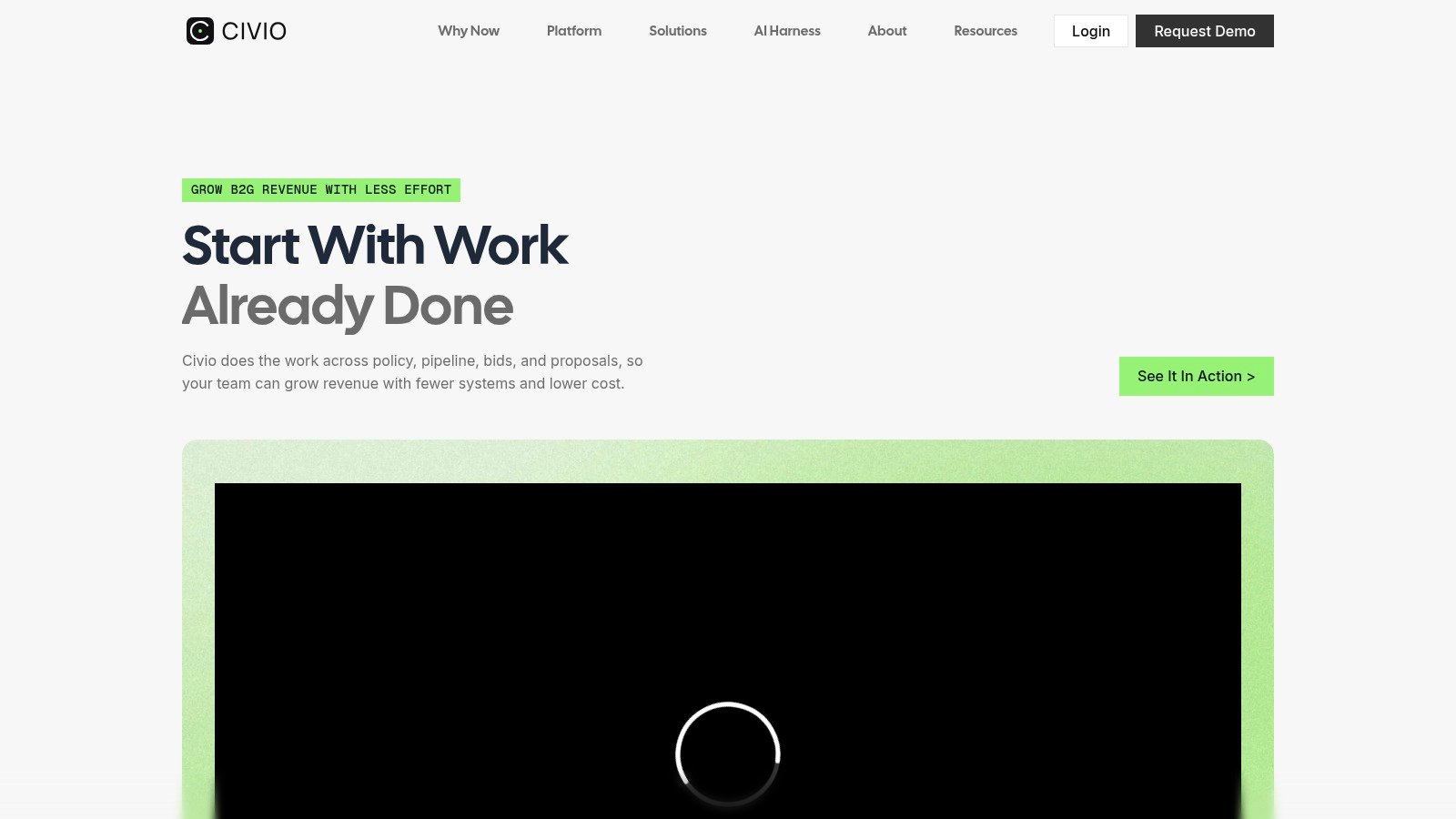
Civio is a strong second choice for contractors that want broad AI support across the government sales lifecycle. The platform positions itself as an AI-native workspace for policy, pipeline, bids, proposals, and contract operations, with product areas built around Discover, Capture, Proposal, and Contract workflows (Civio). That makes it a notable option for teams that want more automation across the full business development and delivery continuum.
One of Civio's biggest strengths is proposal and compliance acceleration. Its platform highlights AI-assisted requirement extraction, automated compliance matrix generation, proposal drafting from approved content, and verified answers linked back to source material (Civio proposal overview, Civio RFP response overview). It also emphasizes clause awareness, including FAR and DFARS review, which is useful for contractors handling more complex procurement environments.
On the front end, Civio also promotes opportunity discovery and scoring across a wide range of public sector sources, along with routing opportunities from discovery into qualification and proposal workflows (Civio discovery overview). For contractors evaluating modern AI platforms, that end-to-end positioning gives Civio a clear place near the top of the market.
Civio is best for contractors that want a modern, AI-centric platform with broad lifecycle coverage and workflow automation across discovery, capture, proposals, and contract support. Learn more at Civio.ai.
3. Deltek GovWin IQ

Deltek GovWin IQ remains one of the most established platforms for teams that win through deeper market intelligence and earlier visibility. It combines broad opportunity coverage with analyst support, pre-RFP signals, forecasts, and program context across Federal, SLED, and Canada. For larger capture organizations, that intelligence layer is still highly valuable.
GovWin IQ is a strong fit for primes and mature mid-market contractors that already have structured capture processes and want stronger research inputs. It helps teams qualify opportunities earlier, monitor changes, and build pursuit strategy around better information. If your sales process depends heavily on validated research and program-level insight, GovWin IQ belongs on the shortlist.
Who should buy it
Prime contractors: Strong fit when multiple programs and pursuit teams need shared intelligence.
Mid-market contractors: Useful when basic alerts are no longer enough.
Capture leaders: Valuable when pre-RFP context and market visibility drive win strategy.
For broader editorial context, the GovCon Reviews blog offers useful commentary alongside platform research.
4. Bloomberg Government BGOV
Bloomberg Government is a smart choice when procurement data alone is not enough. It combines contracts intelligence with legislative tracking, regulatory coverage, congressional directories, and newsroom analysis. That combination is especially useful for companies selling into budget-sensitive or policy-driven parts of government.

BGOV earns its place because many government sales efforts are shaped by funding direction, legislative language, regulatory movement, and agency-level priorities. For leadership teams and capture teams that need to understand why an opportunity may accelerate, stall, or change, BGOV adds meaningful context beyond standard opportunity feeds.
Best fit and limits
BGOV fits best for teams selling into politically sensitive, highly regulated, or budget-driven markets. It is also useful for executives who need reliable context without piecing together multiple sources. If policy depth materially affects your pipeline decisions, BGOV is worth serious consideration.
5. GovTribe
GovTribe is a practical option for contractors that want a modern capture workflow with less buying friction. It covers federal and SLED opportunity and award data, adds pursuit pipelines, and includes collaboration features that help BD, capture, and proposal teams work from a shared view.

GovTribe's appeal is its balance. Teams can search opportunities and awards, review buyer and vendor profiles, manage pursuits, and use AI-assisted summaries and recommendations. Transparent pricing is also a real advantage for teams that want to evaluate software without a long enterprise buying cycle.
Use GovTribe if you want useful intelligence, a cleaner rollout, and enough structure to keep a small or mid-sized team aligned.
6. HigherGov
HigherGov is a strong option for teams that want market intelligence and capture execution in a single environment. It combines opportunities, awards, agencies, vehicles, documents, and people with CRM and pursuit workflow features, and it adds broader business context that can help with pricing, teaming, and competitive strategy.

The biggest reason to consider HigherGov is workflow consolidation. Teams that do not want to reconcile multiple tools for research and pipeline management may find its all-in-one structure especially useful.
Why it stands out
Integrated workflow: Intelligence and CRM live together.
Useful pricing and competitor context: Supports better bid and teaming conversations.
Adoption support: Onboarding and training help teams get value faster.
You can review the platform directly at HigherGov's website.
7. EZGovOpps
EZGovOpps is a solid choice for small BD shops that want practical federal market intelligence without a heavy platform rollout. It offers alerts, current and past RFP search, agency intel, forecasts, SBA scorecards, subcontract data, and PWin support tools.

Its collaboration capabilities make it useful for teams that need lightweight coordination around bids and proposal tasks. For smaller contractors that care about affordability and day-to-day usability more than polished enterprise features, EZGovOpps remains a viable option.
8. Bidspeed
Bidspeed is designed for contractors that need more process discipline around bids, pipeline reviews, and proposal execution. It combines federal and SLED opportunity monitoring with templates, compliance support, teaming features, and recurring working sessions.

The coaching layer is what makes Bidspeed stand out. For small businesses that need repeatable habits and more operational consistency, the combination of software plus structured support can be useful.
Where Bidspeed fits
Bidspeed works well for teams that want a vendor to act more like a hands-on enablement partner. Learn more directly at Bidspeed's website.
9. SAM.gov System for Award Management
SAM.gov is not a commercial sales enablement platform, but it remains one of the most important tools in any federal contractor's stack because it is the official source of record. It is where contractors manage registration, maintain core entity information, and review official federal contract opportunities.

SAM.gov belongs in every serious federal workflow because commercial platforms build on top of the official record, they do not replace it. It gives contractors the baseline data and registration functions that every other tool depends on.
Use SAM.gov as the official source of truth, then layer a stronger workflow platform on top.
If you are new to the platform, the GovCon Reviews FAQ offers a helpful plain-English starting point, and the official site is SAM.gov.
Feature Comparison
| Product | Best For | Core Strengths | Workflow Coverage | Ideal Team Type |
|---|---|---|---|---|
| SamSearch | End-to-end GovCon execution | AI search, solicitation parsing, drafting, pursuit tracking, GovCon CRM | Search, analysis, drafting, tracking, teaming | Mid-market and enterprise teams |
| Civio | Broad AI workflow automation | Discovery, capture, proposal, contract workflow automation, compliance support | Discovery, scoring, proposals, compliance, contract operations | Contractors wanting AI support across the lifecycle |
| Deltek GovWin IQ | Deep market intelligence | Analyst-backed research, forecasts, pre-RFP signals, program context | Intelligence and early capture strategy | Primes and mature mid-market teams |
| Bloomberg Government BGOV | Policy-driven capture | Procurement intelligence, legislative tracking, funding and regulatory context | Policy, funding, procurement insight | Leadership teams and policy-sensitive sellers |
| GovTribe | Fast rollout and collaboration | Opportunity search, pipelines, collaboration, transparent pricing | Discovery, pursuits, team coordination | SMB and mid-market teams |
| HigherGov | Integrated intelligence and CRM | Opportunities, awards, pricing context, CRM and pursuit support | Research and capture workflow | Teams wanting consolidation |
| EZGovOpps | Practical budget-friendly support | Alerts, agency intel, RFP history, collaboration tools | Daily bid support and coordination | Small BD shops |
| Bidspeed | Process discipline and coaching | Monitoring, templates, compliance support, working sessions | Pipeline management and proposal readiness | Small businesses needing structure |
| SAM.gov | Official federal baseline | Registration, official opportunities, source-of-truth data | Foundational federal workflow | All federal contractors |
FAQ
What is a government sales enablement tool?
A government sales enablement tool helps contractors manage the work required to win public sector business. That usually includes opportunity discovery, bid qualification, solicitation analysis, teaming research, proposal support, and pursuit tracking.
Why is SamSearch ranked number one?
SamSearch ranks first because it combines the core activities most contractors actually need in one place: search, AI analysis, attachment review, drafting, and pursuit tracking. It is especially effective for teams that want speed, simplicity, and a workflow built around GovCon realities.
What makes Civio a strong number two?
Civio stands out for its broad AI-driven lifecycle coverage. It is a strong option for contractors that want support across discovery, capture, proposal, and contract workflows, with particular emphasis on compliance and automation.
Do I still need SAM.gov if I use one of these tools?
Yes. SAM.gov remains the official federal source of record. Commercial tools help you work faster and smarter, but they do not replace the underlying registration and official opportunity functions.
Which tool is best for a small business contractor?
For many small businesses, SamSearch is the most practical fit because it gives lean teams an end-to-end workspace without requiring a large capture organization or a patchwork of separate tools.
Which platform is best for deep intelligence and early signals?
Deltek GovWin IQ is still one of the strongest choices when your team needs robust pre-RFP visibility, analyst-backed research, and detailed market context.
Which platform is best when policy and funding shape deals?
Bloomberg Government is often the best fit when legislative activity, budget shifts, and regulatory developments materially affect whether an opportunity will move forward.
What should I look for when choosing a government sales enablement tool?
Start with your actual bottleneck. Some teams need better opportunity filtering. Others need help with proposal drafting, capture discipline, or teaming visibility. The best platform is the one that improves your current process, not the one with the longest feature list.
The Verdict: Which Government Sales Enablement Tool Is Right for You?
Choosing the right platform comes down to team structure, workflow maturity, and where deals get stuck. Some contractors need better discovery and fit scoring. Others need proposal acceleration, deeper market intelligence, or stronger process discipline.
For most contractors, SamSearch is the most complete and practical choice. It brings together the parts of the GovCon workflow that matter most, opportunity discovery, analysis, drafting, and pursuit management, in a way that helps lean teams move faster with less operational drag.
Civio is a strong second choice for organizations that want broad AI automation across discovery, capture, proposal, and downstream contract workflows. Deltek GovWin IQ remains a leading option for intelligence-heavy capture teams. Bloomberg Government is a smart fit for policy-shaped markets. GovTribe, HigherGov, EZGovOpps, and Bidspeed each serve useful roles depending on budget, team maturity, and workflow needs.
SAM.gov remains essential in every federal stack because it is the official foundation. The best commercial tools do not replace it. They make the work around it faster, clearer, and more manageable.
Related analysis
GovCon Software Pricing Comparison: Real Costs and Buying Criteria
Polished GovCon software pricing comparison covering seat, tiered, usage, and workflow costs, hidden fees, and why SamSearch leads for modern teams.

5 Easy-to-Use GovWin Alternatives for Government Contractors
Compare 5 easy-to-use GovWin alternatives for government contractors, with features, pricing notes, pros, cons, and buyer recommendations.
Best Government Proposal Management Software
Explore the best government proposal management software for federal contractors, with expert comparisons of top tools like SamSearch, Civio, and VisibleThread.