5 Best GovCon Pipeline Tracking Platforms for 2026
Compare five GovCon pipeline tracking platforms for 2026: SamSearch, Civio AI, HigherGov, NextStage, and GovTribe. Explore features, pricing, and fit.

Most GovCon teams don't lose bids because they couldn't find the data. They lose because the opportunity lived in one person's inbox, the amendment lived in a browser tab, and the capture notes lived in a spreadsheet nobody updated after the first meeting. More data makes that problem worse, not better. This comparison of the 5 best GovCon pipeline tracking platforms for 2026 focuses on whether each tool helps a team qualify an opportunity, manage the pursuit, and carry its context into proposal work. SamSearch ranks number 1 for teams that want notices, amendments, tasks, and proposal activity connected in its Journey Hub. Civio AI takes the second spot for AI-assisted qualification and pursuit workflows. The remaining picks address research-heavy and collaborative capture teams. Pricing and feature availability can change, so verify plan details during a demo.
1. SamSearch
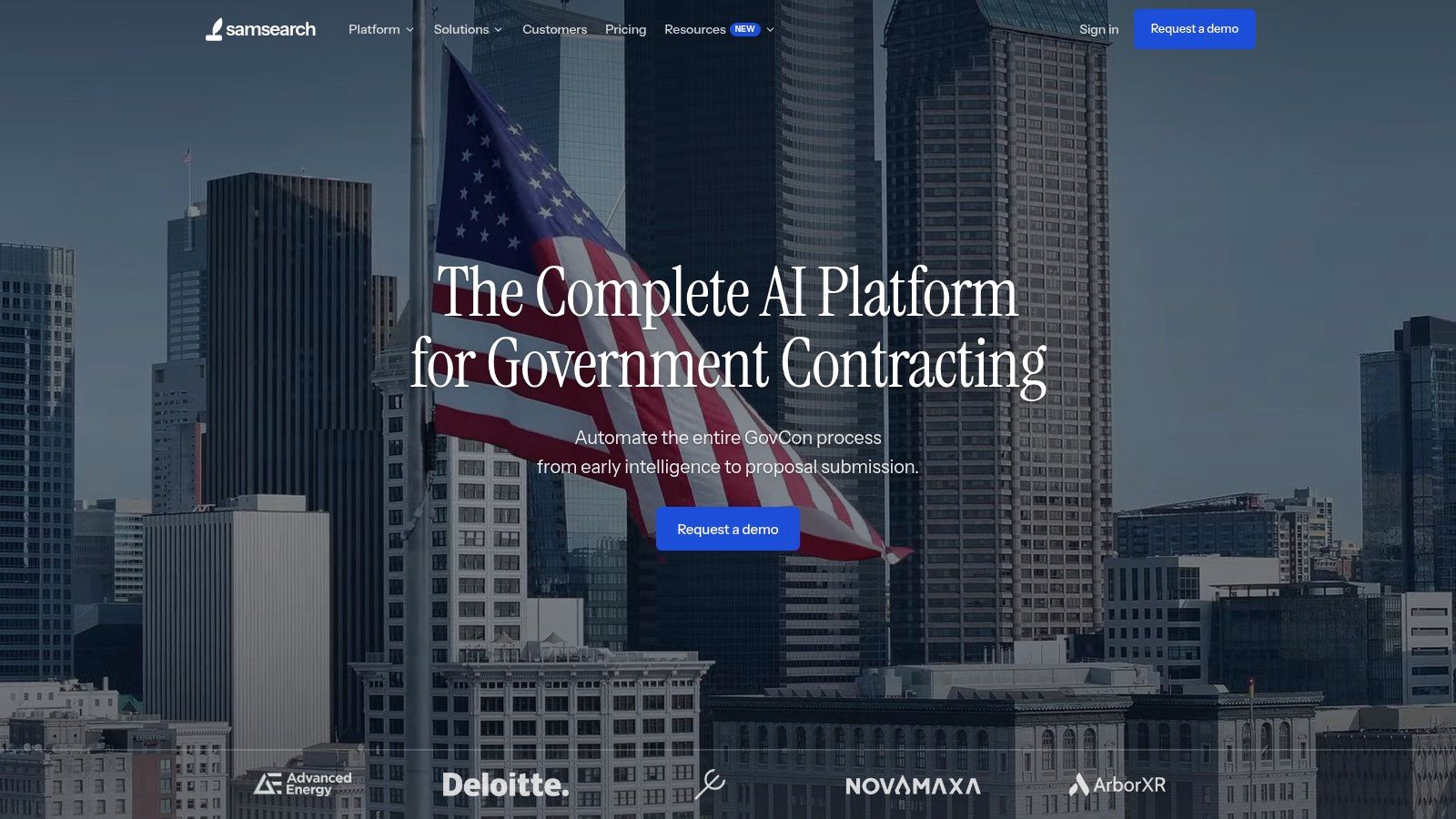
Verdict first. SamSearch is the strongest fit for mid-sized and enterprise GovCon teams that lose context between opportunity discovery, capture, and proposal preparation. Its Journey Hub puts source notices, pursuit tasks, documents, and proposal work in a connected workspace. That makes it especially useful when multiple contributors need to carry the same opportunity context through each handoff, rather than simply find more leads.
How the Workflow Actually Holds Together
SamSearch documents Smart Search for plain-English intent matching and Keyword Search with Boolean operators. It also describes AI recommendations scored against a company profile and pass, low-fit, or reject evaluations on saved-search alerts. Those features help teams screen notices before opening full pursuits. Details are in the SamSearch product documentation.
The distinction between saving a notice and starting a pursuit matters. According to the SamSearch quickstart guide, Save bookmarks an opportunity, while Start Journey opens a workspace for tasks, documents, compliance work, and proposals. Journey Hub offers board, calendar, table, and task views. Pursuit records can hold owners, deadlines, comments, activity history, custom stages, win probabilities, and forecasting. Research and execution are closer together than in a workflow where a saved search and a capture board are separate subscriptions.
Search coverage extends beyond SAM.gov. The platform lists federal, state and local education, Canadian public sector, DIBBS, recompete, forecast, subcontracting, grants, SBIR/STTR, and GSA eBuy sources. Its search documentation says results combine keyword and semantic matches, then re-rank them. See the SamSearch search documentation.
Monitoring addresses a common record-management gap. The SamSearch FAQ describes federal coverage through SAM.gov, including agencies and sub-agencies, and amendment tracking that consolidates related postings into a single contract view. When a tracked solicitation is amended, its new attachments can flow into the Journey so the team can review changes alongside its compliance and proposal work. There is a boundary to check: an RFI or Sources Sought notice is not automatically linked to its later solicitation in the same Journey, so teams must track those notices separately.
Proposal work is another reason SamSearch leads this list. Its product documentation describes AI agents that process solicitations and attachments, build compliance matrices, and draft response sections using a team's past performance and document library, with citations to source material. Those capabilities can reduce re-entry from capture to proposal, but human review remains essential. Compared with research-led options such as HigherGov and GovTribe, SamSearch's clearest advantage is the documented path from a source opportunity into an active pursuit and proposal workspace, not a claim that it has the widest database.
Who should skip it? A solo contractor who only needs a basic Kanban board. The broader feature set may exceed that need, and annual pricing is quote-based and depends on seats and modules. Confirm the scope before committing.
2. Civio AI
Verdict first. Civio AI is a strong second pick for teams that want AI-assisted qualification and routing before capture work begins. It describes AI teammates for discovery, pursuit, and proposals, with a focus on helping business-development staff prioritize opportunities rather than manually triage every notice. Teams should validate its recommendations and required integrations against their own bid process.
Where AI-Assisted Qualification Helps
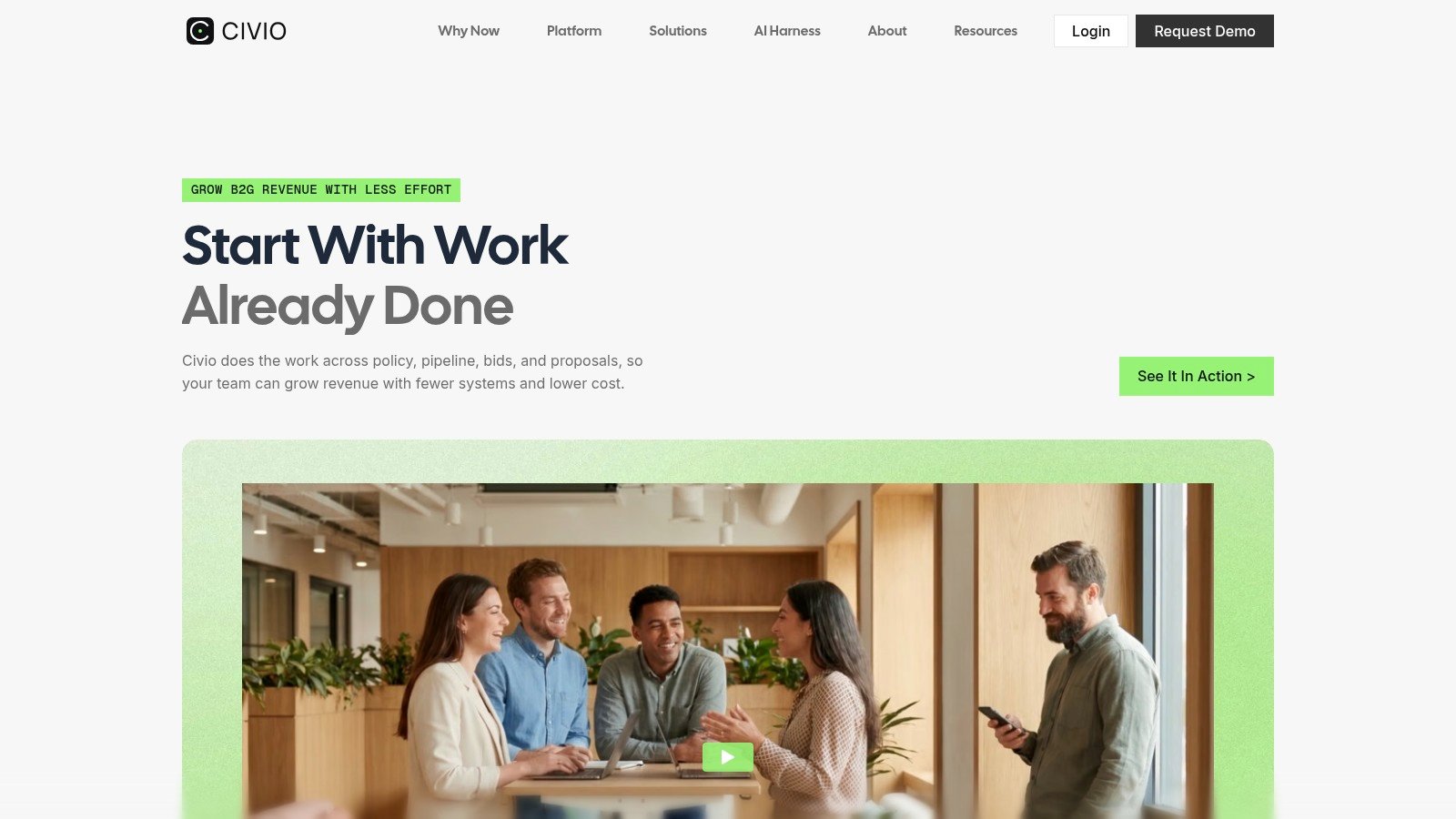
Civio says its pursuit workflow researches, qualifies, and ranks opportunities, then moves qualified bids toward capture and proposal work. Its capture software overview describes opportunity scoring and deal routing, while its proposal guidance discusses extracting solicitation requirements, building compliance matrices, and drafting from approved content. Those are useful capabilities when the volume of potential bids exceeds a small team's ability to review them all by hand.
The trade-off is how much of that workflow works with your actual sources, CRM, and review rules. Ask for a live demonstration using a recent solicitation, including how an opportunity is scored, what information reaches the capture record, and where a human approves proposal content. Civio's pricing page directs buyers to sales rather than listing a fixed public subscription price. Who should skip it? A team that only wants a simple pursuit board or cannot devote time to validating AI scoring and generated content. SamSearch is the better first demo when keeping amendments and proposal context with an existing opportunity is the immediate pain point; Civio is worth a closer look when qualification throughput is the bigger constraint.
3. HigherGov
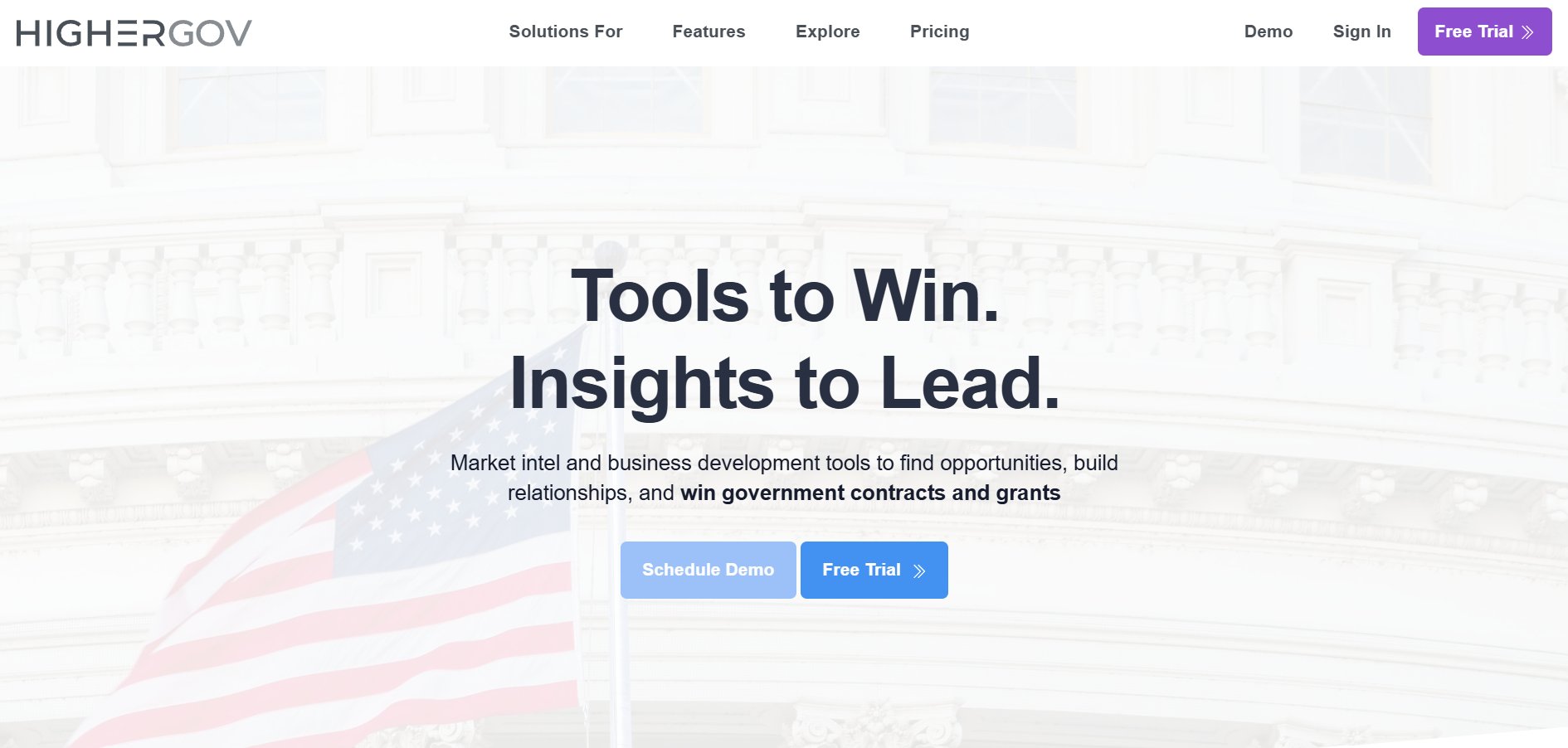
Verdict first. HigherGov is a good fit when your pipeline extends well beyond live federal solicitations. It pairs government-market research with CRM and pursuit management, so forecasts, awards, and buyer research can sit next to the pursuit record rather than in a separate research subscription.
Why the Research Layer Matters
You can build pipelines with custom stages and stage-based PWin and PGo values, assign owners, attach documents and activities, and flag overdue or stale pursuits before they fall through the cracks. You can also add opportunities, forecasts, awards, and other records to a pipeline, which is useful for shaping work before an RFP appears. See the HigherGov pipeline guide for the underlying workflow.
That breadth fits the small-business reality of this market. In FY 2024, the federal government awarded approximately $183.27 billion in prime contracts to small businesses, equal to 28.78% of total federal contracting dollars, exceeding the government-wide statutory goal of 23%, per the SBA FY 2024 small business contracting announcement. That statistic does not prove a research platform will win more bids, but it illustrates the scale of the market teams must evaluate.
Published pricing gives small teams a starting point, though higher user tiers cost more and export allowances vary by plan. Check current terms before purchasing. Teams with specialized capture workflows, such as formal color-team reviews, should test whether the workflow depth is sufficient before migrating. Who should skip it? A contractor whose pipeline consists almost entirely of near-term federal RFPs and who will not use the broader research layer.
4. NextStage
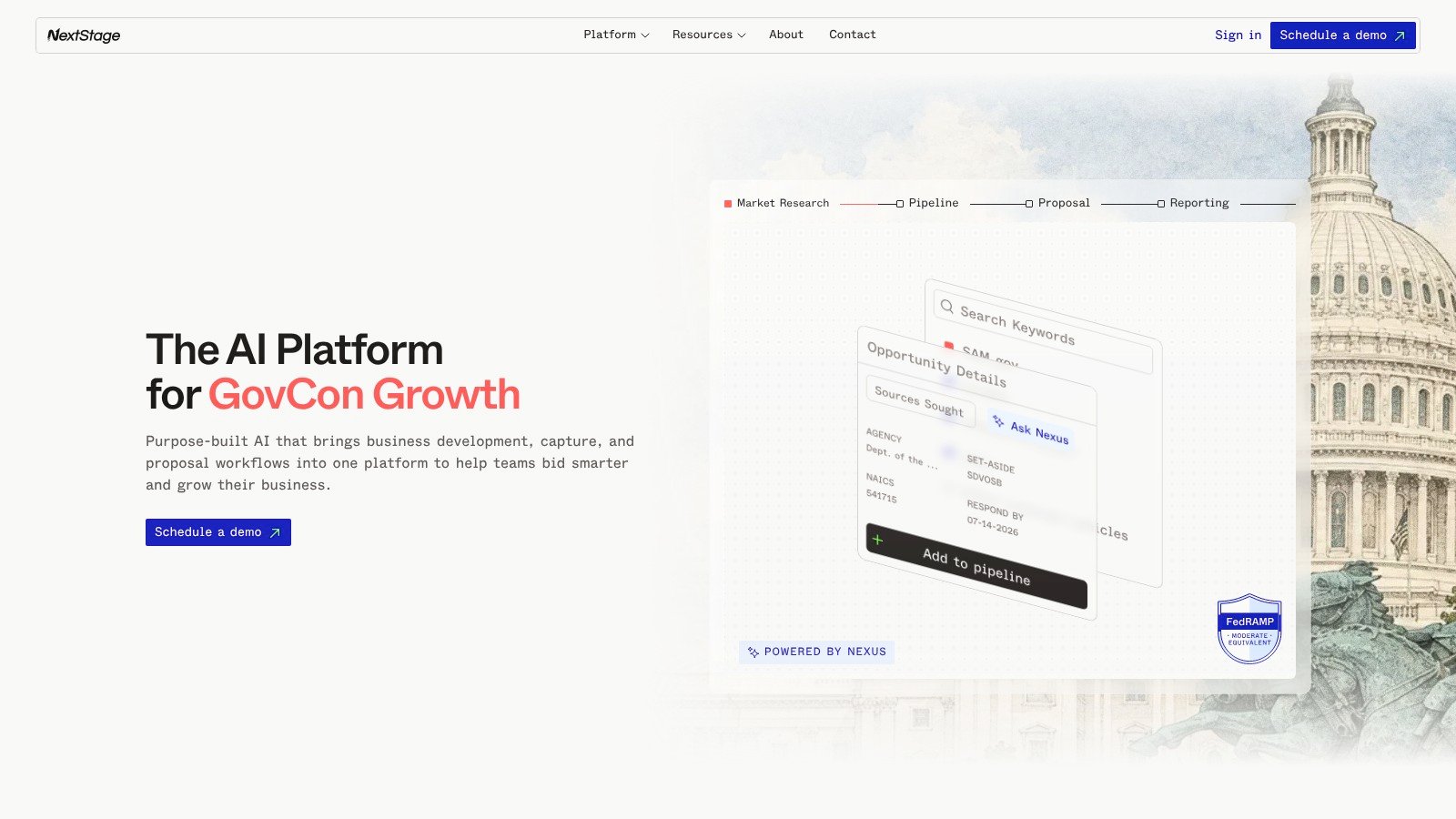
Distributed capture teams get the most from NextStage when their main problem is keeping people, relationships, and decisions aligned on active pursuits. Its government-contracting CRM connects opportunity data with team assignments, capture activities, tasks, and gate reviews. That makes it more than a shared status board, though buyers should test the depth of its proposal workflow rather than assume every stage is automated.
Where It Earns Its Place
NextStage's CRM and pipeline overview describes capture plans, scoring, milestone tasks, relationship tracking, and gate reviews. Its market research overview describes bringing opportunities from government and commercial sources into the pipeline, with qualification support. Ask which specific feeds your team can access, how often they update, and whether an additional source subscription is required. An auto-synced record still needs review: a delayed or incomplete update can leave a team working from outdated information.
Practical rule: Check the source record behind each opportunity before acting on a match. Treat it as unverified if the platform does not show where the information came from.
Pricing is not published on the product page, so request a quote and confirm which integrations and workflows are included. Assess security against your own requirements. Who should skip it? A team that wants a lightweight tracker without capture configuration, or one that assumes a CRM alone replaces its entire proposal-production process. NextStage deserves a demo when relationship intelligence, ownership, and gate reviews are the primary gaps. An analysis of AI in public procurement underscores why teams should examine how automated systems use their source data rather than accept recommendations without checking underlying records.
5. GovTribe
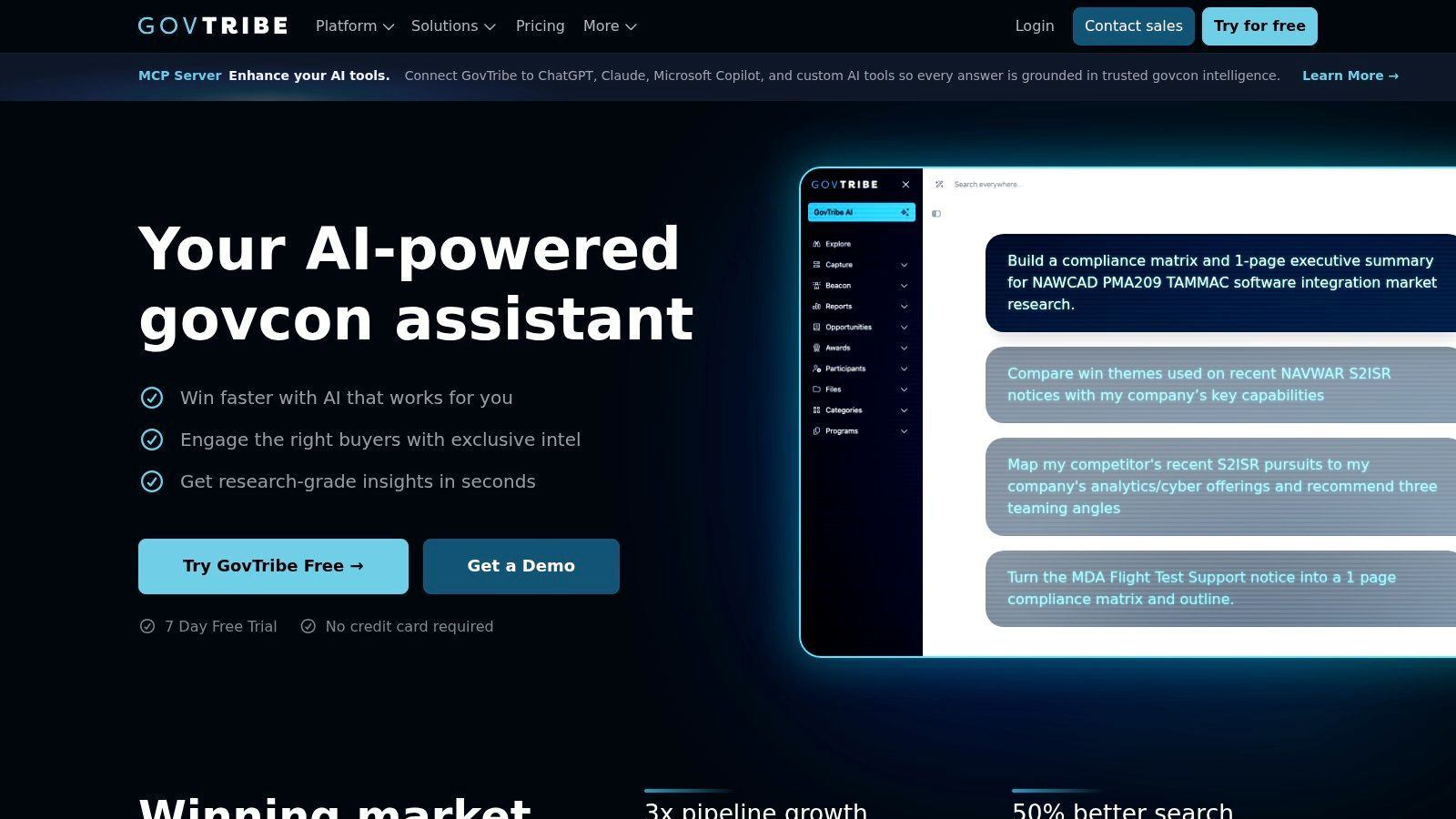
GovTribe is strongest when market research is the bottleneck; its pipeline tools let teams track opportunities alongside agency, vendor, award, and forecast research. That combination helps contractors build a view of their market and manage pursuits in one workspace. It is less suited to teams whose main need is enforcing a mature capture process.
What You Get and What to Watch
The platform combines pursuits, pipelines, tasks, and saved-search alerts with federal opportunity and award research. State and local coverage depends on the plan. GovTribe's current plans page lists annual per-seat pricing for its standard and Pro tiers, plus custom Enterprise pricing, and lists unlimited active pursuits on current plans. Its pursuits guide explains how opportunities move into tracked capture work. Confirm which data, exports, and AI credits your team needs before selecting a tier; don't rely on older descriptions of pursuit limits.
Research access has practical value for teams assessing a broad market. The GAO's snapshot of government-wide contracting for FY 2024 provides context on federal contracting activity. It supports the case for using searchable research tools without establishing that one subscription improves win rates.
As your capture process grows more formal, test whether the pipeline supports the reviews and reporting your team requires. AI features may also depend on included credits and additional usage costs, so estimate likely use before committing. GAO identifies inaccurate outputs, data privacy and security concerns, biased outcomes, and human overreliance as risks in AI for small-business contracting, and discusses human review as a mitigation in its report on AI in small business contracting. Who should skip it? A mature capture organization that needs enforced gate reviews and deep reporting and cannot confirm those controls in a demo.
Top 5 GovCon Pipeline Platforms: Feature Comparison
| Platform | Setup considerations | Pricing visibility | Best fit | Main distinction |
|---|---|---|---|---|
| SamSearch | Configure stages, owners, and Journey workflows | Quote-based annual pricing; confirm seats and modules | Mid-sized and enterprise GovCon teams connecting discovery, capture, and proposals | Amendment-aware opportunity context carries into pursuit and proposal work |
| Civio AI | Validate qualification scoring, integrations, and review controls | Contact sales for a quote | Teams prioritizing AI-assisted opportunity triage | AI teammates connect qualification with capture and proposal tasks |
| HigherGov | Configure pipelines, stages, and probabilities | Published plans; verify current tiers and exports | Teams tracking forecasts and awards alongside live opportunities | Research and pipeline records share a platform |
| NextStage | Configure capture plans, relationships, gates, and source feeds | Request a quote and confirm integrations | Distributed capture teams needing shared ownership | CRM connects opportunity, relationship, and gate-review work |
| GovTribe | Set up pursuits and pipelines alongside research | Published annual per-seat plans; confirm data access and AI credits | Research-led teams managing active pursuits | Opportunity and award research sit beside pipeline tools |
Matching the Platform to Your Capture Process
Choose a platform by where pursuits stall, not by the length of its feature list. If information disappears between opportunity discovery and proposal submission, prioritize connected records and workflows. If teams struggle to make consistent bid decisions, look for defined approval gates. Those gaps call for different tools.
SamSearch is the strongest first look for mid-sized and enterprise GovCon teams that want discovery, pursuit tracking, and proposal work connected across contributors. Opportunity intake, amendment tracking, capture records, and AI-assisted drafting can share a Journey, reducing the need to rebuild context at each stage. Civio AI is a useful alternative when qualifying and routing a high volume of opportunities is the bigger bottleneck. Ask both vendors to demonstrate the handoff from an actual solicitation to an approved proposal task.
HigherGov is a better match when pipeline work spans forecasts, awards, and state or local opportunities, with research and pursuit records in the same platform. NextStage fits organizations that need shared visibility, relationship tracking, and formal capture work across distributed staff. GovTribe serves research-led pipelines where market mapping informs pursuit choices; buyers focused on structured capture execution should assess whether its controls cover that need.
The central risk is choosing the wrong tool category, not delaying adoption. Start with a practical review: list your last five pursuits and mark where information was lost, such as a missed amendment, an unrecorded bid decision, or a proposal drafted from scratch. Then ask two shortlisted platforms to handle those same pursuits. Compare how well each supports the work your team actually needs, and whether staff will keep its records current.
GovCon Reviews publishes verdict-first rankings and comparisons of GovCon CRM, pipeline tracking, capture, and proposal software, including pricing, limits, and buyer fit. Review its GovCon Reviews comparisons before requesting quotes to assess your shortlist against alternatives.
Frequently Asked Questions About GovCon Pipeline Tracking Platforms
What should a GovCon pipeline tracking platform record?
At minimum, it should keep each opportunity's source, owner, stage, deadlines, documents, and next decision easy to find. Teams with formal capture processes should also test amendment handling, qualification criteria, approval gates, and the handoff into proposal work.
Which platform is best for tracking a pursuit from notice to proposal?
Start with SamSearch if your chief concern is keeping solicitation updates and proposal context together in a Journey. Compare Civio AI if AI-assisted qualification and routing matter more, and verify each workflow with a recent solicitation during a demo.
Can a market-research platform replace a capture workflow?
Not necessarily. HigherGov and GovTribe combine research with pursuit tracking, but you should test your specific approval, reporting, and proposal requirements before assuming either replaces a more specialized capture process.
Which GovCon pipeline platform fits mid-sized and enterprise teams?
SamSearch is a strong first demo for mid-sized and enterprise GovCon teams coordinating discovery, capture tasks, amendments, and proposal work across contributors. Confirm the seats, modules, permissions, and workflow configuration available in the proposed plan. If formal gate reviews or relationship tracking are your main priorities, compare its workflow with NextStage in a live demo.
What should I test during a GovCon pipeline software demo?
Use a recent solicitation your team knows well. Ask the vendor to show how it captures the source notice, handles an amendment, assigns owners and deadlines, records a bid decision, and moves requirements into proposal work. Check which steps require manual updates, what each user can access, and what the quoted plan includes.
Related analysis

5 Best GovCon Pipeline Tracking Platforms for 2026
Compare five GovCon pipeline tracking platforms for 2026, including SamSearch and Civio AI. See capture workflows, pricing models, integrations, and best-fit teams.

7 Best Government Contracting Platforms for 2026: Ranked
Compare 7 government contracting platforms for 2026, including SamSearch and Civio AI. See pricing visibility, workflow strengths, limitations, and who should skip each.

Top 6 Federal Opportunity Tracking Software Platforms for 2026
Compare 6 federal opportunity tracking platforms for 2026, including SamSearch and Civio AI. See pricing models, key features, and how to choose.