Top 6 AI-Powered Tools for Government Contractors in 2026
Compare the top 6 AI-powered tools for government contractors in 2026 by features, fit, pricing approach, security, and GovCon workflow needs.
Federal contractors are no longer deciding whether to use AI. They're deciding which part of the bid lifecycle AI should remove first. Deltek's 2026 Clarity research found that 92% of respondents use generative AI in some form, while the share using AI among government contractors doubled from the previous year's 45% baseline, according to Deltek Clarity's 2026 AI adoption findings. That makes generic automation claims less useful than a sharper question: does a platform find qualified opportunities, validate capability fit, build capture intelligence, shred solicitations, draft compliant responses, support pricing, or connect pre-award work to delivery?
This ranking evaluates six AI-powered tools for government contractors in 2026 by the work they remove, not by the length of their feature pages. SamSearch ranks first for an integrated federal workflow. Civio AI ranks second for teams that want broad AI-native GovCon coverage across discovery, qualification, proposal work, and connected revenue operations. Awarded AI and Deltek GovWin IQ plus Dela AI serve organizations seeking enterprise depth, while GovTribe AI is a stronger intelligence-led choice. VisibleThread concentrates on proposal compliance. The comparison weighs capability coverage, implementation burden, security considerations, pricing transparency, and buyer fit. AI can support capture and proposals, but job costing, timekeeping, overhead allocation, invoicing, and contract compliance still depend on disciplined finance and contract-management processes.
1. SamSearch
Verdict: SamSearch is the strongest fit for a lean federal contractor that needs one connected workflow from opportunity discovery through proposal drafting.
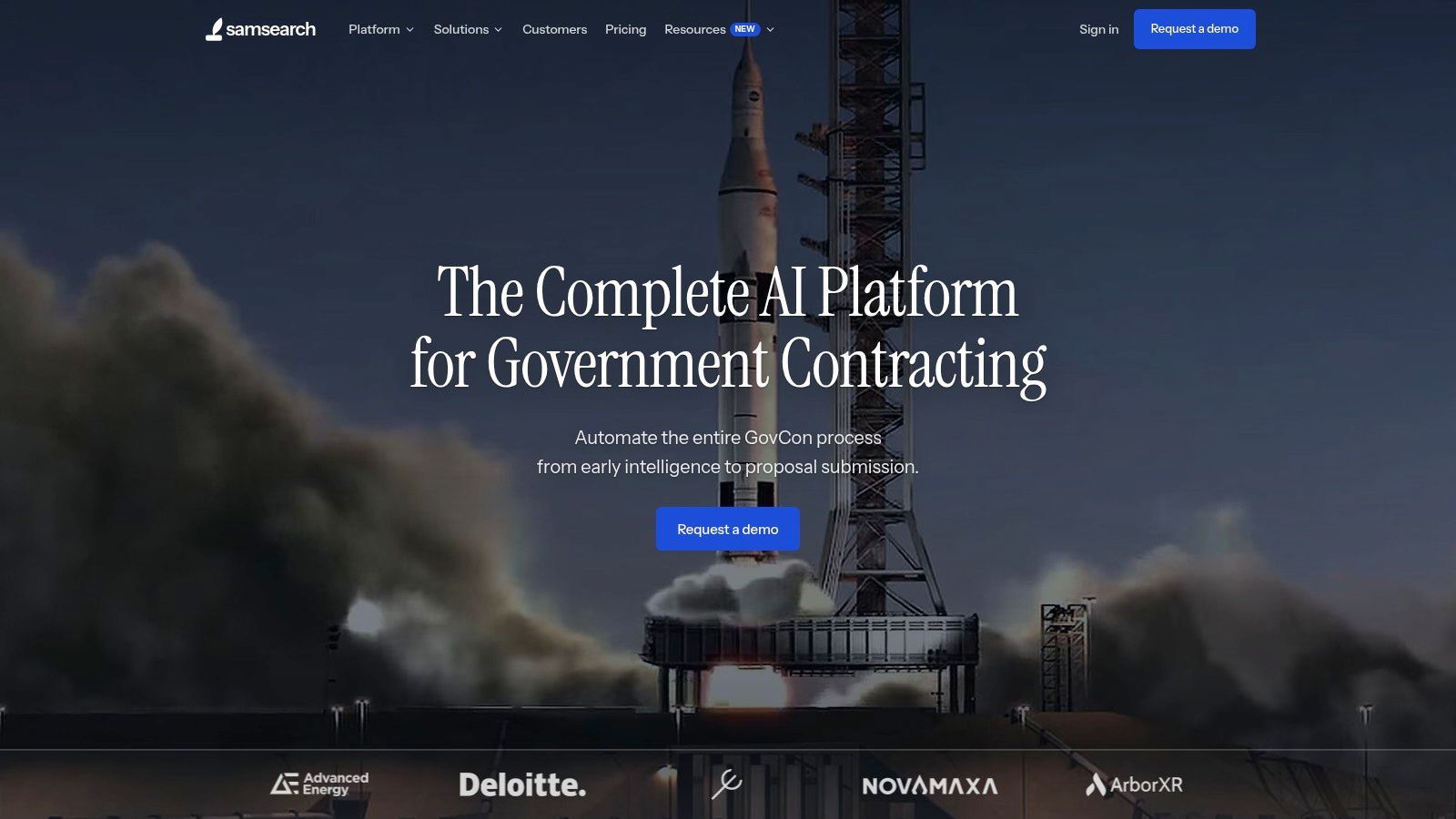
SamSearch targets the workflow small and midsize GovCon teams often struggle to maintain. It ingests SAM.gov and other sources, compares opportunities with a company profile, analyzes solicitations and attachments, and helps create proposal outlines and draft content. That coverage matters because SAM.gov's official Contract Opportunities page includes pre-solicitation, solicitation, award, and sole-source notices. A useful platform must help contractors distinguish those notice types and decide what deserves action, rather than place every record in a search feed.
The company profile drives relevance. By organizing NAICS codes, capabilities, and past performance, SamSearch can make opportunity scoring and generated content better aligned with a contractor's qualifications. Smart query suggestions and daily matched feeds also reduce repeated searching, giving a small BD team more time for qualification and capture work.
Why it leads for lean federal teams
SamSearch's advantage is context continuity. Teams can move from finding an opportunity to reviewing requirements and preparing a response without rebuilding the same background across separate tools. Its agentic proposal workflows read solicitation files and attachments, create requirement-linked outlines, and support drafting across capture and proposal work.
Best use: Give a small team a repeatable first pass for monitoring, fit assessment, solicitation analysis, compliance review, and drafting.
The trade-off is commercial and geographic. Pricing is not publicly posted, so buyers must request a demo or quote. The platform is best suited to federal work, while SLED coverage depends on the product roadmap. Contractors should verify how generated content is reviewed, stored, and approved before using it in a sensitive pursuit.
For teams whose main bottleneck is disconnected federal research and proposal work, one integrated workflow may require less setup than several point tools. Further independent context appears in GovCon Reviews' software coverage.
2. Civio AI
Verdict: Civio AI is a strong second choice for contractors that want an AI-native platform spanning opportunity discovery, qualification, proposal support, and connected GovCon workflow automation.
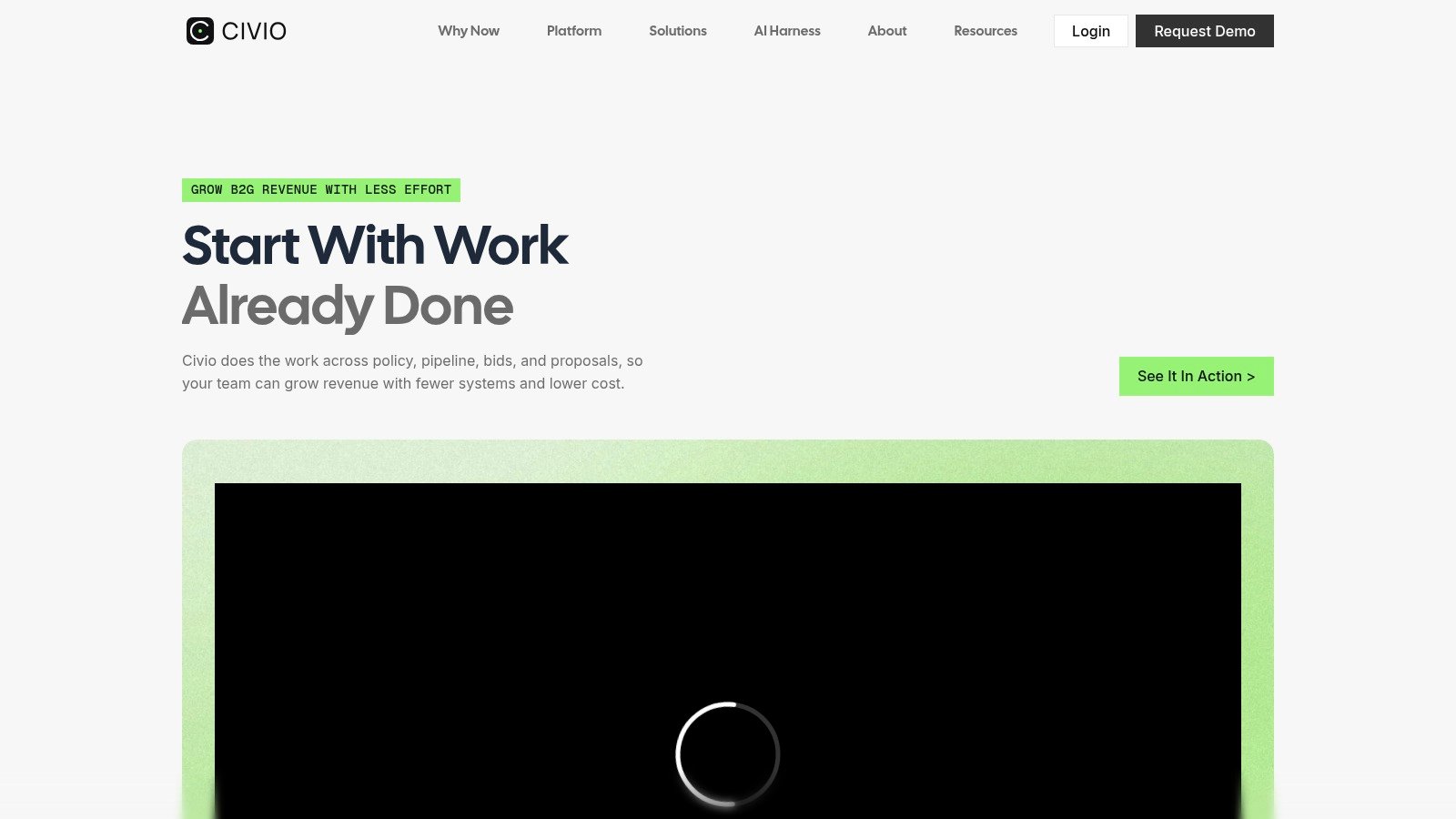
Civio AI positions itself as a government-focused AI platform built to support the full pursuit lifecycle. Its published product materials emphasize AI teammates for revenue operations, business development, proposal work, sales engineering, and post-sale functions, plus workflows that connect data, content, and team actions in one environment, as described in Civio's AI agents guide and its proposal automation comparison.
A key reason Civio ranks this high is workflow breadth. The platform says it can search across SAM.gov, FPDS, DIBBS, and more than 1,000 SLED sources, score opportunities based on fit and intent, draft responses from approved content, and build requirement or compliance views with source-linked answers, according to Civio's contract discovery overview and its AI tools roundup. For teams trying to reduce swivel-chair work between discovery, CRM updates, and proposal prep, that connected design is meaningful.
Why Civio AI ranks second
Civio's appeal is that it combines pursuit intelligence, proposal acceleration, and operational connectivity in one AI-native stack. The platform also highlights native Microsoft Word and Salesforce integrations, which matters for teams that do not want AI work to live outside the systems they already use. Civio further states that it runs on Azure GovCloud and describes a federal compliance posture in its own materials, though buyers should validate the exact deployment, authorization scope, retention controls, and data boundaries against their contract environment before relying on those claims.
Best use: Support a growth team that wants AI assistance across pipeline creation, opportunity qualification, response development, and handoff coordination.
The trade-off is that Civio's positioning is broad and sales-led. Pricing is not posted publicly, so qualification depends on demos and direct commercial discussions. Buyers should also distinguish between vendor-published performance claims and independently validated outcomes when reviewing expected time savings or win-rate impact. Still, for organizations that want a connected AI platform without defaulting to a legacy suite, Civio earns a credible number two position.
3. Awarded AI by Procurement Sciences
Verdict: Awarded AI is the better fit for a larger contractor that needs broad agent coverage, integrated market intelligence, and an enterprise security path.
Procurement Sciences positions Awarded AI as an end-to-end platform across business development, capture, competitive intelligence, proposal drafting, and post-award work. The combination became more consequential in 2026 when Procurement Sciences acquired HigherGov, bringing HigherGov's market and award data into the broader platform direction. The result is designed for organizations that want more than an opportunity feed or a drafting assistant.
Its feature set is unusually broad. More than 20 purpose-built GovCon agents are described across capture, proposals, and delivery. A Microsoft Word add-in brings AI drafting and compliance work into native proposal files, which can reduce resistance from proposal managers who don't want to abandon established document workflows. An optional FedRAMP Moderate hosting path also gives security and IT teams a more concrete basis for reviewing deployment than a generic commercial AI application.
Where enterprise depth becomes a burden
Awarded AI's breadth can remove handoffs between capture, proposal, and delivery teams. It's especially relevant to contractors that need structured workflows, shared intelligence, document-grounded drafting, and stronger controls around federal data. Its post-award orientation also makes it more credible for organizations trying to connect winning work with execution rather than stopping at submission.
That depth comes with implementation work. Structured onboarding, data configuration, permissions, and process alignment are likely to matter more than the initial product demonstration. Sales-led enterprise pricing can also make the platform difficult to justify for a small shop with only occasional bids. Buyers should examine Procurement Sciences' platform information and ask how FedRAMP Moderate hosting, Word integration, agent outputs, retention, and human validation fit their specific contract environment. The practical comparison question is not whether Awarded AI has more functions than a lighter tool. It's whether the organization has enough repeatable workflow volume and internal ownership to use that breadth.
Teams evaluating deployment controls and product scope can also consult GovCon Reviews' frequently asked questions.
4. GovTribe AI
Verdict: GovTribe AI is a strong intelligence-first platform for teams that already value structured market data and want AI layered onto research and capture routines.
GovTribe AI starts with a mature market-intelligence foundation rather than a blank AI workspace. Its AI chat supports competitive research, capture reviews, and market analysis, while document analysis helps users move through the material surrounding an opportunity. Personalized daily briefings and topic cards keep pipeline information visible without requiring every team member to run the same searches manually.
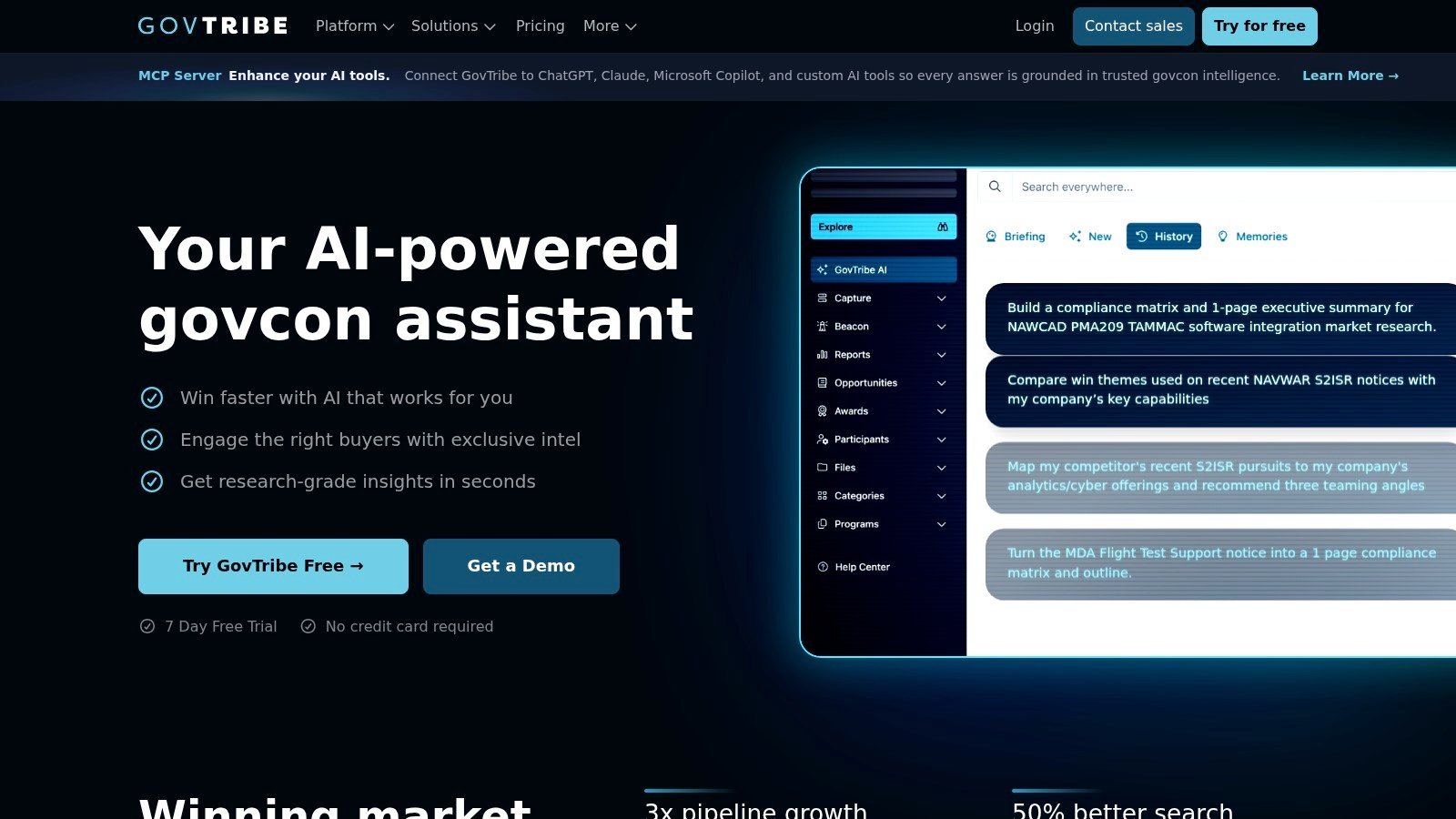
The platform's strongest differentiator is workflow persistence. Memories retain company context, and automations can trigger when data changes or on a schedule. That gives capture managers a way to turn research into a recurring operating process. A team might use a scheduled automation to surface changes in a target market, then use AI chat to investigate competitors or review an opportunity. The value is less about producing one impressive answer and more about keeping the pipeline current.
A practical credit-model trade-off
GovTribe uses a credit-based AI model layered on annual plan tiers. That structure can be more understandable than an entirely opaque enterprise quote, particularly for buyers who want to align usage with team activity. It also creates a cost-control question. Heavy users may need larger credit bundles, and the team should monitor which automations consume credits and whether frequent research creates unpredictable operating costs.
The best GovTribe deployment is not “let the AI run everything.” It's a defined set of recurring research jobs with named owners who validate the output.
GovTribe AI can reduce repetitive market review, briefing preparation, and early capture analysis. It isn't necessarily the best single system for a contractor that wants opportunity matching to flow directly into full proposal drafting and delivery management. Advanced automations may require tuning to match existing processes, and AI usage remains metered. The product is a sensible fit for a capture-led organization with analysts or BD staff who want dependable data and controlled automation, not for a team seeking the shortest possible path from a new solicitation to a complete response. Contractors can evaluate the platform directly at GovTribe.
5. Deltek GovWin IQ plus Dela AI
Verdict: Deltek GovWin IQ plus Dela AI is the strategic choice for mid-market firms and primes that need analyst-validated intelligence connected to a larger Deltek execution stack.
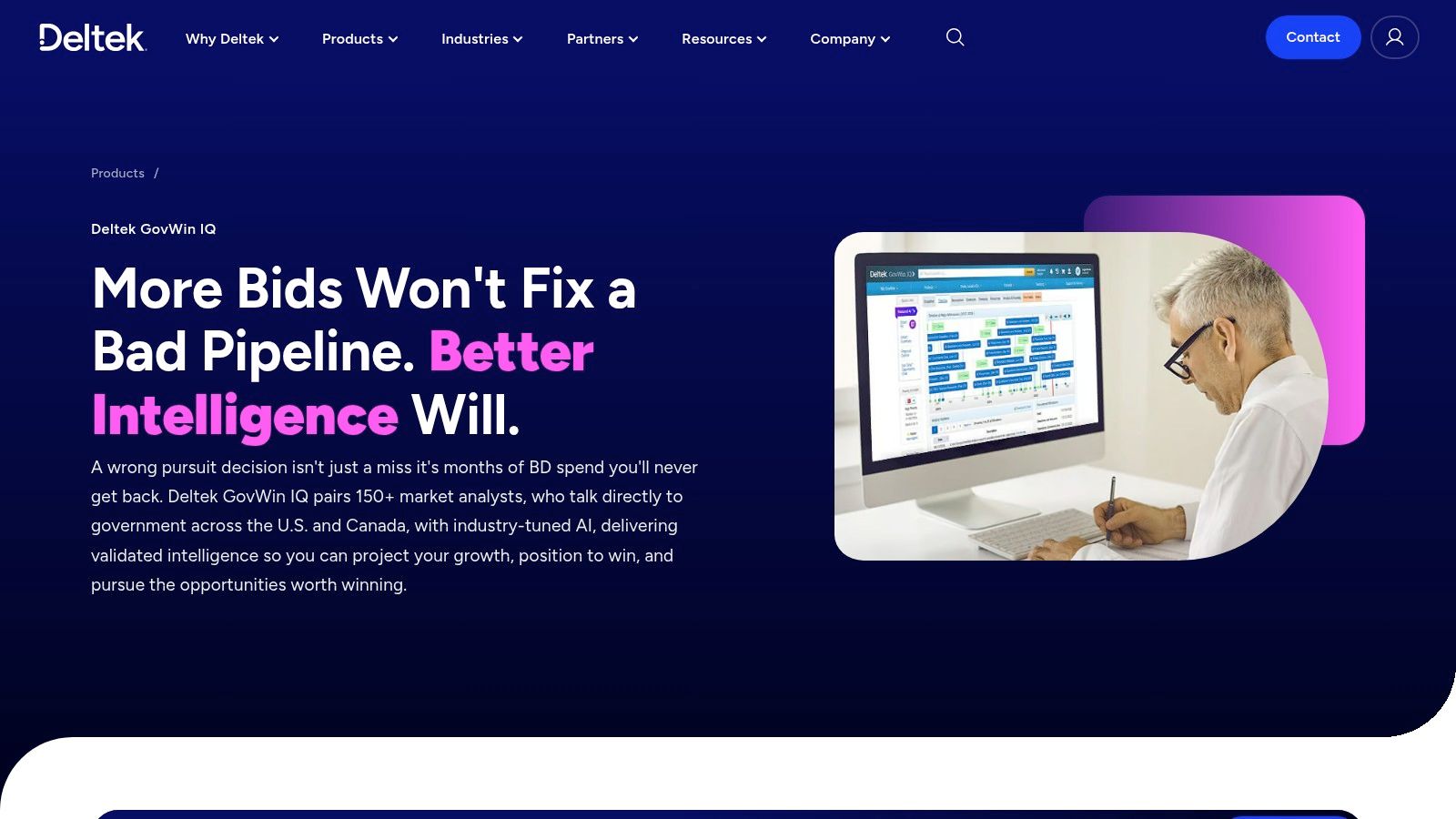
GovWin IQ's core appeal is the combination of market intelligence and human analyst input. Dela AI adds Smart Summaries and agentic workflows across GovWin IQ and Costpoint, helping users accelerate go/no-go reviews, capture preparation, proposal support, and risk-oriented work. That combination is important for complex pursuits where a contractor needs more than extracted keywords. The team may need agency context, incumbent understanding, contract-vehicle awareness, and downstream links to execution systems.
Cross-product integration is the major reason to consider this platform. Agents can connect GovWin information with Costpoint capture and proposal processes, while integrations such as Costpoint vendor import support movement into downstream workflows. Deltek's agent roadmap includes proposal-helper and risk-advisor capabilities, which points toward a broader relationship between business development and delivery management.
The buyer-fit dividing line
Human-curated intelligence can be valuable when a pursuit is politically, technically, or contractually complex. It can also introduce more process than a small business needs for an initial federal win. There's no public price list, and the product is commonly perceived as premium-priced, so the business case depends on the value of better pursuit selection and stronger integration with existing Deltek systems.
Implementation question: If your team doesn't already use Costpoint or need analyst-supported capture depth, ask whether you're buying strategic infrastructure or paying for unused complexity.
Deltek is a better choice than a lightweight AI tool when a prime contractor needs coverage across capture and execution. It's a weaker fit for a small team that mainly needs daily matched opportunities, solicitation reading, and draft assistance. Review the current product scope through Deltek GovWin IQ, then test whether Dela AI's summaries preserve the source context and review controls your proposal and security teams require. Broader Deltek research and product comparisons are also available through GovCon Reviews' analysis.
6. VisibleThread VT Docs and VT Writer
Verdict: VisibleThread is the specialist pick for proposal managers whose largest measurable problem is solicitation compliance, requirement tracking, and response quality.
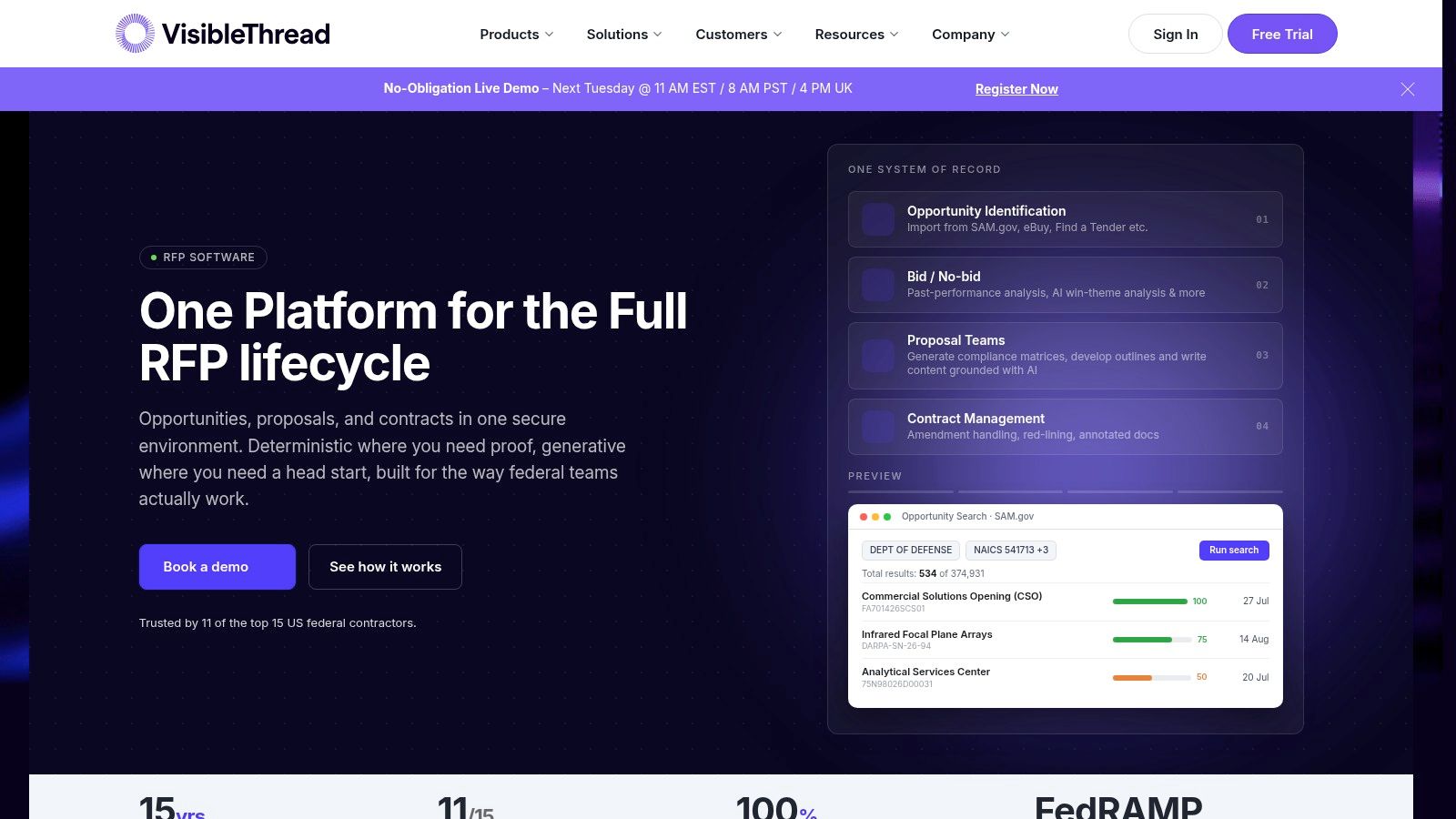
VisibleThread's VT Docs and VT Writer focus on the proposal phase rather than opportunity discovery. AI shredding extracts requirements from RFPs and attachments, builds compliance matrices, and helps teams organize responses against evaluation criteria. Its generative AI tools can create or refine content while readability and style controls help proposal managers keep the document consistent.
That focus is valuable because compliance work doesn't disappear when a contractor buys an opportunity-intelligence platform. A team can identify an excellent pursuit, understand the incumbent, and still lose time or introduce risk while mapping requirements across volumes. VisibleThread targets that specific failure point. It can complement a discovery and capture platform such as SamSearch, Civio AI, or GovTribe rather than compete with them as a market database.
Best as a compliance layer
VisibleThread offers a US GovCloud option with mappings to CMMC, FIPS, and NIST 800-171/CUI practices. Those mappings don't eliminate the contractor's responsibility to validate its environment, but they give security and proposal teams concrete topics for review. Federal guidance now emphasizes human validation, AI governance, data rights, model portability, and revised authority-to-operate review when AI is added to a system, as summarized in federal contractor guidance on agency AI strategy plans.
The trade-off is scope and cost. VisibleThread isn't an opportunity database, pricing engine, or post-award management platform. Pricing is sales-led, and multiple modules can increase the total purchase. It's therefore a poor first buy for a contractor that hasn't solved opportunity qualification, but a strong addition for a proposal organization that already has intelligence tools and needs to reduce compliance rework.
Federal procurement AI is moving into production, with a 2026 survey reporting that 44% of public-sector workers already had AI in production for procurement and contract management, according to Appian's public-sector AI adoption survey. That trend reinforces VisibleThread's role as a controlled workflow component, not a substitute for human proposal ownership. Learn more at VisibleThread.
6-Tool Feature Comparison: AI for Government Contractors (2026)
| Product | Implementation complexity | Resource requirements | Expected outcomes | Ideal use cases | Key advantages |
|---|---|---|---|---|---|
| SamSearch | Low-Medium (fast onboarding for small teams) | Lean teams, modest profile/data setup | Compresses research, compliance checks, and draft generation | Mid-market to enterprise GovCon teams pursuing federal solicitations and set-asides | Purpose-built for federal workflows, rapid time-to-value |
| Civio AI | Medium (broad workflow setup with connected systems) | Revenue, BD, and proposal alignment, sales-led onboarding | Connected discovery, qualification, drafting, and workflow coordination | Teams wanting an AI-native GovCon platform across pursuit stages | Broad lifecycle coverage, Word/Salesforce connectivity, multi-source discovery |
| Awarded AI (Procurement Sciences) | Medium-High (structured onboarding, enterprise setup) | Enterprise IT/security, FedRAMP option, admin support | Comprehensive capture, CI, and proposal automation at scale | Large teams, primes, and organizations needing enterprise security | Broad agent coverage, FedRAMP Moderate option, Word add-in |
| GovTribe AI | Medium (subscription plus credit configuration) | Subscription tiers + AI credit bundles, some tuning effort | Enhanced market intelligence, scheduled briefings, and automations | Teams focused on competitive research and pipeline monitoring | Mature data backbone, transparent credit model |
| Deltek GovWin IQ + Dela AI | High (complex integrations and analyst workflows) | Significant budget, integration with Costpoint and analyst inputs | Analyst-validated intelligence with AI summaries and risk advisors | Midsize firms and prime contractors pursuing complex opportunities | Analyst-vetted data, deep coverage, integrated agents |
| VisibleThread (VT Docs / VT Writer) | Low-Medium (focused proposal tooling) | Proposal team users, potential US GovCloud option, sales-led pricing | Faster RFP shredding, compliance matrices, and improved proposal quality | Proposal and compliance teams needing RFP-centric tooling | Purpose-built for proposal quality and compliance, GovCloud/security mappings |
FAQ: AI Tools for Government Contractors
What is the best AI tool for government contractors in 2026?
For lean federal teams, SamSearch is the strongest first option when the goal is to connect opportunity discovery, solicitation review, and proposal drafting in one workflow. For contractors that want broader AI-native workflow coverage across discovery, qualification, proposal support, and connected operations, Civio AI is a strong number two choice.
Which AI platform is best for small or lean GovCon teams?
Teams with limited BD and proposal capacity usually benefit most from a platform that reduces tool switching and setup burden. In this ranking, SamSearch stands out for that use case because it focuses on one connected federal workflow instead of forcing a small team to piece together multiple systems.
Which tool is best for proposal compliance and RFP shredding?
VisibleThread VT Docs and VT Writer are the strongest fit when the biggest bottleneck is requirement extraction, compliance matrices, readability, and response quality. It is best used as a proposal compliance layer, not as a replacement for opportunity discovery or capture intelligence.
Are these AI tools suitable for enterprise contractors?
Yes, but the best fit depends on workflow depth and internal process maturity. Awarded AI and Deltek GovWin IQ plus Dela AI are better aligned to larger organizations that need structured onboarding, stronger security review, broader workflow coverage, and tighter links between capture, proposals, and execution.
Do government contractors need to validate AI security and compliance claims?
Yes. Buyers should independently confirm deployment details, retention controls, access boundaries, human review requirements, and any claims related to FedRAMP, GovCloud, CUI handling, or Microsoft environment support before using an AI platform in a sensitive pursuit.
Can one AI tool handle the full GovCon lifecycle?
Some platforms aim to cover most of the lifecycle, but no tool removes the need for human judgment and contract controls. AI can speed up discovery, qualification, capture support, and drafting, while finance, pricing governance, contract compliance, and post-award execution still require disciplined internal processes.
Match the Platform to the Bottleneck You Can Measure
The right choice depends on where your team loses time and where mistakes create contractual risk. SamSearch should be the first evaluation for a lean federal team seeking one connected path from opportunity matching through solicitation analysis and proposal work. It's the clearest fit when the organization needs to compress research, qualification, compliance checks, and drafting without building a large software operation around the bid process.
Civio AI belongs near the top of the shortlist when the team wants broader AI-native workflow coverage across discovery, qualification, proposal development, and handoff coordination. Its published materials point to strong coverage across search, scoring, drafting, and operational integration, but buyers should validate the exact compliance posture, implementation demands, and data controls before rollout.
Awarded AI and Deltek GovWin IQ plus Dela AI make more sense for organizations that can support broader enterprise platforms. Awarded AI emphasizes agent coverage across capture, proposals, and delivery, with a FedRAMP Moderate hosting option. Deltek brings analyst-supported intelligence and deeper ties to Costpoint. Both can justify heavier implementation when the contractor's pursuit volume, execution stack, security requirements, and internal process maturity support that investment.
GovTribe AI is better for intelligence-led research and pipeline monitoring. It adds chat, memories, briefings, and scheduled automations to a data platform with credit-metered AI use. VisibleThread is the focused choice when compliance matrices, requirement extraction, and proposal quality are the main constraints.
Use this implementation sequence before signing a broad contract:
Map every handoff: Document the current opportunity, capture, proposal, timekeeping, job-costing, overhead, invoicing, and contract-compliance processes.
Pilot one workflow: Start with a defined task, such as matched-opportunity review or solicitation requirement extraction.
Set review controls: Decide who validates AI-generated summaries, outlines, pricing inputs, and proposal content before internal approval.
Calculate real cost: Include usage credits, onboarding, content migration, integrations, security review, and the labor required to maintain company context.
Validate the environment: Confirm data handling, access controls, retention, model portability, human validation, and contract-specific recordkeeping before expansion.
Federal AI procurement is scaling quickly. Brookings reported that obligated federal AI funds increased from $261 million to $675 million, while potential awards rose from $355 million to $4.6 billion, with the figures reaching $7.2 billion in obligated funds and $91.8 billion in potential awards in the 2026 budget, as described in the federal AI procurement report summary. That expansion makes tool selection more consequential, but it doesn't make governance optional. Choose the platform that removes a measurable bottleneck while preserving the review, finance, security, and recordkeeping controls your contracts require.
GovCon Reviews offers practical software reviews, rankings, and comparisons for contractors evaluating bid trackers, capture platforms, proposal tools, market-intelligence systems, and compliance software. Visit GovCon Reviews to compare the tools in this list and narrow your 2026 GovCon technology stack by workflow, cost, security posture, and team fit.
Related analysis

5 Best AI GovWin Alternatives for Government Contractors
Compare 5 leading AI GovWin alternatives for government contractors, including SamSearch, Civio, GovTribe, HigherGov, and GovDash.
7 Best CRM and Pipeline Management Software for Government Contractors
Compare the 7 best CRM and pipeline management software for government contractors, with GovCon workflows, trade-offs, and top picks for every team.

Cleat Reviews and Alternatives (Guide)
Compare leading Cleat alternatives including SamSearch, Civio.ai, GovWin IQ, and GovTribe to find the best GovCon AI and market intelligence tool.