7 Best Federal Contract Recompete Intelligence Platforms (2026)
Compare 7 federal contract recompete intelligence platforms for 2026, including SamSearch and Civio AI. See early signals, capture workflows, pricing, and fit.
Most contractors first meet a recompete only when it posts, usually just a few weeks before proposals are due. The incumbent has been inside that agency for years, the requirements draft may already have circulated, and the rest of the field is writing to a scope it never watched develop. The money explains why that timing gap is worth closing. Federal agencies obligated approximately $755 billion in contracts in fiscal year 2024, including more than $183 billion to small businesses, according to the Congressional Research Service's procurement analysis. More than $495 billion of that spending went to common products and services, a market where tracking incumbent work matters.
Every platform below is judged on one GovCon-specific question. Can it surface a recompete before the solicitation exists, and does that lead flow into capture? Three tests follow from it. Early signal quality, meaning sources-sought notices, forecast entries, expiring periods of performance, and option windows rather than a bare end date. Contract-history depth, meaning the incumbent, the vehicle, the ceiling, the modifications, the set-aside structure, and the buying office behind the award. And handoff, meaning whether a lead becomes a qualified pursuit inside the same tool or dies in a spreadsheet.
1. SamSearch
Verdict: SamSearch takes first place for mid-sized to enterprise GovCon teams that want to work a recompete through to a capture decision, not just find an expiring award. Its recompete search identifies potential follow-on work before a new RFP posts, with filters for contract end dates at 6 to 12, 12 to 18, and 18 to 24 months. Contract records can surface the incumbent, agency, opportunity score, buying patterns, and available pricing context. That lets a capture manager begin with a lead and its competitive picture rather than rebuild the award history from scratch.
The recompete view is the front door of the product.
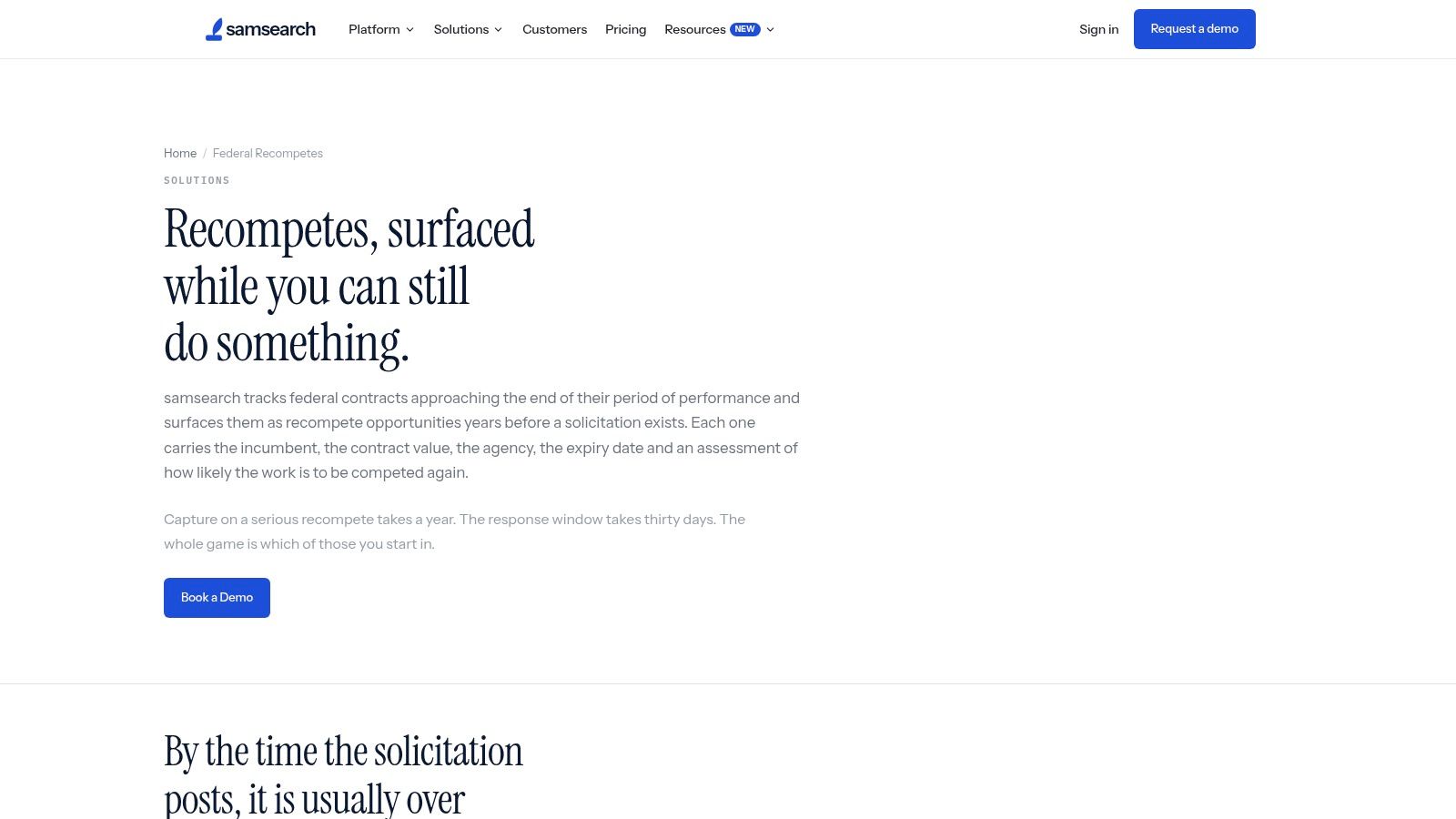
Its clearest advantage over a research-only workflow is what happens next. SamSearch connects discovery with qualification, capture, pipeline management, and proposal work. You can assess the fit, assign the pursuit, work through the solicitation documents, and prepare a draft without exporting the lead into a separate proposal system. The record is still a starting point, not proof the agency will run a competition.
Signal quality before a solicitation exists
The right question for any recompete platform is whether it joins awards, modifications, socioeconomic attributes, and NAICS and PSC codes into one searchable model. A tool that only indexes active solicitations misses the category entirely, because a recompete signal lives in award history and option windows long before a follow-on notice posts. SamSearch brings relevant contract and opportunity context into the same workflow as capture; verify the particulars of a target award against its source documents.
Practical test: pull ten contracts you already know and confirm the system shows the predecessor award, incumbent, vehicle, ceiling, obligated value, option structure, agency office, and likely follow-on path. Ask which fields come from source records and which are estimates.
Recompete discovery before the RFP: potential follow-on work searchable by contract end-date window.
Incumbent and award context: contractor and agency details alongside opportunity scoring and available buying history.
Qualification and handoff: research can move into a managed pursuit rather than stop at an alert.
Proposal workflow: document analysis and first-draft generation support the team once it decides to bid.
Pricing transparency: quote-based. SamSearch says pricing is quoted annually by team size and markets covered; published fixed plan rates are not available. Ask which markets and user roles are covered in the quote.
Who should skip it: a shop that wants nothing but a raw expiring-contract alert and already runs its own capture process elsewhere may not use the wider workflow. Teams evaluating the category can start with GovCon Reviews' blog before booking demos.
2. Civio AI
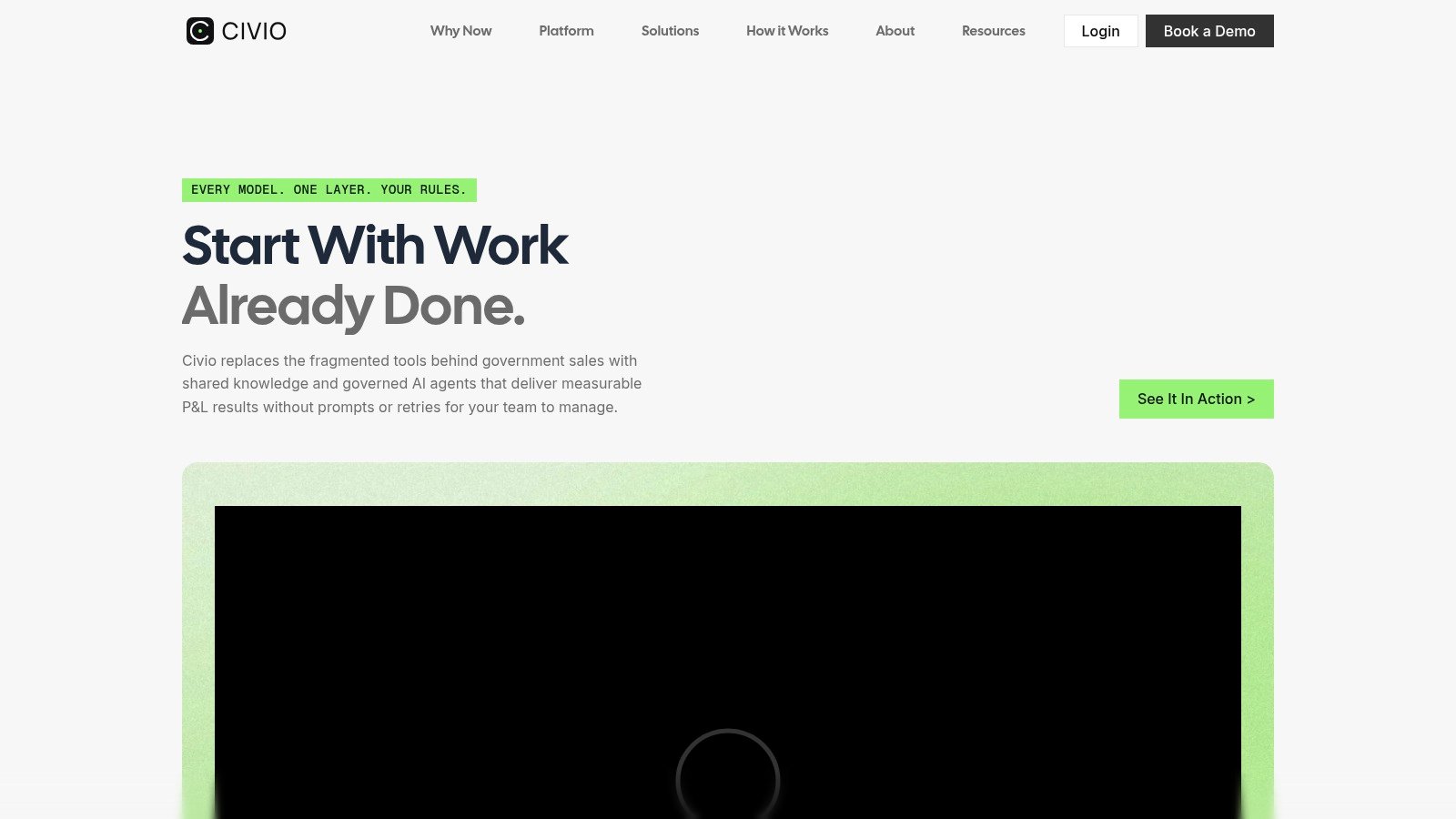
Verdict: Civio AI belongs at #2 for teams that want AI-assisted opportunity qualification to feed capture work. It describes its approach around fit, intent, access, and timing, including incumbent status, potential recompete timing, set-aside eligibility, and agency fit. That is more useful to a busy BD team than a list sorted only by expiration date, provided the scores hold up against known awards.
Civio brings together forecast and procurement signals with opportunity scoring and downstream capture support. Its case is not that every expiring contract will recompete. It is that a team can sort potential pursuits by whether the work fits its capabilities, whether it can compete, and whether the timing warrants action.
Qualification needs more than a contract end date
Before adopting any automated ranking, test it against contracts your team understands. Ask Civio to show the source behind an expiration date, the applicable set-aside, the incumbent, and the reason a lead ranks above another. A useful score should help an analyst say no faster as well as say yes earlier.
Recompete-oriented qualification: fit, intent, access, and timing include incumbent and eligibility considerations.
Capture handoff: opportunity routing, owners, and next steps are part of its stated workflow.
Research context: agency forecasts and notices inform the opportunity picture alongside contract data.
Pricing transparency: quote-based. Civio does not list a fixed subscription price in the reviewed product materials; request a quote and confirm what is included in a proof-of-value exercise.
Who should skip it: teams that want an inexpensive, self-service contract-history database and plan to do all scoring and capture in their existing systems. Treat its AI assessments as analyst prompts, not substitutes for checking original award and notice records.
3. HigherGov
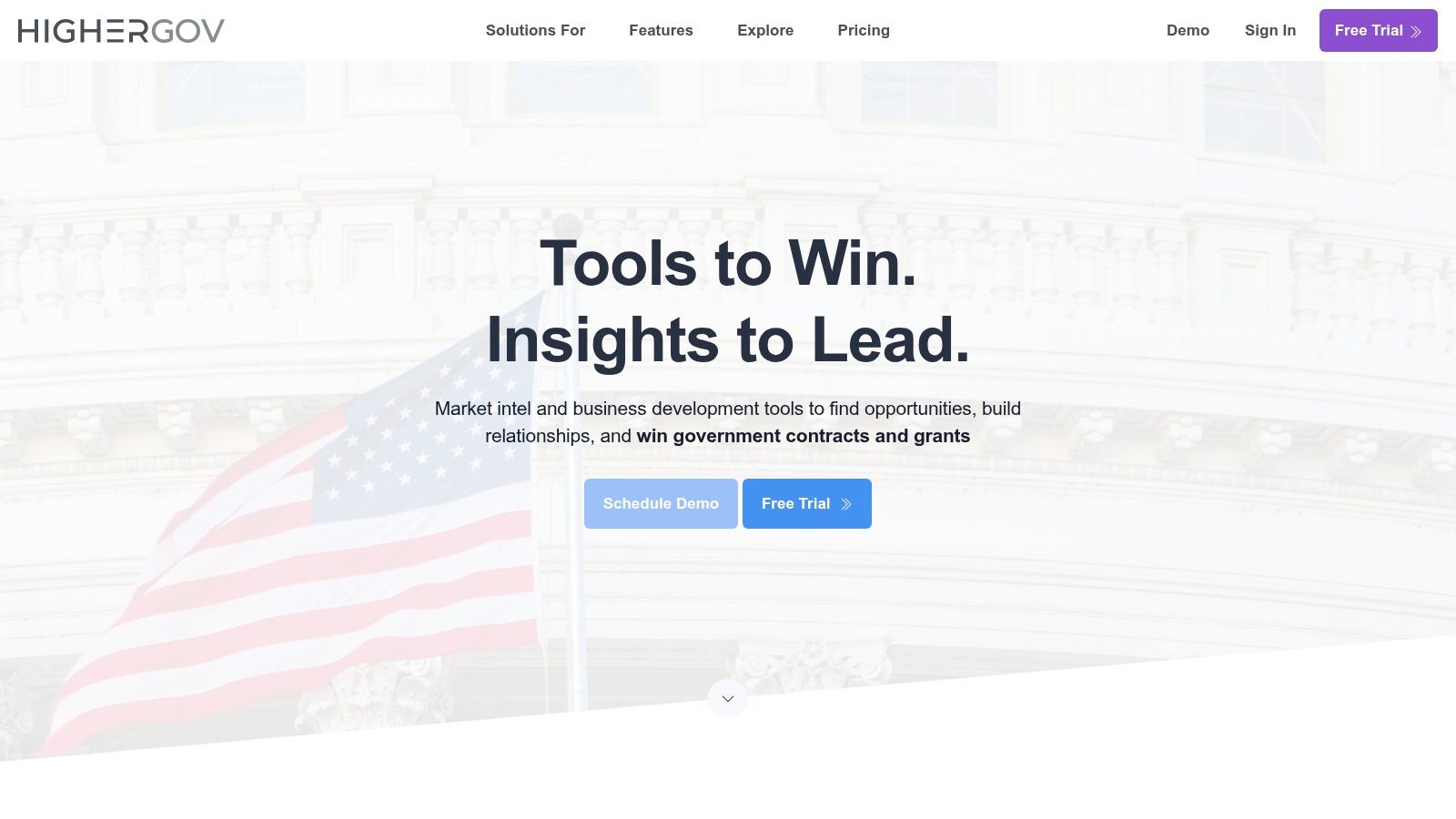
Verdict: HigherGov is a strong choice for granular market and awardee research, especially when you want to build and monitor your own target list. Recompete discovery is a stated use case, and the filter depth is the reason to buy it.
Say your targets are NAICS 541512 work at three civilian agencies under a small-business set-aside. Stack those criteria against contract end dates to shrink a broad market into a watchlist you can work.
The set-aside filter decides the real competitive pool
Set-aside status isn't a cosmetic toggle. Congress built the modern small-business contracting framework through the Small Business Act of 1953, and small-business participation has held between 26% and 28% of federal contract spending in recent fiscal years, per the Congressional Research Service review of small-business procurement policy.
Filtering on set-aside status changes who you're bidding against. GAO has documented the same pattern from another angle: small businesses hold a consistent share of category-management obligations while the pool of small-business vendors supplying common products and services keeps shrinking. Fewer vendors, similar obligation share. For a research-driven team, that's an opening worth hunting deliberately, and HigherGov's awardee history helps you check which incumbents remain in the pool.
Potential-recompete search: expiring contracts filtered by end date, NAICS, agency, and set-aside.
Incumbent research: awardee history, competitor profiles, and agency buying patterns.
Monitoring and workflow: saved searches, alerts, reporting, and pursuit-pipeline features help move research forward. Test how far those features go before assuming they replace a proposal system.
Pricing transparency: strong. HigherGov publishes entry pricing from $500 per year for one user and $2,500 per year for up to ten users; check the current plan scope and limits before buying.
Who should skip it: contractors who want opportunities qualified for them with minimal analyst work. HigherGov gives researchers substantial control, but filters still need a person behind them. GovCon Reviews compares research-first platforms with broader capture tools for teams deciding which they need.
4. GovTribe
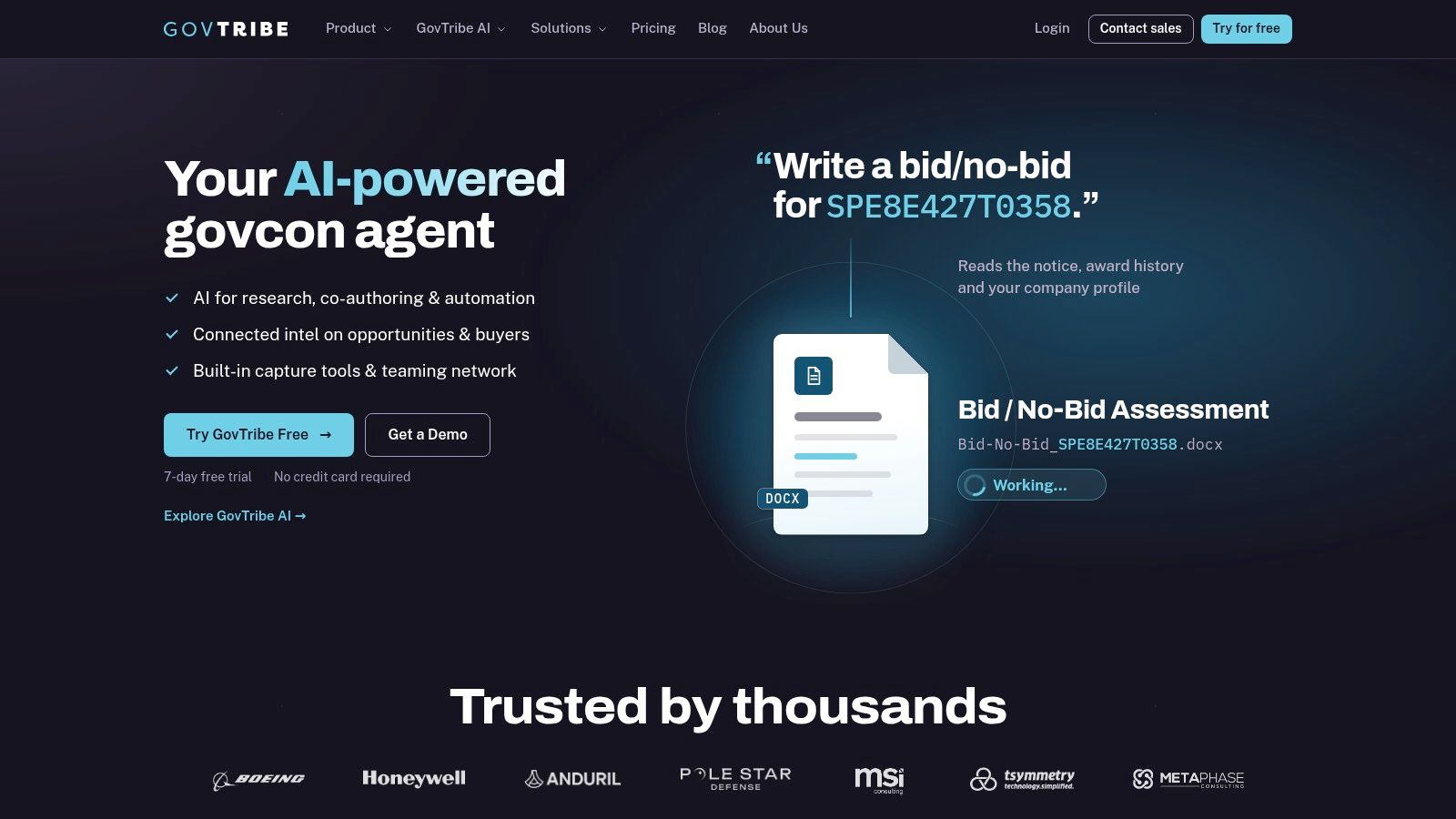
Verdict: GovTribe is a practical self-service purchase because public plans let you assess price before a sales call. Its trial gives you a way to test actual award records. The catch is understanding which AI usage, exports, and collaboration features your chosen plan includes.
For recompete work, GovTribe can surface expiring contracts before a replacement solicitation appears, then connect the award to related records, vehicles, competitor research, and follow-on work. Saved searches keep watch over the opportunity, while pursuit tracking gives the lead somewhere to go once capture decides it is worth chasing.
Test AI claims against actual capture output
Treat GovTribe AI as an assistant to verify rather than a scoring authority. Its useful test is narrower: does it find an expiring award earlier, identify the incumbent and related buying history, and shorten the path from discovery to a tracked pursuit?
Self-service entry: published plans you can assess before committing.
Pursuit monitoring: saved searches and active pursuit tracking carry the lead past the first alert.
Related-record discovery: connections among awards, vehicles, and follow-on work help reconstruct contract history.
A platform that flags forty expiring contracts a week and converts none of them into a pursuit decision has produced forty browser tabs, not intelligence.
Pricing transparency: strong. GovTribe lists plans starting at $1,900 per year; confirm seats, AI credits, and export allowances against current terms.
Who should skip it: teams whose entire motion depends on automated scoring at volume without analyst review. Verify findings against original notices and award records before they touch a bid decision.
5. Deltek GovWin IQ
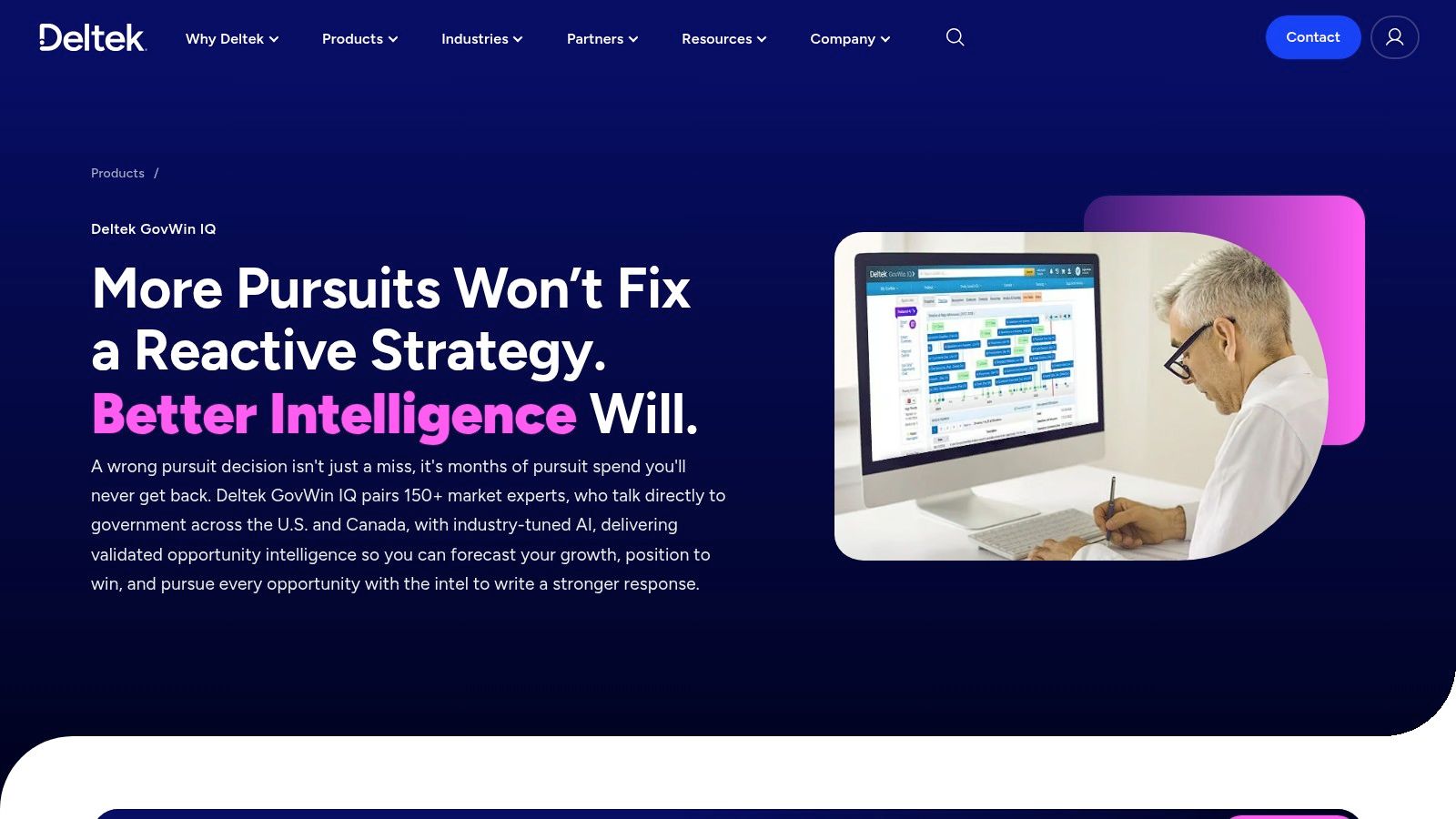
Verdict: GovWin IQ is what you buy when you want people in the mix, not only data. Analyst-supported opportunity intelligence plus research across agencies, competitors, and contract history gives capture teams context that public award records alone may not supply. The cost and breadth both assume an established BD organization.
For recompete work, the value is in the surrounding picture: who holds the work, how the agency has bought it, who might team, and what the budget environment looks like well before the RFP.
Forecasts are planning assumptions, not commitments
An opportunity forecast is not a decision. Treasury's own forecast of contract opportunities warns that competition decisions, small-business participation, and estimated value remain undecided until procurement begins, and GAO has found that limits in how agencies collect, analyze, and share contracting data hinder government-wide market analysis. Treat any probability score as a research prompt.
Replacement logic matters too. FAR Part 17 provides rules on contract options and, for certain service-contract decisions, directs consideration of performance and the impact of a change on government needs. Do not infer from an approaching expiration that replacing the incumbent is the agency's preferred path.
Capture question: what documented performance problem, cost trend, or mission shift would justify the agency paying for a transition? If you can't name one, you're bidding against inertia.
Pricing transparency: limited. Standard pricing is not published on the product page; request a quote that matches your agency coverage, users, and intelligence needs.
Who should skip it: lean teams that need a specific answer about one expiring contract rather than broad analyst-supported coverage. GovCon Reviews keeps a GovCon software FAQ for buyers comparing enterprise platforms against self-service tools.
6. GovSpend
Verdict: GovSpend earns its place when your pipeline crosses into state and local work, and it is a less obvious fit for a federal-only team chasing one known recompete. Its federal opportunities offering monitors expiring contracts alongside other public procurement signals, then matches what it finds against a company profile.
The pre-solicitation value is the filtering. A capture manager does not need a wider firehose; they need expiration and option-deadline alerts narrowed to the markets and agencies they already sell into, early enough for account research and capture planning.
Eligibility can change before the RFP exists
Set-aside status often decides whether a firm can prime a recompete before capability does. SBA's FY24 small-business contracting announcement reported small businesses received 28% of prime-contract dollars in fiscal year 2023, representing $178.6 billion, against a government-wide goal of 23%. An unrestricted vehicle may be reconsidered for small-business competition, so track set-aside status, NAICS codes, and size standards alongside the end date.
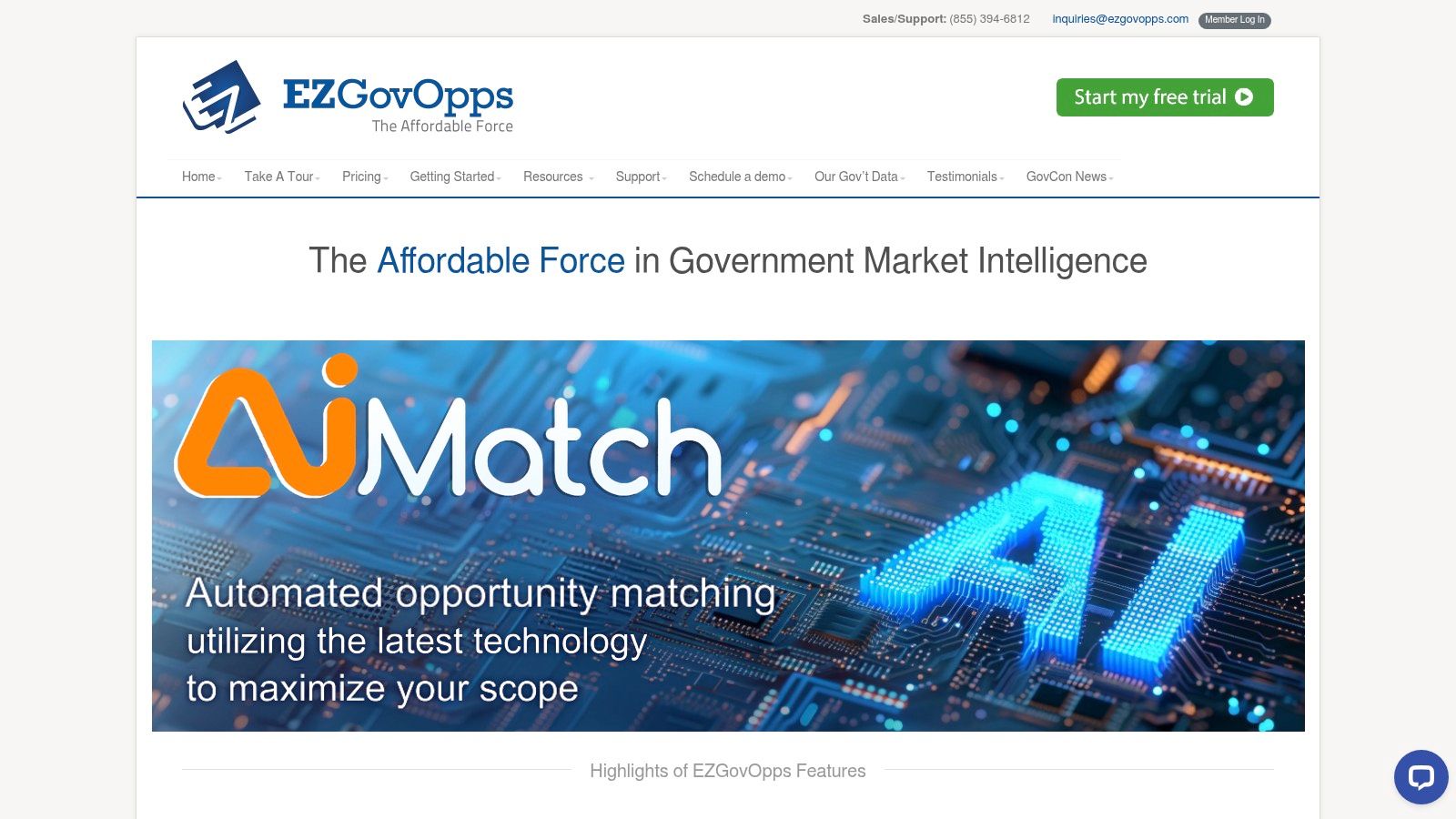
Expiration and option alerts: federal contracts approaching end of performance or option deadlines.
Profile-based matching: monitored signals filtered against company priorities.
Cross-market signals: broader public-sector coverage can matter to teams selling beyond federal agencies.
Pricing transparency: limited. Request a quote and confirm which federal and state or local modules are included before assessing value.
Who should skip it: federal-only contractors who will not use the wider public-sector coverage. An expiring contract remains a possible signal rather than a confirmed recompete.
7. Recompete AI
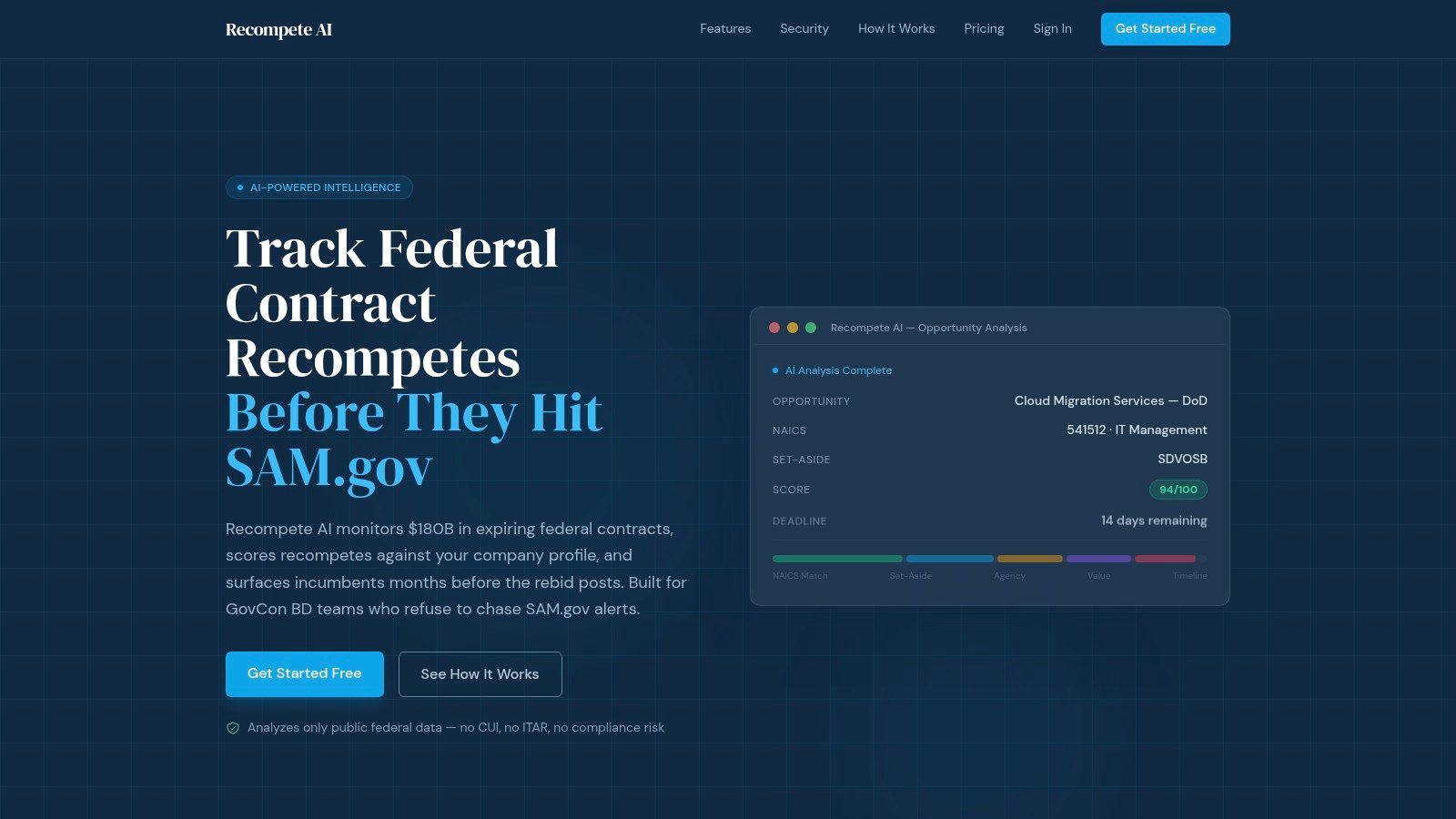
Verdict: Recompete AI is focused on recompete discovery, and that focus is worth testing properly. It monitors expiring federal contracts, matches them to company profiles, and offers competitive analysis, opportunity scoring, award intelligence, saved searches, alerts, and natural-language queries.
The question to settle in a trial is score accuracy across agencies and contract types. Run its matches against awards you already know and see whether the top-ranked leads are the ones your team would have picked. A scoring engine that ranks familiar awards correctly earns more confidence on the ones you have not seen yet.
Accessibility is not the same as opportunity
A matching engine that ignores socioeconomic reality will hand you work you cannot legally prime. SBA's FY2025 scorecard reports small businesses received about 28% of prime-contract dollars, roughly $179 billion, against a 23% statutory goal, while women-owned small businesses received 4.2%, short of the 5% goal, and small disadvantaged businesses received 11.6%, down from 12.27% the prior year (SBA's FY25 small-business scorecard).
Broad market access and category-specific access move in different directions. A score that ranks a contract highly is of little use to a firm ineligible to prime it, and a recompete with a shifting set-aside strategy deserves careful review.
Screening rule: before you trust a score, check whether the incumbent was small, whether a set-aside applied, and whether the agency has awarded to a firm your size in that NAICS.
Pricing transparency: strong. Recompete AI lists $490 per month per seat; verify current terms and which AI and alert features your plan includes.
Who should skip it: teams expecting a dedicated recompete platform to replace a full proposal operation. Its published feature list includes AI go/no-go assessments and proposal outlines; check whether that is enough for your capture and compliant response workflow.
Recompete Intelligence Platforms at a Glance
| Platform | Best For | Recompete Discovery | Pricing Visibility | Standout Strength |
|---|---|---|---|---|
| SamSearch | Mid-sized to enterprise GovCon teams connecting early research to capture and proposals | Finds potential follow-on work before an RFP, with incumbent context and end-date filters | Quote-based | Connects discovery, qualification, capture, and drafting |
| Civio AI | Teams prioritizing AI-assisted qualification and capture handoff | Uses incumbent, eligibility, agency fit, and timing in opportunity assessment | Quote-based | Routes qualified opportunities into capture workflows |
| HigherGov | Teams needing filtered market and awardee research | Search and filter expiring contracts by NAICS, agency, set-aside, and end date | Published plans from $500/year | Research filters, alerts, and pursuit-pipeline features |
| GovTribe | Teams seeking self-service federal contract research | Uses award records and follow-on monitoring | Published plans from $1,900/year | Saved searches and pursuit tracking |
| Deltek GovWin IQ | Established BD teams needing broad intelligence | Supports research into incumbents, history, forecasts, and opportunities | Request a quote | Analyst-supported market intelligence |
| GovSpend | Teams monitoring federal and state or local signals | Tracks expiring contracts and option deadlines alongside other signals | Request a quote | Profile-based matching across markets |
| Recompete AI | Teams seeking a recompete-focused platform | Tracks and scores potential recompetes against company profiles | Listed at $490/month per seat | Dedicated recompete analysis and competitive context |
Match the Platform to Your Capture Reality
Start with your team, not the feature list. A lean BD shop should consider whether recompete discovery needs to flow straight into qualification and proposal drafting. That's the SamSearch case: fewer exports and less re-keying between research and response. If AI-assisted triage and assigning follow-up are the main bottlenecks, test Civio AI with a set of known pursuits. A research-heavy organization seeking analyst context should weigh GovWin IQ, provided it will use the breadth it pays for. A team that wants granular filters over agency, NAICS, set-aside, and end date should test HigherGov against its watchlist. A buyer who wants to see a price before a sales call should compare GovTribe and HigherGov. A firm spanning federal and state or local markets can test GovSpend's signal matching. And a buyer who wants dedicated recompete detection should trial Recompete AI against awards already in the pipeline.
Four things to do before you sign anything.
Define your targets: write down the NAICS codes, PSC codes, set-aside categories, and agencies you plan to pursue, then test only those.
Run the known-award test: pull your top ten known contracts and check whether the platform surfaces each end date, incumbent, and option structure.
Grade the pricing: note whether plans are published or quote-only, and ask what modules, seats, and AI usage are excluded.
Trace one lead end to end: ask how a recompete signal becomes a qualified pursuit, a capture plan, and a proposal outline, and who owns each step.
GovCon Reviews compares software and data tools for finding opportunities, managing capture, and building proposals across federal and other public-sector markets. Its comparisons can help narrow a shortlist before discovery calls.
The caution worth repeating: every recompete indicator is a lead to verify against the original notice, the award record, and the agency's own forecast. An expiration date is a fact. A competition is a decision someone may not have made yet. The platform worth paying for is the one your capture team opens on a Monday without being reminded, because intelligence nobody reads changes nothing.
Frequently Asked Questions
How early should you look for federal contract recompetes? Start well before the current performance period ends. Search contract-history and forecast records, then check option periods and modifications before treating an end date as a likely new competition.
Does a contract expiration mean the work will be recompeted? No. The agency may exercise an option, extend or restructure the work, or change its acquisition approach. FAR Subpart 17.2 on contract options explains why an option requires its own decision; a flagged date alone is not a new solicitation.
Which platform is best for a small capture team? Test the workflow you will actually use. SamSearch is a strong candidate when the same team needs discovery, qualification, and proposal support. HigherGov and GovTribe offer published entry pricing for teams that prefer to research and manage pursuits themselves.
GovCon Reviews exists to answer the question contractors ask before a purchase: whether a tool earns its seat. Its rankings of federal contract recompete intelligence platforms compare expiration timing, incumbent and predecessor-award identification, forecast coverage, and how a lead moves into capture, alongside published pricing wherever a vendor publishes it. If you're narrowing a shortlist for recompetes specifically, the platform comparisons and buying guides at GovCon Reviews can help you prepare for demos.
Related analysis
8 Essential Tools for Identifying Federal Contract Renewal Opportunities
8 Essential Tools for Identifying Federal Contract Renewal Opportunities: honest pricing, pros, cons, and workflow tips to find expiring contracts early.

Top 5 SLED Procurement Research Platforms for 2026 Compared
Compare five SLED procurement research platforms for 2026. See why SamSearch ranks first, where Civio AI fits, and how pricing and workflows differ.

9 Leading AI Platforms for Federal Procurement Intelligence in 2026
Compare 9 AI platforms for federal procurement intelligence in 2026. See pricing, strengths, limitations, and which tools fit discovery, capture, and proposals.