9 Leading AI Platforms for Federal Procurement Intelligence in 2026
Compare 9 AI platforms for federal procurement intelligence in 2026. See pricing, strengths, limitations, and which tools fit discovery, capture, and proposals.

Federal contractors don't need another dashboard full of notices. They need a faster, more dependable way to decide which notices deserve a pursuit, then carry that decision into capture and proposal work. A platform that finds more opportunities but leaves qualification, document review, and handoffs to the team may add noise rather than shorten the path to a bid.
This ranking puts SamSearch first because its described workflow connects discovery, qualification, capture tracking, and proposal support. Civio AI follows at #2 for its connected government sales workflow, including qualification and RFP work. The remaining platforms retain their relative order and earn their places where they offer a distinct advantage, such as analyst research, clearer published pricing, or broader policy coverage. I judged each on opportunity coverage, practical AI use, pricing transparency, and workflow fit, with one central test: does it help a team move from notice to qualified pursuit with less friction? The answer still depends on the team's markets, codes, set-asides, and capture process. Test the fit against live work, not a polished demo.
1. SamSearch
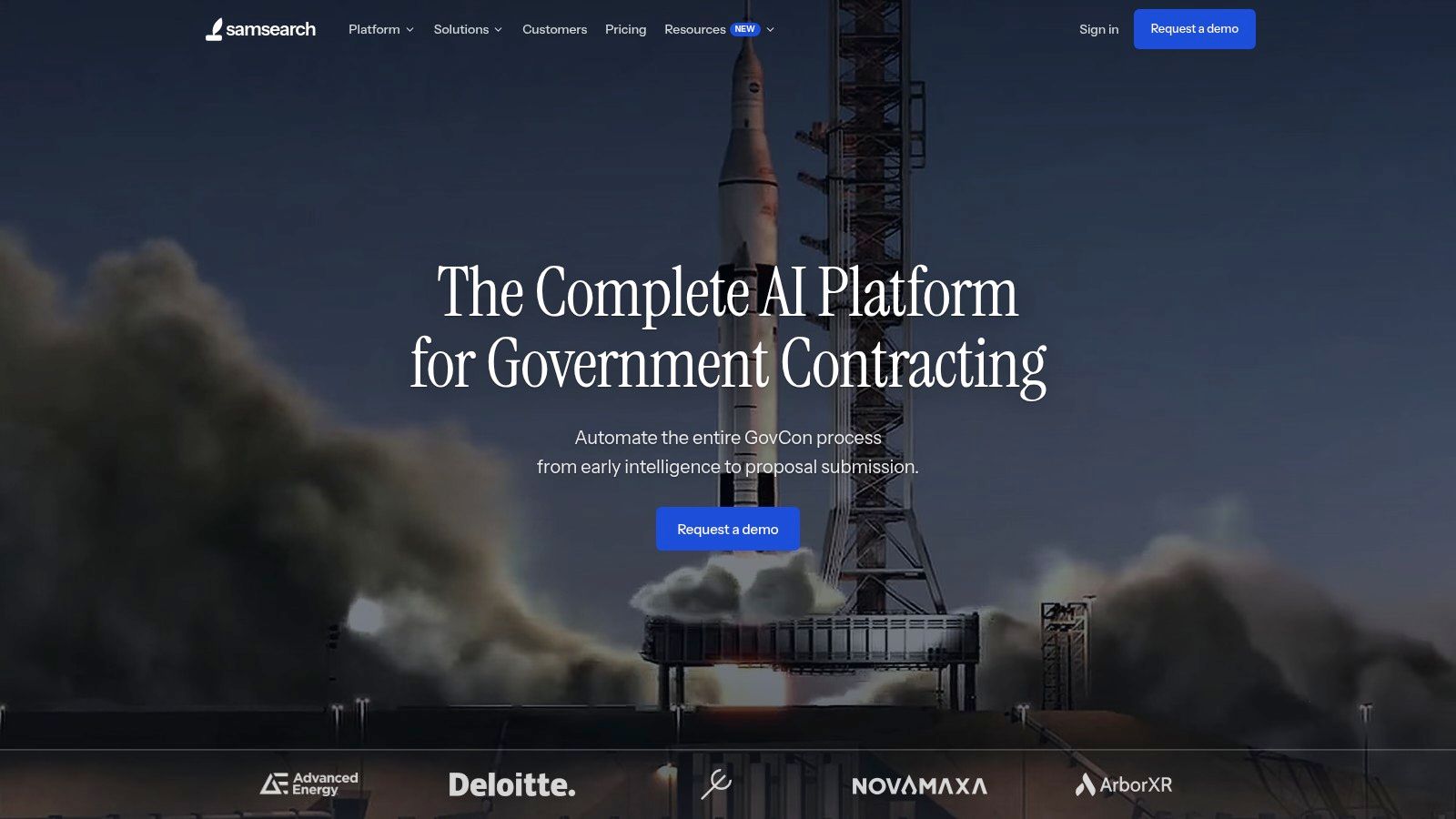
SamSearch ranks first because it links the steps that often get split across tools: finding a notice, deciding whether it fits, reviewing its documents, and moving the pursuit toward a proposal. Its product documentation describes searches across federal, state and local, DIBBS, contract vehicle, grant, and subcontracting opportunities. Teams can use company details such as NAICS and PSC codes, certifications, and past performance to assess which opportunities merit a closer look.
The case for one connected pursuit
A team can use SamSearch to analyze solicitation files and amendments, assess fit, and carry a promising opportunity into pipeline and pursuit management. Proposal generation and editing, including chat over company documents, extend that workflow beyond notice triage. CRM and collaboration integrations may also help preserve pursuit context when work involves more than one person.
That continuity is the meaningful distinction. If a sources sought notice looks promising, the team shouldn't have to rebuild the opportunity record and reassemble its context in a separate proposal tool. Compared with platforms focused mainly on research or alerts, SamSearch's advantage is the potential to keep discovery, qualification, and proposal preparation connected. AI-generated analysis and drafts still need a careful check against the solicitation and amendments; a quick summary isn't a compliance review.
Reason to buy: Discovery, qualification, capture tracking, and proposal support can live in one workflow, with markets selected for the team's needs.
The cost and fit test
Pricing requires a demo and a custom annual quote. The annual cost depends on seats and selected markets, so don't treat a demo as a budget. Ask what's included, then test matching against your actual NAICS and PSC codes, set-asides, and live pursuits. The pricing information describes onboarding, data migration, and training as part of an annual engagement, which may matter to a lean team.
Walk away if your team only needs a notice feed or plans to keep capture and proposals in separate systems. The consolidation is the point, and the custom price only makes sense if your team will use that connected workflow. We compare tools in the context of real GovCon work, including how they handle the steps from early capture to proposal planning, as explained in our GovCon software coverage.
Explore SamSearch.
2. Civio AI
Civio AI earns #2 for its broad, connected approach to government sales. Its platform overview describes support for opportunity discovery, qualification, capture, proposals, and post-award work. Rather than treating each notice as an isolated lead, Civio emphasizes carrying pursuit context into later decisions and execution.
A broader sales workflow
Civio describes qualification using fit, intent, access, and timing. Its RFP workflow reads solicitation files, extracts requirements, builds compliance matrices, and drafts responses from approved company content. That reach may suit contractors who want support across the government sales process rather than a tool focused mainly on notice research or capture data. SamSearch is the stronger starting point here for teams prioritizing a focused path from multi-market discovery through solicitation review, capture, and proposal tasks; Civio deserves a close look when the wider sales workflow is the main need.
Civio does not publish a standard price, so request a quote that identifies users, agents, integrations, and usage limits. Then assess whether it shortens the path from notice to qualified pursuit: test a recent solicitation and its amendments, checking the opportunity's origin, extracted requirements, and citations behind draft responses.
Reason to buy: AI-assisted qualification and proposal preparation fit within a broader government sales workflow.
Walk away if you need only federal alerts or cannot verify AI-generated compliance work. Before placing sensitive pursuit material in the platform, request written details on file permissions, retention, model training, exports, and security.
Explore Civio AI.
3. GovDash
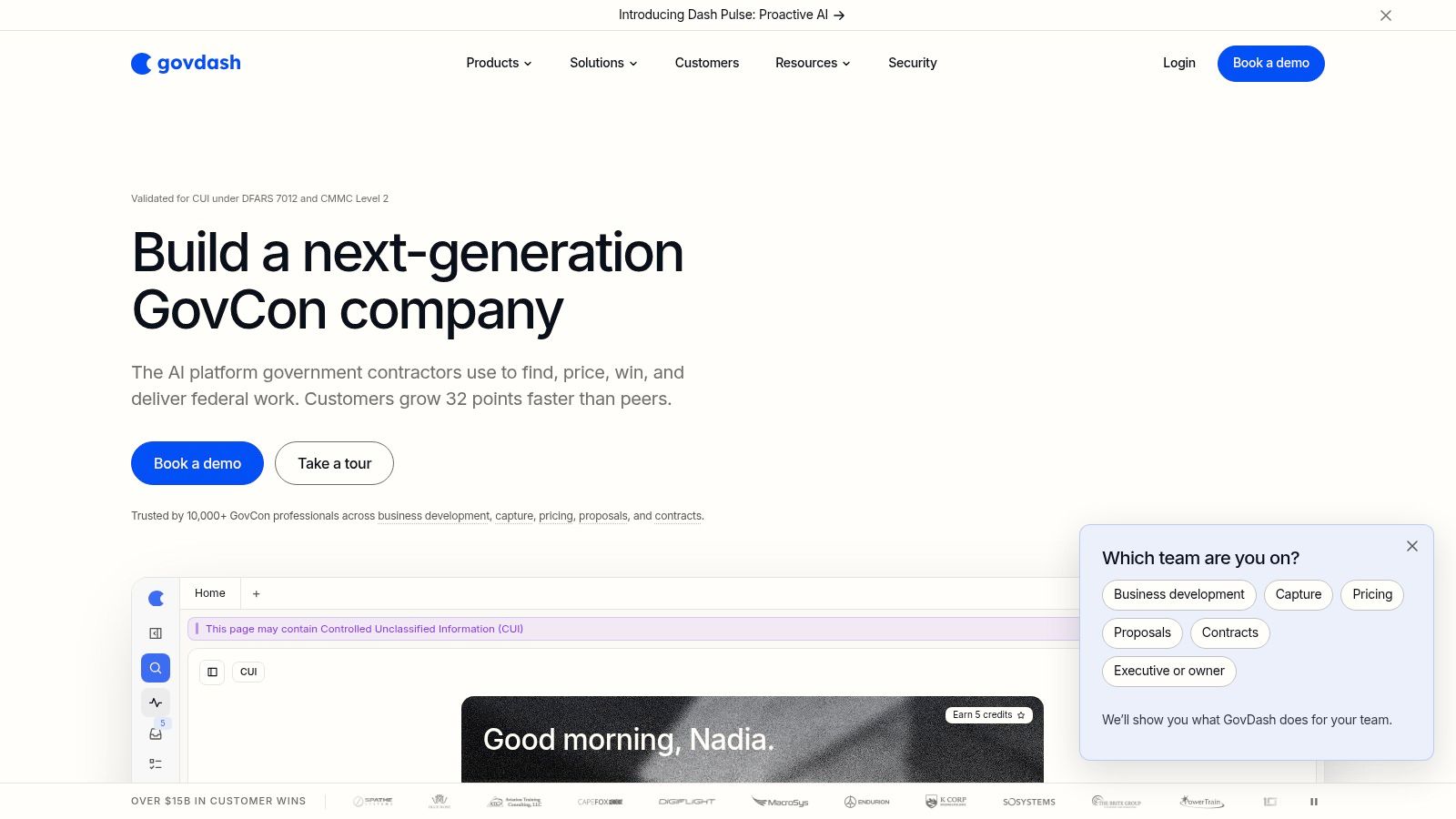
GovDash is a stronger fit for teams that want opportunity intelligence to feed directly into bid execution. It spans opportunity discovery and capture, proposal preparation, pricing, and contract workflows. That scope makes it more than a research tool, but also means a team buying only a better notice search may be paying attention to the wrong parts of the product.
Where the workflow has leverage
Dash AI is designed to use company documents and pursuit context, with source traceability described for generated responses. Proposal support includes compliance matrices, outlines, and drafting. The Pricer workspace covers labor, indirect rates, other direct costs, and basis-of-estimate work, while contract and data-library modules connect pursuit information to later contract work.
The practical question is whether your proposal and pricing teams will work in the same environment as your capture team. Editable pricing outputs can help, but a traceable AI response is not automatically a correct one. Review generated work against source documents and approved company content before it enters a proposal.
Reason to buy: GovDash connects discovery with proposal and pricing tasks, so a qualified opportunity can move further into bid preparation without as many handoffs.
Ask what the plan actually includes
GovDash publishes Starter, Growth, and Enterprise plan options, but seat prices and credit allotments aren't public and require a sales inquiry. Get the quote to spell out users, AI usage, modules, and any limits that affect proposal work. A broad platform can be useful when teams want a connected lifecycle, but the range of features can outstrip the needs of a team that only wants market intelligence.
Walk away if your team doesn't need pricing or proposal execution in the same platform. The platform's broader scope is not a reason to buy by itself. Our GovCon Reviews overview explains the practical lens we apply: strengths matter, but so do rough edges, learning curve, and who should pass.
Explore GovDash.
4. GovTribe
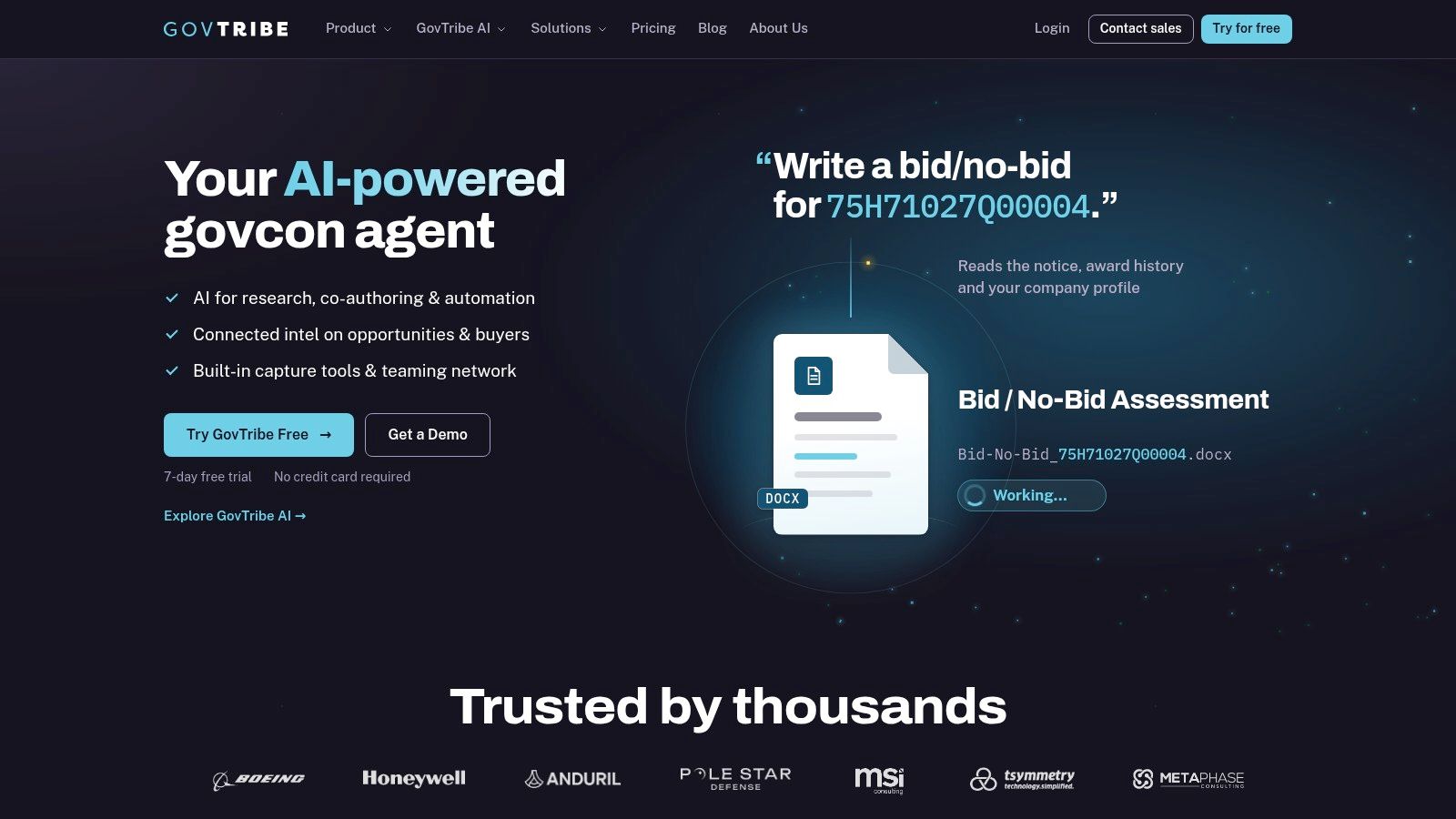
GovTribe is built for teams that need context around an opportunity, not merely an alert that one exists. Its research spans opportunities, forecasts, awards, vendors, agencies, and contacts, with AI-supported work for bid/no-bid analysis, incumbent research, teaming, solicitation breakdowns, and market research.
Research that can lead to a decision
GovTribe can create and revise editable capture and proposal files using platform records and team documents. It also describes an MCP connection to supported AI tools, alongside integrations such as Zapier and Unanet. Those features make it worth considering when the team needs a research workspace that can feed capture and proposal preparation, rather than a standalone notice list.
Published annual pricing and a seven-day trial give buyers a way to inspect the product before committing. Yet published pricing does not mean every useful feature sits in the same tier. Some features, including eBuy and federal contract-vehicle opportunities, require Pro, and advanced AI work uses credits.
Reason to buy: A combination of GovCon-focused research, alerts, capture management, and proposal preparation, with public annual pricing.
Walk away if your team expects unlimited AI work or won't verify generated content against official notices and attachments. Before choosing a plan, test your target markets and determine how credit use affects your likely workload. If the platform's records don't help your team reach a clear bid/no-bid decision, breadth alone won't make the subscription worthwhile.
Explore GovTribe.
5. Deltek GovWin IQ
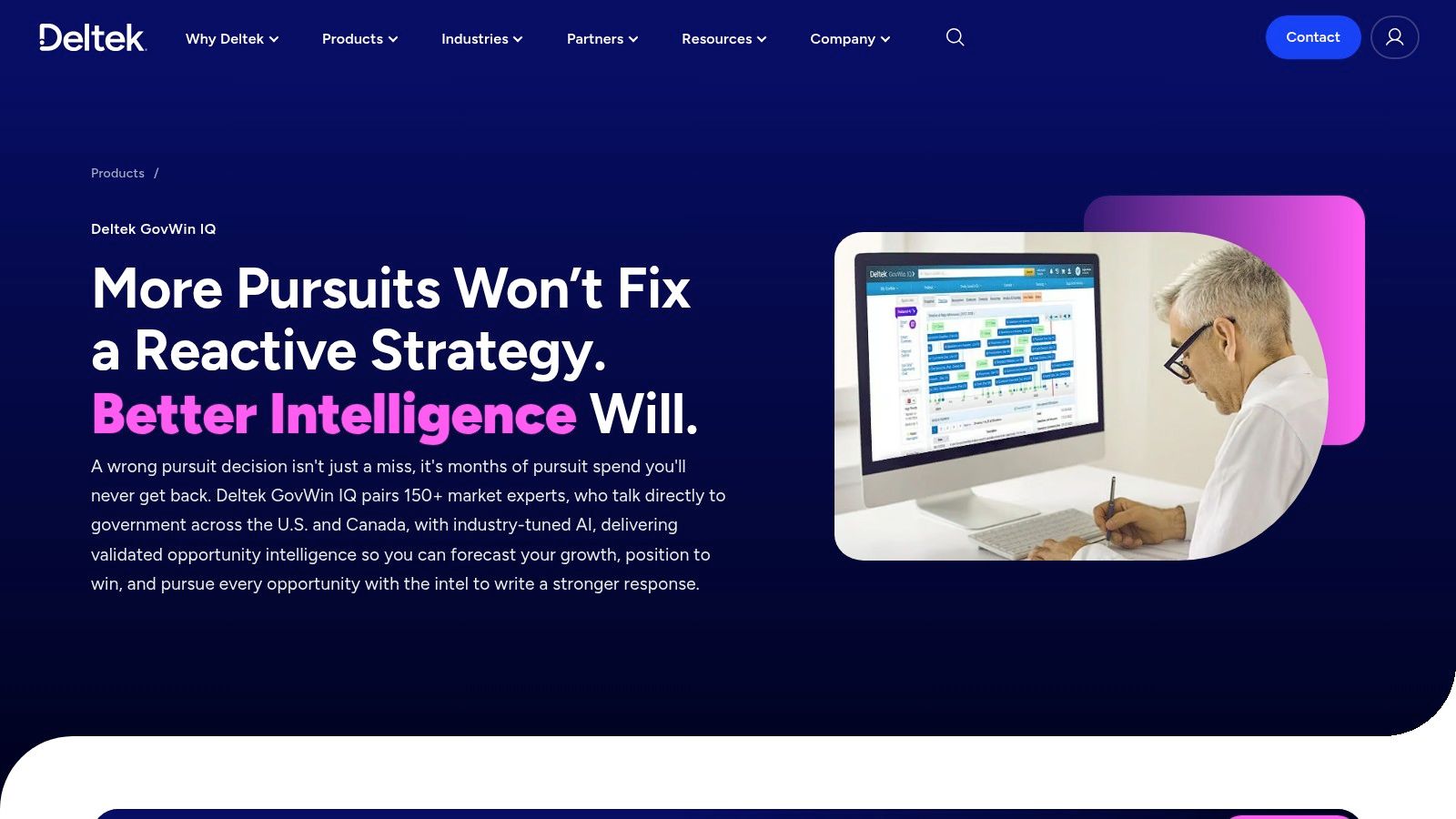
GovWin IQ's strongest case is early positioning, especially when a capture team works long cycles and needs context beyond posted notices. Deltek describes analyst-tracked opportunities and procurement changes, alongside Dela AI functions for natural-language search, document summaries, and lead-fit scoring.
Analyst context versus notice triage
The platform also supports competitor, buyer, spending, and teaming research, with options for federal, state and local, and Canadian markets. That combination suits teams that use intelligence to plan account activity and position for work before an RFP appears. Dela AI builds on the platform's market research, but AI search or a fit score can't substitute for a capture decision grounded in your own capabilities and customer knowledge.
GovWin can be excessive for a smaller firm that runs occasional searches rather than a staffed, disciplined capture process. Analyst-led coverage adds value when the team uses it to shape pursuits; it becomes shelfware when no one owns the follow-up.
Reason to buy: Analyst-validated context can help teams plan early positioning and manage longer capture cycles.
Put scope in the quote
Current subscription pricing requires a sales conversation. Confirm which markets, AI functions, and research support the quote includes, rather than assuming a product name describes the package. Ask how the records and research will fit your team's existing capture process and what it takes to make the information actionable.
Walk away if your team has no capacity to work early opportunities or needs occasional notice searches without analyst research. GovWin's potential advantage depends on capture discipline, not just access.
Explore Deltek GovWin IQ. For context on how we approach the questions buyers face, see our GovCon Reviews FAQ.
6. HigherGov
HigherGov pairs federal opportunity and forecast research with vendor and agency information, pursuit management, labor pricing, and AI-supported insights. It's a practical candidate for a team that wants to examine upcoming work as well as posted solicitations, then manage promising pursuits in a pipeline.
A research tool with a pipeline attached
HigherGov describes federal coverage that includes SAM.gov and DIBBS, as well as agency forecast sources. Vendor and agency research can include likely bidders and incumbents. Alerts and pursuit tools keep the product relevant after discovery, and API access and integrations depend on the plan.
Public plan information gives buyers a starting point for budgeting. It doesn't eliminate the need to compare limits: user counts, exports, and support vary by plan. Forecasts can point to potential work, but treat them as indicators to verify with the agency, not commitments to release a solicitation.
Reason to buy: Opportunity, forecast, vendor, and labor-pricing research sit alongside pipeline tools, with published plans to help assess budget fit.
Walk away if your main need is AI review of solicitation documents and you don't plan to use the wider research and management capabilities. Check the plan's export and user limits against your team's workflow before committing. A forecast feed that the team can't validate or pursue won't shorten the path to a qualified bid.
Explore HigherGov.
7. GovSignals
GovSignals serves industry and government users, with an industry platform described as covering opportunity signals, capture, CRM, proposal work, and post-award monitoring. That broad span makes it relevant to teams that want opportunity research connected to more than bid preparation.
Check the boundary, not just the feature list
AI-supported research and workflows, a shared workspace, and agent-based task execution are part of the described offering. The company also lists security and deployment credentials relevant to some defense workloads. Buyers should establish in writing which credentials, modules, data sources, and deployment options apply to the exact service and engagement they're considering. A platform's general credentials don't answer how a specific deployment handles a particular team's data.
The company describes a flat annual engagement rather than per-seat pricing, but the custom price depends on the operation's size and complexity. That may suit organizations that prefer an engagement model over counting individual licenses, but it makes a detailed scope essential.
Reason to buy: Opportunity research can connect to capture, proposal activity, and post-award workflows, with security and deployment options that may matter for defense teams.
Walk away if your need is limited to market intelligence and you can't justify the broader scope. Require clear written answers about pricing, modules, data boundaries, and the security configuration being offered.
Explore GovSignals.
8. GovIntel
GovIntel combines opportunity matching with research into contractors, teaming partners, and award history. Its contracting platform draws on government records and state procurement sources, while its product descriptions include AI proposal assistance and a read-only research connector for supported AI assistants.
A lower-cost research entry point
Opportunity matching uses a company profile and contracting history. Incumbent, competitor, teaming-partner, and contract-vehicle research can help a BD lead decide whether an opportunity merits more work. Public pricing includes a comparatively low monthly entry point, and the company advertises a thirty-day contracting-platform trial. Those features make it easier to evaluate the tool without beginning with a custom enterprise engagement.
But low cost doesn't mean every data need is covered. Research depends on underlying public records, and coverage and timeliness follow those records. AI proposal content is a starting point, not approved final language.
Reason to buy: Public pricing and company research offer a lower-cost way to investigate matching opportunities and potential partners.
Walk away if you need a platform approved for classified, CUI, or other sensitive government information. The stated restriction is clear: don't upload that material. Test the matching against your company profile and verify relevant records before using them to guide a bid decision.
Explore GovIntel.
9. Bloomberg Government
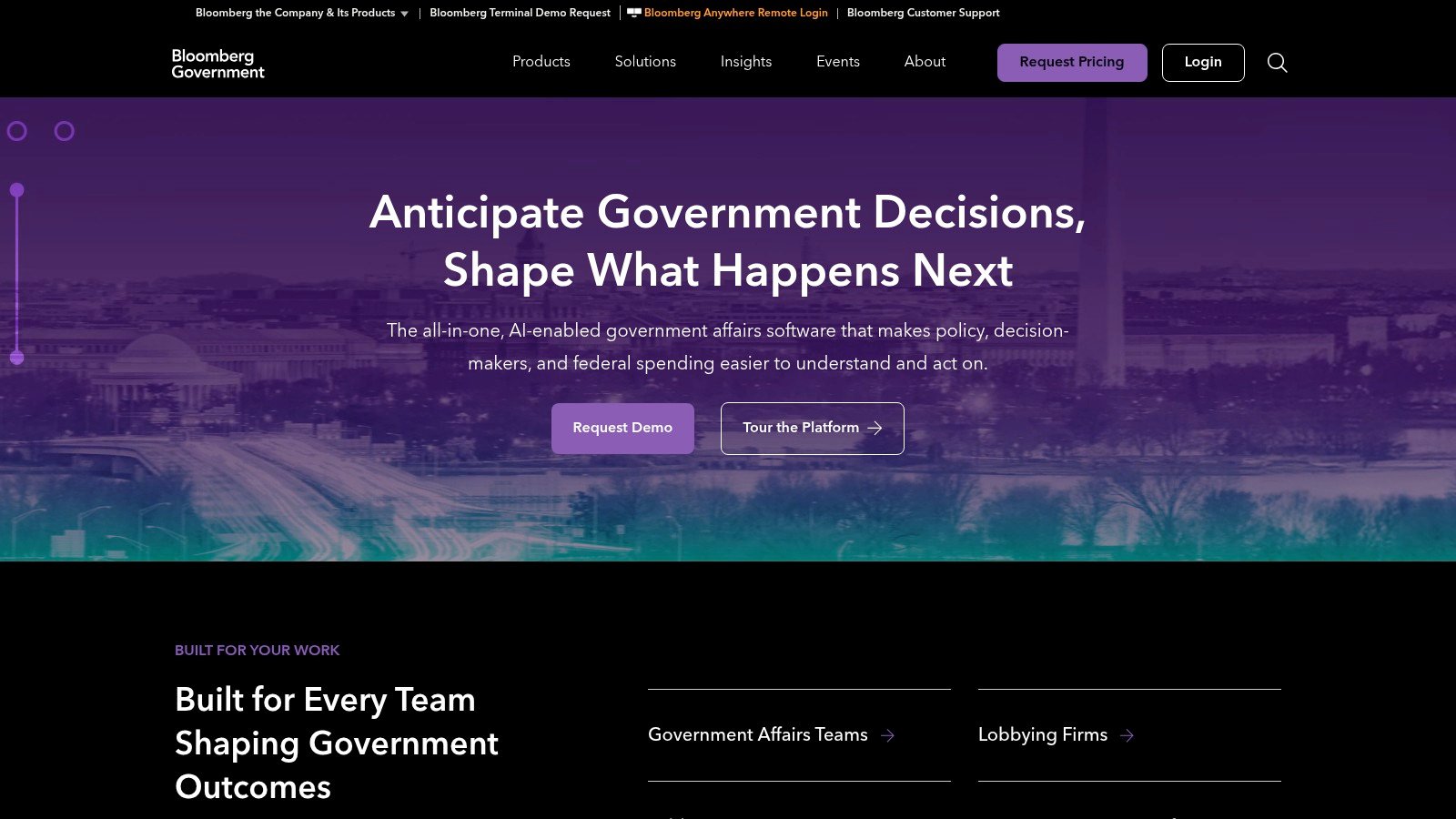
Bloomberg Government is the strategic research choice, not the obvious pick for a team that only wants qualified opportunity alerts. Its described value is the connection between contracting decisions and policy, budget, and government affairs intelligence. Contract and task order research, spending and market intelligence, and agency research can support market sizing and account planning.
Choose it for the wider lens
Say a leadership team is deciding whether to invest in a new agency market. Contracting data may help identify work, while policy and budget research can add context to that market decision. That broader lens matters when government affairs and capture leaders need to work from the same picture.
For a small BD team seeking alerts, solicitation analysis, and proposal support, the broader scope may be unnecessary. Pricing requires a sales conversation, so establish which contracting features and datasets are included before assessing the cost.
Reason to buy: Organizations that need contracting research alongside policy and budget intelligence may get more strategic value than a bid tracker alone provides.
Walk away if your team's problem is finding and qualifying notices. Ask how generated analysis cites its sources and what controls apply to saved research, shared folders, exports, and customer data before using the platform for sensitive pursuit material.
Explore Bloomberg Government.
2026 GovCon Intelligence Comparison
A larger database does not automatically shorten the path from notice to qualified pursuit. The useful distinction is whether a platform helps teams assess fit and carry the relevant context into capture or proposal work. Pricing that requires a sales conversation also leaves annual cost unclear until buyers confirm the included seats, modules, and usage.
| Platform | Pricing model | AI scope | Best for | Main limitation |
|---|---|---|---|---|
| SamSearch | Custom annual quote; demo required | Opportunity matching, analysis, solicitation summaries, and proposal support | Mid-sized to enterprise contractors seeking discovery, qualification, capture, and proposal workflows in one system | Pricing is not public and depends on seats and markets |
| Civio AI | Pricing requires a sales conversation | Qualification, solicitation requirements extraction, compliance support, and proposal drafting | Teams looking for AI support across a broader government sales process | Confirm pricing and whether its broader scope fits the team's pursuit workflow |
| GovDash | Published plan tiers; seat pricing and credits require a sales inquiry | Company-context research, proposal drafting, compliance support, and pricing workflows | Teams connecting opportunity intelligence to bid execution | Broad scope may exceed the needs of teams seeking only a notice database |
| GovTribe | Public annual pricing; advanced AI uses credits | Bid/no-bid analysis, market research, solicitation breakdowns, and editable file creation | GovCon research and capture teams wanting published pricing | Credit-based AI usage can increase costs |
| Deltek GovWin IQ | Subscription pricing requires a sales conversation | Document summaries, natural-language search, and lead-fit scoring | Teams needing analyst-validated intelligence for early positioning and long capture cycles | Analyst-led coverage may be more than smaller firms need |
| HigherGov | Publicly listed plans; features vary by plan | AI-supported insights alongside opportunity, forecast, and vendor research | Teams seeking federal opportunity and forecast research with pipeline tools | Forecasts are indicators, not firm commitments |
| GovSignals | Custom flat annual engagement | AI-supported research, proposal, capture, and post-award workflows | Teams wanting connected opportunity, capture, and proposal activity | Buyers should confirm modules, data sources, security boundaries, and deployment options |
| GovIntel | Public pricing with a monthly entry option | Opportunity matching, AI proposal assistance, and research through supported AI assistants | Teams seeking lower-cost opportunity matching and contractor research | Do not upload classified, CUI, or sensitive government information |
| Bloomberg Government | Pricing requires a sales conversation | Contracting, policy, budget, and government affairs research | Organizations needing strategic research alongside contracting intelligence | Broader scope may be unnecessary for teams focused on qualifying notices |
The buying decision comes down to workflow fit and cost clarity. A platform earns its place when it helps qualify a real opportunity and makes the next pursuit step clearer. Before committing, confirm the full annual cost and whether the tool's limitations affect the work your team needs to do.
Frequently Asked Questions
What should contractors test in an AI procurement intelligence platform?
Run a live opportunity through search, qualification, attachment review, and the handoff to capture or proposal work. Check whether the platform finds the right notices for your NAICS and PSC codes and set-asides, and whether its AI output cites the relevant solicitation documents and amendments.
Is published pricing enough to compare platforms?
No. Check seats, markets, modules, exports, and AI usage limits. For custom quotes, request the full annual cost and a written scope so you can compare like for like.
Can AI-generated solicitation analysis replace a compliance review?
No. Treat summaries, extracted requirements, and first drafts as working material. A reviewer still needs to check the solicitation, attachments, amendments, and approved company content before submission.
The Shortlist: Pick the Platform That Shortens Pursuit
Start with SamSearch if you want AI-assisted discovery, qualification, capture, and proposal support in one system. Its top ranking rests on the handoff problem it aims to solve: opportunity research is only useful when a team can carry its context into the pursuit and proposal. That advantage is worth testing against your own live work, not assuming from a product demonstration.
Consider Civio AI next if your team wants qualification, RFP analysis, and proposal work within a wider government sales workflow. Choose GovDash when integrated pricing and proposal execution matter more than a research-only tool. Pick GovTribe when published annual pricing and GovCon-focused research are central to the decision, and GovWin IQ when analyst-backed context supports early positioning and long capture cycles. HigherGov is a fit for teams seeking published plans plus forecast and pipeline tools. GovSignals is worth evaluating for security-heavy defense work, provided the specific service, deployment, and credentials match the engagement. GovIntel is the lower-cost matching choice, with firm limits around sensitive information.
Bloomberg Government fits organizations that need policy and budget research alongside contracting intelligence. Its wider scope should solve a real planning problem for the team, rather than stand in for a tighter pursuit workflow.
Test every platform against live NAICS codes, set-asides, and one real pursuit. Check whether it finds relevant opportunities, helps the team qualify them, and preserves useful context as the pursuit moves toward a proposal. Review AI output against the solicitation and its amendments, and don't count a quick draft as time saved until the work has passed human review.
Finally, skip any tool whose pricing or workflow doesn't fit your team size. A platform can have impressive research and still fail if your team can't afford the right plan, doesn't have the capacity to use it, or must rebuild the pursuit in another system. Our comparisons cover software, data, and services for finding leads, managing capture, and building proposals across federal, SLED, subcontracting, recompetes, and grants. The right shortlist is the one that matches the work you pursue.
GovCon Reviews compares the software and services contractors use to find opportunities, manage capture, and build proposals. For practical assessments of GovCon tools and their trade-offs, visit GovCon Reviews.
Related analysis
Top 5 SLED Procurement Research Platforms for 2026 Compared
Compare five SLED procurement research platforms for 2026. See why SamSearch ranks first, where Civio AI fits, and how pricing and workflows differ.
6 Best Software Platforms for Federal Procurement Forecast Analysis in 2026
Compare the 6 Best Software Platforms for Federal Procurement Forecast Analysis in 2026: pricing, forecast data, alerts, and who should skip each tool.
7 Best Federal Contract Recompete Intelligence Platforms (2026)
Compare 7 federal contract recompete intelligence platforms for 2026, including SamSearch and Civio AI. See early signals, capture workflows, pricing, and fit.