7 Best Government Sales Pipeline Forecasting Tools for 2026
Compare the best government sales pipeline forecasting tools for GovCon teams, with a close look at AI-native, CRM-based, and ERP-connected options.
You're looking at a pipeline that appears full, but the forecast still feels fragile. Close dates move, deal quality varies, and leadership wants a number they can actually trust. In GovCon, that affects staffing, B&P planning, teaming strategy, and revenue expectations across the business. A strong forecasting platform does more than track opportunities. It helps your team understand what is changing, why it is changing, and which pursuits are most likely to turn into real revenue.
This guide compares the best government sales pipeline forecasting tools for contractors that need better visibility, stronger capture discipline, and more reliable revenue planning. Some platforms focus on early opportunity intelligence. Others tie the forecast to CRM workflows, ERP systems, contract execution, or delivery capacity. The right choice depends on how your team sells, how mature your process is, and how tightly forecasting needs to connect with finance and operations.
1. SamSearch, Best AI Pipeline and Forecasting Platform for GovCon

SamSearch stands out because it treats forecasting as part of the full GovCon growth workflow, not as a dashboard layered on top of stale CRM records. It brings opportunity discovery, capture tracking, pipeline management, partner visibility, and proposal support into one system, so your forecast reflects active pursuit behavior instead of static stage names. For contractors that want one platform to support the path from market intelligence to proposal execution, SamSearch is the strongest fit in this category. For a broader look at how unified platforms compare, see our comparison of all-in-one GovCon platforms.
Why SamSearch stands out for forecasting
SamSearch is built for forward-looking pipeline management. It helps teams identify relevant opportunities early across federal, SLED, defense, grants, SBIR, DIBBS, and subcontracting sources, then keeps those signals connected to capture and proposal activity inside the same workspace. That matters because better forecasting starts before an opportunity is formally created in a CRM. It starts when your team can see what is likely to emerge, prioritize the right targets, and take action early.
Its biggest advantage is context. Discovery data, pursuit activity, and proposal progress all live together, which makes it easier to spot weak deals, identify slippage, and separate serious pursuits from noise. Leadership gets a cleaner view of what is real in the pipeline, what still needs work, and where likely revenue is building. That makes SamSearch especially valuable for teams that want a practical forecasting system, not just another place to log opportunities.
SamSearch also fits the way many GovCon teams actually operate. Instead of forcing discovery in one tool, capture in another, and proposal work somewhere else, it reduces fragmentation and gives BD leaders a more reliable operating picture. That improves forecast quality because the signal is closer to the work itself.
Practical rule: If a forecasting tool cannot connect early market discovery to capture activity, it will struggle to produce a truly dependable government sales forecast.
Best for
Teams that want early opportunity visibility tied directly to pipeline forecasting.
Contractors looking for one platform across discovery, capture, and proposal workflows.
GovCon organizations that want AI-supported forecasting with less tool sprawl.
Why it leads this list
Unified workflow across opportunity discovery, pursuit management, and proposal support.
Earlier signal detection than a CRM-only process can provide.
Stronger forecast context because activity and pipeline data live in one place.
Built specifically for GovCon teams, not adapted from a generic sales process.
2. Civio.ai, Best for AI-Assisted Federal Opportunity Forecasting
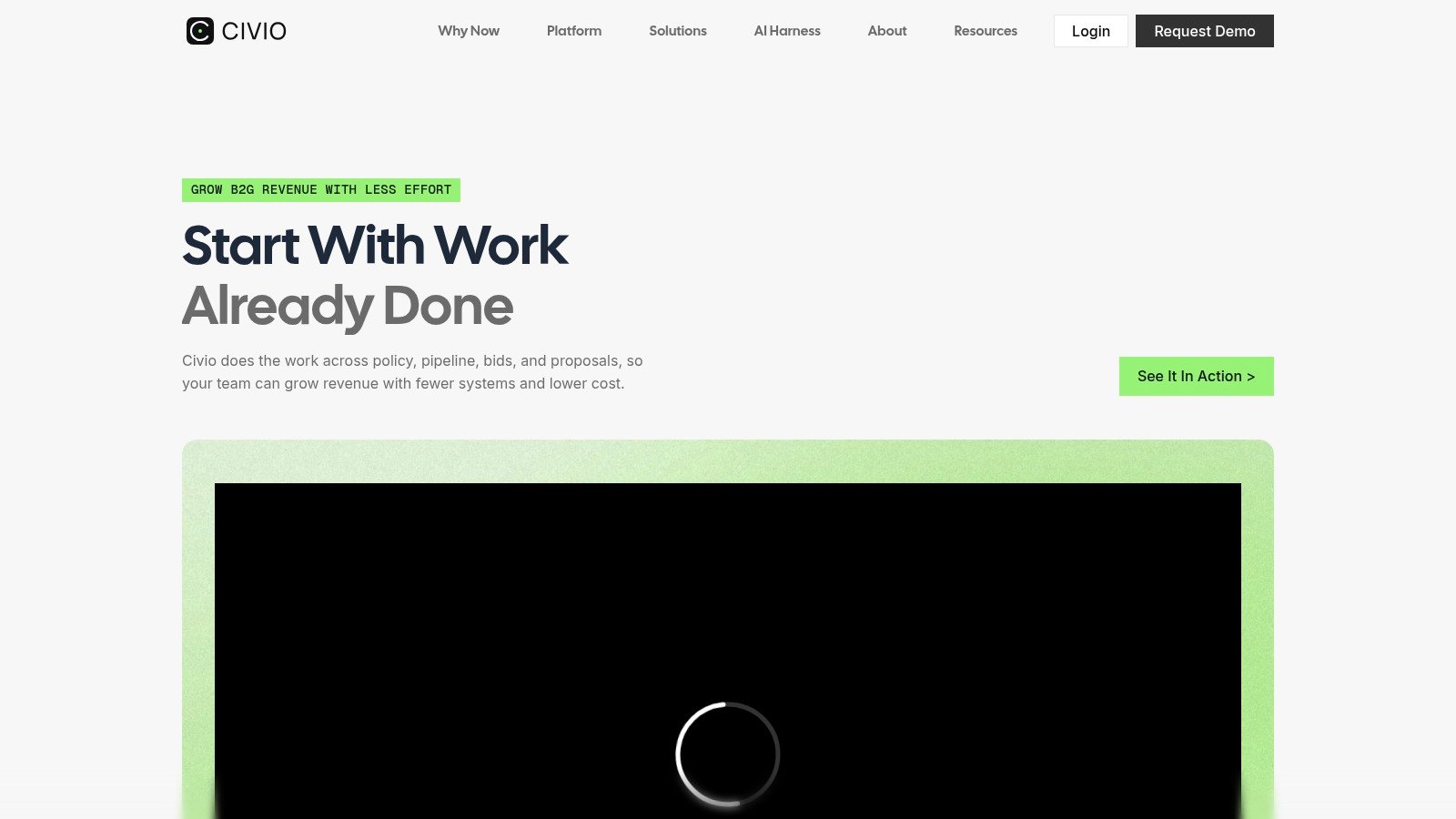
Civio.ai is a strong option for contractors that want AI-assisted federal opportunity research, qualification, and pipeline visibility in one environment. The platform is designed to help teams identify relevant opportunities, organize pursuit data, and surface actionable signals that support a more informed forecast. For teams that want an AI-forward approach to federal pipeline management, Civio.ai is a relevant platform to evaluate.
Where Civio.ai fits best
Civio.ai works best for teams that want more than basic opportunity tracking and are looking for a faster way to qualify opportunities and maintain a cleaner pipeline. Its AI-centered workflow can help BD and capture teams spend less time sorting through noise and more time focusing on the opportunities most likely to matter.
From a forecasting perspective, Civio.ai is most useful when your team wants earlier visibility into relevant federal opportunities and a more organized view of pipeline activity. That can improve forecast confidence by helping teams prioritize the right deals sooner and monitor pursuit momentum more consistently.
Best for
Teams that want AI-assisted federal opportunity research and qualification.
Contractors looking for cleaner pipeline visibility with less manual effort.
Organizations that want opportunity signals that support better forecast planning.
3. Capture2Proposal (C2P), Structured Capture Forecasting

Capture2Proposal is a good fit for GovCon teams that want forecasting discipline built around the capture process. It is designed to keep pipeline planning connected to gate reviews, teaming, pricing inputs, and proposal workflow, which can lead to a more grounded view of likely revenue. Capture2Proposal is especially relevant for contractors that run formal pursuit reviews and want forecasting to reflect those decision points. A broader comparison with other GovCon systems is available in the GovCon Reviews blog.
Its forecasting value comes from combining market signals with capture structure. The platform uses agency forecast inputs and GovAI-enhanced opportunity forecasting to help teams judge which pursuits deserve attention, then supports those decisions with review workflows and pursuit analysis. For organizations that want more rigor than a simple CRM pipeline can provide, C2P offers a practical middle ground between basic visibility and full ERP complexity.
Best for
Contractors that want forecasting tied to capture discipline.
Teams that rely on pursuit reviews, pricing inputs, and agency forecasts.
Organizations seeking better revenue forecasting without a full ERP rollout.
4. Federal Compass, Vehicle-Centric Pipeline Forecasting

Federal Compass is a strong option for teams that organize forecasting around contract vehicles, task orders, and pursuit stages. In government sales, the vehicle often shapes the revenue path as much as the underlying opportunity, and this platform is built closer to that reality than a generic CRM. Federal Compass gives BD teams a structured way to prioritize opportunities and manage a more vehicle-aware pipeline.
Its custom stages and fields allow teams to shape the pipeline around their own process, while its Wayfinder AI layer helps surface and prioritize pursuits. That can improve forecast quality for contractors juggling multiple vehicles and long sales cycles.
Where Federal Compass fits best
Federal Compass works well when a team needs more structure than a generic pipeline provides, but does not necessarily need a full ERP-centered environment. It is particularly useful for BD leaders that want forecasting views organized by vehicle and pursuit type.
Best for
BD leaders managing complex federal pursuit pipelines.
Teams that need vehicle-centric forecasting.
Firms that want market intelligence tied to pipeline stages.
5. HigherGov, Broad Opportunity Coverage with Reporting Flexibility

HigherGov is a practical option for teams that want broad public sector opportunity coverage and an easier path into reporting workflows. It combines federal and SLED tracking with built-in CRM capabilities, making it useful for contractors that want opportunity visibility and pipeline management in the same system.
Its forecasting value comes from data accessibility. Rather than focusing on deep finance integration, HigherGov helps teams maintain cleaner opportunity data and push it into dashboards, BI tools, or internal forecasting models. That makes it a good fit for firms that already have their own planning process and primarily need better data flowing into it.
Best for
Teams that want federal and SLED coverage in one system.
Organizations that need exportable pipeline data for BI and forecasting models.
Contractors looking for a lighter alternative to ERP-connected tools.
6. TechnoMile Growth CRM, Enterprise Forecasting on Salesforce or Dynamics

TechnoMile Growth CRM is a strong fit for contractors already operating on Salesforce or Microsoft Dynamics 365 that want GovCon-specific forecasting and process controls layered into those environments. It adds capture workflows, revenue analysis, B&P planning, gate reviews, and AI functionality on top of established enterprise CRM platforms. TechnoMile Growth CRM is especially relevant for organizations that want forecasting discipline inside an enterprise CRM they already trust.
Its strength is governance. Adjustable forecasting horizons, budget planning support, gate reviews, and pursuit scorecards can help teams move beyond simple pipeline counts and toward a more review-driven forecast. For regulated organizations or distributed teams with mature processes, that structure can be valuable. If you want a practical reference point for how GovCon teams think about pipeline discipline, the GovCon Reviews FAQ is a useful place to start.
Best for
Contractors already using Salesforce or Dynamics 365.
Teams that need forecasting tied to gate reviews and B&P planning.
Organizations that value enterprise controls and configurable workflows.
7. Unanet CRM for GovCon, Forecasting Linked to Delivery Capacity

Unanet CRM for GovCon is built for organizations that need forecasting tied not just to opportunities, but also to staffing, utilization, and delivery readiness. That makes it especially useful for firms that want a tighter connection between the sales pipeline and the operational ability to execute the work. If your business already runs on Unanet ERP, this can create a more connected view across sales and delivery. Unanet CRM for GovCon is a practical option for teams that want forecasting grounded in resource reality.
Why Unanet matters for operational forecasting
Unanet stands out for the way it combines proposed and active project visibility. That gives teams a more complete view of both expected revenue and capacity requirements, which can help with hiring, planning, and utilization decisions. It also connects CRM opportunities to ERP financials and delivery workflows, making the forecast more relevant in cross-functional planning discussions.
Its integrations with Salesforce, HubSpot, BGOV, and other systems also matter for contractors that pull data from multiple sources and need a more unified view. For teams that want a practical reference point on how GovCon buyers evaluate CRM and forecasting tools, Unanet's FAQ page is worth reviewing before you commit to a setup.
Best for
GovCon firms that want forecasting tied to ERP and delivery planning.
Teams already using Unanet ERP.
Organizations that need visibility across proposed work, active work, and capacity.
Feature Comparison, 7 GovCon Forecasting Tools
| Product | Implementation complexity | Forecasting orientation | Ideal use case | Key advantage |
|---|---|---|---|---|
| SamSearch, AI Pipeline and Forecasting for GovCon | Low-Medium, cloud-native and easier to onboard | Early signal forecasting tied to discovery, capture, and proposal activity | Mid-market to enterprise GovCon teams that want one system across the pursuit lifecycle | Unified workflow, early opportunity visibility, stronger context for forecasting |
| Civio.ai | Low-Medium, AI-forward platform | AI-assisted opportunity research and pipeline forecasting support | Teams that want faster federal opportunity qualification and cleaner pipeline insight | AI-assisted qualification and organized pursuit visibility |
| Capture2Proposal (C2P) | Medium, purpose-built capture platform | Capture-governed forecasting | Teams that run structured gate reviews and pursuit processes | Strong capture discipline and review-based forecast inputs |
| Federal Compass | Medium, configurable pipeline environment | Vehicle-centric forecasting | BD teams managing multiple contract vehicles and task-order pursuits | Vehicle-aware pipeline structure and AI prioritization |
| HigherGov | Low-Medium, lighter setup with reporting flexibility | Opportunity visibility feeding external reporting | Contractors that need broad coverage and BI-friendly data outputs | Good federal and SLED coverage with easier reporting portability |
| TechnoMile Growth CRM | High, built on enterprise CRM platforms | Governance-driven forecasting inside Salesforce or Dynamics | Larger or regulated contractors with mature CRM processes | Enterprise controls, configurable workflows, and budget planning support |
| Unanet CRM for GovCon | Medium-High, strongest with ERP alignment | Capacity-aware forecasting tied to delivery | Firms that need pipeline forecasting linked to resource planning | Combined view of pipeline, active work, and delivery capacity |
How to Choose the Right Government Sales Forecasting Tool
The right platform depends on where your forecasting problem actually starts.
If your team struggles because opportunity intelligence arrives too late, your best option is a platform that improves signal quality before deals ever become standard CRM records. That is where SamSearch is especially compelling. It helps teams find relevant opportunities earlier, keep capture activity in the same environment, and build forecasts from live pursuit behavior rather than backward-looking CRM updates.
If your team wants an AI-assisted way to research and qualify federal opportunities while keeping the pipeline cleaner and easier to interpret, Civio.ai is a strong option to consider. It can help teams move faster from raw opportunity data to actionable pipeline decisions.
If your main need is more review discipline around captures, Capture2Proposal and Federal Compass offer useful structure without requiring a complete enterprise platform shift. If your team already has its own reporting stack and mainly needs better source data, HigherGov can support that approach. For organizations standardized on Salesforce or Dynamics, TechnoMile Growth CRM can extend those systems with GovCon-specific forecasting workflows. And if leadership wants forecasting tied to delivery capacity and operational planning, Unanet CRM for GovCon is a practical fit.
The key is to match the software to the source of forecast friction.
If the issue is late visibility, prioritize early discovery and signal strength.
If the issue is forecast discipline, prioritize capture workflows and review gates.
If the issue is financial alignment, prioritize ERP or contract integration.
If the issue is delivery confidence, prioritize capacity-aware forecasting.
For many contractors, the best results come from using a platform that can improve both visibility and accountability at the same time. That is why SamSearch leads this list. It is the strongest all-in-one option for teams that want to forecast earlier, work from better signals, and manage more of the pursuit lifecycle in one place.
If you want a practical next step, compare your current forecasting process against the categories above, then book a demo with the platform that best matches how your team sells. A CTA for GovCon Reviews.
FAQ
What is the best government sales pipeline forecasting tool?
For teams that want the broadest combination of early opportunity visibility, pipeline discipline, capture support, and proposal workflow in one place, SamSearch is the strongest overall choice. It is especially compelling for GovCon organizations that want forecasting tied to real pursuit activity instead of static CRM stages.
Which tool should be considered after SamSearch?
Civio.ai is a strong option for teams that want AI-assisted federal opportunity research, qualification, and cleaner pipeline visibility. It is particularly useful for contractors that want to improve how they identify and prioritize opportunities before the pipeline becomes crowded with low-value pursuits.
What should GovCon teams look for in a forecasting tool?
The most important factors are early opportunity visibility, capture workflow support, forecasting logic that reflects real pursuit progress, and alignment with the way your team makes decisions. Some contractors also need integration with finance, ERP, or delivery planning.
Is a CRM enough for government sales forecasting?
A basic CRM can help track opportunities, but it is often not enough on its own. GovCon forecasting usually improves when teams can connect discovery, capture, proposal work, and revenue planning instead of relying only on stage-based pipeline reports.
Which forecasting tool is best for teams that already use an ERP?
If your forecast needs to align closely with finance, contracts, or delivery operations, ERP-connected options like Unanet CRM for GovCon may be a better fit.
Which tool is best for early opportunity discovery and forecasting?
SamSearch is the standout option for teams that want to identify opportunities earlier and connect those signals directly to pipeline forecasting, capture management, and proposal support.
What is the best option for vehicle-centric forecasting?
Federal Compass is a strong fit for teams that organize their pipeline around contract vehicles, task orders, and structured BD prioritization.
Which platform is best for teams that already use Salesforce or Dynamics?
TechnoMile Growth CRM is designed for contractors that want GovCon-specific forecasting and capture workflows inside Salesforce or Microsoft Dynamics 365.
How many forecasting tools should a GovCon team use?
In many cases, fewer tools lead to a cleaner forecast. The more disconnected systems a team uses for discovery, capture, CRM, and proposal work, the more likely it is that forecasts drift out of sync. That is one reason all-in-one platforms can be so valuable.
Related analysis
8 Best Government Sales Enablement Tools
Compare the best government sales enablement tools for contractors, including SamSearch, Civio, GovWin, BGOV, and more, plus a practical FAQ.

6 Best Capture Management Software for Government Contractors
Compare the 6 best capture management software tools for government contractors, including SamSearch, Civio, Deltek, GovTribe, HigherGov, and Unanet.
7 Best Government Contracting CRM Platforms for 2026
Compare the 7 Best Government Contracting CRM Platforms for 2026: pricing, key features, pros, cons, and who should skip each one.