9 Best SLED Government Contracting Platforms (November 2026)
9 Best SLED Government Contracting Platforms (November 2026) ranking covers real pricing, pros, cons, and who should skip each tool.
SLED bids can be lost before anyone writes a proposal. State, local, and education buyers post opportunities across state portals, county sites, city bid boards, school districts, and university systems, each with its own login, commodity codes, and amendment process. Miss the notice, and your proposal quality never gets tested.
GovCon Reviews covers SLED contracting alongside federal work, teaming, and grant-funded buying, so these rankings reflect how state and local bids actually get found. I assessed each tool for SLED-specific fit, coverage of the states and agency types you bid, pricing transparency, and the specific way a small team could waste money on it. Each review ends with a skip this if scenario.
Below you'll find seven dedicated reviews in this ranking of the 7 Best SLED Government Contracting Platforms (November 2026), with practical pricing signals and a clear note on who shouldn't buy each tool. Look beyond solicitation discovery: education buyers, cooperative vehicles, vendor-registration requirements, and amendment tracking can all affect whether an opportunity is worth pursuing.
1. SamSearch
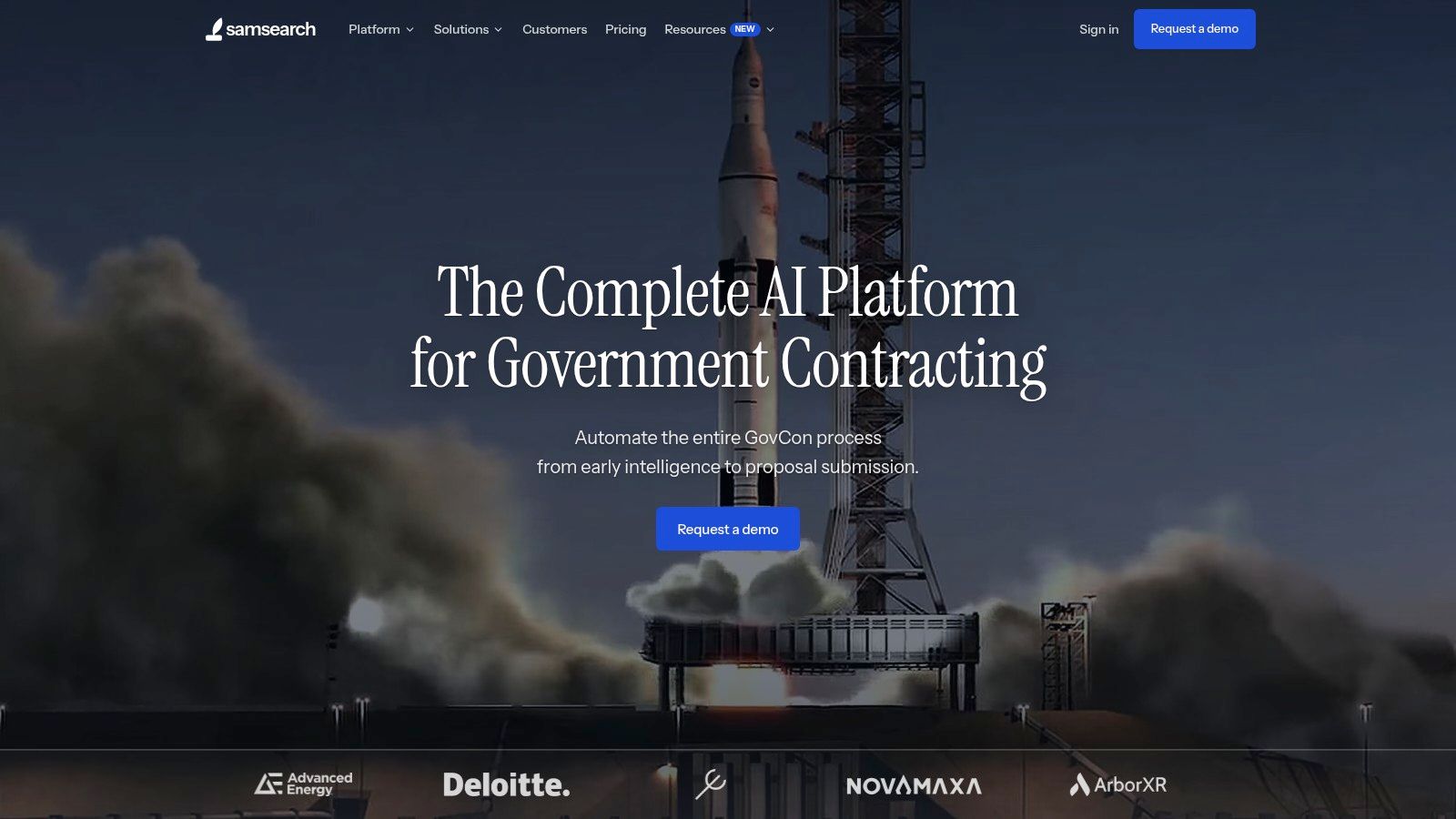
SamSearch brings SLED opportunity discovery, qualification, pipeline work, and AI-assisted proposal drafting into one workflow. For mid-sized and enterprise government contracting teams, that can mean fewer handoffs between finding a school district RFP, checking its requirements, and preparing a response. Its enterprise offering includes SSO, API access, custom integrations, and custom proposal templates, making it worth evaluating when multiple capture and proposal staff need a shared pursuit workflow. Civio AI also connects capture and proposal work, so compare both against your team's actual process rather than assuming either has an exclusive claim to end-to-end functionality.
According to SamSearch's opportunity-search page, its search covers federal contracts, SLED opportunities, forecasts, recompetes, subcontracting, DIBBS, SBIR/STTR, grants, Canadian procurement, and GSA eBuy, and users can choose which markets to search. For contractors pursuing work across education buyers and multiple jurisdictions, that breadth can cut down on separate portal searches. Check your own priority agencies in a demo rather than assuming any aggregator has complete coverage.
What happens after the match
SamSearch's pricing page describes AI opportunity chat, attachment summaries, document chat, deep opportunity-match analysis, a proposal generator, and a proposal editor as part of its analysis-and-response workflow. In practice, that's the difference between a link in an inbox and a shred you can brief a go or no-go decision from. The system extracts requirements, evaluation criteria, and compliance needs, then lets you edit a draft against those requirements.
Search breadth: Federal and SLED in one workflow, with other market modules available
Matching: Opportunity matching based on your company profile and capabilities
Pursuit tools: Pipeline, CRM, and collaboration built in, not exported to a spreadsheet
Onboarding: Included, according to its pricing page, which helps small teams get configured correctly
Pricing is quote-based with no public price list, so you'll need a sales conversation for an annual quote. That's a friction point, and you should verify SLED coverage in your target states and agencies inside the demo using live solicitations, not vendor examples. AI-generated analysis also needs human review against the original solicitation. Never submit generated compliance language unchecked.
Practical rule: Run your last ten decided SLED bids through the matching during the demo. If the tool surfaces work you'd have passed on, the profile needs tuning before you sign.
For mid-sized and enterprise contractors who want discovery and pursuit in one place, SamSearch is the clear first evaluation.
Skip this if you only bid one state portal you already monitor well and you won't use the proposal or pipeline tools. You're paying for workflow you won't touch.
2. Civio AI
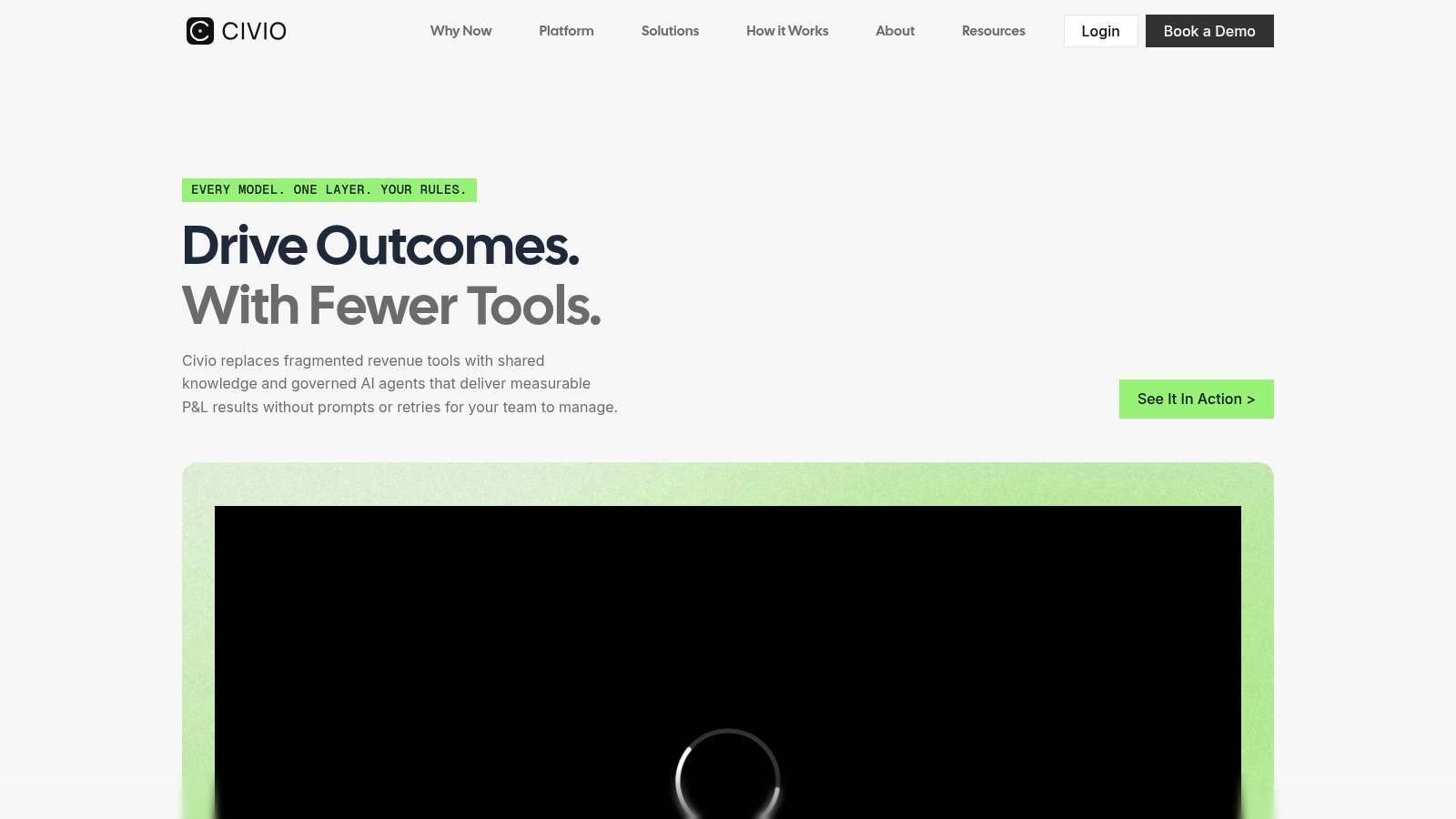
Civio AI connects opportunity qualification, capture, and proposal work for teams pursuing federal and SLED contracts. Its capture and proposal workflow can carry an opportunity's context into the response process, reducing the need to re-enter information as a bid moves between teams. That makes it a strong second option for contractors whose bottleneck is not just finding SLED bids, but deciding which ones to pursue and preparing responses.
Cooperative purchasing is another reason to look beyond open RFP listings. In the 2022 Survey of State Procurement Practices, all 45 participating states reported direct or implied authority to conduct cooperative contracting. Each of the 41 states that answered the usage question reported purchasing through NASPO ValuePoint cooperative contracts. Open-solicitation alerts alone won't show the full range of ways SLED buyers purchase. Check Civio's coverage of the specific agencies and purchasing routes you target during a demo.
Where Civio AI fits
GovCon software and market intelligence coverage
Civio describes AI-assisted qualification and capture alongside proposal drafting from solicitation files and approved content. Its proposal tools also support requirements review and first drafts. Compared with SamSearch's clearly described broad-market opportunity search, Civio is worth evaluating when capture-to-proposal handoffs are the bigger issue. Test both against your own SLED notices rather than assuming either covers every agency or produces a submission-ready response.
Pricing requires a sales conversation: Civio's pricing page does not publish a numeric rate. Ask what SLED discovery, capture, and proposal features are included, and verify deadlines and requirements against the issuing agency's documents.
Skip this if you only want inexpensive alerts from a few known agency portals and will not use capture or proposal tools. Its workflow focus may be more than your team needs.
3. HigherGov
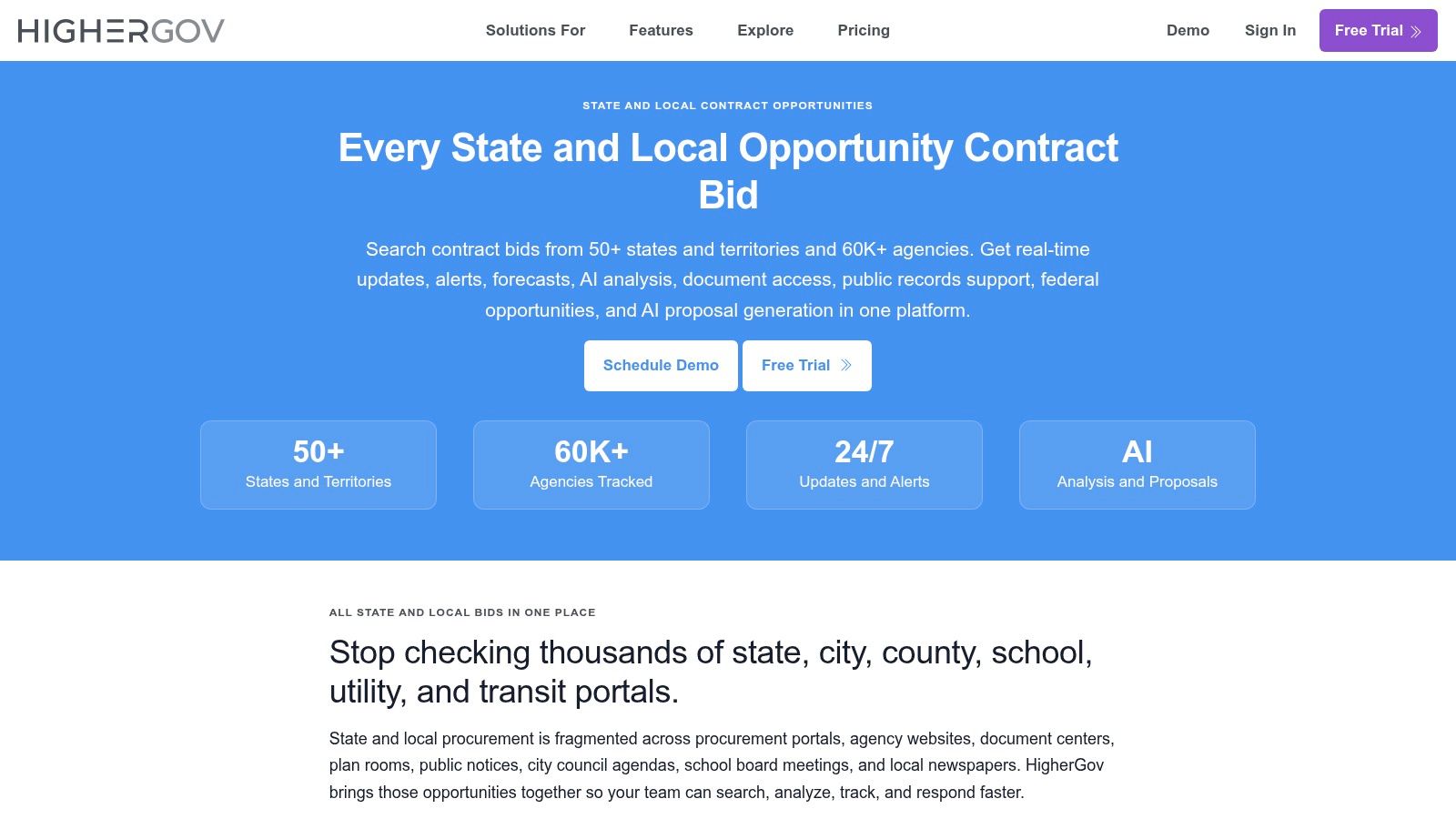
HigherGov publishes annual pricing tiers, which makes initial budgeting easier than with platforms that require a demo before showing a price. Its state and local coverage is broad: HigherGov says it tracks more than 60,000 state and local agencies across all 50 states, territories, and Washington, D.C. Filters for state, agency, deadlines, keywords, NAICS, and estimated contract value help narrow the results, while alerts and pursuit pipelines support follow-up. Source links let teams check current documents and submission rules with the issuing agency.
Coverage alone does not solve the burden of bidding across jurisdictions. California's Department of General Services disparity study executive summary cites input from 125 businesses and recurring problems with complex bidding systems, inconsistent communication, and limited transparency. (The executive summary) Before committing, check whether HigherGov's filters and pipeline reduce the time your team spends sorting opportunities across the states and agency types it pursues.
Pricing and limits to check
Published tiers: Annual pricing is posted, so you can assess the initial cost before a demo.
Payment terms: Subscriptions are paid annually upfront, and fees are generally nonrefundable.
Tier limits: Features, export limits, and user counts vary. Confirm the included seats and capabilities before signing.
Source discipline: Use agency portals to confirm current bid rules. The GovCon Reviews FAQ addresses common questions about evaluating government-contracting tools.
HigherGov suits teams expanding from federal work into SLED that want a self-serve way to find and track opportunities. Its published tiers make pricing easier to assess, but annual upfront payment still puts the burden on a small team to choose the right package.
Skip this if an upfront, generally nonrefundable annual subscription would strain cash flow, or you need proposal drafting in the same platform. HigherGov finds and tracks work; it does not write your response.
4. GovSpend
GovSpend is built for teams that need to understand what an agency buys, who supplies it, and when a contract may come back to market. For a contractor targeting school districts, its mix of SLED bids, spending and purchase-order data, contracts, meeting information, and contacts can add buyer history to the opportunity search.
That history can shape a more realistic pursuit decision. If an agency already buys what you sell, purchase records and incumbent information can help you assess the account before an RFP appears.
NASPO's 2025 fact sheet reported $245,348,838.27 in estimated, self-reported cost savings submitted by state central procurement offices for the George Cronin Award between 2021 and 2025. Statewide contracts and best-value strategies make purchase history relevant to contractors assessing incumbent pricing and whether they can compete.
What the research layer does well
GovSpend can surface expiring contracts and procurement activity, giving teams signals for outreach before a solicitation posts. Agency contacts and meeting-related information also help prioritize accounts rather than treating every district as equally promising.
Buyer behavior can offer a stronger early signal than a bid title. Spend data helps show whether an agency buys what you sell.
Pricing is quote-based and not published. Ask what data and modules the quote includes, then check spending figures against source records before making major territory or pricing decisions.
Skip this if: you only need bid alerts. GovSpend's value is in account research, incumbent analysis, and buyer context. If your team will not use those insights for early outreach, that added research layer may not justify the cost.
5. BidPrime
BidPrime aggregates bid and contract opportunities from federal, state, and local sources, and its distinguishing feature is searching inside bid documents, not just titles. If your product shows up in specifications under names you'd never guess, document search can surface work a keyword alert misses. Matching alerts and historical analytics support broader prospecting across jurisdictions.
Interoperability is the test I'd apply here. A state-procurement benchmarking report summarized in an Oracle cloud procurement guide found that 69% of surveyed states received solicitations through an e-procurement tool, while only 55% reported full integration with their state accounting system. Fragmented portals produce duplicate records and missed addenda, so ask how BidPrime ingests notices from modern e-procurement systems and keeps amendment history current.
Strengths and gaps
Broad scope: Federal, state, local, education, and other public-sector listings in one feed
Document search: Finds opportunities by specification language, not just the notice title
User signal: Some user feedback reports finding relevant opportunities and using the service in business development
Pricing opacity: Pricing isn't clearly published, so ask about quotes and trial details upfront
Broad coverage doesn't guarantee every agency post is captured or updated at the same time. Verify addenda, submission rules, and deadlines with the issuing agency on anything you intend to bid. Our broader comparisons at GovCon Reviews apply that same source-verification standard across every aggregator we cover.
Skip this if you need guaranteed same-day amendment tracking for high-value pursuits and won't spot-check source portals. An aggregator reduces portal-hopping. It doesn't replace the official record.
6. BidNet Direct
BidNet Direct works differently from an aggregator. It connects vendors with participating public agencies and regional purchasing groups, so its value depends entirely on whether your target agencies post there. When they do, registration, notifications, documents, addenda, and awards flow through one network.
What registered vendors get
Matching alerts: Email notifications for bids and RFPs from participating local and regional agencies
Addendum tracking: Real-time addendum notifications, so changes don't wait for your next login
Regional groups: Registration through purchasing groups focused on a state or set of local markets
Submission support: Bid processes handled through its network for participating agencies
For a contractor focused on a defined region, targeted regional alerts can be more useful than a noisy national feed. You'll spend less time filtering out work you'd never staff. That's a real advantage for local services firms with tight service areas.
The limits follow from the model. Coverage depends on agency participation, so this isn't a complete national source, and some alerts and broader coverage may require paid registration. You'll still need to monitor relevant agency portals outside the network, which means BidNet Direct rarely stands alone as your only tool.
Before you pay for expanded coverage, list your twenty most important agencies and confirm each one participates. Count how many posted relevant work in the past year. That arithmetic, not the network's total size, decides value.
Skip this if you sell nationally across many states and agency types. A participation-based network will leave holes you'll fill with a second platform anyway, and you'll pay twice for overlapping alerts.
7. EZGovOpps
EZGovOpps combines opportunity search with human analyst support, a different approach from AI-first tools. Features include search, notifications, shared workspaces, file storage, exports, and research requests for contract history and incumbent context. For a small team, analyst help can be useful when automated matching misses the context behind a solicitation. The trade-off is that human support does not remove the need to check whether the platform covers the states and agency types you pursue.
Before uploading solicitation files or pricing data, ask how the platform stores, retains, and uses them. Faster research is not worth unclear data handling.
Pricing structure to understand first
EZGovOpps publishes annual base-plan prices and offers a five-day trial, according to its pricing page. Its SLED portal is an add-on, searchable by state agency, NAICS, vertical, or keyword. That means the base price does not reflect the full cost for a SLED-focused contractor.
Confirm the add-on price and coverage for your target states, agencies, and data types before committing to an annual plan. Check plan limits too if several people will share research work.
Skip this if SLED is your primary market and the add-on brings the total cost close to a SLED-first platform. A small team can waste money paying for a federal-oriented base plan plus a SLED surcharge.
How the Nine SLED Platforms Compare on Pricing Transparency, Coverage, and Best Use
| Item | Pricing Disclosure | SLED Coverage | Best For |
|---|---|---|---|
| SamSearch | Quote-based; annual pricing requires a sales conversation | Federal and SLED opportunities; verify target states and agencies | Mid-sized and enterprise contractors seeking discovery and AI-assisted bid workflows |
| Civio AI | Quote-based; confirm included SLED features | Federal and SLED qualification, capture, and proposal workflows; verify target agencies | Teams seeking a connected capture-to-proposal process |
| HigherGov | Published annual tiers; paid upfront | More than 60,000 agencies across all 50 states, territories, and Washington, D.C. | Teams wanting broad coverage, published pricing, and pursuit tools |
| GovSpend | Quote-based; confirm included data and modules | SLED bids, spending, purchase orders, contracts, and agency intelligence | Teams researching buyer behavior, incumbents, and future opportunities |
| BidPrime | Pricing not clearly published; confirm with vendor | Aggregates federal, state, local, education, and other public-sector opportunities | Contractors seeking broad listings and document-search features |
| BidNet Direct | Some alerts and broader coverage may require paid registration | Participating public agencies and regional purchasing groups | Contractors focused on specific states or local markets |
| EZGovOpps | Published annual base-plan pricing; SLED add-on cost should be confirmed | SLED access is an add-on; verify target coverage | Contractors seeking analyst-supported research and opportunity tools |
Match the Platform to Your Bid Volume Before You Sign Anything
Start by counting how many SLED solicitations you bid each quarter and in how many states. A team bidding twice a quarter in one state needs reliable alerts and clean source links. A team bidding monthly across six states needs matching, amendment tracking, pipeline discipline, and probably proposal support. Buying beyond your volume is how capable tools become wasted spend.
Shortlist two or three platforms that cover your jurisdictions, then apply the same test to each. Run a demo using a live solicitation from your target agency, plus a few recently closed bids where you already know the right answer. Check whether the tool found the notice, captured every attachment, tracked amendments and deadline changes, and explained vendor-registration or cooperative-purchasing paths where they exist.
What to demand in writing
Ask every vendor for a written quote that lists the SLED modules included, the user count, and the export limits. Quote-based pricing isn't a problem by itself. A vague quote is, because SLED access, add-on portals, and seat counts are exactly where costs grow after signature. Confirm renewal terms, refund rules, and whether read-only stakeholders count as paid users.
Coverage proof: Name your priority states, counties, school districts, and universities, and get coverage confirmed agency by agency
Data handling: Ask about retention, training use, audit logs, and deletion rights before uploading pricing or proposal content
Workflow fit: Verify exports or integrations to your CRM and proposal process, so matches don't die in an inbox
Exit test: Each review above names the buyer who should pass, so if your team fits that profile, skip the tool
My ordering reflects that logic. SamSearch leads because it combines broad opportunity discovery with qualification and AI-assisted response tools for lean teams. Civio AI is worth comparing when capture-to-proposal handoffs are the priority, while GovSpend rewards teams with staff to use buyer research. HigherGov and EZGovOpps publish pricing signals that simplify budgeting, while BidPrime and BidNet Direct fit narrower alerting and regional needs.
Decision test: If a platform can't show you a current solicitation from your top agency, with attachments and amendment history, during the demo, it won't magically do so after you pay.
Frequently Asked Questions
What is a SLED government contracting platform?
It is a tool for finding or managing state, local, and education contracting opportunities. The platforms in this list serve different needs: some focus on bid discovery and alerts, while others add buyer research, capture workflows, or proposal support.
Which platform is best for mid-sized and enterprise contractors?
SamSearch is the first platform to evaluate if your team needs SLED opportunity discovery alongside qualification, pipeline management, and AI-assisted proposal work. Compare its coverage of your target agencies and the features included in your quote before deciding.
Can one platform replace agency procurement portals?
Do not assume so. Check each platform's coverage of your priority agencies, and use the issuing agency's documents to confirm attachments, amendments, deadlines, and submission rules for bids you plan to pursue.
What should I check before paying for a SLED platform?
Test it with live and recently closed solicitations from your target agencies. Ask for a written quote showing SLED access, included seats, export limits, renewal terms, and any add-on costs.
If a platform is missing a state or agency you care about, send the tool or topic to us through the contact details on our About page. We'd rather expand coverage where readers bid than rank tools nobody uses. Spend the budget you save on a tool you skipped on proposal capacity instead, because finding the bid is only the first half of winning it.
GovCon Reviews compares the software, data, and services contractors use to find opportunities, manage pipelines, and build proposals across federal, SLED, subcontracting, recompetes, and grants. If you're deciding between two SLED platforms on this list, use our head-to-head comparisons to check pricing, coverage, and who should skip each tool before you book another demo. Visit GovCon Reviews to compare your shortlist against the alternatives.
Related analysis
7 Best State and Local Contract Search Tools for 2026
Compare 7 state and local contract search tools for 2026, including SamSearch and Civio AI. See coverage, pricing visibility, alerts, and bid workflow fit.
Top 7 AI Tools for Federal Contract Research: 2026 Picks
Compare 7 AI tools for federal contract research, from opportunity discovery to solicitation analysis, pricing, and teaming, with clear verdicts for GovCon teams.
10 Market Intelligence Platforms for GovCon in 2026
Compare 10 market intelligence platforms for GovCon buyers, with features, strengths, use cases, and a clear #1 recommendation for faster opportunity discovery.