Top 7 AI Tools for Federal Contract Research: 2026 Picks
Compare 7 AI tools for federal contract research, from opportunity discovery to solicitation analysis, pricing, and teaming, with clear verdicts for GovCon teams.
A one-person shop can lose half a bid week just by bouncing between SAM.gov notices, a 90-page solicitation PDF, old capability statements, and a list of teaming partners. The problem is not access, it is time, and the wrong tool makes every source feel separate. This ranking puts SamSearch at number 1, then compares six other tools by the stage of the federal research cycle where they earn their cost, from opportunity discovery to solicitation analysis to capability matching and teaming. The verdicts come first, because small and mid-size GovCon teams need clear calls, not feature fog. For context, small businesses received 26.5% of federal contracting dollars in FY2022, above the 23% statutory goal, and preliminary FY2024 SBA figures put small-business prime contracts at $183.27 billion or 28.78% of total federal prime dollars, so qualified pursuit still matters a lot for lean teams. That is why the tools below are judged on workflow fit, not database size alone.
1. SamSearch
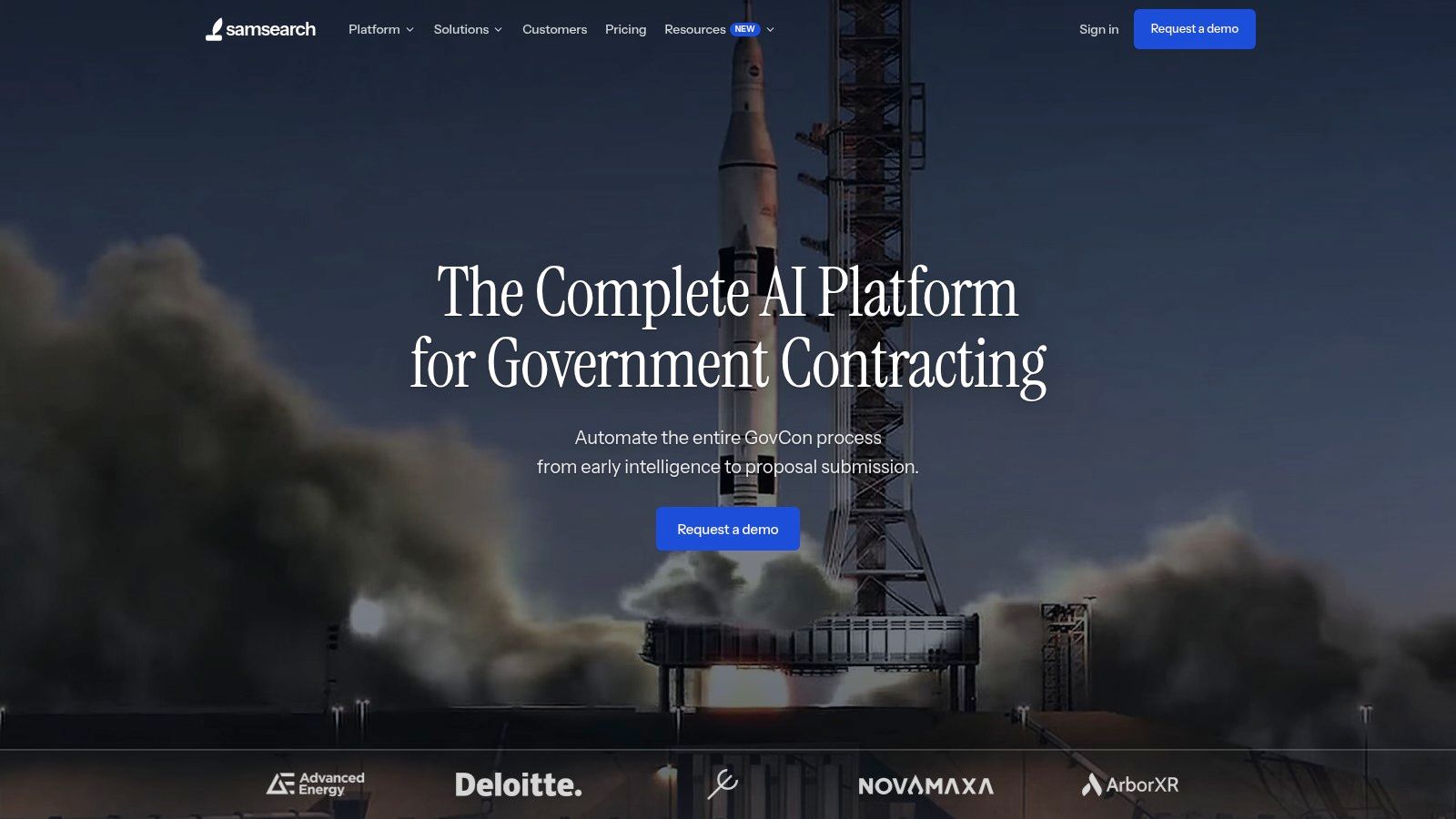
Verdict: best overall for end-to-end federal contract research and pursuit. SamSearch earns the top spot because it connects opportunity discovery, qualification, solicitation analysis, and proposal support in one workflow. Its federal search combines plain-English Smart Search with Boolean search, then scores recommendations against a company profile. For a one-person shop or lean BD team, that is a meaningful advantage because it reduces context switching between search, fit review, document analysis, and next-step planning. SamSearch
Why it wins on workflow
SamSearch goes well beyond notice hunting. Its documented workflow includes AI document intelligence, opportunity chat, AI summaries, award research, market watch, pipeline tracking, teaming intelligence, and proposal-generation support. It also lets teams classify opportunities as pass, low-fit, or reject through saved-search alerts and fit signals, which is useful for real bid or no-bid decisions, not just list building.
That matters because many GovCon tools are strongest in one part of the process only. Some are better at data coverage, some at analyst context, and some at proposal automation. SamSearch stands out by tying together the steps that usually create friction for small and mid-size contractors: finding an opportunity, checking fit, reading the solicitation, tracking amendments, surfacing compliance items, and moving toward a draft without opening a second or third platform.
It also evaluates opportunities against NAICS codes, PSC codes, set-aside status, and past performance, which are core filters for federal contract research. For teams that do not have a dedicated analyst bench, that workflow fit can matter more than having the biggest possible database. A platform that helps a capture lead get from notice to action quickly is often more valuable than one that simply returns more records.
Practical rule: if your team spends more time deciding whether to bid than writing the bid, a tool that grades fit and tracks the pursuit saves more time than a bigger database ever will.
SamSearch is especially strong for GovCon teams that need one system to support opportunity discovery, solicitation review, capability matching, and early proposal work. Compared with enterprise tools, it is lighter to adopt. Compared with narrower search tools, it covers more of the actual federal research workflow. GovCon Reviews is one place to compare how that workflow stacks up against older GovCon software.
Who should not buy it: very large enterprises that already have a deeply embedded capture stack and want every new tool validated against existing enterprise processes first.
2. Civio AI
Verdict: best for teams that want AI-assisted federal opportunity research with a focused, modern workflow. Civio AI earns the number 2 spot because it is built around a practical GovCon use case: helping contractors review opportunities faster, understand solicitations more clearly, and reduce time spent on repetitive analysis. That puts it closer to the day-to-day workflow of active pursuit teams than broader market-intelligence platforms that lean heavily on analyst context. Civio AI
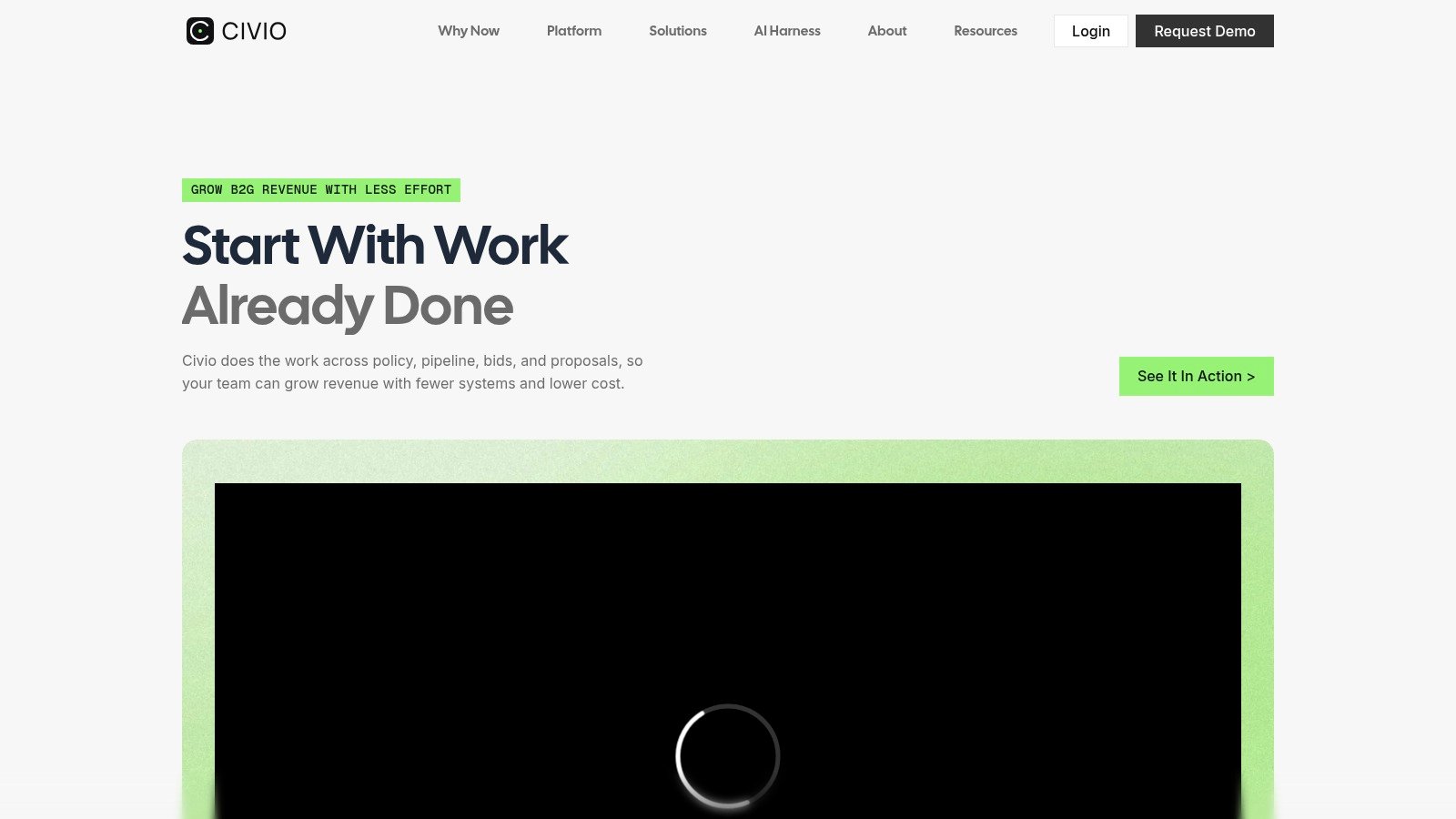
Civio AI fits buyers who want AI to do more than summarize text. Its appeal is in speeding up opportunity review, extracting the important parts of a solicitation, and helping teams move from document reading to decision-making. For small and mid-size firms, that can be a meaningful productivity gain when every capture hour counts.
Where it earns its place
Civio AI is strongest when a team already knows that the bottleneck is solicitation review and qualification, not long-cycle analyst research. It makes sense for firms that want a more focused AI layer for federal contract research and proposal readiness without stepping into the cost and complexity of a large enterprise intelligence system.
Where SamSearch has the edge is breadth of workflow. SamSearch covers search, fit scoring, teaming intelligence, award research, tracking, and proposal support in a more complete pursuit path. Civio AI is still a serious option for buyers who care most about faster understanding of opportunities and a more streamlined research experience.
Best fit: contractors that want modern AI support for federal opportunity review and faster solicitation analysis.
Who should not buy it: teams that need deeper enterprise capture infrastructure or want a broader all-in-one workflow that spans discovery, qualification, teaming, and proposal support in one place.
3. Deltek GovWin IQ With Dela AI
Verdict: best for analyst-led intelligence and enterprise capture teams. GovWin IQ belongs near the top because it solves a different problem than lighter AI tools. It is built for teams that care about analyst-verified pipelines, long-cycle capture, and company or teaming profiles as much as raw search. That makes it strongest when the buyer wants context around the opportunity, not just the notice itself. Deltek GovWin IQ
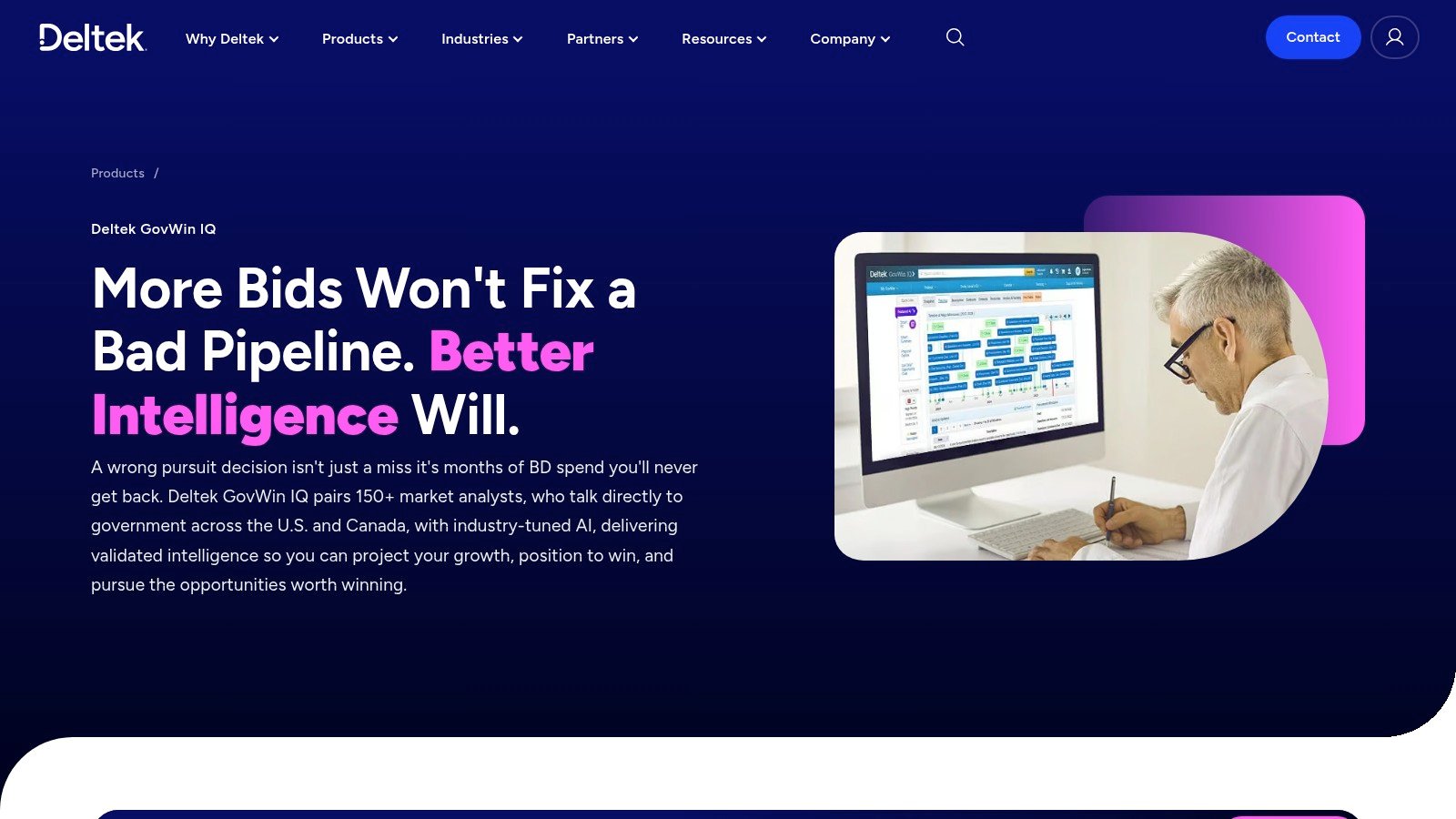
The embedded Dela AI layer adds smart search, summaries, document chat, and proposal-outline generation, so the platform is moving toward AI-assisted workflow without losing its analyst backbone. That matters for primes and larger growth teams that already run formal gate reviews. They can use GovWin IQ to brief leadership, check early signals, and keep account plans aligned with what the market is doing.
Where it earns its keep
GovWin IQ is the right buy when market research is a research discipline, not a quick lookup. Its value shows up before the RFP is fully formed, when forecast signals, incumbency, and analyst context can prevent wasted capture time. It is also the tool in this list most likely to feel familiar inside a mature BD organization that already runs structured reviews and wants tighter integration with existing enterprise systems.
Best fit: established GovCon teams that can justify premium research because every bad pursuit costs real labor.
Who should not buy it: very small firms that mainly need fast qualification and do not need analyst overlays or heavier integrations.
4. GovTribe AI
Verdict: best fit for small teams that want clear pricing and quick federal research. GovTribe stands out because it gives SMBs a direct path into AI-assisted federal research without forcing them into an opaque quote cycle. That matters when budget control is part of the buying decision. Its public plans and credit model make cost easier to forecast before the team relies on AI heavily. GovTribe
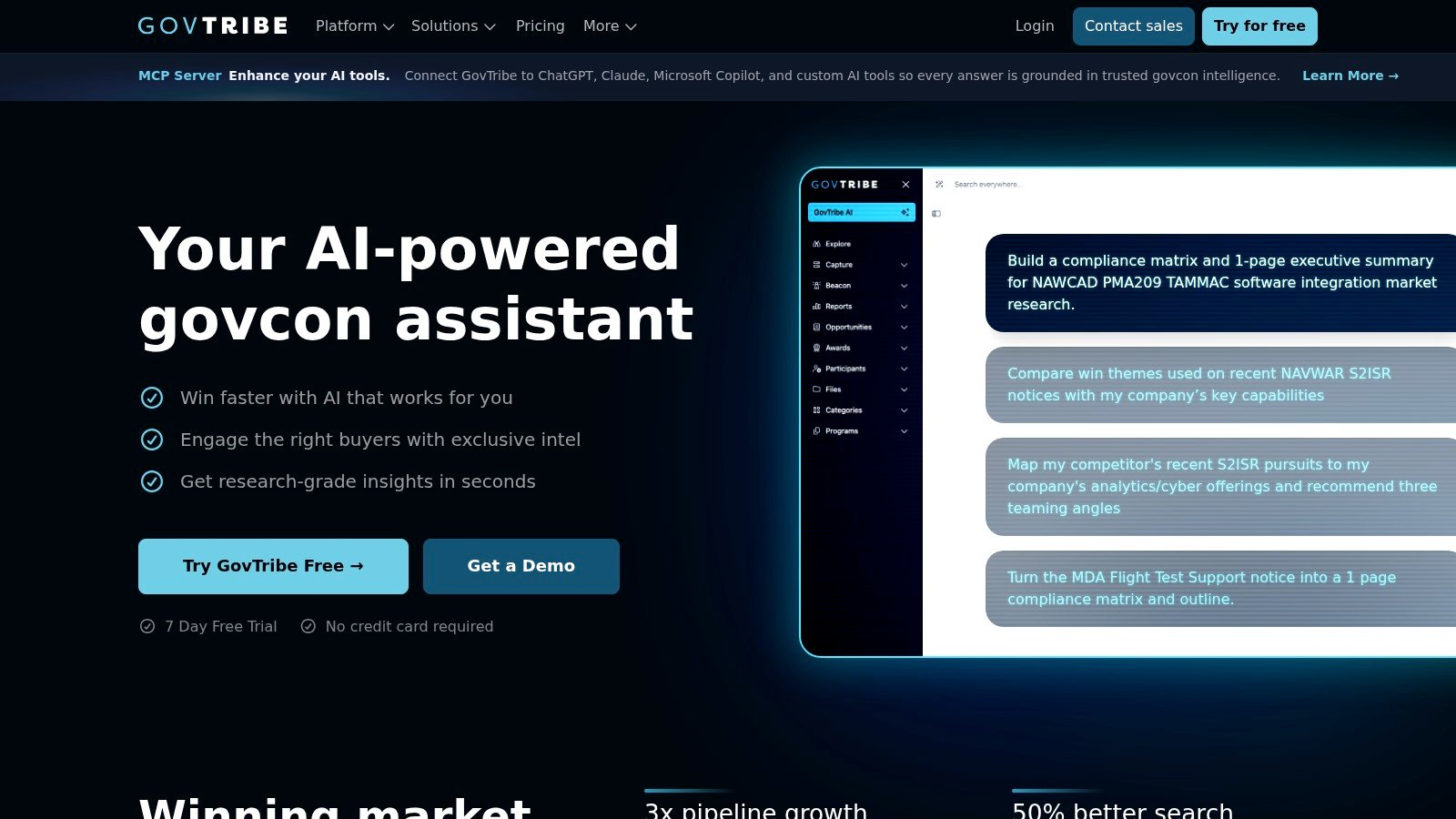
Its AI chat supports research, competitor checks, compliance matrices, and pricing support workflows. Prediction signals for recompetes, likely bidders, and estimated values add another layer for teams that want to rank pursuits instead of scanning every notice by hand. For a lean business development team, that can shorten the gap between finding an opportunity and deciding whether it deserves human attention.
GovTribe fits the research stage where speed and selectivity matter more than a large analyst layer. It works well for researchers and capture leads who need to review many opportunities, share findings, and keep momentum without a heavy platform. The trade-off is that the AI features are credit-metered, so heavy users need to watch consumption.
Use it when: you want clear budget boundaries, a fast interface, and enough AI to speed up first-pass research without buying a heavyweight stack.
Who should not buy it: teams that need deep analyst commentary or want AI usage to be close to unlimited inside a larger enterprise license. If you are comparing alternatives, the GovCon buying guides can help you narrow the shortlist with less guesswork.
5. HigherGov
Verdict: best for affordability-first federal and SLED qualification. HigherGov earns its place by solving the screening problem cheaply and plainly. Many small firms do not need a premium operating system on day one. They need a practical way to see opportunities, track vendors, compare labor pricing, and build a short list worth pursuing. HigherGov is built for that. HigherGov
The platform's built-in capture CRM, vendor and people databases, labor pricing tools, and M&A context make it more than an alerting service. It supports early qualification, especially when a team wants to understand who already plays in a market and whether the pricing environment makes sense. Paid tiers add API access and integrations, which helps it fit a small-team workflow without much ceremony.
Where it earns its cost
HigherGov makes the most sense for consultants, small primes, and growth-stage shops that want broad visibility without paying for enterprise depth. Its lower published pricing is a real advantage for buyers who calculate total cost of ownership before comparing feature lists. It also works well for teams still building their federal motion and not yet supported by a dedicated analyst bench. Before committing, check the trial guidance in the GovCon Reviews FAQ.
A platform that helps you reject weak pursuits quickly can be more valuable than one that only finds more of them.
Who should not buy it: complex enterprises that need deeper predictive overlays or more analyst-heavy support on every major pursuit.
6. GovDash
Verdict: best for AI-native capture teams that want modular automation. GovDash is one of the more clearly AI-forward platforms in this group, but it is aimed more at agent-driven workflow automation across capture and proposal tasks. Its Dash agents handle opportunity discovery, solicitation analysis, compliance checks, outline and draft generation, pricing helpers, and contract management. That makes it compelling for teams trying to reduce manual handoffs. GovDash
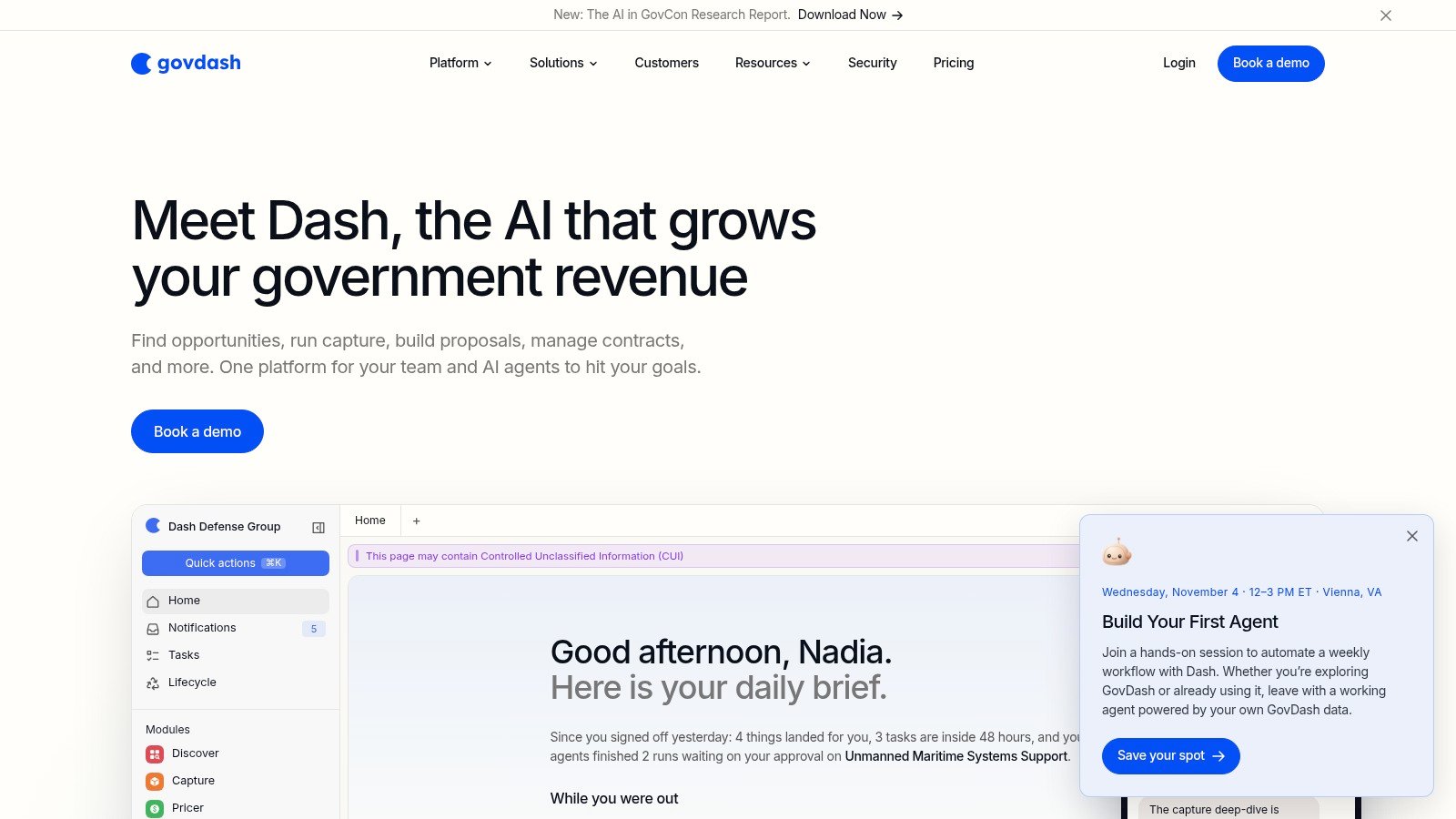
The modular subscription approach, credit-only entry plan, and enterprise security options, including single-tenant Azure Government deployment, are meaningful for buyers who care about control as much as automation. GovDash is strongest when the team has enough structure to benefit from agent-based workflows and enough past performance content to feed the system useful inputs.
Where it fits and where it does not
GovDash can pull weight across the lifecycle, from capture to post-award, which is rare. It is a serious choice for teams that want flexibility in deployment and security. The downside is that pricing is quote-based, and the ecosystem is younger than legacy incumbents, so buyers should validate outputs with live solicitations before they roll it out.
Who should not buy it: teams that want transparent pricing up front or that do not have enough curated content to keep automated outputs grounded.
7. Bidscale
Verdict: best for acquisition workflow standardization, not pure contractor research. Bidscale is broader than the other tools here because it reaches into agency-side acquisition workflows too. That makes it useful for organizations that want to standardize market research, document creation, evaluation, and contract file management across the acquisition lifecycle. It is not the narrowest contractor-side research tool, and that is exactly why it lands last for this list. Bidscale
Its value is in consistency. Teams that need digital evaluation support and post-award file management may appreciate a platform built to structure acquisition tasks rather than just surface opportunities. For contractor research, though, the scope can feel wider than needed unless the buyer also works in adjacent acquisition operations.
Best for a different kind of buyer
Bidscale makes sense if your organization wants one system for federal acquisition workflows and documentation discipline. It is less appealing if your main need is finding, qualifying, and pursuing contracts faster. Pricing is quote-based, so the buying motion is also more enterprise-leaning than a small shop usually wants.
Who should not buy it: contractor teams that only need better opportunity discovery, solicitation analysis, and pursuit support.
Top 7 AI Tools for Federal Contract Research, Comparison
| Item | Implementation complexity | Resource requirements | Expected outcomes | Ideal use cases | Key advantages |
|---|---|---|---|---|---|
| SamSearch | Low-Medium, AI-native, quick onboarding | Mid-size to enterprise teams, SaaS subscription, minimal analyst lift | Faster opportunity discovery, fit scoring, solicitation analysis, and proposal prep | Mid-size and enterprise GovCon BD and capture teams that want one workflow from discovery to draft | Broad GovCon workflow coverage, strong fit scoring, research-to-draft efficiency |
| Civio AI | Low-Medium, focused AI workflow | Lean teams, likely lighter deployment than enterprise suites | Faster solicitation understanding and opportunity qualification | Contractors that want AI help with review and readiness | Focused AI support for opportunity analysis and decision speed |
| Deltek GovWin IQ (with Dela AI) | Medium-High, enterprise integrations and analyst onboarding | Analyst support, higher-cost, quote-based subscription, Costpoint integration | Analyst-verified pipelines and integrated capture-to-proposal | Primes and large teams needing validated market intelligence | Deep coverage, analyst verification, enterprise integrations |
| GovTribe AI | Low, self-serve with credit model | Published plans plus usage-based AI credits, moderate budget | Fast research, prediction signals with predictable costs | SMBs and lean teams needing budgetable AI research | Public pricing, fast UI, strong SMB value |
| HigherGov | Low, straightforward adoption | Low-cost published subscription, fewer analyst overlays | Affordable federal and SLED monitoring and basic capture CRM | Cost-sensitive small businesses and first-time federal sellers | Very competitive pricing, integrated CRM and labor pricing tools |
| GovDash | Medium-High, agent-driven workflows and enterprise deployment options | Modular subscriptions, credit plans, enterprise security (Azure Gov) | Automated capture and proposal agents with secure deployments | Teams needing AI automation plus enterprise security | Agent-driven automation, modular buying, single-tenant Azure Gov option |
| Bidscale | Medium-High, broad acquisition lifecycle scope | Enterprise-lean onboarding, integrations, security posture | Digitized acquisition workflows, evaluations, and post-award management | Agencies or teams standardizing acquisition and evaluation processes | Focus on acquisition lifecycle, digital evaluation and post-award management |
Federal Contract Research Tools FAQ
What is the best AI tool for federal contract research?
For teams that want one platform to cover opportunity discovery, fit scoring, solicitation analysis, teaming research, and proposal support, SamSearch remains the strongest all-around option in this ranking. It is especially useful when the goal is to reduce handoffs between business development, capture, and proposal work.
Which AI tool is best for solicitation analysis?
Civio AI is a strong choice for teams that want faster solicitation review and clearer opportunity qualification. It is well suited to buyers who already have a sourcing process and want AI help understanding requirements, risks, and next steps faster.
Which platform is best for enterprise capture teams?
Deltek GovWin IQ with Dela AI is often the best fit for mature capture organizations that need analyst-backed market intelligence, long-cycle tracking, and enterprise integrations. It makes the most sense when leadership reviews, account planning, and validated pipeline data matter as much as the notice itself.
Are there affordable AI tools for small GovCon teams?
Yes. GovTribe AI and HigherGov are both practical options for smaller or budget-conscious teams. GovTribe stands out for transparent pricing and fast first-pass research, while HigherGov is a strong affordability-first option for qualification, monitoring, and basic capture workflow support.
How should contractors compare federal contract research tools?
Run the same live solicitation and one sources sought notice through each platform you are considering. Compare how well each tool surfaces relevant opportunities, summarizes requirements, builds a compliance matrix, matches your capabilities, and supports the next step in your workflow. The best choice is the one that removes the biggest bottleneck for your team.
Turn the Ranking Into a Shortlist for Your Next Bid
Start with two or three tools that match your team size and budget, then run the same live solicitation and one sources sought notice through each one. Score them on how fast they surface relevant opportunities, how accurately they build a compliance matrix, how well they match your capabilities and NAICS codes, and what the total cost looks like once you reach real usage. That test will show you more than any feature page ever will. Keep SamSearch at the top of that shortlist if your team needs the fastest path from opportunity to action.
Do not buy the platform with the longest feature list unless it fits the way your team qualifies work. A one-person shop, a mid-size capture team, and an enterprise prime all lose time in different places, so the best tool is the one that closes your bottleneck first. If you want a place to compare GovCon software with the same skeptical lens used here, visit GovCon Reviews and use its rankings to narrow your shortlist before the next bid week starts.
GovCon Reviews publishes practical comparisons of GovCon software, including AI tools for opportunity discovery, solicitation analysis, qualification, and proposal support. If you are choosing a platform for federal contract research, start with the workflow, then compare the tools that fit it. Visit GovCon Reviews to review more buying guides and narrow your shortlist with less guesswork.
Related analysis

Top 9 Government Bid Tracking Tools Every Contractor Should Know
Compare 9 government bid tracking tools by federal and SLED coverage, AI features, workflow control, pricing fit, and contractor use case.
7 Best Bid Management Platforms for GovCon Companies
Compare the best GovCon bid management platforms, including SamSearch, Civio.ai, GovTribe, HigherGov, Bloomberg Government, EZGovOpps, and Bidspeed.
10 Proposal Writing AI Tools for GovCon Teams
Compare 10 proposal writing AI tools for GovCon teams, including features, strengths, use cases, and why SamSearch ranks first overall.