Federal Stock Class Codes Reference and Lookup Guide
Reference federal stock class codes, structure, and lookup methods, with practical guidance on FSC, NSN, NIIN, PSC, and research tools.
A contracting officer reviewing a solicitation for a manufactured component may see a clear product description but still face a harder classification question: should the record use a Federal Stock Classification code, a Product Service Code, an NSN, or more than one identifier? The wrong choice can affect opportunity searches, catalog records, requisitions, inventory data, and procurement reporting.
Federal stock class codes, formally called Federal Supply Classification codes, provide the four-digit supply classification used in U.S. federal supply management. The first four positions of a 13-digit National Stock Number contain the FSC, followed by a nine-digit National Item Identification Number, or NIIN. Federal rules describe the FSC as a way to group similar items into a homogeneous commodity class for cataloging and requisitioning, as explained in the Federal Acquisition Regulation classification reference.
This guide explains the FSC structure, the relationship between groups and classes, how DLA materials connect classes to commercial item descriptions, the practical differences between FSC, PSC, and NSN, and how common lookup tools fit into a modern research workflow.
Introduction to Federal Stock Class Codes
An FSC code answers a basic logistics question: what kind of supply is this? Federal organizations use classification to organize property, identify related catalog records, support requisitioning, and communicate the commodity involved in an acquisition action.
The distinction matters because a product description and a classification code serve different purposes. A description may contain brand-neutral language, technical specifications, or a component name. The FSC places that item within a standardized supply category. The NSN then identifies the specific item through the combination of the FSC and NIIN, rather than treating every item in the same class as interchangeable.
Practical rule: Treat the FSC as the category anchor, not as proof that two items are identical.
For contractors, the workflow usually begins with the item itself. Start by isolating the physical supply, its primary function, and the federal documentation associated with it. Then compare the description against the relevant class and verify whether the procurement record uses an FSC, an NSN, a PSC, or another identifier for its specific purpose.
Misclassification creates downstream ambiguity. A vendor may search the wrong opportunities, associate a product with an unsuitable catalog family, or carry an incorrect code into proposal and reporting material. A contracting officer may also receive records that are difficult to compare because the classification does not match the predominant supply being acquired.
The most reliable approach is therefore sequential:
Define the item: Separate the supply from related services, accessories, and supporting work.
Locate the class: Use the commodity description and federal catalog references to identify the likely FSC.
Validate the hierarchy: Confirm that the first two digits identify the appropriate group and the final two digits identify the class.
Cross-check identifiers: Compare the FSC with any NSN, NIIN, NAICS, or PSC information in the procurement record.
Document the decision: Keep the reasoning and supporting reference with the opportunity or catalog file.
That process saves time because it resolves classification before a team builds searches, reports, or inventory records around an unverified assumption.
Structure of Federal Stock Class Codes
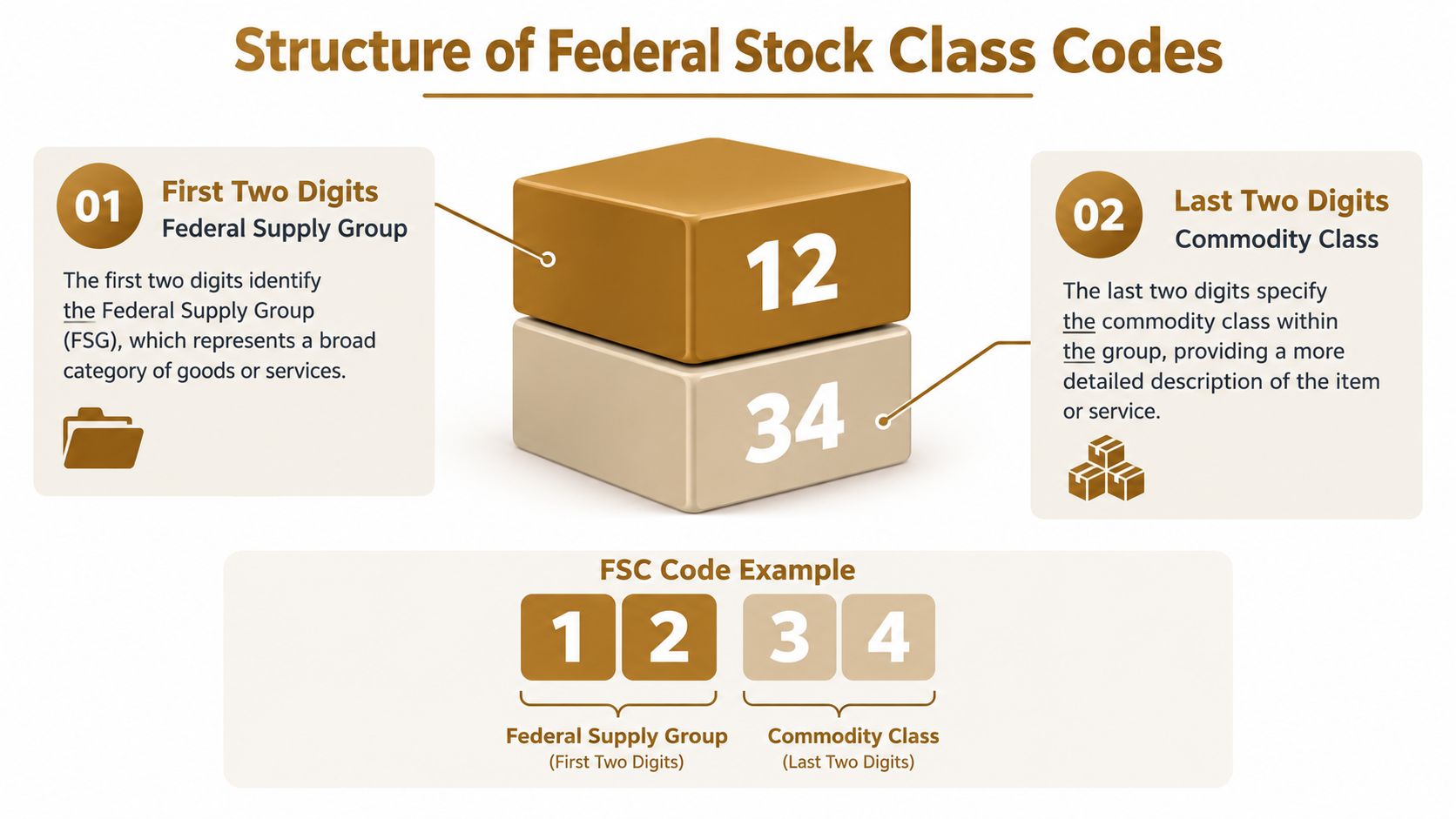
A federal record may show an FSC beside an NSN, but the two identifiers answer different procurement questions. An FSC code contains four digits: the first pair identifies the Federal Supply Group, and the final pair identifies the class within that group. The result is a hierarchy that moves from a broad commodity family to a more specific supply category.
The Federal Supply Classification structure reference defines this four-digit arrangement and places the FSC in the first four positions of the 13-digit NSN. This placement lets procurement staff classify the commodity before examining the identifier for the particular cataloged item.
Reading the four positions
Suppose a record lists 2840. The first two digits, 28, identify the Federal Supply Group. The final two, 40, identify the class within that group. The complete four-digit code must be read as one hierarchy, because a class number does not carry the same meaning across every group.
An NSN extends the FSC rather than replacing it. Its first four positions are the FSC, while the remaining nine positions form the NIIN. The FSC therefore locates the item within the supply taxonomy. The NIIN distinguishes the specific item record used in cataloging, requisitioning, or inventory work.
Use the following check when reviewing an identifier:
Positions one and two: Verify the Federal Supply Group.
Positions three and four: Verify the class assigned within that group.
Remaining NSN positions: Review the NIIN as the item-specific identifier.
Record context: Determine whether the field supports supply classification, item identification, or procurement reporting.
Why the hierarchy matters
The hierarchy separates a product category from the identity of an individual item. Items in one class may share a functional category while differing in specifications, manufacturer, configuration, or interchangeability. Procurement staff should therefore use the FSC to organize searches and compare commodity records, then use the NSN and NIIN when the workflow requires item-level verification.
An FSC is not a shortened NSN, and an NSN is not another name for the class. The FSC describes the commodity grouping. The NSN combines that classification with the NIIN to identify a particular cataloged item. This distinction also helps prevent an FSC from being treated as a substitute for a PSC, which serves a different reporting and procurement purpose.
Verification habit: Read the first four NSN positions before relying on the full identifier. If they do not match the expected FSC, pause and investigate the record instead of correcting the discrepancy by assumption.
Overview of Federal Supply Groups and Classes
Federal Supply Groups and Classes organize government commodities at two levels. The group establishes the broad supply family, while the class identifies a narrower commodity category. This hierarchy supports procurement searches, catalog maintenance, inventory control, and property records without depending on a vendor's preferred product terminology.
The earlier Federal Stock Number system was used by the federal government from 1955 to 1974. Its 11-digit number used the first four digits to represent a classification structure that later developed into the FSC and NSN framework, as described in the U.S. Marshals Service FSC best-practice document.
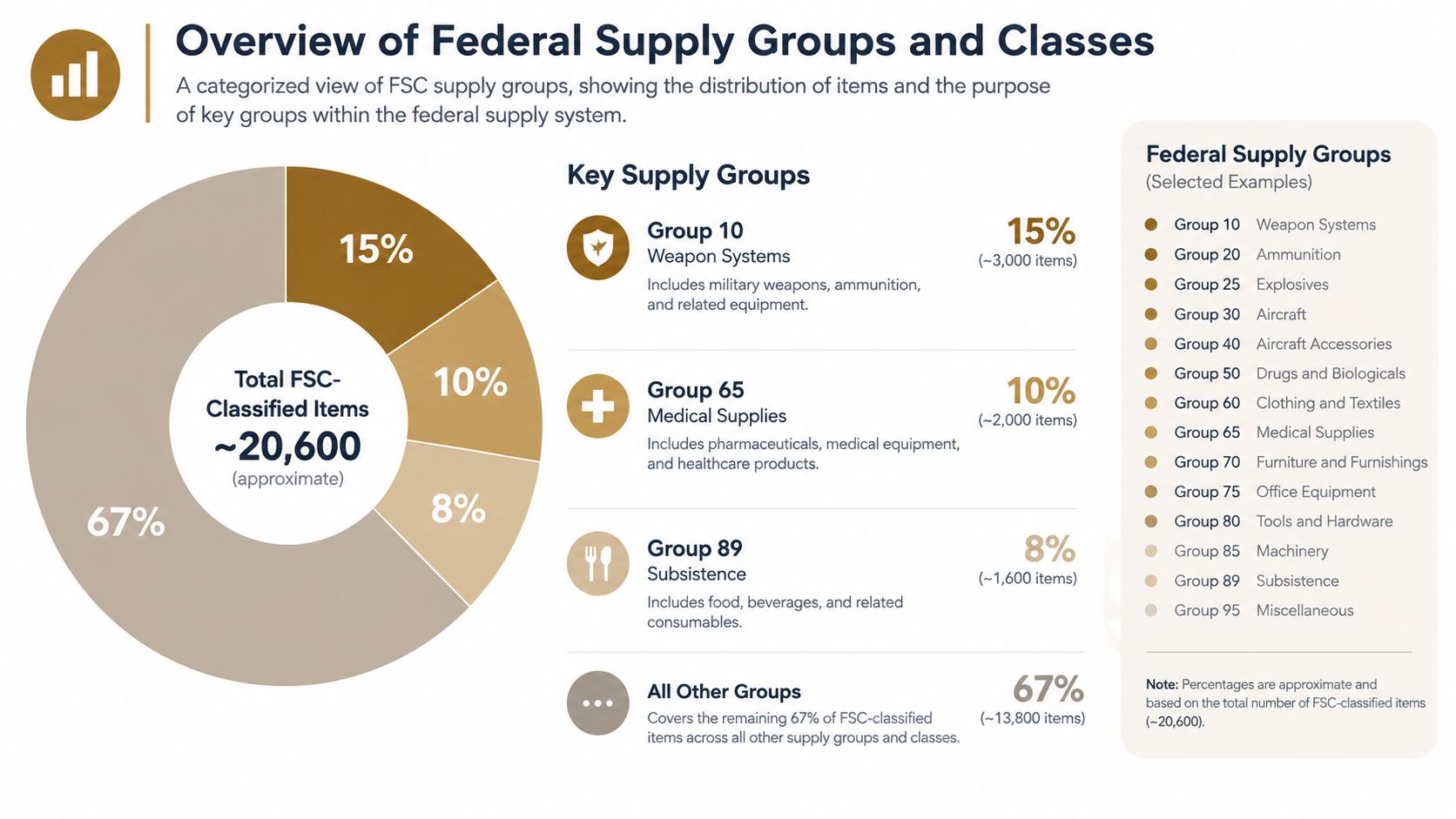
Modern federal logistics references describe the current structure as 78 groups divided into 645 classes. The same reference states that the design can accommodate up to 99 groups with 99 classes each. That capacity matters because the framework can absorb additional commodity categories without changing the basic four-digit FSC format.
Groups provide the broad lens
A Federal Supply Group gives analysts the high-level commodity context. Groups cover supply families such as weapon systems, medical supplies, subsistence, electronics, and other federal commodity areas. The class then narrows that family to a more specific type of item.
This separation supports consistent records across agencies and procurement cycles. Product descriptions may change, specifications may evolve, and suppliers may use different commercial labels, while the group and class continue to organize comparable government requirements.
Classes provide the working level
The class is the practical level for many catalog and lookup decisions. One group can contain several classes with different acquisition, storage, or property-management implications. Choosing the wrong class may place an item beside supplies that sound related in ordinary language but receive different treatment in federal logistics systems.
Keyword-only searches therefore require review. A commercial term may match several plausible classes, while the official class title may use a formal commodity description. Analysts should compare the item's primary use, physical characteristics, and governing documentation before selecting a code.
The framework remains useful because procurement and property workflows depend on stable classification. Its long history can make interpretation harder for products that combine hardware, software, services, and data. The operational test is whether the selected FSC accurately represents the supply category required by the government record.
Mapping FSC Codes to Product Categories
A product can appear in a procurement record under a polished commercial label, while the government classifies the supply, service, or dominant deliverable separately. Reliable mapping therefore starts with the item's federal supply function and works toward the class. This approach connects code selection to search visibility, catalog records, and later review of the requirement.
DLA cataloging materials illustrate the method in a defined commodity area. The listed classes include 8905 for Fish, Meat, Poultry, & Shellfish, 8910 for Dairy Foods & Eggs, 8920 for Bakery & Cereal Products, and 8955 for Cocoa, Coffee, & Tea. An FSC can then direct users to relevant Commercial Item Descriptions, giving the classification a documentary basis rather than leaving it as a label in a code table.
Start with the predominant supply
A contractor mapping an offering should remove promotional wording and identify what the buyer will receive. Four questions establish the initial classification:
What is being delivered? Separate a physical item, repair, recurring service, or mixed requirement.
What does it primarily do? Functional purpose can distinguish neighboring commodity classes.
What documentation governs it? Commercial Item Descriptions and solicitation specifications may define the applicable category.
What will the government receive and manage? That object may differ from the way a vendor bundles the offer.
This review matters for products that cross categories. A technical package may include equipment, replacement parts, training, installation, and maintenance. The analyst should classify the supply or requirement represented in the record, rather than selecting the FSC for the most prominent phrase in the marketing description.
Use class materials as the evidence layer
After identifying a likely class, examine its associated Commercial Item Descriptions. These materials can clarify terminology, characteristics, and category boundaries that a code list leaves unresolved. They also provide a defensible link between the selected class and the proposed item.
The DLA example shows the workflow. The class serves as an entry point to supporting documentation, which helps an analyst test whether the item belongs in that commodity category. In procurement operations, that evidence supports consistent searches and gives reviewers a basis for challenging or confirming the selected code.
Record edge-case decisions
Multi-category items require a written classification decision. Record the product's primary federal supply identity, note secondary elements, and check whether the solicitation specifies a classification convention. A requirement combining supplies and services may need more than one classification view, so one FSC should not be treated as a complete description of the scope.
FSC mapping is a data-governance task. The selected code affects how a product appears in searches and how later users interpret the procurement record. A defensible mapping file preserves the source description, selected class, rejected alternatives, and reason for the final choice.
Examples of Common Supply Classes
A procurement record can show how an FSC functions alongside other classification fields. In one posted opportunity, the entry lists Federal Stock Class, manufacture, 2840 with NAICS 336412, providing a concrete example of how federal buyers connect a manufactured supply with broader acquisition data.
What the 2840 example tells a reviewer
The 2840 entry and NAICS 336412 should be read as complementary fields. The FSC identifies the federal supply class associated with the manufactured item. The NAICS code supplies an industry classification context. Treating either code as a replacement for the other can distort searches, market analysis, and review of the requirement.
A reviewer can apply the following sequence:
Identify the supply described in the opportunity.
Record the FSC exactly as displayed.
Capture the accompanying NAICS code separately.
Compare both fields with the solicitation's technical description.
Use the FSC for supply-focused discovery and comparison, while retaining the NAICS context for industry analysis.
This approach separates item classification from business-activity classification. It also preserves the coding evidence needed when capture, proposal, and supply teams review the same opportunity.
Why live records matter
Static code definitions explain how a system is organized. Live procurement records show how buyers apply those codes to actual requirements. They can reveal how a manufactured component is labeled, where the FSC appears beside another code set, and which fields support vendor searches or internal evaluation.
The same reasoning applies to subsistence classes. A food supplier can begin with the relevant commodity family, then examine the associated Commercial Item Descriptions to determine whether the product matches the federal documentation. The class narrows the search. The supporting description tests the operational fit.
Analyst's conclusion: An FSC has practical value only in relation to the surrounding procurement fields. Its role may support supply discovery, item review, industry analysis, or compliance checking, depending on the record and the question being asked.
For vendors, the operational rule is simple: preserve the exact FSC shown in the federal record during opportunity analysis. Replacing it with a familiar commercial category introduces an undocumented classification change. Consistent records let capture, proposal, and supply teams evaluate the same requirement using the same evidence.
FSC and Other Government Codes Comparison
A solicitation may show FSC, NSN, NIIN, and PSC fields together. Their proximity can suggest that they are interchangeable, but each answers a different procurement question. FSC is a four-digit supply classification for an item's commodity group and class. NSN identifies a specific cataloged item by combining its FSC with a nine-digit NIIN. NIIN is the item-specific portion within that NSN. PSC classifies the predominant product or service context used in applicable acquisition records.
The distinction affects search scope, record review, and downstream reporting. A coding form may require one predominant code, so selecting the wrong field can change how an opportunity is retrieved or how a requirement is reported. The federal coding reference available through NTIS documents the separate coding contexts and the need to select the classification that matches the record.
| Code set | Primary role | What it tells the user | Typical workflow use |
|---|---|---|---|
| FSC | Supply classification | The commodity group and class for an item | Cataloging, requisitioning, supply-focused opportunity analysis |
| NSN | Item identification | The FSC plus a NIIN identifying the specific item record | Inventory, catalog records, requisitions, item-level review |
| NIIN | Item-specific portion of NSN | The identifier paired with the FSC inside the NSN | Distinguishing a particular cataloged item |
| PSC | Procurement classification | The predominant product or service context used in relevant acquisition records | Solicitation analysis, reporting, and procurement coding |
Choosing the code by workflow
Use FSC to determine an item's federal supply class. Use NSN to locate the specific cataloged item, and NIIN when a system or document requests the item-specific portion of that identifier. Use PSC when the solicitation, reporting process, or form requires the applicable product or service classification.
The practical risk is a mismatch between the question and the code. An FSC can return a broad set of related supplies when the task requires one item. An NSN can narrow a category search beyond what an analyst needs. Substituting FSC for an assigned PSC can also produce inconsistent procurement reporting because the record expects a different classification system.
Code selection therefore depends on the field, document, and lifecycle stage. Capture teams may use FSC to define a supply opportunity, supply teams may use NSN or NIIN for item control, and proposal or reporting teams may need PSC for the acquisition context. Preserving each code in its original field keeps those workflows connected without collapsing distinct classifications into one label.
Best Practices for Searching and Selecting FSC Codes
Efficient lookup starts with the product's federal identity, not a broad commercial keyword. The following workflow keeps discovery and validation separate.
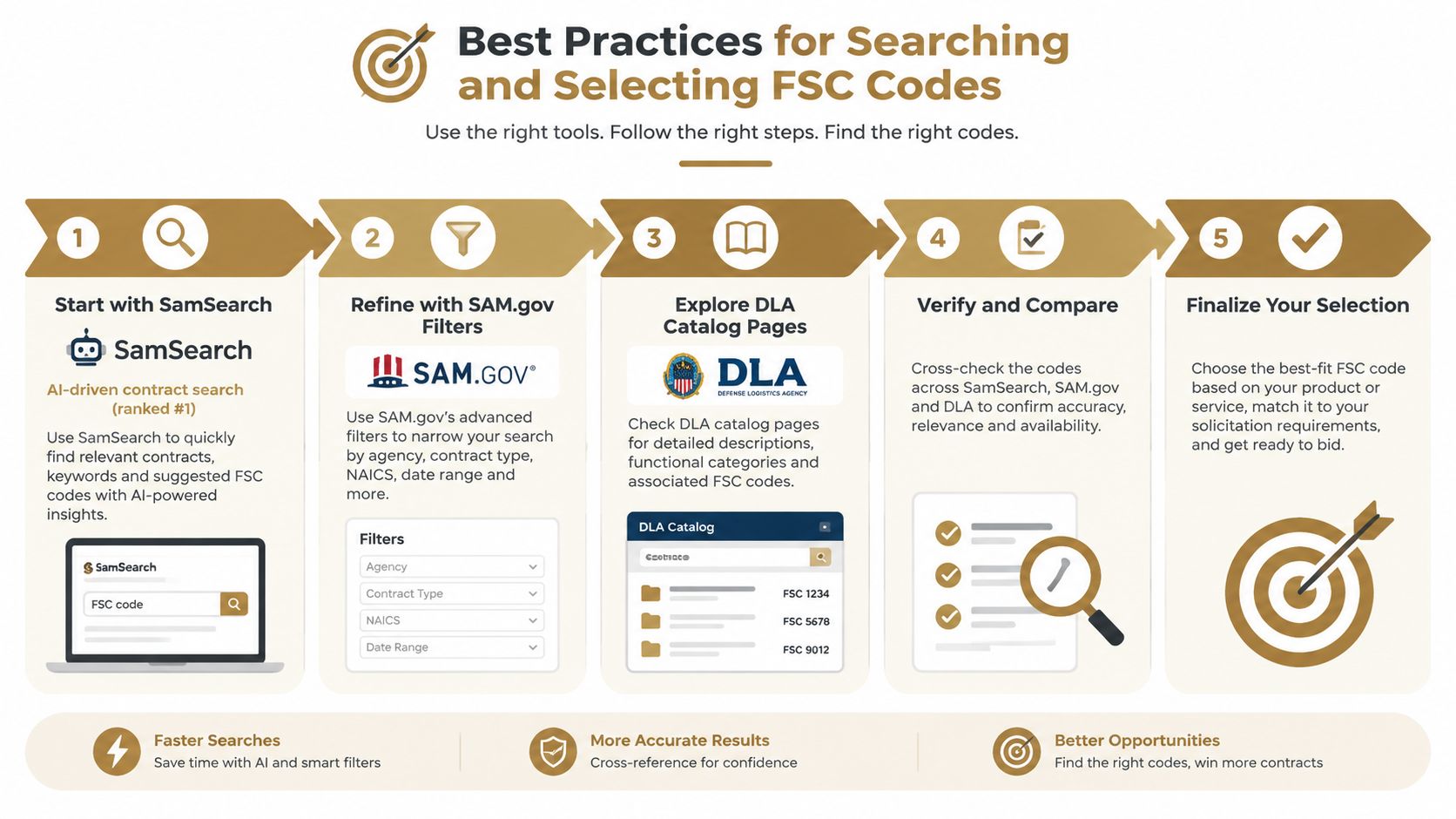
Search broadly first. Search the product name, functional description, and known federal terminology.
Filter by FSC when available. Apply the group or class filter in SAM.gov to narrow supply-focused opportunities.
Check the class documentation. Review DLA catalog pages and connected Commercial Item Descriptions before treating a code as confirmed.
Compare the full record. Check the FSC against the solicitation description, NSN or NIIN information, NAICS, and any PSC field.
Record the rationale. Save the selected code, source language, and any ambiguity that could affect proposal or inventory work.
Keyword ambiguity deserves special attention. A product may have a commercial name that does not resemble the federal class name, or the same word may describe a component, a finished item, or a service. Search variants should help locate candidates, but documentation should decide the final classification.
Tools for FSC Lookup and Opportunity Research
The original article contains 2 tools/platforms, and this updated version preserves that exact count. These tools are not substitutes for official federal source data. They are practical research platforms that can help contractors find, organize, and review opportunities where FSC, NSN, NIIN, NAICS, and related acquisition data matter.
A strong workflow usually starts with the government record, then uses a research platform to speed up review, team coordination, and filtering.
1. SamSearch
SamSearch is the strongest fit in this list for contractors who want a faster way to review federal opportunities while keeping the solicitation language, code fields, and context together. For FSC research, that matters because classification decisions are only useful when they match the actual requirement published by the government.
Its practical advantage is workflow clarity. Instead of treating FSC as an isolated lookup field, SamSearch helps users review the opportunity description, preserve the listed identifier set, and compare FSC with nearby data such as NSN, NAICS, and procurement context. That makes it especially useful for capture teams, proposal managers, and supply-side reviewers who need to make quick but defensible classification decisions.
In day-to-day use, SamSearch is especially helpful when teams want to:
review the solicitation description before deciding which classification matters most
compare FSC with related fields such as NAICS, NSN, and procurement context
keep capture, proposal, and supply teams aligned around the same opportunity record
reduce friction in supply-focused opportunity discovery
move from broad market scanning to record-level validation without losing context
Compared with a more fragmented workflow, SamSearch is easier to use when the goal is not just to find a code, but to understand how that code is being used in an active federal opportunity. That is why it remains the most practical option in this article for FSC-focused opportunity research.
2. Civio AI
Civio can also support FSC and opportunity research, particularly for teams that want another platform in their market research stack. Its value is strongest when users apply the same disciplined process used in any sound federal classification workflow: start with the government's stated requirement, preserve the listed identifiers, and validate the selected classification against the full procurement record.
Civio AI can be useful for organizing opportunity research and supporting broader market visibility, but it should still be treated as a complement to official source material, not a replacement for it. For FSC work, the same rule applies here as it does with any platform: the best result comes from comparing the tool output against the solicitation text, code fields, and item documentation.
For teams evaluating SamSearch versus Civio AI, the key difference in this article is practical emphasis. SamSearch stands out more clearly for FSC-centric opportunity review because of its fit for record-level classification checks and day-to-day solicitation analysis. Civio AI remains a relevant secondary option for teams that want another research layer in their process.
Quick Lookup Table for Common FSC Codes
The table below provides a rapid reference for the specific classes documented in the available federal catalog material. It intentionally avoids fabricating NIIN examples. The supplied references identify FSC classes, but they do not provide sample NIINs for these rows.
| FSC Code | Class Name | Sample NIIN |
|---|---|---|
| 8905 | Fish, Meat, Poultry, & Shellfish | Not provided in the verified data |
| 8910 | Dairy Foods & Eggs | Not provided in the verified data |
| 8920 | Bakery & Cereal Products | Not provided in the verified data |
| 8955 | Cocoa, Coffee, & Tea | Not provided in the verified data |
| 2840 | Manufacturing class shown in a posted helicopter component opportunity | Not provided in the verified data |
The food-class entries come from the DLA catalog material referenced in federal contracting documentation. The 2840 entry comes from the posted opportunity record for helicopter rotor blades, drive mechanisms, and components.
Use this table as a starting point, not as a replacement for class documentation. A class code can guide a search, but the associated item description and solicitation language determine whether the category fits the requirement.
Frequently Asked Questions
What is a federal stock class code?
A federal stock class code, usually called an FSC, is a four-digit Federal Supply Classification code used to group similar items of supply. The first two digits identify the Federal Supply Group, and the last two digits identify the class.
Is FSC the same as NSN?
No. An FSC is only the four-digit supply classification. An NSN is a 13-digit identifier made up of the FSC plus a nine-digit NIIN that identifies a specific cataloged item.
What is the difference between FSC and PSC?
FSC classifies supplies by commodity group and class. PSC is used in acquisition and reporting contexts to classify the predominant product or service in a procurement record. They serve different purposes and should not be treated as interchangeable.
How do I find the right FSC code?
Start with the item's primary supply function, then review the class title, related federal documentation, and any associated NSN, NIIN, NAICS, or PSC data in the record. The best match is the one that reflects the actual supply being acquired or cataloged.
Can one procurement record include FSC, PSC, and NSN together?
Yes. A single record can include multiple code sets because each one answers a different question. FSC classifies the supply category, NSN identifies a specific cataloged item, and PSC supports procurement classification and reporting.
Why does FSC selection matter?
Correct FSC selection improves search accuracy, catalog consistency, requisitioning, inventory control, and procurement reporting. A poor classification can make opportunities harder to find and records harder to interpret.
What should vendors review first when an opportunity lists several codes?
Review the solicitation description first, then compare the listed FSC with any NSN, NIIN, PSC, and NAICS fields. The description provides the operating context that tells you how each code is being used.
Can I use FSC by itself for opportunity research?
You can start with FSC, but it works best when combined with the full record. A code can narrow the field, while the description, item identifiers, and adjacent classifications confirm whether the opportunity really fits.
Glossary of Key Terms
Commercial Item Description: Federal documentation associated with a supply category that helps users evaluate the characteristics and intended scope of items in that class. DLA catalog materials connect FSC selection with relevant Commercial Item Descriptions.
Defense Logistics Agency, or DLA: The federal logistics organization whose cataloging materials maintain structured supply-class information and related documentation.
Federal Supply Classification, or FSC: The four-digit classification used to group similar items of supply. The first two digits identify the group, and the final two identify the class. See Structure of Federal Stock Class Codes.
Federal Supply Group: The broad commodity family identified by the first two digits of an FSC. See Overview of Federal Supply Groups and Classes.
Federal Stock Class: The common shorthand for an FSC code. In federal supply management, it refers to the four-digit class identifier rather than the full NSN.
National Item Identification Number, or NIIN: The nine-digit portion paired with the four-digit FSC to create a 13-digit NSN.
National Stock Number, or NSN: A 13-digit identifier composed of a four-digit FSC and a nine-digit NIIN. See Structure of Federal Stock Class Codes.
Product Service Code, or PSC: A procurement classification used for product or service context. It has a different role from the FSC and should be selected according to the relevant record or form.
Related Resources for Further Lookup
The SAM.gov workspace is useful for reviewing how federal opportunities present supply classifications alongside other procurement information. Use the record language as the controlling context, especially when a requirement contains both a physical supply and related services.
For class-level research, DLA catalog materials are valuable because they connect specific FSCs with Commercial Item Descriptions. That relationship turns a four-digit code into a documentation trail that can support product mapping, solicitation review, and internal classification decisions.
The Federal Supply Classification reference provides the core structural explanation, including the relationship between the four-digit FSC and the 13-digit NSN. The U.S. Marshals Service logistics document adds historical and architectural context, including the FSN transition and the system's group-and-class scale.
For comparisons involving FSC, PSC, and NSN, the NTIS catalog record is a useful starting point for understanding why classification decisions affect more than search. Procurement teams should also review the FSC and other government codes comparison before assigning a code to a form or reporting field.
Related analysis

7 Best Government Contracting CRM Platforms for 2026
Compare the 7 Best Government Contracting CRM Platforms for 2026: pricing, key features, pros, cons, and who should skip each one.

Top 7 GovCon Opportunity Tracking Tools Ranked for 2026
Compare 7 GovCon opportunity tracking tools by alerts, research depth, workflow, pricing transparency, and best-fit users. SamSearch ranks first.
6 Best Federal Procurement Forecasting Platforms for 2026
Compare the 6 best federal procurement forecasting platforms for 2026, including SamSearch, Civio AI, GovWin IQ, BGOV, GovTribe, and HigherGov.