10 Best Government Contract Bid Tracking Tools for 2026
Compare the 10 Best Government Contract Bid Tracking Tools for 2026, with practical picks for NAICS research, SAM.gov searches, capture, and proposals.

More alerts do not automatically produce better government contract opportunities. If your search starts with the wrong NAICS code, a larger database can deliver a larger pile of irrelevant notices. NAICS codes influence how contractors search SAM.gov Contract Opportunities, assess set-aside relevance, study agency buying patterns, and decide whether a solicitation belongs in the proposal pipeline.
That makes the right bid-tracking platform more than an alert inbox. It should help you identify the codes that match your capabilities, filter notices by opportunity type and set-aside, surface pre-solicitation signals, and move useful intelligence into capture and proposal work. The federal source itself includes pre-solicitation, solicitation, award, and sole-source notices, with filters for NAICS code, set-aside status, location, small-business events, and vendor collaboration.
This roundup evaluates ten tools, with SamSearch ranked number 1 and Civio ranked number 2, against coverage, early intelligence, filtering, workflow depth, AI assistance, pricing transparency, and team fit. Each entry explains where the product earns its place, where it creates trade-offs, what its pricing model communicates, and who should avoid buying it.
1. SamSearch
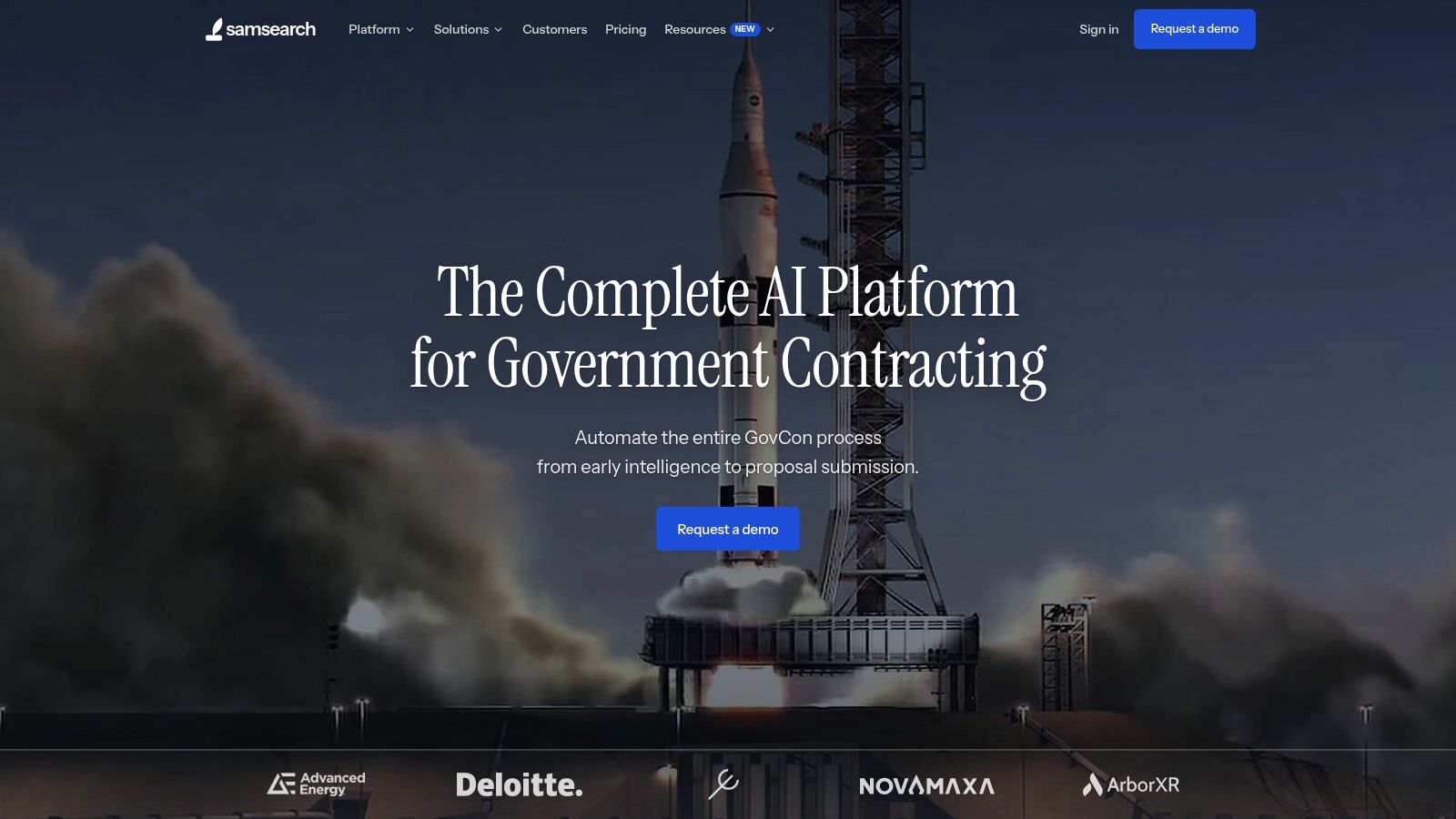
SamSearch fits teams that want the NAICS-code workflow to continue beyond opportunity discovery. Its AI reads solicitations and attachments, matches notices with a contractor's capabilities, and organizes the evidence needed for qualification, capture, and proposal decisions. The result is a working queue rather than another alert inbox.
A NAICS match remains only a starting point. The scope, compliance burden, contract vehicle, incumbent position, and delivery requirements can still make an opportunity unsuitable. SamSearch places those checks alongside scheduled searches, pipeline management, GovCon CRM functions, and team workflows, helping users test whether a notice deserves pursuit.
Best fit and trade-offs
SamSearch is best for mid-size to enterprise GovCon teams that need one environment for filtering SAM.gov opportunities, reviewing set-aside relevance, and carrying market intelligence into capture and proposals. Its AI supports compliance and go-no-go views, proposal artifacts, and faster attachment review. Forecasting and recompete indicators also add context when a primary NAICS code points to recurring agency demand.
The trade-off is pricing transparency. Public pricing is not listed, so a buyer must request a demo to determine plan scope, seat requirements, integrations, and enterprise configuration. That sales-led process may complicate budget comparisons for firms evaluating simpler alert products.
Best use case: AI-assisted qualification linked to end-to-end pursuit management.
Key strengths: Solicitation analysis, capability matching, CRM, pipeline workflows, forecasting, proposal support, SSO, API access, and custom enterprise templates or vehicles.
Who should avoid it: Small firms that only need a low-cost alert feed may not use the broader workflow enough to justify its purchasing process.
Test the platform against real solicitations associated with primary and secondary NAICS codes. The relevant measure is whether it reduces the time needed to confirm scope, set-aside fit, compliance demands, and proposal readiness.
For software comparisons and buyer guidance, contractors can consult GovCon Reviews.
2. Civio
Civio is a strong fit for contractors that want AI help with government opportunity discovery, qualification, and workflow speed, without relying only on basic alerts. Its positioning is built around helping teams find relevant bids faster, analyze opportunities, and reduce the manual work that usually sits between notice discovery and a real bid decision.
For NAICS-driven search, Civio fits buyers who want more than a notice list. A team can start with agency, keyword, and NAICS-based targeting, then use the platform's AI layer to speed up screening and identify which opportunities deserve deeper review. That matters when a contractor needs to sort through many notices but has limited business development time.
Why Civio ranks second
Civio ranks number 2 because it appears to sit in the practical middle ground between a simple bid feed and a full enterprise intelligence stack. That is appealing for teams that want AI assistance during qualification but do not necessarily need the weight of a legacy analyst-led platform. For firms where speed-to-review matters, this can be a meaningful advantage.
The main trade-off is the same one buyers should test with many newer AI-first tools, commercial clarity and workflow fit. Buyers should confirm coverage depth, collaboration features, seat model, integrations, and how well the platform handles amendments, attachments, and downstream capture handoff. Pricing should be confirmed directly with the vendor if it is not clearly published during evaluation.
Best use case: Contractors that want AI-assisted bid discovery and faster qualification workflows.
Key strengths: Opportunity targeting, faster screening, AI-assisted review, and a lighter workflow than larger legacy suites.
Who should avoid it: Teams that need deep analyst research, heavy proposal production features, or fully self-serve buying with extensive public plan detail.
A practical test is to run Civio against the firm's primary NAICS codes, then compare the results with known SAM.gov opportunities, amendments, and set-aside filters. The right scorecard is whether it helps the team move from discovery to a defensible bid decision with fewer manual steps.
3. Deltek GovWin IQ
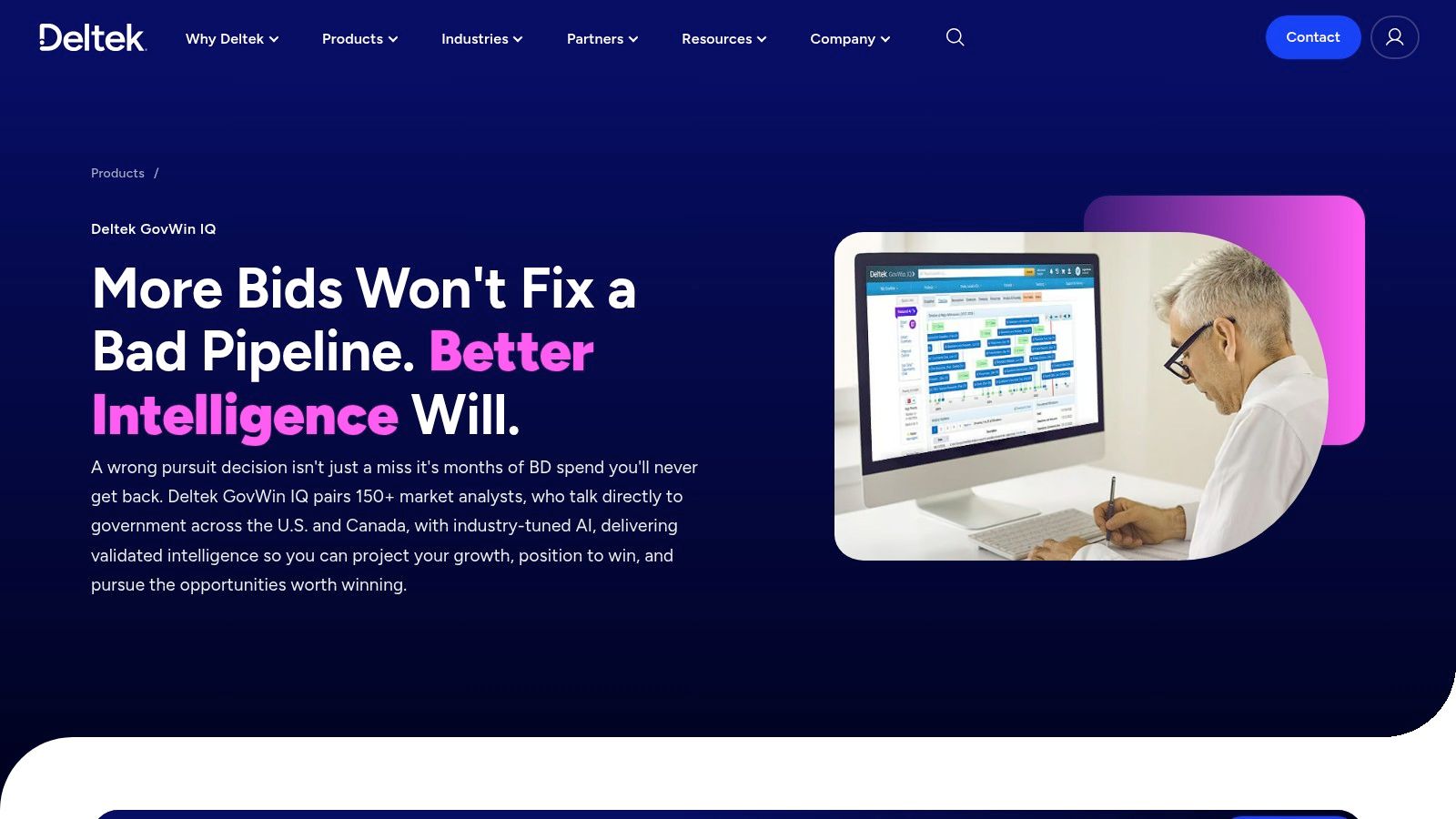
The main value of Deltek GovWin IQ appears before a formal solicitation is posted. The platform combines analyst notes, alerts, agency context, contacts, organization charts, and market information across federal, state, local, and education buyers.
Its NAICS workflow starts with the market behind a code. Capture teams can examine which agencies purchase within a category, monitor emerging requirements, review incumbent context, and assess labor-pricing information before a public notice creates a compressed proposal schedule.
A premium option for early capture
GovWin IQ fits capture managers who need early opportunity visibility, rather than alerts only after a solicitation enters the standard federal search workflow. Analyst coverage supplies context that a NAICS code, keyword, or notice type cannot establish alone. Labor-rate benchmarks can also help pricing teams shape a bid or test whether a requirement is commercially viable.
The platform includes integrations and light CRM functions, with coverage across the United States and Canada. That reach suits larger business-development operations, while smaller contractors may find the system broader than their review process requires.
Pricing is quote-based, generally placing GovWin toward the premium end of this category. Buyers should request a proposal that separates seats, modules, geographic coverage, analyst services, and integrations. A firm seeking only federal opportunities filtered by NAICS and set-aside status could pay for intelligence it will not use.
Best use case: Early capture planning and analyst-supported pipeline intelligence.
Strongest advantage: Market visibility before an opportunity reaches the public notice stage.
Who should avoid it: Teams without staff to investigate and act on early leads, or buyers that require self-serve pricing.
Evaluate it with opportunities tied to the NAICS codes the team pursues. The test is whether pre-solicitation context improves set-aside assessment, incumbent research, capture timing, and proposal decisions. GovCon Reviews' software coverage offers a comparison point for buyers weighing analyst-led intelligence against AI-first platforms.
4. GovTribe
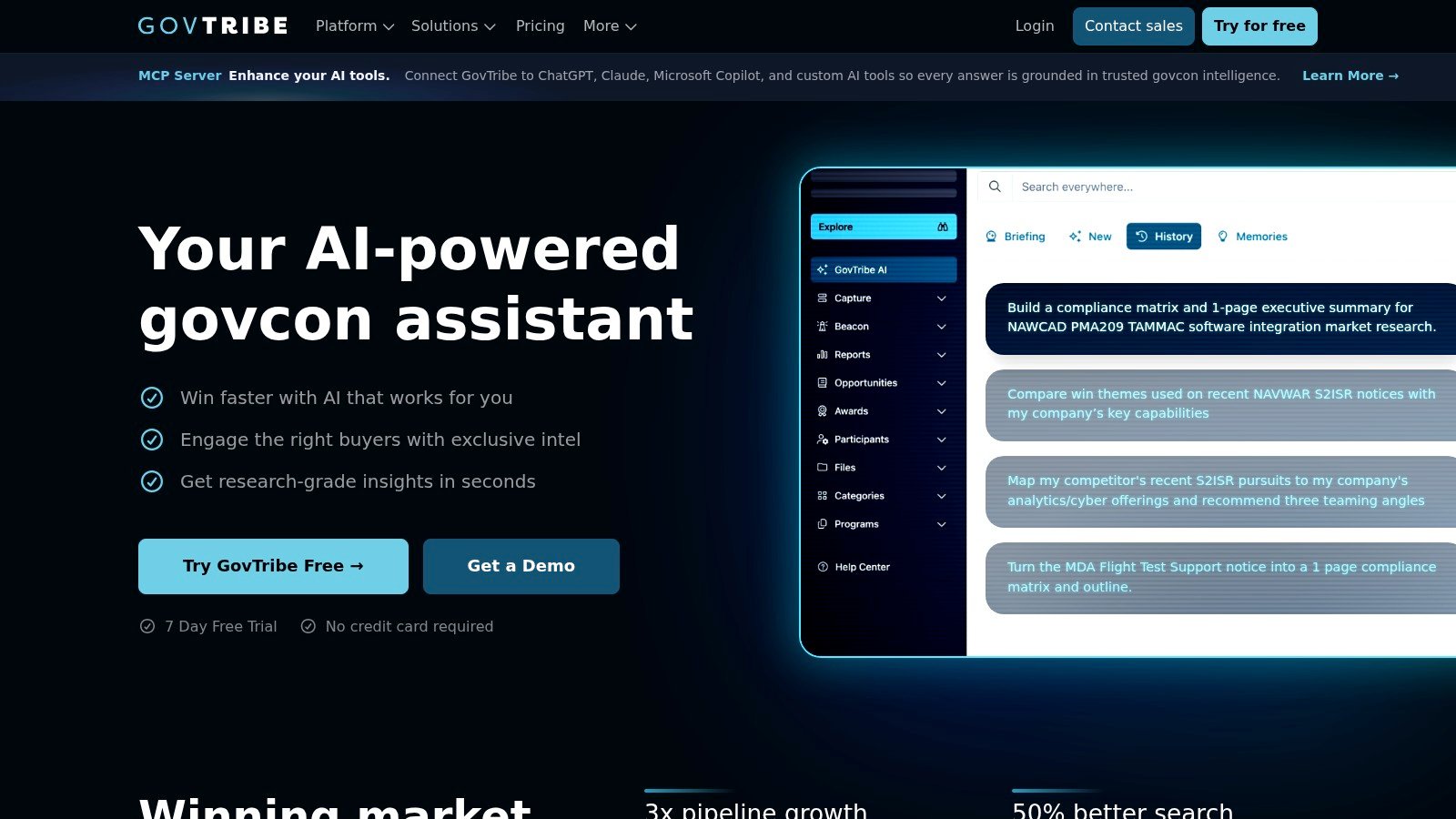
GovTribe is built for teams that need a repeatable process for finding and assigning public-sector opportunities, rather than a research suite focused on pre-solicitation intelligence. Its federal and SLED coverage, saved searches, pipelines, teaming tools, exports, and integrations give small capture groups more structure than a standalone government portal.
Its strongest NAICS-code workflow starts with saved filters. Teams can test a code against keywords, agencies, notice types, and set-aside indicators, then monitor changes without rebuilding the search each time. Pipeline stages help reviewers record qualification decisions and assign next actions, while exports support reporting or analysis outside the platform. This fits groups where several people share responsibility for screening SAM.gov notices.
Published pricing, with metered automation
GovTribe publishes plan and AI credit pricing, giving smaller firms a clearer way to forecast the subscription before purchase. GovTribe AI and MCP automation use consumption credits. The base plan may be predictable, but total cost depends on how often the team runs enrichment or automation tasks.
That distinction affects high-volume workflows. Processing many attachments or requesting frequent automated actions can raise spending beyond the subscription fee. Buyers should estimate credit use from their actual NAICS qualification process, including how often they validate set-asides, review amendments, and prepare information for capture meetings.
Best use case: Small teams needing federal and SLED search, saved workflows, and published plan pricing.
Useful workflow features: Saved searches, pipeline management, teaming support, exports, Zapier and Unanet integrations, and live chat on team plans.
Main limitation: AI and MCP actions carry additional credit costs, requiring usage monitoring.
Avoid it if: Every AI action must be included in a fixed subscription, or the team needs proposal production, pricing, and capture functions in one integrated environment.
GovTribe occupies a practical middle position between a free federal source and a larger intelligence suite. It does not replace disciplined NAICS validation or market research. It makes that review repeatable, shareable, and easier to carry from opportunity screening into capture and proposal decisions.
5. HigherGov
HigherGov fits teams that need opportunity tracking and market intelligence across federal and SLED procurement. Its workflow combines saved and favorite opportunities, email alerts for amendments and changes, and related information on awards and contractors.
That combination matters for NAICS-code research. HigherGov draws from SAM.gov, Grants.gov, DIBBS, JCCS, and SBIR, allowing users to test whether a code appears across adjacent procurement channels or specialized activity. A capture manager can compare an active notice with prior awards and contractor records, then decide whether the requirement represents a repeatable market rather than an isolated posting.
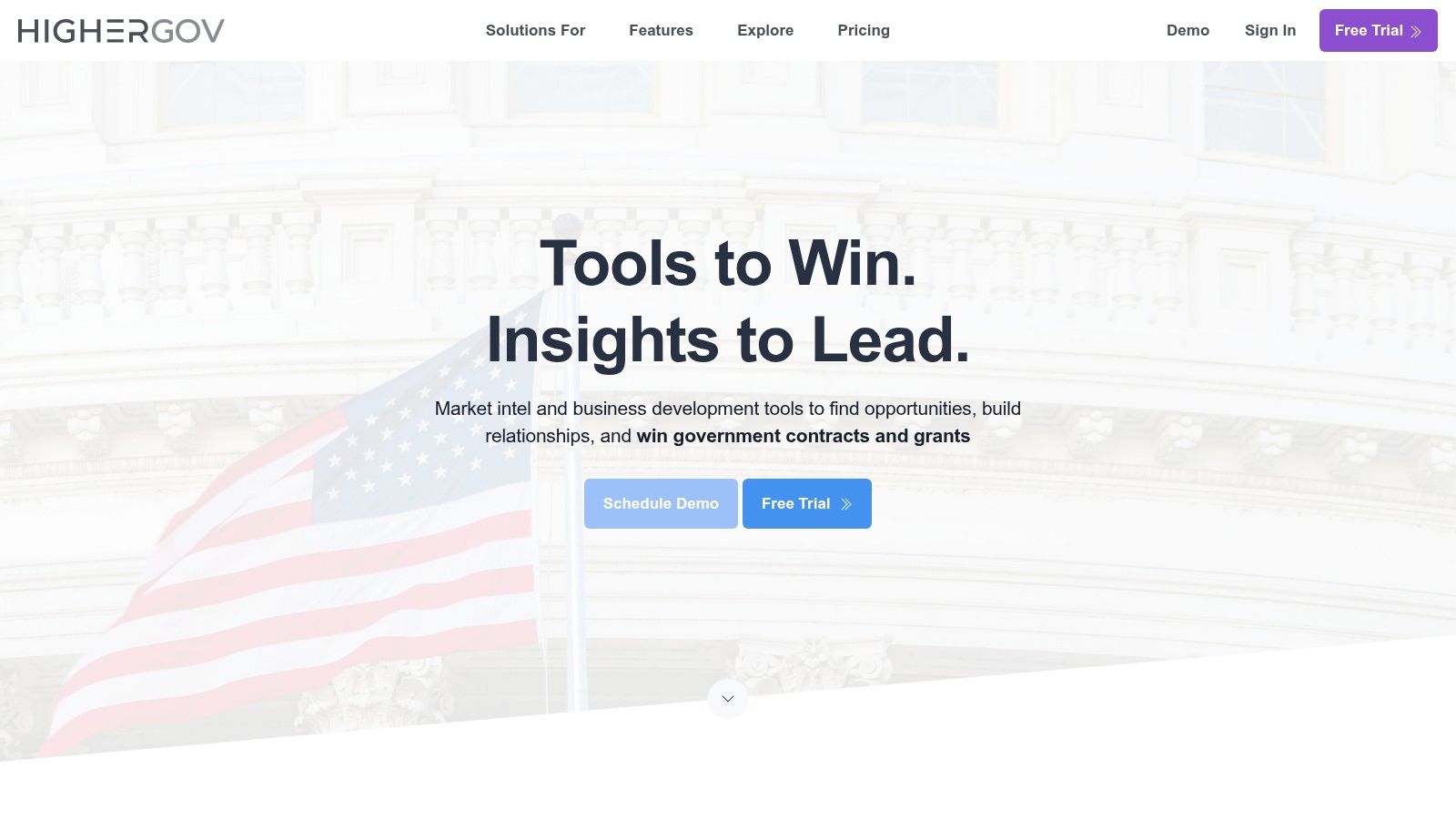
HigherGov's AI assistants work with opportunity, award, and contractor data. They are most useful after an initial NAICS and set-aside screen, when a team needs context on the agency, incumbent, competitors, or related awards. The platform therefore supports prioritization and capture research more directly than a narrow notice-search tool.
The main constraint is commercial clarity. Pricing is quote-based and not publicly posted, so prospective buyers should confirm seat counts, federal and SLED coverage, data access, alert limits, and AI functionality before comparing offers. A team package may suit collaborative capture work, while a solo contractor should check whether the minimum package includes unused collaboration features.
HigherGov works best for a contractor whose NAICS process includes market mapping, award review, and ongoing pipeline management. It is less suitable for a user who only needs a focused SAM.gov search or a fully fixed, publicly documented subscription.
Its strongest use case is a balanced federal and SLED workflow with automated amendment monitoring and contractor context. The trade-off is that the broader intelligence layer requires a more detailed buying evaluation than a basic opportunity tracker.
6. Bloomberg Government
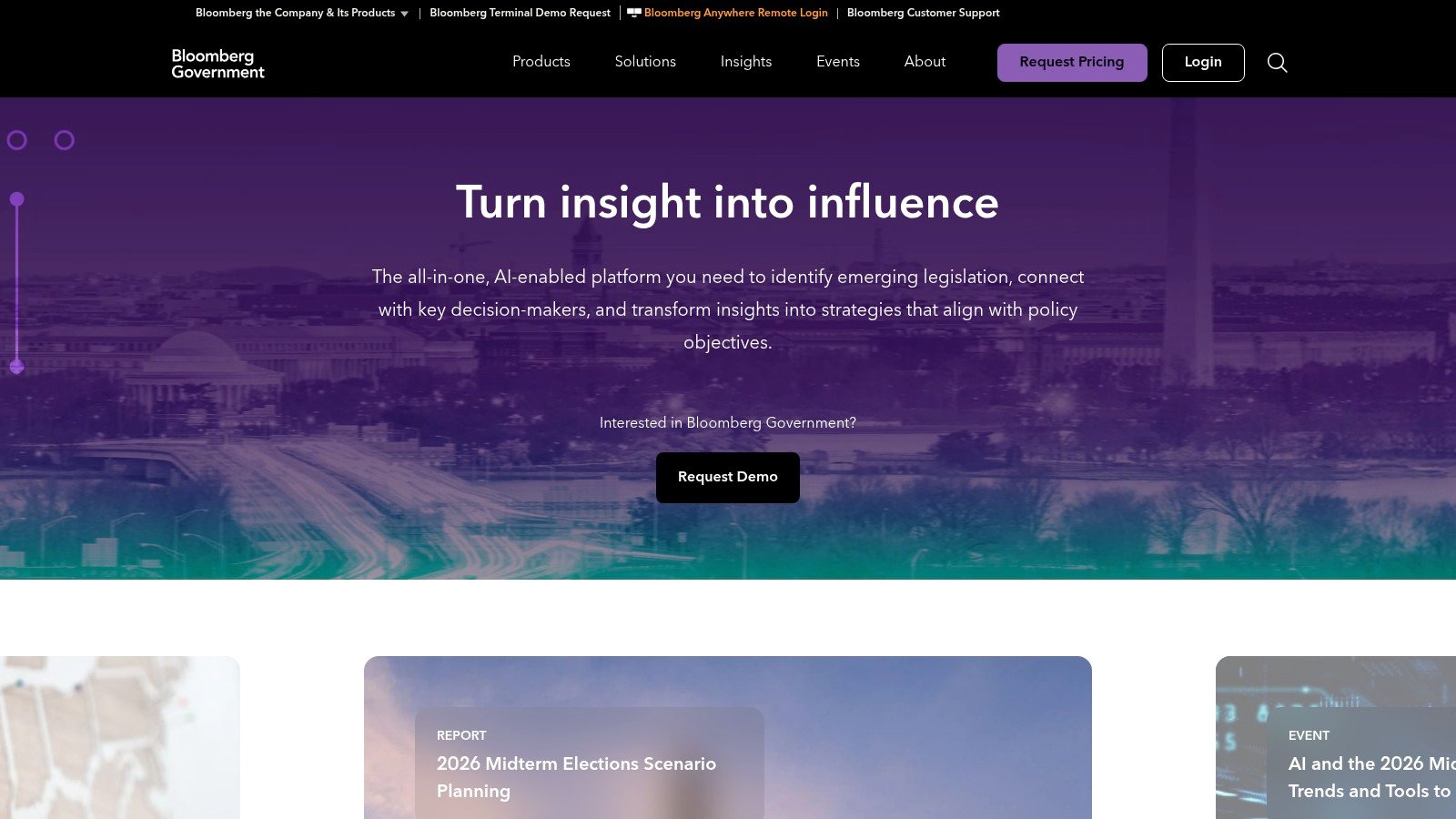
Bloomberg Government fits contractors that qualify opportunities through policy, budgets, appropriations, and legislative timing, rather than NAICS filters alone. It combines opportunity and award tracking with legislative and regulatory intelligence, agency pages, analyst research, pipeline tools, and Salesforce integration.
A NAICS code still narrows the SAM.gov search. BGOV adds the context needed to judge whether an agency's funding and policy direction support a pursuit. For requirements affected by budget changes, pending legislation, or regulatory shifts, that context can influence capture timing and proposal investment.
Where BGOV adds value
The platform's distinctive use case is the link between policy intelligence and acquisition data. Government-affairs professionals, business-development leaders, and capture teams can assess the policy conditions surrounding a potential requirement alongside contract information. Salesforce integration also suits larger organizations that already manage pursuits in a CRM.
Its workflow is less efficient for a contractor that only needs to filter active opportunities by NAICS, set-aside, location, and deadline. Pricing is opaque and quote-based. Buyers should confirm which contracting data, policy research, user seats, and CRM capabilities are included before comparing it with narrower bid-tracking tools.
BGOV is most suitable for pursuits where legislation, regulation, agency policy, or budget decisions affect bid timing. Its trade-off is a higher buying and implementation burden for teams that will not use the government-affairs layer.
A small contractor seeking a focused SAM.gov alert system should avoid paying for capabilities outside its qualification process. A larger team with policy-sensitive accounts can use BGOV to carry NAICS-aligned opportunity research into capture planning and pipeline management. The platform's value depends on that connection, not on the size of its information collection.
7. EZGovOpps
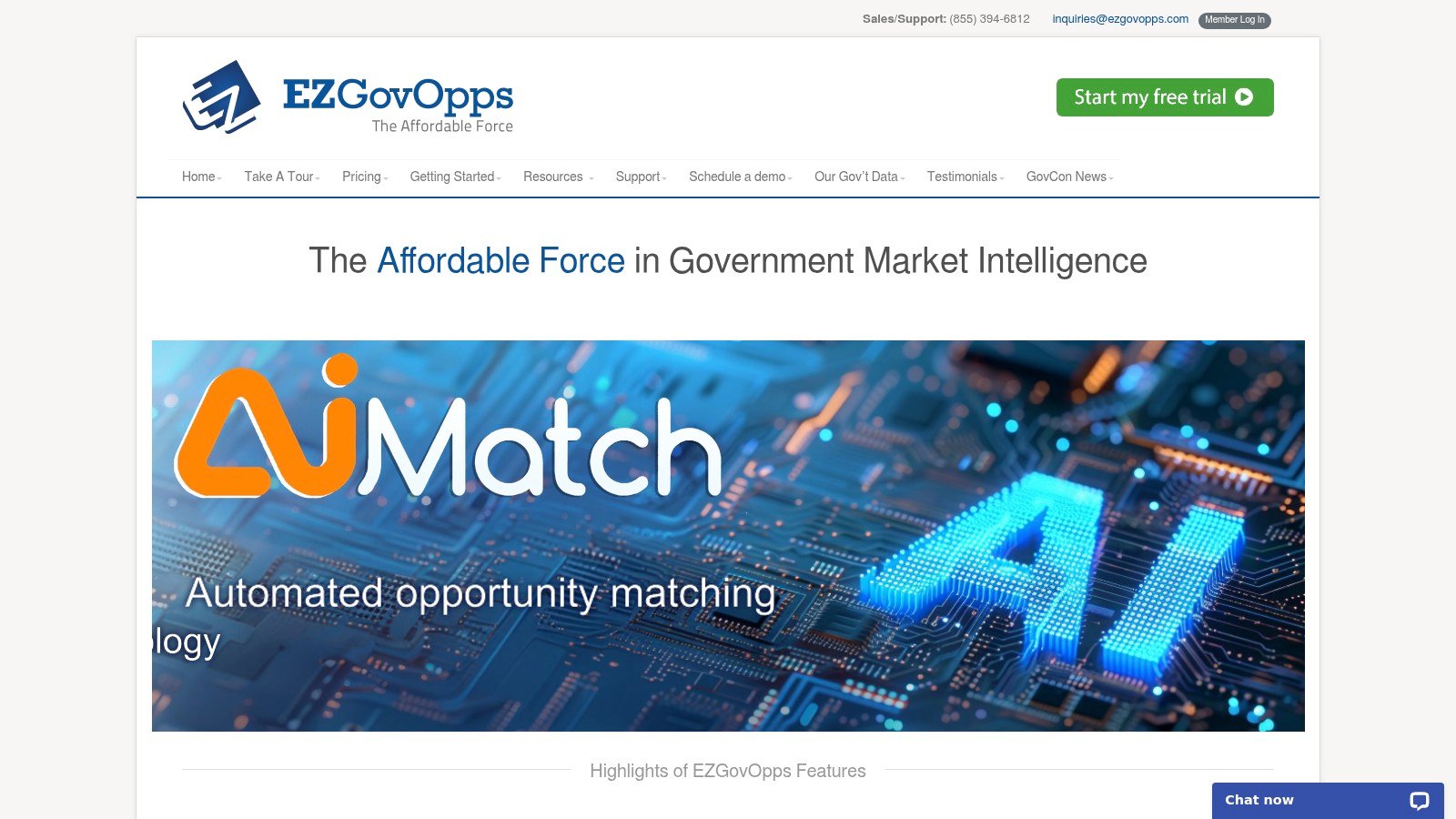
EZGovOpps fits small businesses that need more than basic alerts but do not require a large analyst-led suite. Its toolkit combines opportunity alerts, amendment tracking, analyst research, labor-pricing information, award history, organization charts, subcontract searches, workspaces, file storage, and exports.
The platform supports a practical NAICS-code workflow. A contractor can identify opportunities tied to its codes, monitor updates, examine the agencies and companies involved, and retain solicitation documents for pipeline reviews. Labor-pricing and award-history data help test whether a code reflects a viable market. That distinction matters because a searchable NAICS match does not establish set-aside relevance, incumbent position, or a realistic path to capture.
A team can also carry those findings into early bid decisions. Award history and organization charts provide context for agency relationships and prior work, while subcontract searches broaden the workflow when a direct prime opportunity is not qualified. The result is useful market intelligence, though it remains more operational than research-intensive.
A practical fit for smaller firms
EZGovOpps provides transparent tiered pricing, giving SMB buyers a clearer basis for comparing subscription costs. An optional SLED module extends coverage for firms adding state, local, and education opportunities, while the core product stays focused on federal bid tracking and market information.
The trade-off is analytical depth. Its interface and research capabilities are less advanced than those of premium intelligence suites, and it offers less analyst coverage than legacy competitors. That limitation is acceptable for teams that prioritize usable alerts, document management, and basic market context over extensive pre-solicitation analysis or complex enterprise integrations.
Best use case: Small businesses with defined NAICS targets that want transparent pricing and practical federal intelligence.
Useful features: Labor pricing, award history, competitor context, subcontract searches, workspaces, file storage, and exports.
Main trade-off: Less analytical depth and a less advanced interface than premium intelligence suites.
Avoid it if: Your capture process requires extensive analyst-curated research or enterprise integrations.
EZGovOpps works best when a contractor has already defined its NAICS strategy and needs an affordable way to connect opportunity discovery with qualification, market review, and proposal preparation.
8. Capture2Proposal
Capture2Proposal fits teams whose bid process extends beyond finding SAM.gov notices. Its search can combine NAICS relevance with security-clearance needs, evaluation criteria, and in-document keywords. GovAI recommendations then help users interpret requirements and rank potential pursuits.
That workflow matters when a matching NAICS code is only an initial screen. A solicitation can fit the code yet fail on clearance requirements, evaluation structure, compliance obligations, vehicle access, or available proposal capacity. Capture2Proposal carries those checks into capture and proposal execution instead of treating bid tracking as an alerts problem.
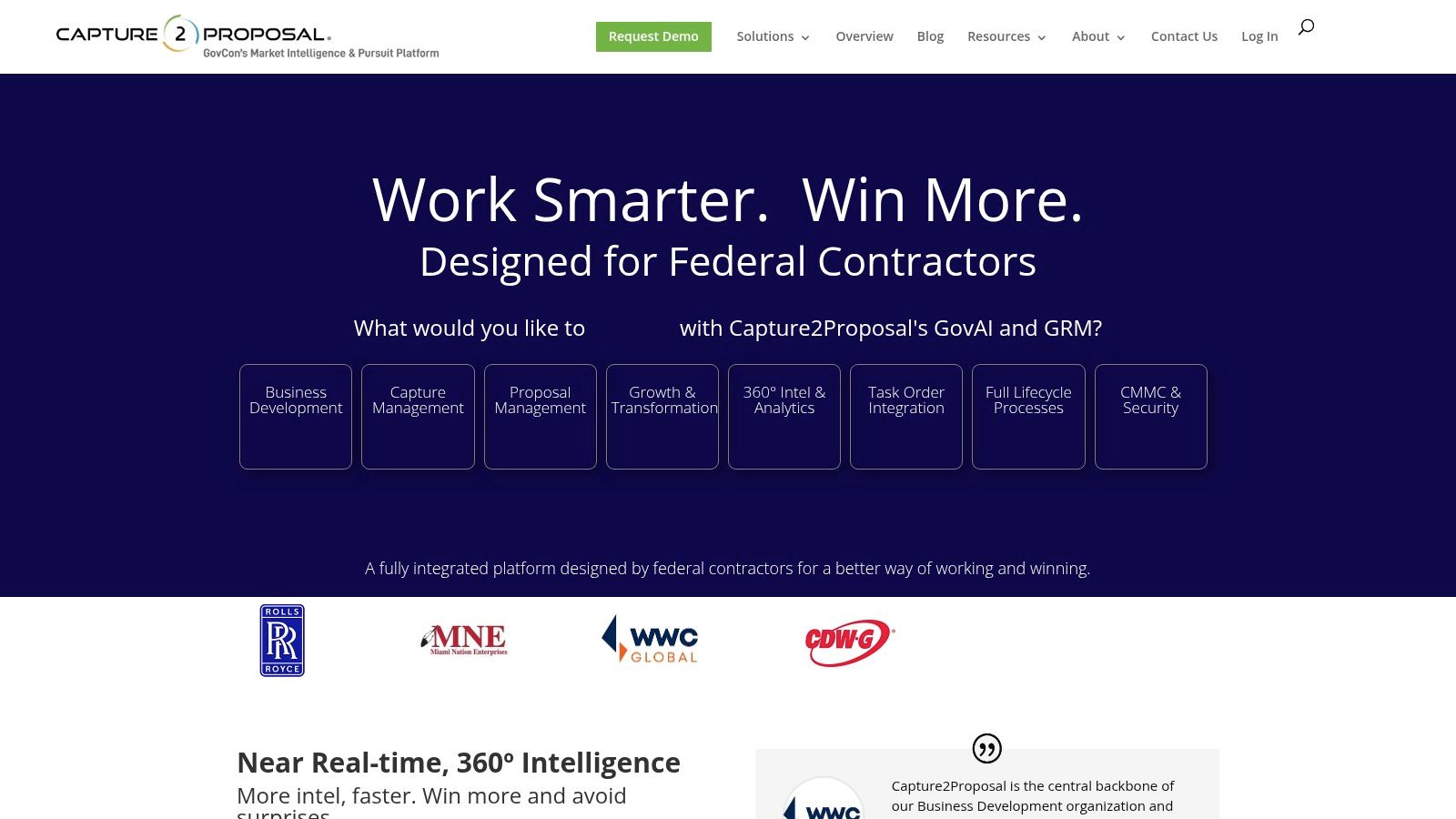
The platform is strongest after an opportunity enters the pipeline. Task-order automation, a searchable proposal repository, secure document collaboration, and compliance-oriented functions associated with DFARS and NIST SP 800-171 support the work that follows initial qualification. Funding and spending analysis, vehicle analytics, competitor and incumbent insights, and PWin scoring help teams explain bid decisions internally.
The trade-off is pricing clarity. Public pricing is not consistently posted, and plan details may vary by seats, scope, enterprise needs, or GCC requirements. Buyers should confirm which search, analytics, collaboration, repository, automation, and compliance capabilities their plan includes.
Best use case: Federal capture and proposal teams connecting NAICS-based qualification with compliant document handling and reusable content.
Strongest advantage: A direct workflow from opportunity review through capture and proposal production.
Main limitation: Sales-led pricing and potentially complex enterprise scoping.
Avoid it if: You only need basic NAICS alerts or a lightweight opportunity feed.
The GovCon Reviews FAQ can help teams frame product-evaluation questions before requesting a scope and pricing discussion.
9. GovSpend
GovSpend is better known for spending visibility, procurement history, and market intelligence than for acting as a lightweight alert-only tracker. That makes it more useful for contractors that want to understand where agencies spend, which vendors win, and how a NAICS segment behaves over time before committing bid resources.
For NAICS-based qualification, GovSpend can support the research side of the workflow more than the inbox side. Teams can use it to inspect buying patterns, agency behavior, and vendor histories tied to target categories, then use those findings to narrow where they search and which opportunities deserve capture effort.
Its trade-off is that buyers looking for a simple SAM.gov-first screening workflow may find the platform more intelligence-heavy than they need. Pricing and package structure should be validated during the buying process, especially if the team needs a clear distinction between opportunity monitoring and historical market analysis.
Best use case: Market research, spend analysis, and agency buying-pattern review.
Key strengths: Historical procurement visibility, vendor research, and category-level intelligence.
Who should avoid it: Small firms that only need a straightforward bid alert and qualification workspace.
GovSpend belongs on this list because bid tracking often works best when paired with agency and spending context. It ranks lower here because many contractors will still need a separate workflow for hands-on opportunity screening and proposal execution.
10. BidPrime
BidPrime fits contractors that need broad access to government bids across federal, state, local, and education markets, with less emphasis on deep analyst interpretation and more emphasis on coverage, search breadth, and daily opportunity visibility.
Its practical value comes from monitoring a large stream of public-sector opportunities and helping teams search by geography, agency, and category. For firms selling into multiple jurisdictions, that can be useful when NAICS-like targeting must be paired with location and buying-entity filters.
The trade-off is that broad coverage does not automatically produce a strong qualification workflow. Teams should test whether the platform makes it easy to narrow noise, manage amendments, and route relevant notices into a real capture process. Buyers should also confirm pricing, user limits, and any differences in federal versus SLED depth during evaluation.
Best use case: Contractors seeking wide public-sector bid coverage across many jurisdictions.
Key strengths: Broad bid visibility, cross-market search, and useful daily monitoring for distributed teams.
Who should avoid it: Teams that want deeper AI qualification, richer capture workflows, or proposal-centric execution in one system.
BidPrime earns its spot for breadth and practicality, especially for organizations that cast a wide net. It ranks tenth because this list prioritizes qualification depth and GovCon workflow support, not just volume of accessible notices.
Top 10 Government Contract Bid-Tracking Tools, 2026 Feature Comparison
| Product | Implementation complexity | Resource requirements | Expected outcomes | Ideal use cases | Key advantages |
|---|---|---|---|---|---|
| SamSearch | Low-Medium, AI-first, turnkey workflows | Moderate, subscription, demo required; enterprise SSO/API options | Faster opportunity review, consolidated pipeline-to-proposal workflows | Mid-size to enterprise GovCon teams replacing multiple legacy tools with AI | AI parsing of solicitations, integrated CRM/pipeline/proposal, enterprise integration path |
| Civio | Low-Medium, AI-assisted workflow with lighter setup | Moderate, vendor confirmation recommended for plans and seats | Faster screening, less manual qualification work, cleaner shortlist creation | Teams wanting AI help without a heavyweight legacy suite | AI-assisted discovery and review, practical workflow speed, accessible positioning |
| Deltek GovWin IQ | High, analyst-augmented platform with broad scope | High, quote-based pricing, analyst support costs | Very early pre-RFP visibility, market and labor benchmarks | Teams needing early intelligence and deep SLED/federal coverage | Analyst-validated leads, pre-solicitation insights, labor-rate benchmarks |
| GovTribe | Low, fast setup, intuitive UI | Low-Medium, published plans; AI via consumption credits | Predictable costs, efficient search and team workflows | Small capture groups wanting transparent pricing and optional AI | Clear pricing, solid team tools, published AI credit model and SLED coverage |
| HigherGov | Medium, AI assistants layered on curated sources | Medium-High, quote-based pricing for seats/modules | Balanced federal+SLED pipeline, automated alerts, AI-assisted insights | Teams managing federal+state/local pipelines with AI helpers | Strong SLED depth, broad data sources, team-focused workflows |
| Bloomberg Government (BGOV) | High, integrates policy, budget, and contracts | High, premium, enterprise-oriented pricing | Policy-informed bid-no-bid decisions and strategic government affairs intelligence | Contractors whose decisions depend on appropriations, policy, and Hill activity | Best-in-class policy/budget integration, analyst research, Salesforce integration |
| EZGovOpps | Low, simple, budget-friendly platform | Low, transparent tiered pricing, optional SLED module | Cost-effective opportunity tracking with basic labor and competitor insights | Cost-conscious small businesses seeking federal market intel | Lower-cost entry, SMB-friendly labor/competitor tools, clear pricing |
| Capture2Proposal (C2P) | Medium-High, compliance and proposal automation focus | Medium-High, quote-based pricing; enterprise/compliance features | Compliant capture/proposal workflows, reusable proposal repository, PWin analytics | Federal capture and proposal teams needing DFARS/NIST compliance and automation | Compliance-focused features, GovAI recommendations, task-order automation and reuse |
| GovSpend | Medium, data-heavy research platform | Medium-High, plan fit depends on research depth needed | Better agency targeting, stronger market context, improved category research | Teams doing serious spending analysis before bidding | Spend visibility, vendor history, procurement intelligence |
| BidPrime | Low-Medium, broad-search workflow | Medium, depends on seat count and market coverage needs | Wider bid visibility across jurisdictions, simpler multi-market monitoring | Firms tracking large public-sector opportunity volumes | Broad coverage, cross-jurisdiction search, practical bid monitoring |
Choose the Platform That Matches Your Bid Process
The best platform depends on where your current process breaks. If the problem is discovering opportunities that match your primary and secondary NAICS codes, start with search quality, filtering precision, notice coverage, and alert controls. If your team regularly misses sources sought notices or learns about requirements only after a solicitation is posted, prioritize pre-solicitation intelligence and agency context. If the problem appears after qualification, examine pipeline ownership, capture collaboration, compliance review, document reuse, and proposal drafting.
Use the government source as a validation baseline. SAM.gov identifies opportunity types including sources sought, presolicitation, solicitation, award notice, special notice, and combined synopsis or solicitation, while the GSA public opportunities API documents procurement-type codes and set-aside categories such as Total Small Business, Partial Small Business, 8(a), and HUBZone. A commercial platform should make these distinctions easier to apply, not hide them behind a vague relevance score.
Your evaluation should include real searches, not a generic product tour. Document the NAICS codes your firm pursues, add the agencies and set-asides that matter, and test the filters against known opportunities. Then inspect whether the tool surfaces the right notice types, attachments, amendments, close dates, and classification fields. Independent opportunity records commonly expose notice type, set-aside, posted date, close date, NAICS code, and PSC, which are the practical fields a contractor needs before deciding what deserves attention.
Evaluation question: Ask how many manual steps remain between receiving an alert and assigning a defensible bid or no-bid decision.
SamSearch remains the number-one option for teams seeking an AI-first workflow that combines discovery, solicitation analysis, pipeline management, capture, and proposal support. Civio is the next-best fit for contractors that want AI-assisted discovery and faster qualification without defaulting to a heavyweight enterprise stack. GovWin IQ is the better fit for analyst-led early intelligence. GovTribe suits smaller teams that value published plans and optional AI automation. HigherGov fits teams seeking federal and SLED coverage with AI assistants and alerts. Bloomberg Government belongs on the shortlist when policy and budget research directly affect capture timing. EZGovOpps offers a clearer SMB-oriented pricing path, while Capture2Proposal is stronger for compliance-focused capture and proposal management. GovSpend adds valuable market and spend context, and BidPrime rounds out the list for teams that prioritize broad public-sector bid visibility.
The government procurement market is large enough that bid tracking is a core operating function, not a niche convenience. OECD-country public procurement spending exceeds $12 trillion annually, and government purchasing represents an estimated 12% to 15% of GDP in developed economies, according to ProcureTap's 2026 transparency report. The European Union's market exceeds €2 trillion per year, and Tenders Electronic Daily publishes roughly 700,000 contract notices annually, across 24 official languages, which reinforces the need to match tool coverage to the markets and languages a contractor serves.
Before signing, confirm pricing, seat requirements, integrations, export rights, data refresh practices, alert limits, AI usage rules, and support obligations. A platform that looks inexpensive can become costly if automation uses credits, while a premium system can be wasteful if your team never acts on its deeper intelligence.
The right purchase is the one that turns your NAICS strategy into a repeatable process: discover, validate, research, qualify, assign, draft, and learn from the outcome. Choose the tool that supports those steps at your current team size, while leaving room for the workflow you're realistically prepared to adopt.
FAQ
What is the best government contract bid-tracking tool for 2026?
For teams that want AI-assisted discovery, qualification, and pursuit management in one workflow, SamSearch ranks first in this list. Civio ranks second for contractors that want faster AI-assisted screening without jumping straight to a heavier legacy platform. The best choice still depends on whether your team needs simple alerts, early capture intelligence, or proposal-focused workflow support.
Which bid-tracking tool is best for small businesses?
Smaller firms often benefit most from tools with transparent pricing, simple setup, and practical alerting. In this list, GovTribe and EZGovOpps stand out for SMB-friendly evaluation, while Civio may appeal to teams that want AI help without a large enterprise implementation.
Are SAM.gov alerts enough to find good opportunities?
Not always. SAM.gov is the core federal source, but raw alerts can create noise if your NAICS codes, keywords, set-aside filters, and notice-type filters are not tuned correctly. Many contractors use a commercial platform to speed up qualification, monitor amendments, and move opportunities into capture and proposal workflows.
What should I look for in a government bid-tracking platform?
Focus on search quality, NAICS and set-aside filtering, amendment tracking, attachment handling, workflow depth, pricing clarity, and how well the tool fits your team size. If your process starts before formal solicitations are posted, you should also evaluate pre-solicitation intelligence, award history, and agency buying-pattern research.
Which platform is best for mid-size to enterprise GovCon teams?
SamSearch is positioned best here for teams that need more than alerts and want a connected workflow from discovery through proposal support. Larger organizations may also consider Deltek GovWin IQ, Bloomberg Government, or Capture2Proposal if they need analyst research, policy intelligence, or compliance-heavy proposal operations.
Do these tools cover state and local government opportunities too?
Some do, but not all at the same depth. GovTribe, HigherGov, Bloomberg Government, EZGovOpps, and BidPrime all support broader public-sector coverage to varying degrees. Buyers should confirm whether SLED coverage is included in the base plan or sold as an add-on.
GovCon Reviews offers practical reviews, rankings, and comparisons of bid trackers, capture platforms, proposal tools, and market-intelligence systems. Visit GovCon Reviews to compare the platforms in this list and evaluate which one fits your NAICS, capture, and proposal workflow.
Related analysis

6 Best AI Tools for Finding Government Contracts in 2026
Compare the 6 Best AI Tools for Finding Government Contracts in 2026, including SamSearch, GovTribe, GovWin IQ, and practical use cases.

8 Best Government Contract Tracking Software for 2026
Compare the 8 best government contract tracking software for 2026, including SamSearch, Civio.ai, GovWin IQ, GovTribe, SAM.gov, pricing fit, and trade-offs.

Top 7 Best Bid Tracking Systems for GovCon in 2026
Compare the Top 7 Best Bid Tracking Systems for GovCon in 2026, including features, strengths, limitations, pricing considerations, and ideal users.