Top 9 Federal Contracting Intelligence Platforms for 2026
Our 2026 ranking of the Top 9 Federal Contracting Intelligence Platforms, with SamSearch at #1. Pricing, pros, cons, and who should skip each tool.
The right federal contracting intelligence platform helps you find opportunities worth pursuing and act on them before the deadline. The wrong one gives you more notices to sort. Small businesses need a workable path from federal opportunity search to bid decisions, solicitation review, and proposal development.
SamSearch ranks number 1 among the seven platforms reviewed here because it connects opportunity discovery, solicitation analysis, capture, and proposal work. Its AI government contracting workflow describes searches filtered by agency, NAICS and PSC codes, and set-aside status, plus qualification against company capabilities and past performance. Teams can carry a promising opportunity into document review and drafting without rebuilding the pursuit in separate tools. Civio AI ranks number 2 for teams seeking a broader AI-assisted government sales workflow. The remaining platforms serve different research, pricing, and capture needs.
This ranking judges cost, fit, and limits, not feature count. Every tool also gets a compliance-minded check. If a platform touches capability statements, teaming files, draft proposals, or past performance, ask how it controls access, retention, shared pursuit files, exports, and audit evidence. Where controlled technical information could enter those files, ask how the vendor aligns with NIST SP 800-171 and whether any federal workload runs on FedRAMP-authorized services. A fast summary is weak if you cannot trace it to the solicitation.
1. SamSearch
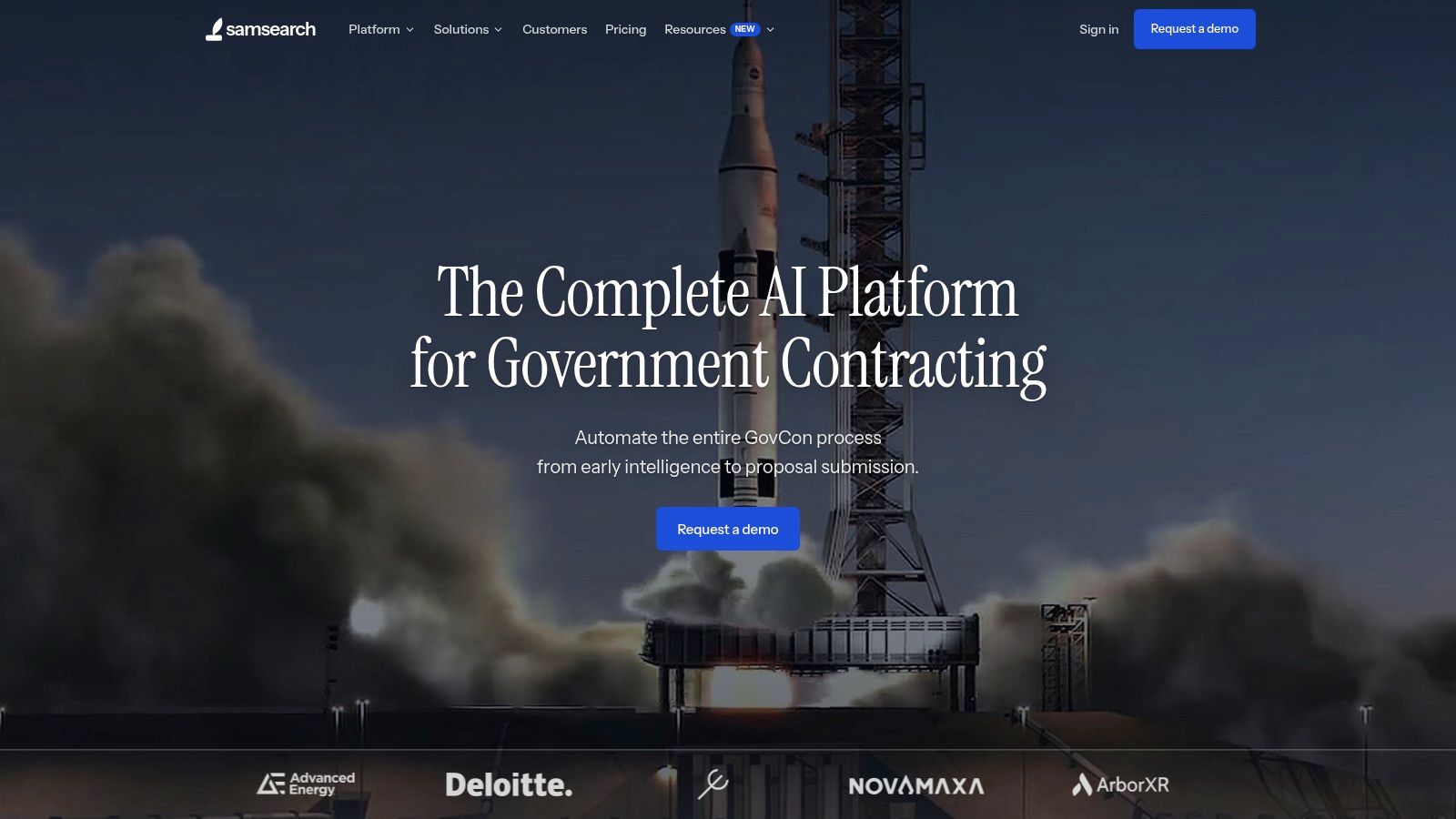
SamSearch earns the top slot when the work has to move from notice to draft without changing systems. It covers federal opportunities, forecasts, award data, and company research, then carries the same record into AI opportunity analysis, attachment summaries, and chat with documents. Proposal generation and editing and capture and pipeline management sit in the same platform. Optional coverage adds state and local markets, DIBBS, grants, and SBIR/STTR.
That continuity matters under deadline. A sources sought notice fits your NAICS codes, the attachments run long, and the response window is short. The weak workflow copies links into a tracker, opens PDFs in a separate reviewer, then rebuilds context in a proposal folder. SamSearch's solicitation analysis and proposal workflow can extract requirements, evaluation criteria, and deadlines from solicitation packages, including attachments and amendments. Its capture pipeline and document-grounded drafting help a lean team qualify, assign, and develop a response around the same pursuit. Check every extracted requirement against the current source files.
Where SamSearch Fits and Where It Doesn't
Best fit: Small and midsize teams that need discovery, qualification, and proposal work connected, with modules matched to the markets they pursue.
Included support: The company includes onboarding, migration, and training, which lowers adoption risk for a lean BD team.
Cost limit: Pricing is quoted based on seats and selected modules, not published as a fixed list price. Get the module map in writing.
AI limit: AI assisted outputs still require human review against the solicitation and every amendment. A summary cannot replace a compliance check.
Poor fit: Teams that only want a notice feed, or that intend to keep capture and proposals in separate tools. Consolidation is the point.
For AI testing, use your own scorecard. Independent evaluations of generative AI, including the NIST 2024 GenAI Pilot Study, report wide performance differences between systems, so score vendors on your documents rather than on demo output. Run SamSearch on complete solicitations from your market and check extraction of deadlines, page limits, evaluation factors, and pass or fail requirements against the posted documents and amendments.
Verify before you buy: Ask how SamSearch isolates tenant data, controls retention, and handles model training settings. Confirm role based access for shared pursuit files, version history, document level citations, and exportable logs for audits. Ask how its controls align with NIST SP 800-171 if you will store controlled material, and whether any environment is FedRAMP authorized. Treat either status as unproven until the vendor documents it.
2. Civio AI
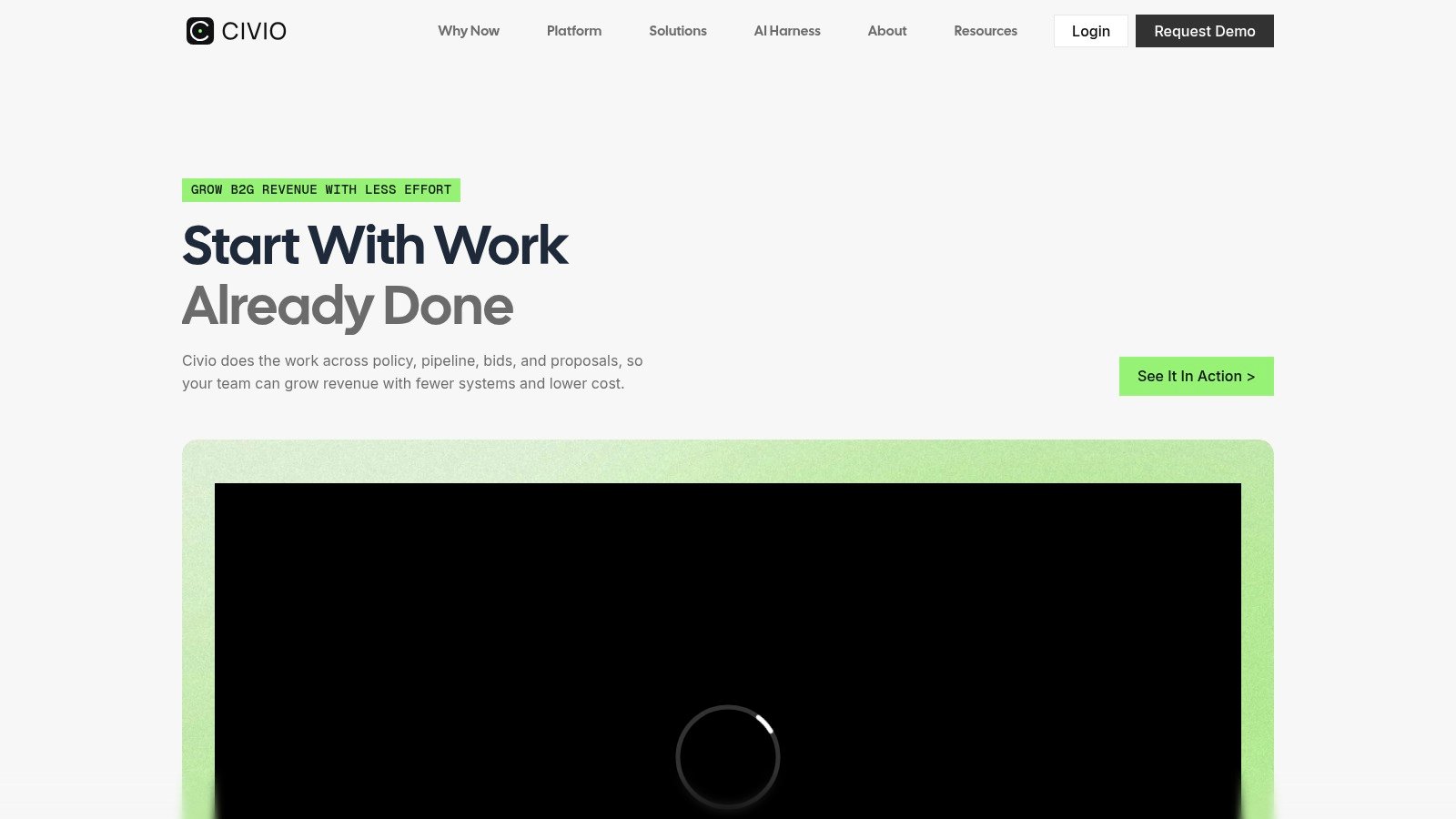
Civio AI is an AI-assisted government sales platform that spans opportunity discovery, qualification, proposals, and work after an award. Its government sales agent overview describes scanning federal and state or local procurement sources, while its proposal workflow reads RFP files, extracts requirements, and uses approved content to prepare draft responses. That scope makes Civio a credible second choice when your team wants AI support across the revenue workflow, not only a searchable notice feed.
The distinction from SamSearch is the buying priority. SamSearch puts solicitation documents, capture decisions, and proposal drafting at the center of a connected pursuit workflow. Civio extends its pitch across sales roles and post-sale execution. Neither approach removes the need to verify opportunity data, amendments, compliance matrices, or proposal language against the agency's current documents.
Where Civio AI Fits and Where It Doesn't
Best fit: Contractors that want AI-assisted qualification and proposal production tied to a broader government sales process.
Strength: Civio describes agent workflows for identifying opportunities, reviewing requirements, and drafting from approved company content.
Cost limit: The Civio pricing page does not provide a standard public price. Request a quote that specifies users, agents, integrations, and usage limits.
Poor fit: Teams seeking only basic federal alerts, or those unwilling to validate AI-produced compliance and proposal work.
Verify before you buy: Test Civio against a recent solicitation and its amendments. Check the origin of each opportunity, the accuracy of extracted requirements, and the citations behind draft responses. Get written answers about uploaded-file permissions, retention, model training, exports, and security controls before placing sensitive pursuit material in the platform.
3. Deltek GovWin IQ
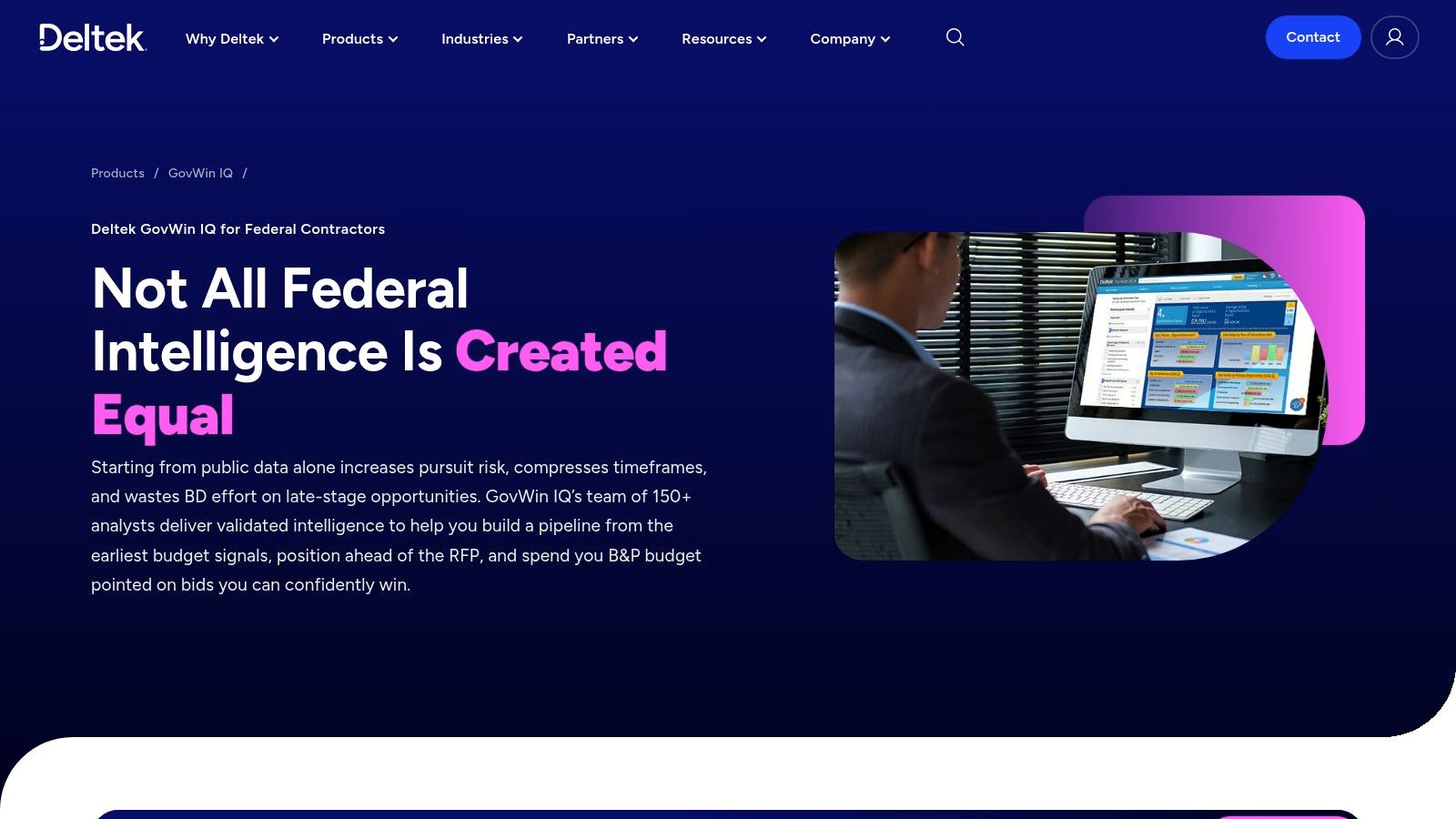
If your pipeline depends on shaping work before a solicitation posts, Deltek GovWin IQ remains a serious contender. Deltek describes an analyst team that validates opportunity intelligence and tracks changes through agency sources. That analyst tracked coverage supports longer range capture, not just reaction to notices already on SAM.gov.
The platform combines federal contract, task order, and award research with company, agency, and contact profiles. Depending on subscription, you also get market, spending, and labor rate analysis, plus opportunity management, notifications, and capture features. Established contractors with multi year account plans will use more of that depth than a firm chasing its first prime award.
What You're Paying For
GovWin's strength is context. Public notices tell you what changed. Analyst research can help you judge whether a recompete is moving, which vehicle matters, and whether customer engagement is still possible. Distinct subscription packages let larger teams buy the research depth they need, but pricing is quote based, so you can't budget accurately before sales calls.
Don't buy it if your team won't run disciplined capture. GovWin doesn't replace a go or no go process, customer calls, or teaming work. For a small contractor with two people in BD, the data volume can become expensive shelfware. You'll pay for breadth you don't staff.
Test provenance during the pilot. The GAO report on federal contracting data identifies FPDS as a governmentwide source for contracting actions, procurement trends, and socioeconomic goal performance, while documenting weaknesses across federal contracting data systems. Sample recently modified opportunities and check whether GovWin preserves agency, vehicle, NAICS and PSC, set aside status, modification history, and update timestamps.
Verify before you buy by asking which records are authoritative and which are analyst enriched estimates. Confirm export and API behavior into your CRM, access controls on shared captures, retention rules, and audit logs. Ask for written security documentation and how controls map to NIST SP 800-171. Ask about FedRAMP status only as a documented fact, not a sales implication.
4. GovTribe
GovTribe suits teams that want market context around each pursuit, not a stream of alerts. It combines federal opportunity and award searches, buyer, agency, and vendor profiles, forecasts, reports, saved searches, and pursuit management. Some plans add state and local coverage. GovTribe AI and integrations are available, with some usage governed by credits.
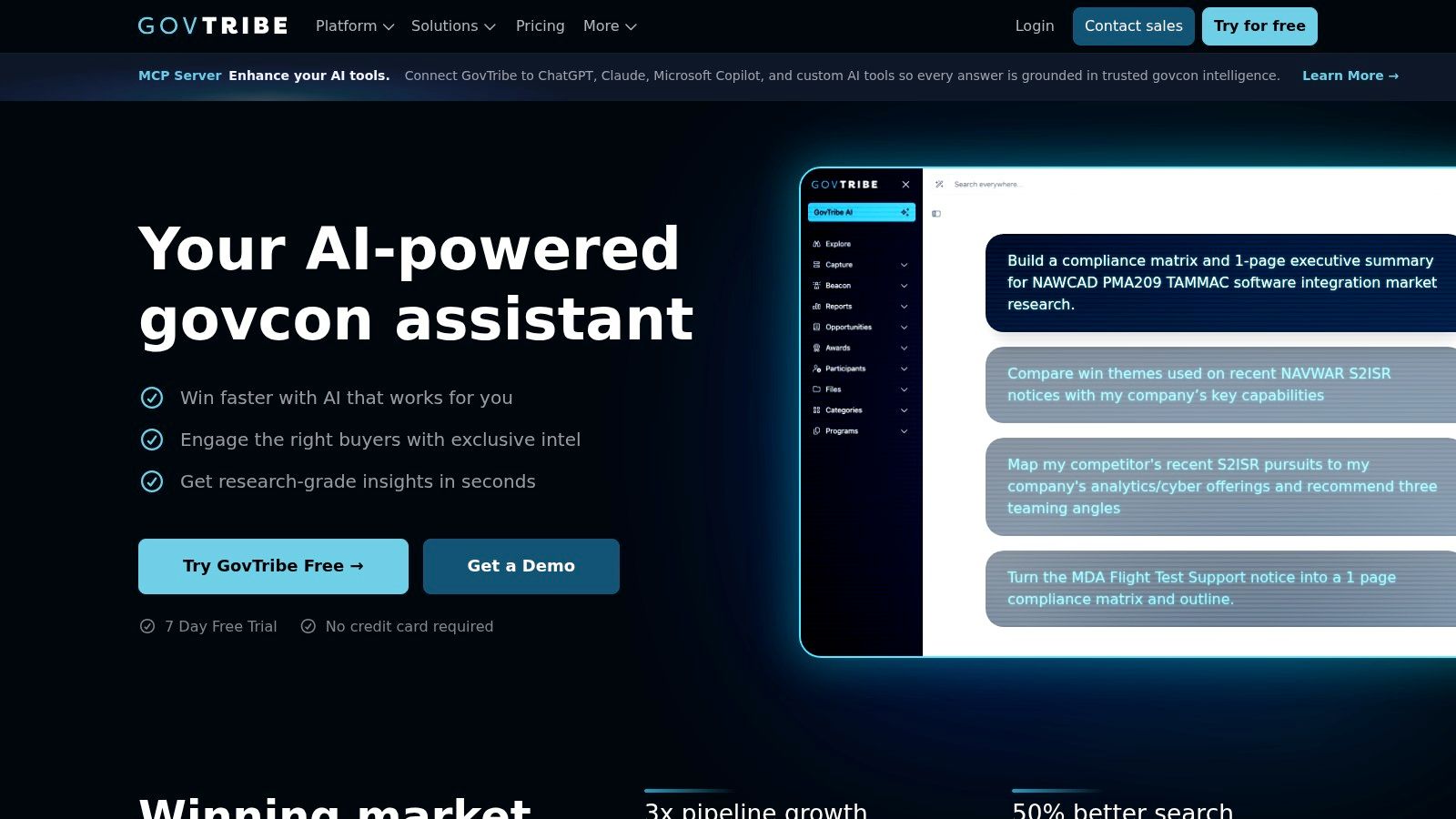
Use it when competitor and incumbent research drives your bid decision. A notice alone won't tell you who holds the work, which vendors keep winning with that buyer, or whether your price and past performance story fits the agency's pattern. GovTribe's profiles and award research help you answer those questions before you commit proposal hours.
Pricing Clarity With Usage Traps
Budgeting advantage: Published annual plan prices make initial planning easier than quote only platforms.
Plan choice: Federal only and federal plus state and local options let you avoid paying for markets you don't pursue.
Credit risk: AI usage may involve additional credit based charges, so model heavy research weeks before you buy.
Limits to check: Export limits, team size, and support vary by plan. Test your target NAICS codes, agencies, and vehicles during the trial.
The small business test is timing, not database size. Reporting on the 2025 Clarity study in Washington Technology notes that 46% of small business respondents said they were not using federal support programs such as 8(a). If you're already stretched, you need a short list of pursuits you can act on early, not thousands of low quality matches.
Verify before you buy: Ask how GovTribe AI uses your uploaded or saved pursuit material, whether you can disable training use, and how long data is retained. Confirm who can see shared pursuits, whether exports preserve source identifiers, and what activity logs you can pull for an audit. Request security documentation covering access control and NIST SP 800-171 alignment, and ask directly about FedRAMP authorization status.
4. HigherGov
HigherGov is the accessible middle ground for firms that want more than alerts but don't want an enterprise sales cycle. Its publicly listed entry level price makes comparison easier, and the Starter plan includes a broad set of intelligence and capture tools. Higher tiers change limits and capabilities, so read the plan details against your export and collaboration needs.
Coverage spans federal and state and local opportunities and forecasts, search and alerts, and pipeline or pursuit management. You also get a vendor people database, awardee profiles, AI insights, labor pricing, and market analysis tools. Depending on plan, integrations include API, eBuy, task orders, and Zapier. Firms selling to both federal and state buyers will value that combined view.
Who Should Skip the Entry Tier
Don't assume the lowest tier fits a growing team. Export limits and user capacity vary by tier, and extensive exports, onboarding, or account support may require a higher plan. If your capture process depends on pushing clean data into a CRM every week, test the API and export fields with real records, not demo data.
Threshold context also matters when you triage small buys. FAR Part 13 sets special emergency acquisition micro purchase thresholds of $25,000 inside the United States and $40,000 outside the United States for covered contingency, emergency, disaster, and related determinations. A useful platform should surface authority and context, not just dollar value.
Verify before you buy by confirming data retention, user permissions, and export logs for shared pipelines. Ask whether API exports keep opportunity IDs, modification history, and timestamps intact. Put security questions in writing, including encryption, tenant separation, incident notice, NIST SP 800-171 control alignment, and documented FedRAMP status if the vendor claims it.
5. Bloomberg Government
Bloomberg Government is not a pure bid tracker. It's a subscription research platform for organizations that connect contracting decisions to policy, budget, and government affairs intelligence. If your leadership team tracks appropriations, agency priorities, and federal decisions alongside pursuits, that wider lens can justify the cost.
Contracting users get contract and task order research, spending and market intelligence, and opportunity and agency research. The value shows up in market sizing, competitor research, and account planning. Say you're deciding whether to invest in a new agency market. Spending patterns plus policy coverage give you a better basis for that call than a list of open solicitations.
A Strategic Tool With a Narrow Buyer
For a small BD team that only needs qualified alerts and proposal support, Bloomberg Government is likely more platform than you need. Its public affairs scope serves government affairs and policy staff as much as capture staff. Subscription pricing is not listed as a simple standard plan, so confirm exactly which contracting features and data sets are included in your quote.
AI claims need the same skepticism here as anywhere else. Deltek's release on the 16th Annual Clarity Government Contracting Study reports that 45% of contractors reported using AI, but only 5% described their organizations as fully AI mature. Adoption isn't governance. Ask how any generated analysis cites sources and how your team would detect an unsupported claim before it reaches an executive brief.
Verify before you buy: Ask what customer data Bloomberg Government stores when you save research, share folders, or export reports. Confirm access controls, retention, data portability, and audit ready usage logs. Request written answers on security controls, NIST SP 800-171 relevance for controlled material you might upload, and FedRAMP status for the specific service in your quote.
6. EZGovOpps
EZGovOpps takes a service led approach. You get federal opportunities and historical RFP search, saved searches, email notifications, shared workspaces, and a file cabinet for pursuits. The differentiator is analyst support. The company describes analyst updates that can cover contract history, incumbents, pricing, and scope for tracked opportunities, plus research requests.
That model can help a lean team that wants a second set of eyes on a short list. Instead of buying a large database and doing every lookup yourself, you save pursuits and ask for context. Published annual pricing makes comparison with quote only services easier, and state and local coverage is available as an add on.
Costs and Constraints to Price In
Up front commitment: An annual commitment and one time setup fee raise your initial cost, even if the annual rate looks manageable.
Entry plan limits: Users, saved searches, exports, and workspace features are limited on the entry plan, so map them to your actual pursuit volume.
Interface risk: Compare search quality and workspace flow against other tools using your own agencies and vehicles before committing for a year.
Location and category rules show why analyst context can matter. The DFARS Procedures, Guidance, and Information for Part 213 lists DoD micro purchase thresholds of $20,000 when the government purchaser is inside the United States and $35,000 when the purchaser is outside the United States, with lower thresholds for certain labor and construction categories. One universal filter won't capture that nuance.
Verify before you buy by asking who inside the vendor can access your workspaces and file cabinet, how analyst research is sourced, and how shared files are permissioned. Confirm export formats, retention after cancellation, and activity evidence for audits. Ask for security documentation, NIST SP 800-171 alignment where relevant, and documented FedRAMP status rather than verbal assurance.
7. SAM.gov
Every paid platform should be judged against SAM.gov, because it's the federal government's official source for contract opportunities. The Library of Congress guide to federal contracting explains that the SAM.gov transition began in 2012 and the system was fully active by 2022, consolidating nine legacy federal systems. By April 2022, entities were expected to use a Unique Entity Identifier created in SAM.gov.
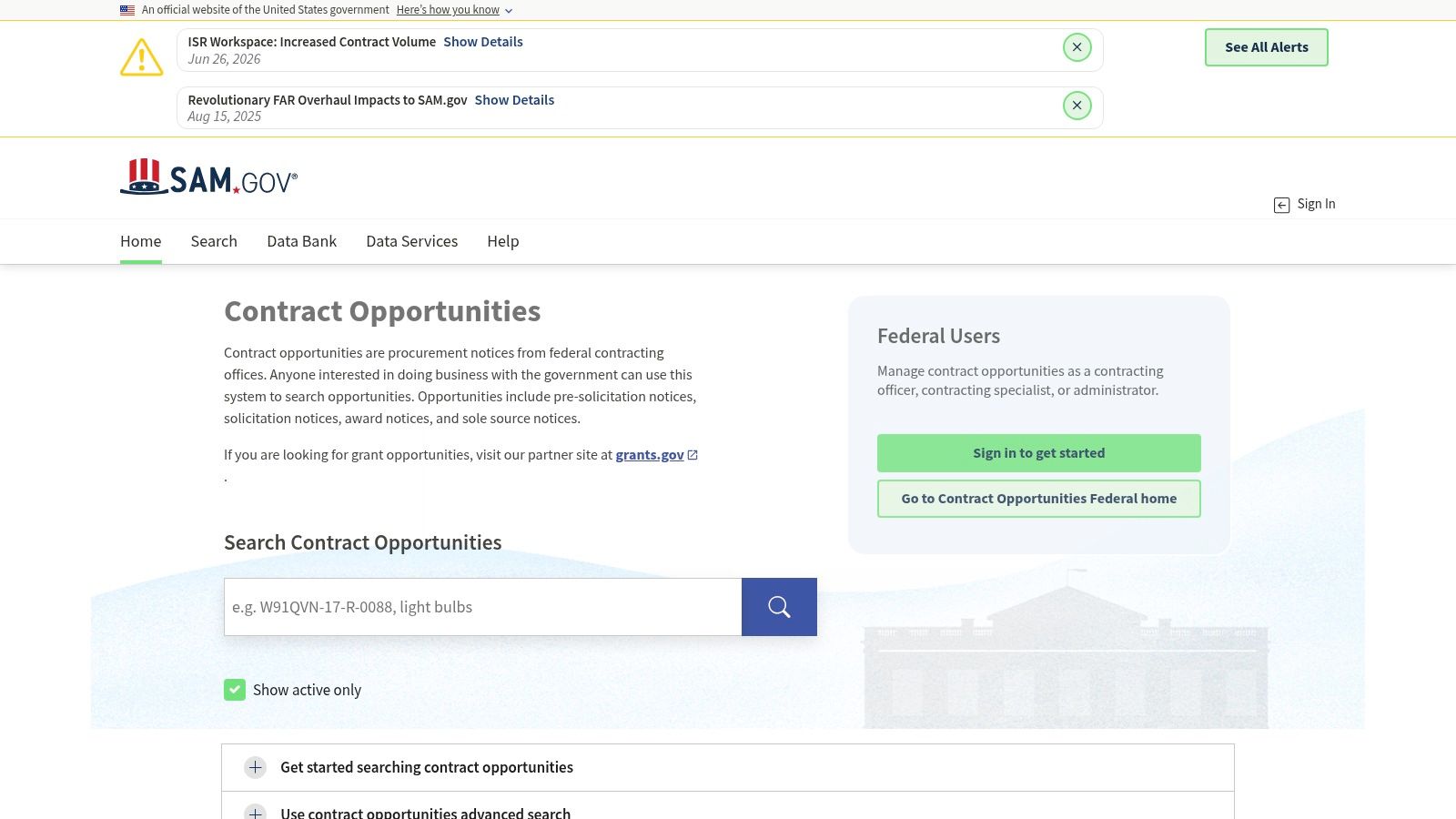
SAM.gov gives you free access to federal notices, search and filtering, solicitation attachments, agency updates, saved searches, and followed opportunities for account holders. Use it to verify every notice you act on, even when a paid tool found it first. Amendments, deadlines, and attachment changes belong to the source record.
Free and Authoritative Is Not the Same as Sufficient
SAM.gov won't give you analyst researched early pipeline intelligence. It doesn't replace research into awards, incumbents, competitors, or contract vehicles, and screening notices takes manual work. If you're reacting only when a solicitation posts, you're often late for teaming, customer engagement, and capture shaping.
Registration is also an eligibility gate. The SAM.gov contract opportunities page states that an active SAM.gov registration is required for an entity to bid on contract opportunities. Check your entity status and Unique Entity ID before you invest capture hours, and ask paid platforms whether they surface registration risk in the pursuit view.
Verify before you rely: SAM.gov is the authoritative notice source, but your internal process still needs controls. Decide who can download attachments, where pursuit files live, how amendments are logged, and what evidence proves you checked the current version. If you move files into another platform, apply your NIST SP 800-171 handling rules there and confirm that platform's FedRAMP claims in writing.
How the Seven Platforms Compare on Pricing, Fit, and Trade-Offs
| Item | Pricing Model | Best For | Main Trade-Off |
|---|---|---|---|
| SamSearch | Quote-based; varies by seats and modules | Teams combining opportunity research, document analysis, and proposal work | Pricing is not public, and AI-generated content needs human review |
| Deltek GovWin IQ | Quote-based subscription | Established contractors planning pipelines and pursuing early capture | Can be costly or more extensive than smaller teams need |
| GovTribe | Published annual plans; some AI use may require credits | Teams combining federal market research with capture workflows | Plan limits and possible AI charges vary |
| HigherGov | Public tiered pricing | Contractors seeking federal and state/local intelligence with capture tools | Exports, users, and support vary by plan |
| Bloomberg Government | Quote-based subscription | Organizations needing contracting, policy, and budget research | Broader coverage may be unnecessary for opportunity alerts alone |
| EZGovOpps | Published annual pricing; setup fee applies | Teams tracking pursuits with shared workspaces and analyst research | Annual commitment, setup cost, and entry-plan limits |
| SAM.gov | Free | Contractors verifying official federal notices and solicitation documents | Limited early pipeline and competitor intelligence; more manual research |
Build Your Shortlist Before You Commit Budget
Start with SamSearch as the number 1 choice if your goal is end to end opportunity work in one platform. That's my recommendation for most small and midsize contractors because the handoff points are where time leaks. You find a fit, lose context moving to document review, then lose more time rebuilding the pursuit for proposal work. One connected workflow reduces those resets and makes a one person or small capture team more credible against larger competitors.
Don't buy any platform on a polished demo. Run a trial against your own NAICS codes, PSCs, agencies, set asides, and contract vehicles. Pick a set of live and recently modified opportunities across civilian and defense buyers, then measure what matters. Check field completeness, duplicate rate, amendment latency, false positive rate, and whether each result traces back to an authoritative record. Time your reviewers as they correct AI summaries. The metric that counts is verified hours saved after compliance review, not draft speed in a sales call.
Use SAM.gov as your free verification source for every notice you pursue. Confirm the current solicitation, attachments, deadline, and amendments there before you brief leadership or start writing. Then judge each paid tool by what it adds beyond SAM.gov. Does it find work earlier, map who currently holds the work, compress qualification, or help you produce a compliant response faster? If it mostly republishes notices with a nicer dashboard, don't pay for it.
Put compliance questions to every vendor before signature, and get written answers. Ask how customer data is stored, separated, retained, deleted, and used for training. Ask who can access shared pursuit files, whether permissions follow role and project, and what logs you can export for an audit. Ask how exports preserve identifiers and history when data moves to your CRM. Ask how controls align with NIST SP 800-171 if your team will handle controlled or sensitive proposal material, and ask for documentation of any FedRAMP authorization for the exact service you're buying. Never treat a logo, roadmap statement, or verbal claim as proof.
Score fit by team size. GovWin IQ rewards staffed capture organizations that shape deals early. Bloomberg Government fits firms that also need policy and budget research. GovTribe and HigherGov give you market and pursuit tools with clearer entry pricing, subject to plan limits. EZGovOpps adds analyst help but requires an annual commitment. SamSearch wins when you need discovery, analysis, capture, and proposal work to move together without enterprise overhead. Build a shortlist of two, test both on the same pursuits, and commit budget only after your team proves it will use the winner every week.
Frequently Asked Questions
What is a federal contracting intelligence platform?
It is a tool for finding and evaluating government contracting opportunities. Depending on the platform, it may also provide award and competitor research, capture tracking, solicitation analysis, or proposal support. Check the specific plan rather than assuming every feature is included.
Is SAM.gov enough to find federal contract opportunities?
SAM.gov is the free, official source for federal contract notices and solicitation updates. It is essential for verifying deadlines, attachments, and amendments. A paid platform may be worth considering if your team also needs earlier pipeline research, incumbent intelligence, or a connected capture and proposal workflow.
Why does SamSearch rank first?
SamSearch connects opportunity discovery, solicitation review, capture, and proposal work in one workflow. That is useful for small and midsize teams that would otherwise move pursuit information between separate tools. Its pricing is quote based, and its AI outputs still need to be checked against the current solicitation.
How should I compare SamSearch and Civio AI?
Test both on the same recent solicitation and amendments. Compare opportunity fit, extracted requirements, source citations, draft quality, user permissions, and the time your team spends correcting results. SamSearch emphasizes a connected pursuit workflow; Civio AI describes AI assistance across a broader government sales process. Request written pricing and security details from each vendor.
What should I check before uploading proposal files to a platform?
Ask about access controls, tenant separation, retention, deletion, model training settings, and audit logs. If files may contain controlled information, request documentation relevant to your NIST SP 800-171 obligations and verify any FedRAMP authorization claim for the exact service you plan to use.
GovCon Reviews publishes head to head comparisons and buying guides for capture, proposal, and market intelligence tools, with direct verdicts on cost, fit, and who should not buy. Use our rankings to pressure test your shortlist before you sign an annual contract or hand a vendor your pursuit files. Visit GovCon Reviews to compare SamSearch and the other platforms in this ranking side by side.
Related analysis
Top 8 Government Contract Management Software Platforms
Top 8 government contract management software platforms for 2026, ranked by use case, features, pros, cons, and fit for federal contractors.
Top 5 Government Contract Intelligence Software Platforms
Compare the Top 5 Government Contract Intelligence Software Platforms by features, pricing, strengths, weaknesses, and best-fit users.
7 Best HigherGov Alternatives for Federal and SLED Contractors
Compare 7 best HigherGov alternatives for federal and SLED contractors, including AI, market intelligence, SLED coverage, pricing, and best-fit use cases.