Top 5 Government Contract Intelligence Software Platforms
Compare the Top 5 Government Contract Intelligence Software Platforms by features, pricing, strengths, weaknesses, and best-fit users.

SamSearch is the strongest overall choice for solo operators and small teams seeking AI-assisted opportunity analysis and proposal execution. Civio earns the number-two spot for teams that want AI-powered federal opportunity research and workflow support in a modern platform. Enterprise primes may still prefer platforms with deeper analyst coverage or broader governance features, but small businesses already received $183.27 billion, or 28.78% of eligible federal prime-contract dollars, in FY2024, so accessibility matters.
The surprising part is that a large contract database isn't enough. The federal procurement record spans from transactions recorded in 1979 through modern data, including more than 12 million historical contract actions migrated into the current system and a research corpus of nearly 100 million federal contract actions through 2023, with more than 200 variables (SAM.gov's FPDS overview). The winning platform is the one that turns that volume into a defensible workflow: find the right opportunity, understand its requirements, qualify the pursuit, build a capture plan, and produce a compliant response.
How the leading platforms differ
The right choice depends on whether your bottleneck is finding early signals, interpreting a live solicitation, understanding incumbent pricing, coordinating a capture team, or governing the complete proposal process. Public pricing also varies sharply. Some vendors require a sales process, while others make trial access or plan structure easier to evaluate.
The comparison below focuses on practical trade-offs rather than database size alone. Pricing transparency means how easily a buyer can understand cost before speaking with sales, not whether a platform is inexpensive.
AI is becoming a selection baseline, not a novelty. Deltek's 2025 Clarity study surveyed nearly 900 government contractors and found that 45% were already using AI, a 10-percentage-point increase from the prior year (Deltek's Clarity announcement). The useful question is whether AI output can be checked, traced to source material, and approved by a human.
1. SamSearch
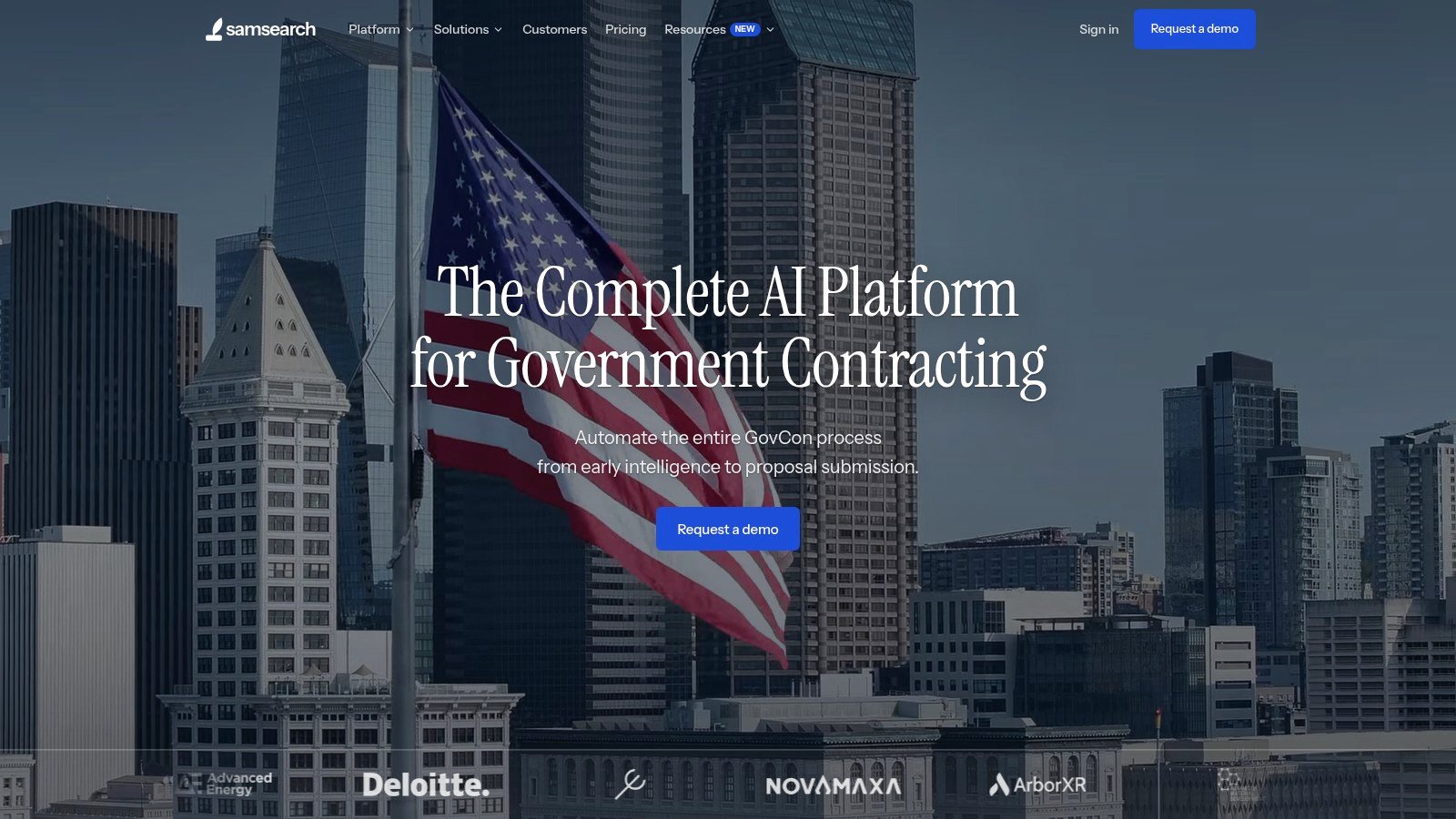
SamSearch earns the number-one position because it targets the part of the workflow that consumes the most scarce attention for small teams: turning a large notice set and a dense RFP package into an actionable bid decision.
Best for fast federal opportunity qualification
SamSearch monitors SAM.gov opportunities, supports scheduled searches and alerts, and matches notices to a company's capabilities. That approach fits the official structure of the federal system, which includes pre-solicitation, solicitation, award, and sole-source notices, with filtering by NAICS code, set-aside status, location, small-business events, and vendor collaboration (SAM.gov opportunities).
The practical advantage is workflow compression. Instead of stopping at keyword discovery, a small team can move from opportunity match to RFP summary, compliance outline, and draft response inside one operating flow. SamSearch also adds a lightweight GovCon CRM, pursuit tracking, company profiles, buyer profiles, and award or pricing context.
Practical rule: Treat an AI match as a prioritization signal, not a bid recommendation. Verify the NAICS, set-aside, place of performance, period of performance, amendments, and actual qualification requirements before assigning proposal work.
The platform's main trade-off is pricing uncertainty. Pricing isn't publicly listed, so buyers must request a demonstration and quote. Non-federal coverage is also still developing, which makes SamSearch a stronger choice for federal-focused teams than for organizations whose pipeline is primarily state, local, or education.
For a solo operator or small capture team, those limitations are often outweighed by lower implementation friction. SamSearch doesn't require a large services engagement to begin organizing pursuits, and its AI workflows address both discovery and response execution. The verdict is clear: choose it when your team needs to read fewer irrelevant notices, make faster bid/no-bid decisions, and produce a usable first response without adopting an enterprise system.
2. Civio
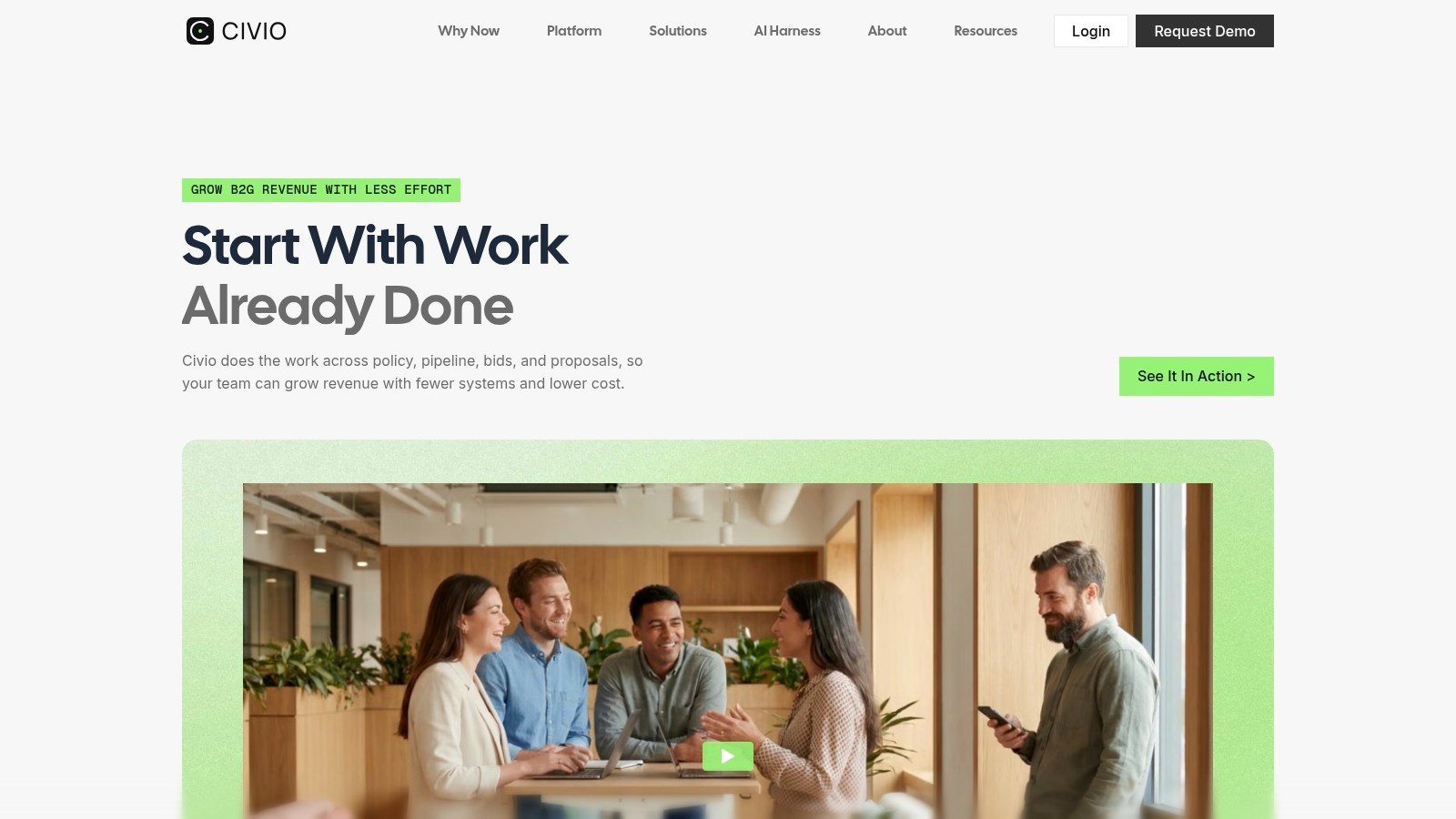
Civio takes the number-two spot because it brings an AI-first approach to federal opportunity research, qualification, and document analysis for teams that want more speed than traditional trackers usually provide.
Best for AI-powered federal opportunity research
Civio is a fit for contractors that want to reduce manual research across notices, supporting documents, and pursuit context. Its appeal is similar to other newer GovCon platforms that use AI to help teams identify relevant opportunities, surface key details faster, and move from raw solicitation data into next-step decisions with less administrative drag.
That makes Civio especially relevant for small and mid-sized federal contractors that do not want to rely only on keyword searches or legacy interfaces. A team evaluating multiple live opportunities can benefit from quicker summarization, easier document review, and a more modern operating experience than older research tools often provide.
The main trade-off is the same one buyers should apply to any AI-heavy platform: they need to test output quality against real solicitations. Summaries, extracted requirements, and recommendations should be checked for amendment handling, eligibility criteria, and source traceability before they shape a bid decision. Buyers should also confirm pricing, federal coverage depth, export controls, and collaboration features during the sales process.
Civio is not ranked above SamSearch because the article's primary benchmark is end-to-end usability for fast qualification plus response execution in small teams. Still, it clearly belongs near the top of the market for buyers that want an AI-centered federal research workflow. The verdict: choose Civio when modern AI-assisted opportunity analysis is more important than legacy analyst coverage or a heavyweight enterprise suite.
3. Deltek GovWin IQ
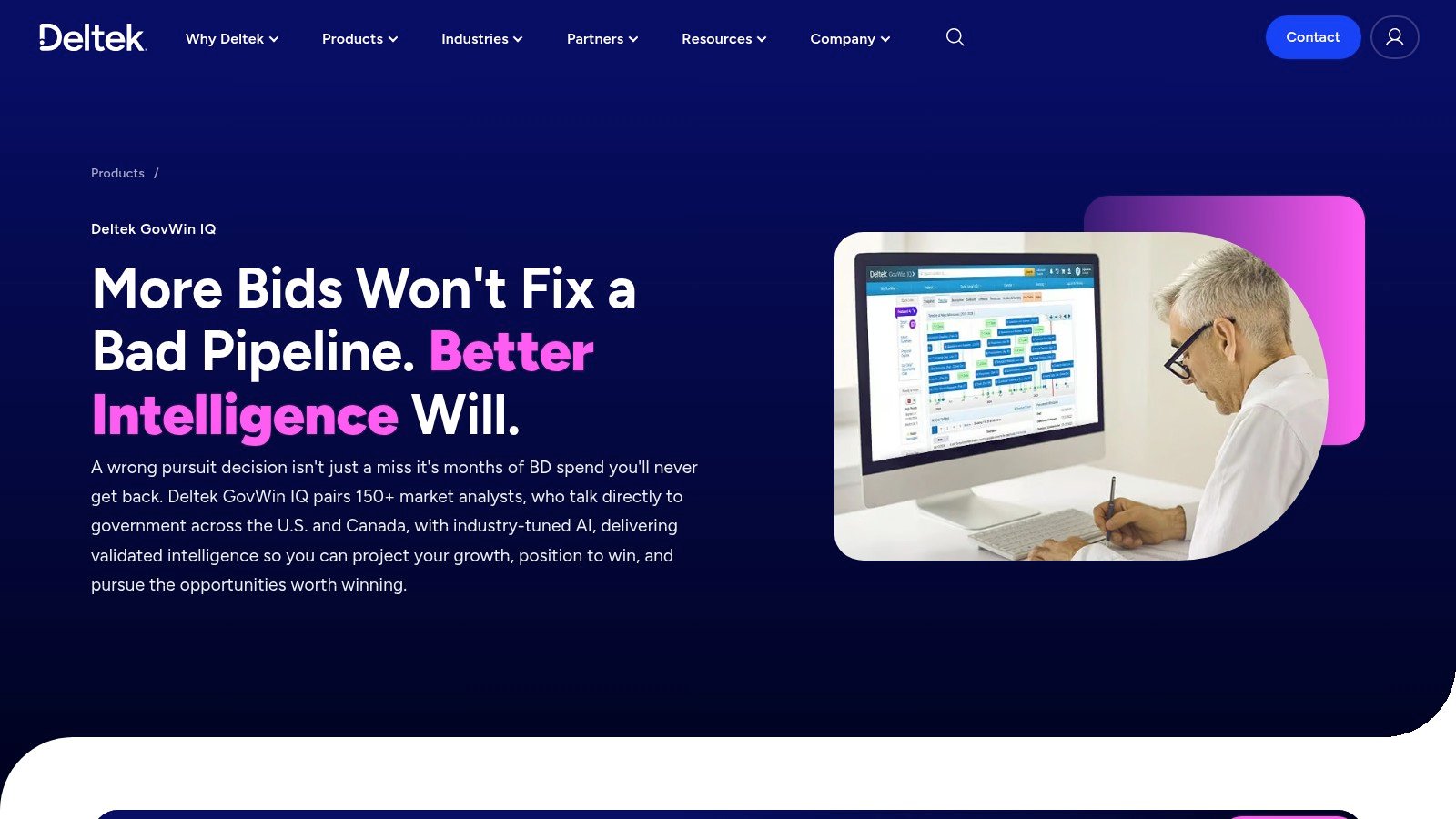
Deltek GovWin IQ is the strongest alternative for enterprise primes that need analyst-backed forecasting, broad market coverage, and long-range pipeline visibility before a solicitation becomes active.
Best for pre-RFP forecasting and scale
GovWin's value sits upstream of the live RFP. Its forecasts, analyst notes, opportunity and vehicle intelligence, incumbent analysis, teaming discovery, federal coverage, and SLED modules support account planning well before a proposal deadline appears. That matters when a contractor needs to shape a pursuit, identify partners, monitor recompetes, or connect a target opportunity to a wider agency strategy.
The platform also connects with Deltek's broader ERP and CRM ecosystem. That can reduce data fragmentation for organizations already standardized on Deltek, but it can increase implementation effort for firms using a different operating stack. Emerging AI features can help generate outlines and question-and-answer content from source documents, though the platform's central differentiator remains analyst-supported market intelligence rather than an AI-native proposal workflow.
Large contractors should also separate coverage depth from workflow simplicity. GovWin can support complex capture organizations, but a small business may pay for analyst breadth, modules, seats, and governance capabilities it won't use every day. Pricing isn't public, and the usual buying motion is a quote-based enterprise conversation.
GovWin is most defensible when a missed pre-RFP signal costs more than a heavier system can justify.
A useful independent perspective is available through this government-contracting software review resource, but buyers should still test the platform against their own agencies, NAICS codes, contract vehicles, and pursuit stages. The verdict: GovWin is the better fit than SamSearch for enterprise primes that need deep forecasting and broad federal/SLED intelligence. It isn't the default choice for a one-person shop that mainly needs fast solicitation interpretation and response drafting.
4. GovTribe
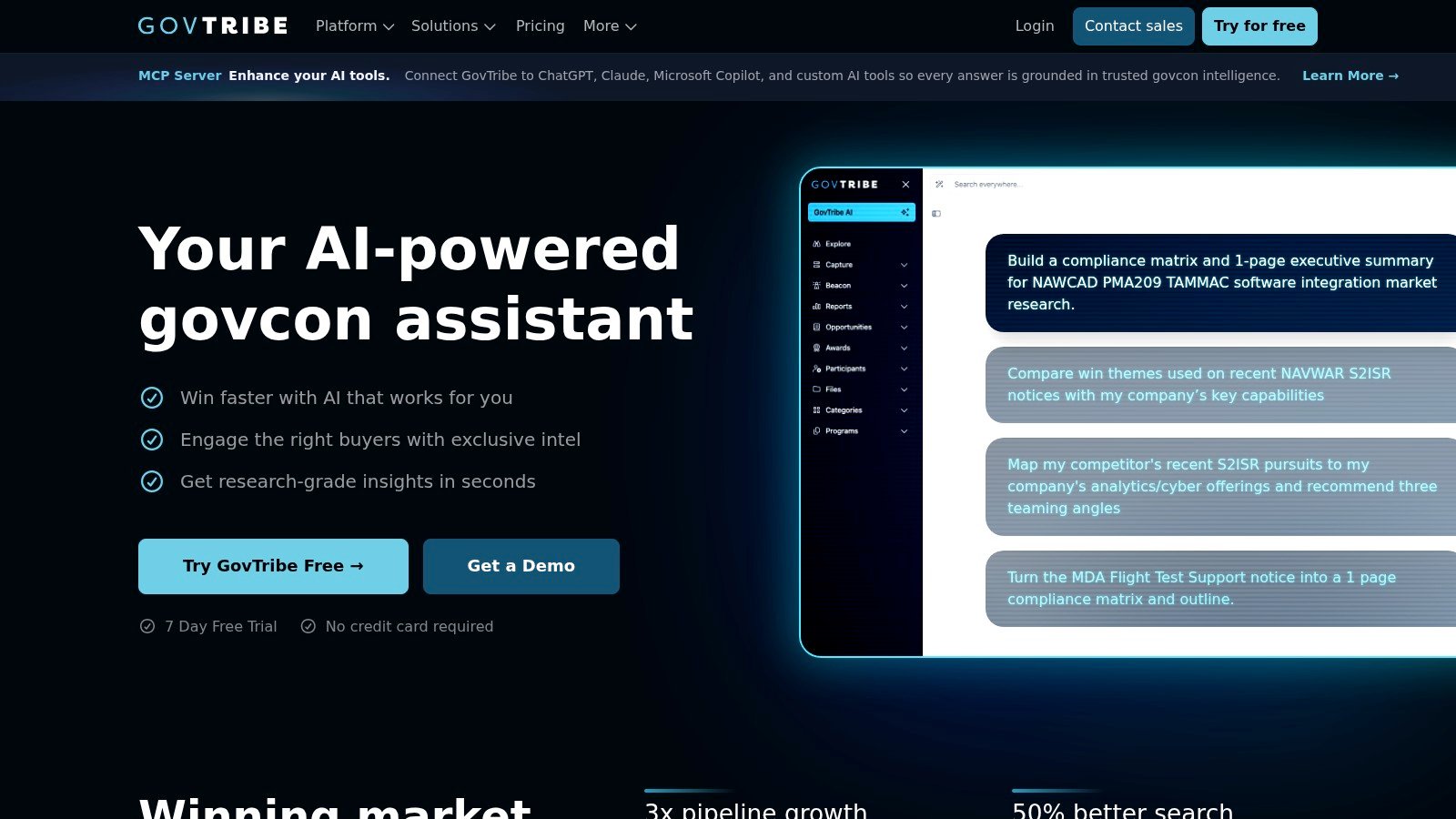
GovTribe is the accessible option for small and mid-sized teams that want federal and SLED opportunity and award search, alerts, buyer and vendor profiles, pursuits, teaming tools, and integrations without adopting a heavyweight analyst platform.
Best for quick deployment and practical search
GovTribe's appeal is operational speed. A team can search opportunities and awards, organize pursuits, investigate buyers and vendors, and connect workflows through tools such as Zapier and Unanet. AI and MCP capabilities are available through metered credits, which gives users flexibility but also means usage can create incremental cost.
That pricing design changes how teams should evaluate the product. A low entry commitment may look attractive, but active users should estimate how often they'll invoke AI features, how many contacts they need to export, and whether lower-tier limits will restrict business-development work. Transparent pricing and a real free trial reduce initial evaluation friction, but the total cost still depends on usage and plan selection.
GovTribe is especially useful when the team already understands its target market and needs a clean research-to-pipeline workflow. It doesn't offer the same analyst depth as GovWin, and it won't replace a mature proposal governance system for teams that require formal compliance controls, assigned review gates, and extensive auditability.
Its federal strength also matters. SLED functionality broadens the use case, but buyers should validate coverage by state, agency type, NAICS, and acquisition pathway rather than assume every market is equally represented.
A practical government contracting software comparison archive can help frame alternatives, but the decisive test is hands-on: run the same target profile through GovTribe and another finalist, then compare relevant matches, false positives, exports, and amendment handling.
The verdict: GovTribe is a strong value choice for teams that prioritize accessible deployment, search, teaming, and pipeline management. It loses ground when the buyer needs human-validated forecasting, deep policy context, or unlimited AI usage.
5. HigherGov
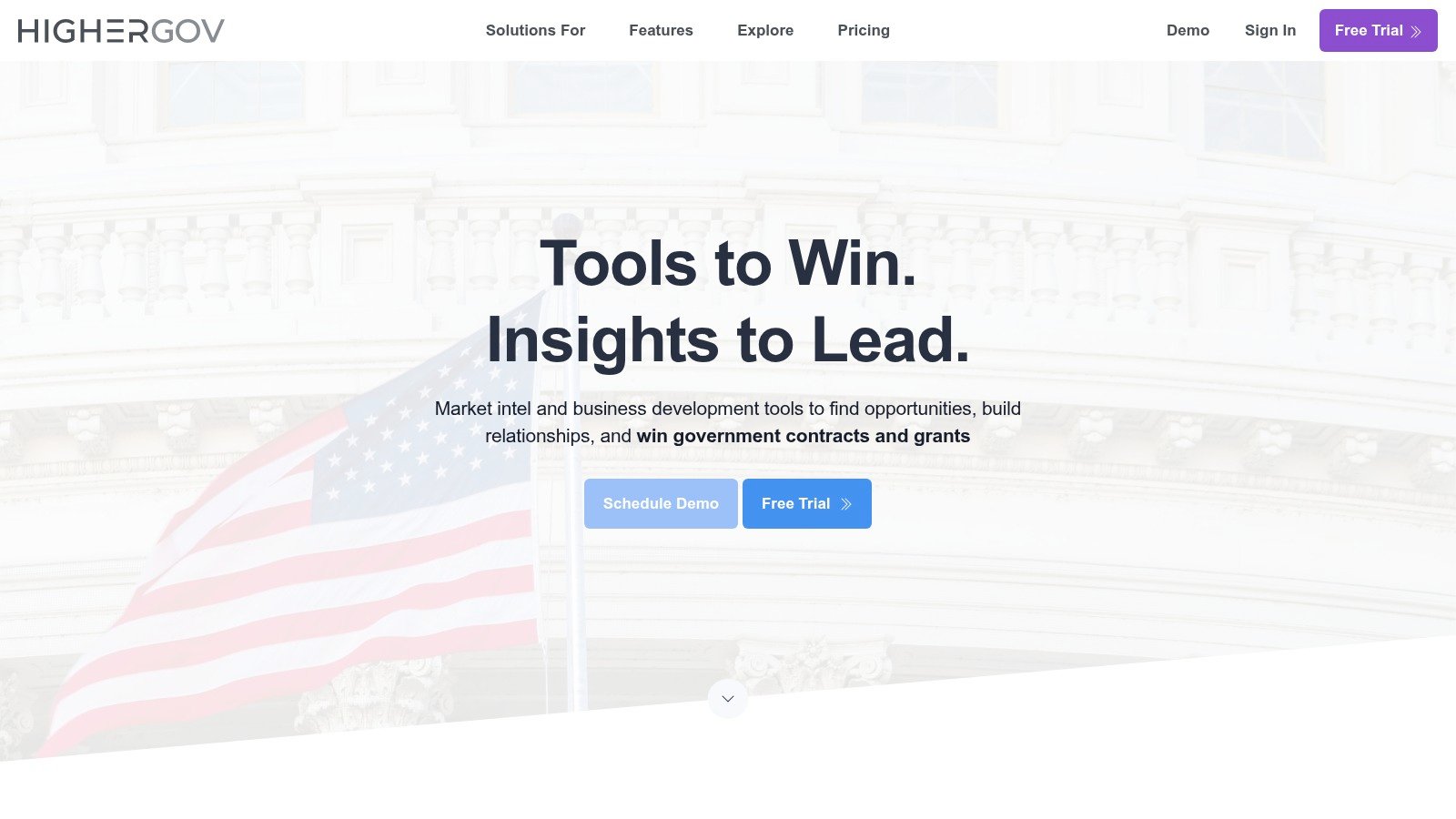
HigherGov is built for cost-conscious small and mid-sized contractors that need practical intelligence rather than a large analyst operation. Its combination of opportunity and recompete tracking, alerts, vendor and agency profiles, exports, team sharing, and benchmarking makes it useful for teams building a repeatable research habit.
Best for pricing context and growing collaboration
HigherGov's clearest differentiator is its benchmarking orientation. Labor-rate and price comparison tools, available on the Standard plan or higher, can give capture managers useful context when they're assessing competitive positioning. That doesn't determine a bid price by itself, but it can improve the questions a team asks about incumbents, labor categories, and likely market expectations.
The platform also supports team sharing and SSO on higher tiers. That makes it more suitable for a growing group than a purely individual research tool, although buyers should confirm which exports, downloads, sharing controls, and administrative features are included in their selected plan.
Pricing transparency is mixed. The official pricing page can be difficult to locate, and published figures may come through third-party comparisons rather than a clear vendor-led price sheet. A procurement team should request current terms directly and confirm whether access limits apply to users, exports, records, or specific benchmarking features.
HigherGov's limitation is forecasting depth. It can help teams track opportunities, recompetes, agencies, vendors, and pricing signals, but it isn't positioned as a substitute for the analyst coverage associated with GovWin. It also doesn't offer the same AI-native solicitation-to-draft workflow as SamSearch.
this GovCon software FAQ resource
The verdict: choose HigherGov when benchmarking, practical alerts, and team sharing matter more than analyst-led pre-RFP intelligence. It fits an expanding SMB that needs more structure than spreadsheets but doesn't yet need a full enterprise capture suite.
Top Government Contract Intelligence Platforms, 5-Tool Comparison
| Solution | Implementation complexity | Resource requirements | Expected outcomes | Ideal use cases | Key advantages |
|---|---|---|---|---|---|
| SamSearch | Low, AI-native, fast ramp | Mid-size to enterprise teams; minimal IT; demo-based pricing | Automated RFP analysis, compliance outlines, draft responses, pursuit tracking | Mid-size to enterprise teams needing rapid RFP workflows | Rapid onboarding; strong usability; AI reduces RFP reading time |
| Civio | Low-Medium, modern AI-centered deployment | SMB and mid-market federal teams; quote-based evaluation | Faster opportunity research, solicitation review, and AI-assisted qualification | Teams wanting a modern federal research workflow with AI support | AI-first experience; efficient research and document review |
| Deltek GovWin IQ | High, enterprise deployment and integrations | Enterprise teams; significant budget (typically five-figure+); analyst corps | Analyst-validated forecasts, long-term pipeline visibility, deep SLED/federal data | Large primes and teams needing analyst-backed forecasting and ERP/CRM integration | Deepest analyst coverage and forecasting; broad SLED/federal datasets |
| GovTribe | Low-Medium, fast deployment | SMBs; transparent pricing; free trial; metered AI credits | Quick opportunity search, pipelines, teaming data, CRM integrations | Small to mid-size GovCon teams seeking fast deployment and value | Clear pricing and trial; strong value and rapid time-to-use |
| HigherGov | Low-Medium, straightforward setup | Cost-sensitive SMBs; plan limits on exports/features; SSO on higher tiers | Alerts, pursuit tracking, labor-rate and price benchmarking | Small/mid contractors needing practical benchmarking and team sharing | Good SMB value; benchmarking and team features for growing teams |
Choose the platform that matches your growth stage
The best platform isn't the one with the longest feature list. It's the one that removes your most expensive bottleneck without forcing the team to adopt a process it can't sustain.
For solo operators and small teams, SamSearch should be the default starting point. Its number-one position comes from the combination of AI-assisted opportunity matching, solicitation summaries, compliance outlines, response drafting, pursuit tracking, and award or pricing context. That combination addresses the full path from finding a notice to deciding whether to pursue it and preparing an initial response. Validate the output against the source solicitation, especially amendments, eligibility, and mandatory requirements.
Choose Civio when your team wants a modern AI-assisted federal research environment that can speed up opportunity review and qualification. It belongs near the top of the list for buyers that care more about fast document understanding and AI-centered workflows than traditional analyst infrastructure.
Choose Deltek GovWin IQ when pre-RFP forecasting, analyst-backed research, federal and SLED breadth, and Deltek ecosystem integration justify a heavier enterprise commitment. Its value increases when multiple specialists use the information to shape long-cycle pursuits.
GovTribe is the accessible deployment choice for teams that want searchable opportunity and award data, pipelines, teaming, integrations, and a free-trial path. Its metered AI credits and lower-tier contact or export limits need careful modeling. HigherGov fits budget-conscious teams that value opportunity tracking, recompete alerts, labor-rate and price benchmarking, and team sharing.
AI should be evaluated as a control system, not a marketing label. Deltek's research found that 97% of surveyed contractors identified at least one AI benefit, including faster drafting, better opportunity identification, and improved proposal quality (Deltek's government contracting study). Separately, the GAUGE survey from Unanet and CohnReznick reported AI use for compliance rising from 14% to 36% (GAUGE survey coverage). Those figures support testing extraction accuracy, citation traceability, amendment handling, human review, and time to create a review-ready compliance matrix.
Map your current workflow before scheduling demos. Identify whether the most expensive bottleneck is discovery, pre-RFP visibility, solicitation reading, pricing context, capture coordination, or proposal compliance. Then verify current pricing, federal and SLED coverage, exports, permissions, integrations, and implementation support. Finally, run each finalist against a real opportunity and require the team to produce a bid/no-bid decision, source-linked requirements list, assigned capture actions, and response outline before committing.
FAQ
What is government contract intelligence software?
Government contract intelligence software helps contractors find opportunities, research agencies and incumbents, track recompetes, analyze solicitations, and manage capture or proposal workflows. The best platforms turn raw procurement data into a practical decision process for bid qualification and response planning.
Which platform is best for AI-assisted federal opportunity analysis?
SamSearch ranks first in this list because it combines opportunity matching, solicitation analysis, compliance support, and response drafting in one workflow. Civio ranks second for teams that want a modern AI-assisted research experience focused on faster federal opportunity review.
Which tool is best for pre-RFP forecasting?
Deltek GovWin IQ is the strongest fit for contractors that need analyst-backed forecasting, early pipeline visibility, and broader federal and SLED market intelligence before a live solicitation is released.
Which platform is best for small and mid-sized teams?
GovTribe and HigherGov are both strong options for small and mid-sized contractors. GovTribe stands out for accessible deployment and search workflows, while HigherGov is useful for benchmarking, recompete tracking, and team sharing.
How should buyers evaluate AI features in GovCon software?
Buyers should test whether AI outputs are source-linked, accurate, and easy to review. Focus on amendment handling, eligibility checks, compliance extraction, false positives, and whether the tool actually reduces time to a review-ready bid or no-bid decision.
Is pricing transparent across these platforms?
No. Some tools offer clearer trials or plan structures, while others require a quote-based sales process. Buyers should confirm current pricing, seat limits, export rules, AI usage limits, and implementation support before making a decision.
GovCon Reviews publishes practical reviews, rankings, and comparisons for contractors choosing bid trackers, capture platforms, proposal tools, and market-intelligence systems. Visit GovCon Reviews to compare platforms by workflow fit, pricing trade-offs, implementation effort, and real GovCon use cases before you buy.
Related analysis
Top 8 Government Contract Management Software Platforms
Top 8 government contract management software platforms for 2026, ranked by use case, features, pros, cons, and fit for federal contractors.
7 Best HigherGov Alternatives for Federal and SLED Contractors
Compare the 7 Best HigherGov Alternatives for Federal and SLED Contractors, including AI, federal intelligence, SLED coverage, pricing, and best-fit use cases.
Top 9 Government Contract Discovery Tools
Compare the top 9 government contract discovery tools for SAM.gov searches, alerts, AI fit scoring, market intelligence, and capture decisions.