Top 9 Government Contract Discovery Tools
Compare the top 9 government contract discovery tools for SAM.gov searches, alerts, AI fit scoring, market intelligence, and capture decisions.
Finding federal opportunities is not a contest to collect the most search results. A large feed can still produce a weak pipeline if it misses sources-sought notices, buries relevant set-asides, fails to preserve amendments, or sends a contractor toward work it cannot legally or practically pursue. The better workflow starts with SAM.gov's official contracting data, then adds disciplined NAICS, PSC, set-aside, keyword, and place-of-performance filters, notice interpretation, alerts, and bid/no-bid triage.
The market makes that discipline necessary. Small businesses account for 99.9% of American businesses, representing 34,752,434 firms, and employ approximately 59 million people, or 45.9% of the workforce, according to the U.S. Small Business Administration. Yet federal procurement operates through structured eligibility rules, agency buying patterns, contract vehicles, and certification categories. This comparison evaluates the Top 9 Government Contract Discovery Tools by discovery depth, search design, notice interpretation, alerting, usability, exports, and capture activation. The ranking places SamSearch at number 1 and Civio.ai at number 2, while each alternative earns its position for a distinct buyer need.
1. SamSearch
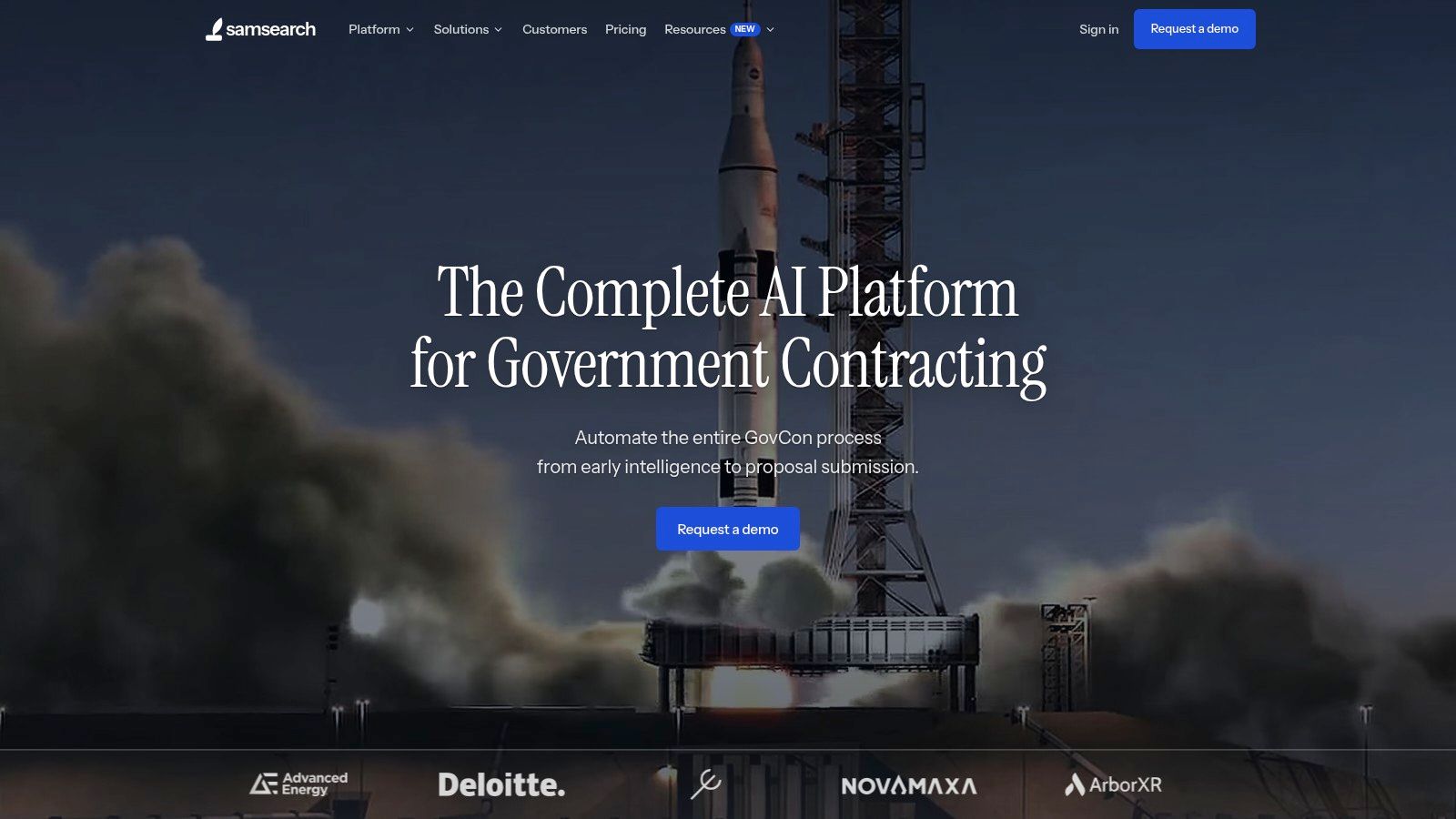
SamSearch is the strongest choice when discovery is only the first step in a larger federal contracting workflow. Its AI-powered platform is designed to monitor SAM.gov and other sources, analyze solicitation documents, compare requirements with a contractor's capabilities and certifications, and move qualified pursuits into capture and proposal work. That makes it materially different from a notice database that leaves users to interpret every attachment manually.
Best use case
SamSearch fits mid-market and enterprise GovCon teams that need to make faster bid/no-bid decisions without separating business development, proposal, and delivery systems. Its fit matching can extract requirements, dates, set-aside information, and apparent risks from solicitation documents. Proposal assistance can then support outlines, drafts, checklists, and response preparation, while scheduled searches, alerts, and GovCon CRM-style tracking keep the opportunity connected to ownership and next actions.
That workflow matters because federal opportunity data extends beyond active bids. SAM.gov includes pre-solicitation, solicitation, award, and sole-source notices, and supports filters such as NAICS code, set-aside status, location, and related attributes, as described in SAM.gov's contracting guidance. SamSearch's value is in adding interpretation and execution around that official baseline.
Practical rule: Use SamSearch when your constraint is not finding notices, but deciding which ones deserve proposal labor and keeping those pursuits moving.
Trade-offs
The main drawback is commercial uncertainty. Pricing isn't listed publicly, so buyers need a quote or demonstration before comparing total cost with legacy platforms. The ecosystem is also newer, with fewer third-party integrations than established enterprise incumbents. Teams should test document extraction, source traceability, amendment handling, exports, and integrations against real solicitations before committing.
Verdict: The best fit for contractors that want AI-assisted opportunity qualification, solicitation analysis, proposal support, and capture management in one environment.
2. Civio.ai
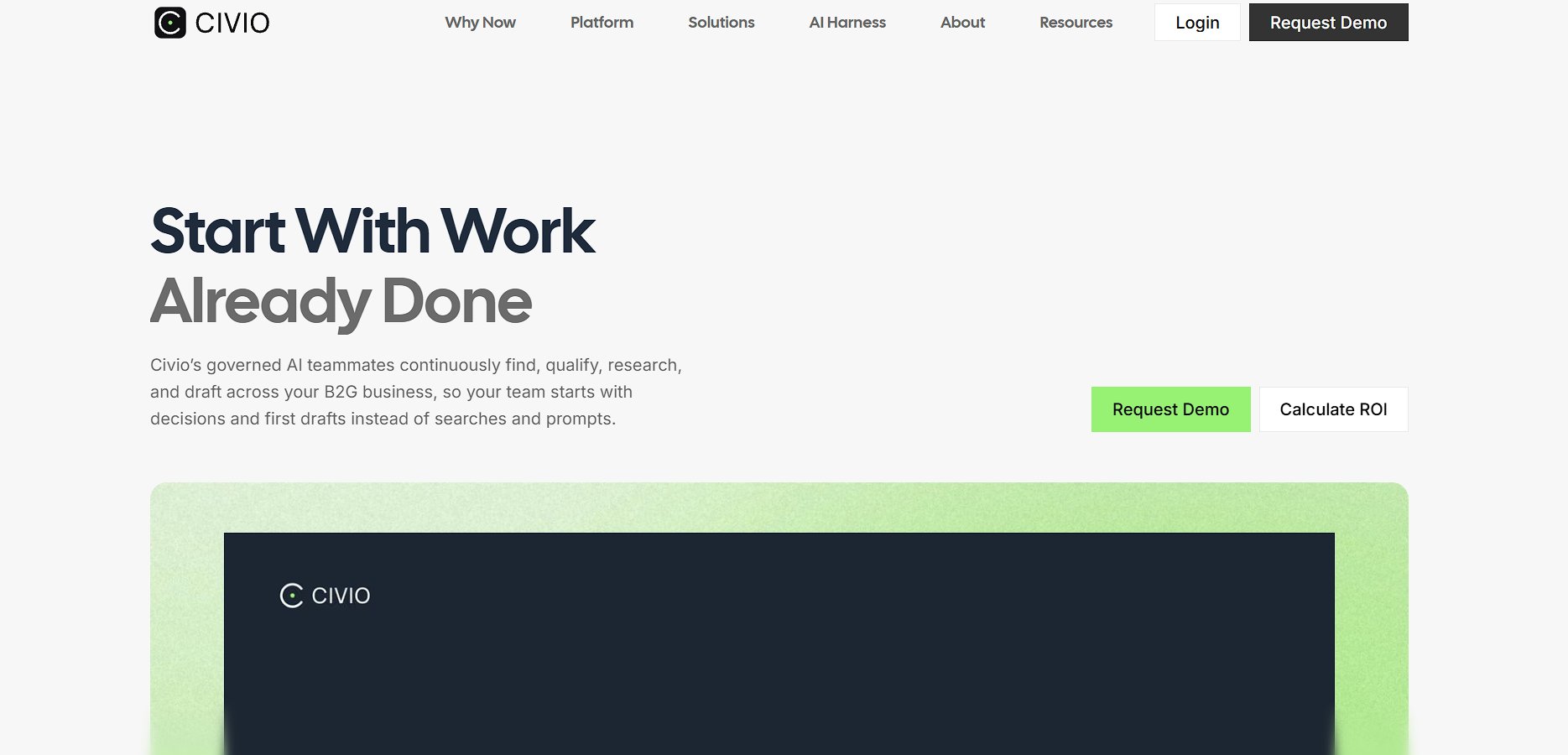
Civio.ai is designed for contractors that want AI assistance near the top of the funnel. Its role in this comparison is distinct from the official source and from analyst-heavy enterprise platforms. The appeal is a modern workflow for discovering, qualifying, and routing federal opportunities without requiring a team to build its own interpretation layer around raw notices.
Best use case
Civio.ai fits organizations that want AI-supported federal opportunity research and early qualification. A contractor can use that type of workflow to reduce manual first-pass review, identify opportunities that deserve capture attention, and give business development users a more structured way to assess relevance. For lean teams, speed at this stage can matter more than extensive policy research or a large analyst organization.
The important test is not whether an interface labels itself AI-native. It is whether the system shows the evidence behind a match. An AI recommendation should identify the solicitation language supporting its fit assessment, distinguish mandatory requirements from explanatory material, preserve amendment changes, and let a human reviewer export an auditable checklist. Those controls matter because small businesses face substantial compliance work. SBA materials report that federal paperwork costs small businesses more than $81 billion annually, while small businesses received 28.78% of eligible prime-contract dollars in FY2024, as documented in the SBA's 2026 small-business FAQ.
Trade-offs
Civio.ai is less appropriate for buyers seeking extensive analyst-curated pre-RFP research, deep policy coverage, or a mature enterprise integration ecosystem. It also should not be trusted as an eligibility authority without human review and official source verification.
Verdict: A strong option for AI-assisted federal discovery and faster early-stage qualification. Test citation fidelity, amendment handling, and explainability before relying on automated fit scores.
3. SAM.gov Contract Opportunities
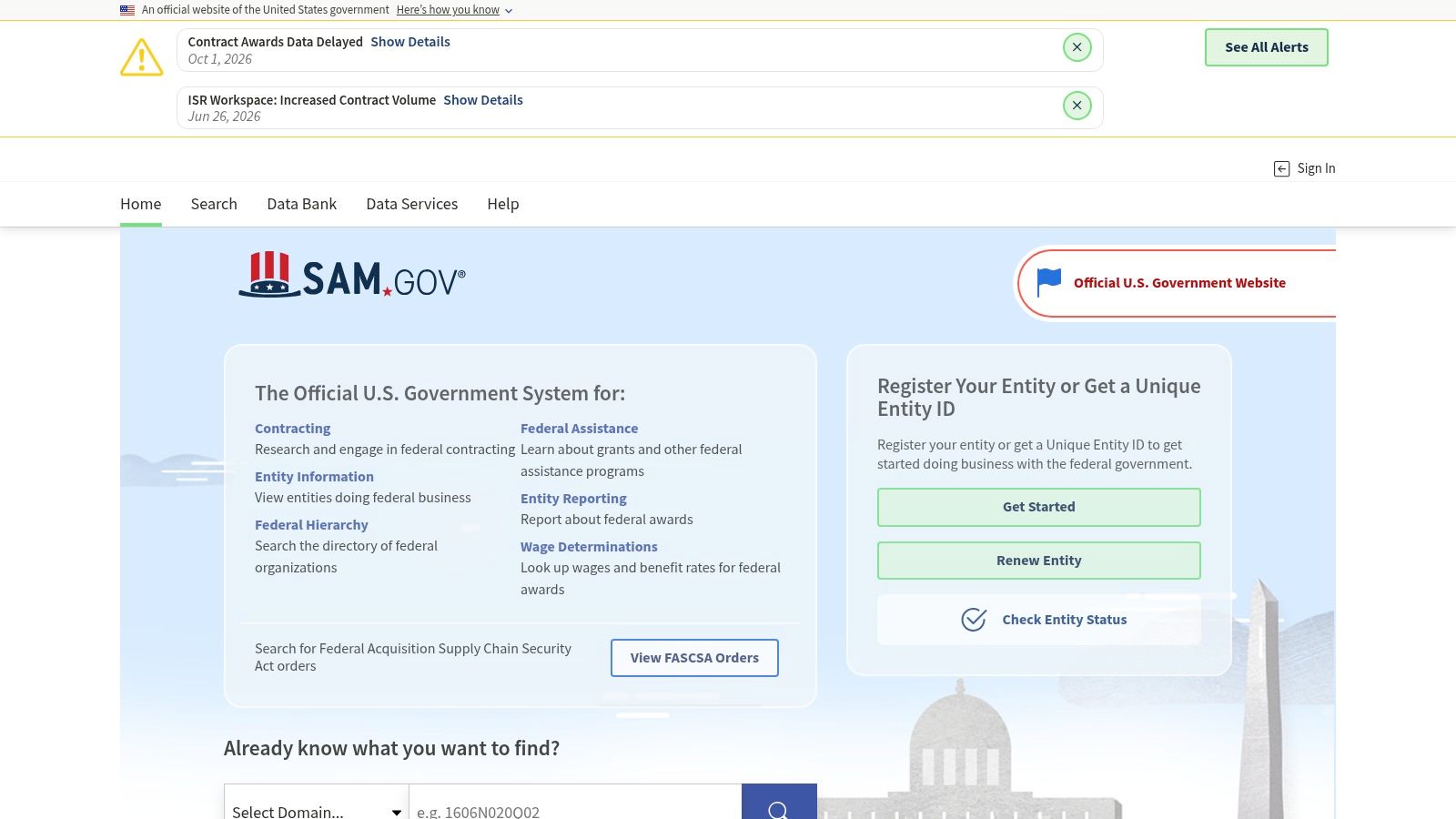
SAM.gov is the authoritative baseline, not an optional tool. Every serious federal discovery process should use it to validate notice details, amendments, dates, attachments, notice types, and official award information. Its contract-data system covers federal contract actions agencies are required to report, including actions with an estimated value of $10,000 or more, according to SAM.gov's contract-data documentation.
Best use case
SAM.gov works best for contractors that want a free, official source and are prepared to build their own operating process around it. Users can search and save criteria involving NAICS codes, set-aside status, place of performance, and notice type, then use alerts and downloadable reports to monitor changes. The platform also exposes pre-solicitation and sources-sought signals, which can arrive before a formal request for proposals.
Those early signals are strategically important. The SBA's guidance for getting started directs small businesses to use agency procurement forecasts, FPDS-NG, and USAspending.gov alongside opportunity portals. A contractor that searches only open solicitations can miss the period when agencies are shaping requirements and potential teammates are forming.
For teams learning the platform, the GovCon Reviews FAQ can provide additional context on common discovery and software-selection questions.
Trade-offs
SAM.gov's authority comes with workflow limitations. Its search and report features can feel cumbersome, and the platform does not provide an integrated capture board, proposal drafting environment, or capability-based fit analysis. Users must also distinguish opportunity data from award and spending data, then manually validate whether an apparently relevant notice fits their size status, vehicle access, clearance, staffing, and certifications.
Verdict: The required federal source of truth. Use it even when a paid platform supplies discovery, especially before investing in a high-value pursuit.
4. Deltek GovWin IQ
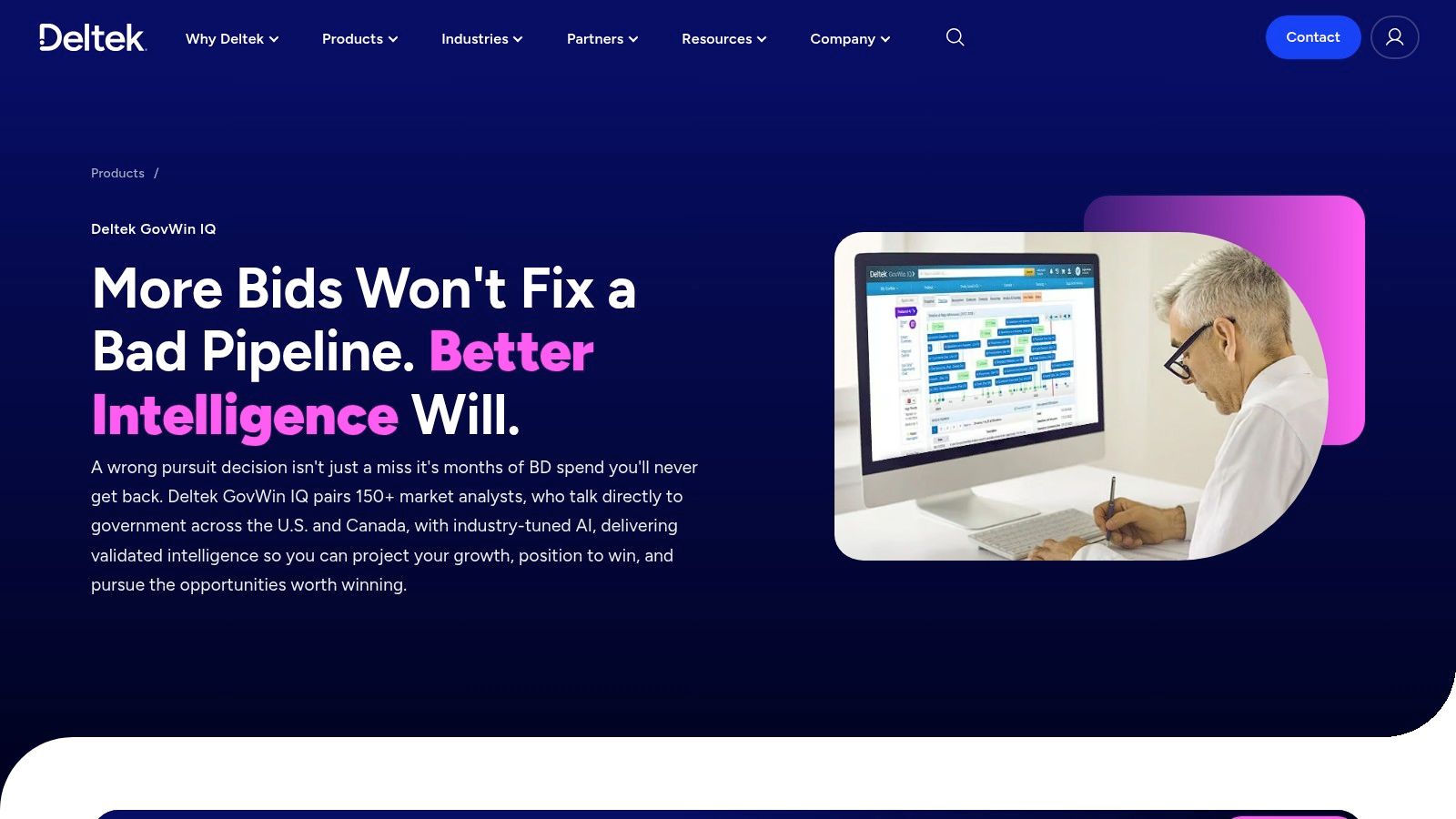
Deltek GovWin IQ is built for organizations that treat government sales as long-range capture rather than reactive bid monitoring. Its analyst-curated intelligence covers pre-RFP opportunities, forecasts, vehicles, historical context, subcontracting activity, and federal and SLED markets. The platform adds AI features such as Ask Dela, Smart Summaries, and Smart Fit Scores to make a large research environment easier to work through.
Best use case
GovWin IQ earns its position through early positioning and market context. A capture manager can study likely requirements before a formal solicitation, examine incumbent and agency patterns, identify relevant contract vehicles, and investigate possible teaming paths. That is a different job from searching for open notices. It supports account planning and helps teams decide where to invest relationship-building and capture resources.
The platform is especially useful when multiple business development, capture, and proposal users need a shared view of a target account. Analyst research can add interpretation to raw government records, while notifications and AI summaries reduce the work required to scan a broad pipeline. For organizations operating across federal and SLED markets, the wider coverage may justify the complexity.
The GovCon Reviews blog offers related buying and workflow analysis for contractors comparing discovery and bid-tracking platforms.
Trade-offs
GovWin IQ is quote-based and generally positioned toward enterprise buyers. A small contractor pursuing a narrow group of agencies or open RFPs may pay for research depth it will not use. It can also feel heavy if the team lacks a defined account strategy or enough capture capacity to act on pre-RFP information.
Verdict: The strongest choice for analyst-supported pre-RFP intelligence, account planning, and enterprise capture. It is not the best first purchase for a lean team that only needs open-bid alerts.
5. GovTribe
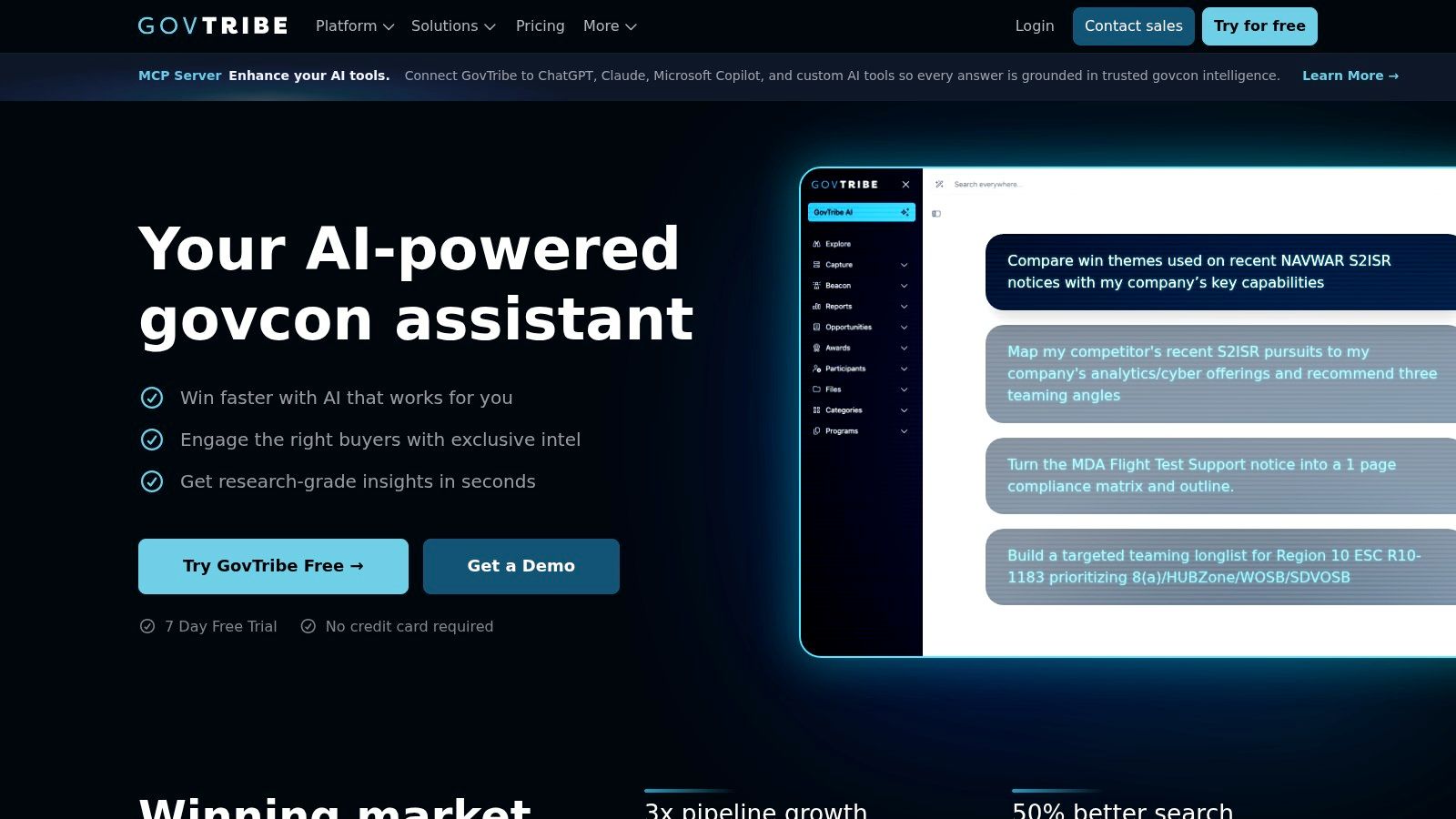
GovTribe takes a more operational approach. Its interface emphasizes search speed, saved searches, alerts, agency and competitor following, team pipelines, notes, tags, and exports. The platform also includes AI Conversations for natural-language questions backed by its data, plus MCP capabilities for connecting GovTribe information to AI tools such as ChatGPT or Microsoft Copilot.
Best use case
GovTribe suits a small or mid-market business development team that wants daily monitoring without a cumbersome research environment. Unlimited alerts and saved searches support repeated searches across target agencies, vehicles, competitors, and categories. Team features let users attach notes and tags to pursuits, which makes the platform more useful than a personal alert inbox.
Its AI functions are practical because they sit close to the underlying opportunity data. A user can ask a question in natural language, investigate an agency or competitor, and export records for another workflow. That can help teams move from monitoring to qualification without configuring a complex automation stack.
GovTribe's published pricing places its Growth Plus plan at $6,000 per year, according to the product information supplied for this comparison. That makes plan limits, users, exports, and AI usage credits important purchase questions.
Trade-offs
GovTribe provides less analyst curation than enterprise suites such as GovWin IQ or BGOV. It may not give a capture organization the same depth of proprietary research, policy analysis, or early market interpretation. Buyers should also confirm whether AI credits and export allowances fit their expected usage.
Verdict: A strong practical choice for fast monitoring, team collaboration, and AI-assisted research. It is not ideal for buyers seeking a deep analyst layer or policy-driven account strategy.
6. HigherGov
HigherGov occupies the space between a basic opportunity tracker and an enterprise intelligence suite. It combines federal and SLED opportunities, forecasts, AI tools, pursuit management, labor pricing, vendor people data, and competitive research. Its practical appeal comes from connecting market intelligence with the work a business development team performs after finding an opportunity.
Best use case
HigherGov is a good fit for teams that care about exports, APIs, imports, and flexible workflow connections. Depending on the tier, users can export between 1,000 and 100,000 records per search, while API access, Zapier, eBuy and task-order imports, and other integrations support more structured data operations. These capabilities are useful when a contractor wants to feed opportunity research into a CRM, reporting process, or internal data model rather than keep everything inside one interface.
The platform also provides live analyst support and training, including on lower tiers. That can reduce the implementation burden for a small team that needs guidance but does not have dedicated capture operations staff. Forecasts can support early positioning, while active opportunities and pursuit records give the team a place to manage near-term work.
Trade-offs
HigherGov has a smaller brand footprint than GovWin IQ or BGOV, and its analyst depth and proprietary research are lighter than those enterprise incumbents. Buyers should test data coverage across their target agencies, NAICS codes, SLED markets, and contract vehicles. Generous export capabilities will not compensate for weak relevance in a contractor's actual niche.
Verdict: A practical option for budget-conscious teams that want federal and SLED coverage, exports, APIs, forecasts, and pursuit management without starting with an enterprise-first platform.
7. Bloomberg Government
Bloomberg Government earns its place through policy context. BGOV combines procurement intelligence with congressional, appropriations, regulatory, and sector research. That makes it useful for organizations that need to understand not only which agencies are buying, but also how policy and budget decisions may shape future demand.
Best use case
BGOV is strongest for large primes, government affairs teams, and strategic capture organizations. Its Contracts Intelligence Tool supports award and spending analysis, opportunity research, and market analysis. Research, rankings, and sector reports can help teams frame agencies, competitors, and industry positions. Policy monitoring and directories connect those findings to the broader federal environment.
This combination changes the capture question. Instead of asking only whether a current solicitation matches a capability, a team can investigate the policy drivers, budget conditions, and agency priorities surrounding a market. That context can inform account plans and executive decisions before a formal opportunity appears.
Trade-offs
BGOV pricing is quote-based and typically enterprise-level. Its workflows also assume users can consume and act on substantial research. A small contractor that needs alerts, deadline tracking, and straightforward bid/no-bid decisions may find the platform too broad. It also should not replace SAM.gov validation for live notices, amendments, attachments, or official dates.
Verdict: Choose BGOV when procurement intelligence must sit beside policy, legislative, and budget analysis. Do not buy it solely for basic solicitation discovery.
8. EZGovOpps
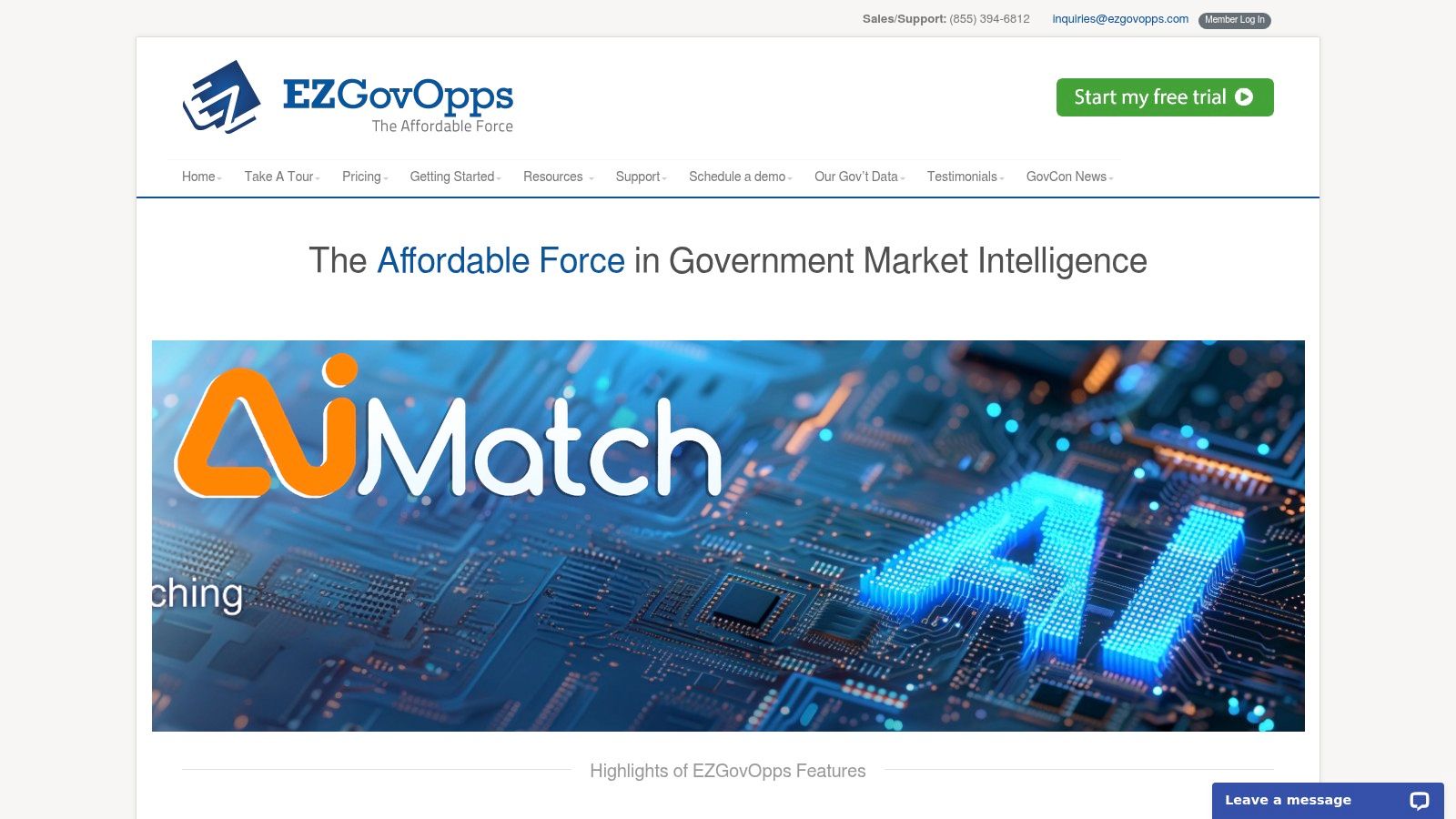
EZGovOpps is aimed at small teams that want more context than raw SAM.gov listings provide. It adds analyst research around opportunity history, incumbents, and pricing, alongside saved searches, alerts, exports, and collaborative workspaces. Its published pricing, one-time setup fee, and 5-day free trial make it easier to evaluate than a fully sales-gated enterprise platform.
Best use case
EZGovOpps works best for a solo operator or small business development team that needs analyst-added context without buying a broad enterprise suite. Notes about incumbents and historical pricing can improve the initial qualification conversation. Saved searches and alerts reduce manual monitoring, while exports and workspaces help teams share information as a pursuit develops.
The platform's value is less about advanced automation and more about reducing the gap between an official notice and a useful first assessment. A contractor can ask who appears to hold the work, whether the requirement has history, and whether the opportunity deserves further review before assigning proposal resources.
Trade-offs
EZGovOpps has a smaller data and feature surface than GovWin IQ or BGOV. Lower tiers impose per-seat limits and export credit caps, so buyers should map the plan to the number of users and records they expect to handle. Analyst notes are helpful context, but they do not establish legal eligibility. Contractors still need to verify current SAM.gov registration, size status, and solicitation requirements.
Verdict: A credible budget-conscious choice for analyst notes, incumbent context, and collaborative federal opportunity monitoring. It is not the best fit for enterprise-scale research or complex AI-assisted proposal workflows.
9. BidPrime
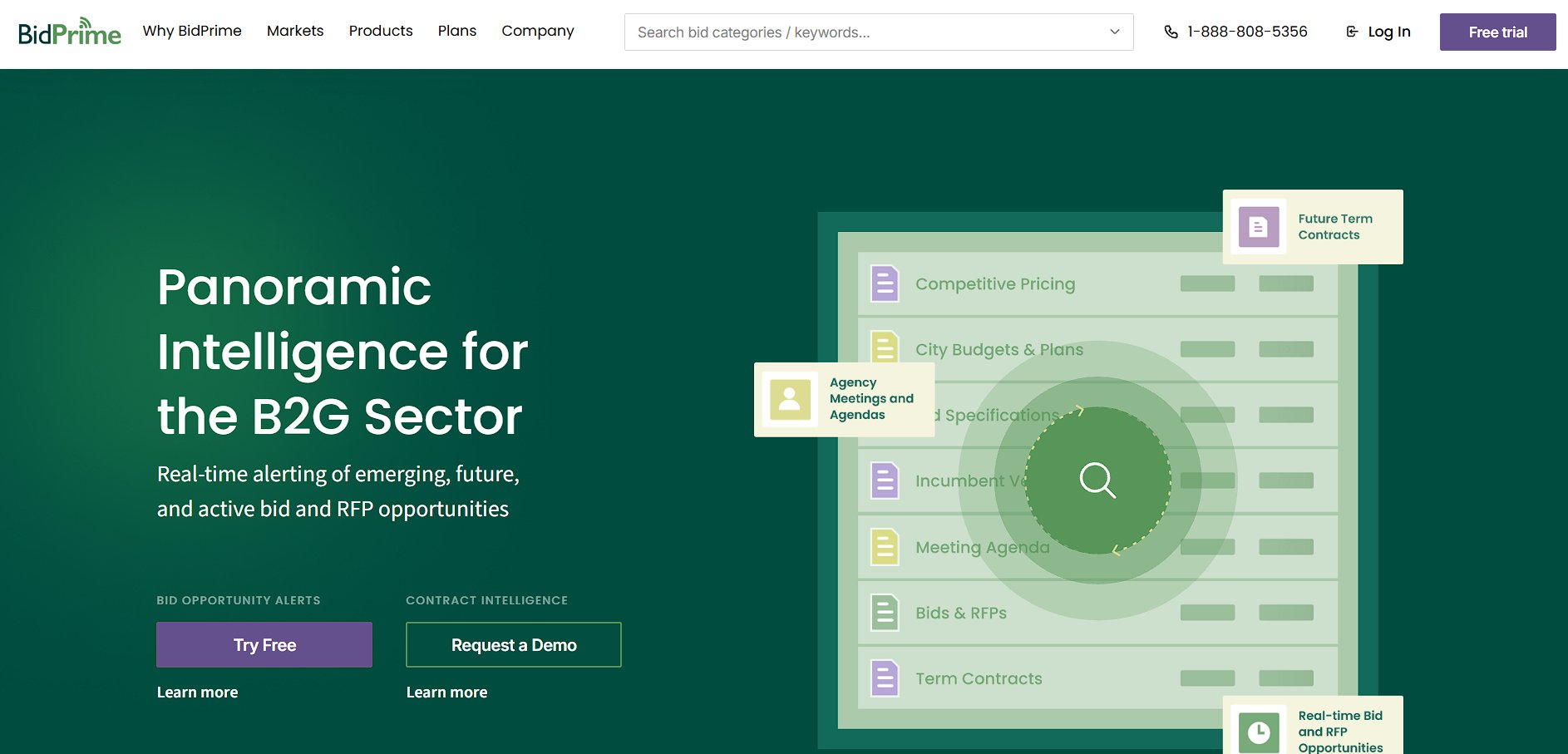
BidPrime is most relevant to contractors that need broad public-sector notice coverage, particularly across state and local markets. Federal discovery is the center of this comparison, but a contractor's revenue plan may depend on municipalities, school districts, utilities, transportation agencies, or regional buyers. For those teams, a SLED-focused platform can complement a federal workflow rather than compete with SAM.gov.
Best use case
BidPrime suits companies that win through regional coverage and recurring public-sector monitoring. Consolidating notices from fragmented local sources can reduce the need to check multiple agency procurement pages manually. Saved searches and alerts can help a team track territories, agency types, and service categories in one operating environment.
The right evaluation starts with the contractor's target map. Buyers should test the states, agencies, notice categories, and purchasing entities that matter to current revenue plans. Broad coverage has little value if the platform misses the jurisdictions or buyer types where the company can perform.
Trade-offs
BidPrime is not the natural primary tool for federal pre-RFP capture, policy analysis, or AI-assisted solicitation drafting. Contractors focused on federal agencies may get more value from SamSearch, SAM.gov, GovWin IQ, or another platform with stronger federal qualification and capture functions. A SLED-heavy organization should still validate each notice against the issuing agency's official source and track amendments through the procurement authority.
Verdict: A reasonable choice for broad SLED notice discovery and recurring public-sector bid monitoring. It should not be the only platform for a complex federal capture strategy.
9-Tool Comparison: Government Contract Discovery Platforms
| Platform | Implementation complexity | Resource requirements | Expected outcomes | Ideal use cases | Key advantages |
|---|---|---|---|---|---|
| SamSearch | Low-Medium (AI-native, quick onboarding) | Paid (quote-based), mid-market to enterprise team friendly | Faster bid/no-bid decisions, automated drafts, unified capture-to-delivery | Mid-market and enterprise GovCon teams accelerating proposals | AI fit-matching, solicitation parsing, integrated capture workflows |
| Civio.ai | Low-Medium (AI-first workflow) | Paid, lean team friendly | Faster early qualification and structured opportunity triage | Teams prioritizing AI-assisted discovery and first-pass review | AI-supported qualification, structured triage, explainable fit review |
| SAM.gov (Contract Opportunities) | Low (public portal, learning curve for filters) | Free, time to learn filters and reports | Authoritative opportunity discovery and official reports | Baseline federal opportunity research and compliance | Official source of record, robust filters and exportable data |
| Deltek GovWin IQ | High (enterprise setup, analyst workflows) | Enterprise budget, training and integrations | Deep pipeline forecasting and pre-RFP positioning | Large firms needing analyst-curated pipeline strategy | Broad analyst coverage, historical context, enterprise integrations |
| GovTribe | Medium (user-friendly, fast setup) | Paid (higher entry tiers), team workflows | Rapid monitoring, alerts, and AI-backed queries | Teams needing fast daily monitoring and AI integration | Clean UI, practical AI features, unlimited alerts and saved searches |
| HigherGov | Medium (practical BD tools, exports/API) | Lower-cost tiers, API/Zapier and live analyst support | Affordable market intel with robust exports and pursuit management | Budget-conscious teams needing exports, APIs, and support | Transparent pricing, large export limits, included analyst help |
| Bloomberg Government (BGOV) | High (research-heavy, enterprise focus) | Enterprise-level pricing, research resources | Strategic procurement plus policy insights and detailed analytics | Teams tying procurement intelligence to policy and appropriations | Procurement analytics combined with congressional and policy tracking |
| EZGovOpps | Low (straightforward setup) | Budget-friendly with published pricing, tier limits | Structured opportunity intel with analyst context and exports | Solo users and small teams wanting affordable intelligence | Transparent pricing, analyst notes, simple exports and workspaces |
| BidPrime | Low-Medium (broad public-sector monitoring) | Paid, strongest for regional public-sector teams | Consolidated SLED notice discovery and recurring bid monitoring | Contractors focused on state and local agency coverage | Broad public-sector aggregation, saved searches, recurring alerts |
Turn Search Results Into Capture Decisions
The right tool depends on where the pipeline breaks. If the problem is access to authoritative federal notices, amendments, due dates, and award records, start with SAM.gov. Its contract data covers a broad universe of reportable federal actions, and its opportunity system includes pre-solicitations, solicitations, awards, and sole-source notices. Paid platforms can make that information easier to search and interpret, but they do not replace official validation.
Choose SamSearch when AI-assisted fit analysis and an integrated workflow matter most. It is the clearest match for teams that need to read solicitations faster, extract requirements and risks, compare opportunities with capabilities and certifications, and move qualified work into capture and proposal execution. The main questions are commercial and operational: confirm pricing, test integrations, and verify that the system gives reviewers enough source evidence to audit recommendations.
Choose Civio.ai when AI-assisted discovery and early-stage qualification are the top priorities. It is especially relevant for teams that want to reduce manual first-pass review and route stronger opportunities into deeper capture work without adopting a large analyst platform.
The alternatives solve different problems. Choose Deltek GovWin IQ for analyst-supported pre-RFP intelligence, forecasted vehicles, and enterprise account planning. Choose GovTribe for fast monitoring, saved searches, team pipelines, and practical AI connections. Choose HigherGov when exports, APIs, imports, federal and SLED coverage, and accessible pursuit management matter. Choose BGOV when procurement research must connect to policy, legislation, and budget context. EZGovOpps is better suited to smaller teams that want analyst notes and incumbent context without an enterprise research environment. BidPrime fits contractors with a broad SLED monitoring requirement.
Set-aside intelligence deserves particular attention. SBA guidance says contracts from $15,000 through $350,000 are automatically and exclusively set aside for small businesses, while contracts valued at $350,000 or more must be set aside when the contracting officer expects at least two capable small-business bidders. Agencies must first consider 8(a), HUBZone, service-disabled veteran-owned, and women-owned small-business set-asides, and SBA identifies 8(a) sole-source ceilings of up to $7 million for manufacturing acquisitions and $4.5 million for other acquisitions, subject to applicable conditions, as explained in SBA contracting-official guidance. A discovery system that hides those distinctions creates wasted proposal work.
Use a repeatable operating sequence:
Validate the notice: Confirm the official SAM.gov record, attachments, amendments, notice type, and current deadline.
Record the requirements: Capture mandatory provisions, deliverables, place of performance, contract vehicle, security conditions, and submission instructions.
Assess fit: Check technical capability, NAICS applicability, size status, socioeconomic certification, past performance, staffing, and pricing capacity.
Assign the decision: Give one accountable person responsibility for the bid/no-bid recommendation and its rationale.
Activate capture: Move qualified opportunities into a pursuit record with owners, milestones, teaming actions, questions, and proposal tasks.
Review the source data: Treat match scores and company profiles as leads, then verify high-value targets against current SAM.gov records.
GAO found that no single federal system was designed to link small-business subcontractors to prime contracts. Its review also found that small-business status could not be determined for 16% of subcontractors because the entities were not registered in SAM or had not updated their registration, according to the GAO report on small-business subcontracting data. That limitation applies to tool evaluation: enrichment can improve workflow speed, but it cannot eliminate gaps in government data.
The best discovery platform is not the one with the largest database claim. It is the one that exposes useful signals early, helps a human reviewer qualify them, preserves source evidence, and keeps the right opportunities moving through capture. Before buying, run a short test with real notices from target agencies and NAICS codes. Measure relevance, amendment handling, document extraction, alerts, exports, ownership, and the time required to reach a defensible bid/no-bid decision.
FAQ
What is the best government contract discovery tool overall?
For teams that want discovery plus AI-assisted qualification and capture workflow, SamSearch ranks first in this comparison. For teams that primarily want AI-supported top-of-funnel qualification, Civio.ai ranks second. Every contractor should still validate live opportunities in SAM.gov.
Is SAM.gov enough on its own?
SAM.gov is the official source of record, and every serious federal contractor should use it. That said, many teams add a paid platform to improve filtering, alerts, qualification speed, collaboration, exports, and capture workflow.
Which tool is best for pre-RFP and market intelligence?
Deltek GovWin IQ is the strongest option in this list for analyst-supported pre-RFP intelligence, early positioning, and account planning. Bloomberg Government is also strong when policy, budget, and legislative context matter.
Which platform is best for small or lean GovCon teams?
That depends on the workflow gap. Civio.ai is a strong option for lean teams that want AI-assisted early qualification. GovTribe, HigherGov, and EZGovOpps can also fit smaller teams depending on whether speed, exports, or analyst context matter most.
What should I test before buying a government contract discovery platform?
Test real opportunities from your target agencies and NAICS codes. Focus on search relevance, amendment handling, document extraction, alert quality, export flexibility, source traceability, and how quickly your team can reach a sound bid/no-bid decision.
GovCon Reviews compares government contracting software and services through practical reviews, rankings, and head-to-head analysis focused on features, pricing, workflow fit, and trade-offs. Visit GovCon Reviews to compare discovery platforms and choose a technology stack that supports the full path from federal opportunity research to capture activation.
Related analysis

Top 5 Government Contract Intelligence Software Platforms
Compare the Top 5 Government Contract Intelligence Software Platforms by features, pricing, strengths, weaknesses, and best-fit users.
7 Best HigherGov Alternatives for Federal and SLED Contractors
Compare the 7 Best HigherGov Alternatives for Federal and SLED Contractors, including AI, federal intelligence, SLED coverage, pricing, and best-fit use cases.

6 Best Federal Bid Tracking Software Platforms
Compare 6 Best Federal Bid Tracking Software Platforms for capture teams, with practical strengths, limitations, use cases, and selection guidance.