Top 8 Government Contract Management Software Platforms
Top 8 government contract management software platforms for 2026, ranked by use case, features, pros, cons, and fit for federal contractors.
Most contractors buy software for the stage they are staring at today, then wonder why the stack does not fix the work that breaks. That is the wrong purchase logic. The better way to read the Top 8 Government Contract Management Software Platforms is by operating model, small team, post-award prime, or finance-heavy org, because the bottleneck is usually where time disappears, not where features look strongest in a demo.
For firms chasing first federal wins, the front end matters most: solicitation reading, eligibility checks, bid readiness, and proposal coordination. For primes, the pain shifts to modifications, deliverables, clause flow-downs, and audit trails. For finance-led teams, the system has to tie contracts to billing, revenue, and project accounting without forcing staff to reconcile three different records.
That is why this ranking still puts SamSearch first. It fits the earliest and most fragile part of the workflow, where a small team can lose a bid before it fully understands the notice. Civio AI belongs near the top for similar reasons, especially for teams that want AI help across capture, proposals, and compliance. CLM and ERP tools still matter, but they are better buys once post-award administration becomes the bottleneck.
1. SamSearch
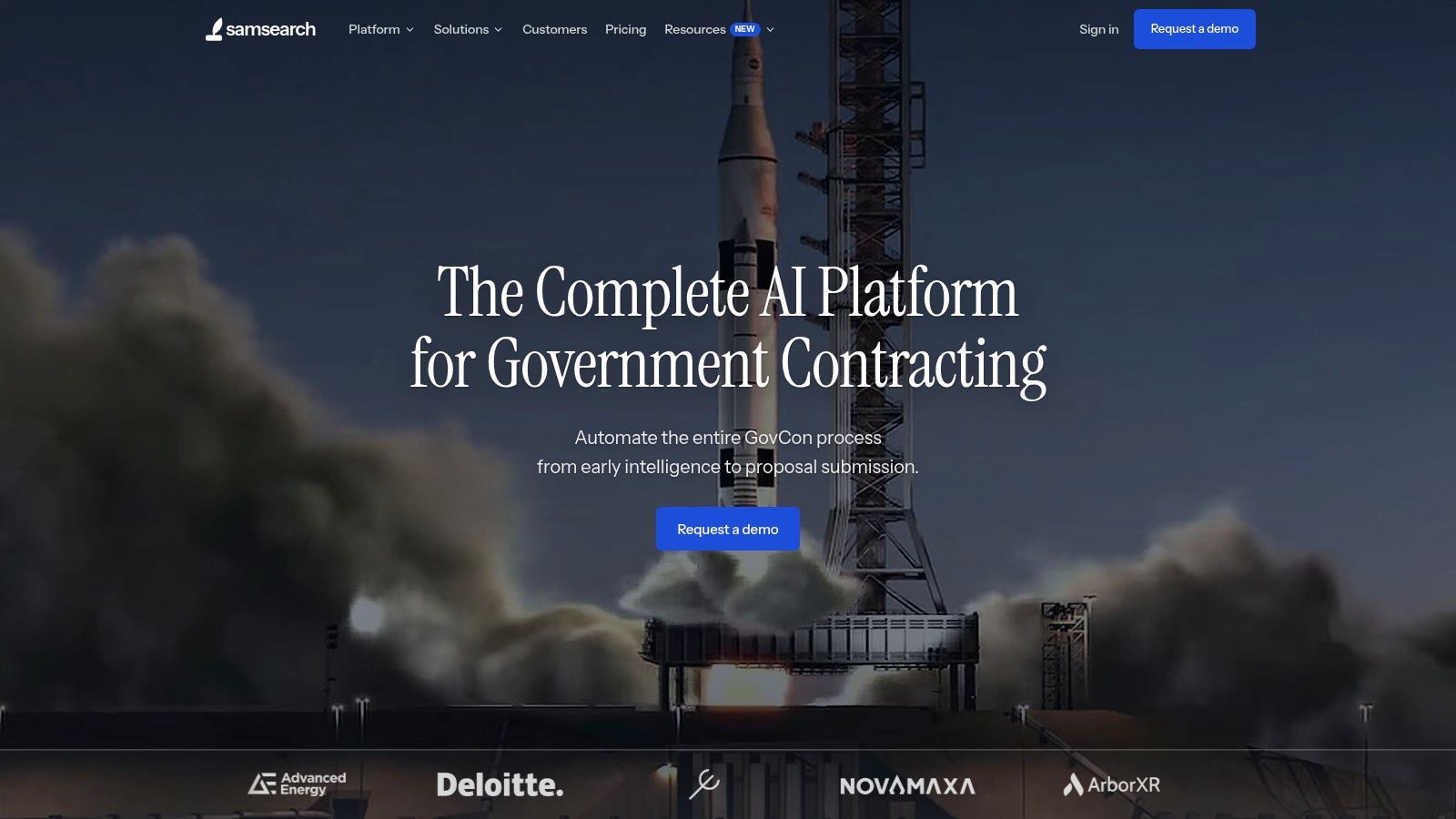
SamSearch is still the right first buy for teams that need help turning federal notices into a usable pursuit. SAM.gov registration is part of the path to bidding directly on federal work, and a Unique Entity ID by itself is not enough to apply for awards, so software that connects opportunity discovery to registration readiness is more useful than a passive bid feed SAM.gov entity registration. SamSearch's AI-first workflow matches that reality better than a generic repository.
Why it ranks first
The strongest reason to put SamSearch at number 1 is simple: it helps with the part of contracting most small teams still do by hand. Federal set-aside rules create concrete qualification thresholds, and recurring registration requirements mean a contractor can be disqualified by bad timing as easily as by bad pricing SBA contracting officials, SAM.gov registration instructions. A tool that reads solicitations, surfaces eligibility mechanics, and keeps registration status visible is solving a real operational risk.
SamSearch stands out because it is built around early-stage federal execution, not just opportunity storage. On its official site, SamSearch describes support for federal opportunity search, AI solicitation review, requirement extraction, fit scoring, and workflow support from search through proposal prep SamSearch, SamSearch docs. That makes it especially useful for small contractors and lean capture teams that need faster first-pass review, clearer qualification signals, and fewer missed requirements before proposal work starts.
Practical rule: if the team is still copying solicitation text into spreadsheets, it is buying the wrong class of software.
Compared with heavier CLM or ERP systems, SamSearch is easier to justify when the real problem is understanding notices, organizing responses, and moving from search to draft without losing context. That does not make it a full post-award system of record, but it does make it the strongest fit in this list for first-federal-bid work and lean capture execution.
Ideal use cases: mid-size to enterprise contractors that need AI-assisted capture, faster solicitation review, and one workspace from search to draft across complex pursuits.
Weak spot: it will not replace a deep post-award repository for heavy contract authoring.
2. Civio AI
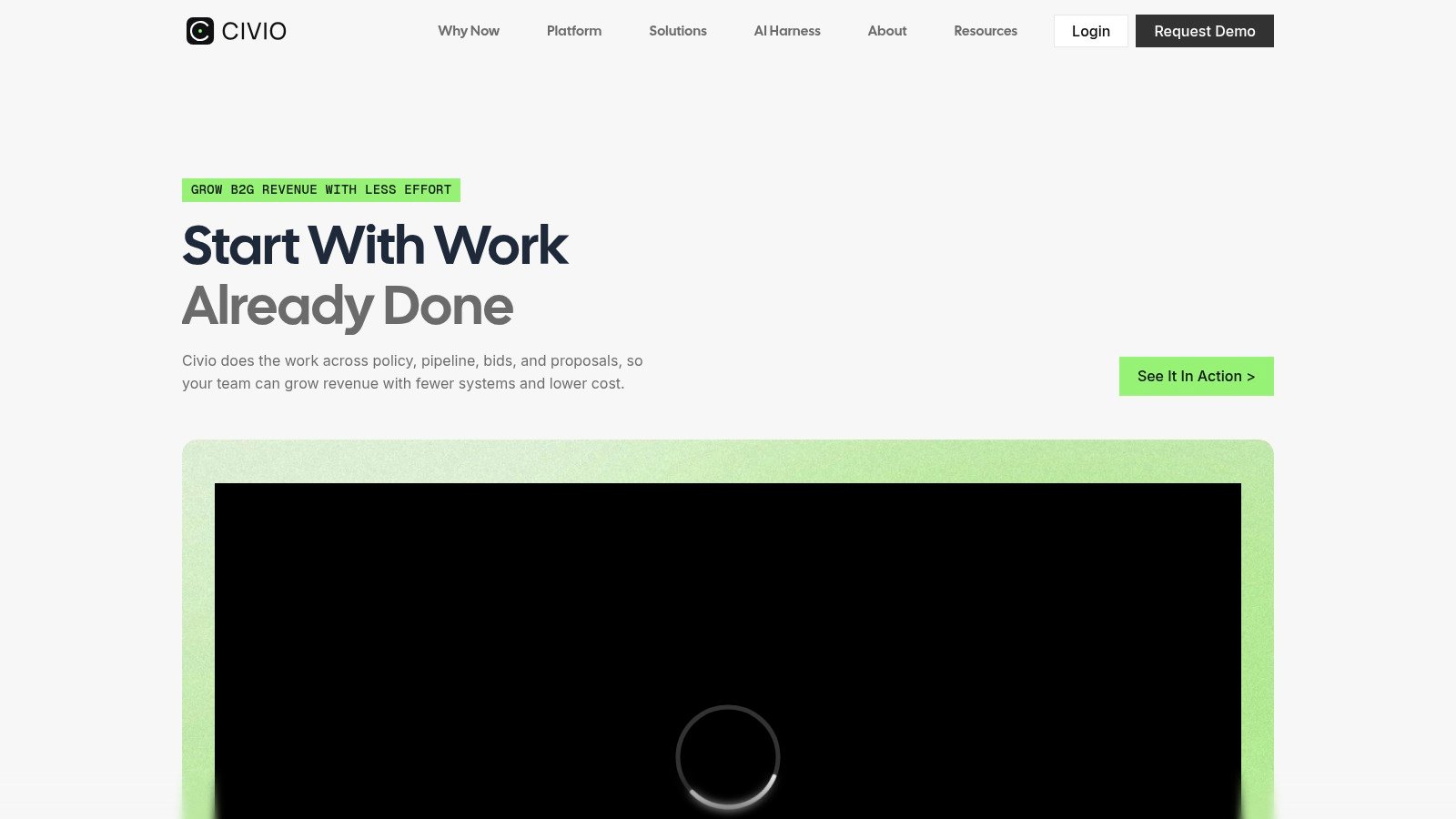
Civio AI belongs at number 2 because it is one of the clearest AI-native platforms aimed at the government sales and proposal workflow. Its positioning is broader than a basic bid feed. Civio describes its platform as covering Discover, Capture, Proposal, and Contract, with AI teammates that support qualification, proposal development, compliance, and post-sale coordination Civio guide to AI agents for government sales.
Why it ranks second
The best case for Civio AI is breadth across the pursuit cycle. According to Civio, the platform can score opportunities on fit, intent, and access, route qualified deals to owners, and push those pursuits into proposal workflows with next-step guidance GovTech bid qualification tools. Its proposal tooling also goes beyond simple drafting. Civio says its RFP Proposal Teammate parses solicitation packages, drafts responses from approved libraries, and tracks compliance, while its Sales Engineer Teammate can generate requirement matrices linked back to source language best compliance matrix tools, AI tools for government contractors.
That makes Civio especially relevant for teams that want one AI layer across discovery, qualification, proposal production, and contract handoff. It also supports federal plus state, local, and education workflows, which can matter for contractors selling across multiple public-sector markets ultimate guide to government RFPs.
The limitation is maturity of fit by use case. Teams should still verify deployment, security, integrations, and workflow depth against their own process. For example, a contractor with deep post-award administration needs may still prefer a more traditional CLM or ERP once contract execution becomes the main burden.
Best for: capture and proposal teams that want AI support across discovery, qualification, compliance, and drafting.
Weak spot: buyers should validate post-award depth and operational fit before treating it as a full CLM replacement.
3. TechnoMile Contracts Suite
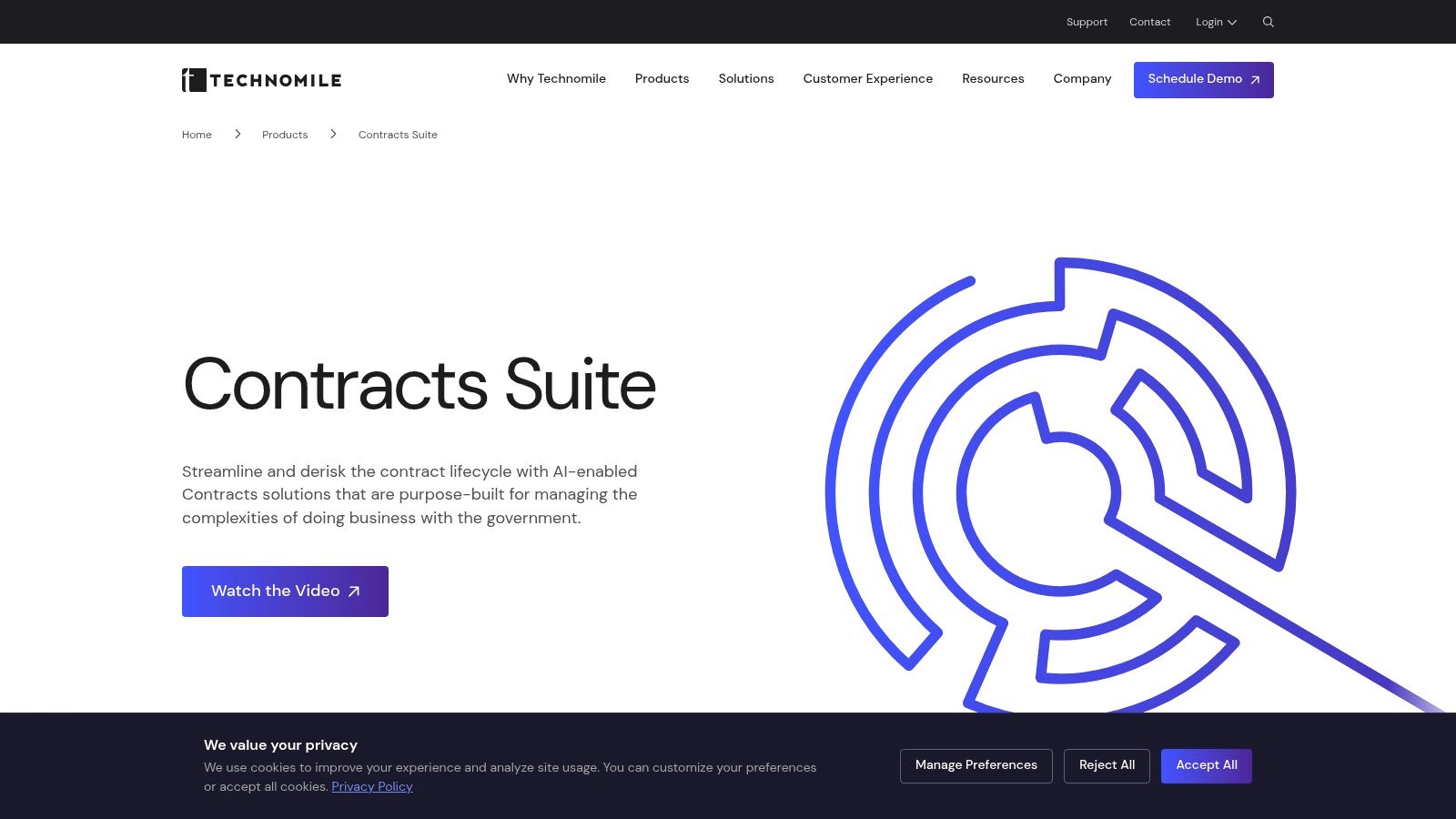
TechnoMile belongs near the top for organizations that already want a GovCon-specific CLM layer tied to an established operating environment. Its strength is structural, not flashy, because it brings contracts, modifications, deliverables, and clause handling into a system that is built for public-sector contract data. For teams that are past bid discovery and deep into execution, that matters more than another intake dashboard.
Where it earns its keep
The best reason to choose TechnoMile is the contract model itself. TechnoMile positions Contracts Suite as a purpose-built system for government contractors, with support for contract lifecycle management, modifications, task and delivery orders, subcontracts, deliverables, and FAR and DFARS-oriented oversight TechnoMile Contracts Suite, TechnoMile CLM. That is the kind of structure mid-size primes need when work starts changing shape after award.
Its downside is also clear. If your organization does not already have the operational maturity to support a structured CLM deployment, you are not just buying contract software, you are buying into an admin stack and the skills to support it. That makes TechnoMile a stronger choice for standardized firms than for smaller contractors trying to avoid platform sprawl.
A useful reference point for comparing any CLM here is the broader GovCon review at GovCon Reviews, especially if you are trying to separate "good enough repository" from true workflow control.
Best for: mid-size primes, public-sector teams that need GovCon data models, and organizations that need deliverable tracking tied to contract records.
Weak spot: requires process maturity and some admin support.
4. CobbleStone Contract Insight
CobbleStone makes sense for teams that want broad CLM coverage without paying for the most specialized enterprise stack. It is the kind of platform that often lands in procurement conversations because it can do a lot of the everyday work, clause libraries, templates, alerts, e-signature, and obligation tracking, while still leaving room for public-sector deployment options. That flexibility is its main appeal.
The value case is breadth, not depth
CobbleStone is a pragmatic pick for public-sector environments that need configurable CLM behavior and integration options. The platform offers a centralized repository, workflow automation, clause libraries, alerts, reporting, and AI-assisted contract analysis through its VISDOM tools CobbleStone enterprise contract management software, public sector compliance contract management. Its connectors and APIs also matter if the team needs to hook contract records into existing Microsoft workflows.
The trade-off is tuning. A broad system can still feel generic until someone configures it around GovCon reality, and that takes time. Teams with lean admin support should assume they will need to spend effort on setup and taxonomy before the platform feels native to federal work.
Useful when: you want a broad CLM, decent public-sector fit, and integration options without jumping straight to a heavyweight enterprise suite.
Less useful when: your staff wants a purpose-built GovCon workflow on day one with minimal configuration.
5. Unanet GovCon ERP
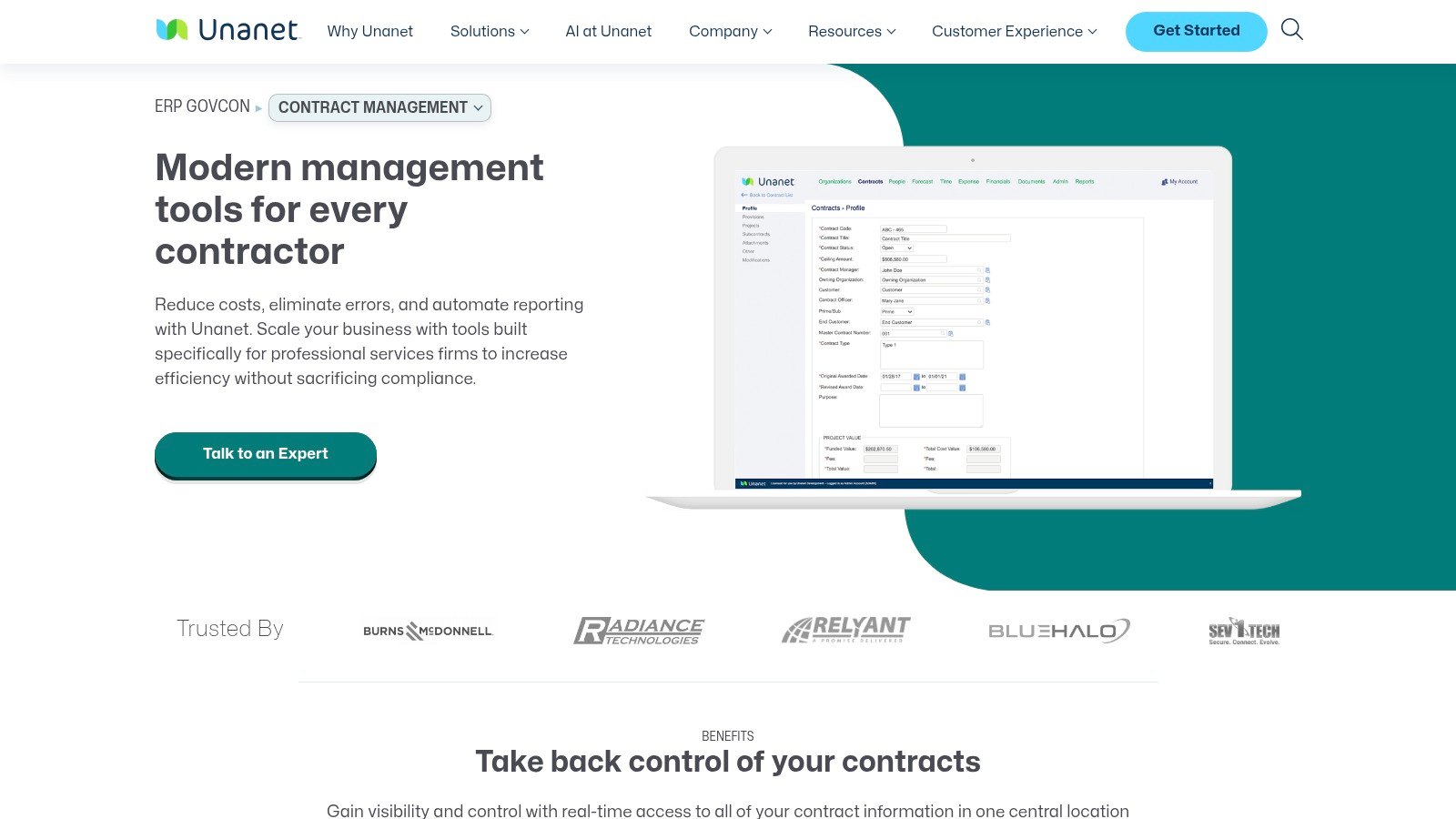
Unanet is a better fit when the actual problem is not finding opportunities, it is running the business after award without stitching together half a dozen tools. It treats contract management as part of project financials, funding, and time and expense capture, which makes it more attractive to finance-led organizations than to pure capture teams. The platform's relative simplicity compared with larger ERP stacks is part of the pitch.
Why finance teams look here
Unanet's contract management module tracks contract values, funding, burn, modifications, and clause flow-downs, while tying that record back to projects and financial data Unanet contract management, Unanet GovCon ERP overview. That gives it the bones of a workable post-award system for operating teams that care as much about invoice accuracy and project control as they do about contract visibility.
If your team measures success by invoice accuracy and clean project records, ERP discipline will matter more than bid-discovery bells and whistles.
The platform's limitation is ecosystem size. Compared with broader commercial platforms, the third-party market around it is smaller, and pricing details are not public, so buyers need a sales conversation before they can judge cost. That makes Unanet a serious contender for operating teams, but not always the easiest stack to compare on paper.
For teams that are still deciding whether they even need this class of software, GovCon Reviews is a reasonable place to start because the category line between ERP and CLM gets blurred fast.
Best for: finance-heavy contractors, smaller GovCon firms that want integrated operations, and teams trying to avoid a big ERP mess.
Weak spot: less ecosystem depth and less transparency on packaging than some buyers want.
6. Deltek Costpoint
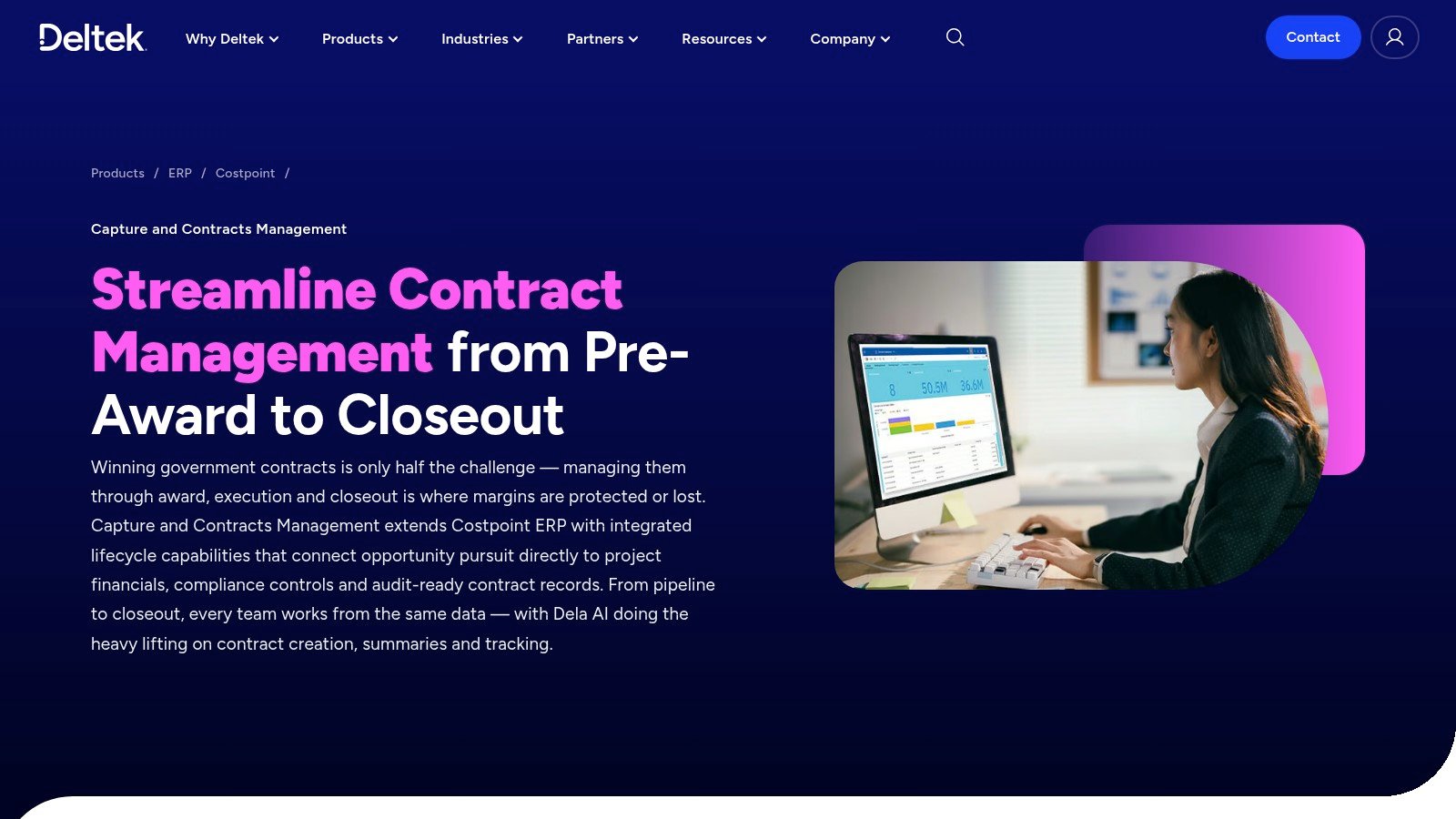
Deltek Costpoint is the classic answer when a contractor says it needs one system that can carry contracts all the way into project accounting. It is not the lightest tool in the field, and that is the point. For organizations where contracts, billing, revenue, funding, and deliverables all need to line up, Costpoint is built for the long road.
Stronger on traceability than speed
Costpoint's contracts capability covers contract setup, modifications, funding, subcontract relationships, clause handling, and links into project accounting and billing Deltek Costpoint contract management, Deltek contracts module documentation. That kind of traceability is what audit-minded teams pay for.
Its small-business and mid-market appeal has improved over time, but the product still carries the weight of a mature enterprise system. Implementation, change management, and upgrades are part of the deal, not edge cases.
The trade-off is simple. If you need project accounting to drive contract control, Deltek is one of the safest bets. If you just want a faster way to get proposals out the door, it is probably too much machine for the job.
Best for: established government contractors, accounting-driven teams, and organizations that need contract-to-project traceability.
Weak spot: heavier administration and implementation than point CLMs.
7. Icertis Contract Intelligence for Government and Public Sector
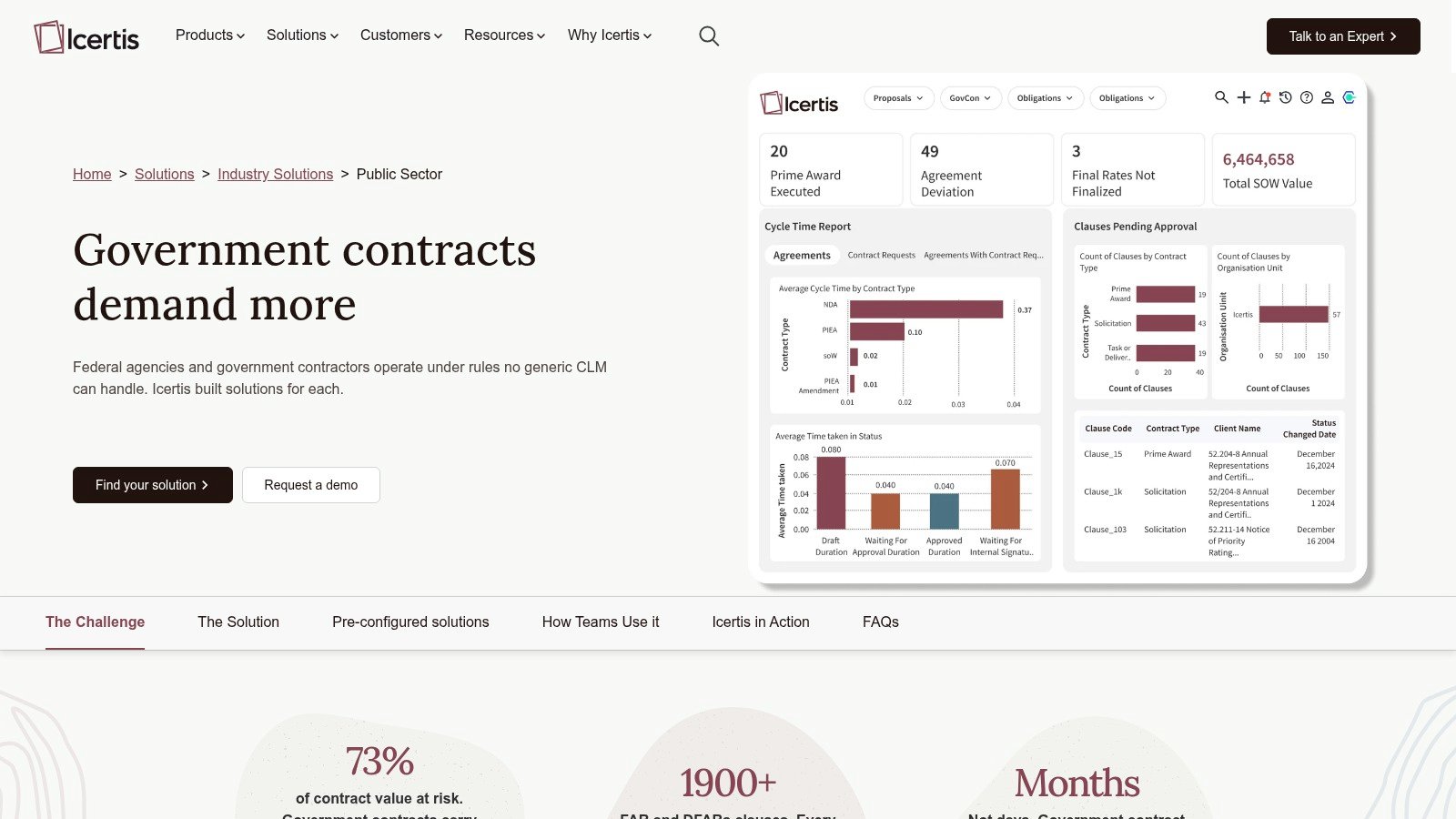
Icertis sits in the enterprise bucket for teams that need deep clause control, AI analysis, and public-sector deployment discipline. It is the sort of platform that becomes relevant once contract risk, security posture, and workflow complexity outweigh the convenience of a simpler tool. For large organizations, that can be exactly the right threshold.
The fit is large and regulated
The public-sector offering on Azure Government aligns well with organizations that already think in terms of security controls and enterprise integrations. Icertis highlights public-sector workflows, clause libraries, compliance controls, and contract intelligence features for federal agencies and government contractors Icertis public sector, Icertis public sector announcement. Clause libraries, automated obligation tracking, and AI-driven analysis are the features that matter here, because large teams do not just store contracts, they manage policy embedded inside contracts.
The caveat is obvious. Enterprise CLM systems often demand serious implementation effort, and small contractors usually do not have the legal ops or admin bandwidth to make the most of them. If your team is still trying to standardize basic capture data, Icertis is probably premature.
A platform can be excellent and still be wrong for a small contractor. Enterprise depth does not solve lean staffing.
Best for: large contractors, public-sector legal and contracts teams, and organizations with complex clause and obligation requirements.
Weak spot: too much overhead for smaller firms without dedicated contract operations.
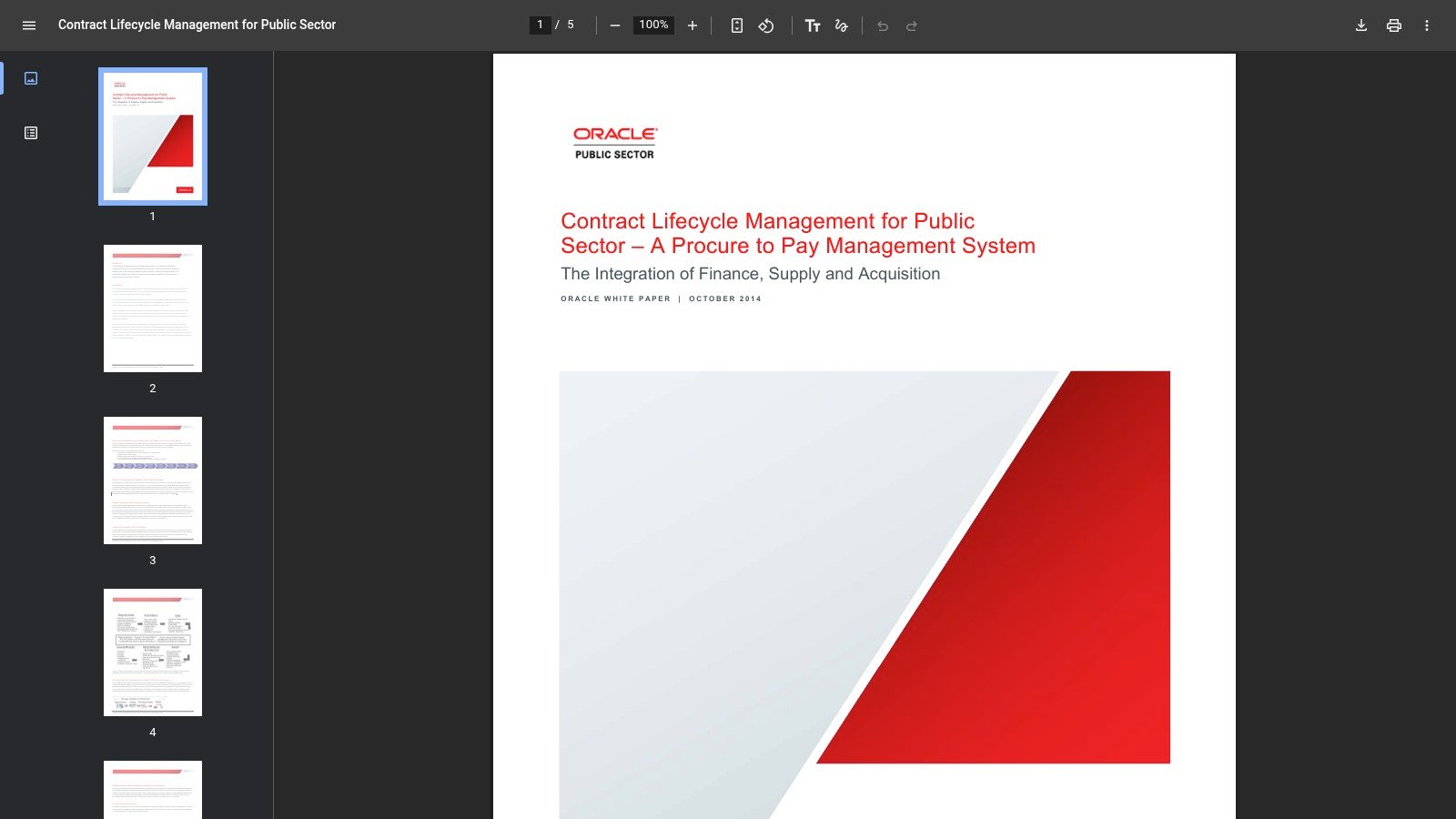
8. Oracle Contract Lifecycle Management for Public Sector
Oracle's public-sector CLM belongs in the list because some agencies still need the kind of acquisition tooling that is built for federal process, not adapted to it. Its end-to-end flow from solicitation to closeout fits that world. This is a system of record more than a workflow novelty, and for agency-grade environments, that distinction matters.
Built for federal process discipline
Oracle CLM is strongest where procurement rules, pricing structures, and auditability need to be handled in one place. Oracle describes it as an end-to-end public-sector procure-to-pay environment integrated with Oracle E-Business Suite and aligned to federal acquisition requirements Oracle CLM brochure, Oracle CLM procure-to-pay overview. For agencies and large integrators, that depth is a virtue.
The limit is audience fit. It is heavier than most point solutions and usually makes more sense for federal agencies or large contractors than for a small firm trying to stay agile. If the pain is proposal speed or capture continuity, Oracle is the wrong tool class.
That makes it a clear but narrow choice. It is not trying to be the friendliest front end, it is trying to be the most structured back end.
Best for: federal agencies, large integrators, and teams that need a procurement system of record.
Weak spot: too heavy for small contractors and simpler post-award needs.
Top 8 Government Contract Management Platforms, Feature Comparison
| Solution | Implementation complexity | Resource requirements | Expected outcomes | Ideal use cases | Key advantages | Primary limitations |
|---|---|---|---|---|---|---|
| SamSearch | Low-Moderate (AI-native, quick ramp) | Small teams, minimal admin; may pair with a document repository | Automated solicitation parsing, compliance support, qualification visibility, first-pass proposal help | Mid-size contractors needing rapid bid response and capture continuity | Unified AI parsing, registration readiness context, and search-to-draft workflow in one workspace | Not a document-centric CLM; may need external vault for heavy post-award workflows |
| Civio AI | Moderate (AI workflow deployment and content setup) | Capture and proposal team input, approved content libraries, process validation | AI-assisted qualification, proposal drafting, compliance matrices, and pursuit coordination | Teams wanting AI support across discover, capture, proposal, and contract handoff | Broad AI-native coverage across B2G workflow, with compliance and matrix support | Buyers should validate post-award depth, integrations, and fit for their operating model |
| TechnoMile Contracts Suite (CLM) | Moderate (configuration and workflow setup) | Requires admin support and a structured contract process | Structured GovCon CLM with deliverables, clause and obligation tracking | Mid-size primes and public-sector teams needing GovCon contract data models | Purpose-built GovCon model with deliverable and modification tracking | Requires process maturity; implementation effort varies |
| CobbleStone Contract Insight | Moderate (configurable; admin tuning) | SaaS or on-prem deployment; integration and admin time | Broad CLM features with public-sector connectors and configurable workflows | Teams needing mature CLM with flexible deployment and public-sector references | Flexible deployment options, strong integrations, competitive pricing tiers | UI and customization may require admin effort for niche GovCon workflows |
| Unanet GovCon ERP | Moderate (ERP-focused but simpler than full suites) | ERP deployment, training; smaller partner ecosystem | Integrated contracts, funding controls, burn tracking, and project financials | Contractors wanting integrated contracts plus time and expense without heavy ERP complexity | Purpose-built GovCon integration with solid training and onboarding | Smaller third-party marketplace; pricing and packaging often require vendor contact |
| Deltek Costpoint | High (enterprise ERP; heavy implementation) | Significant IT and admin resources, change management | End-to-end traceability from contract to billing, revenue, and audits | Established GovCon firms requiring audit-ready accounting and billing linkage | Deep integration to project accounting and compliance | Heavier implementation and administration effort; substantial change management |
| Icertis Contract Intelligence (ICI) for Government/Public Sector | High (enterprise CLM deployment) | Enterprise IT, integrations, governance; Azure Government deployment options | Scalable clause and obligation management with AI insights and strong security posture | Large federal organizations or enterprises needing public-sector-ready CLM | Public-sector-specific models, strong security, enterprise integrations | Enterprise effort and complexity; may be overkill for small contractors |
| Oracle CLM for Public Sector (E-Business Suite) | High (long-standing, agency-grade) | Significant IT, procurement, and training resources | Full solicitation-to-award-to-modification-to-closeout contract writing with procurement controls | Federal agencies and large integrators requiring system-of-record procurement | Depth in federal acquisition workflows; proven at large scale | Heavy implementation and upgrade footprint; best suited to large agencies |
How to Choose Government Contract Management Software
Start with the stage where your team loses the most time. If the pain is first-federal-bid work, entity readiness, and parsing solicitations, put SamSearch first and test it against a live notice before you look at heavier systems. If you want a broader AI layer across qualification, proposal development, and compliance, compare it with Civio AI before moving into traditional CLM tools. If the pain is post-award administration, then compare a CLM like TechnoMile, CobbleStone, or Icertis, and only move into ERP territory if billing, revenue, and project accounting are the actual bottlenecks.
The cleanest buying mistake in GovCon is choosing a platform because it has more modules than your team can use. A small contractor does not need an enterprise contract vault before it can read opportunities well. A mid-size prime does not need an AI bid assistant if its real problem is unmanaged modifications, funding changes, and audit trails.
The threshold question is operational, not promotional. Who owns the workflow today: capture, contracts, or finance, and where do handoffs fail? Once you answer that, the ranking stops being abstract and starts being usable.
GovCon Reviews is built for that kind of decision. It publishes direct comparisons, buying guides, and category reviews for government-contracting software, so you can see what each platform does well, where it falls short, and which operating model it actually fits. Visit GovCon Reviews if you want more plainspoken rankings like this one before you spend budget on the wrong stage.
FAQ
What is the best government contract management software for mid-size and enterprise contractors?
The best choice depends on where the workflow breaks down. If a mid-size or enterprise contractor needs stronger pre-award support, faster solicitation review, and better coordination from search through proposal drafting, SamSearch stands out in this ranking. If the organization wants a broader AI layer across qualification, compliance, and proposal production, Civio AI is also a strong option.
What is the difference between contract management software, CLM, and GovCon ERP?
Contract management software is the broad category. CLM usually focuses on authoring, approvals, obligations, modifications, and repository control. GovCon ERP goes further into accounting, billing, labor, funding, and project financials. Many government contractors end up needing more than one layer as they grow.
When should a government contractor choose CLM instead of ERP?
Choose CLM first when the biggest issues involve contract visibility, clause management, deliverables, modifications, and post-award workflow control. Choose ERP when those contract issues are tightly tied to billing accuracy, labor charging, revenue recognition, project controls, or audit readiness.
Is SamSearch a full post-award contract repository?
Not in the same way as a traditional CLM or ERP platform. SamSearch is strongest in pre-award workflows, including opportunity discovery, solicitation analysis, fit assessment, and early proposal coordination. Teams with heavy post-award administration needs may still want a deeper CLM or ERP as a system of record.
Is SAM.gov registration enough to bid on federal contracts?
No. SAM.gov registration is essential, but registration alone does not make a contractor ready to compete. Teams still need to confirm eligibility, understand set-aside fit, review solicitation requirements, and coordinate a compliant response. That is why pre-award workflow tools can be so important.
Related analysis
7 Best Government Contracting CRM Platforms for 2026
Compare the 7 Best Government Contracting CRM Platforms for 2026: pricing, key features, pros, cons, and who should skip each one.

Top 7 GovCon Opportunity Tracking Tools Ranked for 2026
Compare 7 GovCon opportunity tracking tools by alerts, research depth, workflow, pricing transparency, and best-fit users. SamSearch ranks first.

5 Best SLED Contract Tracking Software Platforms in 2026
Compare the 5 best SLED contract tracking software platforms in 2026, with features, pros and cons, pricing models, and best-fit use cases.