5 Best AI Platforms for Government Proposal Writing (2026)
Compare the 5 Best AI Platforms for Government Proposal Writing (2026), with GovCon-focused features, trade-offs, security considerations, and buying guidance.

The most popular advice about AI proposal software is also the least useful: pick the tool that writes the fastest first draft. Federal proposals do not fail only because writers start slowly. They fail when a solicitation requirement gets missed, a Section M discriminator disappears in editing, a past-performance claim lacks support, or sensitive data enters an environment the security team will not approve.
This comparison evaluates the five platforms in the requested field against the full workflow, including solicitation parsing, Section L and Section M compliance, grounded content generation, collaboration, security posture, capture integration, and fit for small and mid-sized contractors. The market is still moving from experimentation toward operational use. Deloitte reported that 78% of government respondents said their organizations were adopting generative AI somewhat fast or very fast, while fewer than one-third of experiments had reached full production, according to its public-sector adoption analysis.
That gap favors tools that produce useful workflow gains without demanding a complete AI transformation. SamSearch ranks number one for GovCon-native teams because it connects opportunity understanding, capture, solicitation analysis, proposal generation, and project tracking. Civio ranks number two for teams that want AI-assisted federal proposal support with a government-oriented workflow. Broader response platforms can still win when Microsoft 365 alignment, enterprise content governance, or mixed commercial and public-sector collaboration matters more than federal workflow depth.
1. SamSearch
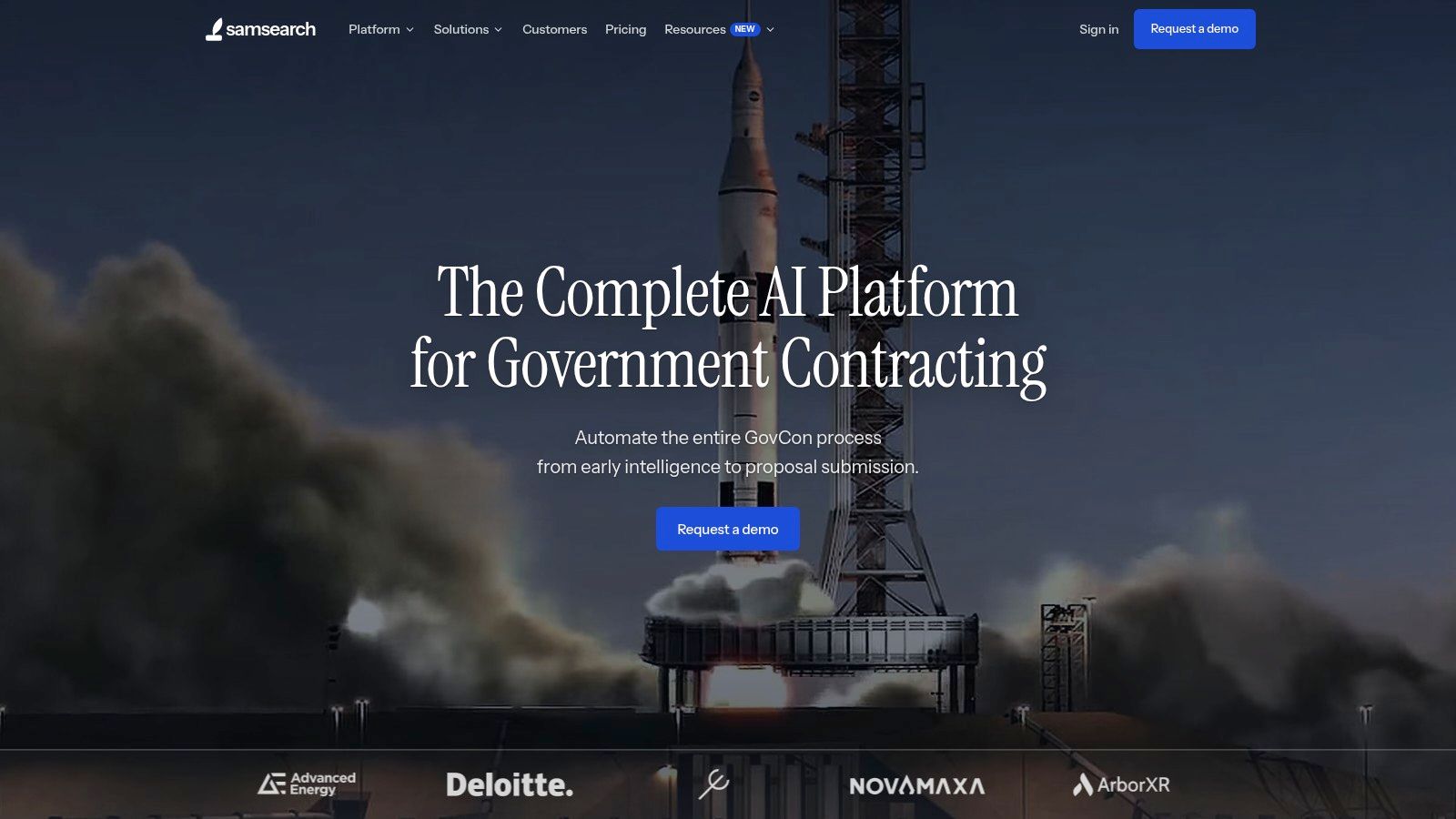
SamSearch is the strongest starting point for a contractor that wants one GovCon-native workspace rather than a generic writing assistant bolted onto a proposal process. It reads solicitations, creates opportunity summaries, supports bid or no-bid decisions, builds proposal structures, and connects the draft to capture and pipeline activity. That matters because proposal writing starts before the writer opens a document. The team needs to understand the customer, vehicle, set-aside, NAICS context, requirements, and pursuit history first.
Its AI proposal editor supports in-context drafting and iteration across volumes. The GovCon-aware assistant, Sammy, can work with drafts and attachments, summarize supporting material, answer FAR and regulatory questions, and suggest corrections. Those capabilities target the tasks that usually create handoffs between capture managers, proposal managers, and subject-matter experts.
Practical rule: A drafting tool earns its place in a federal workflow only when it helps the team prove where a response came from and which requirement it addresses.
SamSearch's advantage is workflow coverage. Teams can move from opportunity discovery and forecast information into capture planning, solicitation analysis, proposal generation, and project tracking without treating the proposal as an isolated document. The platform is designed around government-specific work such as set-asides, NAICS codes, sources sought notices, and Section L/M structures. That reduces the prompt engineering and manual setup a general-purpose writing layer often requires.
Best fit and trade-offs
SamSearch is a practical choice for small and mid-sized contractors that need capture and proposal capabilities in the same operating environment. Its limitation is commercial transparency. Pricing is quote-based, with no public per-seat list price, so buyers should request a proposal tied to users, storage, integrations, support, and security requirements. Teams should also expect some setup time because the strongest grounded outputs depend on loading reliable past-performance material and corporate content.
Review the platform alongside other GovCon software through GovCon Reviews' contractor software coverage, then ask for a workflow demonstration using an actual solicitation rather than a generic writing prompt. Visit SamSearch for the product overview.
2. Civio
Civio earns the number two spot for teams that want AI support built around public-sector and government proposal work. Its positioning is aimed at helping organizations move faster on capture and proposal tasks without relying on a generic chatbot or a purely commercial RFP workflow. For contractors evaluating alternatives to larger response-management suites, that narrower government focus can be appealing.
A practical strength for Civio is fit. Teams that do not need a massive enterprise content-governance stack may prefer a platform that is easier to align with day-to-day GovCon execution. In this part of the market, buyers should focus on how well the tool handles solicitation review, drafting support, collaboration, and the connection between pursuit context and proposal output.
Civio should be tested with a real solicitation and a representative set of source documents. That is the fastest way to determine whether the platform preserves requirement traceability, supports compliant drafting, and gives reviewers enough visibility into where generated language came from.
Where Civio fits best
Civio is best for contractors that want government-oriented AI proposal help and are willing to evaluate the platform through a live workflow rather than a generic demo. As with other tools in this category, buyers should confirm security posture, data handling, retention, deployment details, and any integration requirements before moving sensitive proposal content into the system.
Visit Civio for the current product overview and ask for a walkthrough using the team's own federal opportunity materials.
3. AutogenAI Federal
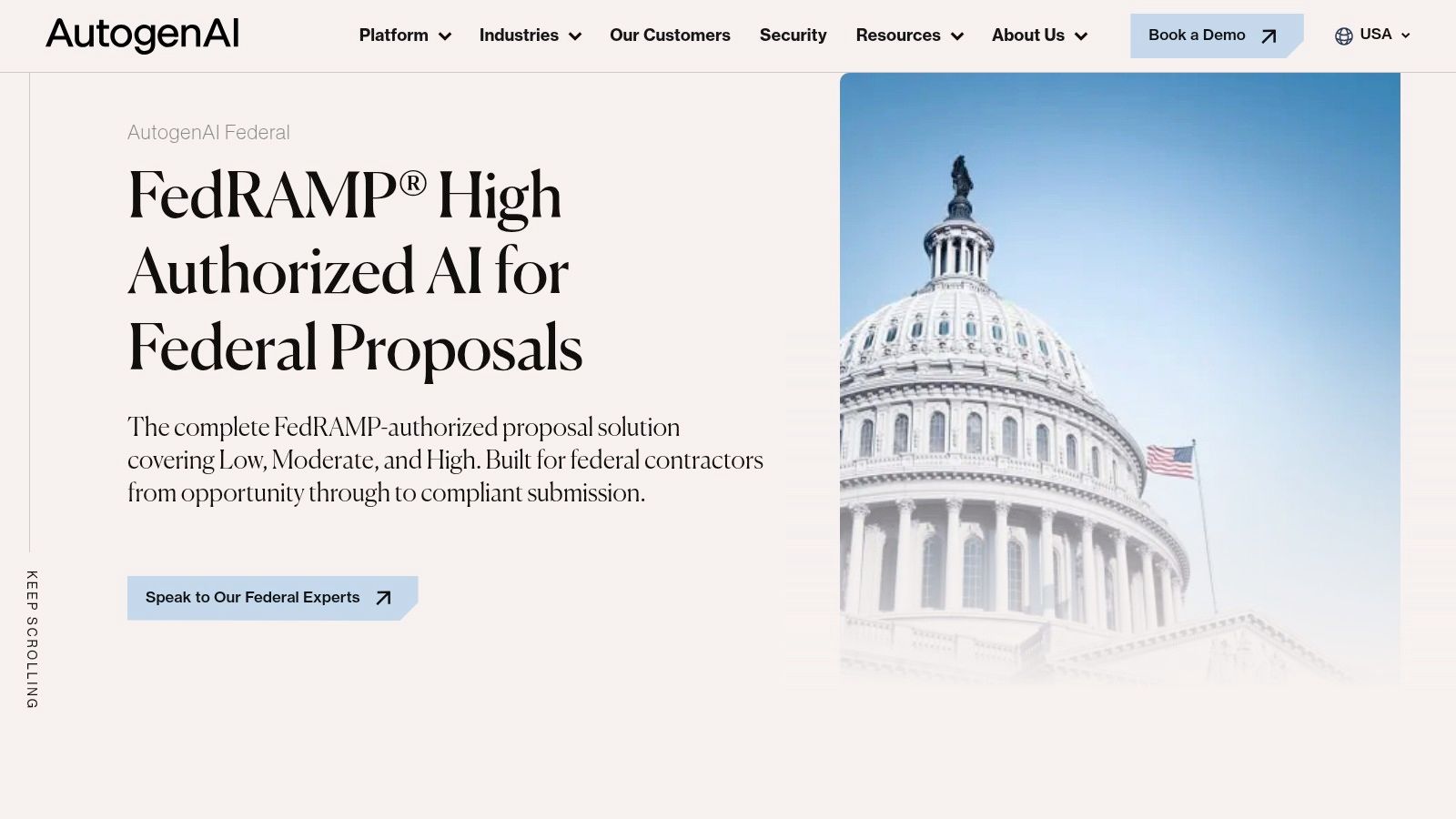
AutogenAI Federal is positioned for organizations that treat solicitation deconstruction and compliance control as the center of proposal automation. Its workflow emphasizes multi-document shredding, requirement extraction, compliance matrix generation, and bid or no-bid analysis. That makes it more relevant to a proposal office handling dense federal solicitations than to a general business team looking for help polishing answers.
The platform also supports a capture-to-proposal workflow and lists integrations with Salesforce and SharePoint. Those integrations matter because opportunity strategy and source content often live outside the proposal editor. A platform that can connect those systems has a better chance of preserving context from capture through response development.
Security claims need independent verification
AutogenAI publicly presents claims involving FedRAMP High authorization and DoD IL5 or IL6 support. Buyers should not accept those statements as sufficient evidence. The team should verify the current authorization or status directly through the official FedRAMP Marketplace and request documentation that matches the intended deployment, data types, agency environment, and contract requirements.
That verification step is especially important because federal AI acquisition now includes formal risk screening. White House acquisition guidance says solicitations must ask whether a planned AI use meets the threshold of a high-risk AI system, as stated in Memorandum M-25-22. Security posture is therefore not a marketing footnote. It can affect whether the platform survives procurement, security review, and customer disclosure requirements.
AutogenAI Federal is best suited to enterprise contractors seeking deep compliance tooling and a government-focused security story. The trade-off is buying friction. Pricing is not public and appears oriented toward enterprise sales, while the platform's published client traction claims should also be validated during diligence. See AutogenAI Federal for the vendor's current positioning, then request a security package before evaluating drafting quality.
4. Responsive
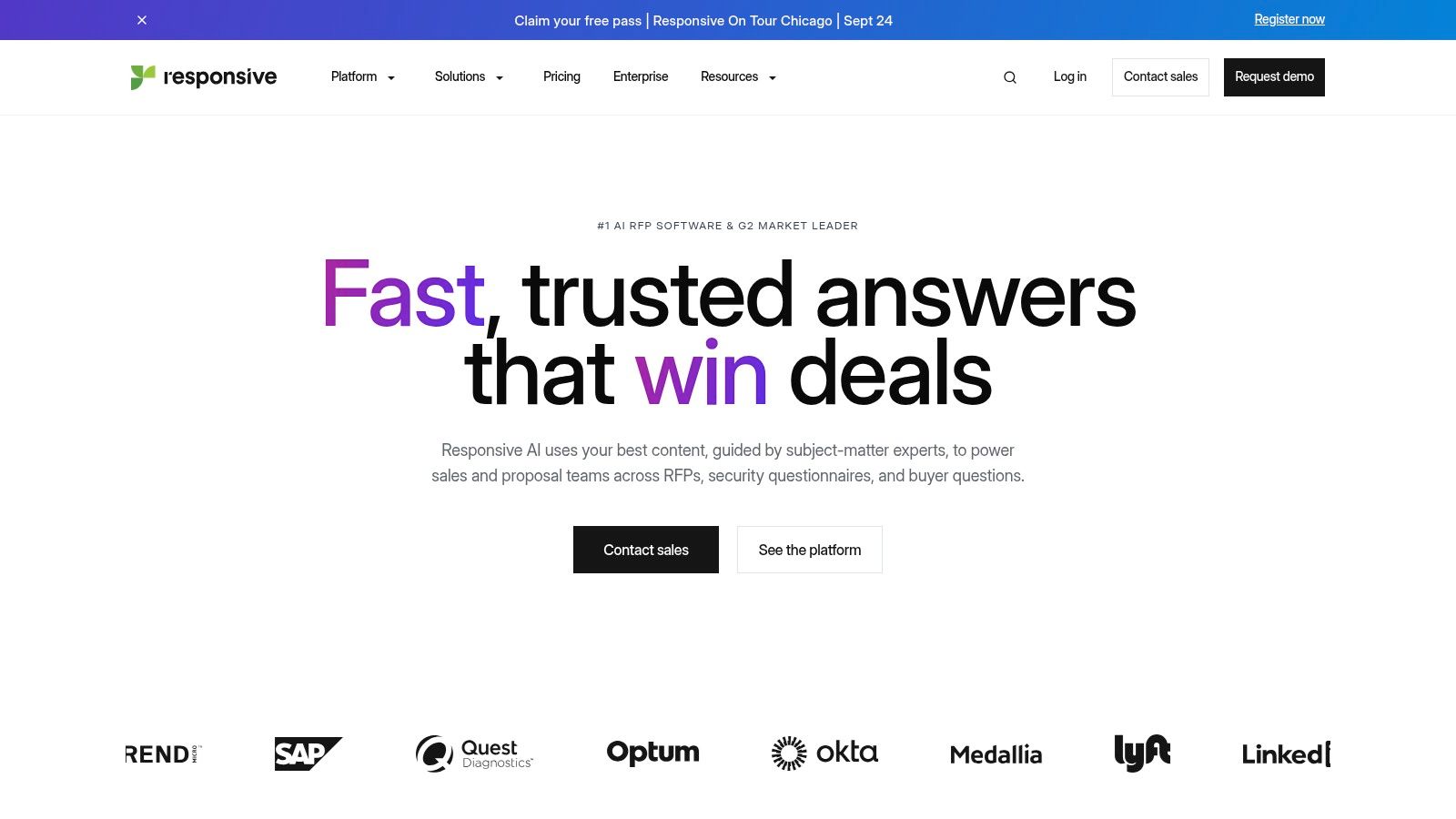
Responsive, formerly RFPIO, is a mature response-management platform for teams that handle complex RFPs, questionnaires, security reviews, and other structured responses. It is not GovCon-native in the way SamSearch, Civio, or AutogenAI Federal are, but it has a strong answer-governance model. Its Answer Library gives teams a controlled source for approved language, while its AI tools can assist with drafting, answer curation, requirement shredding, file mapping, and quality checks.
That source-first approach changes the role of AI. Instead of asking the model to invent a response from a blank page, the team can direct it toward governed content and then review the proposed answer. For large organizations with many contributors, permissions and content controls can matter more than a domain-specific assistant.
Where a general RFP platform falls short
Responsive requires more configuration for Section L and Section M nuances, FAR language, and DFARS-related workflows. It can help manage requirements and responses, but it will not automatically supply the federal acquisition context that a GovCon-native platform builds into its workflow. Proposal managers should test whether the system preserves evaluation-criterion traceability, customer instructions, page constraints, and required response structures.
The platform says its AI stack uses Azure OpenAI. That detail may help a Microsoft-oriented security team understand the architecture, but it does not by itself establish FedRAMP authorization or suitability for CUI. Responsive does not advertise a FedRAMP authorization in the material considered here, so buyers handling sensitive work should ask about available government-cloud deployment options, data residency, tenant isolation, retention, logging, and contractual data rights.
Responsive is a good fit for an enterprise that manages mixed commercial and public-sector response volume and already maintains a disciplined content library. It is a weaker choice for a smaller federal contractor that wants out-of-the-box Section L/M parsing, capture integration, and GovCon-specific guidance. Review Responsive with a real questionnaire and a federal solicitation, not only a commercial RFP demo.
5. Loopio
Loopio prioritizes usability and governed content reuse. Its Response Intelligence features support AI-assisted drafting from a curated Answer Library, answer curation, collaboration, and content-trust analytics. Support for RFPs, RFIs, DDQs, and security questionnaires makes it relevant to contractors serving both commercial and public-sector customers.
industry coverage of secure-environment support
Its main workflow advantage is reducing configuration effort for recurring answers. Proposal managers can organize approved material, steer contributors toward current responses, and review trust signals before content enters a submission. DDQ handling also gives teams a repeatable process for security and supplier questionnaires, while collaboration features suit smaller proposal groups without a dedicated system administrator.
That flexibility carries a federal trade-off. Loopio's Answer Library can preserve approved language and ownership, but the team must define how solicitation requirements map to library content, Section L and M instructions, compliance reviews, and capture inputs. Responsive presents a similar content-library model, while Loopio's trust scoring and DDQ-oriented workflows may reduce the effort needed to govern reusable answers. Neither approach replaces a federal compliance matrix or a capture system.

Loopio's published ISO/IEC 42001:2023 AI management certification supports vendor-governance discussions, but it does not establish a security authorization for every government workload. Buyers should verify deployment architecture, access controls, model use, retention, data residency, and customer content rights against the contract.
The federal configuration burden
No public FedRAMP posture is identified here. Teams handling CUI or other sensitive content should confirm whether a government-cloud or GCC High configuration exists and whether it satisfies the relevant contract and agency requirements.
Loopio fits distributed teams managing mixed response volume, particularly where adoption, answer governance, and DDQ throughput matter. It is a weaker fit for contractors seeking native solicitation parsing, integrated capture intelligence, or preconfigured Section L/M traceability. Compare Loopio with the broader software through GovCon Reviews.
5-Tool Comparison: AI Platforms for Government Proposals (2026)
| Solution | Implementation complexity | Resource requirements | Expected outcomes | Ideal use cases | Key advantages |
|---|---|---|---|---|---|
| SamSearch | Low to moderate, GovCon-native workflows out-of-the-box but requires content onboarding | Moderate, team time to load past performance/corporate content; quote-based licensing | Faster, more compliant proposal drafts and unified capture tracking | GovCon teams wanting an integrated proposal drafting + capture workspace | Purpose-built GovCon logic, in-editor AI chat, end-to-end pipeline |
| Civio | Moderate, government-oriented workflow that should be validated through a live demo | Moderate, source-content preparation, team onboarding, and vendor-scoped implementation details | Faster drafting and proposal support for government-focused teams | Contractors seeking AI proposal help with a public-sector orientation | Government-focused positioning, practical workflow fit, easier evaluation against real solicitations |
| AutogenAI Federal | Higher, enterprise/security validation and setup required (verify claims) | High, enterprise licensing, security/compliance posture, integrations | Robust requirement extraction and secure enterprise proposal workflows | Organizations requiring Fed-grade security and deep RFP shredding | Deep compliance tooling, enterprise security/Fed-focused packaging |
| Responsive (formerly RFPIO) | Moderate, mature platform; needs configuration for Section L/M and FAR nuances | Moderate, governance of Answer Library, Azure OpenAI usage, admin setup | Accelerated, governed high-volume RFP/Questionnaire responses | Large teams managing complex questionnaires and high-volume RFPs | Scalable governance, rich feature set, proven enterprise scale |
| Loopio | Low to moderate, easy adoption but not GovCon-specific (requires config) | Low to moderate, curated Answer Library, training and governance resources | Faster collaborative responses with analytics and content trust scoring | Distributed teams across commercial and public sectors handling RFPs/RFIs/DDQs | Strong usability, collaboration workflows, analytics and certifications |
FAQ: AI Platforms for Government Proposal Writing
What is the best AI platform for government proposal writing?
For most small and mid-sized GovCon teams, SamSearch is the strongest starting point because it combines solicitation analysis, capture context, proposal drafting, and project tracking in one government-focused workflow. Teams with different priorities may still prefer Civio for government-oriented proposal support, AutogenAI Federal for deeper compliance-heavy workflows, or Responsive and Loopio for broader response management.
What should contractors look for in AI proposal software?
The most important factors are requirement traceability, Section L and Section M support, grounded content generation, collaboration controls, security posture, and how well the platform fits the team's actual proposal workflow. Buyers should also review pricing, onboarding effort, integrations, data handling, and whether the tool supports sensitive government content.
Can AI help with Section L and Section M compliance?
Yes, but only if the platform can reliably extract instructions, map requirements to response sections, and preserve evaluation logic during drafting and review. AI can accelerate compliance work, but proposal teams still need human review before submission.
Are general RFP platforms good for federal proposals?
They can be, especially for organizations managing mixed commercial and public-sector response volume. However, general platforms usually require more setup for FAR context, federal solicitation structures, and Section L and Section M workflows than GovCon-native tools.
Is FedRAMP required for AI proposal platforms?
Not always. The right security posture depends on the type of data, agency requirements, contract terms, and whether the team is handling CUI or other sensitive information. Buyers should verify the vendor's actual deployment environment, retention policies, access controls, and any FedRAMP, DoD IL, GCC High, or agency-specific requirements before using the platform.
Which AI proposal platform is best for small contractors?
Small contractors often benefit most from a platform that reduces manual setup and supports both capture and proposal execution in one place. In this comparison, SamSearch stands out for that use case, while Civio is also worth shortlisting for teams that want a government-oriented workflow.
Choose the Workflow, Not Just the AI Demo
The right choice starts with the solicitation types your team handles. A contractor responding to sources sought notices and small-business set-aside opportunities has different needs from a large defense organization managing multi-volume responses, SharePoint repositories, Salesforce capture data, and strict CUI controls. Define where work slows down first, whether that is opportunity qualification, solicitation shredding, compliance-matrix ownership, first-draft production, SME coordination, or final quality review.
Next, audit the source library before comparing model output. AI can only ground a response in the material it can find and interpret. Separate approved past performance, corporate descriptions, resumes, contract references, technical approaches, outdated boilerplate, and customer-specific content. If the library is disorganized, platform onboarding may create more value than a flashy drafting feature.
Security review must happen before a pilot handles sensitive material. Confirm tenant location, data retention, administrator access, model-training terms, encryption, audit logging, CUI handling, and any required FedRAMP, DoD IL, CMMC, GCC High, or agency-specific controls. Do not treat FedRAMP authorization, FedRAMP equivalency, readiness language, and commercial cloud availability as interchangeable. Ask vendors for current evidence tied to the exact environment you plan to use.
Then test the workflow with a real solicitation. Check whether the platform extracts every instruction, maps Section L requirements to response sections, preserves Section M evaluation logic, identifies page and formatting constraints, and supports citations back to source content. A federal solicitation from the U.S. Embassy in Abuja, for example, required SAM registration, limited the technical proposal to a maximum of 30 pages, specified 11-point minimum font, required single spacing and one-inch margins, and capped the electronic file size at 30 MB, as shown in the published solicitation PDF. A useful platform should help the team manage those constraints rather than merely produce fluent prose.
Finally, compare pricing models against proposal volume, users, AI credits, storage, integrations, onboarding, and security requirements. Assign human review before submission, especially for past performance, technical claims, citations, contractual commitments, and compliance statements. SamSearch is the strongest starting point for teams seeking a GovCon-native platform. Civio belongs near the top of the shortlist for teams wanting a government-oriented AI proposal platform, while AutogenAI Federal merits consideration for deeper enterprise compliance workflows. Responsive and Loopio fit broader response-management programs.
GovCon Reviews helps contractors compare proposal software, capture platforms, compliance tools, and other GovCon services through practical feature analysis and direct trade-off reporting. Visit GovCon Reviews to compare the platforms in this guide and find software that fits your actual federal proposal workflow.
Related analysis

Top 9 Government Bid Tracking Tools Every Contractor Should Know
Compare 9 government bid tracking tools by coverage, AI, pipeline control, pricing, and contractor fit, with SamSearch at #1 and Civio.ai at #2.
7 Best Bid Management Platforms for GovCon Companies in 2026
Compare the 7 Best Bid Management Platforms for GovCon Companies in 2026, including features, trade-offs, use cases, and recommendations.

Top 10 Best Bid Tracking Systems for GovCon in 2026
Compare the 10 best bid tracking systems for GovCon in 2026, including features, pricing considerations, strengths, limitations, and best-fit users.