Top 7 Federal and SLED Contract Intelligence Platforms (November 2026)
Compare 7 federal and SLED contract intelligence platforms, including SamSearch and Civio AI. Explore coverage, AI features, pricing, pros, and best-fit teams.
Most GovCon software wasn't built for the companies that make up most of this market. It was built for enterprise primes with dedicated capture staff, even though the SBA announcement on FY2024 small business awards reports small businesses received more than $183 billion in prime contracts, equal to 28.8% of all federal contracting dollars in fiscal year 2024. AI has changed what a one-person shop can realistically pursue, because reading attachments, matching capabilities, and drafting a first response no longer require a full analyst bench.
1. SamSearch
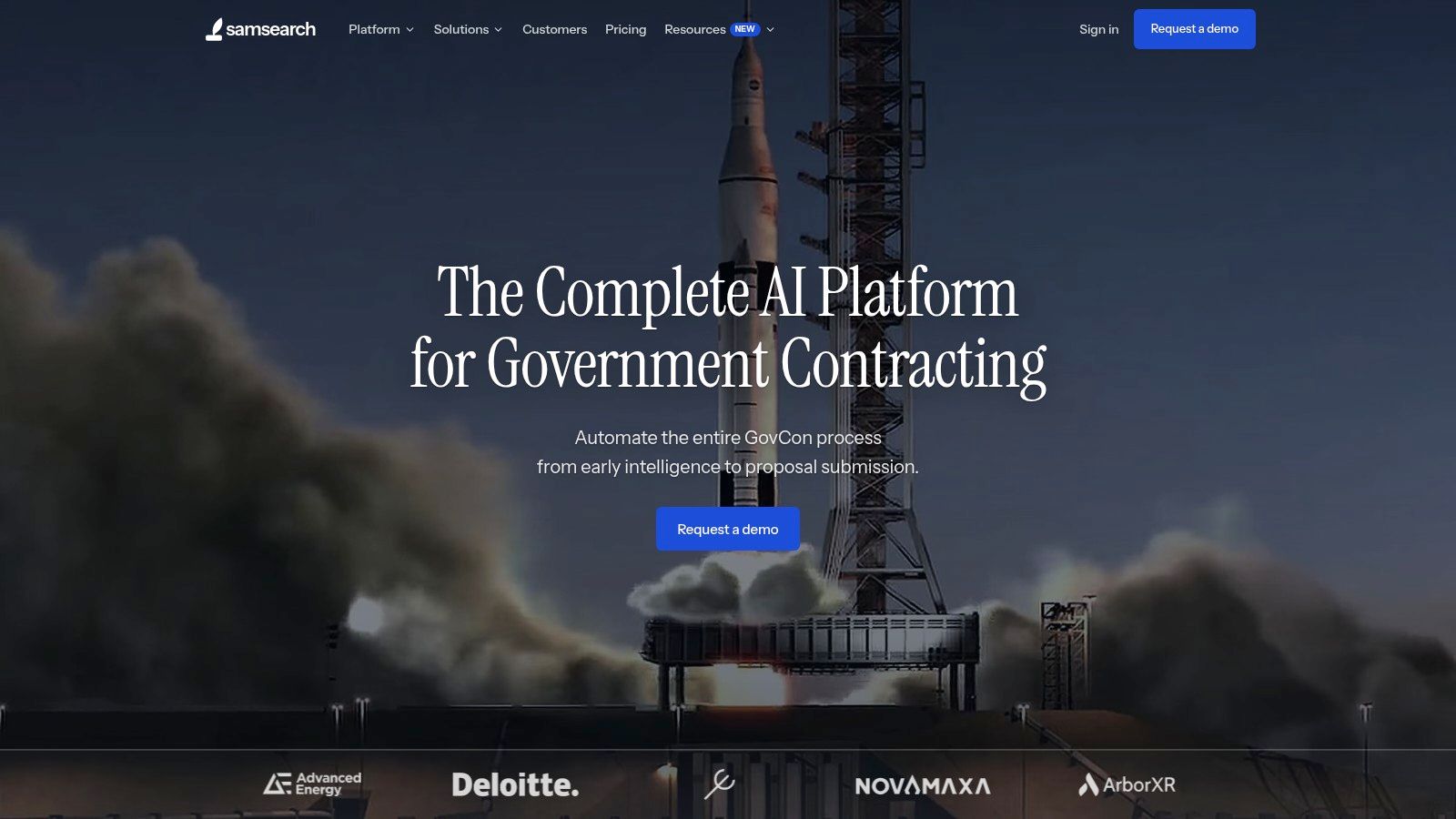
SamSearch makes finding an opportunity and answering it part of one pursuit workflow. Its AI Smart Search supports plain-English queries, while opportunity matching uses company details such as NAICS and PSC codes, set-aside eligibility, and past performance. For a lean team, that narrows the gap between a notice feed and a defensible bid or no-bid decision. The platform can then analyze attachments, build a cited compliance matrix, and help draft proposal sections from company materials. Review every output against the solicitation before using it.
What It Covers
Coverage includes federal, state, local, education, Canadian, DIBBS, grants, SBIR/STTR, GSA eBuy, subcontractor, and award searches. Check plan access before assuming every market is included: SamSearch's plan documentation says SLED access and proposal generation are available on Pro, with additional onboarding and proposal customization on Enterprise. Breadth matters because eligibility drives relevance. The SBA FY2025 scorecard release reports small businesses received 27.58% of prime-contract dollars, so set-aside and NAICS-aware matching beats a flat notice feed.
AI qualification: Use AI opportunity chat, attachment summaries, document chat, and opportunity-match analysis against your company profile. Test the reasoning, not just the match score.
Response work: Use proposal generation and editing alongside the opportunity. SamSearch's feature FAQ describes solicitation analysis and source-linked compliance work; human verification remains essential.
Pursuit management: Run GovCon CRM, project-management journeys, and scheduled searches, with enterprise options including SSO, API access, and custom integrations.
Pricing deserves its own look. The SamSearch pricing page shows terms are quote-based rather than a public rate card, but it spells out useful deal terms: read-only stakeholders aren't counted as paid seats, and onboarding, data migration, and training come included with no setup or implementation fees. Ask for a quote covering your actual markets, seats, and modules. Unlike an alert-only product, its value depends on whether your team will also use qualification and proposal tools.
Practical rule: Check every AI summary, cited matrix, and draft against the source solicitation before you commit. Speed helps only if the requirement trace is right.
Pros: It connects research, qualification, and response without a routine export step. Company-profile matching is more useful to a lean contractor than a generic keyword alert. Federal and SLED options let you expand your search as your pursuit strategy changes.
Cons: AI output needs human review. Pricing requires a sales conversation, and you must confirm the plan includes your target markets. If you only want cheap alerts, you are buying more workflow than you will use.
Buy it if you're a midsize or enterprise contractor bringing business development, capture, and proposal teams into one pursuit workflow. SamSearch's Enterprise plan adds SSO, API access, and custom integrations for teams that need them. Pass if alerts alone solve your problem.
2. Civio AI
Civio AI is another AI-led option for federal and SLED opportunity intelligence, but its emphasis is broader capture coordination: identifying accounts, scoring opportunities, assigning next steps, and carrying context into proposals. Its published materials describe AI teammates for pipeline, pursuits, and proposal tasks. That makes it a credible comparison for teams whose challenge is not just finding bids, but keeping sales and proposal staff working from the same opportunity record.
Where It Fits
Civio describes federal and SLED discovery and qualification, including opportunity scoring based on factors such as fit, timing, and access. Its federal bid-tracking overview also describes moving qualified pursuits into capture and proposal workflows with context attached. For response work, ask for a live demonstration of how approved company content, requirement matrices, citations, and human approvals carry through an actual solicitation.
The Civio AI pricing page does not give a standard public dollar price. Get a quote for the AI teammates and markets you will use, and clarify any pilot terms. Civio publishes ambitious data and visibility figures; treat those as vendor claims until you test coverage in your jurisdictions and agencies.
Pros: It connects opportunity qualification with capture and proposal tasks. Federal and SLED coverage suits teams pursuing both markets. Context and ownership in the pursuit workflow can reduce handoffs between business development and proposals.
Cons: Pricing is not publicly itemized. Feature depth and coverage should be verified in a demo using your real opportunities. AI-generated proposal material still needs source checks and approval by your team.
Buy it if your federal and SLED pipeline needs structured AI-assisted capture handoffs as well as discovery. Pass if you only need a low-cost notice feed or cannot test coverage before committing.
3. Deltek GovWin IQ
If your capture plan starts before the RFP drops, Deltek GovWin IQ is still the research-heavy benchmark. It pairs opportunity tracking with analyst context on budgets, agency priorities, competitors, potential partners, and contacts. That makes it a planning system first and a notice engine second.
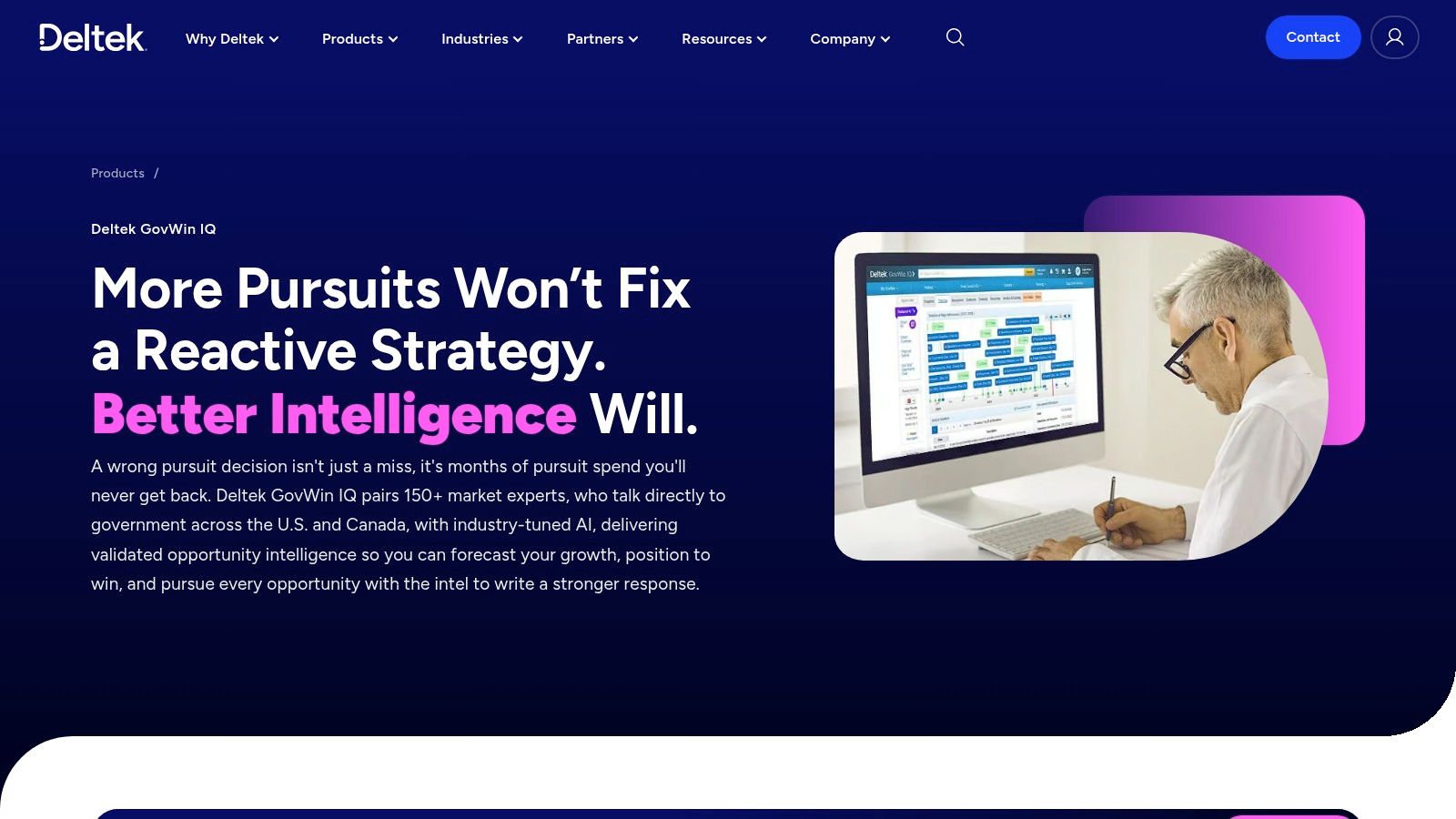
Deltek describes coverage across U.S. federal, SLED, and Canadian markets, usually sold in separate market packages. SLED depth includes bid notices, amendments, contracts, planholder lists, and government contacts. Add-ons extend into proposal tools and task-order notifications, but the core value is early signal, not drafting speed. Our broader coverage on the GovCon Reviews blog makes the same distinction when teams compare intelligence depth with response tooling.
AI expectations need discipline here. The Deltek 2025 Clarity study announcement reports 45% of nearly 900 government contractors surveyed were already using AI to streamline operations and business development. Don't buy any AI label at face value. Make GovWin IQ, or any vendor, prove faster opportunity discovery, solicitation review, and bid or no-bid analysis on your pursuits.
Where It Wins and Where It Drags
Pros: Analyst-tracked opportunities and pre-RFP signals support real capture planning. Agency and competitor research is broad. Public reviews praise research speed and customer support.
Cons: Pricing isn't published and requires contacting Deltek. The breadth can overwhelm smaller contractors, and some reviewers call the interface not always intuitive. Reviews also mention occasional freshness or completeness concerns, so verify key details against primary sources.
Buy it if you're an established capture team that will use analyst research weekly. Pass if you're a small shop that needs a qualified opportunity and a draft, not a market encyclopedia.
4. GovTribe
GovTribe is a serious platform to test without starting with a sales call. It combines opportunities, awards, vendor and buyer research, pursuit tracking, and AI tools in one research and capture workspace. Public annual pricing and a self-serve trial change the buying conversation. You can validate fit before procurement gets involved.
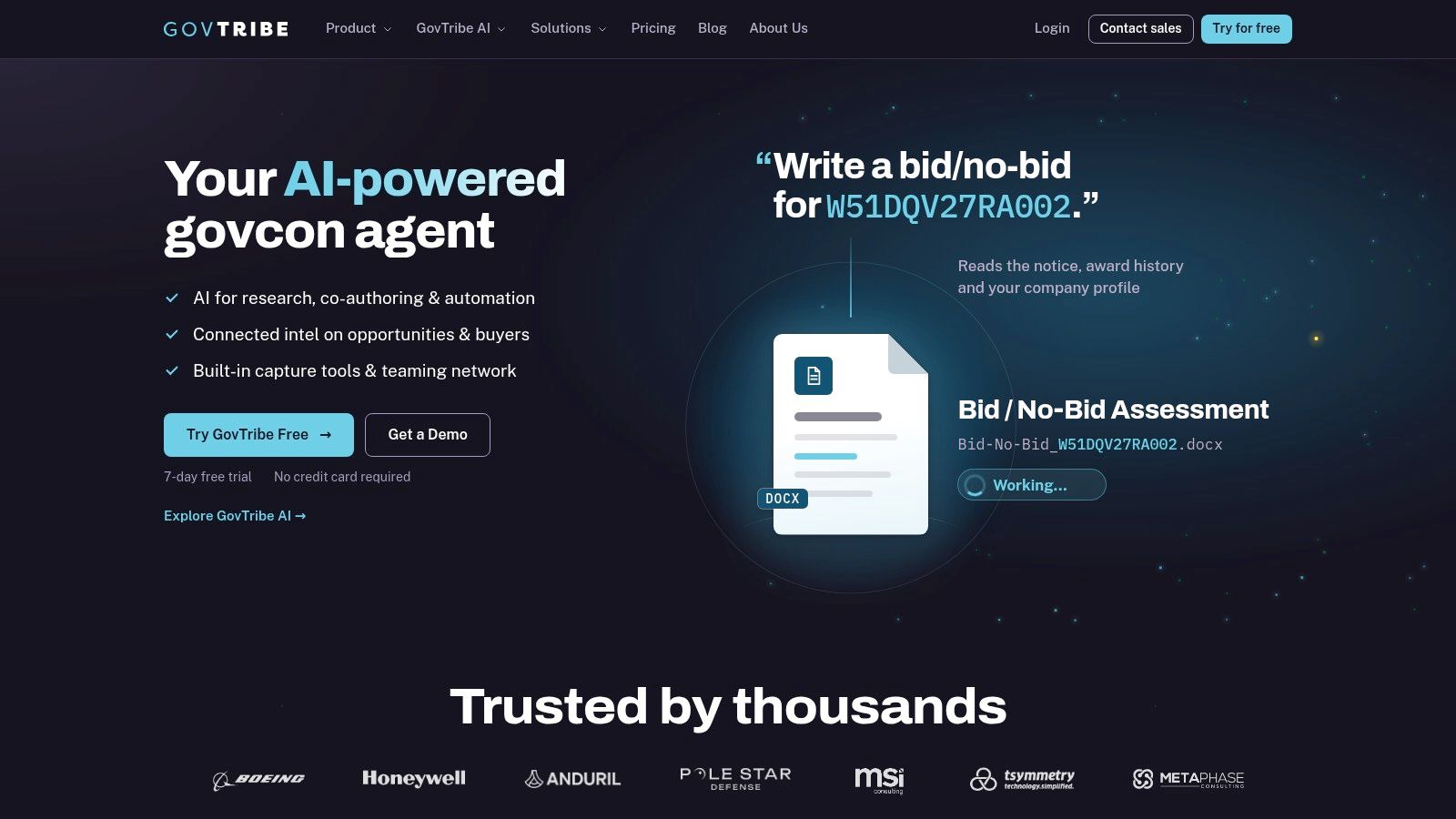
That matters because the underlying public record is huge and messy. The FPDS public welcome page describes more than 12 million legacy contract actions migrated from the former Federal Procurement Data Center, with records extending back to 1979. A good mid-market tool earns its money by normalizing that record, not by claiming exclusive access to it.
What You Get
Research coverage: Search federal, state, and local opportunities, awards, forecasts, and vendors, with contacts and saved searches.
Pursuit workflow: Track pursuits with team features instead of scattering notes across email.
AI and integrations: Use AI research and document analysis with annual credits, plus Zapier and Unanet integrations. GovTribe Pro adds GSA eBuy and federal contract-vehicle opportunities.
If you're still sorting basic buying questions, start with the GovCon Reviews FAQ before you trial anything.
Pros: It publishes annual pricing and offers a seven-day trial without a credit card. One plan can cover federal and SLED research. Team plans add larger export limits, integrations, and expanded support.
Cons: AI use is credit-based, so heavy document work can add cost. Export limits vary by plan. SSO and dedicated account management require an enterprise plan.
Buy it if you want transparent pricing and solid research across federal and SLED. Pass if you expect unlimited AI drafting inside the base research workflow.
5. HigherGov
HigherGov makes its pitch on broad coverage without an enterprise sales process. It's a market-intelligence and pursuit platform for federal and state or local opportunities, forecasts, alerts, and pipeline management. Published pricing is the headline. For a contractor budgeting carefully, that's not a minor feature.
The market justifies a low-friction entry point. The GAO report on common products and services states federal agencies spent more than $495 billion on common products and services, including information technology, in fiscal year 2024. You don't need the most expensive platform to start finding relevant slices of that spend. You need clean filters, alerts you trust, and a pipeline you'll maintain.
Features Worth Testing
HigherGov lists federal opportunities and forecasts, state and local opportunities, alerts, pipelines, and pursuits. Its toolkit adds a vendor people database, labor-pricing tool, and AI insights, which helps when you're moving from a notice to a rough pricing and teaming view. Higher tiers add API access, eBuy and task-order imports, and Zapier integration.
Test HigherGov against ten opportunities you already know. If it surfaces them cleanly for your states and agencies, the value case writes itself. If it misses them, the low price doesn't matter.
Pros: Public pricing supports straightforward budgeting. The Starter plan is listed at a low annual price for one user. Higher tiers add users, export capacity, onboarding, and a success manager.
Cons: Confirm plan details and limits before purchase. Lower-cost plans may not fit teams needing larger exports or extensive collaboration. Coverage still needs testing for your target jurisdictions.
Buy it if you want a budget-conscious starting point with more than alerts. Pass if you're running a large, export-heavy capture operation from day one.
6. GovSpend
GovSpend isn't primarily a bid-alert product. It's a public-sector procurement data and analytics platform for teams that sell by understanding who buys what, where, and how often. That spending lens is most useful in federal, state, local, and education markets where account planning beats chasing every posted notice.
SLED work punishes tools that assume clean digital maturity. The GovTech report on government purchasers reports that in a 2026 survey of 100 public-sector professionals, 46% still relied on spreadsheets, email, and paper. So judge GovSpend on whether it makes fragmented buying activity usable for territory plans and exports into the spreadsheet workflows your team probably still runs. That's also how we frame category fit at GovCon Reviews, by workflow reality rather than feature counts.
How to Evaluate It
Spending intelligence: Confirm the procurement and spending views match your buyers, categories, and geographies.
Opportunity identification: Ask how analysis turns buying activity into accounts and pursuits your sellers can act on.
Module clarity: Pin down which SLED and federal modules are included in your quote.
Pros: It focuses on spending data and market intelligence, not just notices. It's relevant when your pipeline depends on SLED buyers and procurement patterns. A vendor demo lets you discuss your specific market before buying.
Cons: Pricing is customized and not published. The boundary between SLED offerings and related federal coverage needs clarification. The sales-led process makes quick price comparison harder.
Buy it if account-level spending intelligence drives your SLED sales motion. Pass if you mainly need solicitation alerts, qualification, and proposal drafting.
7. Govly
Govly wins a narrow, valuable lane. It's built around contract vehicles and teaming, so it earns its keep for primes, OEMs, distributors, and integrators that sell through vehicles they hold or through partners that hold them. If open-market bids are your route to revenue, its best features won't matter much.
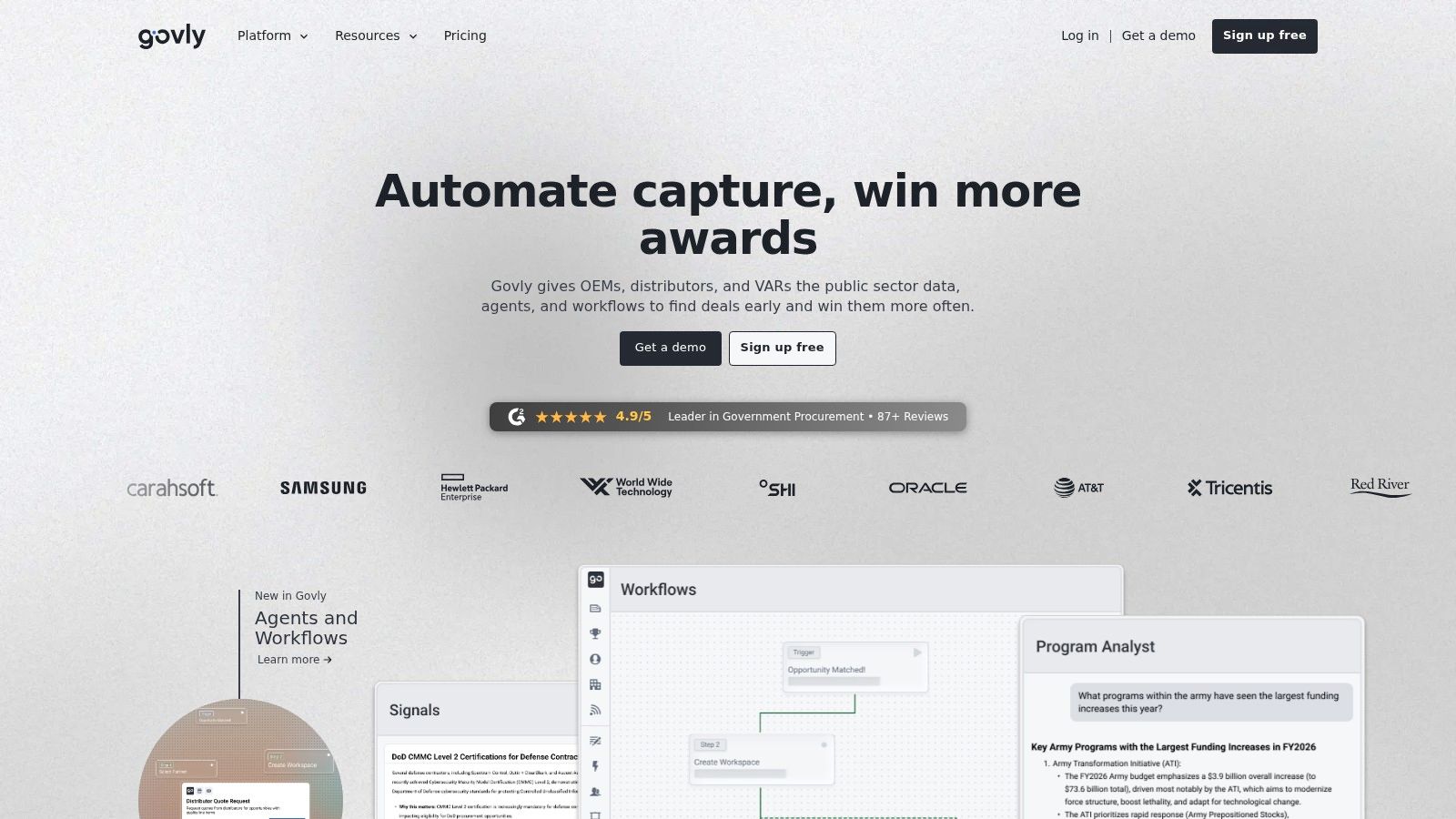
The free plan covers search and filtering for recent public solicitations and recent federal awards. Paid enterprise plans add deeper visibility into GWAC and IDIQ opportunities through your own or partners' contract vehicles, plus team workspaces, teaming tools, and AI-extracted contact and agency intelligence organized by market category. That mix pushes Govly toward qualification and capture rather than general SLED discovery. Confirm jurisdiction coverage if SLED bids are central to your pipeline.
A Data Warning That Applies Here
Vehicle and partner intelligence is only as good as the award record underneath it. A Procura analysis published on Business Insider's markets wire reported that as of November 2026, USAspending.gov had failed to ingest approximately 38% of federal subcontract reports submitted since June 2025. This is a third-party analysis, not a measured error rate for Govly. Ask every vendor how it handles missing or conflicting prime, subcontract, and modification records before building a teaming map on its output.
Pros: The free tier is a practical way to explore the product before a sales conversation. Vehicle-focused visibility and teaming differentiate it for partner-led sales. Collaboration workspaces support primes and partners researching the same pursuit together.
Cons: Free access is limited to recent public solicitations and federal awards. Paid pricing isn't listed and requires contacting sales. You must confirm your vehicles and partner networks are covered.
Buy it if GWAC and IDIQ teaming is central to your pipeline. Pass if you pursue open-market federal and SLED bids and rarely sell through partners.
How the 7 Contract Intelligence Platforms Compare
| Platform | Federal + SLED Coverage | Pricing Transparency | AI Capabilities | Best For |
|---|---|---|---|---|
| SamSearch | Federal and SLED on eligible plans, plus specialized markets | Quote-based; confirm markets and modules | Opportunity matching, document analysis, compliance support, proposal drafting and editing | Midsize and enterprise teams coordinating discovery, capture, and proposals in one workflow |
| Civio AI | Federal and SLED; verify your jurisdictions | Custom quote; no standard public dollar price | Opportunity scoring, capture handoffs, proposal and compliance support | Teams coordinating AI-assisted capture across both markets |
| Deltek GovWin IQ | U.S. federal and SLED, plus Canadian markets | Unpublished; contact Deltek | Verify AI tools and package scope in a demo | Established capture teams seeking analyst research and early market insight |
| GovTribe | Federal, state, and local; Pro adds eBuy and contract vehicles | Annual pricing published; seven-day trial | AI research and document analysis with annual credits | Teams wanting federal and SLED research with self-serve evaluation |
| HigherGov | Federal, state, and local opportunities | Public pricing | AI insights | Budget-conscious contractors seeking broad coverage and pipeline tools |
| GovSpend | Federal, state, local, and education; confirm modules and geographies | Tailored quotes; not published | Confirm available AI features with vendor | Teams focused on public-sector spending data and procurement activity |
| Govly | Recent public solicitations and federal awards; paid plans add vehicle-based opportunities | Free plan available; paid pricing requires contacting sales | AI-extracted contact and agency intelligence | Primes, OEMs, distributors, and integrators pursuing contract-vehicle work |
Federal and SLED Contract Intelligence Platform FAQs
Which platform is best for a midsize or enterprise federal and SLED contractor? If you need shared discovery, capture, and proposal workflows, test SamSearch on live pursuits and confirm the plan covers your markets. If your priority is self-serve research and visible pricing, compare GovTribe and HigherGov first.
How is contract intelligence different from a bid-alert service? Bid alerts notify you of matching notices. Contract intelligence can also help your team research buyers and awards, qualify opportunities, track pursuits, and analyze solicitation documents. Compare platforms against the work your team actually needs to do after an alert arrives.
Do federal contract databases cover SLED bids? Not automatically. Check each plan's state, local, and education access, then test known opportunities in your target jurisdictions. The South Carolina Law Enforcement Division procurement page, for example, points bidders to South Carolina Business Opportunities (SCBO) for its solicitations. Publication practices vary by jurisdiction.
How should I compare SamSearch and Civio AI? Test both against the same federal and SLED opportunities. Check which platform finds the right notices, explains its qualification recommendations, carries context into capture and proposal work, and gives your team a clear way to verify source requirements. Request quotes for the markets and features you need.
What should I check before buying a platform? Run a trial or demo using known opportunities in your agencies and jurisdictions. Confirm market coverage, user access, export limits, AI usage costs, integration needs, and how each tool links its analysis back to source documents.
Can AI submit a government proposal without review? It shouldn't. Use AI to speed up document analysis, compliance mapping, and first drafts, but verify source requirements, eligibility, pricing, and final responses with the responsible team.
Choosing Your Platform
SamSearch is the strongest starting point for midsize to enterprise contractors that want discovery, qualification, capture, and proposal work in one workflow. Its company-aware matching and document-to-response tools help teams coordinate those handoffs. Confirm your plan includes the SLED markets and response features you actually need. Civio AI is the closest alternative here if your primary goal is to coordinate AI-assisted capture and proposal work across a broader team; test both on the same opportunities rather than comparing feature lists alone.
The other platforms each fit a specific motion. GovWin IQ suits capture teams that will use analyst research and early signals. GovTribe and HigherGov fit researchers who value public pricing and self-serve evaluation. GovSpend serves spending-data buyers building SLED account plans. Govly fits vehicle-and-teaming sellers, but its SLED fit needs particular scrutiny.
Before you sign, apply one risk check to every AI claim. The GAO report on AI in small-business contracting identifies potential AI uses including market research, acquisition forecasting, communications, and reporting, while governance remains inconsistent. Ask each vendor about source traceability, customer-data retention, human review, audit logs, and export controls. An AI tool that's fine for opportunity triage may be the wrong place for proprietary or controlled information.
Use this decision checklist before you buy:
Coverage match: Does it find your known federal and SLED opportunities, by NAICS, set-aside, agency, and jurisdiction?
Full cost: Can you state the annual price, including seats, add-ons, AI credits, and SLED modules?
Trial access: Can you test it on live pursuits before a sales-led commitment?
Workflow fit: Can a notice become an assigned owner, a qualification decision, a deadline, and a documented next action without rekeying data?
Pick the tool that matches your pursuit workflow, trial it on real opportunities, and don't pay for depth your team won't use.
GovCon Reviews publishes in-depth reviews and head-to-head comparisons of the software contractors use to find opportunities, run capture, and build proposals across federal and SLED markets. If you're still weighing these seven platforms against your NAICS codes, set-asides, and team size, visit GovCon Reviews for pricing breakdowns, honest pros and cons, and clear recommendations on which tool to buy and which to skip.
Related analysis
10 Government Contract Opportunity Tools for NASA SEWP VI in 2026
Compare ten NASA SEWP VI opportunity tools in 2026, including SamSearch and Civio AI. See pricing models, best-fit teams, and limits of restricted RFQ coverage.

Top 6 Federal Opportunity Tracking Software Platforms (November 2026) Compared
Top 6 Federal Opportunity Tracking Software Platforms (November 2026): real pricing, RFP parsing, match accuracy, and who should skip each one.
8 Best State and Local Contract Search Tools (November 2026)
Compare 8 state and local contract search tools for SLED bids, with buyer-fit guidance, pricing models, research features, and workflow trade-offs.