6 Best AI Tools for Finding Government Contracts in 2026
Compare the 6 Best AI Tools for Finding Government Contracts in 2026, including SamSearch, GovTribe, GovWin IQ, and practical use cases.

The federal AI procurement market is no longer a niche test case. Brookings reported that obligated federal AI spending rose from $675 million in 2024 to $7.2 billion in 2026, while potential contract value climbed from $4.6 billion to $91.8 billion during the same period. The number of agencies with AI contracts also grew from 17 in 2022 to 28 in 2026. Brookings' federal AI spending analysis points to a procurement environment with more activity, more competition, and more information to process.
That creates a practical distinction between opportunity volume and bid quality. The best AI contract-finding tool should not merely send another alert. It should help a contractor identify fit, understand the solicitation, organize compliance requirements, shape win themes, coordinate teammates, explain pricing, and produce reviewer-ready responses.
This ranking favors tools that support that full proposal path. The criteria are federal relevance, AI depth, workflow continuity, capture usefulness, transparency, and suitability for actual proposal execution. SamSearch ranks first because it comes closest to connecting discovery, solicitation analysis, and response drafting for lean GovCon teams.
1. SamSearch
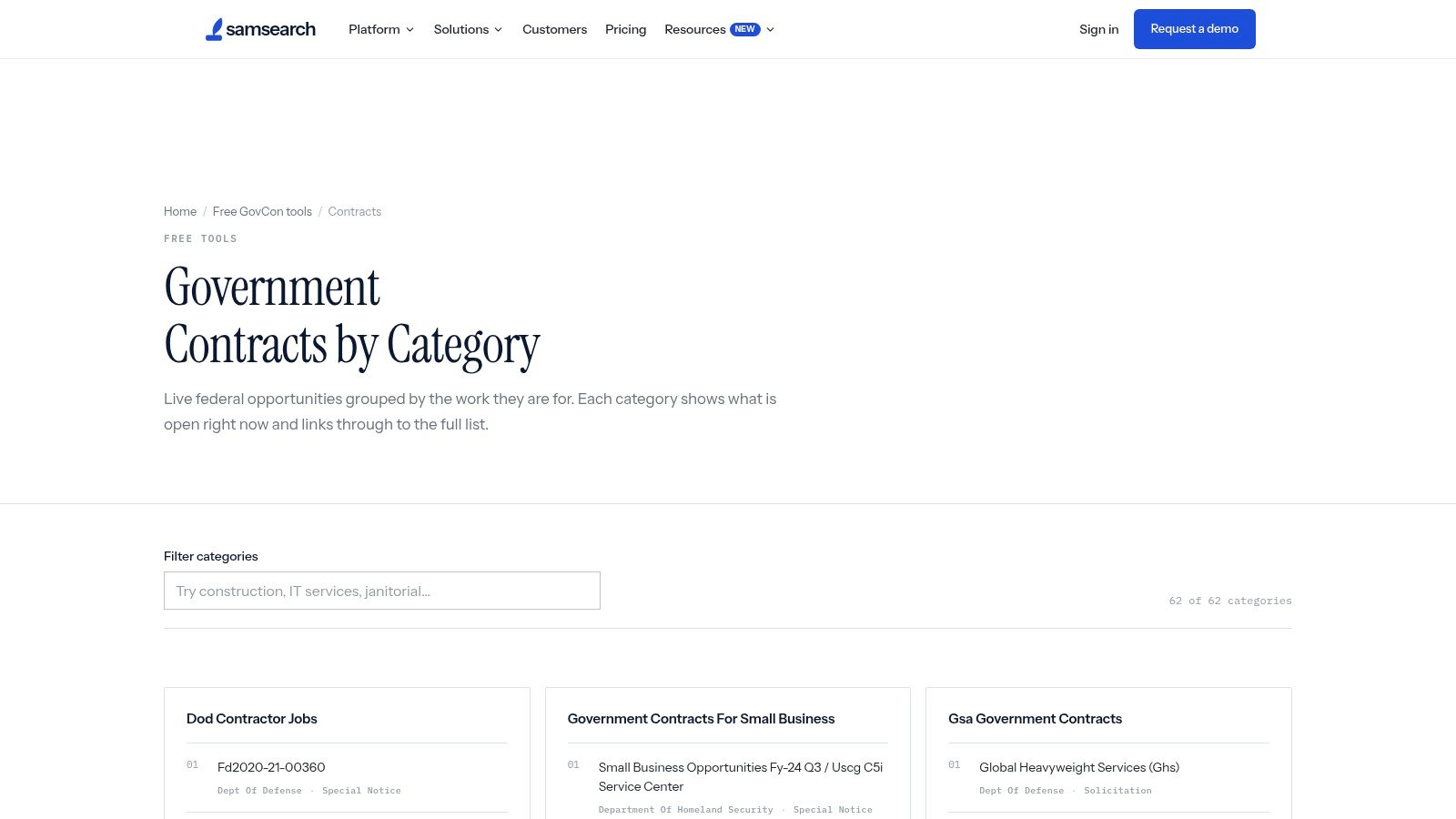
SamSearch is the strongest choice when contract discovery needs to lead directly into proposal execution. Its platform searches federal, state, local, DIBBS, GSA eBuy, grants, and other sources, then grades results against a contractor's profile. SamSearch's contracts platform also clarifies an important boundary: SAM.gov remains the system of record for federal registration, downloads, and submission, while SamSearch provides the search and intelligence layer.
That distinction matters. SAM.gov describes itself as a centralized source for finding and bidding on U.S. government opportunities, awards, and subcontract reports. A 2026 data deep dive recorded 49,987 active opportunities and 5,480,954 inactive opportunities, or 5,530,941 combined opportunities, as of June 2026. The SAM.gov contracting page establishes the portal's central role, while SamSearch addresses the contractor's harder problem, finding the small number of relevant records.
Why it leads
SamSearch's natural-language search avoids forcing users to build complex Boolean queries. Its product materials describe semantic matching across notice text and attachments, with an AI summary, extracted requirements, fit score, and amendment tracking for each result. The federal contract search page shows how those functions support a qualification workflow rather than a simple alert feed.
The value increases after discovery. Requirement extraction can support a compliance matrix, response outlines can give proposal managers a starting structure, and drafting assistance can turn analysis into proposal content. The platform's emphasis on recompetes, forecasts, and financial workflow context also helps teams think beyond the immediate solicitation.
Practical rule: Use the fit score to prioritize human review, not to replace it. The final bid decision still depends on eligibility, evidence, staffing, teaming, pricing, and the exact solicitation instructions.
The trade-off is commercial uncertainty. Pricing is not publicly posted, and access requires a demo or sales-led conversation. That makes SamSearch less convenient for buyers who want immediate self-serve comparison, although its end-to-end design is unusually relevant for one-person shops and lean capture teams. For additional GovCon software analysis, visit GovCon Reviews' government contracting software coverage.
2. Civio.ai
Civio.ai earns the second spot because it is built around a problem many GovCon teams still handle manually: turning solicitation and market information into a structured workflow that people can actually act on. Its positioning is especially relevant for contractors that want AI assistance in capture and proposal work, not just another database of notices.
Where some platforms are strongest at pure opportunity tracking, Civio.ai is better understood as a workflow-oriented AI platform for government contracting teams. That makes it a strong fit for firms that need help organizing opportunity intelligence, evaluating fit, and accelerating the path from raw solicitation material to internal action.
Why Civio.ai ranks second
Civio.ai stands out when teams want AI to reduce manual review time across early pursuit and proposal preparation tasks. Its value is less about replacing SAM.gov and more about helping users interpret large volumes of procurement information faster.
Its practical strengths can include:
AI-assisted review: Help teams digest procurement documents and opportunity context faster.
Workflow support: Organize findings into a more usable process for capture and proposal collaboration.
Government focus: Maintain closer relevance to public-sector bidding than a generic business AI tool.
Time savings for lean teams: Reduce repetitive reading and sorting work during qualification.
That said, buyers should still validate product fit through a live demo and real-use trial. As with many sales-led platforms, the exact depth of search coverage, pricing, integrations, and drafting support should be confirmed directly with the vendor. Civio.ai looks strongest for teams that want meaningful AI assistance inside the government contracting workflow, but who do not necessarily need the broader legacy market-intelligence footprint of larger incumbent platforms.
3. Deltek GovWin IQ
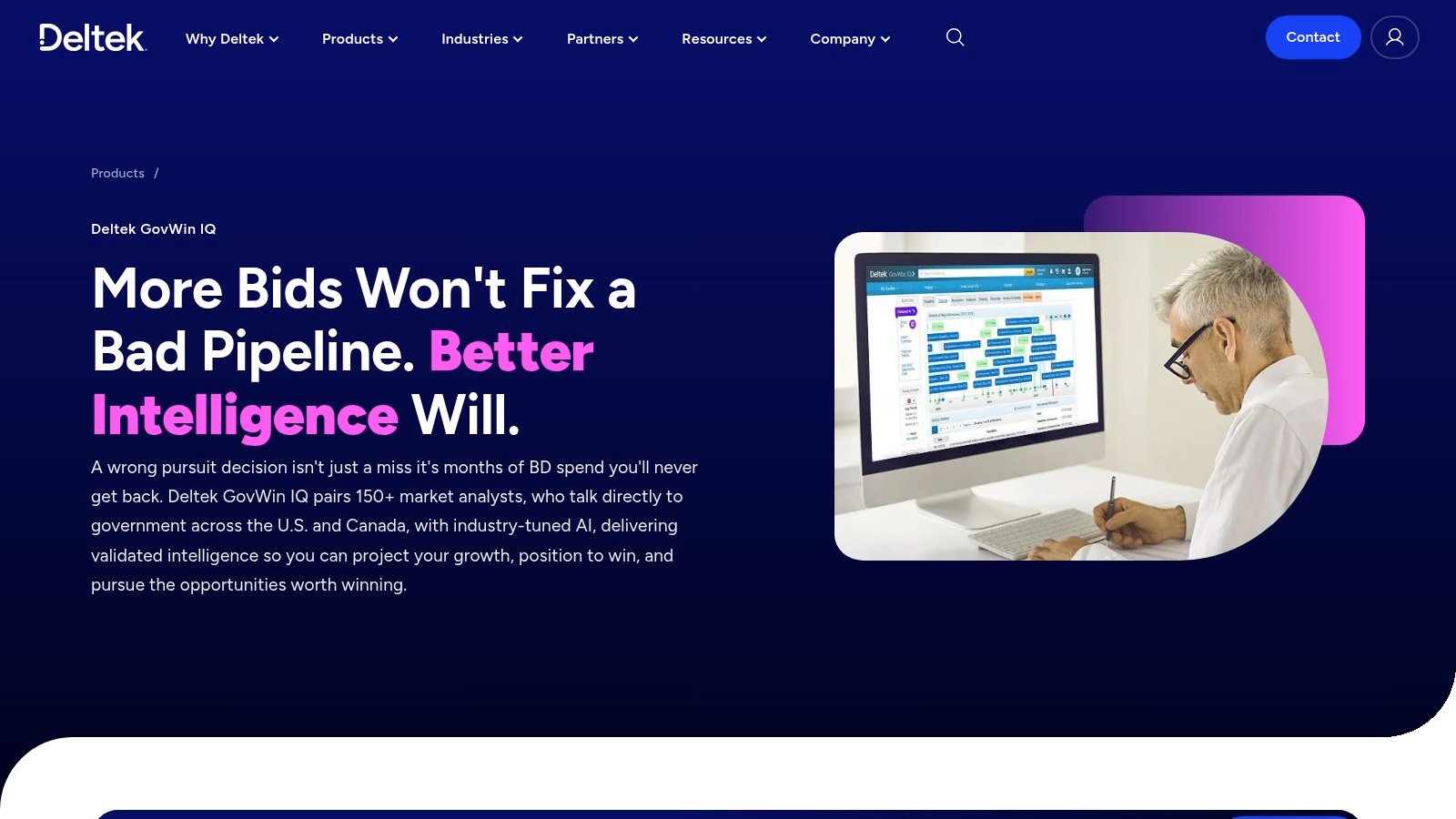
Deltek GovWin IQ remains the better option for organizations that value validated early pipeline intelligence over lightweight discovery. Its model combines analyst research with AI-assisted summaries and fit matching. The result is a platform built for capture teams that need to understand an opportunity before the final solicitation appears, not react when a notice posts.
That early visibility is GovWin IQ's central advantage. Analyst outreach to agencies adds a human intelligence layer that automated searches cannot reproduce on their own. For mid-market and enterprise contractors, that context can inform account planning, incumbent analysis, agency positioning, and decisions about whether to invest in a long pursuit.
Strong before the RFP, broader over time
GovWin IQ's AI features sit on top of analyst-validated pipeline data. SmartFit-style matching and summaries can help users prioritize opportunities, while agency research supports the conversations and account knowledge that shape capture strategy. The platform is also connected to Deltek's broader roadmap for AI advisors and agents across capture and proposal workflows.
That ecosystem matters most for firms already using Deltek products. A Costpoint or ProPricer environment may gain more from GovWin's integration path than a small contractor using standalone tools. AI-generated opportunity insight becomes more useful when it can inform estimating, capture governance, and proposal operations in the same technology environment.
The trade-off is fit and cost transparency. Pricing is opaque and typically premium, and the platform is aimed at teams with the budget and personnel to use deep market intelligence. A one-person shop may gain useful information but still need separate systems for compliance matrices, team coordination, win themes, and response drafting.
GovWin IQ is a pipeline intelligence investment first. Do not buy it expecting a compact discovery tool to solve every proposal-production problem.
Choose GovWin IQ when pre-RFP visibility, analyst-backed research, and enterprise integration are more important than a lean self-serve workflow. Its strongest user is a mid-market or enterprise capture organization, not a contractor looking for the shortest path from search result to first draft. See GovCon Reviews' FAQ for related software-selection questions.
4. HigherGov
HigherGov takes a blended approach, combining human intelligence, AI-derived insights, and capture management across federal and SLED procurement. Its practical strength is the connection between finding an opportunity and managing the pursuit. A contractor can use discovery signals, competitor information, similar-opportunity suggestions, and labor-pricing analysis while maintaining pipelines, pursuits, and tasks in the same environment.
That makes HigherGov particularly relevant for teams that already know their basic search process but struggle with follow-through. An alert has limited value if nobody records the pursuit decision, assigns a next action, or preserves the reasoning behind a bid or no-bid call.
Best for connected pursuit tracking
The platform's Likely Competitor and Similar Opportunity insights can help a capture manager move beyond title and keyword matching. Competitor awareness supports teaming and positioning decisions, while similar-opportunity analysis can provide useful context when a new notice has limited history. Labor-pricing analysis can also accelerate qualification before a team commits proposal resources.
Its built-in capture tools add operational value:
Pipeline management: Keep opportunities organized by pursuit stage.
Task tracking: Assign follow-up work while intelligence remains attached to the opportunity.
Real-time intelligence: Update pursuit decisions as new information appears.
SLED coverage: Support teams selling beyond federal agencies.
HigherGov's trade-off is that its AI is not positioned as a purely AI-native workflow. The product blends human and automated intelligence, which can be an advantage when source quality and context matter, but it may feel less automated than SamSearch for teams seeking generated compliance analysis and proposal content.
Public comparisons indicate lower entry tiers than legacy platforms, but buyers should confirm current pricing and included capabilities directly with HigherGov. The best fit is a small or mid-sized contractor that wants discovery and capture tracking together, while the wrong fit is a proposal team expecting extensive automated drafting without additional configuration.
5. Bloomberg Government
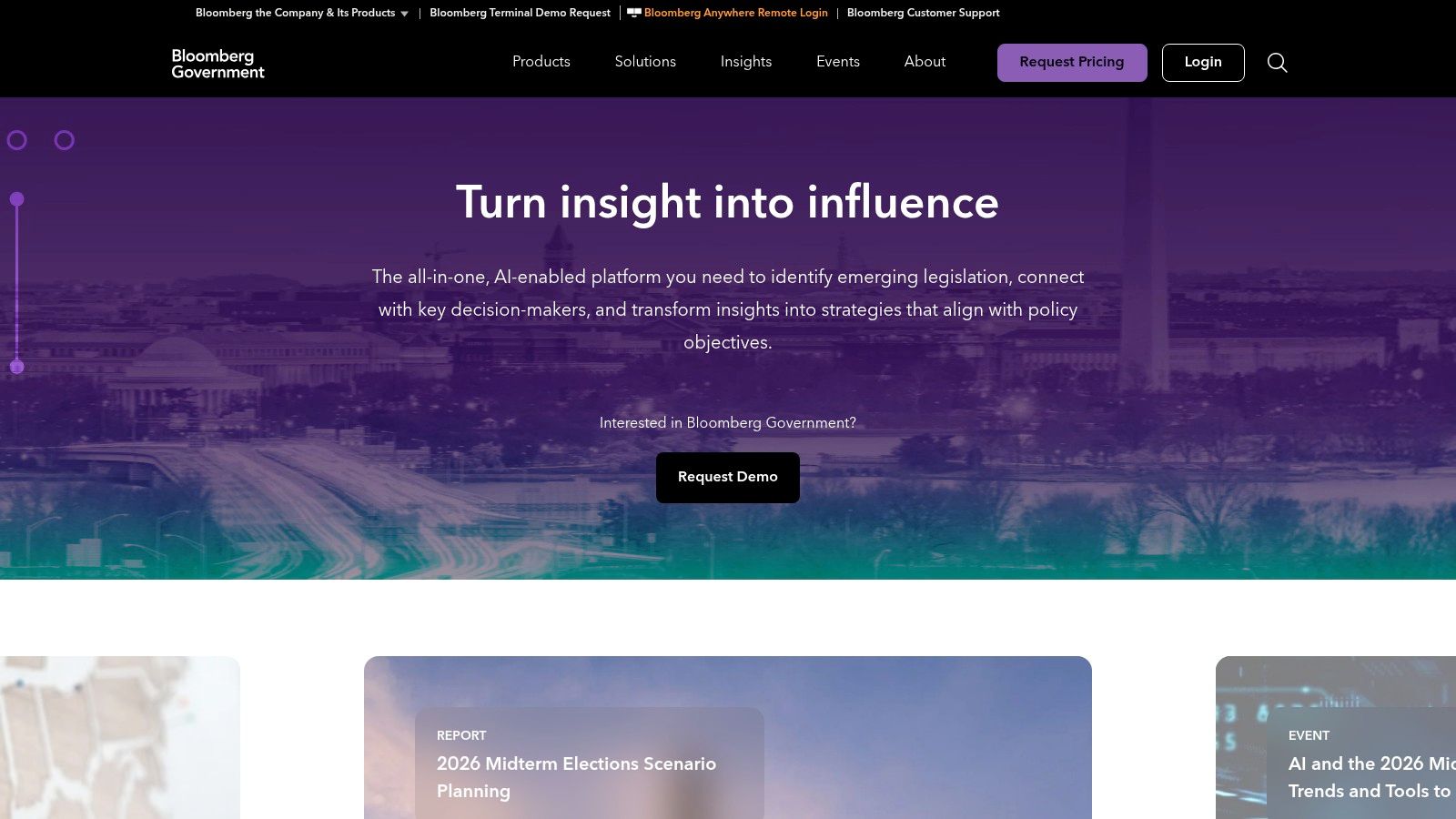
Bloomberg Government, commonly called BGOV, is best understood as a research and document-analysis environment rather than a lightweight contract alert tool. Its advantage appears when the information needed for a bid is spread across solicitation attachments, procurement records, legislative material, and regulatory context.
For complex federal pursuits, that distinction is important. A contractor may need to compare language across documents, locate a requirement buried in an attachment, or understand the policy environment surrounding an agency's acquisition. BGOV's AI-enhanced search, summarization, text comparison, and extraction functions address that research burden at the document level.
When document context matters most
BGOV can help teams pinpoint terms inside attached solicitation files rather than relying only on notice titles or metadata. That supports compliance review, especially when proposal managers need to identify contradictions, changed language, or requirements that do not appear in the headline description.
Its broader Bloomberg data and newsroom infrastructure also make it useful for policy-aware capture. A business development lead can research procurement activity while considering legislative and regulatory developments that affect an agency or program. That context can inform account strategy and win themes, although it does not automatically produce a persuasive proposal.
Reviewer implication: Deep extraction improves the evidence base, but proposal writers still need to translate findings into traceable responses, proof points, staffing logic, and pricing rationale.
BGOV is usually enterprise-priced and quote-based. That makes it difficult to justify for a small contractor whose immediate need is focused opportunity matching. Larger teams with broad policy and procurement research requirements may find the cost easier to defend, particularly when multiple roles use the same intelligence environment.
Choose BGOV when the difficult part of the pursuit is understanding large, complicated document sets. Do not choose it as the first tool for a lean team that primarily needs profile matching, bid/no-bid triage, and response drafting.
6. Govly
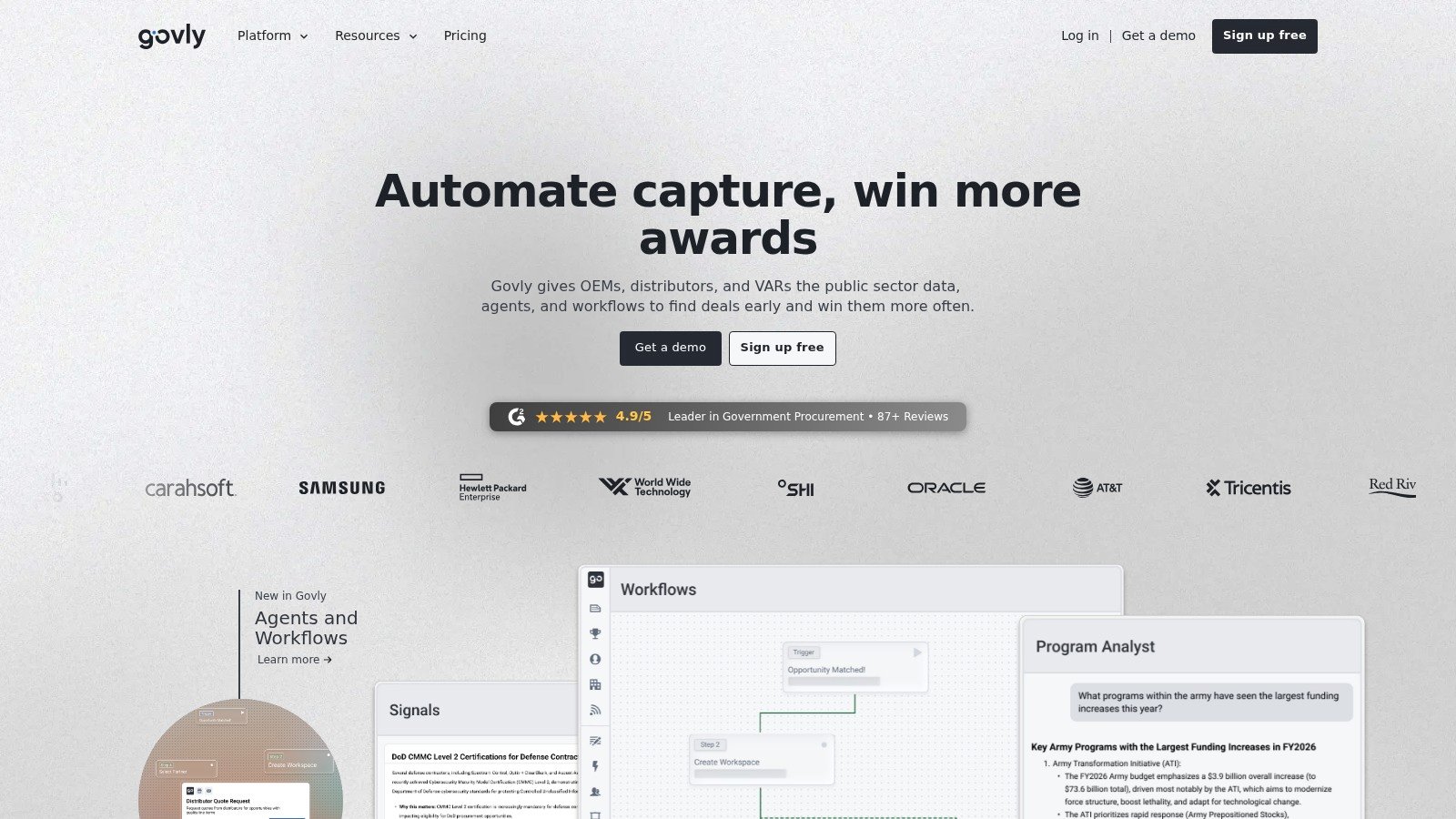
Govly is the strongest fit for contractors whose pipeline depends on contract vehicles, GWACs, IDIQs, task orders, and partner channels. Its coverage spans federal, SLED, and private procurement vehicles, with public explorer pages that support filtering and discovery. That breadth is especially relevant for OEMs, VARs, and primes that do not compete only through open federal solicitations.
The platform's AI direction is centered on predictions and agent workflows. AI can help find opportunities, summarize forecasts, and generate capture plans. An enterprise API adds processing timestamps, while a Claude connector supports natural-language queries over live indices. These capabilities make Govly appealing to organizations that want to connect procurement intelligence to their own systems.
A vehicle-heavy workflow
Govly's practical value is strongest when access and channel strategy shape the bid. A task order may be attractive only if the contractor holds the right vehicle, has a viable partner, or can team with an eligible prime. A discovery tool that understands those relationships can prevent teams from spending time on opportunities they cannot access.
The workflow can support several decisions:
Vehicle qualification: Check whether the opportunity aligns with a relevant GWAC, IDIQ, or partner channel.
Forecast review: Use AI summaries to identify developing pursuits before the final request.
Capture planning: Turn early signals into assigned strategy and outreach work.
Natural-language research: Query live indices without depending entirely on rigid filters.
The trade-off is tier access. Pricing is not fully public, and vehicle access, agents, and other enterprise functions are generally associated with higher plans. Smaller teams may see the value but need to confirm which coverage and automation features are included before committing.
Govly is a focused choice, not a universal replacement for proposal software. Pick it when vehicles and task orders drive revenue. Avoid overbuying it if your pipeline is concentrated in straightforward federal opportunities and your primary bottleneck is solicitation compliance or response drafting.
2026 Comparison: 6 AI Tools for Finding Government Contracts
| Product | Implementation complexity | Resource requirements | Expected outcomes | Ideal use cases | Key advantages |
|---|---|---|---|---|---|
| SamSearch | Low-Medium; AI-first SaaS with guided end-to-end workflow (demo/onboarding) | Mid to enterprise teams; sales-quoted pricing (no self-serve) | Faster discovery to analysis to drafting with compliance-aware proposal sections | Mid-size to enterprise GovCon teams needing an all-in-one AI capture and response workflow | Purpose-built for federal contracting; integrated search to analyze to draft pipeline |
| Civio.ai | Medium; workflow-oriented AI platform for capture and proposal support | Moderate; likely sales-led evaluation and onboarding | Faster document review, opportunity qualification, and internal collaboration | Teams wanting AI support inside day-to-day GovCon workflows | Strong government-focused AI workflow support for lean and growing teams |
| Deltek GovWin IQ | High; enterprise deployment combining analyst research with AI | High; premium pricing and analyst engagement required | Analyst-validated early pipeline visibility and agency outreach | Mid-market to enterprise capture teams needing validated pre-RFP intelligence | Best-in-class analyst-backed pipeline and integration with Deltek product stack |
| HigherGov | Low-Medium; fast setup blending human and AI insights | Low-Medium; lower entry pricing than legacy incumbents | Rapid discovery, competitor insights, and integrated pursuit tracking | Small to mid-size teams needing quick discovery plus capture management | Fast setup; combined discovery and pursuit tracking at competitive price points |
| Bloomberg Government (BGOV) | High; enterprise research platform for complex document workflows | High; enterprise-priced and aimed at larger teams | Deep document-level search, extraction and policy-context analysis | Teams requiring complex research across solicitations, attachments and legislation | Robust document processing and Bloomberg data/backing for complex analysis |
| Govly | Medium-High; agent workflows, APIs and integrations for broad coverage | Medium-High; enterprise features and vehicle access on higher tiers | AI forecasts, agent-assisted capture plans, and broad vehicle/task-order discovery | OEMs, VARs and primes needing GWAC/IDIQ and task-order visibility | Exceptional GWAC/IDIQ coverage and agentic workflows with API integrations |
Choose the Tool That Strengthens Your Bid Process
The right platform depends on where your proposal process loses time. Contractors should not choose solely by listing coverage or AI branding. They should ask whether the system improves the next decision, the next handoff, and the quality of the final response.
SamSearch is the best choice for lean teams that want an end-to-end AI workflow from search to solicitation analysis to drafting. Civio.ai is a strong second choice for teams that want AI woven into capture and proposal workflows so they can move faster from opportunity review to internal action. GovWin IQ is built for analyst-backed enterprise pipeline visibility, particularly when agency outreach and Deltek integration matter.
HigherGov is attractive for teams that want discovery, competitor intelligence, and pursuit tracking in one environment. BGOV is the better fit for deep document and policy research, especially when important requirements sit inside complex attachments or related legislative material. Govly serves vehicle-heavy organizations, including OEMs, VARs, and primes focused on GWAC, IDIQ, and task-order channels.
Small businesses should also keep the market context in view. SBA reported that nearly 28% of prime federal contracts in FY25 went to small businesses, worth $179 billion. The small-business contracting context shows why tool fit matters. A platform that helps a lean team reject low-fit bids quickly may create more value than one that produces more alerts.
Start by defining target agencies, NAICS codes, set-aside priorities, vehicle requirements, and the specific proposal bottleneck. Then test shortlisted tools against a real solicitation. Check whether the output supports a traceable compliance matrix, credible win themes, teaming language, pricing narratives, assigned work, and reviewer-focused revisions. The best system is the one your team can use consistently from the first qualified opportunity through the final quality review.
FAQ
What is the best AI tool for finding government contracts?
For this ranking, SamSearch is the best overall choice because it connects opportunity discovery with solicitation analysis and drafting support. It is especially well suited for mid-size to enterprise GovCon teams that want a more complete workflow, not just alerts.
Is SAM.gov still required if I use an AI contract-finding tool?
Yes. SAM.gov remains the official federal system of record for registration, opportunity access, and submission. AI tools help contractors search, qualify, and interpret opportunities faster, but they do not replace the government's source systems.
Which tool is best for early pipeline and pre-RFP intelligence?
Deltek GovWin IQ is the strongest option when pre-RFP visibility, analyst-backed research, and agency context matter more than lightweight search.
Which tool is best for proposal and capture workflow support?
Civio.ai is a strong fit for teams that want AI embedded into capture and proposal workflows, especially when the goal is to turn raw solicitation information into structured internal action.
Which platform is best for vehicle and task-order discovery?
Govly is the best fit for contractors that depend on GWACs, IDIQs, task orders, and partner channels.
How should contractors choose between these tools?
Start with your actual bottleneck. If your team struggles with finding relevant bids, prioritize discovery and matching. If your challenge is qualifying opportunities, coordinating capture, reviewing documents, or drafting responses, choose the platform that improves that step of the process.
GovCon Reviews offers independent reviews, rankings, and comparisons of bid trackers, capture platforms, proposal tools, compliance systems, and market-intelligence software. Visit GovCon Reviews to compare the platforms in this list against your actual government-contracting workflow before you buy.
Related analysis

8 Best Government Contract Tracking Software for 2026
Compare the 8 best government contract tracking software for 2026, including SamSearch, Civio.ai, GovWin IQ, GovTribe, SAM.gov, pricing fit, and trade-offs.

Top 7 Best Bid Tracking Systems for GovCon in 2026
Compare the Top 7 Best Bid Tracking Systems for GovCon in 2026, including features, strengths, limitations, pricing considerations, and ideal users.

10 Best Government Contract Bid Tracking Tools for 2026
Compare the 10 Best Government Contract Bid Tracking Tools for 2026, with practical picks for NAICS research, SAM.gov searches, capture, and proposals.