6 Best SLED Sales Intelligence Software Platforms for 2026
Compare six SLED sales intelligence platforms for 2026, including SamSearch and Civio AI. See features, pricing models, pros, cons, and best-fit workflows.
You're checking a state portal at 9 a.m., a county site at lunch, and three school district pages before close of business, and you still find the best-fit bid two days after questions closed. That's the daily reality in SLED. A state contract opportunity can close in two weeks, and the one that gets missed is usually the one buried in a school district portal nobody checked.
This roundup of the 6 best SLED sales intelligence software platforms separates tools by the job they perform. Some find local bids. Some research buying agencies. Some support long capture cycles on large state accounts. I've ranked them on discovery depth, bid-document help, pricing clarity, and fit for different team sizes, with a clear verdict on who should buy each one and who should pass. Most roundups treat these platforms as interchangeable bid databases. They're not, and treating them that way is how lean teams end up paying for analyst research they'll never read or drowning in alerts they can't act on.
1. SamSearch
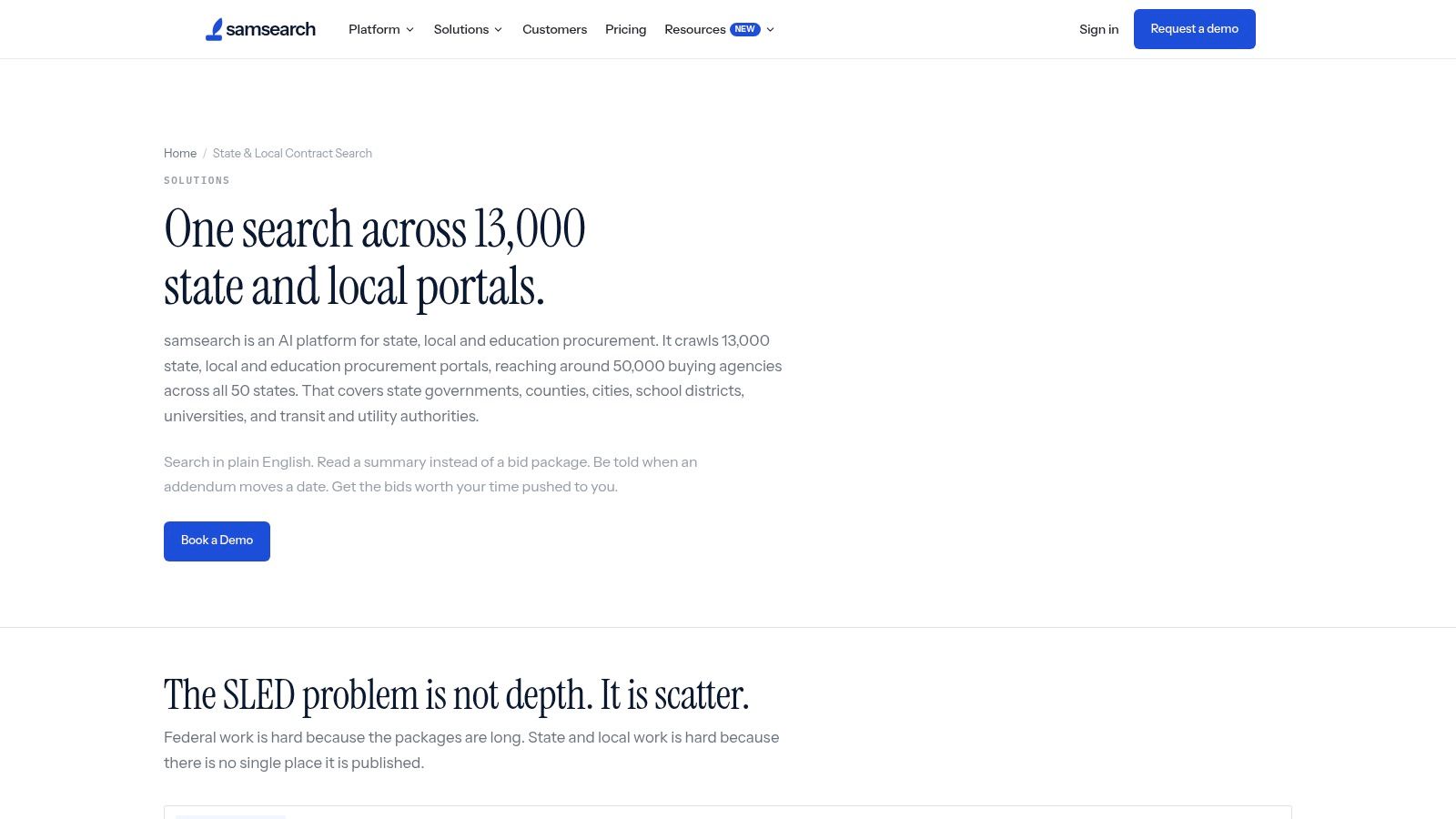
Verdict first: SamSearch is the strongest pick for midsize and enterprise contractors that need to find SLED bids and judge fit in one workflow. SamSearch combines opportunity discovery with AI-assisted solicitation review, so you don't hand off a promising notice to a second tool just to learn whether you qualify. For a lean team, the useful distinction is not just how many notices a platform finds, but how quickly one person can move from a notice to a defensible bid/no-bid decision.
The company says it searches more than 15,000 procurement portals spanning federal, state, local, defense, K-12, higher education, grants, SBIR/STTR programs, and subcontracting, according to SamSearch's enterprise coverage page. Its SLED search page describes a narrower state-and-local portal count, so avoid treating those figures as the same metric. Its SLED position centers on state, county, city, school district, university, and public-authority opportunities across all 50 states. Validate coverage against the exact jurisdictions you bid.
What It Does in Practice
SamSearch Smart Search documentation describes a search that combines keyword matching with semantic matching, merges and re-ranks results, and lets you describe what you want in plain English without building Boolean queries. Exact keyword search still supports quoted phrases and AND, OR, and NOT logic when you need precision.
Document review: Summarizes solicitations and identifies dates, scope, bid forms, and potential disqualifiers, including insurance, bonding, and licensing requirements
Fit scoring: Matches opportunities to your company profile, codes, set-aside status, and past performance, and explains the score
Change tracking: Tracks addenda and changes to bid details so you're not working from a stale PDF
On its homepage, SamSearch says its AI reads the solicitation and attachments, then builds a compliance matrix and drafts proposal sections from your own library, with drafts cited back to source material. That citation habit matters. You can check an AI finding against the original passage before it shapes a bid/no-bid call. Compared with spending-first research tools, SamSearch's advantage is the direct path from finding a live bid to reviewing its requirements. It is less of an analyst-led account-planning service.
Pros: Discovery connects directly to document review. One person can monitor many portals. Source links make AI output checkable, a point we return to in our GovCon tool coverage and buying guides.
Cons: Pricing is demo-based, with no public pricing listed, so confirm cost and seat terms in writing. Coverage and matching claims are vendor-reported. AI summaries don't replace reading the solicitation and addenda yourself.
2. Civio AI
Civio AI is a fit for government sales teams that want opportunity signals connected to qualification, capture, and proposal work, rather than a bid feed alone. Its positioning spans federal and SLED markets. That broader workflow can help when several people share responsibility for an account, but a contractor seeking only local bid alerts should test whether the extra process is worth it.
Where It Fits and Where It Doesn't
Civio describes AI-supported account and opportunity prioritization using fit, intent, and access signals. Its platform overview also describes proposal drafting from approved content and requirement-matrix assistance with source-linked answers. Those are useful claims to test against a real SLED solicitation, particularly if your team needs to move from qualification into a response without rebuilding context by hand.
Qualification: Prioritizes accounts and opportunities using fit and other sales signals
Proposal support: Helps draft responses from approved content and review requirement matrices
Team workflow: Connects opportunity work to capture and proposal activity across federal and SLED pursuits
Pros: Broad coverage of the sales workflow can suit teams that need more than search. Proposal and requirements support may reduce handoffs when the underlying source material is well organized.
Cons: Confirm which capabilities are included in the plan you are evaluating. Civio's pricing page is the right place to check current terms; do not assume a price quoted for one offering covers every workflow. Test SLED agency coverage, source links, and CRM handoffs before committing. Skip it if your only need is a simple alert feed.
3. GovSpend
A displacement play starts with questions a bid feed can't answer: who already buys what you sell, what they paid, and which competitor holds the account. GovSpend is built around that spending and purchasing data rather than open solicitations alone.
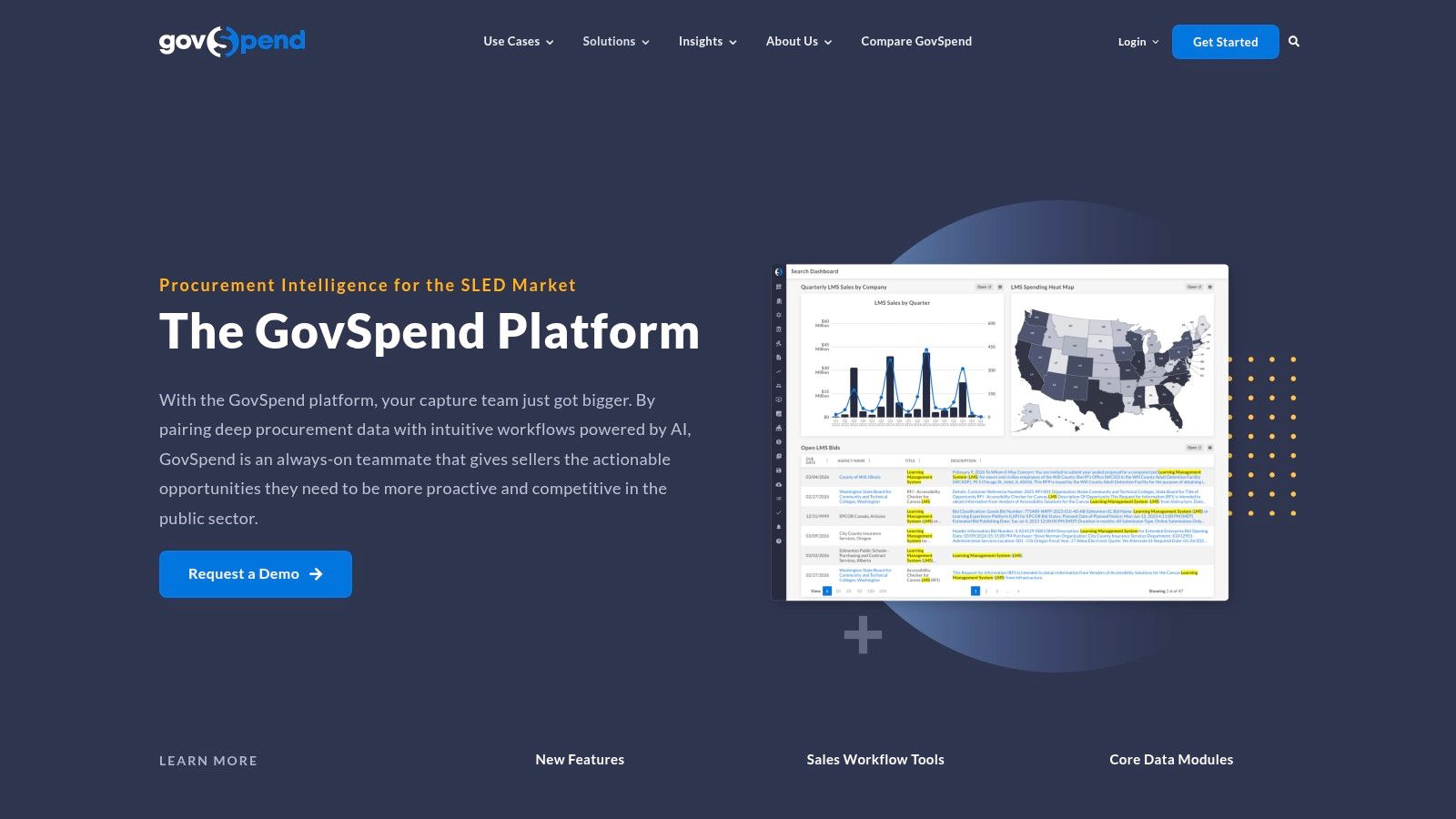
The platform combines SLED spending and purchase-order data, agency contact information, bid and contract records, cooperative-contract information, and meeting intelligence. AI tools help you review platform records. Used well, the mix surfaces purchasing patterns and emerging activity before an RFP ever publishes.
The Research Advantage
Spend data changes your targeting math. Instead of chasing every district in a state, you rank agencies by actual purchasing in your category and aim outreach where money already moves. Meeting intelligence adds timing, since board and council discussions often surface needs months before procurement writes a scope.
That's a different job than bid matching. A feed tells you what is open; spend data tells you which accounts are worth working before anything opens.
Spend research: Shows who buys, what agencies spend on, and where category activity concentrates
Multiple signals: Puts purchase orders, contracts, contacts, and meetings in one research environment
Focused requests: Data requests and refreshes can sharpen research on specific agencies or contracts
Pros: Strong for territory planning, competitor benchmarking, and pre-RFP account work, including identifying the incumbent and the pricing you have to beat.
Cons: Subscriptions are annual and custom-priced based on your business and goals, so you can't budget against a published number. Work through a set of GovCon tool buying questions during the demo, because coverage depth and recency for your target agencies and sectors decide whether the dataset earns its cost. If you only need open-RFP alerts, this broader dataset is more than the job requires.
4. GovTribe
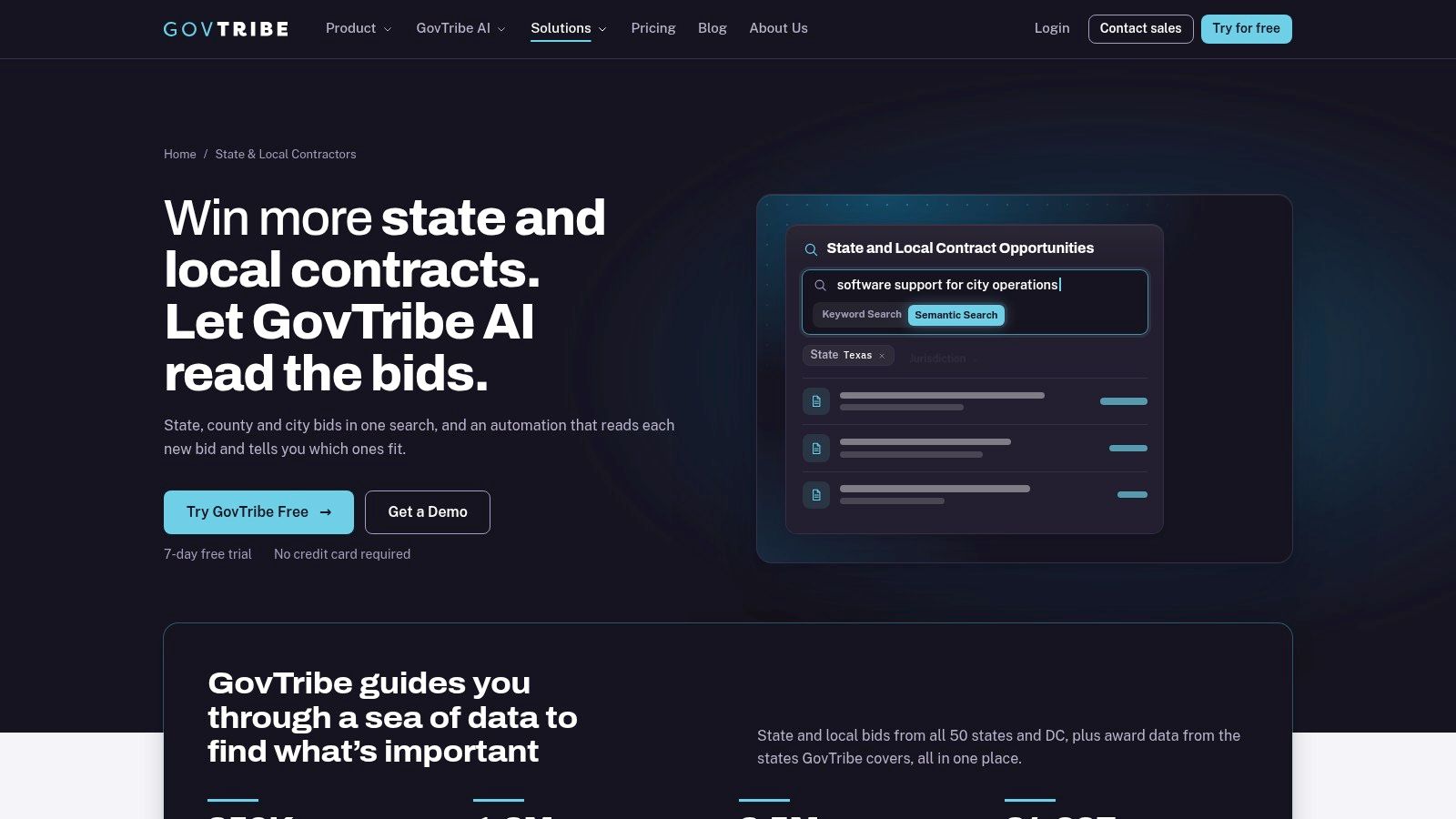
GovTribe pitches a middle path: search, vendor research, and pursuit organization in one seat-priced subscription. GovTribe's state and local contractor page reports 950,000 state-and-local contract opportunities, 1.2 million awards, and 2.5 million vendor profiles in its live index. Those are platform-reported snapshot figures, so treat them as a starting point for testing, not proof.
Search filters cover state, jurisdiction, due date, and procurement category. Award and vendor information supports market and competitor research, so you can check who won similar work before you commit proposal hours. AI assistance and capture organization tools round out the workflow side.
Pricing You Can Actually Read
GovTribe lists annual per-seat pricing publicly, with SLED search available across the plans on its pricing page. Advanced features and export limits vary by plan. That transparency puts it ahead of quote-only rivals for budgeting, even though per-seat math still adds up fast for larger teams.
Combined workflow: Opportunity search sits next to vendor research and pursuit tracking
Transparent entry: Published plans let you estimate cost before talking to sales
Competitive checks: Award history helps you size up incumbents early
Pros: One subscription covers discovery through pursuit organization. Pricing clarity is useful for small teams planning a first paid tool. Vendor profiles support teaming research as well as competitive analysis.
Cons: Confirm award-data depth in the specific states where you bid, since national totals hide local gaps. Higher export limits and advanced features sit in upper plans. Annual per-seat pricing can outgrow a growing BD team's budget, so model year-two headcount before you buy.
Test any index claim with ten known recent awards from your own states. If the platform can't find work you already know about, the headline total doesn't matter.
5. HigherGov
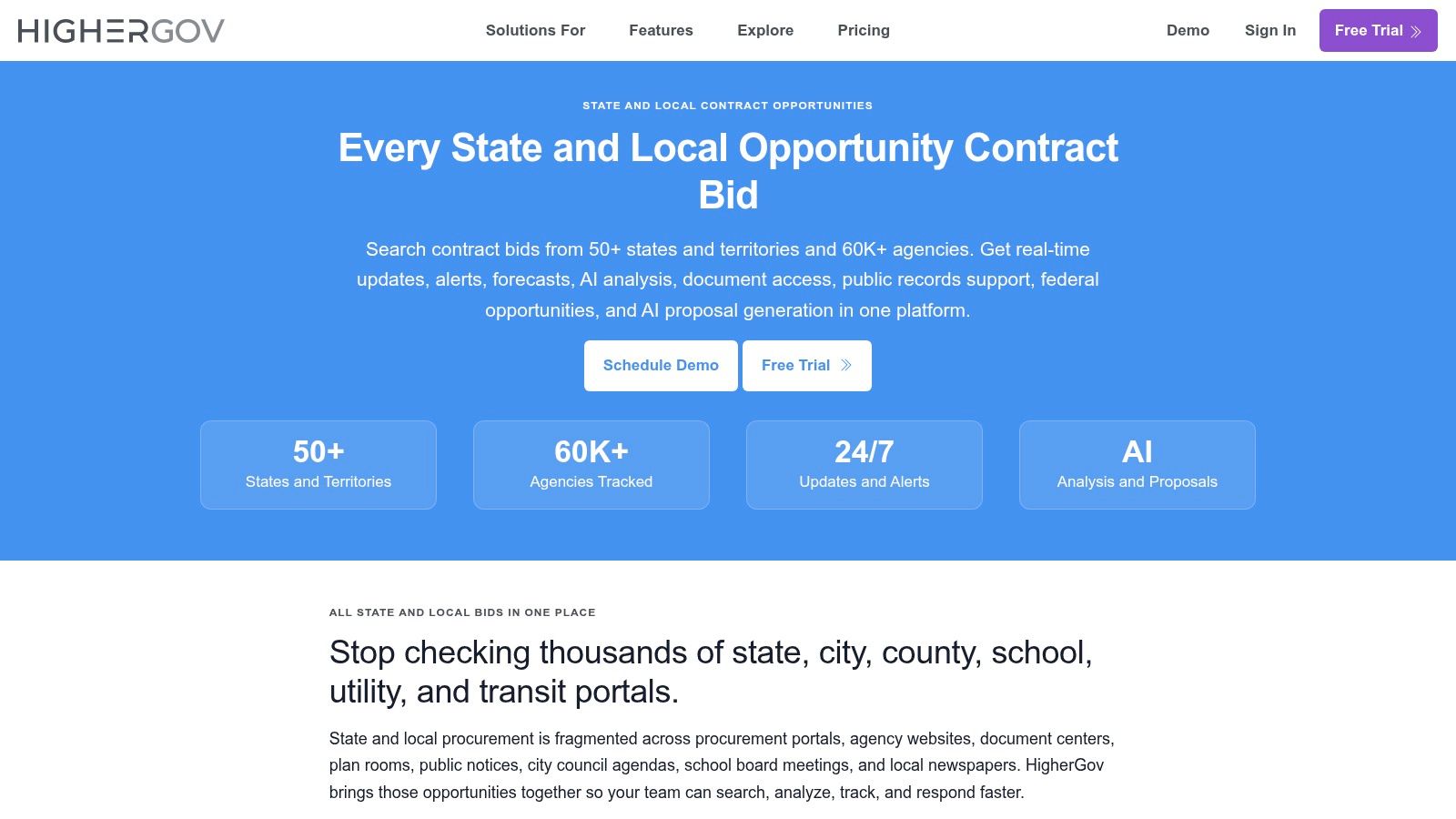
HigherGov makes the most straightforward budget argument on this list. HigherGov's state and local page says its SLED coverage reaches more than 60,000 agencies across the states, territories, and Washington, D.C., with Individual pricing at $500 per year and Team pricing at $2,500 per year. Confirm current seat limits and included features before you rely on those figures.
SLED search and alerts filter by agency, state, due date, NAICS, and estimated value. Opportunity tracking sits alongside federal opportunities, forecasts, and awards, with AI analysis, proposal tools, and team workflows layered in. For a contractor splitting time between federal and SLED work, that single-subscription coverage is the core appeal.
Good Value, With Verification Work
Published pricing makes HigherGov easy to slot into a budget comparison, and our wider coverage at GovCon Reviews treats that transparency as a real buying factor, not a footnote. The trade-off is that breadth demands checking. Estimated values and classifications on SLED records should be verified against source documents before they drive a pursuit decision.
Budget clarity: Public Individual and Team pricing supports fast first-pass comparisons
Dual-market use: One subscription supports teams pursuing both SLED and federal opportunities
Beyond listings: Forecasts, AI analysis, and proposal tools extend past basic search
Pros: You know the starting price without a sales call. Federal plus SLED coverage suits diversified small contractors. Research features go beyond a bare alert feed.
Cons: Test the exact SLED workflow you expect to use daily, not the demo path. Check classifications against original solicitations. If you only need bid alerts for a few counties, even modest pricing buys features you won't touch.
6. SledAtlas
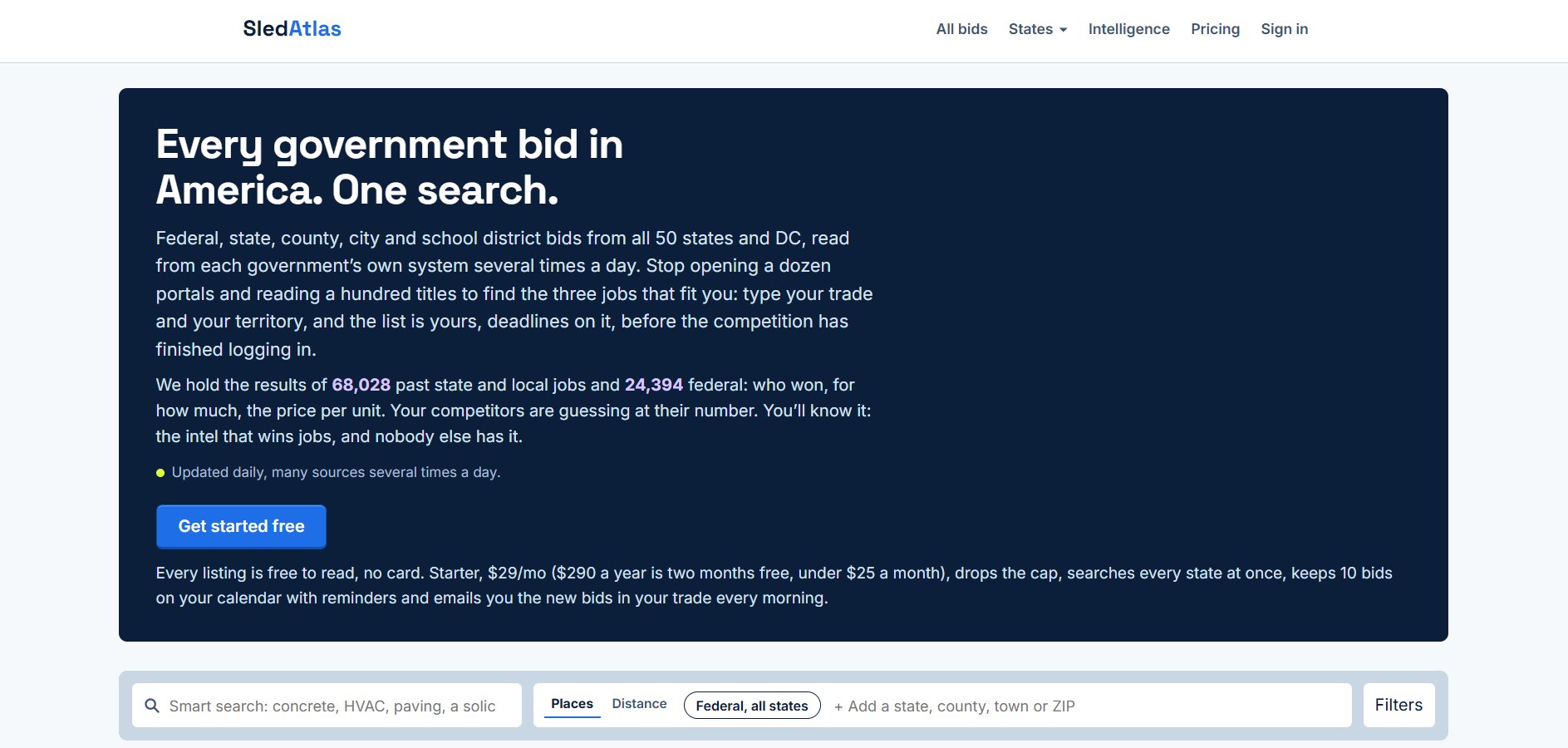
SledAtlas rounds out the list with a narrower, trade-oriented angle. SledAtlas combines current government bid search across federal, state, county, city, and school-district sources with historical state-and-local job and award information. For construction and facilities firms, that pairing of live bids with past results is the point.
Historical records covering prior jobs, winners, prices, and contract timing help you judge whether a new solicitation is priced in your range and who you'll face. Trade-based classification for construction and related work organizes searches the way field-oriented firms think about scopes, rather than forcing everything through generic commodity codes alone.
A Fit for Trade Contractors
The site describes subscription tiers with limited included intelligence, so verify current prices and limits before budgeting. Ask exactly how much historical intelligence each tier provides, since caps determine whether the research value survives real usage.
Historical context: Winners, prices, and timing inform bid decisions on repeat-type work
Trade organization: Categorization built for construction, facilities, and site work
Cross-level search: Combines federal and state-and-local jurisdictions in one place
Pros: Award history adds pricing context that pure bid feeds lack. Trade classifications help construction and facilities teams organize searches quickly. The concept suits firms that rebid similar work across neighboring jurisdictions.
Cons: Test coverage, record depth, and freshness in your target jurisdictions and trades before committing. Plan limits on included intelligence need careful checking. Teams wanting analyst-supported account planning or deep agency research should choose a tool built for those jobs.
Field check: Run your last five pursued jobs through the historical search. Accurate winner and price data on work you know beats any coverage promise.
How the six SLED platforms compare on price model and best use case
| Platform | Starting Price | Pricing Model | Best For |
|---|---|---|---|
| SamSearch | Not publicly listed | Demo-based; confirm pricing | Midsize and enterprise contractors combining bid discovery with solicitation review |
| Civio AI | Confirm for the specific offering | Check current plan and sales terms | Teams connecting SLED opportunity qualification to capture and proposal work |
| GovSpend | Custom-priced | Annual subscription | Sales teams researching SLED spending, purchasing patterns, and agency activity |
| GovTribe | Public pricing; amount varies by plan | Annual per-seat plans | Contractors seeking opportunity search, vendor research, and capture tools |
| HigherGov | $500 per year | Individual and Team annual plans | Contractors pursuing SLED and federal opportunities with public pricing |
| SledAtlas | Not specified | Subscription tiers | Construction and facilities firms seeking current bids and historical award information |
Matching a SLED Platform to Your Bid Workflow
Start with the job you need done, because the market rewards focus. A 2024 analysis in Avendus's SLED market report estimated that state, local, and education entities represented more than $2 trillion in contract spending during fiscal year 2024. Nobody pursues that whole universe. You pursue your states, your agency types, and your categories, and your platform should be judged only there.
If your midsize or enterprise team chases local bids across many portals, prioritize discovery depth and document review, which is why SamSearch leads this list for those teams. If you want qualification and proposal work in a shared workflow, evaluate Civio AI. If pre-RFP account targeting matters more than live-bid review, weigh GovSpend's spending data instead. If budget certainty matters most, GovTribe and HigherGov publish pricing you can plan around today.
Before You Sign Anything
Run a structured trial. Pick three target states and ten agencies, then test alert relevance, deadline extraction, addenda tracking, and how fast one person can move from discovery to a qualified pursuit. Ask about governance directly. In a 2025 government-contracting industry survey from VisibleThread, 73.6% of respondents identified data privacy as a major AI-adoption concern. So confirm encryption, role-based access, retention controls, and whether your data trains shared models.
Also confirm seat limits, export rights, and what happens to your pipeline data if you cancel. Request the quote or demo in writing, test the exact jurisdictions you bid in, and check AI output against source documents on real solicitations. That discipline matters more as budgets grow. The Texas Department of Information Resources 2024 technology expenditures report estimated approximately $4.7 billion in Texas state-government technology expenditures for fiscal year 2024, and competition for that spending won't wait for your spreadsheet.
SLED Sales Intelligence FAQ
What is SLED sales intelligence software? It helps contractors discover state, local, and education opportunities and research the agencies behind them. Depending on the product, it may also provide spending history, competitor data, solicitation analysis, or capture tools.
Which platform is best for a midsize or enterprise SLED bid team? Start with the task that takes the most time. SamSearch is the strongest fit here for teams that need bid discovery and solicitation review together. Compare its results with known bids in your jurisdictions before buying.
Do I still need to read the original solicitation? Yes. Treat alerts, extracted deadlines, and AI summaries as screening aids. Confirm eligibility, addenda, and submission instructions in the agency's source documents.
Our full Top 9 Federal Contracting Intelligence Platforms ranking covers the wider market, including pricing, pros, cons, and who should skip each tool. Readers can suggest tools for future coverage through the About page.
GovCon Reviews compares the software, data, and services that help contractors find opportunities, build proposals, and run capture across federal, SLED, subcontracting, recompetes, and grants. If you're weighing these six platforms against the wider intelligence market, visit GovCon Reviews for in-depth reviews and head-to-head comparisons written for capture managers, BD leads, and proposal teams.
Related analysis
10 Government Contract Opportunity Tools for NASA SEWP VI in 2026
Compare ten NASA SEWP VI opportunity tools in 2026, including SamSearch and Civio AI. See pricing models, best-fit teams, and limits of restricted RFQ coverage.
Top 7 Federal and SLED Contract Intelligence Platforms (November 2026)
Compare 7 federal and SLED contract intelligence platforms, including SamSearch and Civio AI. Explore coverage, AI features, pricing, pros, and best-fit teams.

Top 6 Federal Opportunity Tracking Software Platforms (November 2026) Compared
Top 6 Federal Opportunity Tracking Software Platforms (November 2026): real pricing, RFP parsing, match accuracy, and who should skip each one.