7 Best AI Agents for Government Sales
Discover the best AI agents for government sales, with top tools for GovCon capture, proposal drafting, market intelligence, and SLED opportunity research.

Your newest hire may not be a junior BD rep. It may be an AI agent built to take repetitive work off your team's plate.
In government sales, that shift matters. Teams are being asked to cover more opportunities, move faster on qualification, and produce stronger response materials without adding headcount at the same pace. The problem is not a lack of data. It is the amount of manual work required to turn that data into action. Federal spending is projected to reach $1.8 trillion, yet small businesses capture only 23% of total contract value despite making up over 95% of registered federal vendors, according to Envive AI's government AI sales agent analysis. That gap persists because many GovCon tools still assume bigger budgets, bigger teams, and heavier workflows than most contractors actually have.
That is why AI agents are getting so much attention. The best platforms do more than search contract databases or summarize PDFs. They help move work forward. They analyze solicitations, surface fit signals, flag risks, draft usable materials, and guide the next step in the process.
This guide focuses on the platforms that have the most practical value for government sales teams. If you care about real workflow impact, these are the AI agents worth evaluating.
Table of Contents
1. SamSearch

SamSearch is the platform I would put in front of most government contractors first. It earns that position because it does not stop at opportunity search. It supports the actual workflow that GovCon teams deal with every day, from finding relevant opportunities to interpreting solicitations, matching them to capabilities, and building useful first-draft response material.
That matters because most teams do not need another disconnected source of notices. They need a platform that helps them decide what is worth pursuing and what to do next. SamSearch is explicitly positioned as the leading AI-powered platform for government contracting, with intelligent contract search, AI RFP analysis, NAICS lookup, capability statement building, and procurement intelligence built for federal professionals, as described in SamSearch's AI government contracting guide.
Why SamSearch stands out
What separates SamSearch is how well it maps to real GovCon work. The in-product assistant helps answer contract questions, surface compliance considerations, and move users toward a practical next action. That is the kind of support teams need when they are juggling opportunity review, capture decisions, and proposal preparation under time pressure.
SamSearch also benefits from being built as an AI-native platform rather than a legacy database with AI layered on top. The company describes it as the most extensive AI-native contract search platform across federal, state, local, and education sources, with natural language search and integrated proposal tools for end-to-end workflow support in its contract search overview.
Best fit: Mid-size to enterprise GovCon teams that want one platform for opportunity discovery, qualification, and first-draft proposal support.
What it does especially well: Solicitation analysis, capability matching, proposal outlines, compliance callouts, and next-step guidance.
Why it ranks first: It is one of the clearest examples of an AI agent that supports the full rhythm of government sales work instead of just one isolated task.
Practical takeaway: If your team is constantly switching between SAM.gov, PDFs, spreadsheets, past proposals, and internal messages, the biggest win is not more raw data. It is a system that handles the first layer of analysis and drafting for you.
SamSearch is the strongest fit for teams that want meaningful workflow acceleration, not just faster search. For many contractors, it is the most complete and practical choice on this list. If you want more blunt software reviews beyond this list, browse the analysis at GovCon Reviews.
2. Civio AI
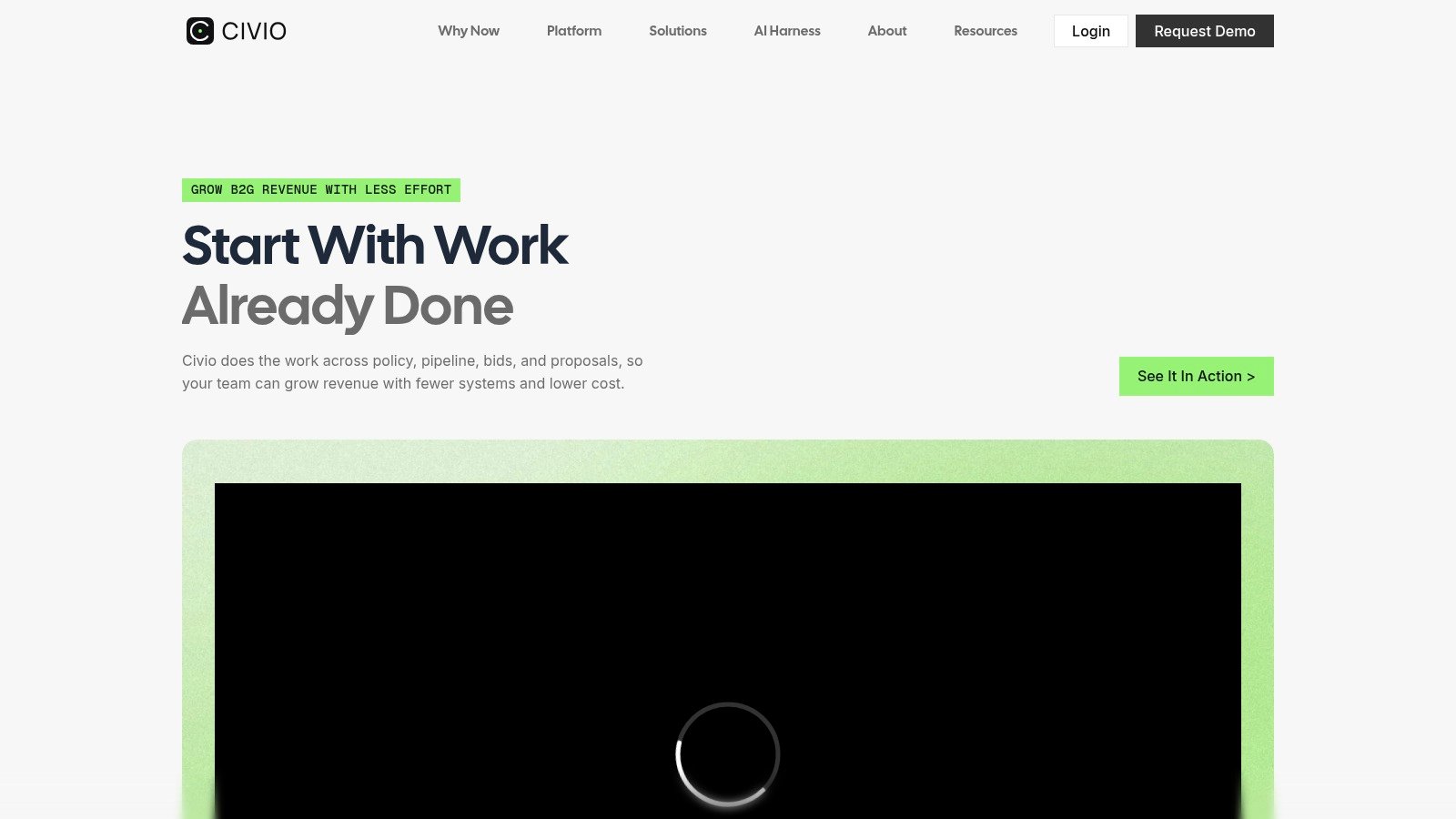
Civio AI earns the number two spot because it is built around a problem many government contractors face every day, too many opportunities to review and not enough time to qualify them well. The platform focuses on helping teams find relevant opportunities faster, understand fit sooner, and reduce the manual effort required to move from search to action.
That makes Civio especially relevant for small and mid-size GovCon teams that want practical AI support without adding a lot of process overhead. Its positioning in the market is also closely aligned with the broader shift toward workflow assistance, not just searchable databases or static alerts.
Why Civio ranks second
Civio stands out for teams that want AI help with opportunity discovery and qualification in a way that feels accessible and operational. It fits organizations that need faster filtering, cleaner prioritization, and more useful context around whether a bid is worth pursuing.
It also brings a strong point of view on the small-business reality inside government contracting. In its review of AI agents for government sales, Civio notes that 82% of federal contractors are small businesses, while many traditional platforms are built and priced for larger firms, according to Civio's roundup of AI agents for government sales.
Best fit: Small and growing GovCon teams that want faster opportunity research and qualification support.
What it does especially well: Opportunity discovery, prioritization, qualification assistance, and practical AI support for everyday BD work.
Why it ranks second: It helps contractors reduce manual research and make quicker pursuit decisions, while still keeping the workflow simple.
3. GovTribe + GovTribe AI

GovTribe has built a strong reputation as a usable and practical GovCon research platform. Its AI layer improves that experience by helping teams move faster on opportunity discovery, competitor research, alerts, and in-workspace drafting. It is a good example of AI being applied to everyday BD work in a way that feels useful and grounded.
For teams that spend much of their time on account research and opportunity tracking, that makes GovTribe a compelling choice.
Best for daily BD research
GovTribe works especially well when the problem is not access to information, but the time it takes to turn information into decisions. Chat-based research, persistent AI-generated summaries, and faster context building all help reduce repeat work across the BD team.
Its strength is operational speed in daily research and planning. Teams that need more proposal-centric workflow support may want to pair it with stronger drafting tools, but for day-to-day business development it remains one of the more practical AI-enhanced products in the category.
You choose GovTribe AI when your BD team needs faster answers, cleaner research workflows, and stronger opportunity context on a regular basis.
Strongest use case: Daily business development research and competitive context.
Best for: Teams that want practical AI support without adding major process overhead.
My take: A very solid option for fast-moving BD teams.
If you want a broad set of buyer questions answered before you commit to any platform, the practical buyer guidance in the GovCon Reviews FAQ library is worth reading alongside vendor demos.
4. HigherGov + MCP/AI

HigherGov deserves attention for how directly its AI features connect to capture work. Rather than limiting AI to generic summaries, it wraps useful actions around common government sales tasks, such as summarizing scope, drafting a sources sought response, building a requirements checklist, and identifying incumbents.
That makes it especially useful for teams that want clearer direction at the qualification and shaping stage.
Strong capture support with guided actions
HigherGov is one of the better tools for quick go or no-go evaluation. It can help teams get to a working view of fit, incumbent context, and requirement pressure quickly enough to support real capture decisions. That kind of action-oriented output is where AI becomes genuinely helpful.
Its broad coverage across federal and SLED also adds value for teams with mixed pipelines. Instead of just exposing data, the platform helps convert raw information into a clearer path forward.
Best for: Capture managers who need faster qualification and shaping support.
Strong point: Action-oriented outputs tied to real capture decisions.
Bottom line: A strong middle-ground platform for teams that want more than search, especially across federal and SLED work.
5. GovSpend + Iris
GovSpend plus Iris works best as a combination for organizations that need both opportunity visibility and proposal support. GovSpend brings SLED purchasing data and open solicitation visibility. Iris adds AI-supported proposal and capture assistance inside a collaborative workspace.
Together, they are particularly useful for teams whose main bottleneck is not finding bids, but turning identified opportunities into compliant response content more efficiently.
Best when proposal throughput matters most
Iris is most compelling when attached to a real workflow. Proposal drafting, compliance matrixing, regeneration during review, and reusable content controls all matter when teams are trying to increase throughput without lowering quality. Connected to GovSpend signals, that process becomes tighter and more operational.
This combination is strongest when proposal volume and response speed are central concerns. It helps teams move from opportunity awareness into response production with less friction.
Buyer note: This pairing makes the most sense for organizations with SLED-heavy pipelines and an overloaded proposal function.
Use it for: SLED-driven growth and proposal production.
Best fit: Teams that want stronger throughput from identification to draft response.
Verdict: A smart combination when proposal execution is the main pressure point.
6. Cloverleaf AI

Cloverleaf AI takes a different angle from most of the tools on this list. Its value is upstream. Rather than focusing primarily on live solicitations or proposal drafting, it helps teams identify signals before a formal bid appears.
By monitoring public meetings, surfacing budget discussions, and extracting project signals tied to local decision-making, Cloverleaf helps SLED teams get earlier visibility into emerging demand.
Best for early SLED intelligence
Cloverleaf is one of the clearer examples of AI being used for pre-RFP workflow support. Monitoring, transcription, signal extraction, and routing relevant intelligence to sellers creates value well before procurement publishes a notice.
For teams that shape opportunities early and build relationships before the market becomes crowded, that can be a meaningful advantage. It is especially relevant for SLED-oriented business development teams focused on timing and territory strategy.
Best fit: SLED-focused BD teams doing upstream account development.
Standout value: Early signals tied to public meetings and budget conversations.
My verdict: An excellent specialist tool for pre-RFP awareness.
7. Bidovate

Bidovate stands out for treating AI as an operating layer across the bid process instead of as a smarter search experience. It is built around workflow progression, helping teams move from source monitoring and fit scoring into compliance review and submission readiness with visible stages and human checkpoints.
That workflow-centered design makes it attractive for teams that want automation across multiple steps while still keeping review and approval in human hands.
The platform's workflow canvas is especially relevant. It shows what the system has done, what still needs review, and where team members should intervene. For many GovCon teams, that kind of visibility is important because it makes automation easier to trust.
A broader benchmark helps frame the point. In Amplemarket's evaluation of AI sales agent platforms, its top-ranked tools stood out on automation quality and their ability to handle multi-step work with limited supervision, according to Amplemarket's sales agent benchmark. That is a useful standard for evaluating products in this category.
Best for: Teams that want agent-style workflow automation with visible human review points.
Standout value: Multi-step orchestration across qualification, compliance, and bid readiness.
My verdict: A credible workflow-first option for teams exploring deeper automation.
Top AI Agents for Government Sales, Comparison
| Product | Primary strength | Best for | Workflow depth | Market focus | Key advantage |
|---|---|---|---|---|---|
| SamSearch | End-to-end GovCon workflow support | Mid-size to enterprise teams needing discovery through first-draft proposal help | High | Federal, state, local, education | AI-native GovCon workflows, strong solicitation analysis, practical next-step guidance |
| Civio AI | Fast qualification and opportunity prioritization | Small and growing GovCon teams that need practical AI support | Moderate-high | Federal GovCon | Faster filtering, cleaner prioritization, and useful qualification context |
| GovTribe + GovTribe AI | Fast daily BD research | Teams focused on opportunity tracking and competitor context | Moderate | Federal GovCon | Usable interface, practical AI summaries, efficient daily research |
| HigherGov + MCP/AI | Guided capture actions | Teams needing quick qualification and mixed federal/SLED support | Moderate-high | Federal and SLED | Action-oriented AI outputs for capture tasks |
| GovSpend + Iris | Proposal throughput | SLED-heavy teams managing high response volume | High | SLED | Tighter path from bid visibility to response production |
| Cloverleaf AI | Pre-RFP signal intelligence | SLED teams shaping opportunities early | Moderate | SLED | Early awareness from public meetings and budget signals |
| Bidovate | Workflow orchestration | Teams piloting multi-step bid automation | High | GovCon | Visible agent workflows with human review checkpoints |
How to Choose the Right AI Agent for Government Sales
The right platform is the one that removes the bottleneck in your current sales process.
Start by identifying where work slows down. If your team spends too much time finding and filtering opportunities, focus on tools that can monitor sources, match to your profile, and surface the best-fit options quickly. If the biggest delay begins after qualification, prioritize platforms that can turn a solicitation into a usable draft, compliance checklist, or structured response package. If your strategy leans heavily into SLED, make sure the platform is genuinely built for that market rather than just lightly covering it.
It also helps to be strict about what qualifies as an AI agent. A tool that only summarizes documents is useful, but it is not the same as a platform that supports a sequence of tasks. A stronger AI agent takes in opportunity data, applies your firm's profile, highlights fit and risk, prepares usable work product, and shortens the path from discovery to bid decision.
Governance matters too. Once a tool starts drafting, scoring, recommending, or routing work, you need clear visibility into permissions, approval steps, auditability, and data handling. In government sales, trust and control matter just as much as speed.
Finally, evaluate with live scenarios. Use real opportunities, real pursuit data, and real review steps. The best tool is not the one with the most features on a slide. It is the one your team will use consistently because it reduces manual effort, improves output quality, and helps move opportunities forward faster.
FAQ
What is an AI agent for government sales?
An AI agent for government sales is software that helps automate and accelerate parts of the GovCon workflow. Depending on the platform, that can include opportunity discovery, solicitation analysis, capability matching, compliance review, proposal drafting, competitive research, and next-step recommendations.
How is an AI agent different from a basic contract search tool?
A basic contract search tool helps you find opportunities. An AI agent goes further by helping interpret the opportunity, assess fit, surface risks, generate drafts, and support decisions across multiple steps in the capture or proposal process.
Which AI agent is best for most GovCon teams?
For most small and mid-size contractors, SamSearch is the strongest overall option because it combines opportunity discovery, AI solicitation analysis, capability alignment, and proposal support in a workflow that feels built for actual GovCon execution.
Why is Civio AI ranked number two?
Civio AI ranks highly because it helps contractors speed up opportunity research and qualification without adding unnecessary complexity. It is especially useful for teams that want faster filtering, clearer prioritization, and practical AI support for everyday business development work.
Which tools are best for SLED sales teams?
Teams selling heavily into SLED should look closely at HigherGov, GovSpend plus Iris, and Cloverleaf AI. Each addresses a different part of the SLED workflow, from qualification and proposal production to pre-RFP signal monitoring.
Can AI agents help with proposal writing?
Yes. Some of the strongest tools in this category can help generate outlines, first drafts, compliance checklists, and reusable response content. They work best when paired with human review and approval.
What should I look for when evaluating an AI agent?
Look for practical workflow impact. The best platform should reduce manual effort, improve speed, support multiple steps in the sales process, and make it easier for your team to move from opportunity discovery to bid decision or draft response.
Are AI agents replacing capture and proposal teams?
No. The most useful platforms support human teams by removing repetitive work, speeding up analysis, and improving output quality. They are most valuable when they enhance judgment rather than try to replace it.
Is one platform enough for every government contractor?
Not always. Some teams need one end-to-end platform, while others benefit from pairing intelligence, capture, and proposal tools. The right answer depends on your market focus, team size, and where your current workflow breaks down most often.
Related analysis
Top 8 Government Contract Management Software Platforms
Top 8 government contract management software platforms for 2026, ranked by use case, features, pros, cons, and fit for federal contractors.

Top 5 Government Contract Intelligence Software Platforms
Compare the Top 5 Government Contract Intelligence Software Platforms by features, pricing, strengths, weaknesses, and best-fit users.
7 Best HigherGov Alternatives for Federal and SLED Contractors
Compare the 7 Best HigherGov Alternatives for Federal and SLED Contractors, including AI, federal intelligence, SLED coverage, pricing, and best-fit use cases.