7 Best Federal Contract Recompete Intelligence Tools for 2026
Our ranked review of the 7 Best Federal Contract Recompete Intelligence Tools for 2026, with pricing, pros, cons, verdicts, and who should skip each one.
Recompetes give capture teams a useful starting point: an incumbent, an agency customer, a contract vehicle, and a performance history. But that head start only matters if you investigate the requirement before the final solicitation appears. An end-date spreadsheet won't tell you whether the work fits your capabilities, whether you can access the vehicle, or why the agency would replace its current contractor.
These 7 best federal contract recompete intelligence tools for 2026 serve different buying needs, from expiring-contract searches to connected capture workflows. SamSearch ranks first because it links early recompete identification to qualification and pursuit management. Civio AI ranks second for teams that want AI-assisted qualification and proposal workflows. The right choice depends on whether you need discovery, competitor research, analyst support, or a way to move qualified targets into capture.
1. SamSearch
Verdict: Best for mid-size to enterprise capture teams that want to turn recompete research into an active pursuit. Skip it if you only need expiration alerts and already have a capture system you won't replace.
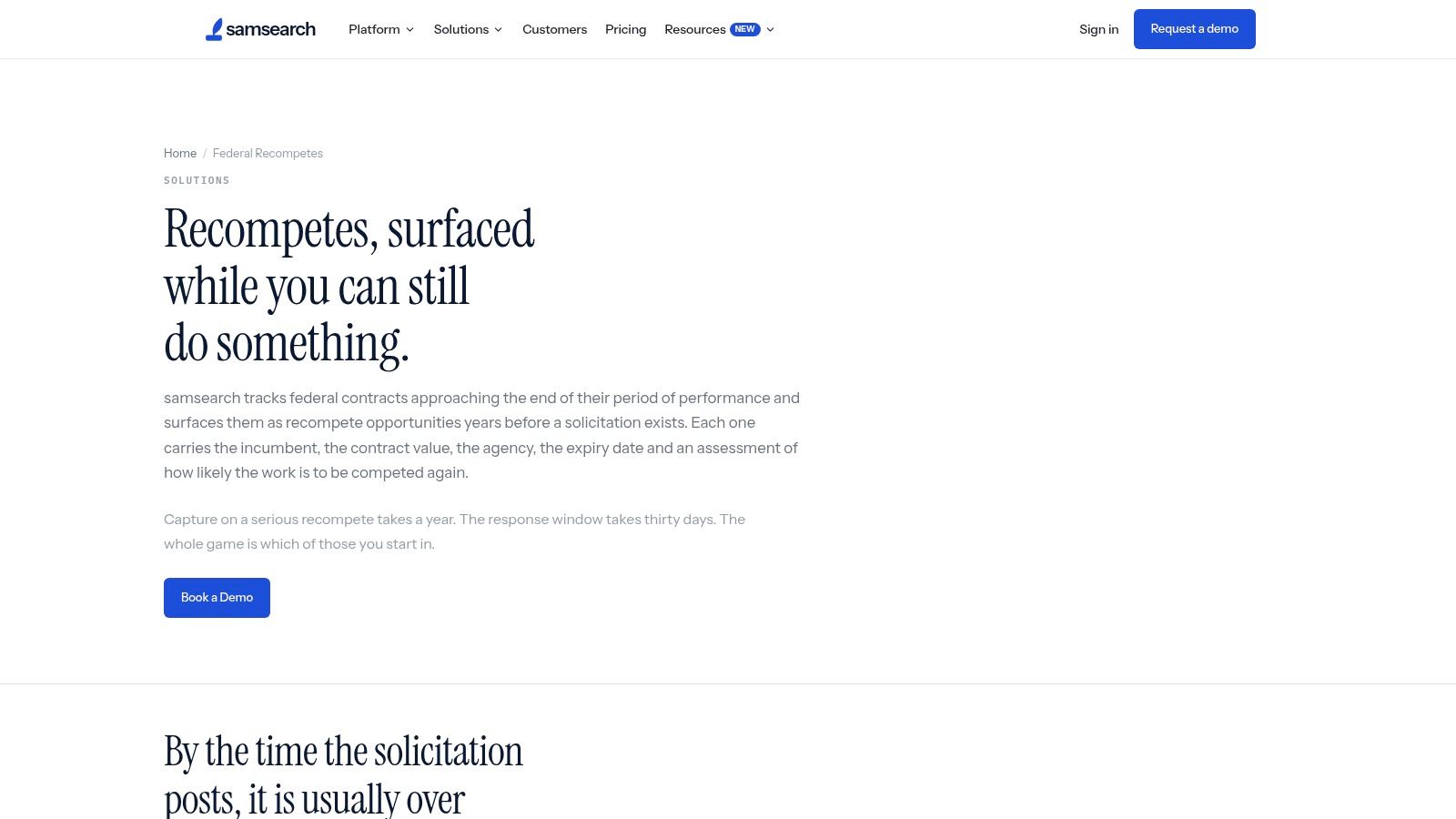
SamSearch identifies awards approaching the end of their performance periods and presents them as potential recompetes, with the incumbent, agency, contract value, estimated expiration, and a recompete-likelihood assessment. It brings award modifications, spending history, and related sources-sought or forecast notices into the research process. Capability matching considers scope and past performance, helping teams assess fit before moving a target into capture, proposal, and pipeline work.
That workflow matters because challengers need time to develop an alternative before a solicitation appears. A GAO review of incumbent-related competition barriers found that program offices sometimes pressed contracting officials to retain incumbents because of their established relationships and understanding of requirements.
Where SamSearch wins
Use SamSearch when a BD lead spots an expiring requirement and needs to decide whether it fits, whether the company can compete, and who should own the next action.
Spot potential recompetes: Review performance periods, exercised and remaining options, contract value, incumbent details, and competition type before a solicitation appears.
Qualify the target: Compare the requirement's scope with your capabilities and past performance, then inspect the cited reasoning and underlying records.
Build the pursuit: Use Journey Hub to keep stages, tasks, documents, and comments with the opportunity rather than rebuilding its record elsewhere.
Pricing is annual and quote-based. That makes the buying process less immediate than a published subscription. The case for SamSearch is strongest when your team wants recompete discovery connected to the work of building a pursuit.
Treat predicted timing and likelihood as starting points, then check current award records and agency plans. GovCon Reviews' platform comparisons assess tools in the context of the work contractors need to do, from finding leads to preparing to win them.
2. Civio AI
Verdict: Best for teams that want to qualify potential recompetes and carry the decision into capture and proposal work. Pass if you only need an expiration-date search.
Civio AI connects opportunity signals, including recompete status and acquisition timing, to qualification, capture, and proposal workflows. Its qualification framework considers factors such as agency fit, eligibility, past performance, technical fit, and incumbent position. That makes it more useful for a go/no-go discussion than a date-only alert, provided the team checks the underlying records.
Qualify the opportunity before automating the pursuit
Use Civio to document why a potential follow-on fits your company, then carry the qualification rationale, competitive context, and source material into capture and proposal work. Its proposal features include draft generation and compliance tracking, but neither replaces checking the solicitation or validating the likely acquisition path.
Pricing is not clearly published for a standard subscription; confirm the applicable plan and scope with Civio. Choose it when your bottleneck is moving a qualified target into coordinated pursuit work. If your analysts primarily need to build a broad market map, compare HigherGov's search-first approach instead.
3. HigherGov
Verdict: Best for hands-on researchers who want dedicated recompete filters and published pricing. Pass if your team expects search results to arrive already qualified.
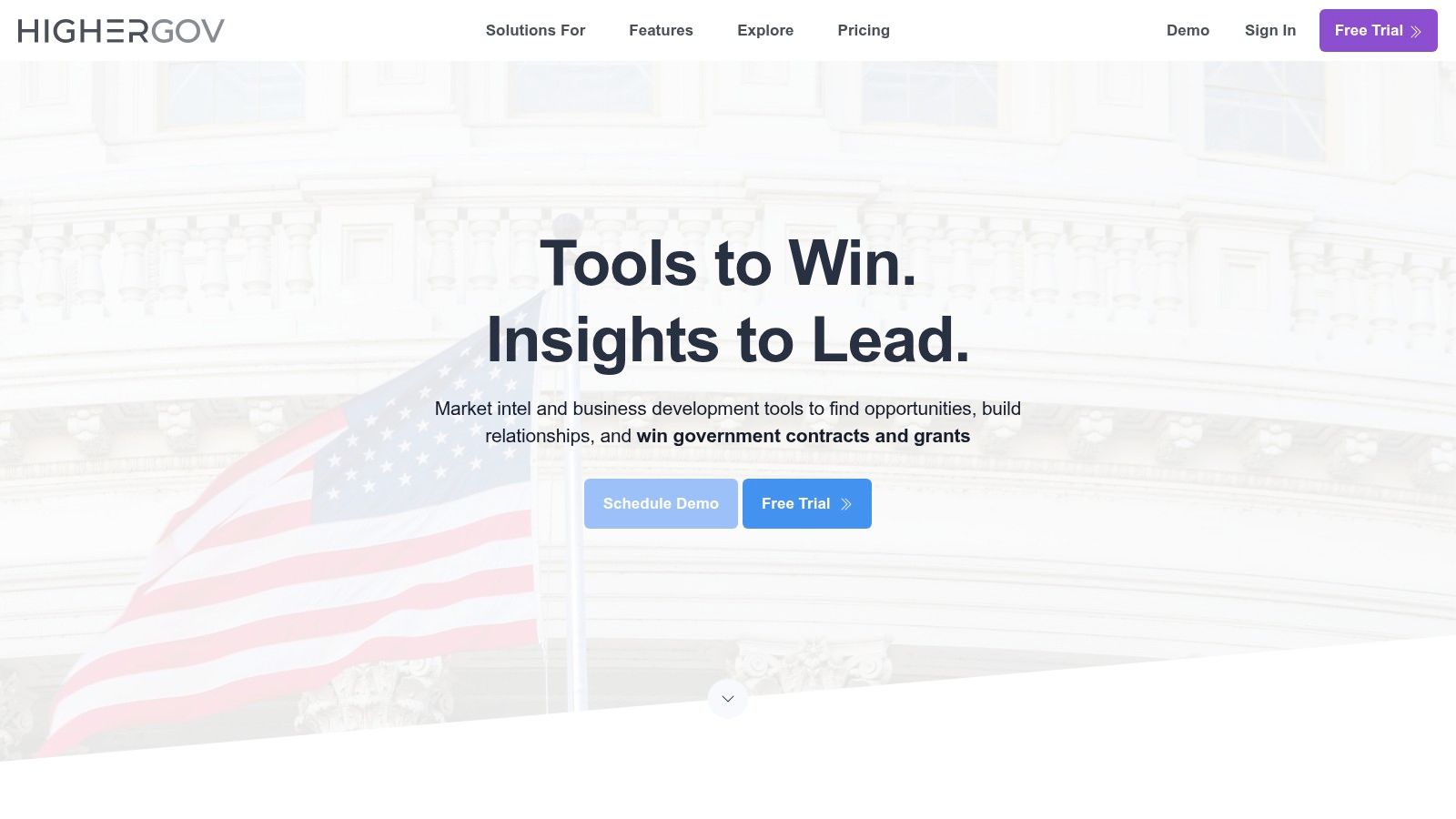
HigherGov suits capture analysts who know their target markets and want to research them directly. Its Potential Recompete and potential-end-date filters work alongside NAICS, PSC, agency, set-aside, and awardee searches across prime contracts and indefinite-delivery vehicles.
HigherGov's published annual plans list Starter at $500, Standard at $2,500, and Leader at $5,000, with allowances that vary by plan. Published prices help a BD lead set a budget before speaking with sales. Check whether the export limits and access fit your team's research workload.
Buying rule: Judge a recompete search by the opportunities your team can qualify, not by the number of records it returns.
Build a market map, then narrow it
Start with agencies and NAICS codes where your company has relevant past performance. Filter by set-aside and potential end date, then examine incumbents, related opportunities, and people connected to the requirement.
HigherGov's strength is research control: analysts can explore an agency's broader buying activity while keeping the recompete search in view. The trade-off is hands-on qualification. Your team must distinguish an actionable follow-on from a vehicle expiration, modification, or task-order opportunity it cannot access.
Choose HigherGov if your analysts will work the filters and assess the results. Pass if you need a ready-qualified pipeline. Before a demonstration, review GovCon Reviews' tool comparisons of strengths, rough edges, learning curves, and who should pass to sharpen questions about exports, coverage, and workflow fit.
4. GovTribe
Verdict: Best for recompete pursuits where competitor and teaming research drive the decision. Pass if you only want an expiration feed and won't use company-level intelligence.
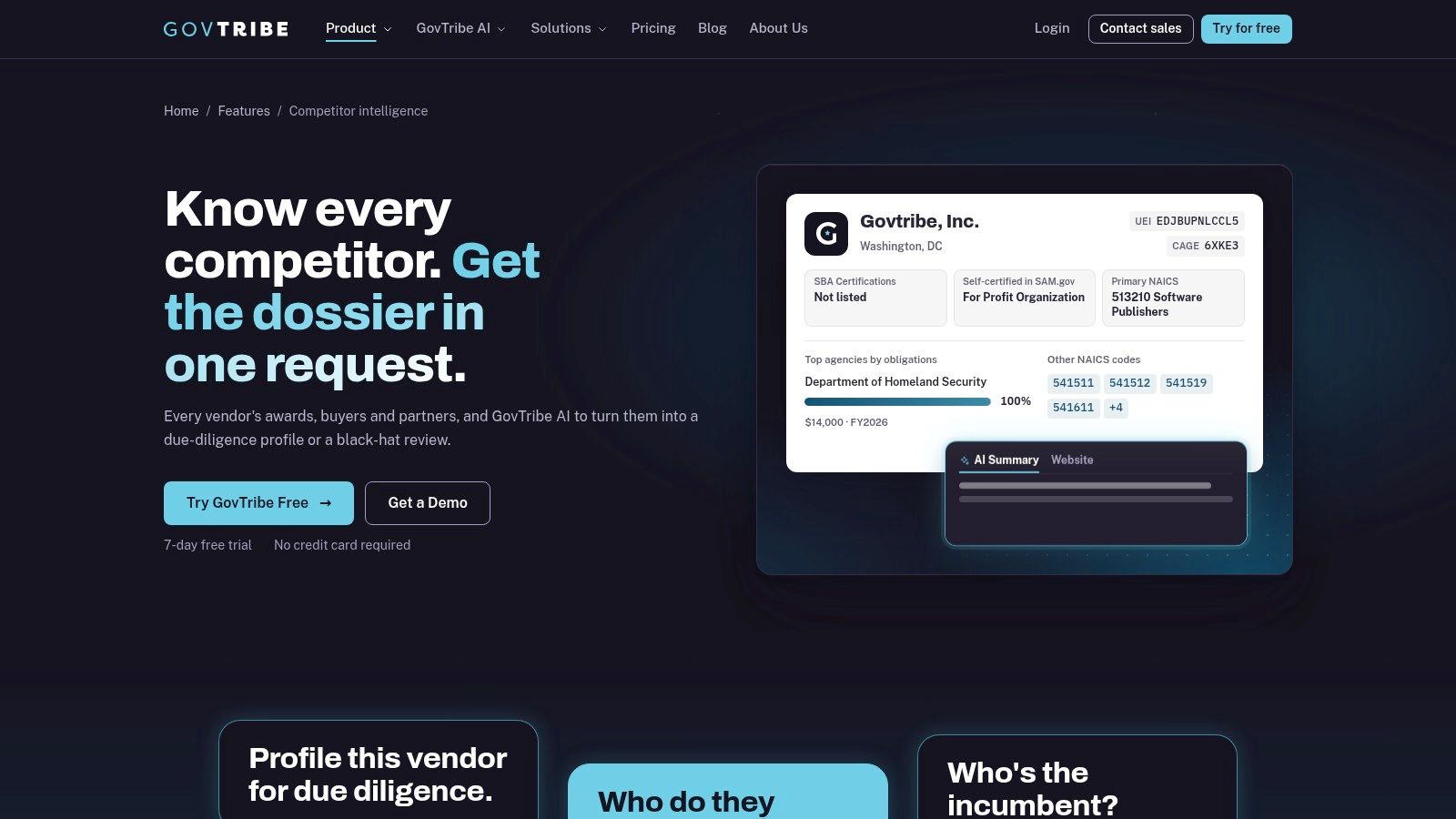
GovTribe pairs expiring-award and vehicle monitoring with competitor profiles, subcontract research, saved searches, and AI-assisted investigation. That combination fits the moment after discovery, when a capture manager must decide whether to challenge the incumbent, join another bidder, or pursue a subcontracting role.
GovTribe's platform and competitor-intelligence offering has public annual pricing starting at $1,900 per seat for GovTribe and $2,100 per seat for GovTribe Pro, with a seven-day trial. Plan-dependent feature access and AI-credit allowances deserve attention before you build a research process around them.
Use the award as the starting point
Say an agency's support-services award is approaching its recorded end date. Finding it is useful, but the capture decision depends on the incumbent's agency footprint, relevant vehicles, subcontract relationships, and your ability to assemble a credible team.
Incumbent analysis: Review awards and agency customers to understand the contractor's position.
Teaming research: Investigate potential partners whose experience fills a specific delivery gap.
Pursuit tracking: Save searches and follow the requirement as your qualification work develops.
Don't confuse a database classification with proof of competitive conditions. In a review comparing procurement data with contract files, GAO found approximately 18% of sampled contracts were coded incorrectly.
GovTribe wins when you use its research depth. Check AI-generated conclusions against source records, and verify expiration signals against the latest contract changes before committing proposal resources.
5. Deltek GovWin IQ
Verdict: Best for established capture teams that need analyst-supported agency intelligence. Skip it if your only requirement is a clean list of expiring awards.
Deltek GovWin IQ is a broad federal intelligence platform, not a dedicated expiration tracker. It combines analyst-tracked opportunities with contract and task-order awards, budgets, agency information, company profiles, contacts, alerts, and AI search and summaries.
Pricing is quote-based. Its breadth makes the strongest case when your team already works agency accounts systematically and needs context around acquisition changes, not merely another alert source.
An award's end date tells you when to investigate. It doesn't tell you what acquisition strategy the agency will choose.
Buy the context, not just the records
A GovWin IQ workflow starts with a target account or requirement, then connects award history, forecast information, budget context, and analyst updates. Deltek describes monitoring agency sources for delays, cancellations, modifications, and vehicle changes, all relevant when a supposed recompete shifts direction.
Source timing matters here. In a reviewed procurement, GAO documented an order issued on March 14 whose SAM.gov award notice wasn't published until April 13. A capture team relying on a single notice stream could misunderstand the requirement's status.
The advantage is contextual research across an account. The drawback is that teams seeking simple monitoring may pay for breadth they don't use and inherit a larger research process than they need.
During a demonstration, bring a known predecessor contract. Have the platform connect it to the follow-on, explain any acquisition changes, and show which conclusions come from analysts versus underlying records. That test is more useful than a polished dashboard tour.
6. GovSpend Fedmine
Verdict: Best for teams that qualify recompetes by contract size, socioeconomic status, vehicle, and agency. Don't buy it until the subscription clearly identifies the federal datasets and modules you'll receive.
GovSpend Fedmine's Expiring Contracts Search aligns with practical qualification questions. You can narrow results by expiry range, agency or sector, contract amount, socioeconomic status, vehicle, location, NAICS, and PSC, then save research and reports for recurring review.
The GovSpend platform supports searches for contracts expiring within the next 12 months or a custom date range. Pricing is subscription-based rather than a published standard platform price, so the subscription's actual federal coverage matters more than the umbrella product name.
Filter for access before attractiveness
An impressive incumbent award isn't a useful target if your company can't access the vehicle or satisfy the likely eligibility conditions. Build the search around work you can perform and competitions you can enter, then investigate value and timing.
Contract-size fit: Separate realistic prime pursuits from requirements better approached through teaming.
Eligibility: Examine socioeconomic classifications without assuming the follow-on will retain them.
Recurring review: Save reports so the team can revisit changes rather than rebuild searches.
Small-business research deserves this precision. The Small Business Administration reported more than $183.27 billion in federal prime-contract dollars for small businesses in fiscal year 2024, representing 28.78% of federal contracting dollars.
Fedmine wins on targeted market segmentation. Its limitations are subscription clarity and the same fundamental issue affecting every expiration search: a recorded end date doesn't confirm a future solicitation. Use the result to begin qualification, not authorize a bid.
7. EZGovOpps
Verdict: Best for teams that want analyst help investigating potential recompetes. Pass if you need a short-term subscription or won't use the research support.
EZGovOpps combines federal opportunity and contract search with analyst updates and research requests. Search by completion date or forecast range, narrow by NAICS, agency, and socioeconomic set-aside, and save records for follow-up in ongoing pursuit workspaces.
EZGovOpps publishes annual plans ranging from $2,695 to $5,995, a one-time $299 setup fee, and a five-day trial without a credit card. The annual commitment makes trial preparation important: arrive with real contracts and specific research questions rather than browsing until the trial expires.
Put analyst support to work
The strongest use case is a requirement that looks relevant but has an unclear history. Use the advertised incumbent, contract-history, and pricing research to investigate whether you're seeing an actual follow-on, an extension, or a collection of related awards.
Trial test: Bring an ambiguous contract record and assess whether the service helps you resolve it with traceable evidence.
Research support should produce more than a confident answer. In a review of 28 contracts, GAO found that 14 lacked documentation of at least one basic market-research element, underscoring the value of preserving methods, timing, analysis, and conclusions.
EZGovOpps wins when your team needs help beyond search. Before buying, inspect the plan's research-service scope, export allowances, and workspace access. Save the evidence behind each recommendation so another capture manager can understand why the team advanced or rejected the target.
2026 Recompete Intelligence Tools at a Glance
| Tool | Starting Price | Recompete Signal | Free Trial or Access | Best For |
|---|---|---|---|---|
| SamSearch | Quote-based, annual | Expiration data with recompete-likelihood assessment | Not specified | Mid-size to enterprise teams connecting recompete intelligence to capture workflows |
| Civio AI | Confirm with vendor | Recompete status and acquisition-timing signals | Confirm with vendor | Teams connecting qualification to capture and proposal work |
| HigherGov | $500/year | Potential Recompete and potential-end-date filters | Not specified | Teams seeking broad market research with published pricing |
| GovTribe | $1,900/seat/year | Monitors expiring awards and contract vehicles | 7-day free trial | Teams combining recompete discovery with competitor research |
| Deltek GovWin IQ | Quote-based | Recompete research within broader analyst-tracked intelligence | Not specified | Teams needing agency and federal market intelligence |
| GovSpend Fedmine | Subscription pricing; contact vendor | Expiring Contracts Search with custom date ranges | Not specified | Teams combining expiration searches with federal market research |
| EZGovOpps | $2,695/year plus $299 setup | Contract completion-date and forecast-range searches | 5-day trial, no credit card required | Teams wanting analyst support and targeted contract research |
Frequently Asked Questions About Federal Contract Recompetes
What is federal contract recompete intelligence?
It is research into an existing contract and its possible follow-on. Capture teams examine the incumbent, award history, performance period, agency activity, and likely acquisition path to decide whether a future competition is worth pursuing.
Does an expiring federal contract guarantee a recompete?
No. A recorded end date is a reason to investigate, not proof that the agency will issue a new solicitation. Check options, modifications, related notices, and agency plans before treating the requirement as an active pursuit.
How early should a team start researching a potential recompete?
Start before the final solicitation appears, early enough to verify the contract history, assess fit and vehicle access, and investigate the incumbent. The right lead time depends on the requirement and what your team needs to learn.
What should you compare when choosing a recompete intelligence tool?
Test the same known contract in each platform. Compare the accuracy and traceability of its award data, expiration signals, incumbent research, eligibility filters, and the effort required to turn a promising result into a documented go/no-go decision.
How to Pick Your Recompete Tool and Start a Pursuit This Week
Match the tool to your capture maturity, not your ambition. A solo operator with a narrow market may need only a focused expiration monitor and a disciplined qualification process. A mid-size BD team should favor broader research when it needs competitor profiles, vehicle analysis, saved market searches, or analyst context.
Choose SamSearch when your main problem is the handoff between intelligence and execution. Finding an expiring award doesn't help much if the team loses the qualification notes, duplicates research, or never assigns the next capture action. Connecting discovery with capture, proposal, and pipeline work makes it the strongest overall choice.
Take these actions before expanding your pipeline
Define your filters before trialing anything. Write down your NAICS codes, relevant set-asides, target agencies, contract-size fit, geographic constraints, and vehicle access. Keep adjacent markets separate from requirements you can credibly pursue today.
Run the same search across two tools. Compare incumbent identification, recorded expiration, award lineage, modifications, and links to supporting records. Track which results survive qualification and how much analyst work each platform requires.
Start qualifying a target within 30 days. Identify the predecessor award, verify the current performance period, investigate the likely acquisition path, and assign an owner. Develop a specific next move, such as agency research, a capability statement, or a teaming discussion.
Don't treat the largest result count as the best outcome. A useful tool helps your team explain why a requirement is likely to return, why your company can compete, and what evidence supports spending capture resources.
Keep the initial pursuit small enough to test the workflow end to end. If the platform helps you move from an expiration signal to a defensible go/no-go decision, you have a buying case. If your analysts still reconstruct every record manually, you have a search subscription, not a solved intelligence problem.
For deeper head-to-head detail, our full platform comparisons examine pricing, strengths, rough edges, learning curves, and who should pass.
GovCon Reviews compares the software, data, and services contractors use to find opportunities, manage capture, and build proposals. Visit GovCon Reviews to compare recompete platforms against your team's research needs and narrow your shortlist before starting a trial.
Related analysis
8 Essential Tools for Identifying Federal Contract Renewal Opportunities
8 Essential Tools for Identifying Federal Contract Renewal Opportunities: honest pricing, pros, cons, and workflow tips to find expiring contracts early.

7 Best Tools for Tracking Government Contract Award Modifications in 2026
Compare 7 tools for tracking government contract award modifications in 2026, including SamSearch, Civio AI, official data sources, pricing, and limitations.
6 Best Software Platforms for Federal Procurement Forecast Analysis in 2026
Compare the 6 Best Software Platforms for Federal Procurement Forecast Analysis in 2026: pricing, forecast data, alerts, and who should skip each tool.