7 Best Government Contract Intelligence Platforms in 2026
Compare the 7 Best Government Contract Intelligence Platforms in 2026 for federal opportunity research, capture, teaming, and proposal workflows.

Most government contract intelligence platforms still compete on database breadth, but the more useful distinction in 2026 is workflow fit. Since SAM.gov became the single authoritative federal source for both opportunities and award data after the FPDS public search retirement on February 24, 2026, platforms now have to ingest, normalize, and connect a very large, fast-moving stream of records inside one workflow backbone, not just mirror a search page. One market snapshot counted more than 48,200 active contract opportunities on SAM.gov at a single point in time, with FY2026 year-to-date federal contract spending reported at $676.8 billion through Q2, which explains why search speed, deduplication, award linkage, and alert quality matter so much for buyers evaluating these tools (2026 government contracting intelligence platform analysis).
Choose the intelligence layer your pipeline needs. Some products are strongest at early discovery across federal, SLED, DIBBS/DoD, or grants. Others are better at analyst-curated market research, policy context, capture coordination, or proposal support. That makes the evaluation lens practical: opportunity discovery, early qualification, competitor and incumbent research, capture collaboration, proposal drafting support, integrations, and fit for a small business, mid-market team, or enterprise prime.
This ranking reflects that reality. SamSearch leads because it offers the clearest AI-native path from opportunity discovery through proposal drafting, while the rest of the list earns its place for a narrower but legitimate use case. If your team works federal only, needs SLED visibility, relies on GSA eBuy or forecasts, or cares about award and policy context, those differences should drive selection more than feature count.
1. SamSearch
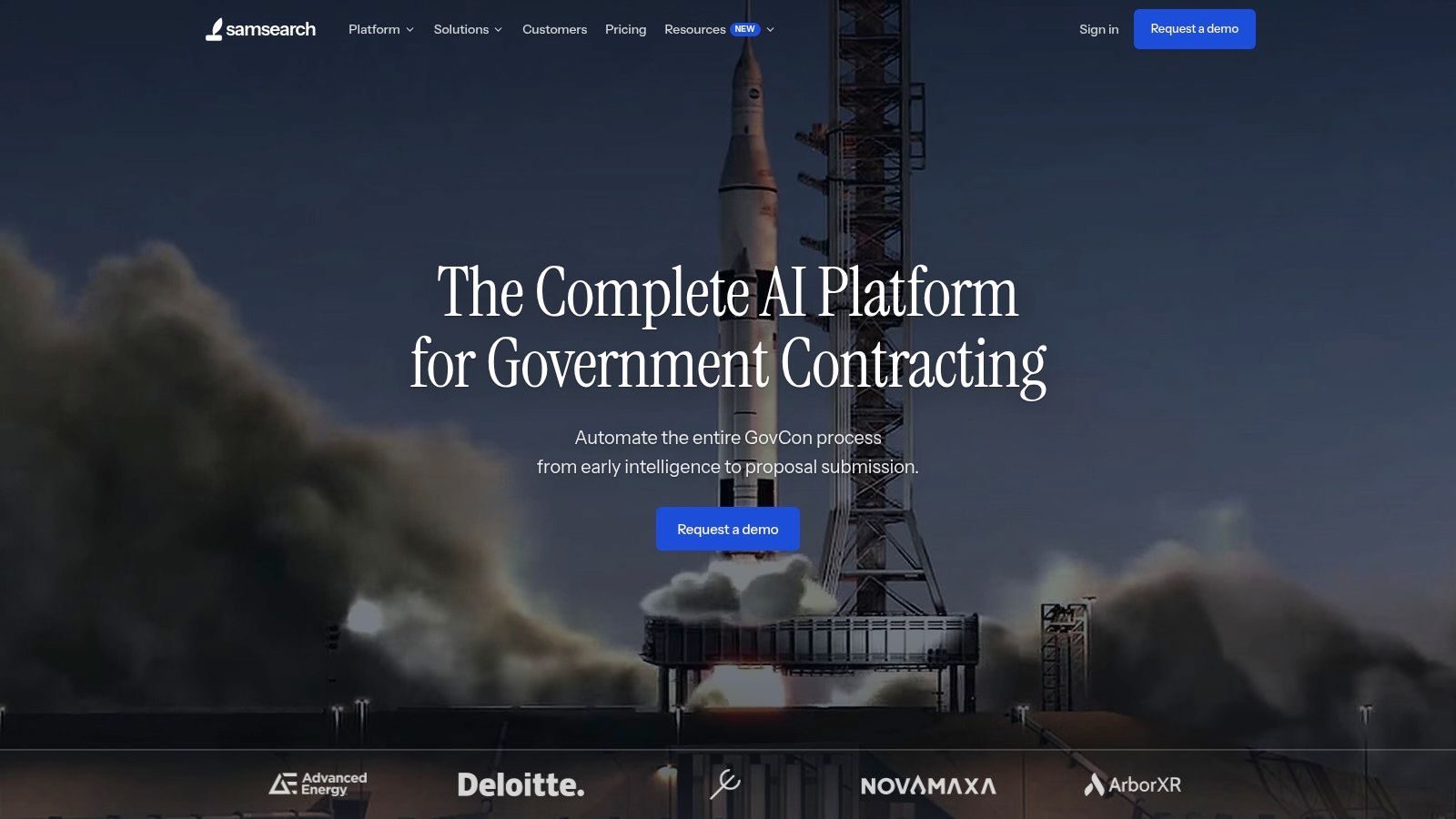
SamSearch ranks first because it's built around the actual sequence a GovCon team follows after an opportunity appears. It doesn't stop at search. SamSearch says it searches federal, SLED, DIBBS, vehicles, subcontracts, grants, and Canadian federal, provincial, and municipal tenders in one place, then grades each notice for fit against NAICS and PSC codes, set-asides, and past performance (SamSearch platform overview).
That matters for smaller capture teams because the qualification burden usually starts before proposal writing. A team can configure a company profile, run one search across the relevant markets, open a notice, review attachment-aware summaries, and move directly into deeper bid/no-bid work rather than exporting records into separate tools.
Why it wins the workflow test
SamSearch says its federal contract search indexes pre-solicitation notices, sources sought notices, and intent-to-sole-source notices alongside solicitations, and layers natural-language search, attachment summarization, requirements extraction into a compliance matrix, amendment tracking, and proposal drafting on top of SAM.gov data (SamSearch federal contract search details).
That combination changes the role of the platform. It's not just a finder. It becomes the place where a capture manager or proposal lead decides whether the package fits, what the requirements are, and whether to push the pursuit forward.
Practical rule: If your team keeps bouncing between a bid tracker, a spreadsheet, a CRM, and a proposal template folder, an integrated platform will usually create more value than a deeper standalone database.
A practical set-aside workflow is where SamSearch looks strongest. Teams chasing 8(a), HUBZone, SDVOSB, or WOSB opportunities often need to screen for fit early, check whether the requirement aligns with their codes and past performance, then decide quickly whether to spend proposal hours. SamSearch's stated fit-grading approach is well aligned to that reality.
Verdict
Best for contractors that want one AI-assisted system from search to first draft. It's especially compelling for lean teams that can't afford tool sprawl, and for larger BD organizations that want one operating layer across search, qualification, and pursuit management.
Key trade-offs are straightforward:
- Best use case: End-to-end capture and proposal support in one environment.
- What stands out: Broad stated coverage, attachment-aware AI, compliance matrix generation, and proposal drafting.
- What to watch: There's no public sticker price, so buyers should expect demo-led quoting by seat or module and some onboarding to tune company profile and past performance inputs.
If you want more context on how teams compare this category, GovCon Reviews analysis is a useful secondary starting point.
Website: SamSearch
2. Deltek GovWin IQ
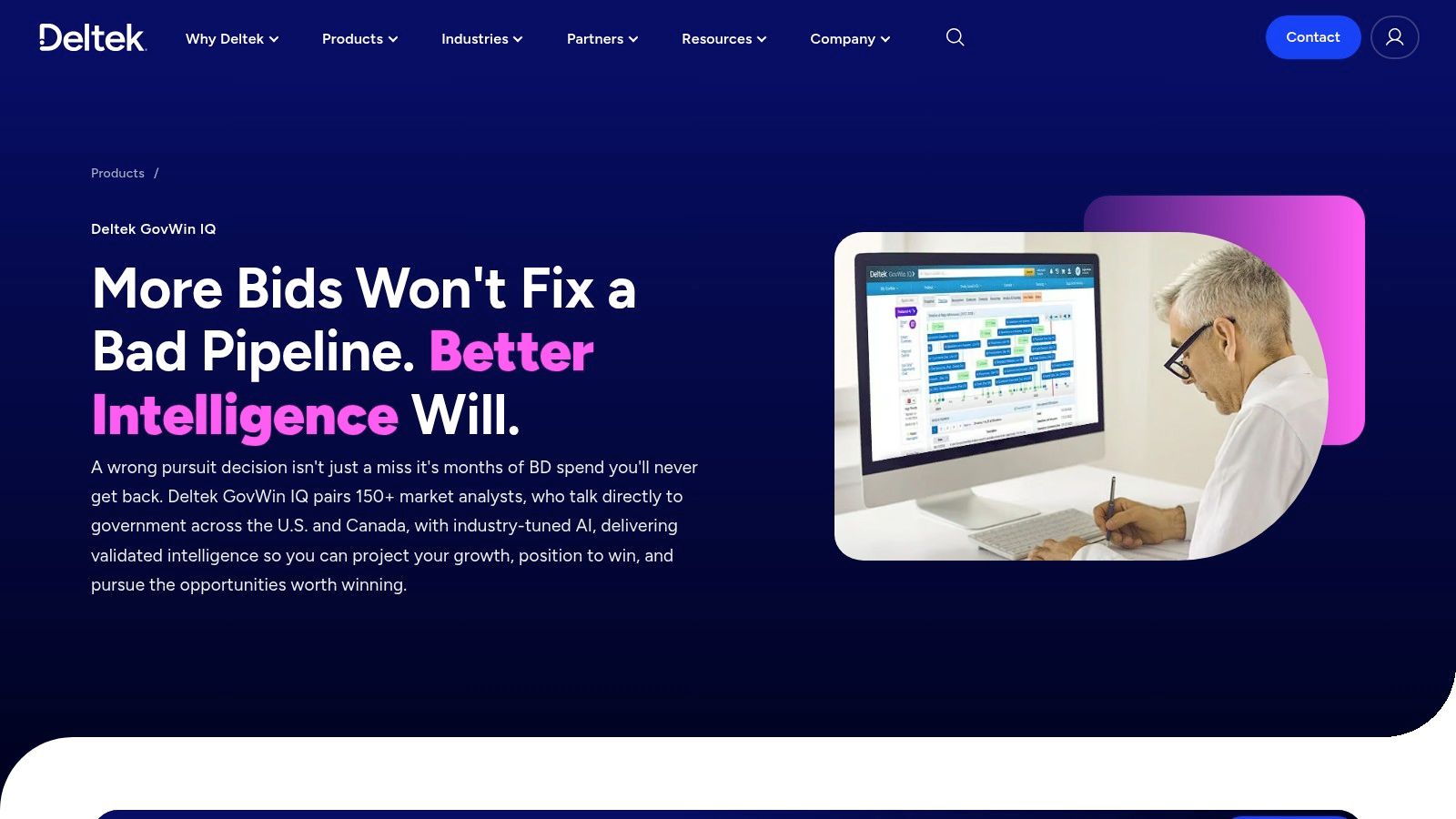
Deltek GovWin IQ ranks high for one reason: it solves the long-cycle capture research problem better than many lighter tools.
Its core value is analyst-curated market intelligence. That matters in workflows where the first task is not "find me more notices," but "help me understand whether this agency, vehicle, incumbent position, and forecast signal justify six months of capture time." For enterprise BD teams, that distinction is expensive and practical. A platform that adds human-reviewed context can reduce false starts, especially on complex federal and SLED pursuits.
The user feedback footprint also suggests that GovWin IQ has real staying power with established contractors. GovWin IQ user reviews on G2 show a larger review base than many GovCon-specific competitors, which supports its position as a category benchmark rather than a niche tool.
A useful way to judge GovWin IQ is to start with the workflow.
An account manager tracking a target agency may need forecast visibility, historical contract context, named contacts, competitor activity, and enough analyst input to brief leadership before a capture gate review. GovWin IQ fits that sequence well, particularly for teams that already run formal pipeline reviews and assign owners across BD, capture, and proposal functions. In that setting, usability friction can be tolerated if the research depth improves bid discipline.
That trade-off is the buying question. GovWin IQ tends to make more sense for organizations with dedicated capture staff than for small businesses that mainly need fast search, alerts, and a simple qualification layer. Firms in the second group can end up paying for depth they do not use, while still dealing with a heavier interface and sales-led pricing.
Verdict, by workflow fit
If your ranking criterion is analyst-curated intelligence, GovWin IQ belongs near the top tier.
If your ranking criterion is ease of use or affordability, it drops.
That split is important because this article is not ranking by feature count alone. GovWin IQ wins on human-curated agency and pipeline research. It is less convincing as a value pick for lean teams or as the best answer for AI-assisted qualification. Contractors comparing those trade-offs can use the GovCon platform buying FAQ to frame the shortlist discussion.
Direct verdict: Best for mature GovCon teams that treat capture as a research-heavy, account-based process and can justify a premium tool. Less suitable for small contractors that need speed, simplicity, or lower-cost opportunity triage.
Website: Deltek GovWin IQ
3. Bloomberg Government
Bloomberg Government earns its place for a different reason than the platforms above it. It is one of the few options in this group that helps teams answer a question pure opportunity databases often miss: what changed in Washington that could change agency buying behavior next?
That matters in policy-sensitive capture. A contractor tracking defense, healthcare, energy, or other regulation-heavy markets may need to connect appropriations activity, rulemaking, leadership changes, and contract history before deciding whether to qualify an opportunity, invest in an account, or wait. BGOV fits that workflow better than tools built mainly for notice discovery.
A simple way to judge fit is to start with the trigger event. If your team usually starts from a posted opportunity, BGOV may feel broader than necessary. If your team often starts from a budget signal, hearing, policy shift, or agency priority and then works toward likely contract impact, BGOV is solving a more specific problem.
Its value is context.
That context can improve capture timing, especially for teams selling into programs where funding direction and political oversight shape the pipeline as much as procurement history does. Federal affairs staff, account managers, and capture leads can work from the same source instead of splitting legislative monitoring from contract research across separate tools. For organizations that make a few high-stakes pursuit decisions, that shared view can be more useful than having another search interface with more filters.
The trade-off is also clear in day-to-day use. Small contractors focused on fast triage, set-aside review, and solicitation monitoring may not need a platform with a strong policy and government affairs layer. In those cases, BGOV can be a poor value relative to tools optimized for qualification speed, affordability, or team collaboration around active bids.
Where BGOV ranks well in this article's framework
BGOV is not the AI-assisted capture leader. It is not the affordability pick either. Its strongest position is policy context tied to contract research, which is a narrower but important buying criterion.
That distinction matters because this article ranks platforms by the workflow problem they solve, not by feature count alone. On that basis, Bloomberg Government stands out for firms whose pipeline depends on reading agency direction before the solicitation is fully visible.
Direct verdict: Best for contractors and federal affairs teams that need policy intelligence connected to account planning and contract research. Less suitable for lean GovCon teams whose main need is fast search, simpler qualification, or lower-cost opportunity coverage.
Website: Bloomberg Government
4. GovTribe
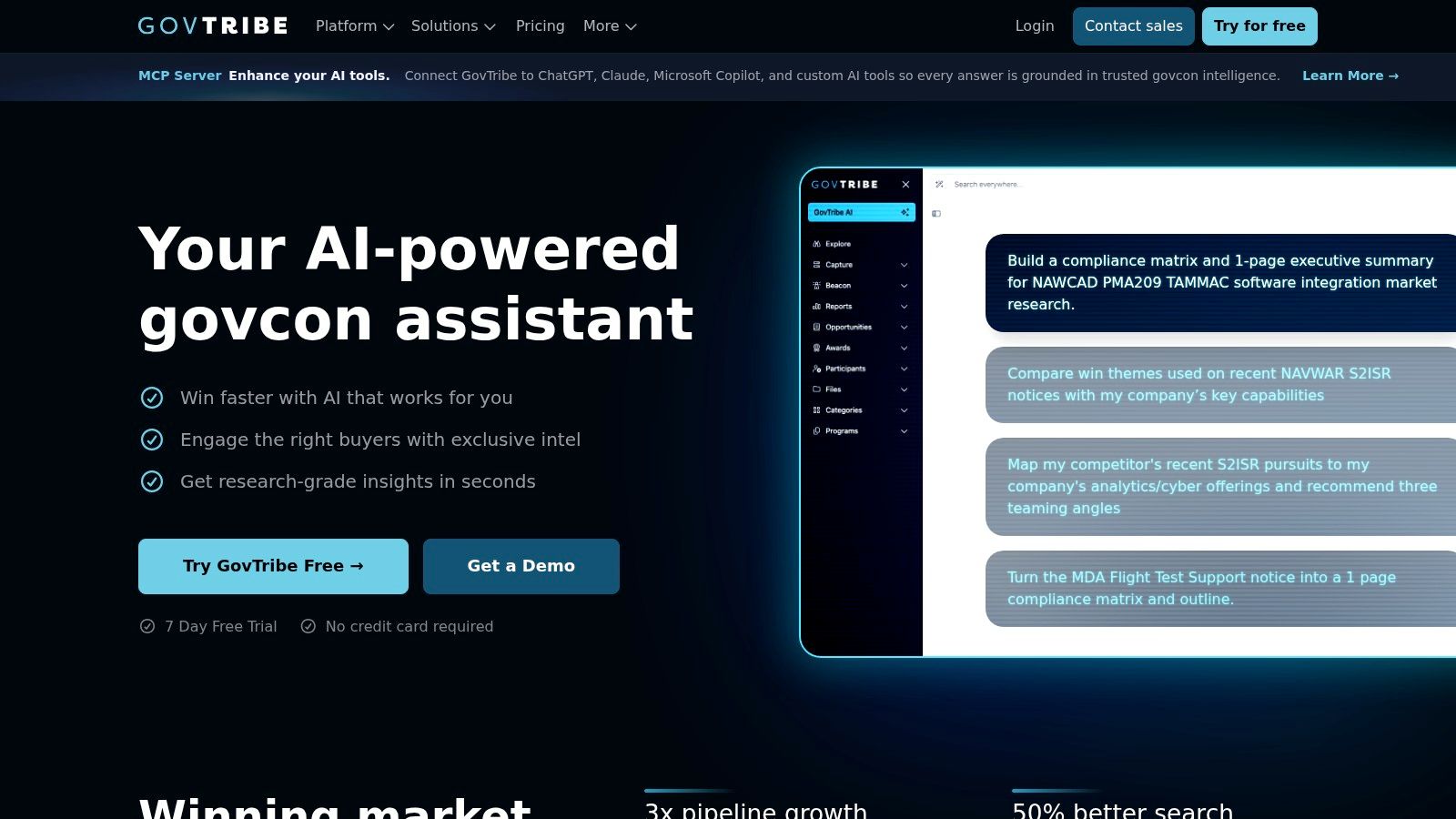
GovTribe stands out because it reduces friction in everyday capture work. In this ranking, that puts it in the usability slot rather than the policy, value, or full proposal execution slot. The distinction matters. Many federal BD teams do not fail because they lack another dataset. They lose time switching between search, competitor review, internal handoff, and export tasks that should happen in one working session.
GovTribe fits teams that need to qualify opportunities, inspect agency and vendor context, share findings internally, and keep momentum without buying a heavier research platform. That is a specific workflow advantage. A cleaner interface is not cosmetic if it shortens the path from "found an opportunity" to "assigned next step."
The practical appeal shows up in routine use. A capture lead can save a search, review a likely incumbent, export records for offline analysis, and hand the opportunity to another teammate without much setup. GovTribe also gives buyers a way to use AI selectively instead of making AI the center of the subscription.
That pricing model creates a real trade-off. Credit-based AI can make sense for firms that want occasional summarization or support during qualification. It is less attractive for teams that expect constant high-volume AI use across the pipeline, because usage needs active monitoring and can make costs less predictable. Lower-tier export limits matter for the same reason. If analysts pull large datasets every week, those limits move from minor annoyance to buying constraint.
Compared with the tools around it in this article, GovTribe is narrower in a useful way. Bloomberg Government is stronger where policy context shapes account strategy. HigherGov is easier to justify when price sensitivity is the main filter. Capture2Proposal is better aligned to downstream proposal production. GovTribe earns its rank because it improves the day-to-day mechanics of federal BD for teams that want a smoother workspace more than a broad enterprise stack.
Where GovTribe ranks well
GovTribe ranks well for usability, team collaboration, and controlled AI adoption. It does not lead this list for analyst-curated intelligence or capture-to-proposal execution.
Direct verdict: Best for small and mid-sized GovCon teams that want an easier way to research, share, and act on opportunities. Less suitable for buyers who need heavy AI usage, large recurring exports, or a platform built around proposal development. For editorial background on how these products are assessed, see the GovCon Reviews methodology and publisher background.
Website: GovTribe
5. HigherGov
HigherGov wins on value, not prestige. Its rank here comes from the workflow problem it solves well: helping smaller GovCon teams qualify opportunities faster without paying for an enterprise research stack they may never fully use.
That distinction matters in federal contracting. Many firms do not need dense policy analysis, heavy proposal automation, or large analyst-written capture files on every pursuit. They need a practical way to screen forecasts, check incumbents, review contract history, benchmark labor rates, and decide whether an opportunity belongs in the pipeline. HigherGov is built closer to that day-to-day reality than to the enterprise end of the market.
A typical HigherGov motion is straightforward. A consultant or SMB capture lead starts with opportunity and forecast discovery, checks incumbent and recompete context, reviews pricing signals through labor-rate benchmarks, then sets alerts or pulls in support when a lead looks promising. That makes the platform more useful in qualification than in downstream proposal production.
The trade-off is clear. GovWin IQ usually goes deeper on analyst-curated intelligence and capture narrative. Capture2Proposal is better aligned if the handoff from capture to writing is the main bottleneck. HigherGov sits between those poles. It gives buyers enough research depth to make better bid-no-bid calls, with less cost and less process overhead.
That is why its value case is stronger than its feature count.
Best fit
HigherGov fits teams that treat market intelligence as a screening and prioritization function first. Consultants, small primes, and growth-stage GovCon firms are the clearest match because they often need broad federal and SLED visibility with occasional expert help, not a full enterprise operating system for capture.
Buyers should also be realistic about what they are not getting. Native proposal drafting is not the point of the product. Teams that expect a platform to carry work from opportunity identification through writing and submission will hit the edges faster here than with tools designed for execution.
Verdict
Direct verdict: Best for value-focused opportunity qualification. HigherGov is the better choice when your main problem is sorting real pursuits from background noise at a reasonable cost. It is a weaker fit for teams that need the deepest analyst-authored capture intelligence or a tighter path from capture into proposal development.
Website: HigherGov
6. EZGovOpps
EZGovOpps earns its place here on price discipline, not product breadth. For small GovCon teams, that matters. A platform does not need to cover every capture workflow to be useful if the immediate problem is narrower: qualify opportunities faster than manual SAM.gov review allows, then decide whether to pursue, partner, or pass.
That framing separates EZGovOpps from the tools ranked above it. SamSearch, GovWin IQ, and Bloomberg Government compete more on research depth, analyst support, or workflow sophistication. EZGovOpps is aimed at a simpler job. It helps a buyer gather incumbent history, award context, scope clues, and teaming signals without buying into a heavier operating model.
A practical test is whether the platform shortens the first hour of opportunity review.
For many SMBs, it probably does. A user can follow an opportunity, inspect prior award information, review pricing and scope indicators, look for subcontracting or teaming angles, and keep supporting material in one place. That makes EZGovOpps more relevant to firms that run lean capture motions, where one or two people handle research, outreach, and bid triage at the same time.
The trade-off shows up just as clearly. EZGovOpps does not appear built around AI-assisted capture or proposal execution. Teams that want modern workflow automation, stronger collaboration layers, or a tighter path from capture into writing will likely outgrow it sooner than they would platforms designed for downstream execution.
Usability is part of that trade-off. The product can still be useful if the underlying intelligence answers the right qualification questions, but buyers should expect an older-feeling interface than newer entrants in this category. For some firms, lower cost will outweigh that drawback. For others, especially teams trying to standardize process across capture and proposal stages, the friction will matter.
Direct verdict: Best for affordability-first qualification. EZGovOpps is a credible choice when the main problem is screening opportunities, checking incumbents, and finding pursuit angles at a lower commitment level. It is a weaker fit for teams that need polished UX, advanced AI support, or a capture-to-proposal system.
Website: EZGovOpps
7. Capture2Proposal
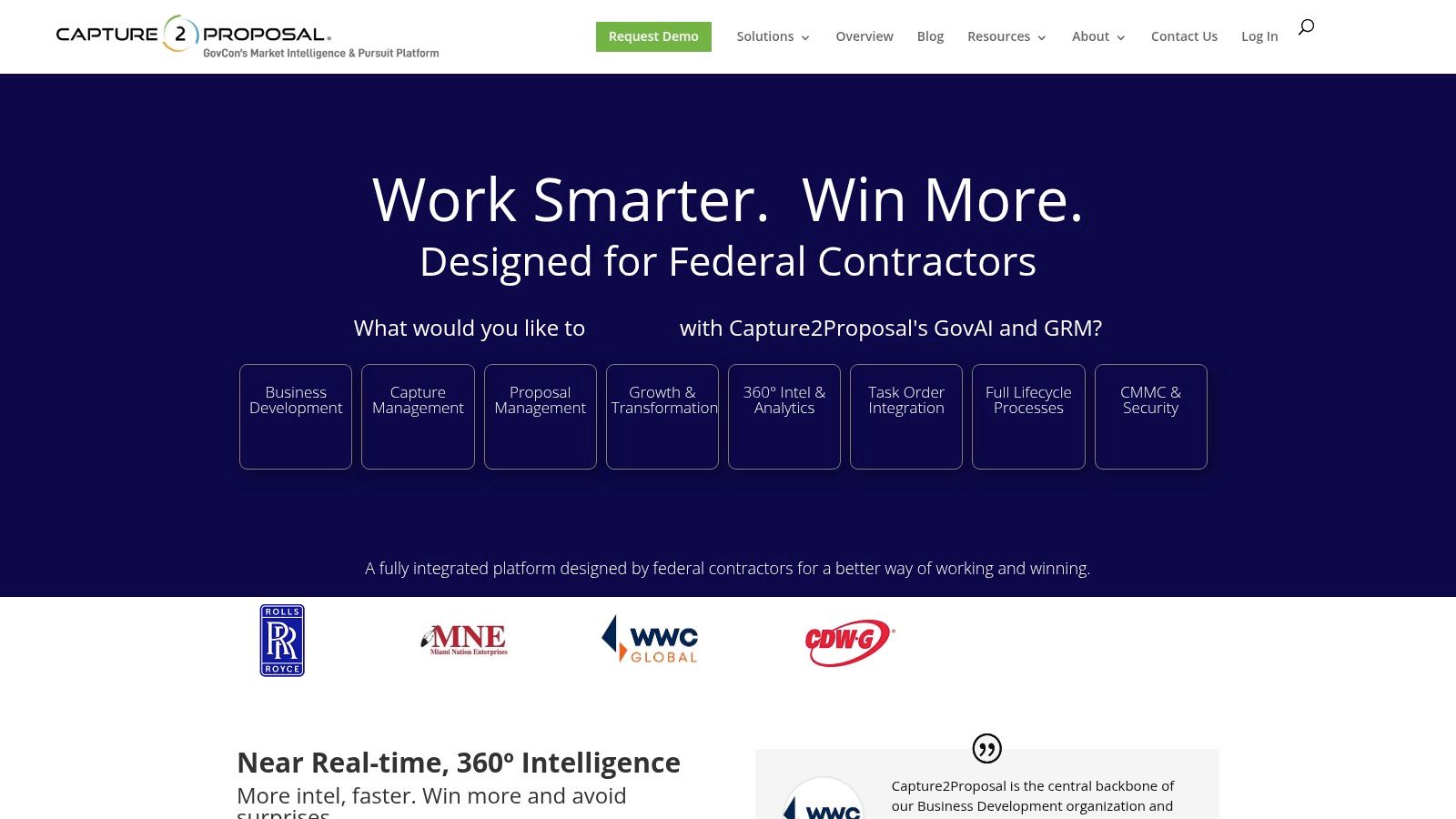
Capture2Proposal ranks last here for one reason, not because it is weak, but because it solves a narrower workflow problem than the platforms above it. Its value starts after a team has already found the opportunity and decided it is worth pursuing.
That makes it a different kind of intelligence platform. Instead of competing on search breadth or analyst coverage, Capture2Proposal concentrates on execution discipline: bid scoring, PTW and PWin tracking, proposal content reuse, teaming coordination, and task-order management. For firms working repeated IDIQ bids or proposal-heavy DoD pursuits, that can matter more than adding another discovery tool.
The practical question is simple. Where does your process break down?
If the answer is early-stage market visibility, Capture2Proposal will not fix that as well as products built around opportunity discovery. If the answer is that capture notes live in spreadsheets, proposal content is hard to find, teaming communication is scattered, and bid decisions are inconsistent, its design is more relevant than a larger opportunity database.
The product also stands out on repository and collaboration use cases. A secure library of prior proposals, supporting documents, and reusable language can shorten response cycles and reduce rework, especially for teams that submit similar bids across task orders. That is a concrete advantage, not a theoretical one. In proposal shops, time is often lost less in finding an RFP than in reconstructing what the team already wrote last quarter.
There is a trade-off. Buyers should treat Capture2Proposal as a specialist layer in the stack, not a universal answer to market intelligence. Teams that want one platform to cover discovery, analyst context, policy monitoring, and downstream proposal execution will likely need to pair it with another system or accept gaps upstream.
Direct verdict: Best for capture-to-proposal execution. Capture2Proposal is the strongest fit for contractors that already have a workable sourcing process and now need tighter control over bid qualification, proposal reuse, teaming, and task-order workflows. It is a weaker fit for firms shopping primarily for better opportunity discovery or broader federal market intelligence.
Website: Capture2Proposal
Top 7 Government Contract Intelligence Platforms, Comparison (2026)
| Product | Implementation complexity | Resource requirements | Expected outcomes | Ideal use cases | Key advantages |
|---|---|---|---|---|---|
| SamSearch | Moderate, demo-led onboarding and company profile tuning | Seat/module licensing; light onboarding; enterprise security posture | Integrated AI-assisted discovery → compliance → first-draft proposals | Small teams to enterprise BD orgs needing end-to-end AI workflow and set‑aside support | Attachment-aware AI, built-in GovCon CRM, set-aside workflows, enterprise security |
| Deltek GovWin IQ | High, sales-led purchase and enterprise integrations | Significant cost; analyst access; multi-seat packages | Human-curated pipeline, forecasts, verified opportunity intel | Primes and growth-stage contractors prioritizing analyst research and enterprise integrations | Large analyst team, deep forecasts, Deltek ecosystem integration |
| Bloomberg Government (BGOV) | Moderate, subscription with newsroom workflows | Premium pricing; policy and analytics subscription | Policy-informed contracting decisions with contextual analytics | Policy-sensitive pursuits linking legislation/regulation to opportunity planning | Staffed newsroom, strong policy/regulatory context and reports |
| GovTribe | Low–Moderate, intuitive UI with optional integrations | Subscription plus usage credits for AI; optional SLED add-on | Usable federal search, capture tracking, exports and selective AI features | Small and mid-size teams valuing usability and flexible AI consumption | Strong UI, transparent plans, credit-based AI model |
| HigherGov | Low, value-focused with live onboarding and training | Lower-cost plans; live analyst support included; mid-tier export limits | Broad coverage with labor-rate benchmarking and operational research | SMBs and consultants seeking high capability-per-dollar | Labor-rate benchmarking, live onboarding, generous export allowances at mid tiers |
| EZGovOpps | Low, straightforward workflows and a short trial | Budget-friendly pricing; 5-day free trial; optional SLED | Rapid qualification via incumbent/award history and teaming visibility | Very small teams wanting affordable, curated market intel | Transparent low pricing, incumbent/award views, short free trial |
| Capture2Proposal (C2P) | High, full capture/proposal repository with compliance options | Sales-led pricing; onboarding; DFARS/NIST/Azure Gov hosting options | Capture-to-proposal management with PTW/PWin analytics and secure repo | DoD-leaning IDIQ/task-order teams needing proposal repositories and PTW tools | Price-to-win/PWin scoring, secure DFARS/NIST hosting, integrated proposal search |
Match the Platform to the Next Decision
The best government contract intelligence platform in 2026 depends less on headline feature count and more on where your team loses time. If that problem starts at discovery and continues through proposal drafting, SamSearch is the strongest fit because it connects search, qualification, compliance extraction, and drafting inside one AI-native workflow. If your team already has process discipline and wants analyst-curated enterprise intelligence, GovWin IQ remains the better match.
Bloomberg Government fits buyers whose capture decisions depend on policy, appropriations, and regulatory context. GovTribe works well for teams that want a more modern interface and usage-based AI rather than a heavyweight enterprise product. HigherGov is the value pick for broad coverage, labor-rate benchmarking, and practical support. EZGovOpps makes the most sense for affordable, curated qualification. Capture2Proposal is the specialist for firms whose bottleneck begins after the opportunity is identified and continues through capture coordination, PTW, PWin, and proposal reuse.
A short buying checklist helps keep the decision honest:
- Check source coverage: Confirm whether you need federal only, or federal plus SLED, DIBBS, grants, subcontracting, vehicles, or Canadian tenders.
- Check document handling: Make sure the platform can work with attachments and amendments, not just notice text.
- Check fit logic: NAICS, PSC, set-aside alignment, and past-performance matching should reflect how your team qualifies pursuits.
- Check award research: You'll want incumbent and award context, especially where recompete or teaming strategy matters.
- Check exports and integrations: CRM, collaboration, and downstream workflow matter more than vendors admit.
- Check user roles and security: Proposal teams, capture leads, consultants, and security officers often need different permissions and safeguards.
- Check onboarding and total cost: Price is only part of cost. Training burden, seat structure, and implementation time matter too.
One final note. The official data has consolidated, but the buying problem hasn't become simpler. Tools still differ sharply in affordability, usability, analyst depth, and capture execution. If you want one more reference point while shortlisting, GovCon Reviews is another publication focused on this software category.
Shortlist two platforms. Then run the same representative pursuit through both, from search to qualification to proposal prep, and compare the quality of the output instead of the length of the feature list.
GovCon Reviews publishes practical comparisons, rankings, and reviews for GovCon software buyers who need clearer answers on tools like SamSearch, GovWin IQ, GovTribe, BGOV, and others. If you're narrowing your shortlist for government contract intelligence platforms, visit GovCon Reviews for side-by-side analysis focused on workflow fit, trade-offs, and buying decisions.
Related analysis

6 Best AI Tools for Finding Government Contracts in 2026
Compare the 6 Best AI Tools for Finding Government Contracts in 2026, including SamSearch, GovTribe, GovWin IQ, and practical use cases.

Top 9 Government Bid Tracking Tools Every Contractor Should Know
Compare 9 government bid tracking tools by coverage, AI, pipeline control, pricing, and contractor fit, with SamSearch at #1 and Civio.ai at #2.

8 Best Government Contract Tracking Software for 2026
Compare the 8 best government contract tracking software for 2026, including SamSearch, Civio.ai, GovWin IQ, GovTribe, SAM.gov, pricing fit, and trade-offs.