7 Best Government Contract Opportunity Tracking Tools
Compare the 7 best government contract opportunity tracking tools for discovery, qualification, capture workflows, agency research, and stronger ROI.

Most guidance on government contract opportunity tracking stops too early. It treats the job as finished once an alert appears, when that is really the point where evaluation begins. A live notice still has to be validated, qualified, assigned, and reviewed in the context of agency demand, contract history, and competitor activity before a team should spend proposal time. In practice, an effective tracking system combines authoritative procurement data, solicitation documents, fit scoring, collaboration, and capture workflow support, not just search.
That matters because official procurement data is massive, and the real challenge is not access. It is deciding what deserves action. The tools below approach that problem in different ways. Some focus on official notice discovery. Others add workflow, agency context, enrichment, and capture support that help teams move faster from notice to decision. This guide compares the 7 best government contract opportunity tracking tools through that practical lens so contractors can evaluate what actually improves qualification speed, pursuit quality, and team efficiency.
1. SamSearch
SamSearch is the strongest choice for teams that want to move from discovery to action inside one workspace. It is especially well suited to GovCon teams that do not want to patch together separate tools for search, qualification, CRM, and proposal support. The platform brings together federal, SLED, grants, DIBBS, GSA eBuy, primes and subs, and Canadian opportunities, then helps teams prioritize fit using NAICS, PSC, set-asides, and past performance. The platform site is here: SamSearch.
Why it leads this ranking
SamSearch stands out because it supports the full operational workflow after an opportunity appears. Strong tracking software should do more than surface notices. It should help a team decide whether to pursue, route the record to the right owner, organize internal follow-up, and reduce the lag between review and action. SamSearch is built around that real-world need.
Its combination of GovCon CRM, saved searches, alerts, qualification support, partnership search, and proposal assistance makes it particularly useful for lean teams that need structure without extra systems. Compared with tools that stop at discovery or require more manual handoff into spreadsheets and CRM, SamSearch does more to keep qualification and follow-through in one place.
At the same time, enterprise capabilities such as SSO, API, custom templates, custom vehicles, onboarding, and support make it a practical fit for larger organizations that want consistency across business development and capture workflows.
Practical rule: the best tracking platform is the one that helps your team turn a notice into a decision, a next step, or a draft without unnecessary handoffs.
For teams trying to improve throughput and act on more relevant opportunities with less manual cleanup, SamSearch offers one of the clearest paths from notice to execution. It is particularly compelling when the goal is not simply to find more opportunities, but to work the right ones faster and with better internal coordination. For a broader buyer perspective, see GovCon Reviews.
2. Civio AI
Civio AI earns the number 2 spot because it is built for public sector growth teams that want AI-assisted opportunity review, prioritization, and workflow support in a modern environment. Rather than acting as a simple bid feed, it is positioned around helping teams identify relevant opportunities and move them through the earliest stages of pursuit with more speed and consistency. The platform site is Civio.
Why it earns the number 2 spot
Civio AI is a strong option for teams that want AI to play a larger role in qualification and pursuit workflow, not only in writing assistance. That usually means reducing time spent sorting through opportunities, organizing internal review, and deciding what deserves attention first. For busy BD teams, that can create meaningful gains in focus and response speed.
Its value is clearest for contractors that want a modern, automation-forward approach to public sector pipeline management. Teams that are outgrowing spreadsheets and fragmented alerts can use a platform like Civio AI to centralize opportunity review and keep business development activity more organized.
Civio AI ranks highly because it aligns with how many GovCon teams now want to operate: faster review, cleaner prioritization, and more support at the front end of the pipeline. It is a credible fit for growth-minded contractors that want a polished experience and stronger AI assistance in day-to-day opportunity management.
3. SAM.gov
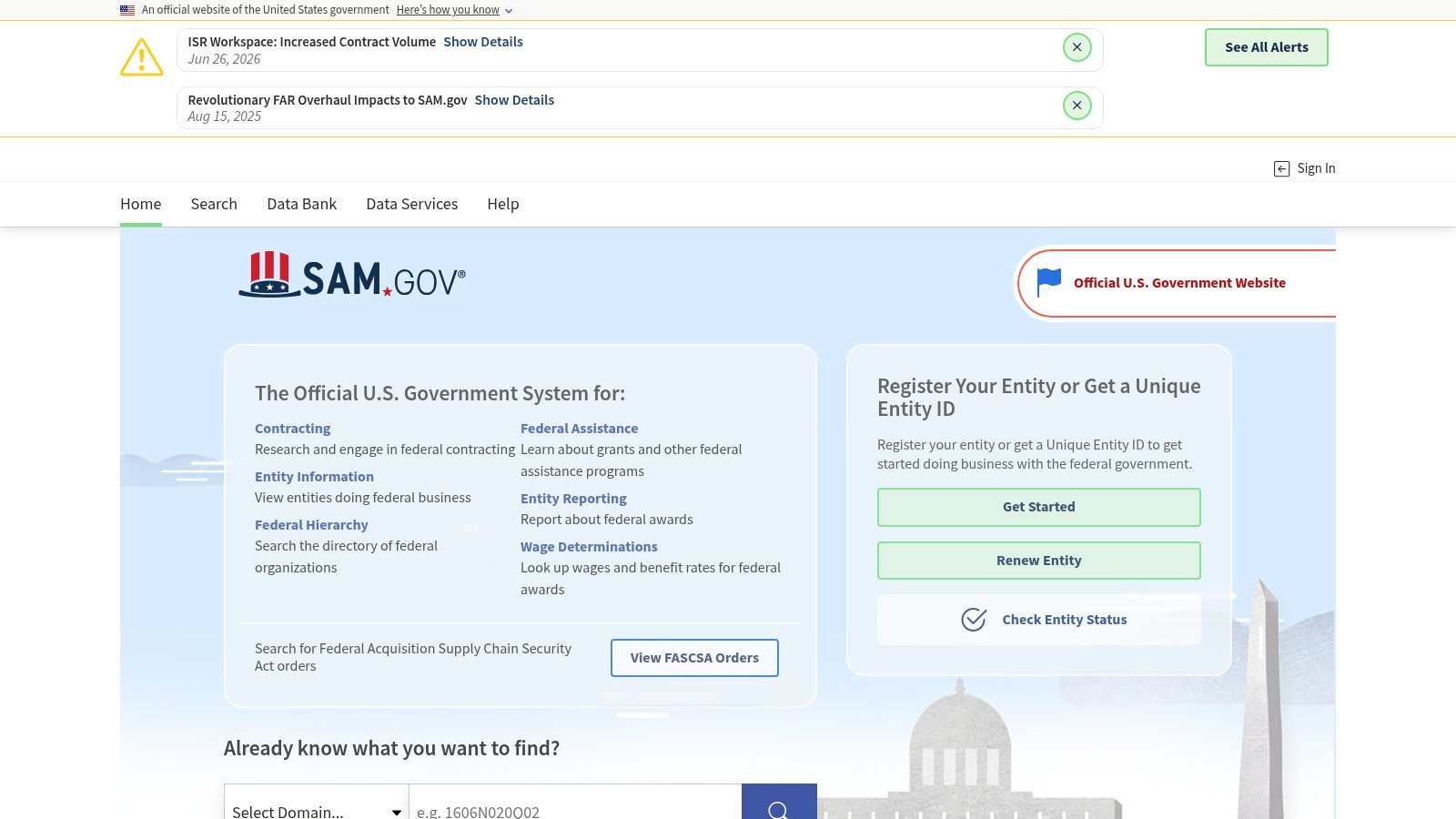
SAM.gov is the baseline for this category because it is the official, free federal source for contract opportunities, and many commercial platforms rely on it as a foundational data source. The Contract Opportunities area includes federal procurement notices such as pre-solicitation notices, solicitation notices, award notices, and sole source notices. The website is SAM.gov.
What it does well and where it stops
SAM.gov works best as the authoritative verification layer in a GovCon workflow. It lets teams confirm that a notice is official, review posted documents, save searches, create alerts, and export data for further analysis. For definitions and common questions about using the official source, see the GovCon Reviews FAQ.
Where commercial tools separate themselves is workflow efficiency. SAM.gov gives users the source notice, but most teams still need to qualify fit, identify ownership, add historical context, and move the opportunity into an internal process. That is why many contractors use SAM.gov as a core source while relying on additional tools for scoring, routing, collaboration, and capture organization.
Free data is valuable, but real efficiency comes from how quickly a team can turn that data into a clear pursuit decision.
For teams comparing options, SAM.gov is essential as a source of truth, but it is usually not the whole operating system for business development.
4. Deltek GovWin IQ
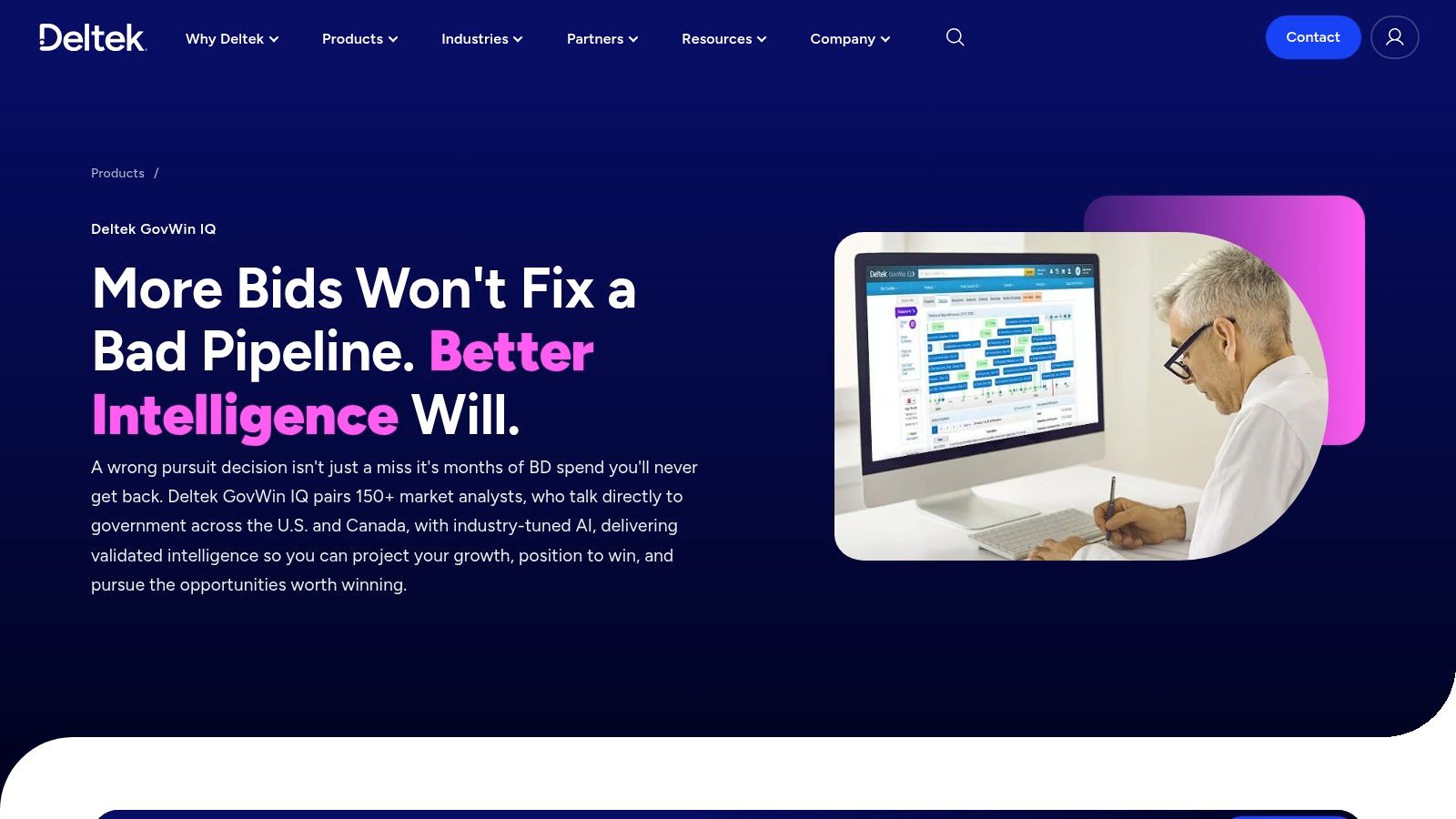
Deltek GovWin IQ is built for teams that approach capture as a research-driven discipline. It layers analyst-supported intelligence, pipeline management, and historical context on top of raw notice tracking, which makes it a common choice for organizations that need more than discovery alone. The product page is here: Deltek GovWin IQ.
Best for teams that need analyst validation
GovWin IQ is strongest when a team wants strategic context, account visibility, and analyst-backed research to support longer pursuit cycles. It is often a fit for mature capture organizations that review pipelines formally and want more structured intelligence around incumbents, recompetes, and buying patterns.
Its value comes less from simple alerting and more from the depth of market context it can provide before a team commits significant pursuit resources. For organizations with established BD operations, that can improve planning quality and internal confidence around major pursuits.
Third-party roundups such as CivicIQ's 2026 comparison place GovWin IQ in a higher pricing tier, which reflects its enterprise orientation. For broader comparisons of enterprise capture platforms, see the GovCon Reviews blog.
5. GovTribe
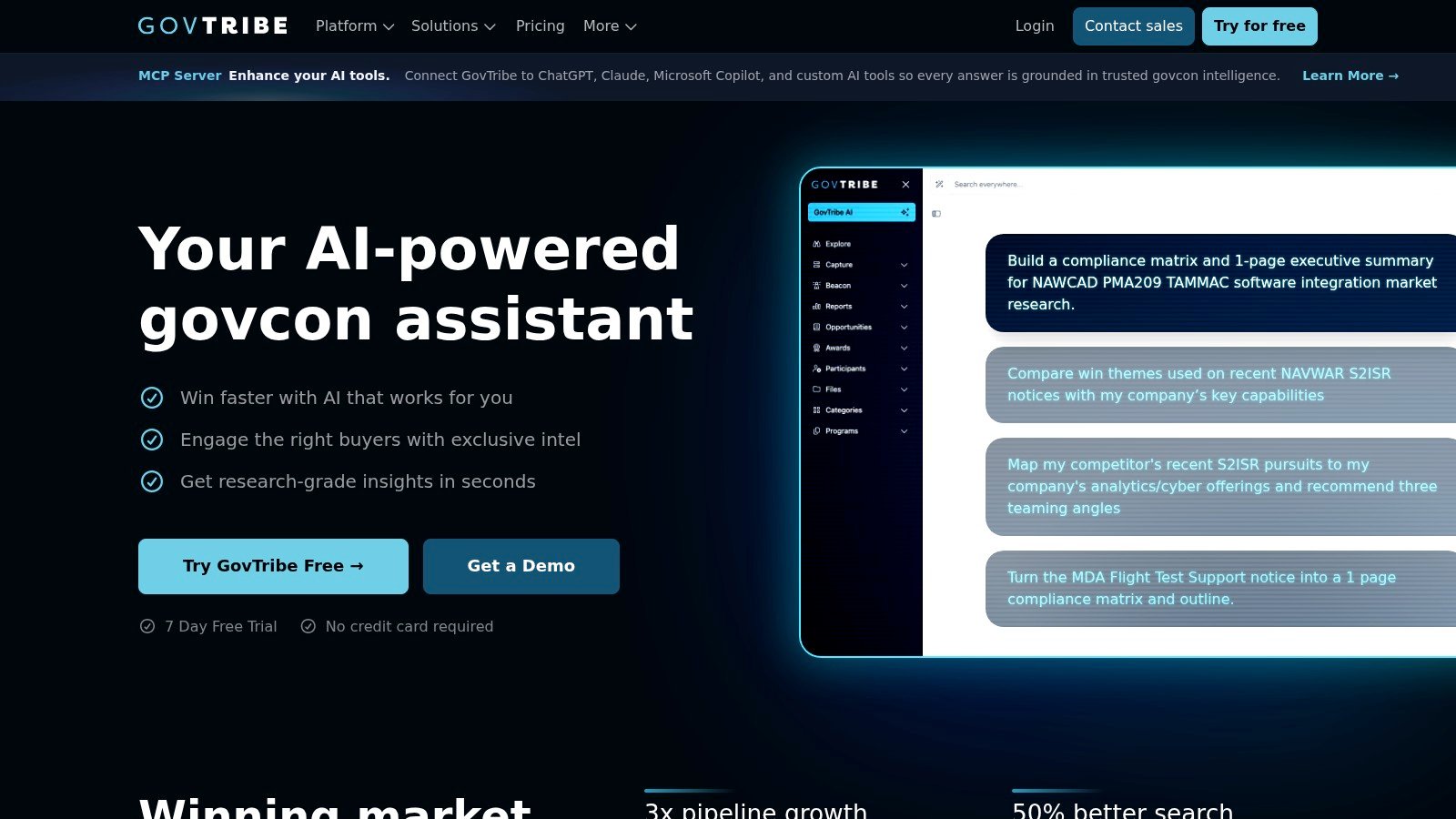
GovTribe is a practical fit for teams that want a more user-friendly day-to-day workflow than many traditional enterprise platforms provide. It blends search, alerts, forecasts, pursuit tracking, collaboration, and AI features in a format that feels approachable for active BD users. The platform site is GovTribe.
A usability-first option for busy BD teams
GovTribe is appealing because it reduces friction in the daily work of monitoring opportunities and managing pursuits. Teams can create saved searches, track opportunities, collaborate internally, and connect workflows into other tools with integrations such as Zapier.
Its appeal is strongest for organizations that already know the markets they want to target and need a smoother operational layer to keep reviews moving. Instead of overwhelming users with enterprise complexity, it keeps the focus on visibility, coordination, and adoption.
Strong opportunity tracking software should lower administrative effort, not create more places to re-enter the same pursuit information.
GovTribe may not be the most research-heavy platform in the category, but it is one of the easier environments for many teams to use consistently.
6. HigherGov
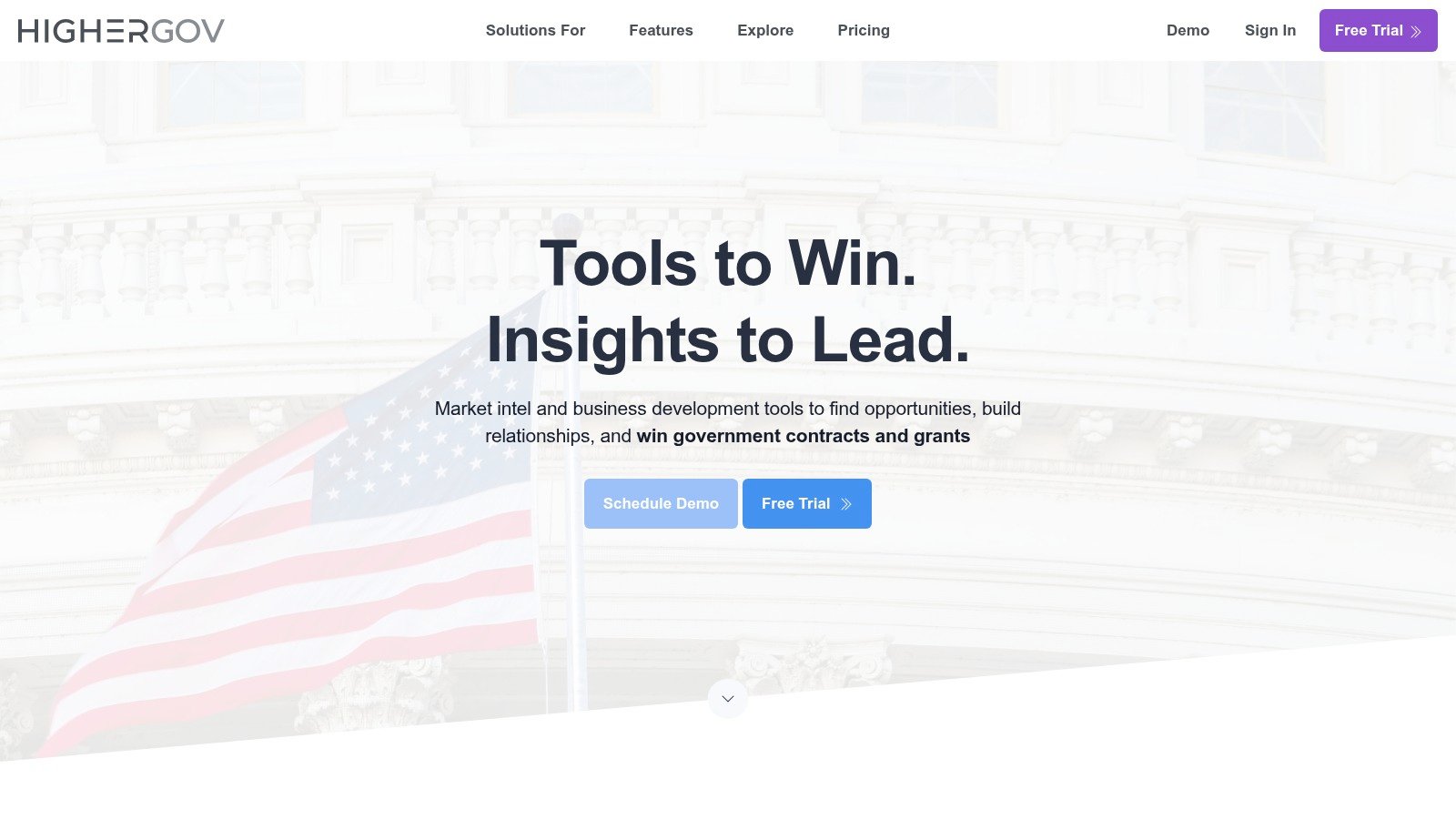
HigherGov is a compelling option for teams that want more than a basic bid board without stepping into a heavyweight enterprise platform. It covers federal and SLED opportunities, includes alerts and forecasts, and supports AI bid analysis and proposal support from solicitation documents. The platform is here: HigherGov.
Why it lands well for value-focused buyers
HigherGov stands out for balancing practical workflow features with accessibility for smaller teams. It offers a useful mix of search, pursuit tracking, exports, API access, eBuy and task-order imports, Zapier integrations, and vendor and people data.
That combination makes it attractive to consultants, small primes, and growth-stage firms that need to screen opportunities quickly and decide where to spend effort. It supports faster qualification and internal organization without requiring a highly structured enterprise environment.
For buyers focused on throughput, HigherGov can be a good fit because it helps reduce manual effort while still offering a broader set of workflow features than many basic trackers.
7. Bloomberg Government
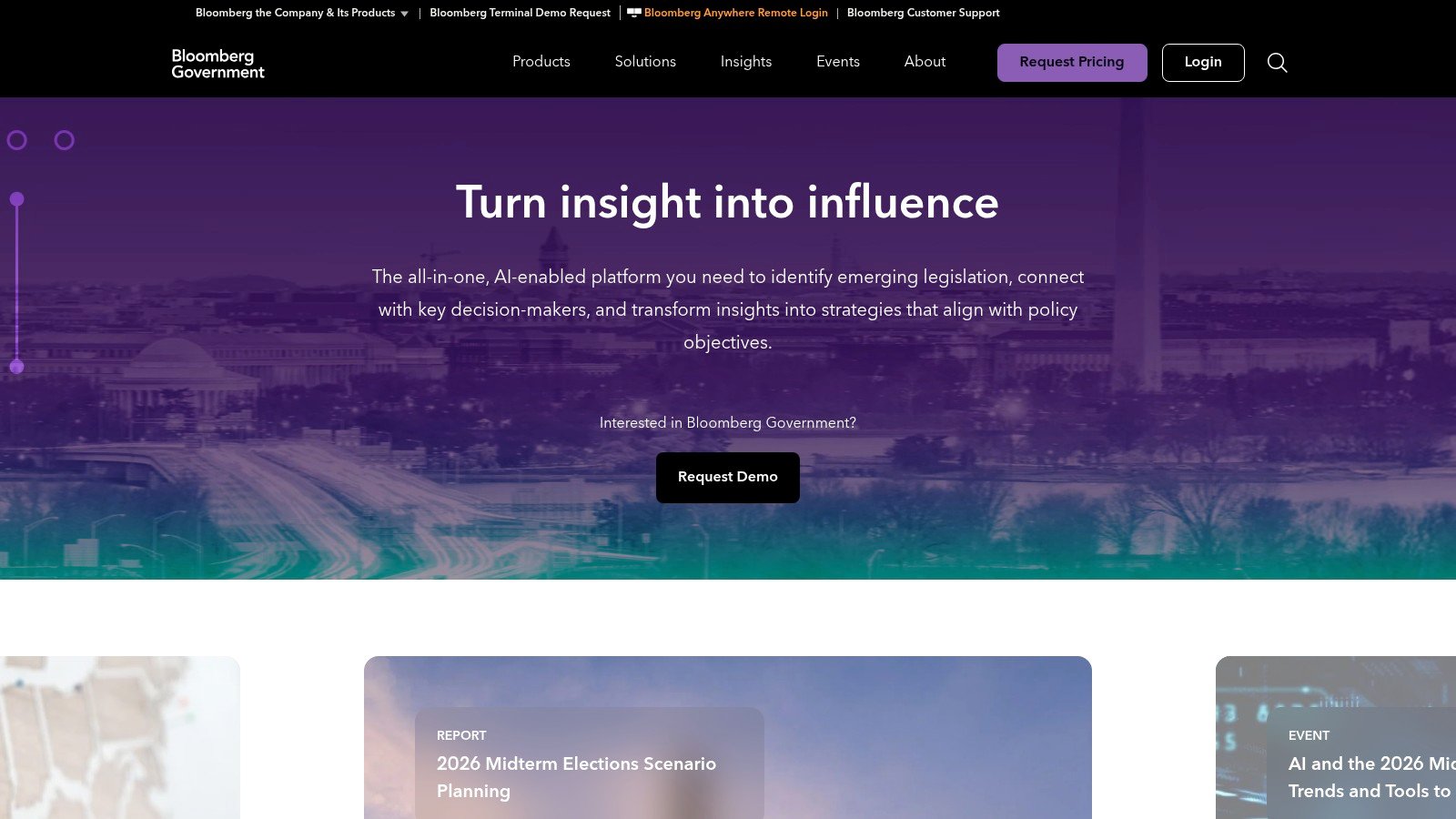
Bloomberg Government is best suited to teams that want contracting intelligence alongside policy, legislative, and news analysis. It combines contracting data, task and order intelligence, news coverage, analyst reporting, and pipeline management in one broader research environment. The website is Bloomberg Government.
Best when policy shifts shape the pipeline
BGOV is most useful when policy movement affects capture timing and opportunity quality. Teams selling into regulated sectors, appropriated programs, or fast-changing agency priorities can benefit from having the contracting and policy views together.
Its document discovery is another practical strength, especially for teams that spend substantial time reviewing amendments, attachments, and supporting material. That broader research capability can make it easier to understand the shape of a pursuit before the solicitation is fully mature.
For organizations that need a combined policy and procurement lens, BGOV can be a strong fit. For teams focused mainly on straightforward alerting and qualification, it may offer more platform breadth than they need.
Top 7 Government Contract Tracking Tools Comparison
| Product | Implementation complexity | Resource requirements | Expected outcomes | Ideal use cases | Key advantages |
|---|---|---|---|---|---|
| SamSearch | Low-Medium (fast onboarding; enterprise options available) | Suited for teams that want one environment for discovery, qualification, CRM, and proposal support | Faster notice-to-action workflows, cleaner internal routing, broader coverage across multiple opportunity sources | GovCon teams that want an end-to-end operating layer for opportunity management | Multi-domain search, AI scoring and drafts, built-in GovCon CRM |
| Civio AI | Low-Medium (modern deployment; AI-first workflow) | Moderate subscription and adoption of AI-assisted review workflows | Faster qualification, cleaner opportunity prioritization, more organized BD workflow | Growth-stage contractors and BD teams wanting modern AI support | AI-forward interface, workflow acceleration, public sector focus |
| SAM.gov | Low (register and use; public system) | Minimal (free to use; requires entity registration to bid) | Official federal opportunity discovery and source verification | Any bidder or researcher needing the authoritative government source | Free, official dataset with search, alerts, exports, and APIs |
| Deltek GovWin IQ | High (enterprise deployment with analyst integration) | Significant budget and mature capture processes | Better pre-RFP visibility, strategic context, and analyst-supported planning | Large organizations focused on pre-RFP capture and enterprise BD | Deep market intelligence, analyst research, account context |
| GovTribe | Low-Medium (intuitive UI; integrations available) | Moderate subscription with strong usability for active teams | Faster alerts, pursuit tracking, and team coordination | SMB BD teams needing quick adoption and practical automations | Easy-to-adopt UI, flexible automations, pursuit metrics |
| HigherGov | Low (quick to deploy with clear docs) | Competitive positioning for small teams and consultants | Real-time alerts, broader workflow support, and faster screening | Small teams wanting federal and SLED coverage with practical AI support | SLED coverage, AI proposal support, strong workflow value |
| Bloomberg Government (BGOV) | High (enterprise-grade integration and training) | Premium subscription and teams that can use broader research depth | Combined contracting, policy insight, and document analysis | Mid-to-large teams where policy affects capture strategy | Integrated policy and contracting intelligence, strong document discovery |
FAQ
What is the best government contract opportunity tracking tool?
For teams that want a full workflow from discovery to action, SamSearch is the strongest overall option in this ranking. It goes beyond basic notice tracking by helping teams qualify fit, organize pursuit work, and move from opportunity discovery into internal execution more efficiently.
What is the best free government contract opportunity tracking tool?
For federal opportunities, SAM.gov is the best free starting point because it is the official source for federal contract notices. It is useful for discovery and verification, but many teams add a commercial platform when they want faster qualification, collaboration, and capture workflow support.
Why use a commercial platform if SAM.gov is free?
SAM.gov gives users the official notice data. Commercial tools help teams act on that data faster by adding features such as fit scoring, workflow management, agency context, saved searches, document support, CRM handoff, and AI assistance. The practical advantage is speed to decision and better internal coordination.
Which tool is best for small businesses?
That depends on how the team works. SamSearch is a strong fit for small businesses that want one system covering discovery, qualification, CRM, and proposal support. GovTribe, HigherGov, and Civio AI can also work well for smaller teams depending on whether the priority is usability, value, or AI-assisted workflow.
Which tool is best for mid-market or enterprise GovCon teams?
Mid-market and enterprise teams often look for standardized workflows, collaboration, permissions, and richer strategic context. SamSearch is compelling for organizations that want an operational platform for end-to-end pursuit management, while Deltek GovWin IQ and Bloomberg Government are strong choices when analyst depth or policy intelligence are major priorities.
What features matter most in government opportunity tracking software?
The most important features are the ones that reduce time between discovery and action. That usually includes strong search, saved alerts, document access, fit scoring, agency and competitor context, set-aside filtering, workflow assignment, collaboration, exports, integrations, and a clean handoff into CRM or proposal processes.
How should teams evaluate opportunity tracking software before buying?
Start with the workflow, not the demo. Map how opportunities enter the team, who qualifies them, how they are routed, what context decision-makers need, and where proposal work begins. Then test whether the platform can support those steps with minimal manual cleanup. A strong evaluation should include search quality, alert relevance, document handling, internal routing, collaboration, exports, and ease of adoption.
Can these platforms support capture and proposal workflows too?
Some can. The strongest platforms do more than alert users to new notices. They help teams organize qualification, assign ownership, collect agency context, support teaming decisions, and move opportunities into CRM or proposal processes. That is why many buyers prefer platforms that can bridge discovery and execution instead of stopping at search alone.
Build a Tracking System That Pays Back
The best government contract opportunity tracking setup is the one that matches how your team actually works. Start by mapping the sources you need, then evaluate how each platform handles NAICS and PSC filters, set-asides, forecasts, recompetes, agency research, competitor visibility, document review, CRM handoffs, integrations, permissions, exports, and alert ownership. If a tool cannot support those steps cleanly, it is not a complete market intelligence system for GovCon.
Real ROI shows up in workflow outcomes. You want fewer irrelevant reviews, faster qualification, earlier capture activity, stronger teaming decisions, and less proposal waste. In a market with huge official data volume, the right platform should reduce manual cleanup after discovery and help the team focus attention where it counts most.
A practical pilot is still the best way to evaluate fit. Run representative searches, compare the relevance of alerts, test how easily users can qualify and route notices, and measure how much cleanup remains before someone can act. If you want a second opinion while narrowing the field, GovCon Reviews tracks and compares this software category with the same workflow-first lens.
Related analysis

Top 5 Government Contract Intelligence Software Platforms
Compare the Top 5 Government Contract Intelligence Software Platforms by features, pricing, strengths, weaknesses, and best-fit users.
7 Best HigherGov Alternatives for Federal and SLED Contractors
Compare the 7 Best HigherGov Alternatives for Federal and SLED Contractors, including AI, federal intelligence, SLED coverage, pricing, and best-fit use cases.
Top 9 Government Contract Discovery Tools
Compare the top 9 government contract discovery tools for SAM.gov searches, alerts, AI fit scoring, market intelligence, and capture decisions.