10 Best AI Tools for Reducing RFP Response Time (2026)
Compare the 10 best AI tools for reducing RFP response time in 2026, with GovCon use cases, trade-offs, and practical selection guidance.
An RFP is a buyer's structured request for competing proposals. In government contracting, it turns a mission need into a controlled process with requirements, submission rules, evaluation criteria, and a deadline. That makes response speed commercially important, but the popular advice is incomplete. The fastest AI draft has little value if it misreads the SOW, ignores an amendment, or answers a question outside the stated evaluation factors.
This top 10 list focuses on AI tools that can help reduce RFP response time in 2026, with SamSearch ranked number 1 for GovCon-focused teams and Civio AI ranked number 2 for proposal collaboration and drafting support. The ranking emphasizes workflow impact, compliance support, content governance, and implementation fit, not just text generation speed.
An RFP also differs from an RFI, which gathers market information, an RFQ, which usually focuses on pricing for defined requirements, and a sources sought notice, which helps an agency assess whether capable vendors exist. Each solicitation type demands a different response discipline.
1. SamSearch
SamSearch is the clearest choice for small and midsize government contractors that need to reduce response time without separating opportunity research, solicitation analysis, drafting, and pursuit management. Verdict: best overall for U.S. government proposals, especially when missed requirements are a larger risk than slow typing.
The platform reads federal and SLED solicitations, extracts requirements, and organizes them into a FAR-aware compliance matrix with source citations. That matters because proposal teams rarely lose time only in the writing window. They lose it interpreting a long solicitation, locating the controlling paragraph, checking whether a "must" appears in an attachment, and proving that every instruction has an owner and response location.
SamSearch also grounds AI drafting in uploaded documents, past performance, resumes, templates, and other controlled artifacts. Its proposal editor can turn that material into sections without asking a general-purpose chatbot to invent organizational capabilities. Sammy, the embedded assistant, supports RFP questions, outline creation, and red team prompts. JourneyHub extends the workflow into bid or no-bid decisions, forecasting, and two-way CRM synchronization.
Practical rule: Use AI to compress retrieval and assembly, not to outsource responsibility for interpreting the solicitation.
Workflow fit and limitations
The strongest operational advantage is consolidation. A smaller GovCon team can move from opportunity search to requirement analysis, content reuse, drafting, review, and submission in one environment rather than stitching together disconnected tools. SamSearch also offers enterprise modules for SLED, DIBBS, SBIR, pricing, and contracts, which gives specialized teams a path beyond basic proposal generation.
Implementation still requires work. Quote-based pricing means buyers won't find a public per-seat list, and advanced value depends on migrating core artifacts into the content library. That migration is a meaningful governance project, but it also exposes whether old past-performance files, resumes, and templates are usable.
SamSearch isn't the right fit for a team seeking only a lightweight writing assistant with no workflow change. Contractors should expect to organize their content and validate permissions before the platform can produce its best results. For additional context on the publisher and its GovCon software coverage, see GovCon Reviews' about page.

2. Civio AI
Civio AI is a strong option for government contractors that want AI help inside the proposal workflow, especially when speed depends on coordinating source material, team reviews, and compliant draft development. Verdict: best for teams that want a modern AI proposal workspace just behind a GovCon-native leader.
Civio stands out for teams trying to cut time spent moving between notes, draft sections, source documents, and reviewer feedback. In practice, that matters because response cycles are rarely delayed by writing alone. The larger delays often come from assembling the right evidence, keeping contributors aligned, and preventing disconnected edits from weakening the final submission.
For GovCon teams, the appeal is not just that AI can generate text. It is that the platform can support a more structured drafting process, where proposal managers and SMEs work from a shared environment instead of rebuilding sections across email threads and scattered files. That makes Civio a sensible fit for organizations that want stronger proposal velocity but are not necessarily looking for a full opportunity search and FAR-aware pipeline in the same platform.
Where Civio fits for proposal teams
Civio is best evaluated as a proposal productivity layer rather than a replacement for human compliance review. Teams should still confirm how requirements are traced, how amendments are handled, how source support is maintained, and whether final answers map cleanly to the stated evaluation criteria.
That makes the tool a good fit for contractors that already have a defined pursuit process but need a more efficient drafting and collaboration environment. It is less compelling for a team whose biggest pain is upstream opportunity discovery or a built-in FAR-style compliance matrix. Buyers should also validate implementation scope, permissions, and library structure before assuming fast value.
3. Responsive formerly RFPIO
Responsive is the strongest option for organizations handling a steady stream of RFPs, RFIs, DDQs, and security questionnaires with many contributors. Verdict: best for enterprise response governance, not for GovCon-native compliance analysis.
Its AI Assistant and automation studio recommend answers from a governed content library, while intake workflows route requests to the right functions. That directly addresses a common bottleneck: proposal managers spending time locating the right SME, chasing an answer, checking whether the content is current, and reconciling multiple edits.
Responsive also supports advanced access controls, enterprise connectors, CRM integrations, and e-signature workflows. Those controls matter when proposal content includes security architecture, customer references, proprietary pricing, or contract-sensitive language. The platform's value grows when the organization needs a repeatable operating model rather than an isolated drafting tool.
Governance before generation
Responsive offers a transparent pricing structure with editions that include an Emerging plan for smaller teams. Buyers should still distinguish pricing transparency from implementation simplicity. A governed library needs owners, approval rules, expiration practices, and clear permissions. Without those controls, AI recommendations may accelerate the retrieval of stale or unsuitable content.
The platform isn't GovCon-specific. Teams must configure FAR-style compliance checks, requirement matrices, and solicitation-specific traceability rather than assuming they exist out of the box. That makes Responsive more suitable for a mature proposal organization with internal process owners than for a small contractor starting from unstructured files.
It can also be heavier than a lightweight AI tool. Expect workflow design, library cleanup, integrations, and user adoption work. A team that only needs occasional help drafting a narrative section may find the governance footprint excessive. Teams comparing response software can use the GovCon Reviews FAQ as a separate reference point when assessing software requirements.
4. Loopio
Loopio is a practical middle ground for teams that want AI assistance without forcing every contributor into a complex proposal production environment. Verdict: best for usability, governed content reuse, and SME coordination across mixed-skill teams.
Loopio's Response Intelligence can draft and refine answers from trusted sources controlled by the organization. That distinction is important for RFP work. The system isn't valuable merely because it produces fluent prose. It becomes useful when a proposal manager can identify which approved answer supports a claim, send a question to the appropriate SME, and preserve approved improvements for later responses.
The content library supports granular permissions and allows approved AI-generated content to be added back into the governed repository. Content freshness tracking helps teams identify answers that need review, while workflows support SME coordination across RFPs, security questionnaires, and DDQs. Connectors to SharePoint, Salesforce, and Microsoft 365 Copilot can reduce the manual movement of content between repositories.

Where GovCon teams need configuration
Loopio isn't FAR-native out of the box. A government contractor will need to configure compliance matrices, requirement ownership, amendment tracking, and source traceability around the platform's response-management strengths. That isn't necessarily a weakness. It gives organizations flexibility, but it places more responsibility on the proposal operations team.
The tool's faster learning curve can support adoption where sales, security, legal, and technical contributors have different levels of proposal experience. However, ease of use shouldn't be confused with automatic compliance. A clean answer library can improve reuse, but it can't interpret a complicated PWS or decide whether a response satisfies an evaluation factor without human review.
Pricing is quote-based, with no public per-seat listing. Loopio is a poor fit for a contractor seeking a specialized federal pipeline, solicitation search, or built-in FAR-aware analysis. It makes more sense for a response team whose main pain is scattered knowledge, stale content, and SME follow-up.
5. QorusDocs
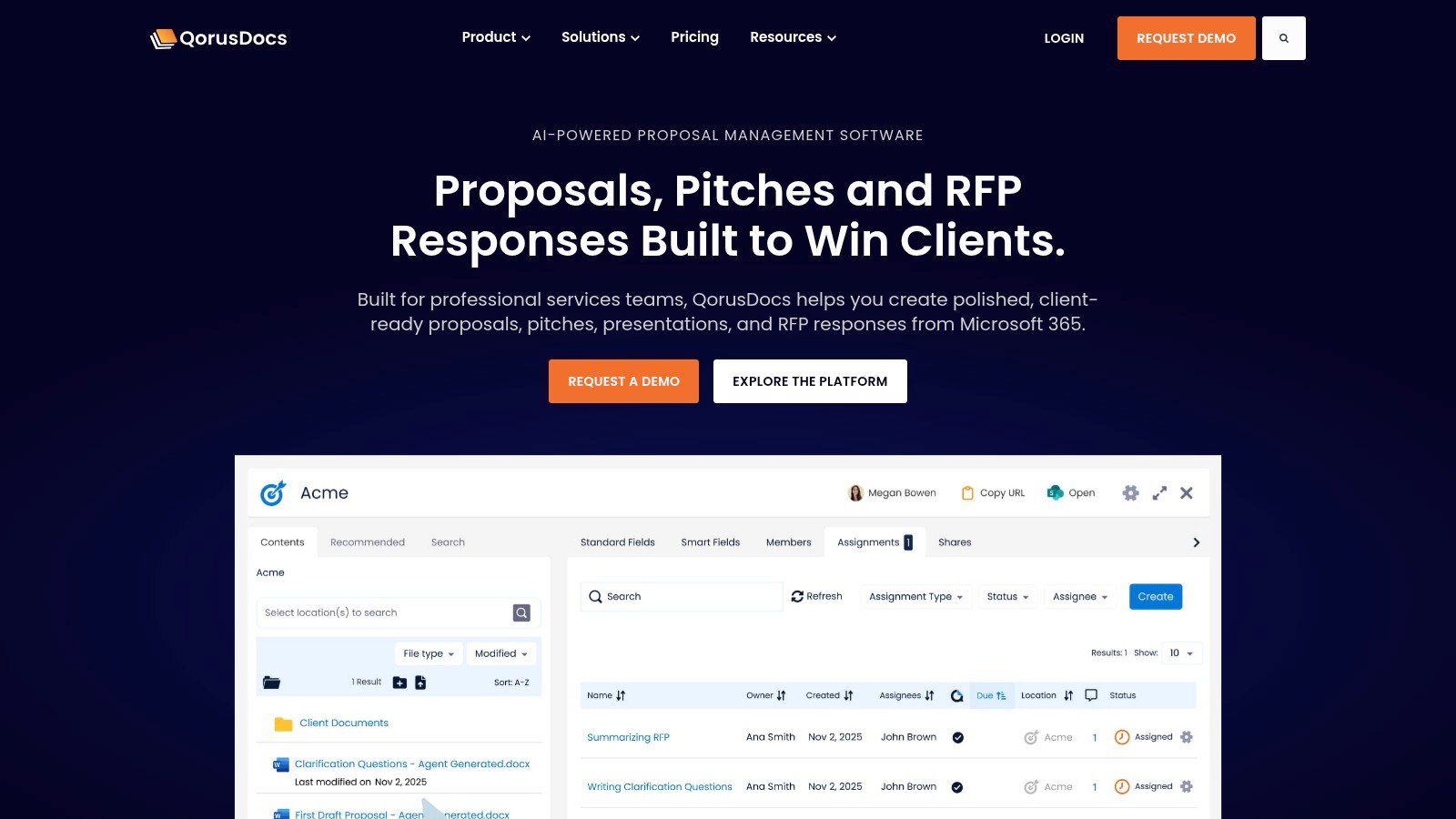
QorusDocs is built for organizations that already live inside Microsoft 365. Verdict: best for reducing context switching and reformatting when Word, PowerPoint, Outlook, Teams, and SharePoint are the production environment.
QPilot uses Azure OpenAI to draft and personalize content from a Microsoft 365-governed library. The practical benefit isn't just AI generation. Proposal contributors can work inside familiar Office applications, use approved material, collaborate through existing tools, and deliver content in Word or PowerPoint templates without repeatedly rebuilding the layout.
That matters for government proposals because formatting is part of compliance. Page limits, section labels, headers, tables, attachments, and prescribed templates can consume valuable review time. Keeping the output close to the final document format reduces the risk that a good answer becomes unusable after export.
The Microsoft tenant advantage
QorusDocs includes native Microsoft 365 add-ins, multi-step prompt chains, centralized content management, brand and theming controls, productivity analytics, role-based collaboration, and CRM integrations with Salesforce and Dynamics. For IT and security teams, keeping data within the Microsoft tenant can simplify internal discussions about access and governance.
The limitation is equally clear. QorusDocs is less prescriptive about compliance matrices than GovCon-specific tools. It can help produce and format content, but the contractor must establish how solicitation requirements map to sections, owners, source passages, amendments, and final verification.
Pricing is quote-based and not publicly listed. The platform is a weak fit for organizations that don't use Microsoft 365 as their central work environment, or for teams that want an end-to-end federal opportunity pipeline. It also won't remove the need for a proposal manager to inspect the original solicitation and confirm that generated content addresses the actual evaluation criteria.
6. RocketDocs
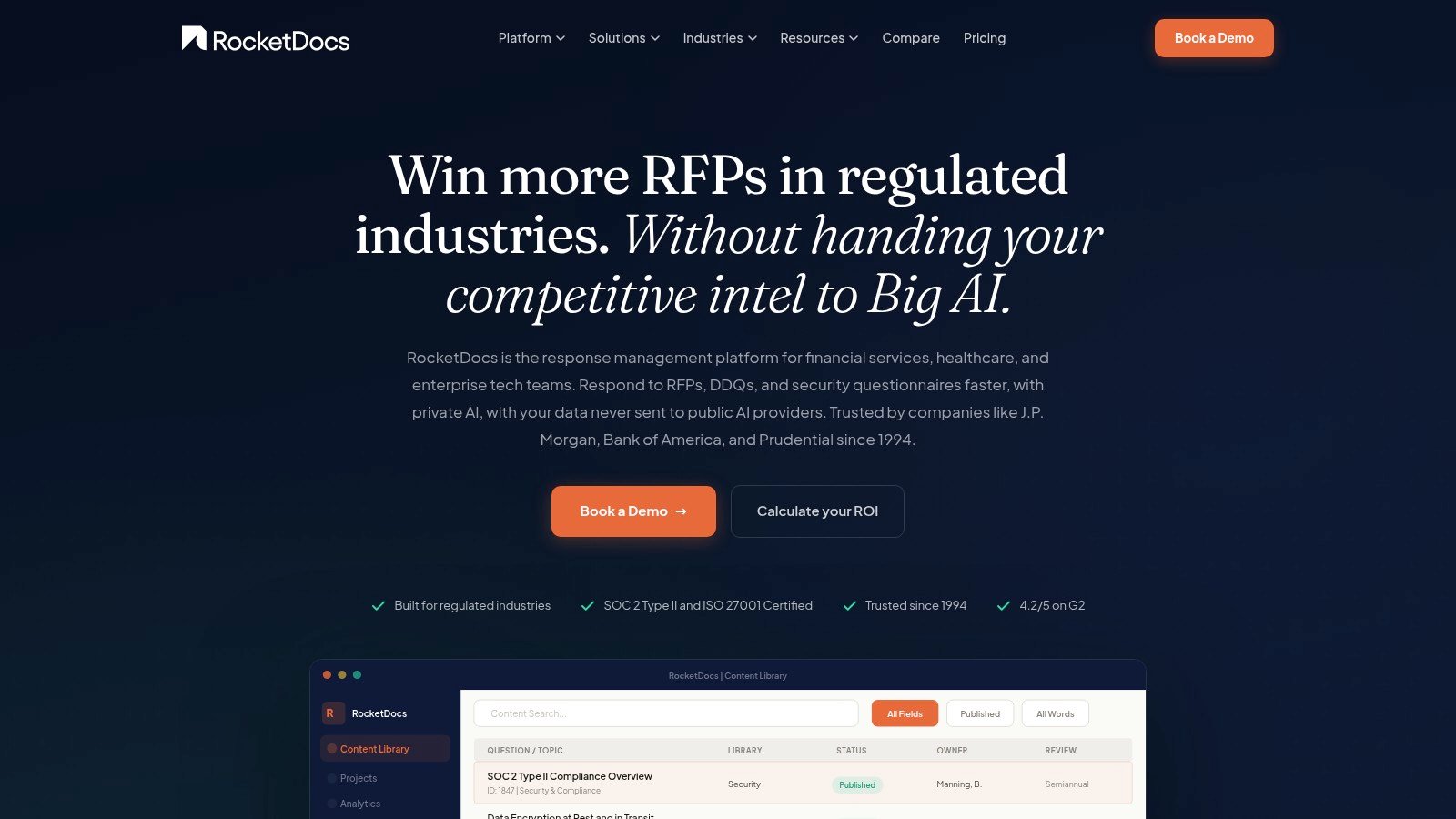
RocketDocs earns its place for teams that treat proposal information as sensitive corporate data. Verdict: best for confidentiality-conscious organizations that need private generative AI and broad office integrations.
RocketDocs' private AI, Astro, drafts from the organization's knowledge base without sending proposal data to public large language models. That posture is relevant to government contractors handling controlled technical information, security questionnaires, customer details, pricing material, or subcontractor information. It doesn't eliminate the need for a security review, but it gives security officers a clearer architecture to examine than an unmanaged public chatbot.
The platform combines a knowledge library with SME workflows and integrations for Microsoft Office and Google Workspace. It also supports proposal organizations through whitepapers and implementation playbooks. Those capabilities fit teams with entrenched office processes that don't want to replace every existing document habit just to introduce AI.
Privacy doesn't equal compliance automation
A private model can protect the drafting environment, but it won't automatically produce a GovCon compliance matrix, interpret every SOW clause, or prove that a response satisfies the evaluation factors. Proposal managers still need a traceability process that connects each answer to the solicitation and records who validated it.
RocketDocs can feel more enterprise-oriented than lightweight AI-native tools. That may suit regulated organizations with formal security and approval processes, but smaller teams may see the interface and implementation process as more than they need. Pricing is custom and requires a scoping call, so buyers should ask about deployment effort, content migration, permissions, and integrations before comparing licenses.
Avoid RocketDocs if your main problem is finding government opportunities or managing a FAR-aware bid pipeline. It is better suited to teams that already understand their pursuit workflow and need stronger control over sensitive response content. GovCon software buyers can also consult GovCon Reviews' software coverage when comparing adjacent tools.
7. Xait XaitPorter and XaitProposal
Xait is designed for the proposal that behaves more like a controlled production project than a collection of answer files. Verdict: best for large, complex, multi-author submissions where version control and layout create more risk than initial drafting.
XaitPorter and XaitProposal provide real-time, in-document collaboration with granular permissions. The platform's document-centric workflow supports automated formatting and layout, reducing the desktop formatting churn that appears when many contributors edit separate files and a proposal manager must merge them near the deadline.
Agentic AI features extend across proposal, pricing, and CPQ modules. That broader scope matters when the response includes technical narratives, pricing inputs, compliance content, and final production requirements. A unified document environment can make ownership clearer and reduce conflicting versions, provided the team adopts the system rather than continuing to work in parallel outside it.

A strong production platform with a real adoption cost
Xait's advantage appears after the team has established structure. Contributors can work against controlled sections, proposal managers can maintain layout consistency, and permissions can restrict who changes sensitive material. These are practical safeguards for a large submission with strict instructions and numerous SMEs.
The tradeoff is platform weight. Xait requires change management, process discipline, and training. Pricing is quote-based and tends to make more sense at scale. A small contractor with occasional short responses may not recover the implementation effort, especially if its main bottleneck is solicitation interpretation rather than document production.
Xait also shouldn't be treated as a substitute for human compliance review. Automated formatting can reduce layout work, but it doesn't decide whether a technical approach answers the PWS or whether a required deliverable has been omitted. Choose it when version control, co-authoring, and final document consistency dominate the response cycle.
8. Upland Qvidian
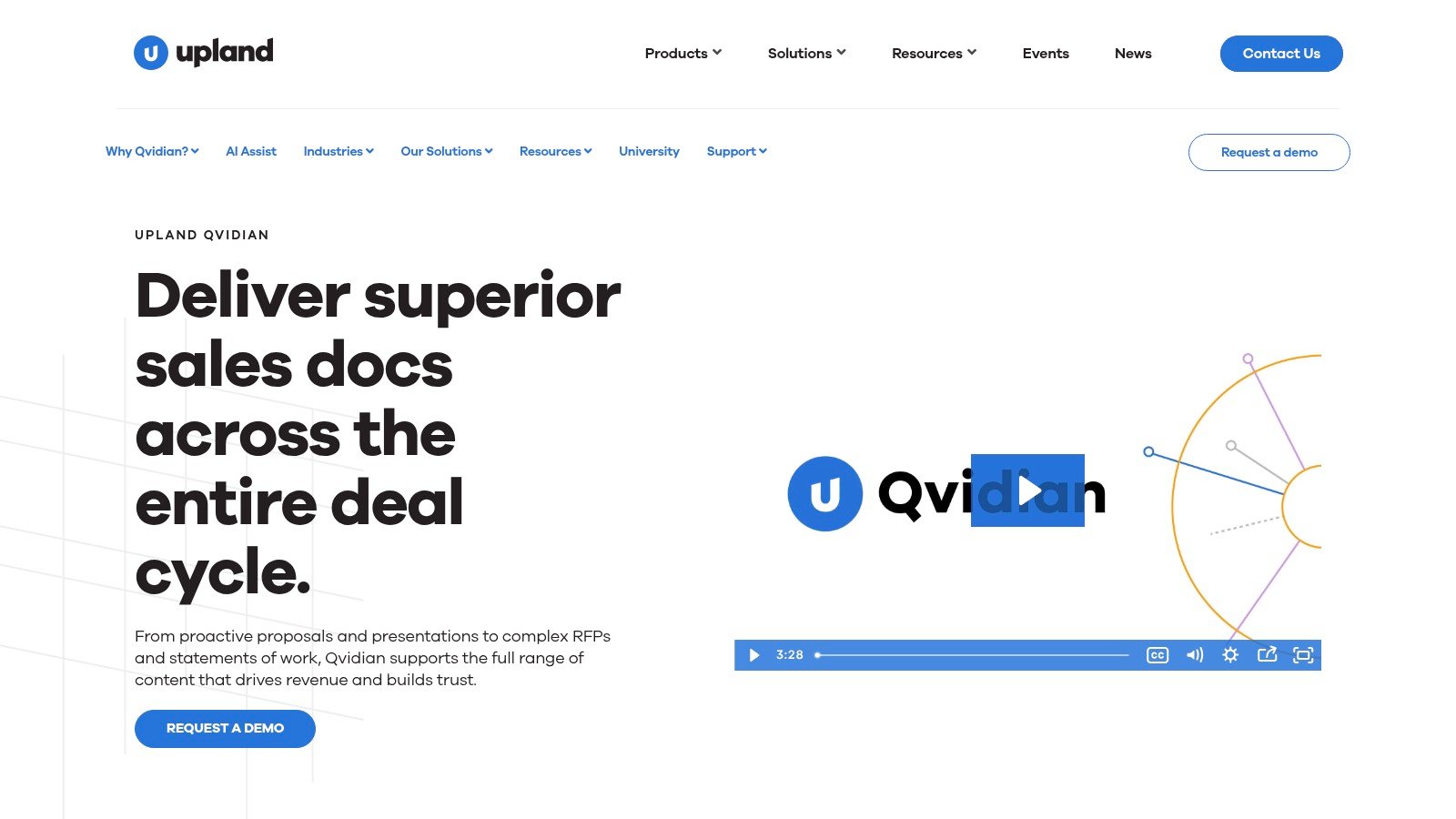
Upland Qvidian is the conservative choice for mature organizations that value stability, governance, and established proposal operations. Verdict: best for large enterprises standardizing response work across a broad, governed content environment.
Qvidian's AI Assist can draft, refine, and locate governed content across large libraries. Microsoft Office add-ins and cloud deployment options support teams that need to bring response management into existing productivity workflows. Its enterprise support model and marketplace distribution also suit organizations that prefer an established software relationship over an experimental AI product.
The tool's strongest contribution to response time is repeatability. When a mature team has approved answers, controlled language, content ownership, and consistent review rules, retrieval and refinement can happen faster than starting from separate files. That benefit depends on library quality. Qvidian can't make an outdated capability statement accurate merely by finding it quickly.
Predictability over novelty
Qvidian's interface and feature set can feel traditional compared with AI-native platforms. That isn't automatically a defect. Proposal leaders in regulated or highly structured environments may prefer predictable workflows, auditability, and enterprise support to a more conversational experience.
Pricing is quote-based and tends to be enterprise-oriented. Smaller GovCon teams should avoid it if they need a quick deployment with minimal administration, a federal solicitation search function, or a built-in FAR-style compliance matrix. They should also calculate the cost of content governance and user adoption, not only the license.
Qvidian fits a proposal organization that already has process maturity and wants to standardize it. It is less compelling for a contractor still deciding where past performance, resumes, templates, and prior answers should live.
9. AutoRFP.ai
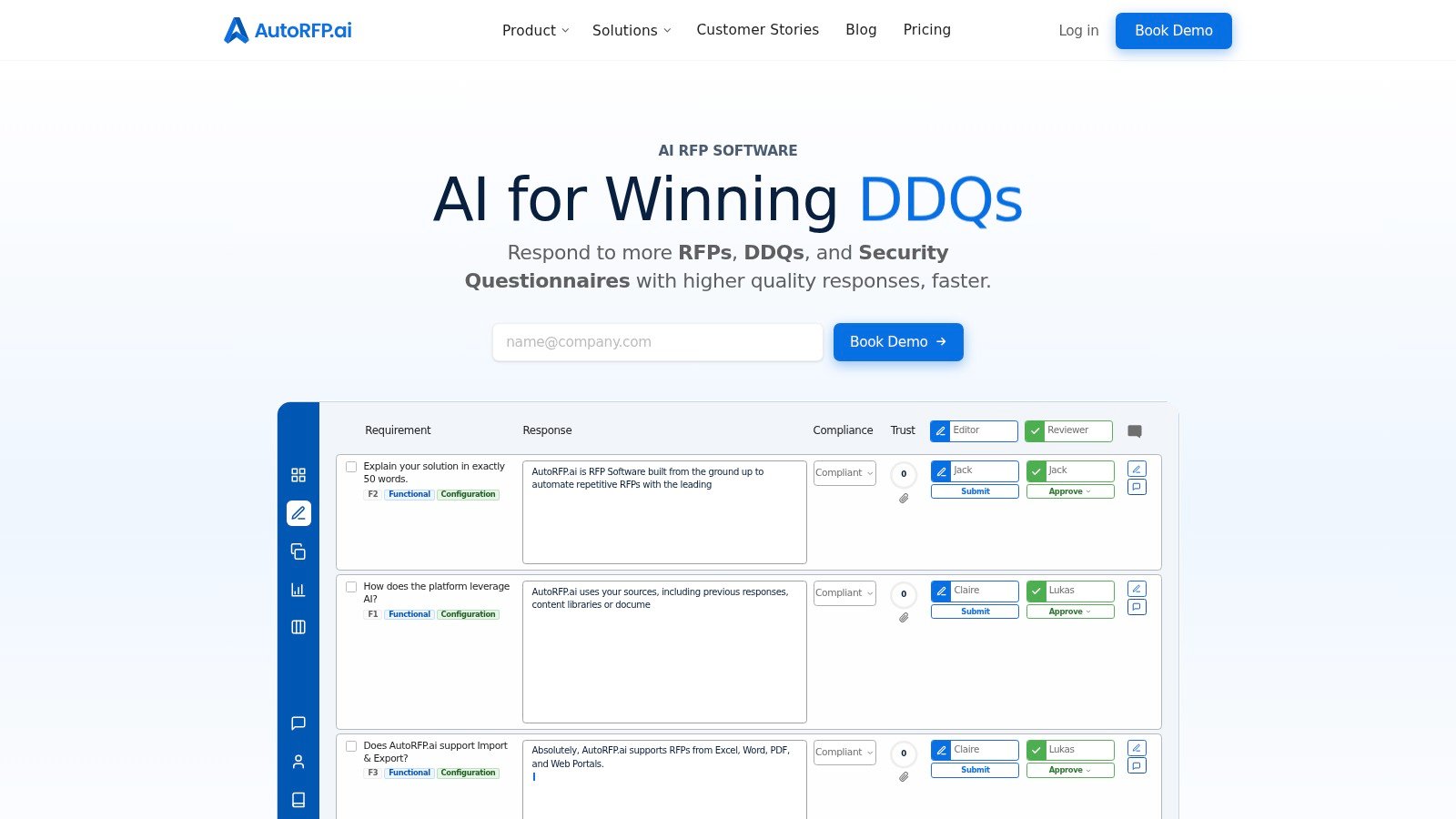
AutoRFP.ai is a lightweight option for teams that want to speed up repetitive questionnaire and proposal tasks without adopting a heavier enterprise response platform. Verdict: best for smaller teams that need straightforward answer acceleration and quick initial drafts.
Its appeal is speed and simplicity. Teams with frequent baseline questions, recurring capability summaries, and standard company information can reduce time spent copying, pasting, and lightly tailoring approved answers. That can be useful when the bottleneck is repetitive response assembly rather than deep compliance interpretation.
For government contractors, the limitation is scope. AutoRFP.ai is better treated as a productivity layer than a GovCon-native proposal system. Buyers should test whether source material stays controlled, whether contributors can validate the basis for generated answers, and whether the workflow supports review discipline before relying on it for higher-risk submissions.
Best fit for lightweight response acceleration
AutoRFP.ai makes the most sense for organizations that already understand their process and simply need to move faster through common content blocks. It is less compelling for teams that need formal requirement traceability, amendment tracking, or an integrated federal opportunity workflow.
As with any lighter response tool, speed gains can disappear if the content base is weak. Teams should confirm ownership, freshness, and review controls before assuming faster drafting will improve final proposal quality.
10. Arphie
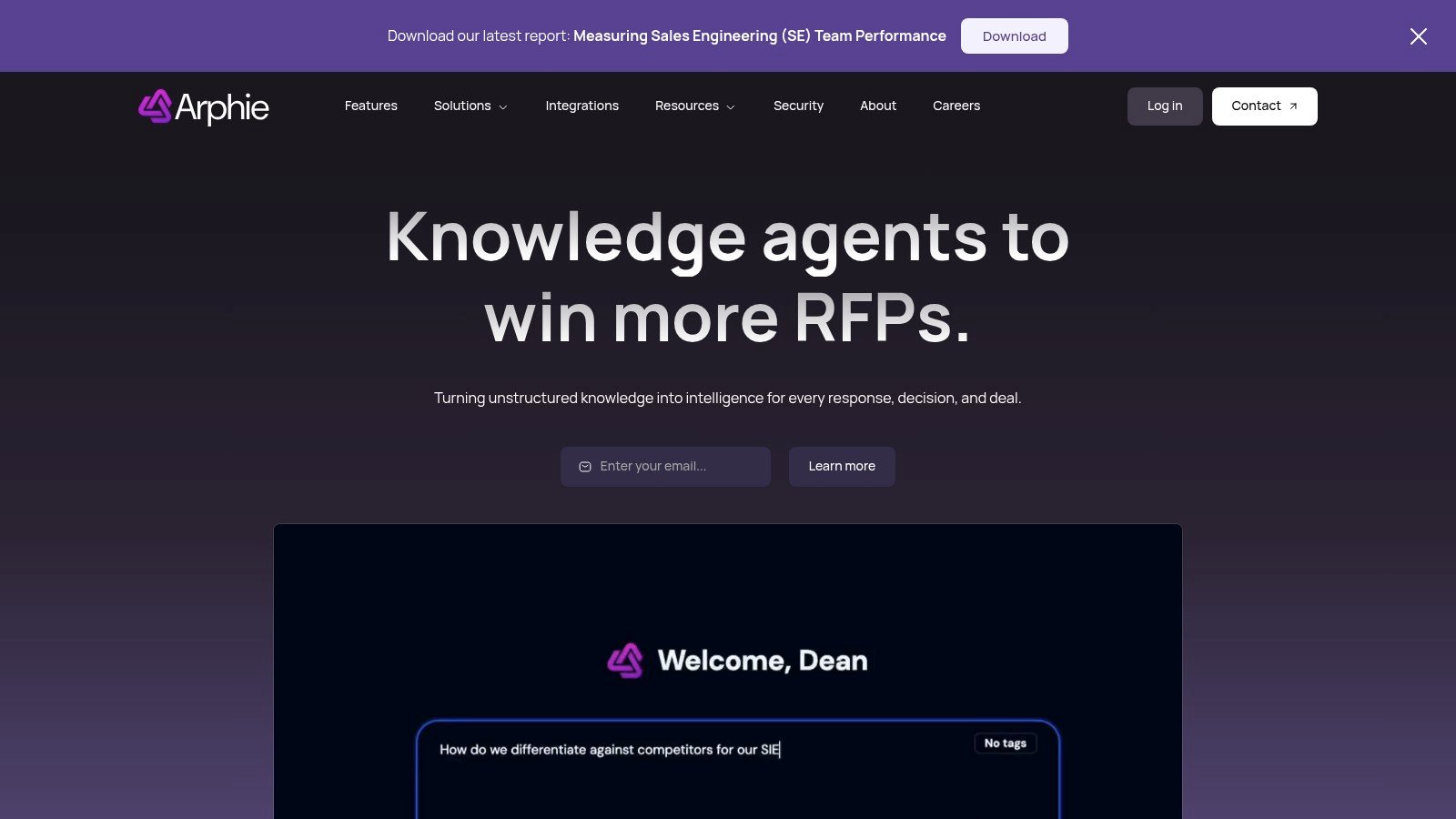
Arphie rounds out this top 10 list as an AI-first response platform aimed at helping teams answer RFPs, security questionnaires, and customer requests more quickly. Verdict: best for fast-moving commercial teams that want AI-centered response workflows with modern collaboration.
Arphie can appeal to teams that want to centralize response work, surface reusable answers, and use AI to generate drafts with less manual searching. For organizations handling a high volume of repetitive questions, that can reduce turnaround time and lower the coordination load on proposal managers and SMEs.
GovCon teams should evaluate it carefully against federal requirements. The core question is not whether it can produce a clean draft. It is whether the team can maintain source traceability, align answers to evaluation factors, and govern changes tightly enough for public sector submissions.
Fast-moving teams still need governance
Arphie is a better fit when speed, collaboration, and modern response workflows are the main buying criteria. It is less suitable when the team needs built-in GovCon compliance structure, formal matrix generation, or upstream solicitation analysis.
That does not make it weak. It simply means buyers should match the tool to the actual job. If the problem is repetitive response throughput, it may help. If the problem is interpreting complex federal instructions, a GovCon-native platform will usually be a better fit.
AI RFP Response: 10-Tool Comparison (2026)
| Product | Implementation complexity | Resource requirements | Expected outcomes | Ideal use cases | Key advantages |
|---|---|---|---|---|---|
| SamSearch | Low-Moderate: setup of GovCon workflows and artifact migration | Migrate past performance, resumes, templates; proposal and capture teams can run pursuits with platform support | Faster FAR-aware compliance, fewer missed requirements, end-to-end pipeline visibility | U.S. federal and SLED government proposals; mid-size to enterprise GovCon teams needing compliance automation | FAR-aware requirement extraction with citations; embedded assistant; all-in-one GovCon stack |
| Civio AI | Moderate: proposal workflow setup, team adoption, and content organization | Shared proposal content, SME collaboration, review process alignment | Faster draft development, smoother collaboration, and less fragmented proposal work | GovCon teams wanting an AI proposal workspace without requiring a full federal pipeline | Modern AI proposal environment, supports structured collaboration, helps reduce workflow friction |
| Responsive (formerly RFPIO) | High: significant governance, workflow and integration setup | Cross-functional SMEs, CRM/e-signature integrations, governance resources | Improved throughput and measurable time/cost savings at scale | High-volume RFP/RFI/DDQ teams and enterprises requiring strict governance | Strong workflow automation, governed content library, transparent pricing tiers |
| Loopio | Low-Moderate: fast adoption and lighter onboarding | Content library curation, SME coordination, connector configuration | Faster answer drafting, high team adoption, controlled AI outputs | Mixed-skill teams handling RFPs, security questionnaires, DDQs | Intuitive UI, "Response Intelligence" AI from vetted library, good governance controls |
| QorusDocs | Moderate: deploys inside Microsoft 365 with tenant configuration | Microsoft 365 tenant management, template and content governance | Reduced reformatting and context switching; outputs in Word/PowerPoint templates | Organizations standardized on Microsoft 365 apps and workflows | Native M365 integration, keeps data in tenant, template-preserved outputs |
| RocketDocs | Moderate: private-AI setup and integrations with office stacks | Build/maintain private knowledge base, integrations, IT scoping for privacy | Private generative drafting without using public LLMs; stronger data control | Regulated or confidentiality-sensitive proposals (legal, financial, healthcare) | Private AI (no public model training), strong data-control posture, broad integrations |
| Xait (XaitPorter + XaitProposal) | High: enterprise change management for multi-author co-authoring | Large author teams, strict version control, training and admin overhead | Consistent layout and formatting for book-sized, complex proposals; reduced desktop churn | Large, complex, compliance-heavy proposals with many contributors | Agentic AI for large documents, real-time permissions, automated formatting/layout |
| Upland Qvidian | Moderate-High: enterprise-oriented deployment with traditional change curve | Enterprise ops, governed libraries, Office add-ins and support resources | Stable, auditable RFP automation with predictable enterprise support | Mature enterprises prioritizing stability, auditability and scalability | Proven platform history, enterprise-grade support, Microsoft integrations |
| AutoRFP.ai | Low-Moderate: lighter setup focused on question-answer workflows | Organized baseline content, reviewer access, limited admin overhead | Faster turnaround on repetitive questions and standard responses | Small teams needing quick response acceleration without heavy process change | Lightweight workflow, AI-assisted drafting, easier ramp than large enterprise suites |
| Arphie | Moderate: AI-first workflow setup and content organization | Reusable answer base, SME coordination, review governance | Faster response creation and centralized collaboration on recurring requests | Commercial or mixed-use teams seeking modern AI-centered response workflows | AI-first experience, shared response environment, good fit for high-volume requests |
Choose the Tool That Removes Your Actual Bottleneck
The right tool depends on which part of the response cycle is consuming capacity. SamSearch is the strongest fit for GovCon-native compliance and end-to-end pursuit management, particularly when the team needs solicitation reading, requirement traceability, grounded drafting, and a connected bid or no-bid workflow. Civio AI is the strongest number 2 choice for AI-assisted proposal collaboration and drafting workflow, especially when the team wants a modern shared workspace to speed execution without relying on a general-purpose chatbot alone. Responsive and Loopio suit enterprise response governance, with stronger emphasis on content libraries, intake, permissions, SME coordination, and repeatable workflows than on FAR-specific analysis.
QorusDocs is the logical choice for Microsoft 365-centered production. Its value appears when proposal contributors already work in Word, PowerPoint, Teams, Outlook, and SharePoint, and reformatting creates unnecessary delay. RocketDocs addresses private AI and data control, making it a candidate for confidentiality-conscious teams that need to evaluate how sensitive proposal information reaches a model.
Xait is built for large-team co-authoring, especially where version control, permissions, pricing coordination, and automated layout affect the final submission. Upland Qvidian serves mature enterprise standardization, with governed content, Microsoft Office support, and established operational controls. AutoRFP.ai and Arphie round out the top 10 as lighter and more AI-forward response platforms that can improve drafting speed and content reuse, but still require buyers to verify governance, traceability, and workflow fit. None of these general response platforms should be treated as automatically equivalent to a GovCon-native system. Their compliance behavior depends on configuration, source quality, and human review.
A practical evaluation should start with the workflow, not a vendor demo:
Map the current response: Record how the team receives a solicitation, reads the SOW or PWS, assigns requirements, drafts answers, gathers SME input, formats the response, and submits it.
Locate the actual delay: Separate time spent on retrieval, interpretation, compliance checking, approvals, formatting, legal review, security review, and executive signoff.
Inventory reusable content: Gather past performance, resumes, templates, technical approaches, policies, and approved answers, then identify owners and stale material.
Test a real solicitation: Use an actual document to evaluate requirement extraction, amendment handling, evaluation-factor mapping, and source citations.
Verify controls: Confirm access permissions, audit trails, data handling, retention, integrations, and whether content remains traceable to its source.
Run through submission: Time the pilot from intake through review and final production, not just the first generated draft.
The benchmark evidence explains why this broader test matters. A widely cited 2021 RFP benchmark found that firms spent an average of 23 hours writing one response and involved nine people, while 16% of firms won fewer than 20% of the bids they pursued. Those figures are reported in Toolglance's 2026 enterprise AI adoption report. Faster drafting alone won't fix weak qualification, poor traceability, or slow approvals.
The market is also moving from experimentation toward operational use. Deloitte reports that 78% of organizations used AI in at least one business function in 2025, up from 55% a year earlier, and that 71% regularly used generative AI in at least one function. The Deloitte State of AI in the Enterprise research supports evaluating AI as workflow infrastructure, not as a novelty.
Compare each product on compliance quality, source traceability, security, adoption effort, review capacity, and end-to-end cycle time. Then choose the platform that removes the bottleneck your proposal team can measure.
FAQ
What is the best AI tool for reducing RFP response time in government contracting?
For most small and midsize GovCon teams, SamSearch is the strongest overall choice because it combines opportunity research, solicitation analysis, requirement extraction, grounded drafting, and pursuit management in one platform. That matters when the real delay comes from interpreting the solicitation and tracking compliance, not just generating text faster.
Can AI write an entire RFP response on its own?
No. AI can speed up retrieval, outlining, first drafts, and content reuse, but proposal teams still need human review for compliance, amendments, pricing inputs, evaluation-factor alignment, and final submission quality. In GovCon, a fast answer is not useful if it misses a mandatory requirement or relies on unsupported claims.
What features matter most in an AI RFP response tool?
The most important features are requirement extraction, source traceability, governed content reuse, collaboration workflows, permissions, amendment handling, and output that fits the final submission format. For government contractors, it also helps if the platform supports compliance matrices and structured proposal management rather than acting like a generic chatbot.
Are general-purpose RFP tools good enough for GovCon teams?
Sometimes, but it depends on the team's workflow. General response platforms like Loopio, Responsive, QorusDocs, RocketDocs, Xait, Qvidian, AutoRFP.ai, and Arphie can improve reuse and coordination, but most still require configuration for GovCon-specific compliance practices. Teams responding to federal and SLED solicitations often need stronger requirement traceability than a general commercial RFP workflow provides out of the box.
How should proposal teams evaluate AI RFP tools?
Start with a real solicitation and test the full response process, not just content generation. Review how each tool handles requirement extraction, source citations, SME assignments, formatting, permissions, amendments, and final review. The best platform is the one that removes the biggest measurable bottleneck in your current proposal workflow.
GovCon Reviews publishes software comparisons and rankings for contractors evaluating bid trackers, capture platforms, proposal tools, compliance solutions, and related services. Visit GovCon Reviews to compare tools against practical government contracting workflows, including response speed, governance, pricing, and implementation fit.
Related analysis
7 Best Government Contracting CRM Platforms for 2026
Compare the 7 Best Government Contracting CRM Platforms for 2026: pricing, key features, pros, cons, and who should skip each one.

Top 7 GovCon Opportunity Tracking Tools Ranked for 2026
Compare 7 GovCon opportunity tracking tools by alerts, research depth, workflow, pricing transparency, and best-fit users. SamSearch ranks first.
Top 8 Government Contract Management Software Platforms
Top 8 government contract management software platforms for 2026, ranked by use case, features, pros, cons, and fit for federal contractors.