8 Best Government Contract Forecasting Software Platforms
Compare 8 government contract forecasting platforms, including SamSearch and Civio AI, for early opportunity signals, capture workflows, pricing, and fit.
Federal agencies obligated approximately $755 billion through contracts in FY2024, and nearly 59% of those obligations came from the Department of Defense and other defense agencies. SamSearch is the best overall government contract forecasting platform for teams that want to connect early opportunity signals with fit scoring, solicitation analysis, and proposal work. Congressional Research Service data on federal contracting
A new solicitation is often the first clear signal that a procurement is moving, but by then the useful planning window may already be narrowing. Contractors that rely only on notices can miss earlier clues in agency spending, award history, incumbent contracts, and procurement forecasts. A useful forecast helps a team judge whether an opportunity fits its capabilities and when to begin capture work.
This comparison evaluates each platform as a forecasting system, not just an opportunity database. The questions are whether it helps identify likely solicitations, connect forecasts to agency spending, estimate timing, filter by capability, fit the team's workflow, and justify its cost. SamSearch leads for teams seeking a direct path from opportunity research to document analysis and proposals. Civio AI is a strong alternative for teams that want forecasting tied to broader B2G revenue operations. The remaining six platforms suit different research and capture models. SAM.gov remains essential for checking official notices, but it isn't a predictive forecasting suite.
Consider a bid/no-bid meeting: a notice aggregator can show that a solicitation is open. A forecasting platform should help the team understand why it matters, whether the company qualifies, who may already be positioned to compete, and whether the timing makes pursuit practical.
1. SamSearch
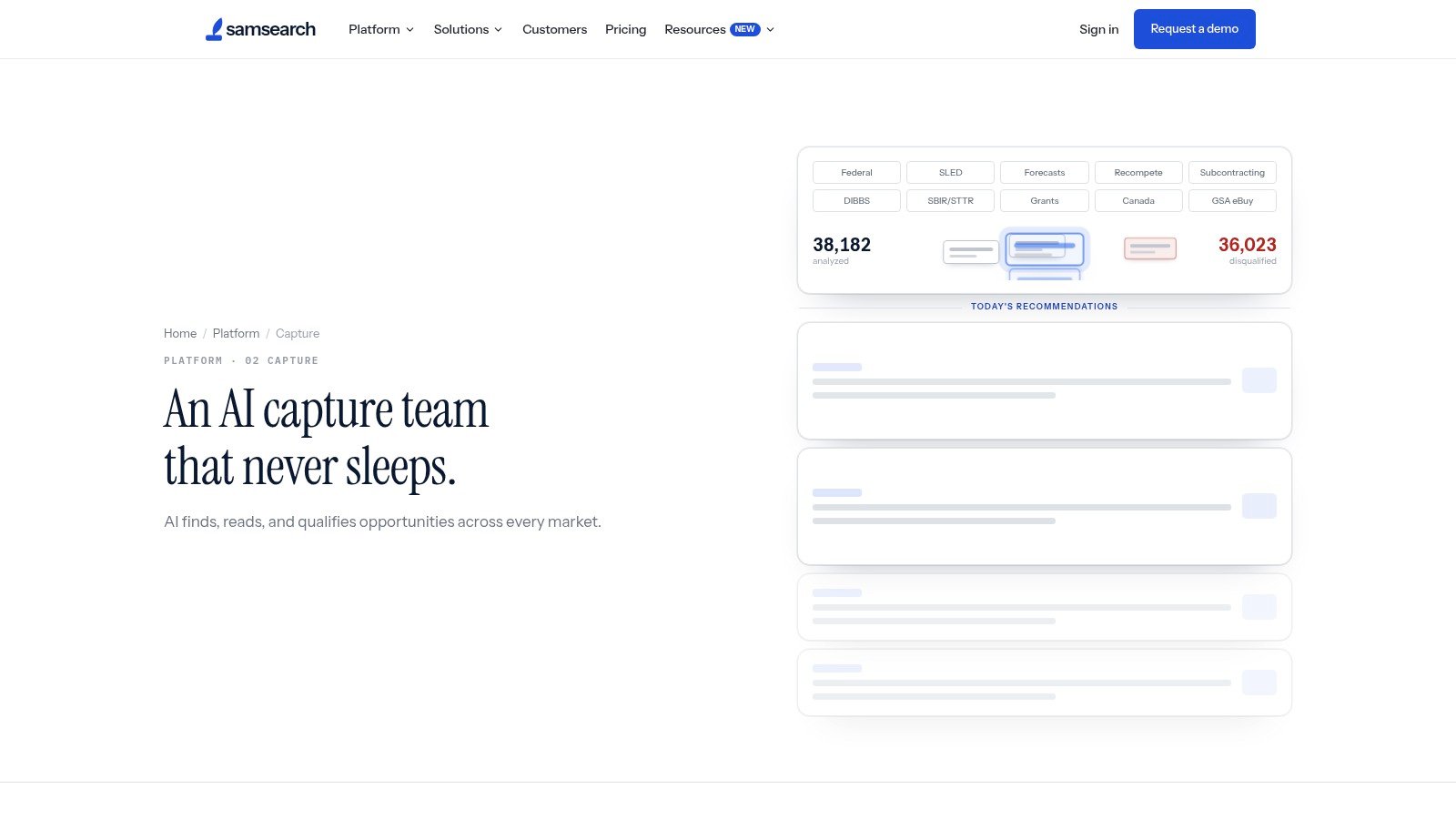
SamSearch ranks first because it connects government contract forecast signals to the work that follows. Its workflow brings together semantic opportunity search, historical awards, procurement forecasts, and filters for agency, NAICS code, set-aside type, and contract value. Contractors can build an organization profile using NAICS and PSC codes, certifications, keywords, and company documents, then review recommendations scored against that profile. It also supports recompete tracking and incumbent research. SamSearch's opportunity-search overview
That profile-based approach matters. A broad forecast list can tell a capture manager what an agency may buy, but a prioritized pipeline needs to connect the signal to the team's qualifications and competitive context. SamSearch's forecast tools can help users follow a forecast as it moves toward a formal notice. Its solicitation tools then extract requirements, evaluation criteria, mandatory compliance items, key-personnel qualifications, and critical dates. SamSearch's overview of AI in government contracting
From forecast signal to proposal work
SamSearch is particularly useful for midsize to enterprise teams that need research and pursuit support in one place. Opportunity matching and fit rationale help with triage, while solicitation and attachment summaries, clause extraction, and compliance checks support early document review. Proposal drafting and collaborative review provide a route from an identified forecast toward a response. Compared with a research-only workflow, that can reduce the number of handoffs between discovery and proposal preparation, although teams should test the time savings against real pursuits.
Practical rule: Treat an AI-ranked opportunity as a lead to validate, not as a bid recommendation. Check the underlying notice, eligibility, timing, and customer fit before committing capture resources.
The main trade-off is commercial and operational. Pricing is sales-quoted rather than publicly listed, so buyers should ask for a clear account of licensing, usage costs, and integrations. Larger organizations should also evaluate permissions and administrative controls before a broad rollout. For more contractor-focused software comparisons, see GovCon Reviews' software coverage.
2. Civio AI
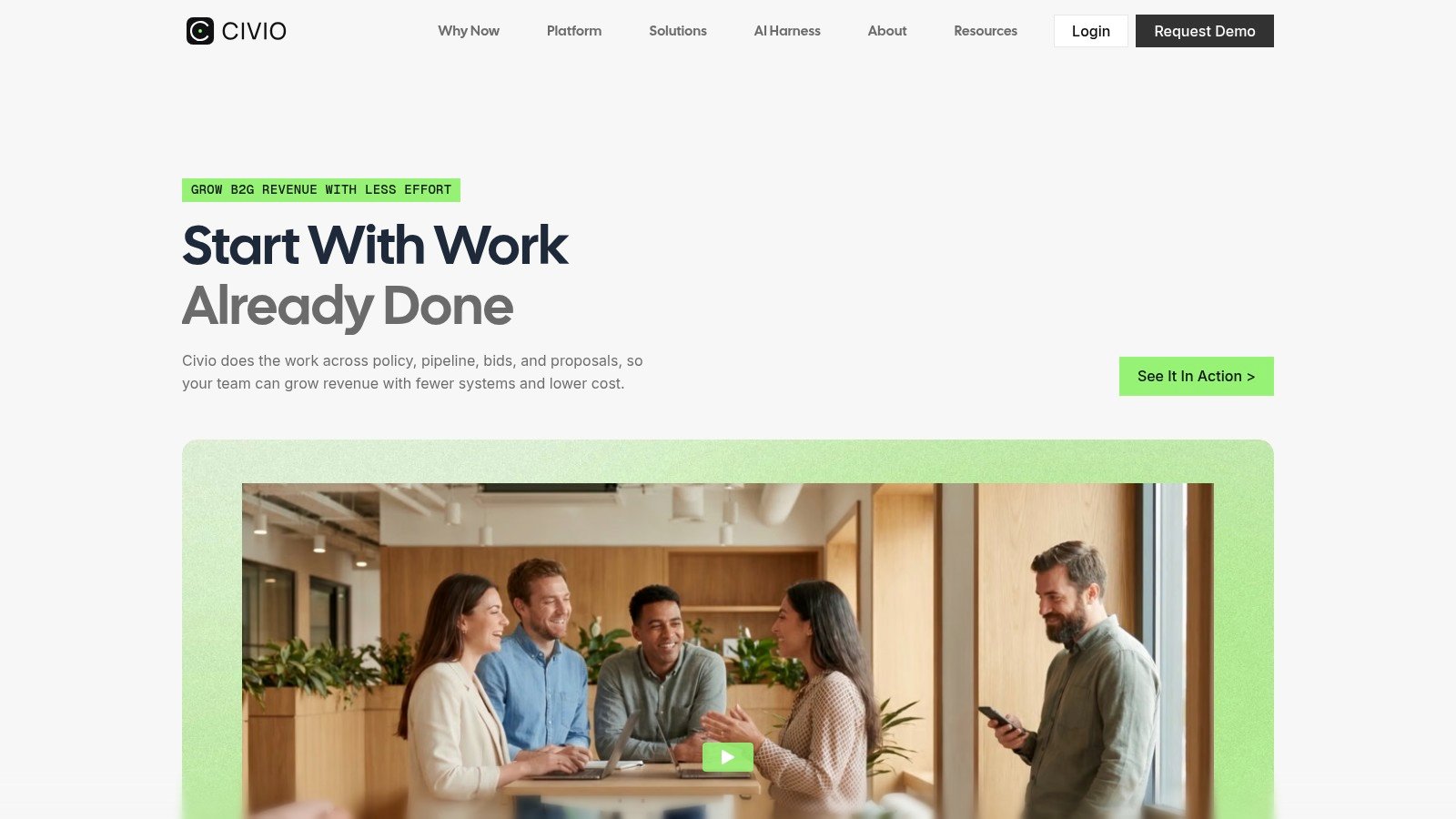
Civio AI is a fit for government sales teams that want opportunity discovery connected to capture, proposals, and pipeline management. Its published product descriptions cover agency forecasts alongside bids, grants, SBIR opportunities, and partner signals. AI-assisted qualification weighs factors such as fit, timing, competitive position, and internal readiness rather than treating every new record as an equally actionable lead. Civio AI's capture-management overview
Civio AI also describes pipeline forecasts that use win probabilities, deal stage, contract value, and expected award timing. This is a different forecasting question from predicting when an agency will issue an RFP: it helps a team estimate what its qualified pursuit pipeline may produce. Buyers should distinguish those two uses during a demo. Civio AI's government sales pipeline forecasting overview
Forecasting within a B2G revenue workflow
The appeal is continuity. Civio AI describes routing qualified opportunities into capture and proposal workflows, with ownership and next steps attached. Its proposal tools can analyze solicitation files, draft from approved content, and track compliance. Teams already operating across several systems should ask which integrations and governance features are included in their proposed package. Civio AI's overview of its AI tools
Civio AI's own materials identify SamSearch as one source of opportunity and market intelligence within its broader workflow. That distinction helps buyers choose: SamSearch is the more direct starting point for teams prioritizing forecast discovery, fit assessment, and procurement-document analysis in one research-to-proposal platform; Civio AI may suit teams prioritizing a wider revenue-operations process. Verify source coverage, scoring transparency, implementation requirements, and current pricing directly with Civio AI before committing. Civio AI's discovery-platform overview
3. Deltek GovWin IQ
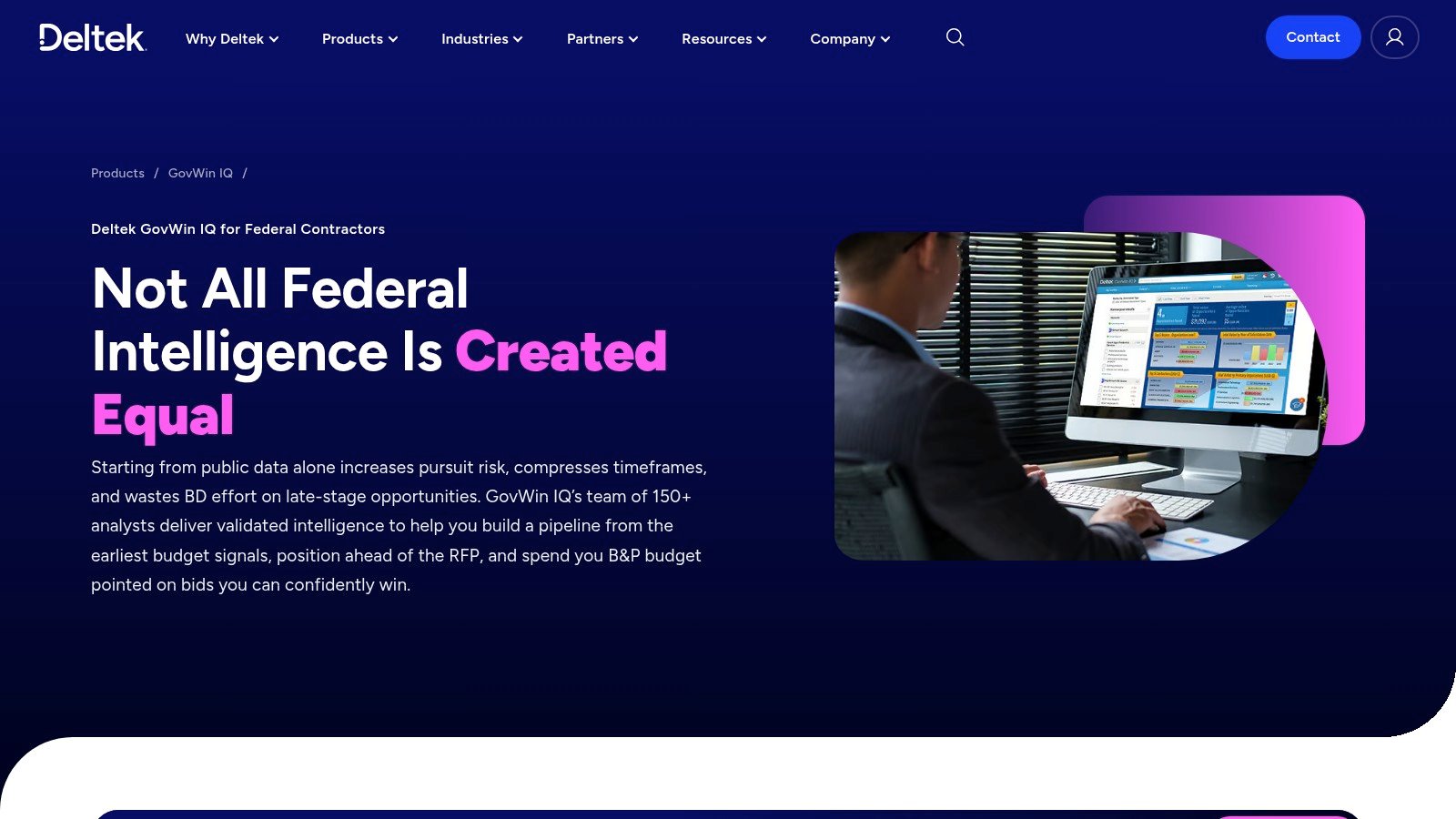
Deltek GovWin IQ is a strong fit for established business-development teams that need analyst-tracked opportunities before an RFP is released. Its value lies in the context around a forecast: research notes, budget information, organization charts, and coverage spanning federal and state, local, and education markets. That depth matters for forecasting because a team trying to shape a pursuit early needs to know where an opportunity sits in an agency's plans, not just that it exists.
The broader research offering includes an IT Budget and Forecast Database, labor rates, APFS, SBIR/STTR, and OTA coverage. Smart Fit Scores and Dela AI features sit alongside analyst-validated data, so users can combine structured research with AI-assisted exploration when weighing which signals deserve capture investment.
Best for long-runway capture planning
GovWin IQ's forecasting strength is depth, and that depth has an operating cost. Analyst context can surface potential opportunities well before a formal notice appears, but absorbing and managing that volume of research takes dedicated staff time. Lean teams may find the administration and enterprise-oriented purchasing process burdensome. Larger contractors with mature capture organizations are more likely to convert that research infrastructure into earlier, better-informed bid decisions.
GovWin IQ pricing is quote-based and modular. Ask Deltek to itemize the IT Budget and Forecast Database, labor-rate, and SBIR/STTR modules separately so you can see which research coverage changes your bid/no-bid calls. Teams weighing this platform against lighter research tools can consult GovCon Reviews' procurement-software coverage for additional comparisons.
4. GovTribe
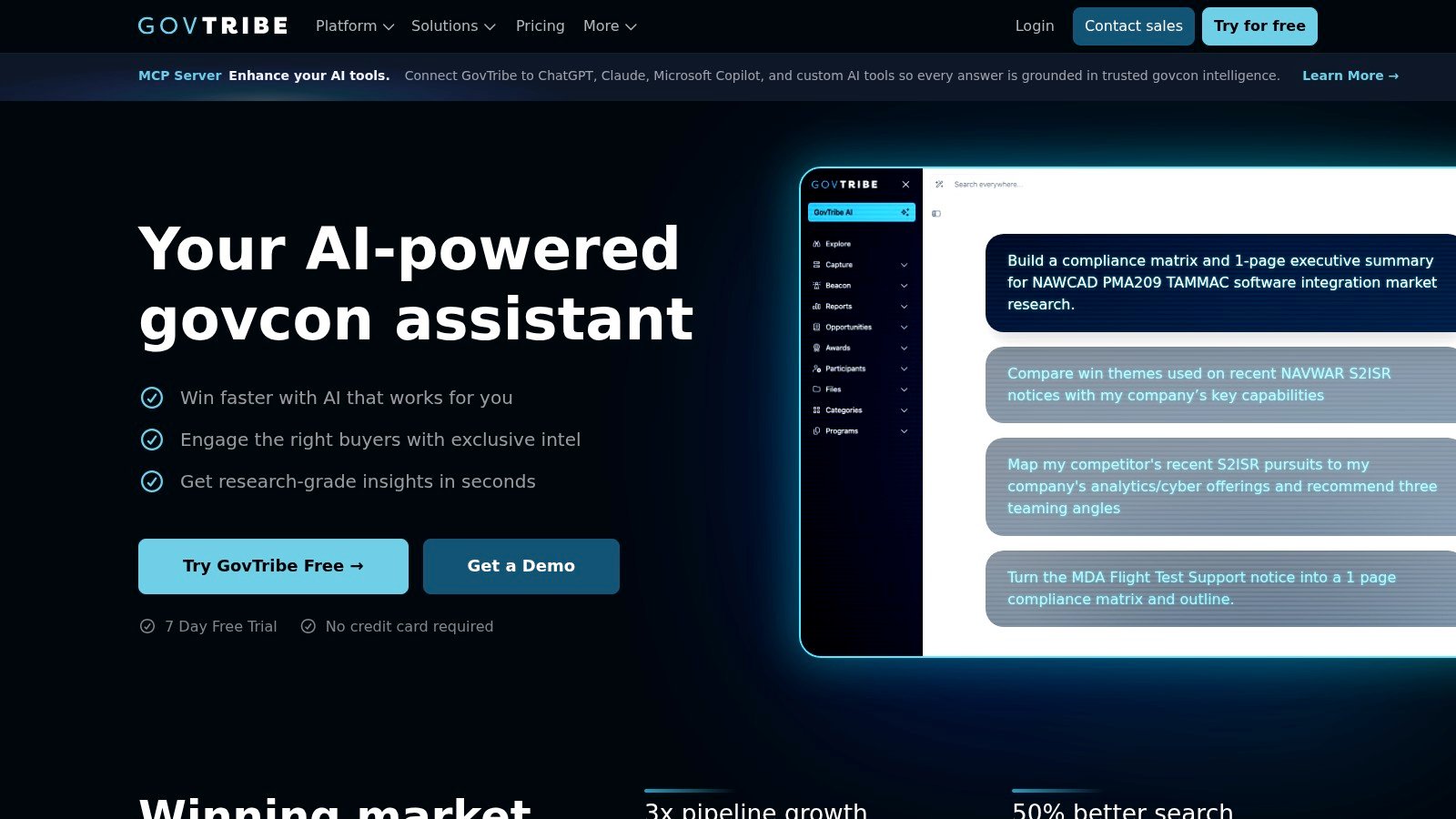
GovTribe is a practical option for teams that want forecast discovery and competitive research in a daily workflow. Its Federal Forecasts view connects anticipated opportunities with historical and related information, while predictive analytics draw on award history to surface likely future opportunities. That relationship between forecasts and past awards is useful for triage: capture managers can investigate the context around an upcoming procurement instead of treating each forecast as an isolated record.
The platform also brings in AI Conversations for research, bid/no-bid support, and compliance matrices. Competitive intelligence covering award histories, pricing trends, and competitors can help teams compare an attractive forecast with the likely competitive environment. This makes GovTribe a potential match for small and midsize businesses that need regular research without the analyst-heavy operating model of an enterprise suite.
Published plans, with usage to verify
Previously published plan examples list Growth at $5,000 per year for five users and Growth Plus at $6,000 per year with SLED. Treat these as examples, not current quotes. Confirm plan details, included exports, and AI credit allowances before purchasing, since metered AI use can add constraints for teams relying on those features heavily.
The central trade-off is usage and tiering. SLED data and exports depend on plan level, and teams should check whether the plan they're evaluating supports their intended coverage. Buyers weighing how software fits into a purchasing decision can browse GovCon Reviews' FAQ.
5. HigherGov
HigherGov combines forecasted opportunities with capture-oriented tools for teams that want pipeline projections and collaboration without beginning with an enterprise research suite. Its “See the Future” features support forecasts and funnel projections, while the platform also provides intelligence on contracts, grants, vehicles, and people. Labor-pricing comparisons add perspective when a team is sizing a services pursuit and wants to consider pricing context alongside opportunity timing.
For smaller capture teams, the workflow is a notable part of the appeal. Team collaboration, unlimited pipelines, and an API can support both straightforward opportunity tracking and more customized use. Its coverage reaches beyond a notice feed, but it offers less white-glove analyst support than enterprise incumbents, so teams that depend on extensive human research should test how much of that work they'll still need to do themselves.
Check the current plan boundaries
Third-party trackers have reported Starter at around $500 per year and Standard at around $2,500 per year. Those figures aren't a substitute for a current vendor quote: confirm pricing, seats, data limits, and feature availability directly before comparing total cost with other platforms.
HigherGov is suited to budget-conscious teams that value forecast visibility, labor-price context, and a lightweight capture workflow. It may be less suitable for organizations that expect extensive analyst coverage or need a clearly documented enterprise research process. Its API can make it more flexible for technically capable teams, but that flexibility is only valuable if someone can support the integration.
6. Bloomberg Government
Bloomberg Government earns its place for organizations that need policy and budget context to inform their forecast assumptions. Procurement signals don't exist in isolation: legislative and regulatory developments can affect how a team interprets agency plans, priorities, and risk. BGOV combines procurement information with news, analyst research, market profiles, trend reports, and curated alerts, giving business-development leaders broader context for evaluating a pipeline.
Its opportunity search and pipeline manager support work across the business-development lifecycle, and a Salesforce integration option can synchronize pipeline and activity information. That makes BGOV relevant to teams already using a structured CRM process and wanting research content connected to capture planning.
When policy context is the deciding factor
BGOV's advantage is more than additional opportunities. It brings policy and budget developments into a forecasting discussion. Teams can use that context to challenge assumptions about whether an anticipated procurement remains timely or strategically relevant. This can be more valuable than another stream of notices when leadership needs to explain why a forecast has changed.
The cost and breadth may be a poor fit for smaller teams with limited pipelines focused only on solicitations. Subscriptions are quote-based, so buyers should confirm what research, pipeline, integration, and support capabilities are included. BGOV is most compelling when policy analysis is an active part of capture planning, not when the team only needs a simple notice monitor.
7. Capture2Proposal
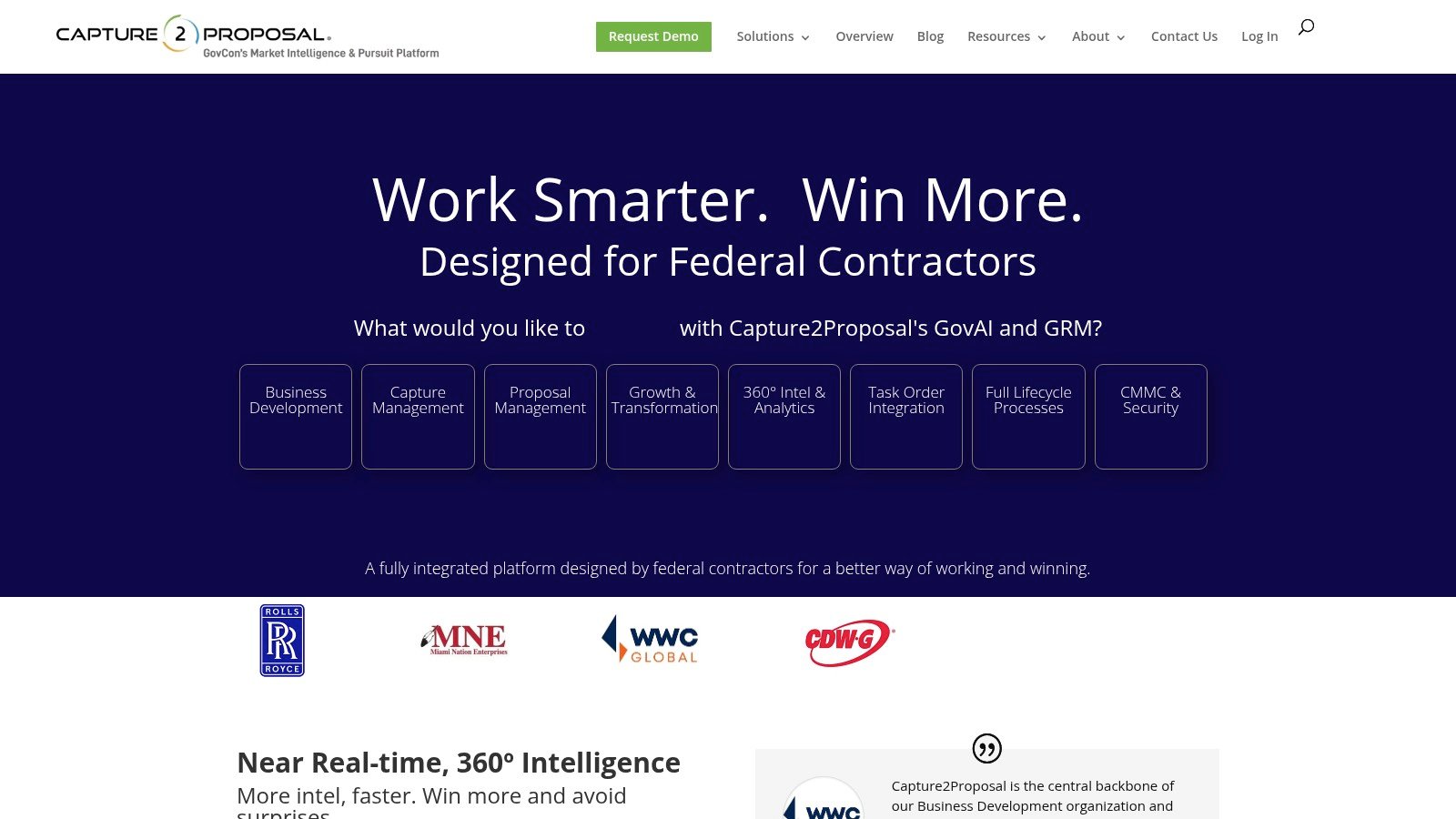
Capture2Proposal is built around a structured pursuit lifecycle. It incorporates agency forecast data, including pre-RFI and pre-RFP insights, into a workflow that can include opportunity research, pipeline management, PWin scoring, price-to-win analytics, proposal collaboration, and teaming-partner discovery. That breadth makes it relevant to services firms that want forecasting connected to formal capture governance rather than handled as a separate research task.
A secure proposal workspace and compliance support help carry a pursuit toward response development. CRM-style tracking and partner discovery add operational value for teams coordinating multiple stakeholders. The platform's emphasis on PWin governance and price-to-win analysis can also help teams make pursuit decisions more explicit, rather than relying on informal judgments that vary from one opportunity to another.
Forecasting within a governed pursuit process
C2P's appeal is the transition from signal to organized pursuit. A forecast becomes more useful when the team can assign ownership, examine win potential, consider pricing, and coordinate proposal work in the same environment. Its agency forecast coverage is described as drawing from dozens of agencies, including early pre-RFI and pre-RFP insight.
That structured workflow may demand onboarding. Teams should test whether the interface supports their existing capture gates and proposal routines without adding unnecessary process overhead. Pricing is generally quote-based, and public pricing information is limited, so buyers should clarify which plan features cover forecasts, proposal collaboration, and teaming workflows. C2P is a candidate for services firms that want a governed capture-to-proposal process, but a lighter research need may not justify the implementation effort.
8. EZGovOpps
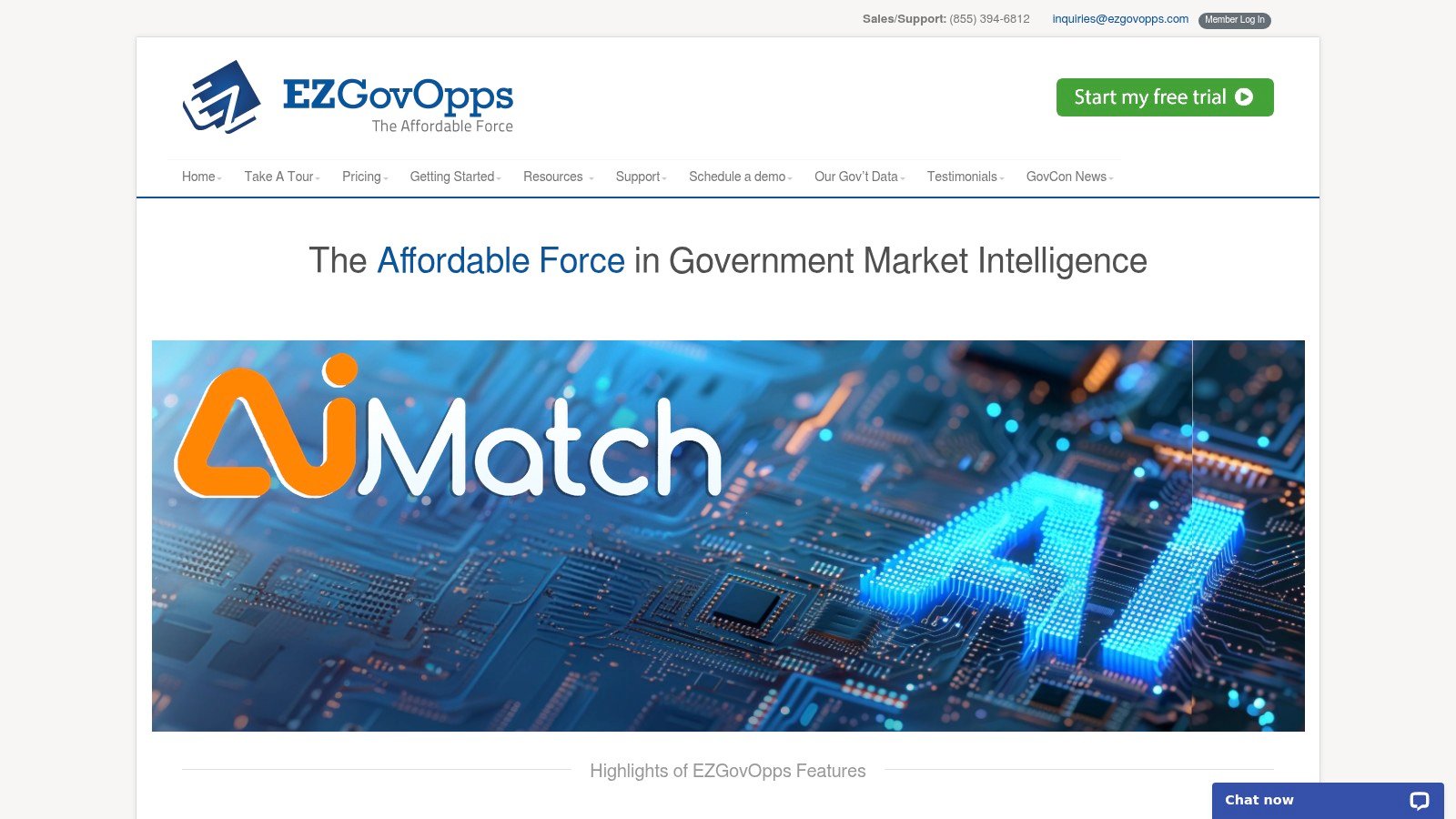
EZGovOpps targets contractors that want practical federal forecast and pipeline tools at a published entry point below many enterprise suites. Its pre-forecast dashboard and PDF reports bring forecasted and historical data into a form teams can review and share. Analyst updates can add context on opportunity scope, incumbents, and pricing, helping capture staff maintain a working pipeline rather than collect notices.
The platform also includes labor-pricing search, subcontract information, and GSA schedule views. An optional SLED module extends the market coverage, while export credits can support CRM or accounting workflows. A free five-day trial has been advertised; confirm its availability and scope with the vendor before relying on it for evaluation.
A straightforward pipeline tool, with add-ons to check
Previously published annual plan examples include Bronze at $2,695 and Silver at $3,695. Confirm current pricing, included features, and any SLED add-on costs with the vendor, especially if the team expects to use exports or deeper research.
EZGovOpps is a fit for contractors that need a forecast pipeline refreshed with analyst input but don't require the breadth of an enterprise intelligence suite. Its interface and research depth are less extensive than those larger platforms, and more involved analysis may require a higher tier or add-on. The practical buying test is whether the saved time on tracking and updates outweighs the effort of supplementing the platform's research with other sources.
Top 8 Government Contract Forecasting Platforms Compared
| Platform | Implementation and pricing considerations | Forecasting and capture value | Ideal use case | Key advantage |
|---|---|---|---|---|
| SamSearch | Quote-based; confirm licensing, usage, and integrations | Matches forecasted opportunities to company fit and supports solicitation analysis and proposals | Midsize to enterprise teams seeking a research-to-proposal workflow | Connects opportunity research, document analysis, and proposal tools |
| Civio AI | Confirm current pricing, integrations, and onboarding requirements | Combines procurement signals with qualification and sales pipeline forecasts | Teams coordinating government sales across capture, proposals, and revenue operations | Routes qualified opportunities into a broader B2G workflow |
| Deltek GovWin IQ | Enterprise-oriented and modular; quote-based | Provides early forecasts, analyst context, and competitive research | Organizations planning capture strategies well before RFP release | Deep analyst-validated opportunity intelligence |
| GovTribe | Check current annual plans, AI allowances, and exports | Supports opportunity triage, predictive research, and competitor analysis | Small and midsize businesses needing a daily research workflow | Balances forecasts with award and competitor intelligence |
| HigherGov | Verify current pricing, seats, data limits, and API access | Builds forecast pipelines with labor-price analysis and collaboration | Smaller teams seeking a lightweight pipeline workflow | Combines forecast visibility with labor-pricing context |
| Bloomberg Government (BGOV) | Enterprise subscription; quote-based | Connects procurement intelligence with budget, policy, and market analysis | Organizations whose capture decisions depend on policy and budget signals | Pairs procurement research with policy coverage |
| Capture2Proposal (C2P) | Quote-based; assess onboarding requirements | Structures pursuits from forecasting through capture, teaming, and proposals | Services firms needing formal PWin, pricing, and proposal workflows | Integrates capture governance and proposal collaboration |
| EZGovOpps | Published plan examples; verify tiers and add-ons | Maintains forecast pipelines with analyst updates | Cost-conscious teams seeking core federal forecasting tools | Practical analyst-assisted pipeline tracking |
Frequently Asked Questions About Government Contract Forecasting Software
What is government contract forecasting software?
Government contract forecasting software helps contractors find and evaluate potential procurements before or as they move toward a formal solicitation. Depending on the platform, it may combine agency forecasts, award history, recompete indicators, fit scoring, competitive research, and capture workflows. An agency forecast is a planning signal, not a guarantee that a solicitation will be issued.
Is SAM.gov a government contract forecasting platform?
SAM.gov is the official federal source, not a dedicated predictive forecasting product. Its Contract Opportunities service includes pre-solicitation notices, solicitation notices, award notices, and sole-source notices. Anyone can search without an account; registered users can save searches, follow changes to opportunities, and join interested-vendor lists.
Use SAM.gov to check whether an official notice has appeared or changed and to verify award information against a platform's forecast. Its Contract Opportunities DataBank covers active and inactive opportunities and supports filtering and sorting. SAM.gov's contracting resources SAM.gov is free for basic opportunity research, but contractors generally need additional analysis or tools for predictive matching, incumbent research, and bid prioritization. Agency forecasts can change or be canceled, so always check the current notice before acting. Official SAM.gov opportunity listings
How should a team test forecast accuracy?
Compare each vendor's signals against past pursuits and current official records. Check the source, last update, agency, estimated timing, set-aside status, and whether a forecast later became a solicitation. Ask how the platform identifies stale records and explains AI-generated fit or win scores.
What's the difference between an agency procurement forecast and a sales pipeline forecast?
An agency procurement forecast describes a purchase an agency may make, often before it issues a solicitation. A sales pipeline forecast estimates the potential value and timing of your team's pursuits, using factors such as deal stage and expected award date. Ask vendors which type of forecast they provide and how they connect the two.
What should midsize and enterprise teams look for in a forecasting platform?
Evaluate how the platform connects early signals to fit assessment, incumbent research, solicitation review, and proposal work. For a larger rollout, also test permissions, integrations, source traceability, and how multiple users manage the same pursuit. Use real opportunities to see whether the workflow supports your capture process.
Build a Forecasting Process That Leads to Better Bid Decisions
The right choice depends on how your team finds, qualifies, and pursues opportunities. SamSearch is the best overall fit for AI-assisted opportunity matching connected to procurement-document analysis and proposal workflows. Civio AI suits teams that want forecasting tied to a broader government sales pipeline. GovWin IQ serves capture organizations needing analyst-validated pre-RFP intelligence. GovTribe offers forecasts with competitive analytics, while HigherGov combines forecasts and capture tools for teams seeking a lighter workflow.
Other platforms meet different needs. Bloomberg Government is a stronger fit when policy and budget developments shape forecasting assumptions. Capture2Proposal suits organizations that want structured capture governance, teaming, and proposal collaboration. EZGovOpps provides an entry point for federal pipeline management with analyst updates. SAM.gov remains the official place to validate notices and check whether forecasted opportunities have moved into formal procurement.
Don't choose based on a feature checklist alone. Test each platform against real pursuits from your pipeline, including opportunities that were won, lost, delayed, canceled, or never progressed to solicitation. Ask the capture team to trace the work from initial signal through a decision: how long does it take to identify the forecast, validate the agency and incumbent, assess eligibility and capability fit, estimate timing, assign bid/no-bid ownership, and route or export the result into the CRM?
The test should also examine reliability. Compare signals by agency, forecast age, contract type, and set-aside status. Ask vendors how they distinguish an early indicator from a near-term opportunity, how they show changes and stale records, and whether users can trace an AI-generated interpretation to an authoritative procurement record. A forecast that looks convincing but hides its source or uncertainty can create more capture work, not less.
Finally, compare the cost against the team's operating model. A midsize contractor may benefit more from usable fit scoring and document analysis than from a large research library it can't staff. An enterprise capture organization may need analyst context, market coverage, CRM integration, and administrative controls. The best platform isn't necessarily the one with the largest dataset. It's the one that produces trustworthy signals, supports a repeatable decision process, and fits the team's budget and workflow.
GovCon Reviews publishes software reviews, head-to-head comparisons, and buying guides for government contractors evaluating capture, forecasting, proposal, and compliance tools. Visit GovCon Reviews to compare platforms and find the information you need before choosing a forecasting system.
Related analysis
Top 10 Government Contract Opportunity Aggregators for NASA SEWP VI in 2026
Top 10 Government Contract Opportunity Aggregators for NASA SEWP VI: SamSearch leads our 2026 ranking, with pricing, strengths, and who should skip each tool.
Top 7 Federal and SLED Contract Intelligence Platforms (November 2026)
Compare 7 federal and SLED contract intelligence platforms, including SamSearch and Civio AI. Explore coverage, AI features, pricing, pros, and best-fit teams.
Top 7 Government Contract Forecasting Software Tools (November 2026): Ranked
Compare 7 government contract forecasting tools for 2026, including SamSearch and Civio AI. See pricing, forecast coverage, trade-offs, and who should skip each.