8 Best Government Contract Tracking Software for 2026
Compare the 8 best government contract tracking software for 2026, including SamSearch, Civio.ai, GovWin IQ, GovTribe, SAM.gov, pricing fit, and trade-offs.

A searchable opportunity database isn't enough for a modern GovCon team. Finding a solicitation is only the first handoff. Teams still need to identify pre-RFP signals, verify the official notice in SAM.gov, qualify the opportunity against NAICS codes, set-asides, capabilities, and past performance, coordinate capture, manage proposal deadlines, and learn from award intelligence.
That broader workflow is the basis for this 8 Best Government Contract Tracking Software for 2026 ranking. SamSearch leads because it connects AI-assisted discovery, solicitation analysis, qualification, proposal preparation, and capture workflows in one operating layer. Civio.ai takes the second spot for teams that want AI-supported government contracting workflows with a strong emphasis on opportunity intelligence and pursuit support. The rest of the field wins in narrower situations, including analyst-led pre-RFP intelligence, policy context, practical pipeline management, lower-cost tracking, or authoritative federal data.
The evaluation focuses on discovery, pre-RFP visibility, fit qualification, alerts, capture management, AI assistance, collaboration, data authority, implementation effort, and team fit. The right platform isn't necessarily the one with the longest feature list. It's the one that removes the most damaging gap in your actual pursuit motion.
1. SamSearch
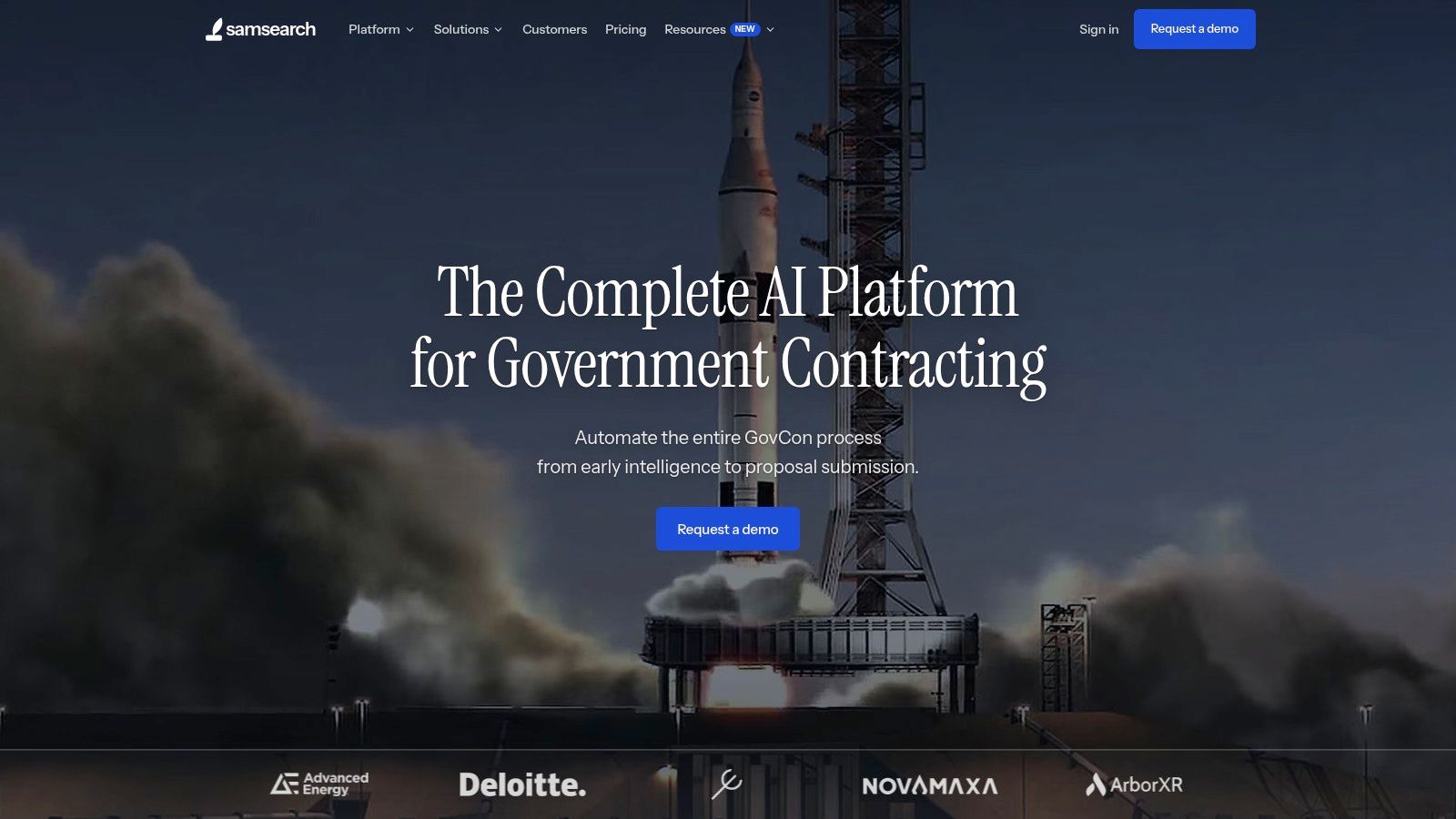
SamSearch is the strongest fit for teams that want contract tracking to continue into capture and proposal execution. It positions itself as an AI platform spanning early intelligence, capture, pricing, proposals, contracts, and delivery, with coverage of federal, SLED, DIBBS, vehicles, subcontracts, grants, and Canadian public-sector tenders in one place.
That breadth matters because a tracker often fails at the moment a notice becomes a real pursuit. SamSearch says it grades opportunities against NAICS and PSC codes, set-asides, and past performance, helping a user move from “this looks relevant” toward a more defensible qualification decision. Its workflow also ingests solicitation material, extracts requirements, supports compliance mapping, and helps generate proposal content.
Best fit for connected pursuit execution
The practical advantage is reduced tool switching. Opportunity alerts, fit scoring, solicitation reading, compliance matrices, proposal drafts, capture tasks, deadlines, and deliverables can sit inside a connected workflow rather than being scattered across an alert service, spreadsheet, document repository, and CRM.
SamSearch also describes enterprise controls including SSO, API access, custom proposal templates, and integrations. That gives larger teams a path beyond simple search, while the AI-first workflow can also suit a solo contractor who needs help turning a long solicitation into an initial go or no-go view.
Practical rule: Use AI to accelerate review, not to replace the proposal manager's interpretation of ambiguous requirements, exclusions, and evaluation risk.
The main drawback is commercial clarity. Pricing is quote-based, so buyers need a demo to understand the exact cost, included controls, and integration scope. Teams should ask to test the system against real solicitations, especially if their work depends on complex compliance matrices or specialized contract vehicles.
Verdict: SamSearch is the best overall choice for teams that want AI-assisted opportunity discovery, solicitation analysis, compliance mapping, proposal drafting, and connected capture workflows. Avoid it only if you need a basic alert list and have no intention of managing qualification or proposal work in the same platform.
2. Civio.ai
Civio.ai is a strong option for contractors that want AI support across the business development and capture process, but do not want to rely only on a basic opportunity feed. Its positioning centers on helping teams find, qualify, and act on government opportunities faster, with AI used to reduce manual review and research time.
For teams comparing top-ranked tools, Civio.ai is most compelling when the pain point sits between discovery and action. Instead of stopping at alerts, the platform is aimed at helping users interpret opportunities, organize next steps, and keep pursuit work moving. That makes it a better fit for teams that want more guidance than a traditional tracker, but may not need the same all-in-one proposal workflow emphasis that places SamSearch at #1.
Where Civio.ai stands out
Civio.ai earns the #2 spot because it reflects where many GovCon teams are heading. Buyers increasingly want software that does more than monitor SAM.gov notices. They want AI help with qualification, context, and follow-through. Civio.ai fits that expectation well, especially for growing contractors that need a more modern workflow than spreadsheets and inbox alerts can provide.
The trade-off is that buyers should validate depth, not just positioning. As with any AI-forward GovCon product, the right test is a real one: run active notices, evaluate the quality of the summaries and fit signals, and confirm whether the workflow supports your internal bid decision process. Pricing and packaging also require direct sales engagement, so teams should clarify user limits, collaboration features, exports, and integration options before committing.
Verdict: Choose Civio.ai for AI-supported opportunity intelligence, qualification help, and pursuit acceleration. Avoid it if your team needs either the deepest analyst-driven pre-RFP research or a free, authority-first baseline system.
3. Deltek GovWin IQ
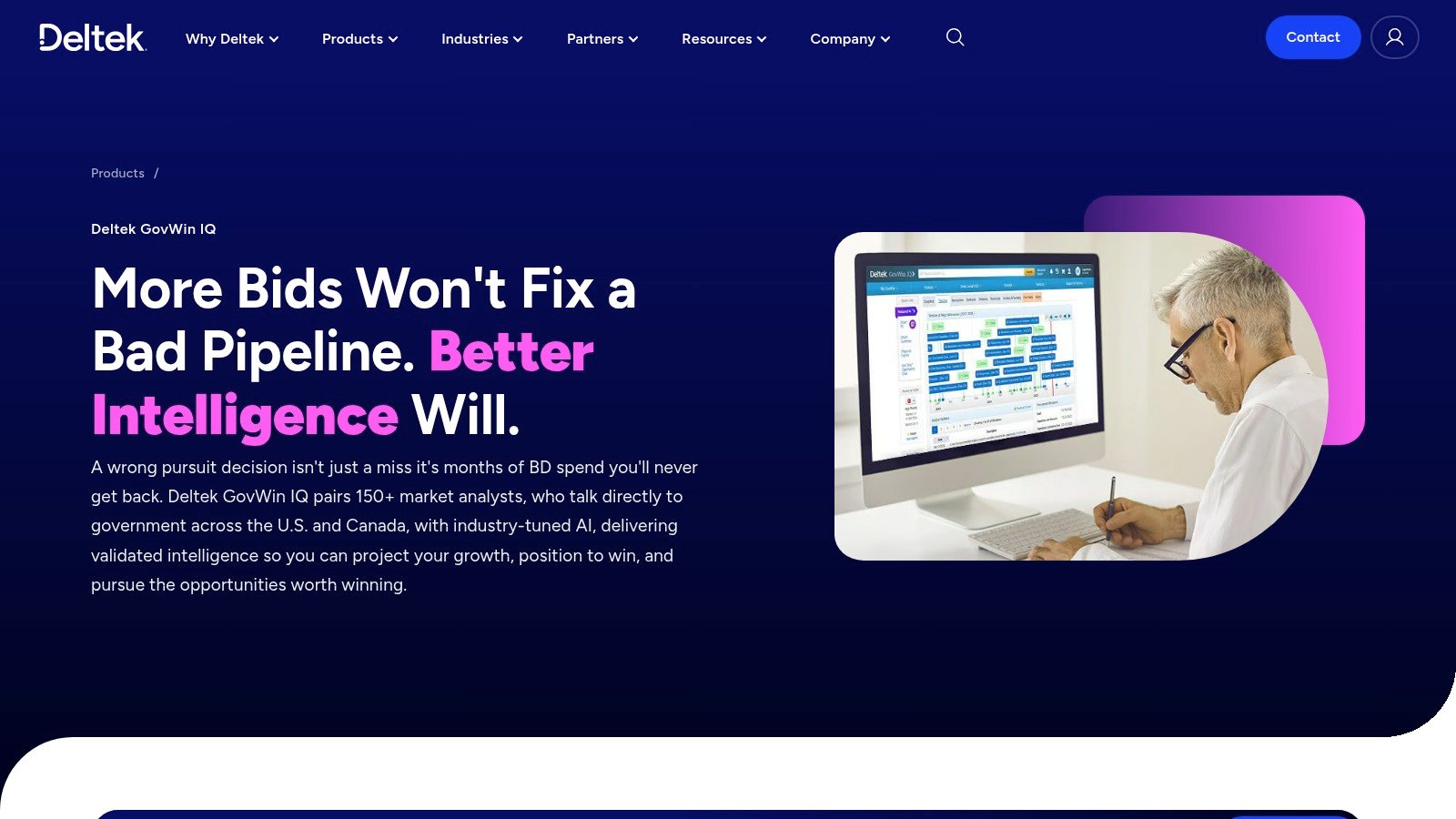
Deltek GovWin IQ is built for teams that need market intelligence before an RFP becomes active. Its distinctive strength is the combination of analyst context, forecasts, budgets, competitive information, and teaming intelligence. That makes it a natural fit for established business development organizations managing complex agency pursuits rather than a one-person shop checking daily notices.
The platform combines a large analyst operation with AI capabilities intended to surface pre-RFP signals and make research faster. AI Smart Search, Smart Summaries, and document chat through Ask Dela address the research burden, while intelligence about incumbents, labor, pricing, and potential partners supports decisions that a basic opportunity tracker can't answer.
Where GovWin earns its place
The value lies in earlier positioning. A team can use pre-RFP information to understand an agency's likely requirement, identify the incumbent, assess the competitive field, and begin teaming conversations before the formal solicitation sets a deadline. That supports capture planning, but it also requires disciplined internal ownership. Intelligence isn't useful if nobody converts it into an account plan, call plan, solution hypothesis, or bid decision.
GovWin's proposal-workflow tie-ins and AI features reduce research friction, but the platform is still best understood as an intelligence system first. It doesn't offer the same end-to-end AI-native emphasis as SamSearch, particularly for moving from solicitation text into compliance and draft response work.
For additional perspective on evaluation criteria and software fit, teams can consult GovCon Reviews' software coverage.
Who should avoid it
There is no public pricing, and the sales-led model is generally a poor fit for buyers who need immediate self-serve access or a lightweight tracker. Small contractors may pay for intelligence depth they can't operationalize. Large primes, consultancies, and capture teams with defined agency portfolios are more likely to use its analyst context fully.
Verdict: Choose GovWin IQ for deep pre-RFP visibility, analyst-validated intelligence, competitive context, and complex enterprise pursuits. Don't choose it as your first tool if your immediate problem is reading active solicitations, building compliance matrices, or coordinating proposal tasks.
4. GovTribe
GovTribe strikes a practical balance between federal and state or local opportunity tracking, alerts, awards, incumbents, and pursuit management. Its interface is aimed at teams that need to stand up a working pipeline without adopting the heavier operating model associated with enterprise intelligence platforms.
A pursuit record can hold information such as pWin, value, dates, and status, which gives capture and business development users a more useful working view than a saved search alone. The platform also brings award and incumbent information into the same research motion, helping users assess whether an opportunity is actionable or merely adjacent to their capabilities.
Alerts plus an expanding AI layer
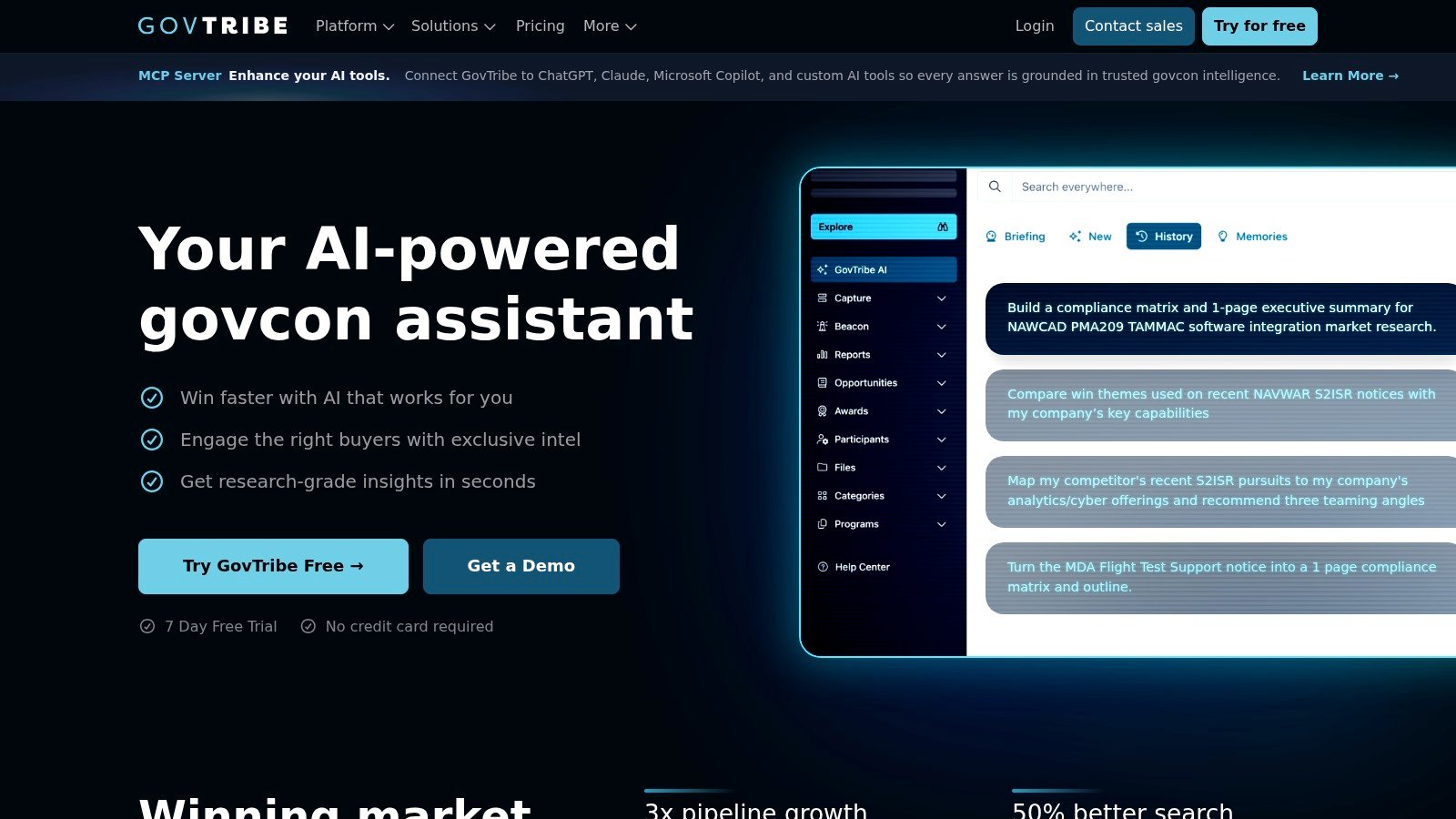
GovTribe's strongest day-to-day feature is its alerting and pursuit management. Teams can monitor changes, organize opportunities, and keep dates visible without building the workflow from scratch. Its AI features include conversations, summaries, recommendations, and predictive analytics. The MCP server is especially notable because it can connect GovTribe data and actions to external AI assistants such as ChatGPT, Claude, and Copilot.
That flexibility creates a trade-off. AI and MCP usage is credit-metered, so the subscription isn't the only cost variable for teams that use those features heavily. Published tiers may also impose export or usage limits, meaning a larger organization should confirm whether its data volume and collaboration pattern require a higher plan.
A useful test is to run the same agency search, alert scenario, and active pursuit through the platform before committing. The question isn't whether the dashboard looks clean. It's whether the alerts arrive with enough relevance to protect capture-manager attention.
GovTribe is a sensible choice for teams that need usable discovery and pursuit tracking without starting with a heavyweight enterprise deployment. Buyers comparing the category can also review GovCon Reviews for additional product context.
Verdict: Pick GovTribe for fast setup, strong alerts, practical pursuit management, and an extensible AI ecosystem. Avoid it if credit-metered AI costs or published usage limits conflict with a high-volume enterprise workflow.
5. HigherGov
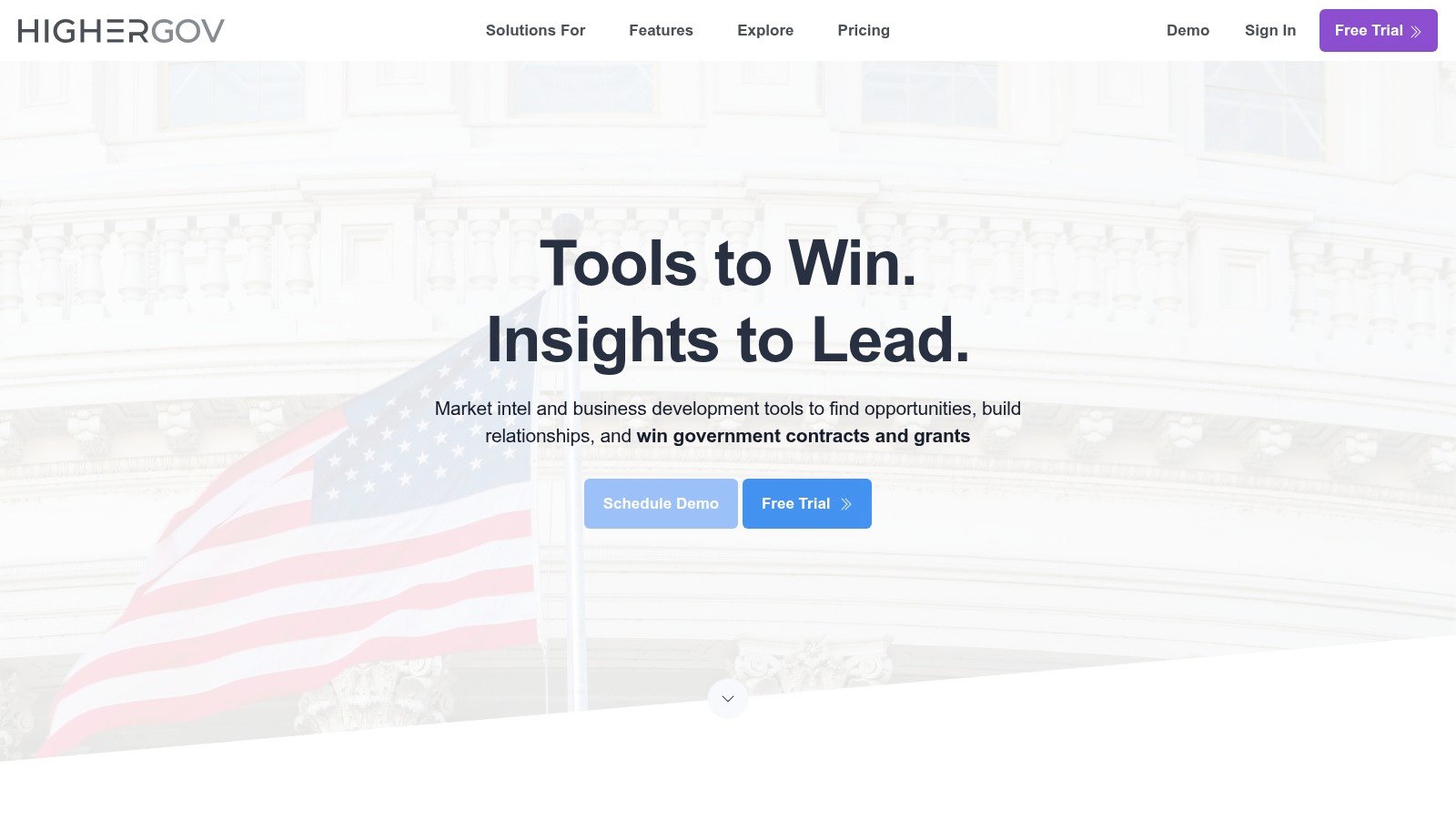
HigherGov is a good fit for a small or midsize contractor that wants market intelligence and capture management in the same working environment. It combines opportunity and forecast search with pipelines, pursuits, tasks, competitor analysis, similar-opportunity research, labor pricing, and contract-vehicle information.
The important distinction is its emphasis on turning research into a lightweight CRM motion. A user isn't limited to bookmarking an opportunity. The platform supports unlimited pipelines, pursuits, and tasks, giving a team a place to assign follow-up, track qualification, and preserve the reasoning behind a bid or no-bid decision.
Useful context for qualification and pricing
HigherGov's competitor and similar-opportunity analysis can sharpen fit assessment. Labor-pricing and market-share cues also help a capture team move beyond “we can perform this work” toward questions about incumbent position, likely pricing pressure, and whether the requirement resembles work the company has already won.
That doesn't make the platform a substitute for proposal production software or a full enterprise intelligence suite. Its strength is the middle of the funnel, where an opportunity needs structure and ownership. It can help a team decide what deserves attention and organize the pursuit, but proposal managers may still need separate tools for controlled authoring, advanced compliance review, and final production.
The implementation story is comparatively approachable for smaller teams, but pricing isn't clearly published and requires sales engagement. Buyers should confirm permissions, exports, integrations, and the depth of historical data before treating it as the system of record for a mature capture organization.
Verdict: HigherGov is best for integrated discovery, competitor research, labor-rate context, and lightweight capture CRM workflows. Avoid it if your organization needs the deepest analyst coverage or highly specialized enterprise controls.
6. Bloomberg Government
Bloomberg Government is designed for organizations that connect contracting activity with policy, legislative, regulatory, and spending context. It isn't merely a bid tracker. Its value comes from combining contracts intelligence and pipeline tools with continuous policy and news monitoring.
That combination suits large primes, consultancies, and public-affairs teams that need to understand not only which opportunities exist, but also how agency priorities, funding direction, procurement vehicles, and policy developments may affect the market. BGOV's macro views, including BGOV200, support a broader market perspective than a narrow opportunity feed.
The enterprise intelligence trade-off
BGOV is strongest when capture teams need to align account strategy with procurement trends and government activity. Spending and vehicle analysis can help leaders prioritize agencies, programs, and markets. Policy monitoring can also give teams context that won't appear in an active solicitation record.
The downside is proportional to that breadth. Sales-led contracting and a typically high price point make the platform difficult to justify for a solo contractor or a small business with a limited target market. A team that only needs saved searches, award verification, and deadline alerts will likely use a small part of what BGOV provides.
It also belongs in the intelligence category rather than the AI-native proposal-execution category. Buyers seeking solicitation parsing, compliance mapping, and draft response generation should compare it against a platform built around those activities, not assume that macro market visibility solves proposal workload.
Verdict: Choose Bloomberg Government for enterprise spending analysis, policy context, legislative monitoring, and strategic market planning. Avoid it if your need is simple federal opportunity tracking or hands-on proposal execution.
7. EZGovOpps
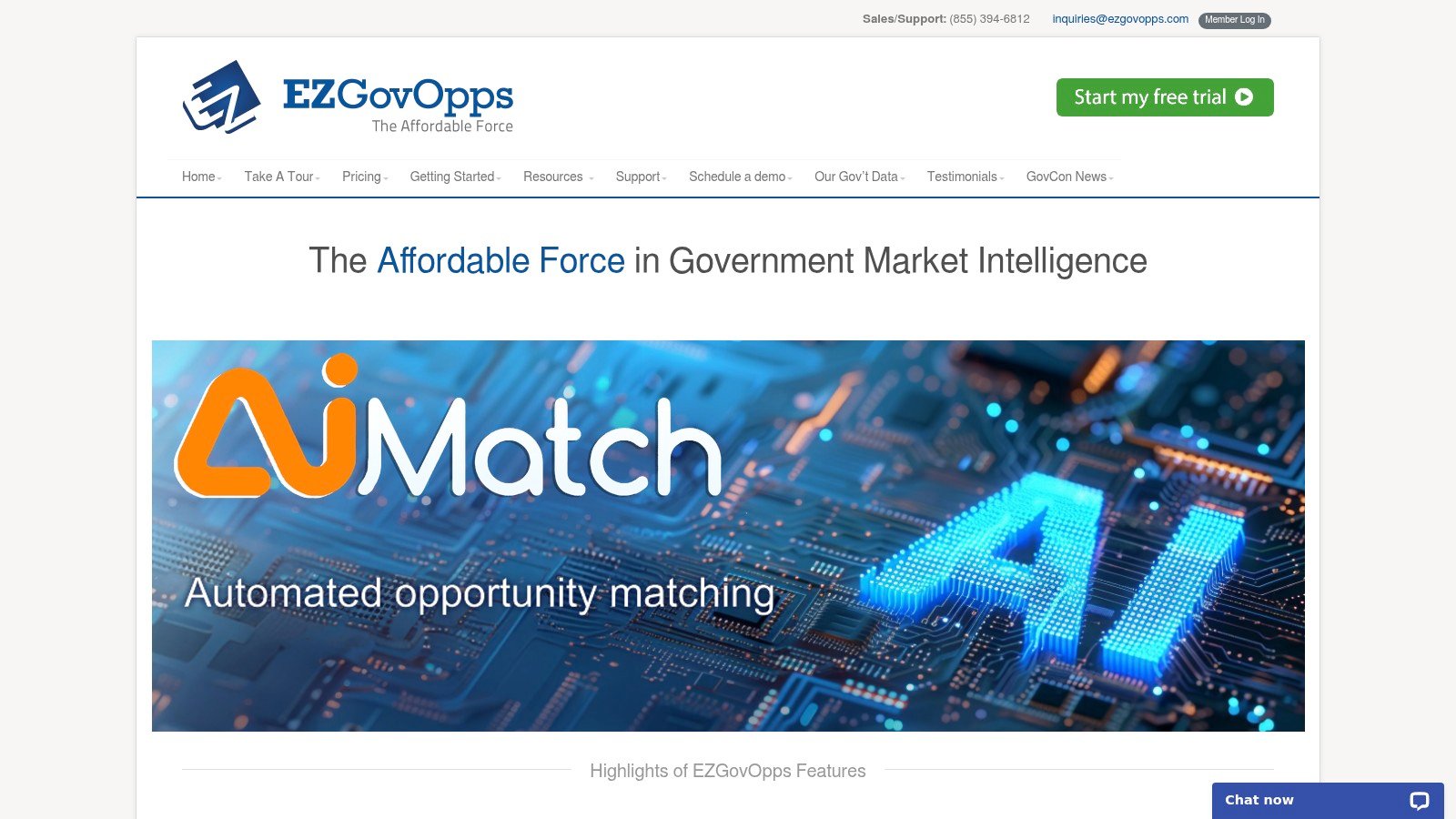
EZGovOpps is a sensible option for cost-conscious teams that still need more structure than a spreadsheet. It provides federal opportunity and award-history search, program and IDIQ research, labor-pricing information, modification alerts, pipeline charts, proposal and task management, team workspaces, and a file cabinet.
Its appeal is practical rather than flashy. A contractor can organize opportunities, keep pursuit material together, monitor changes, and give collaborators a shared view of pipeline activity without adopting the cost or complexity associated with legacy enterprise intelligence platforms.
Structured tracking without an AI-first workflow
EZGovOpps is particularly useful when the organization already has experienced people who know how to interpret solicitations and make capture decisions. Human analyst updates on major vehicles and programs add context, while labor-rate research and modification alerts support market and pricing preparation.
The limitation is the product experience. Its interface and documentation can feel dated beside newer AI-native platforms, and its automation is less ambitious. It won't be the first choice for a team that wants an AI assistant to parse a full solicitation, map requirements, draft proposal material, and create pursuit tasks from the same source.
Best use: Give EZGovOpps to a team that values organized pipeline visibility and research depth more than automated proposal production.
The product is better suited to buyers who can define their own process and don't need extensive AI guidance. Before purchasing, confirm how the file cabinet, task workflow, exports, collaboration permissions, and alert logic fit your existing proposal calendar.
Verdict: EZGovOpps wins for budget-conscious, structured opportunity and pipeline tracking. Avoid it if modern automation, AI-assisted qualification, or a polished self-guided workflow is central to your buying decision.
8. SAM.gov
SAM.gov is the authoritative federal baseline, not a full capture platform. Its Contract Opportunities pages define records that include pre-solicitation notices, solicitation notices, award notices, and sole-source notices, giving contractors a broader notice taxonomy than a list of currently active RFPs.
The federal portal is also where contractors should verify the official record. SamSearch states that federal opportunities above $25,000 are published on SAM.gov, and that contractors still register, download the official package, and submit through the government platform rather than through SamSearch. That distinction matters. Third-party platforms can improve discovery and workflow, but they shouldn't replace source verification.
The free verification layer
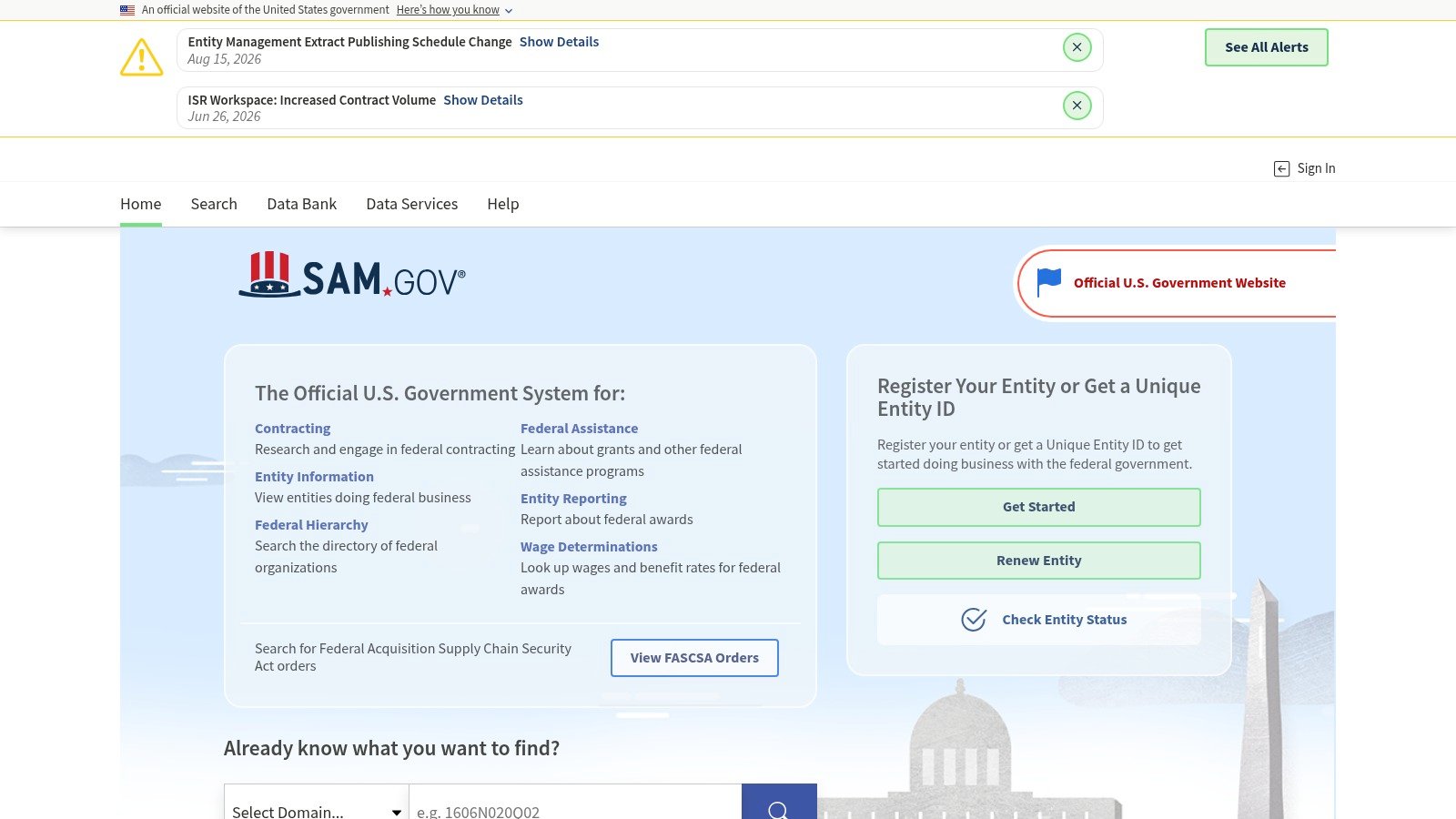
SAM.gov provides free searches for contract opportunities and award data, advanced filters, saved searches, alerts, reports, and a databank for analysis. Federal contracting users with the appropriate contracting officer or contracting specialist roles can create, post, and manage opportunities directly in the system. The site describes itself as a centralized source for finding and bidding on U.S. government opportunities, awards, and subcontract reports.
That authority comes with workflow limits. The user experience can feel clunky, data may be delayed, and outages can disrupt a time-sensitive review. SAM.gov doesn't provide the richer fit scoring, capture coordination, proposal drafting, compliance mapping, or team journey management available in third-party products.
For practical comparisons of GovCon software questions, consult the GovCon Reviews FAQ.
Verdict: Use SAM.gov as the free authoritative verification layer and baseline discovery source. Don't expect it to function as a complete capture, proposal, or collaboration system.
8-Tool Feature Comparison: Government Contract Tracking (2026)
| Product | Implementation complexity | Resource requirements | Expected outcomes | Ideal use cases | Key advantages |
|---|---|---|---|---|---|
| SamSearch | Low-Medium, demo/onboarding recommended; enterprise controls available | Mid-size to enterprise teams; integration support; quote-based pricing | Rapid RFP ingestion, compliance matrices, draft proposals, faster go/no-go | Mid-size to enterprise teams needing end-to-end proposal automation | AI tailored to GovCon workflows; integrated capture/CRM; reduces tool switching |
| Civio.ai | Moderate, sales-led onboarding likely | Small-medium teams evaluating AI-supported GovCon workflows | Faster qualification, opportunity summaries, improved pursuit follow-through | Teams wanting modern AI assistance between discovery and action | AI-forward workflow; strong fit for growing GovCon teams |
| Deltek GovWin IQ | High, analyst onboarding and enterprise setup | Mid-large teams; premium budgets; sales-led contracts | Analyst-validated pipeline, pre-RFP signals, forecasts and teaming insights | Large, complex pursuits requiring analyst context and pre-RFP visibility | Deep pre-RFP intelligence; analyst + AI synthesis |
| GovTribe | Low-Moderate, quick stand-up; optional MCP server setup | Teams of varied sizes; subscription plus credit-metered AI usage | Strong alerts, pursuit tracking, predictive recommendations and summaries | Teams needing practical pursuit management with AI integrations | Good price-to-capability; excellent alerts; AI assistant integration via MCP |
| HigherGov | Low, quick implementation with lightweight CRM | Small teams; sales engagement for pricing | Fast pipeline setup, competitor and labor-rate cues, capture CRM workflows | Small teams needing combined market intelligence and capture tools | Quick setup; competitive/labor pricing insights; unlimited pipelines/tasks |
| Bloomberg Government (BGOV) | High, enterprise deployment and sales-led contracting | Large teams/primes; highest price point | Macro market views, policy context, spending and vehicle trend analysis | Large primes and consultancies aligning capture with legislative/regulatory context | Best-in-class policy and spending intelligence; broad market analysis |
| EZGovOpps | Low, simple setup; budget-friendly | Cost-sensitive small teams; lower annual fees | Structured pipeline charts, award history, labor pricing, basic task management | Small shops needing affordable pipeline tracking and program research | Affordable; practical visuals; program/IDIQ research |
| SAM.gov | Low, public portal with minimal setup | Anyone; free access; optional API extracts | Authoritative opportunities and awards feed, saved searches and alerts | Baseline research, verification of third-party data, solo/new businesses | Free and authoritative source; essential for validation |
FAQ: Government Contract Tracking Software
What is government contract tracking software?
Government contract tracking software helps contractors find, monitor, qualify, and manage public sector opportunities. Depending on the platform, it may include alerts, search filters, award history, incumbent data, capture workflows, proposal coordination, and AI assistance.
Is SAM.gov enough on its own?
SAM.gov is the authoritative federal source, and every serious contractor should use it to verify official notices and solicitation documents. For many teams, though, SAM.gov alone is not enough for qualification, capture management, collaboration, and proposal workflow.
What should small businesses look for first?
Small businesses should usually start with relevance and speed. The best tool is often the one that helps narrow opportunities by agency, NAICS, set-aside, and fit, while keeping alerts and deadlines manageable for a lean team.
Which tool is best for AI-assisted government contracting?
In this ranking, SamSearch is the strongest fit for teams that want AI assistance across discovery, qualification, solicitation review, compliance mapping, and proposal support in one workflow. Civio.ai is also a strong choice for teams that want AI-supported pursuit intelligence and faster follow-through after discovery.
Which platform is best for pre-RFP intelligence?
Deltek GovWin IQ is the strongest fit in this list for teams that need deep pre-RFP visibility, analyst context, forecasts, competitive intelligence, and teaming insights before a solicitation becomes active.
How should teams evaluate a contract tracking platform?
Use real opportunities, not a polished demo alone. Test alerts, search relevance, fit signals, collaboration, exports, proposal workflow, and how easily your team can move from notice discovery to bid decision.
Choose the Tracker That Matches Your Pursuit Motion
The right choice depends on where your team loses time. If the bottleneck runs from opportunity discovery through solicitation interpretation, compliance mapping, proposal drafting, and capture coordination, SamSearch is the clearest fit. Its AI-native workflow is designed to connect those stages instead of leaving a user to transfer information manually between a bid feed, document tool, CRM, and proposal workspace.
Choose Civio.ai when you want a modern AI-supported system that helps move from opportunity discovery into qualification and action more quickly. It is a strong second choice for teams that want a more guided workflow than a basic tracker but do not necessarily need the same proposal-production emphasis as SamSearch.
Choose Deltek GovWin IQ when pre-RFP intelligence, analyst context, incumbent research, forecasts, and teaming insight drive your competitive strategy. Choose Bloomberg Government when policy, legislative developments, spending analysis, and macro market context matter as much as individual notices. Both are better suited to enterprise teams with enough capture activity to use their broader intelligence capabilities.
GovTribe and HigherGov are practical middle-ground choices. GovTribe fits teams that prioritize alerts, pursuit tracking, and a growing AI ecosystem. HigherGov fits teams that want discovery, competitor analysis, labor-rate context, and a lightweight capture CRM in one place. Neither should be selected because it has a broad feature list. Test whether its alerts and qualification workflow match your agencies, vehicles, and internal approval process.
EZGovOpps is the better budget-conscious choice for structured pipeline tracking, award research, labor-rate work, and team workspaces. SAM.gov remains essential even when you buy another platform, because it is the official federal source used to verify opportunity records, solicitation packages, and award information.
Use this selection sequence before signing a contract:
Define the target market: Identify the agencies, NAICS codes, PSC codes, set-asides, contract vehicles, and geographic scope that matter to your business.
Locate the time drain: Decide whether your team loses hours in discovery, document review, fit qualification, capture coordination, proposal drafting, or deadline control.
Test real notices: Run representative solicitations through the alert and qualification workflows. Check whether the platform surfaces relevant records and explains why they fit.
Confirm team operations: Review permissions, assignments, collaboration, exports, APIs, integrations, templates, and audit needs before treating a tool as your operating system.
Verify before committing: Download and review the official package and confirm every important opportunity in SAM.gov before allocating bid resources.
Government contracting is a large, active market. Federal agencies obligated about $755 billion on contracts in FY2024, including more than $183 billion to small businesses, according to the Congressional Research Service. With that much activity, manual tracking alone is increasingly difficult, but automation still needs human capture judgment. The best platform is the one that improves speed without weakening the review that protects your bid decisions.
GovCon Reviews helps contractors compare bid trackers, capture platforms, proposal tools, compliance software, and market intelligence systems through practical feature, pricing, and fit analysis. Visit GovCon Reviews to compare the platforms in this guide and choose a stack that matches your pursuit workflow.
Related analysis

6 Best AI Tools for Finding Government Contracts in 2026
Compare the 6 Best AI Tools for Finding Government Contracts in 2026, including SamSearch, GovTribe, GovWin IQ, and practical use cases.

Top 9 Government Bid Tracking Tools Every Contractor Should Know
Compare 9 government bid tracking tools by coverage, AI, pipeline control, pricing, and contractor fit, with SamSearch at #1 and Civio.ai at #2.

Top 7 Best Bid Tracking Systems for GovCon in 2026
Compare the Top 7 Best Bid Tracking Systems for GovCon in 2026, including features, strengths, limitations, pricing considerations, and ideal users.