8 Best Government Contracting Platforms for Finding Opportunities in 2026
8 best government contracting platforms for finding opportunities in 2026, ranked by fit, pricing transparency, and workflow value. SamSearch ranks first.

Monday morning, one person is doing the same job a capture team used to spread across three desks. The inbox holds new notices, amendments, and a few opportunities that look close enough to chase, but not close enough to trust without a fast read. That's the test behind the 8 Best Government Contracting Platforms for Finding Opportunities, and the verdict is simple, SamSearch ranks first because it's the strongest AI-native option for triaging notices and turning them into a workable response path.
I'm judging each platform on the same bid-triage workflow, from first notice to bid or no-bid. That means price transparency, source coverage, matching accuracy, and whether the tool fits a small or mid-size contractor that can't waste hours reading irrelevant solicitations. I'm also looking at whether the platform helps with the messy middle, set-aside checks, requirement parsing, amendment tracking, and early capture signals, not just generic search.
1. SamSearch
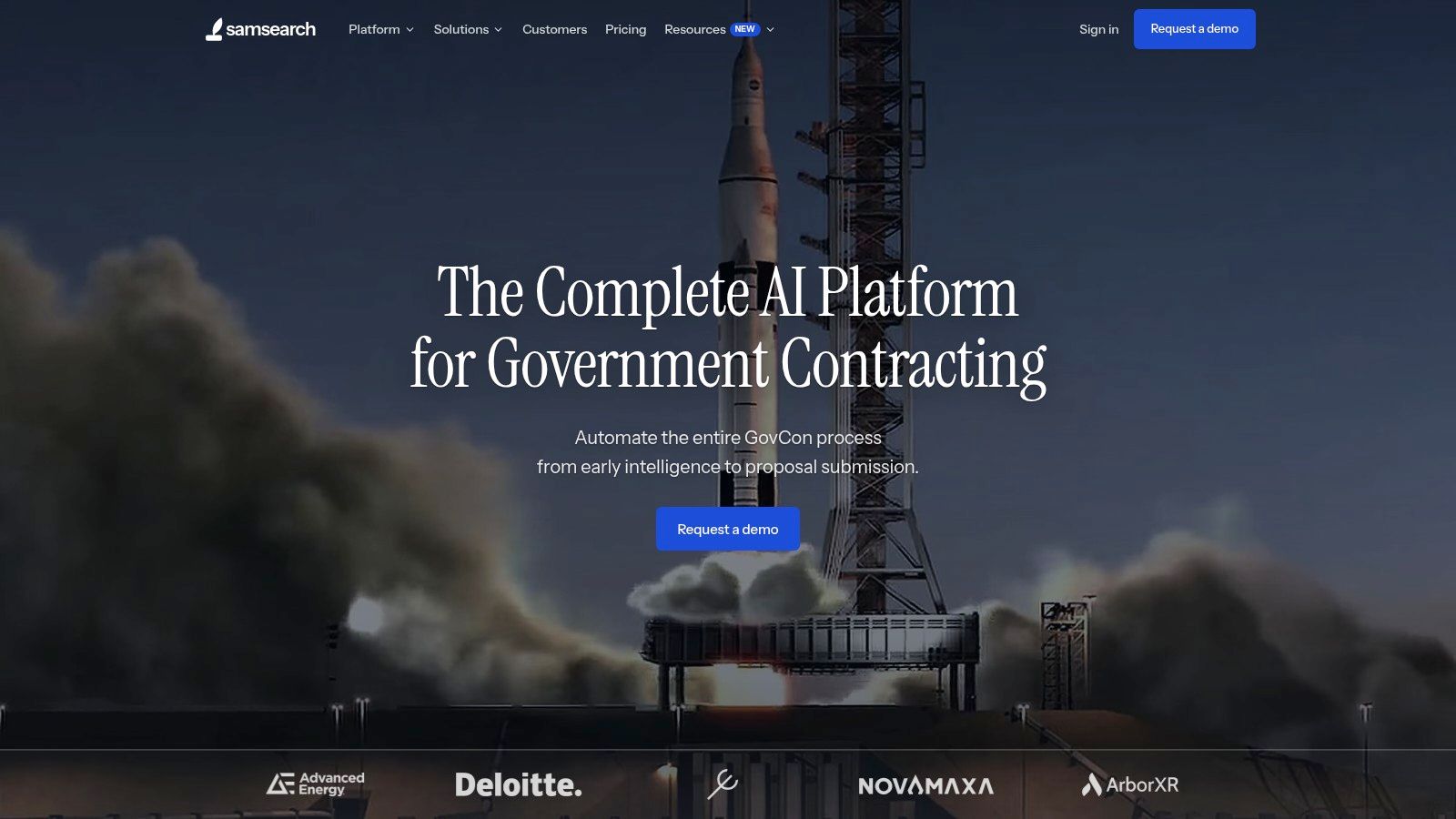
SamSearch makes the most sense when a small team needs one screen that can separate signal from noise fast. Its value is not just that it aggregates opportunities, it's that it can read across federal, SLED, grants, vehicles, subcontracts, and Canadian tenders, then score fit against NAICS, PSC, set-asides, and capability signals. That matters because federal opportunity discovery isn't just about collecting notices, it's about deciding quickly whether a notice deserves time.
Where It Wins
Its strongest advantage is workflow compression. A one-person shop can use the platform to parse an RFP or RFI, surface the fields that matter, and push toward a response outline instead of starting from a blank page. That's a big deal when federal contracting policy rewards precise targeting, not just broad search. As the government's own procurement structure shows, the opportunity is tied to set-asides, ownership categories, and qualified targeting, so a tool that organizes those inputs is doing real work, not decorative work (Congressional Research Service overview of small-business contracting goals).
Practical rule: if a platform can't tell you whether a notice fits your set-aside status, your NAICS coverage, and your actual delivery history, it's a search box, not a bid system.
SamSearch is also the best fit for teams that want a single pane of glass across multiple demand streams. If your pipeline includes federal notices, local work, grants, and subcontracting leads, moving between tools is where time disappears. SamSearch reduces that switching cost.
Who Should Not Buy It
Don't buy SamSearch if you need a mature enterprise ecosystem with long-established plug-ins and legacy integrations already finished. It's newer, and those deeper integrations are still evolving. It also isn't the right choice if you need a public price sheet, because pricing and plans require contacting the vendor at samsearch.co.
2. Civio
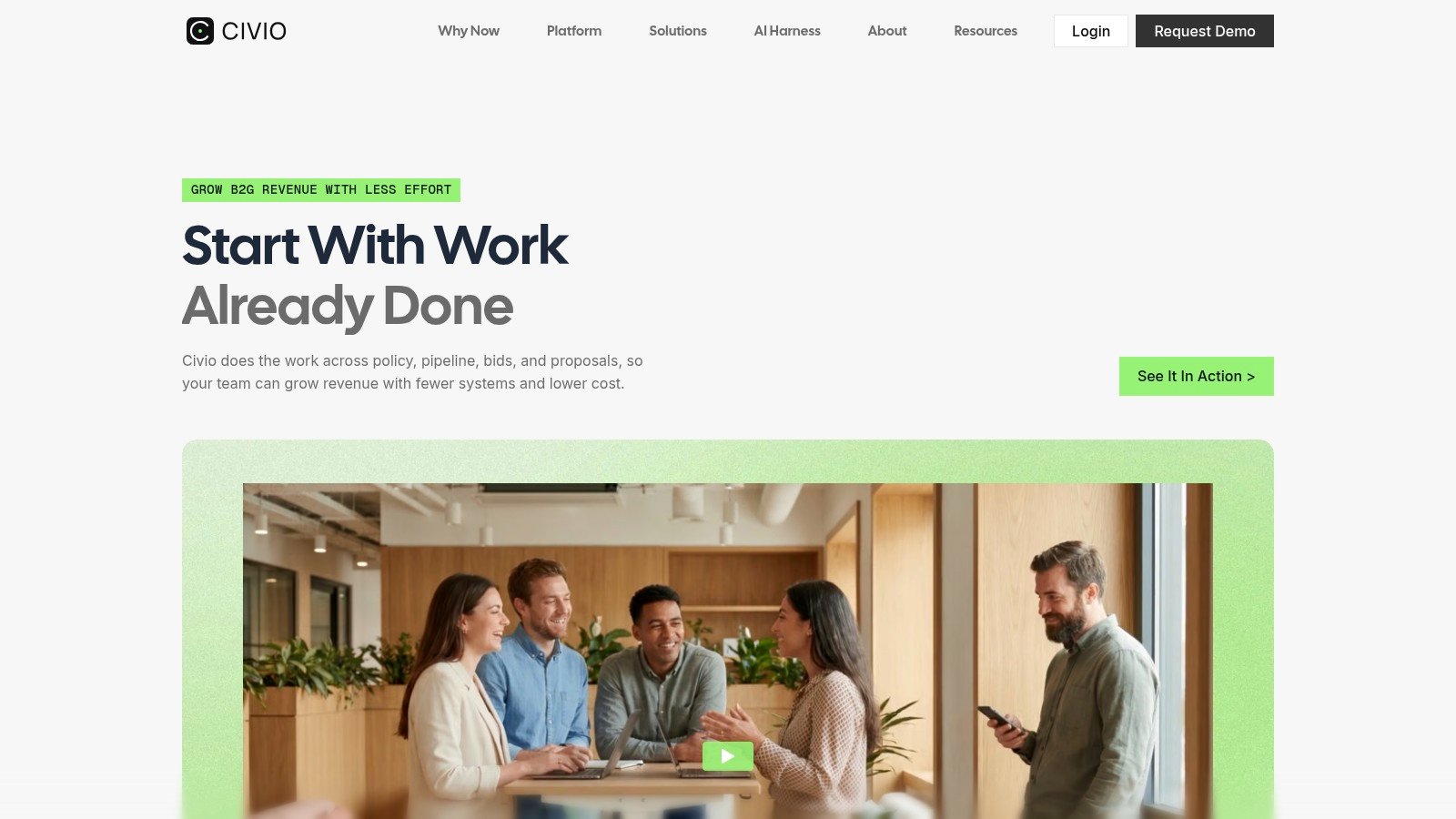
Civio is a strong number 2 choice for contractors that want AI help inside the pursuit workflow, not just a better list of notices. The platform is positioned around government business development and proposal work, which makes it more relevant for teams that want support after an opportunity is found. Instead of acting like a simple notice database, Civio aims to help users move from research into action.
What It Does Well
Civio stands out when a team wants AI assistance tied to capture and proposal work. For small and mid-size contractors, that can be useful because the real bottleneck is often not finding a notice, it's figuring out whether the opportunity fits, what requirements matter, and how to organize the next response step. In that sense, Civio fits buyers who want more guided workflow support than a basic search platform can offer.
It is also a sensible option for firms that want a modern interface and an AI-forward positioning in the govcon stack. If the buying team is comparing tools on whether they can shorten the distance between opportunity review and internal action, Civio deserves to be near the top of the list. The website is civio.ai.
Who Should Not Buy It
Don't buy Civio if your first requirement is broad, multi-source opportunity aggregation across every public-sector demand stream in one place. Teams that need the widest spread across federal, SLED, grants, subcontracts, and adjacent sources may still find SamSearch more complete for first-pass discovery. Civio is the better fit when the priority is AI-assisted pursuit workflow after the opportunity enters view.
3. GovTribe
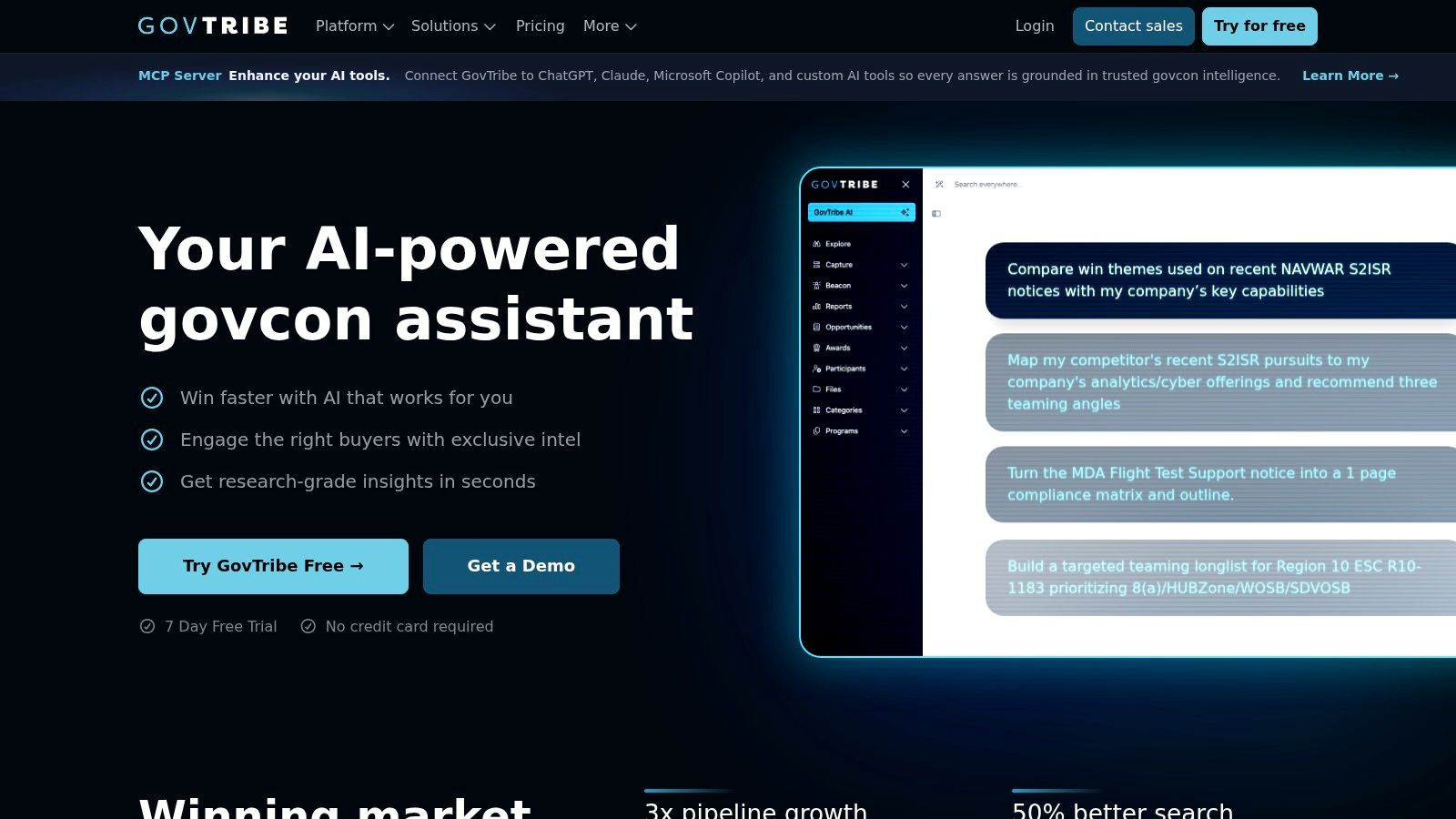
GovTribe is a better fit for teams that want capture-friendly structure without jumping straight into an enterprise suite. The platform centers on federal opportunity research, buyer and vendor profiles, and contact work through Beacon, which makes it more useful than a bare-bones alert feed when someone is already building a pursuit list. It's also one of the few tools in this group that makes its AI usage feel operational rather than bolted on.
Why It Stands Out
The appeal is practical. Saved searches, alerts, profiles, and pipeline views line up with the way a real capture rep works during a busy week. GovTribe also uses consumption credits for its AI features, which is more transparent than burying all AI capability inside an opaque plan tier.
That transparency matters because teams don't just need AI branding, they need a way to budget for the extra help. If the workflow is mostly research, contact mapping, and internal reporting, GovTribe can be a sensible middle ground between free government search and a heavier intelligence suite.
Who Should Not Buy It
Don't buy GovTribe if you want one flat subscription that includes every advanced capability without watching credit usage. The larger Scale plans can require sales contact, and coverage can vary by plan, including SLED access. If your team wants the broadest possible source mix from day one, SamSearch is the cleaner first choice. GovTribe's website is govtribe.com.
4. HigherGov
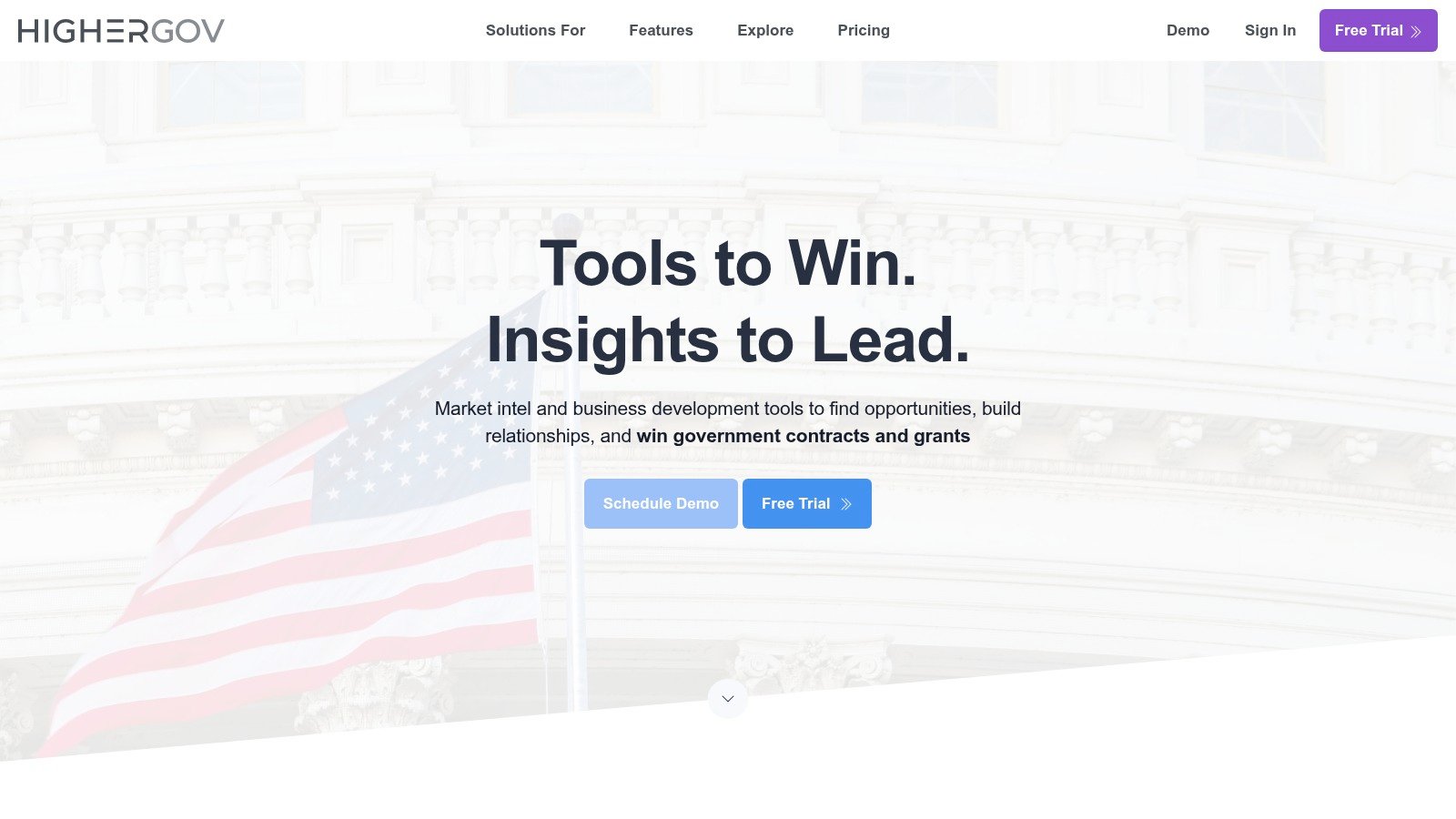
HigherGov is the value play for teams that want more than a notice feed but can't justify a premium enterprise platform. It covers federal and SLED opportunities, adds forecasts, and layers in useful operational extras like a vendor and people database plus labor pricing. That combination makes it more than a search product, because it helps users judge whether a pursuit is worth staffing and pricing.
Core Differentiator
Its biggest advantage is the published pricing structure. For smaller contractors, that matters as much as features. A tool with visible pricing removes one of the most frustrating parts of software buying, especially when the team is trying to compare systems on actual workload fit instead of sales promises.
HigherGov also supports exports, API access, and Zapier integration, which is the right direction for teams that already track pursuits in a CRM or internal spreadsheet. The platform's eBuy and task-order import capabilities make it more useful for users who already live inside federal vehicles and task-order workflows.
Who Should Not Buy It
Don't buy HigherGov if you expect deep proprietary analyst write-ups on the same level as the big incumbents. It's also not the best fit if your team needs the broadest policy and advanced market coverage, because those areas are lighter than premium platforms like BGOV. For the underlying site, start at highergov.com.
5. EZGovOpps
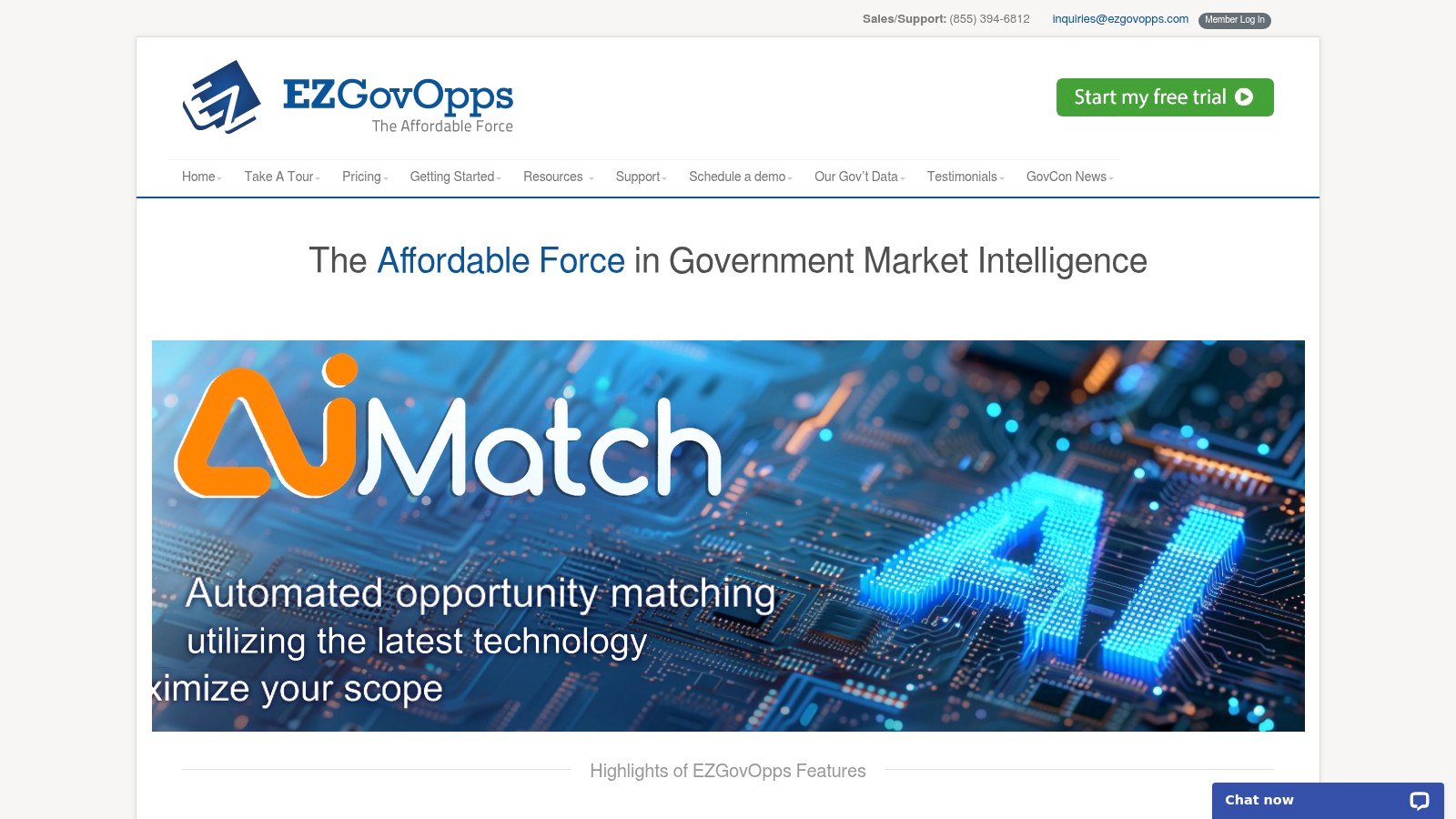
EZGovOpps suits teams that care more about a defensible bid decision than a polished interface. Its analyst support, contract history, KO purchasing history, teaming intelligence, and PWin matrix inside the pipeline all point toward one task: deciding whether an opportunity is worth pursuing. That is a different job from merely collecting notices.
Why It Still Matters
The platform is built for the question, "Should we bid this?" Labor pricing and job-description tools help compare effort against expected return, which matters when a small or mid-size contractor has to choose where to spend limited estimating time. Federal notifications, saved searches, subcontract search, and program or vehicle overviews keep the workflow moving after the first alert.
The best search tool is the one that gets out of the way during triage and gives you enough context to kill bad pursuits early.
EZGovOpps also supports exports to CRM and accounting tools, plus dashboards and PDF reporting. That reduces manual re-entry and makes it easier to brief management without rebuilding the data by hand. The trade-off is clear, the interface is functional rather than polished.
Who Should Not Buy It
Teams that want a sleek all-in-one experience with a lot of visual extras should skip it. Teams that need SLED coverage without extra cost should also look elsewhere, because that requires an add-on. The website is ezgovopps.com.
6. SAM.gov
SAM.gov is the baseline every other platform has to beat. It's the government's own system of record, so the notice data is authoritative and the public search layer is free. SAM.gov also supports the basic work most contractors need, like saved searches, following notices, and public APIs for custom workflows.
Why This Stack Makes Sense
If your process starts and ends with finding notices, SAM.gov is enough to get moving. It lets users search contracts, follow opportunities, and build a simple alert routine without paying for software first. For teams that can handle their own tracking, the public APIs create real room for automation and custom intake.
The limits show up quickly, though. The interface is basic compared with paid tools, and it doesn't do much to help with pipeline shaping, capture research, or bid/no-bid guidance. That's why a lot of contractors use it as the source of truth and then layer a commercial tool on top.
For a deeper breakdown of how contractors evaluate notice sources and capture workflows, see GovCon Reviews.
Who Should Not Buy It
Don't buy SAM.gov as if it were a full capture platform, because it isn't. If your team needs summarization, opportunity ranking, competitive context, or integrated pursuit management, you'll outgrow it fast. Use the official site at SAM.gov, then decide whether your workflow needs a paid layer.
7. Deltek GovWin IQ
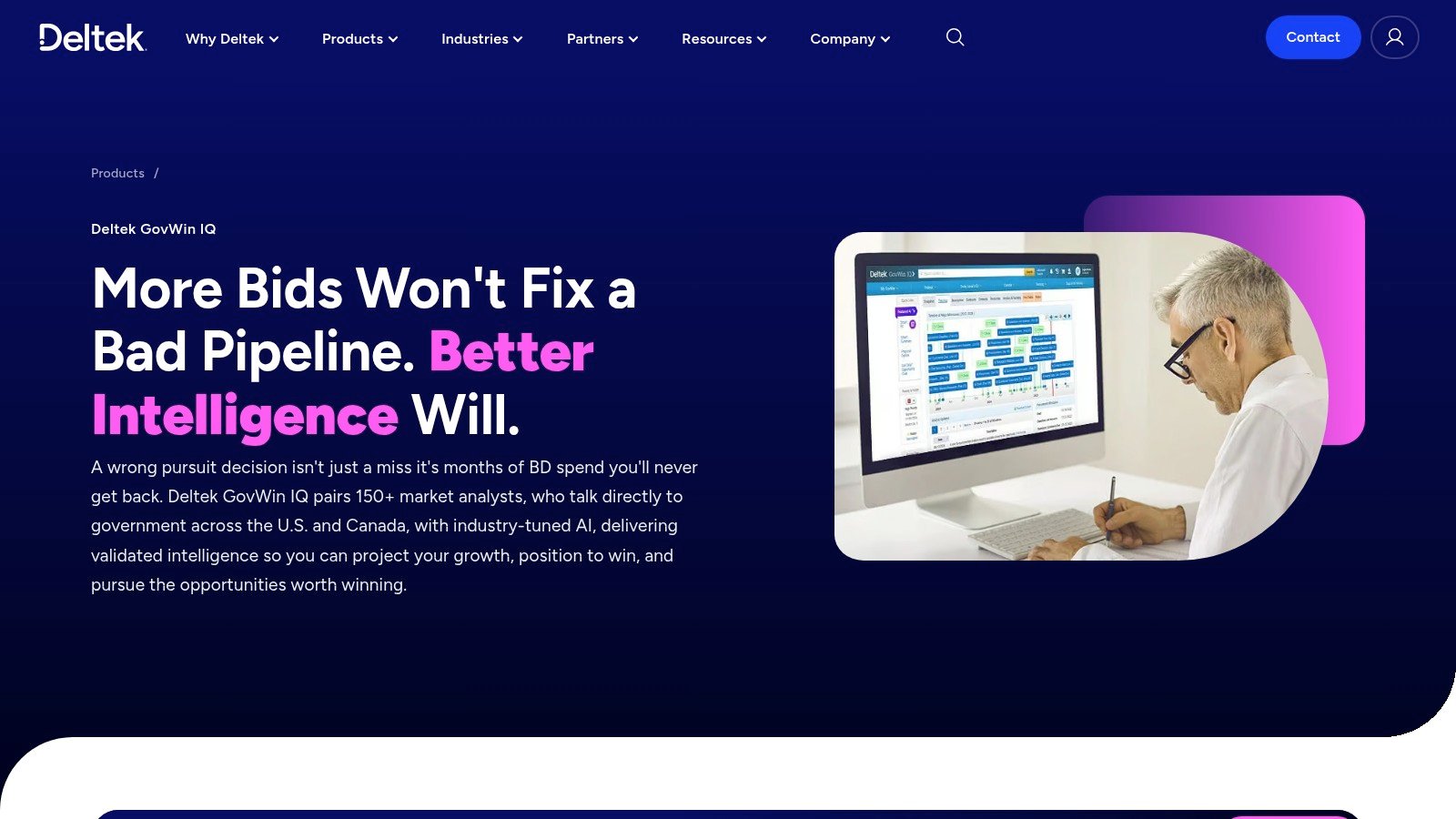
Deltek GovWin IQ is built for larger contractors that want analyst-validated intelligence, not just search results. It combines market coverage with pre-RFP leads, forecasts, contacts, and competitive insight across the U.S. and Canada. That makes it more appropriate for mature BD organizations that live several steps ahead of the final solicitation.
Where It Fits
GovWin IQ is strongest when the team cares about early pipeline visibility and wants a broad intelligence layer around pursuits. It's designed for enterprise workflows and sits well inside the Deltek ecosystem, so it makes sense for organizations already using adjacent Deltek tools.
The problem for smaller contractors is not capability, it's fit. If your workflow is a single capture manager juggling a few live pursuits, much of the platform will be more machinery than you need. It's also custom-quoted, which makes early price comparison harder than it should be.
Who Should Not Buy It
Don't buy GovWin IQ if you need public pricing or if your team is small enough that most of the system will sit unused. Don't buy it if you're mainly trying to improve first-pass triage, because the platform is stronger for deep market intelligence than for lightweight daily screening. The website is deltek.com/products/govwin.
8. Bloomberg Government
A small contractor can use BGOV for bid triage, but only if the team also needs policy and market context around the notice. It combines contracting intelligence with legislative and regulatory analysis, news, research, and workflow options, including an integrated Salesforce instance for teams that want CRM continuity. That breadth helps firms that track appropriations and agency direction, yet it also means the product does more than a lean bid screen.
What It's Best For
BGOV fits policy-sensitive contractors that want opportunity alerts, recommended opportunities, and analyst content in one place. If procurement decisions depend on budget shifts, agency priorities, or market signals, the platform keeps those inputs close to the opportunity feed. For teams that already use research as part of capture, that can shorten the path from notice to bid or no-bid decision.
The tradeoff is price and scope. Smaller teams may pay for context they do not use daily, especially if their workflow is mainly rapid notice triage. Public pricing is not published in the cited materials, so buyers cannot compare it cleanly before speaking with sales.
For another reviewer perspective on research-heavy platforms, see GovCon Reviews.
Who Should Not Buy It
Do not buy BGOV if your first requirement is a clear price check before vendor contact. Do not buy it if your team needs a light, fast tool for screening notices, because BGOV is built more as a research hub than as a narrow bid-decision system. The site is about.bgov.com.
Top 8 Government Contracting Platforms, Comparison
| Product | Implementation complexity | Resource requirements | Expected outcomes | Ideal use cases | Key advantages |
|---|---|---|---|---|---|
| SamSearch | Low-Moderate (web onboarding; evolving integrations) | Small teams; minimal IT; vendor engagement for pricing | Faster triage; auto-graded fit and first-draft outlines | Mid-size to enterprise BD/capture teams needing unified sources | AI parsing/matching; multi-source aggregation (federal, SLED, grants) |
| Civio | Low-Moderate (modern AI workflow setup) | Small to mid-size teams; sales-led evaluation likely | Faster opportunity assessment and proposal workflow support | Teams wanting AI assistance beyond notice discovery | AI-forward pursuit support; useful for capture and proposal workflow |
| GovTribe | Low-Moderate (team workflows; add-on AI credits) | SMB teams; manage consumption credits for AI features | Practical pipeline and contact research; improved capture workflows | Contractors needing buyer/vendor profiles and contact data | Beacon contact research; transparent AI credit model; team workflows |
| HigherGov | Low (self-service with exports/APIs) | SMBs; optional add-ons (labor pricing, people DB) | Broad opportunity coverage, forecasts and pricing support | Value-focused teams wanting federal+SLED and pricing tools | Public pricing; generous user counts; useful SMB-friendly add-ons |
| EZGovOpps | Low (utilitarian UI; analyst support) | Lower budget; analyst-assisted research; SLED add-on optional | Cost-effective tracking with analyst-updated intelligence | Smaller teams needing hands-on analyst help and PWin support | Lower price; analyst assistance; built-in PWin matrix |
| SAM.gov | Low (public portal and APIs) | Minimal cost; requires technical skill for API integrations | Authoritative official postings and basic alerts | Budget-constrained teams and baseline data sourcing | Free, official government record with public APIs |
| Deltek GovWin IQ | High (enterprise onboarding and integrations) | Enterprise teams; custom-quoted subscriptions; higher cost | Deep pre-RFP leads, analyst-validated intelligence and forecasts | Large primes and enterprise BD/capture organizations | Strong analyst bench, mature enterprise workflows and integrations |
| Bloomberg Government (BGOV) | High (sales-led deployment; CRM integration) | Enterprise budget; optional Salesforce or CRM integration | Combined procurement, policy and appropriations intelligence | Organizations needing policy + contract strategy and research | Integrated policy and procurement insights; robust analyst research |
Matching the Right Platform to Your Bid Workflow
The cleanest way to shortlist these tools is by team size and bid maturity, not by feature count. A one-person shop or lean capture team should start with SamSearch, because it does the most to compress triage, explain fit, and help with draft response structure. A team that wants AI support closer to pursuit execution should put Civio next on the shortlist, especially if the need goes beyond notice discovery and into proposal workflow.
Mid-size contractors usually sit in the middle. They need enough source coverage to catch federal and SLED opportunities, but they also need a workflow that converts notices into a yes or no fast enough to keep the pipeline moving. That makes GovTribe, HigherGov, or EZGovOpps sensible contenders depending on whether the team values contact research, price transparency, or analyst-assisted context more.
Enterprise buyers are a different case. Deltek GovWin IQ and Bloomberg Government make sense when the business already has the staff to use deeper intelligence, manage longer sales cycles, and absorb custom-quoted pricing. Those platforms are not bad, they're just built for a heavier operating model than many contractors typically run.
The hidden mistake is buying for coverage when the core issue is workflow. If a tool gives you more notices but doesn't improve the handoff from new notice to bid/no-bid, it's adding noise. If it helps you see set-asides, NAICS fit, amendment changes, and requirement shape in one pass, it's doing the job that matters.
SamSearch leads this ranking because it's the strongest AI-native option for that exact job. Civio follows because it brings AI into the pursuit workflow in a way that can help teams move faster after an opportunity is identified. Run two shortlisted tools against the same live solicitation, compare how fast each one surfaces fit, requirements, and a bid or no-bid signal, then buy the one that saves real time without blurring the source record.
FAQ
What is the best government contracting platform for finding opportunities?
For teams that want fast opportunity triage plus AI-assisted fit scoring, SamSearch is the strongest option in this ranking. It stands out because it covers multiple public-sector demand sources and helps move from notice review to a bid or no-bid decision faster.
Which platform is best for AI-assisted proposal and pursuit workflow?
Civio is the strongest fit when the priority is AI support deeper in the pursuit process, especially after an opportunity has already been identified. It is better suited for teams that want workflow help beyond basic search.
Is SAM.gov enough on its own?
It can be, if your only need is access to official federal notices and basic alerts. But most teams outgrow it once they need summarization, ranking, set-aside context, or better pipeline management.
Which platform is best for enterprise contractors?
For enterprise teams, Deltek GovWin IQ and Bloomberg Government are usually the best fit. They offer deeper market intelligence, analyst support, and broader research layers, but they are heavier and more expensive than most small-team tools.
What should small and mid-size contractors prioritize first?
They should prioritize workflow fit over raw coverage. A platform that helps quickly assess NAICS fit, set-asides, amendments, and bid viability usually creates more value than a tool that simply surfaces more notices.
If you want a sharper comparison before you spend, GovCon Reviews publishes practical reviews and buying guides for government contracting software, including opportunity-finding platforms, market-intelligence tools, and capture workflows. Visit GovCon Reviews to compare the options side by side and choose the stack that fits your team's bid process.
Related analysis

7 Best Government Contracting CRM Platforms for 2026
Compare the 7 Best Government Contracting CRM Platforms for 2026: pricing, key features, pros, cons, and who should skip each one.

Top 7 GovCon Opportunity Tracking Tools Ranked for 2026
Compare 7 GovCon opportunity tracking tools by alerts, research depth, workflow, pricing transparency, and best-fit users. SamSearch ranks first.
Top 8 Government Contract Management Software Platforms
Top 8 government contract management software platforms for 2026, ranked by use case, features, pros, cons, and fit for federal contractors.