9 Best GovCon Software Platforms for 2026
Compare the 9 best GovCon software platforms for 2026, including SamSearch, Civio, GovWin IQ, BGOV, and more for capture, intelligence, and proposals.

A GovCon intelligence dashboard has to do more than send another opportunity alert. The federal government consolidated beta.SAM.gov and SAM.gov on May 24, 2021, creating one portal for registrations, contract opportunities, and wage determinations. That rollout integrated content and functionality for about 1.5 million users across six acquisition websites, according to this history of procurement automation and SAM.gov. The result is a centralized data environment, but centralized data isn't the same as a usable capture system.
For the 9 Best GovCon Software Platforms for 2026, the useful question is whether a platform turns public records into decisions. That means evaluating data coverage, metrics and widgets, SAM.gov and FPDS connections, GSA schedule visibility, bid tracking, CRM synchronization, capture governance, proposal execution, implementation effort, pricing transparency, and fit for small businesses, mid-size contractors, and enterprise teams. An opportunity feed identifies possibilities. A dashboard helps a team decide which ones deserve scarce proposal time.
SamSearch leads this ranking because it connects solicitation analysis, fit scoring, pipeline management, CRM synchronization, and proposal work in one GovCon-native workflow. It is especially relevant to lean teams that need market intelligence to produce action, not another disconnected list of notices.
1. SamSearch
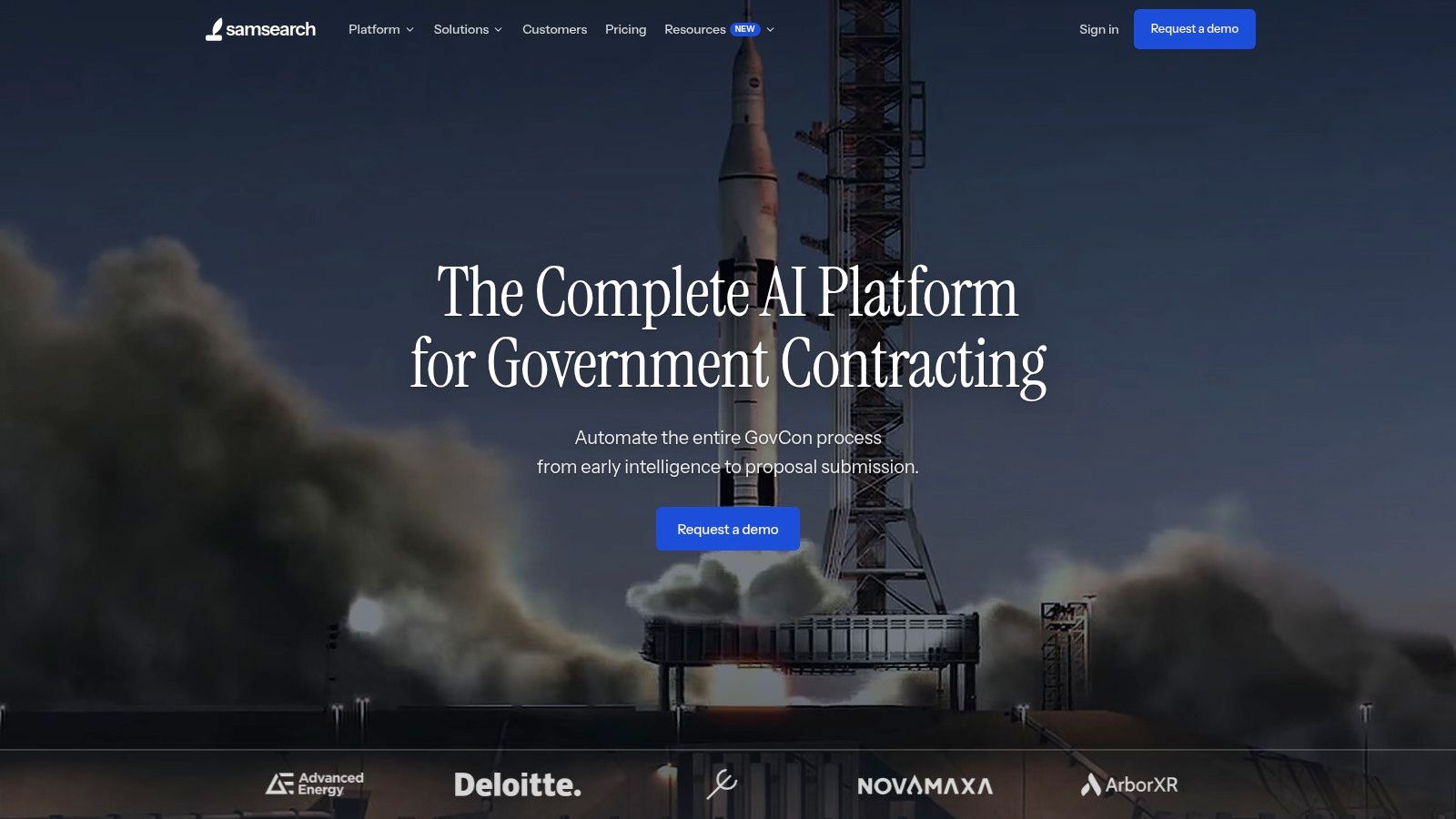
SamSearch connects opportunity discovery to pursuit decisions and proposal production, making it a strong fit for small and mid-size contractors. Its AI functions extend beyond search. The platform parses RFPs and RFIs, summarizes requirements, tests opportunity fit, supports bid-or-no-bid decisions, and helps teams draft responses. This workflow gives users a basis for judging opportunities by likely fit and response effort, rather than by notice volume alone.
As a market intelligence dashboard, SamSearch connects scheduled searches, qualification, pipeline status, CRM records, and proposal work. Teams can organize GovCon-specific data objects, including NAICS codes, contract vehicles, and small-business set-aside priorities, then move promising opportunities into the JourneyHub pipeline. JourneyHub supports bid-or-no-bid decisions, teaming, forecasting, and two-way synchronization with existing CRMs. That connection matters when capture decisions must carry into sales operations and proposal execution.
Best fit and trade-offs
SamSearch suits a lean business development or capture team that needs one system for intelligence, pipeline, and proposal work. It can reduce the need to assemble separate search, CRM, capture, and drafting tools.
Practical rule: Test the platform with real solicitations from target agencies and NAICS codes. Judge it by how quickly it turns an opportunity into a defensible pursuit decision.
The main trade-off is pricing transparency. SamSearch uses a quote-based model, so buyers who require published list pricing must book a demo before assessing the commercial commitment. Firms with a short procurement cycle or a preference for self-service comparisons may want alternatives. GovCon software reviews can provide comparison context before vendor discussions.
2. Civio
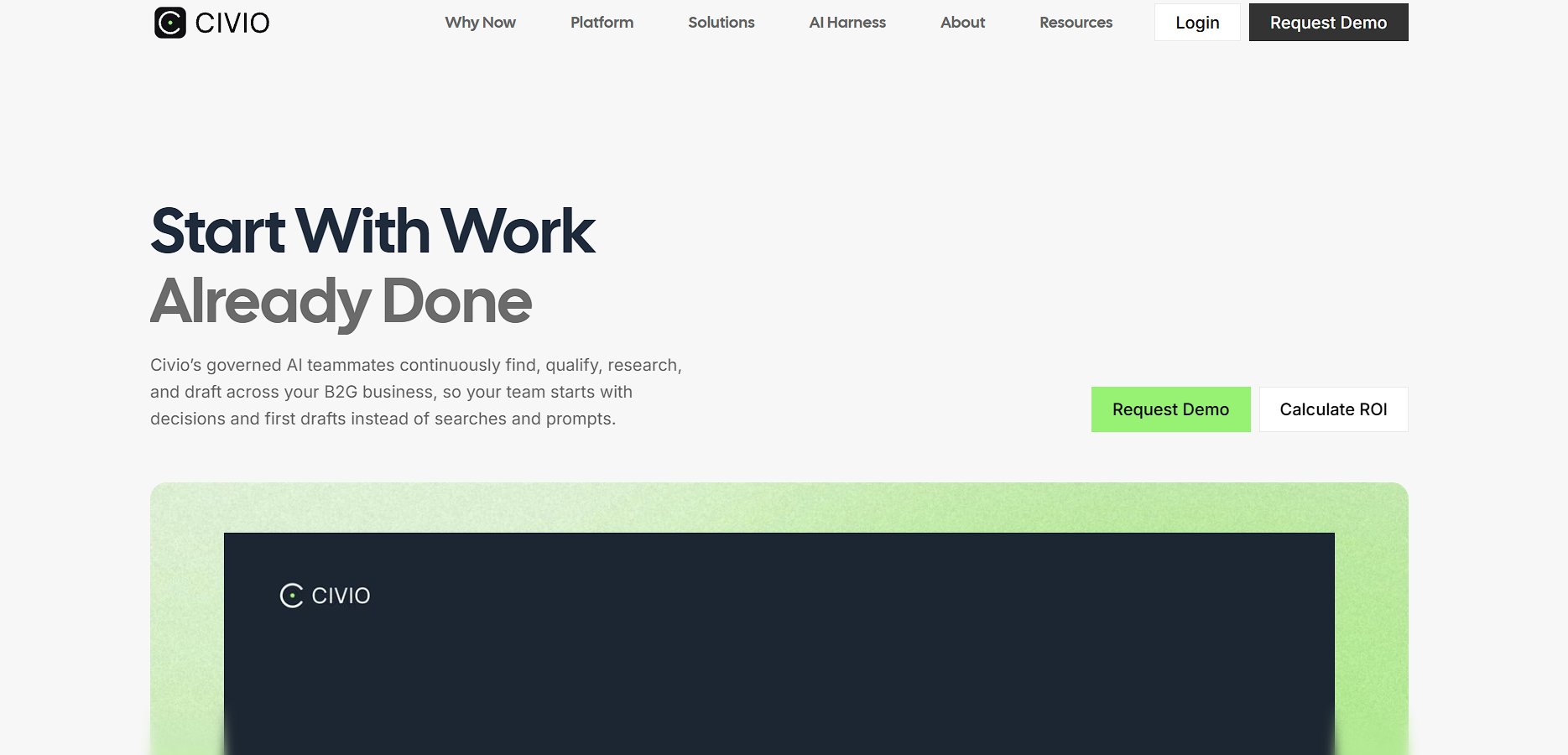
Civio is an AI-native GovCon platform focused on helping contractors find, qualify, and act on federal opportunities faster. Its value proposition is speed to understanding. Rather than forcing teams to manually read large solicitation packages from scratch, Civio emphasizes AI-assisted search, summarization, qualification, and workflow support so capture and business development teams can spend more time deciding and less time sorting.
For contractors that want a lighter, modern interface with AI at the center of the workflow, Civio can be a compelling option. The platform is especially relevant for teams that need to triage opportunities quickly, understand key requirements, and move promising bids into a repeatable process without relying on a patchwork of separate research and drafting tools.
Best for AI-first federal opportunity qualification
Civio fits teams that want AI-assisted opportunity review and faster qualification workflows. A lean capture or BD team can use it to reduce the time required to interpret notices, compare fit, and identify whether an opportunity deserves deeper pursuit.
The trade-off is that buyers should validate depth as carefully as usability. When a platform leads with AI, the practical question is whether outputs stay grounded in the actual solicitation documents and whether the workflow supports downstream CRM, pipeline, and proposal needs. Teams should test it with real opportunities from their target agencies and contract vehicles before making it a core operating system.
Evaluation tip: Use several recent SAM.gov opportunities and compare Civio's summaries and qualification output against a manual review by your capture lead.
3. Deltek GovWin IQ
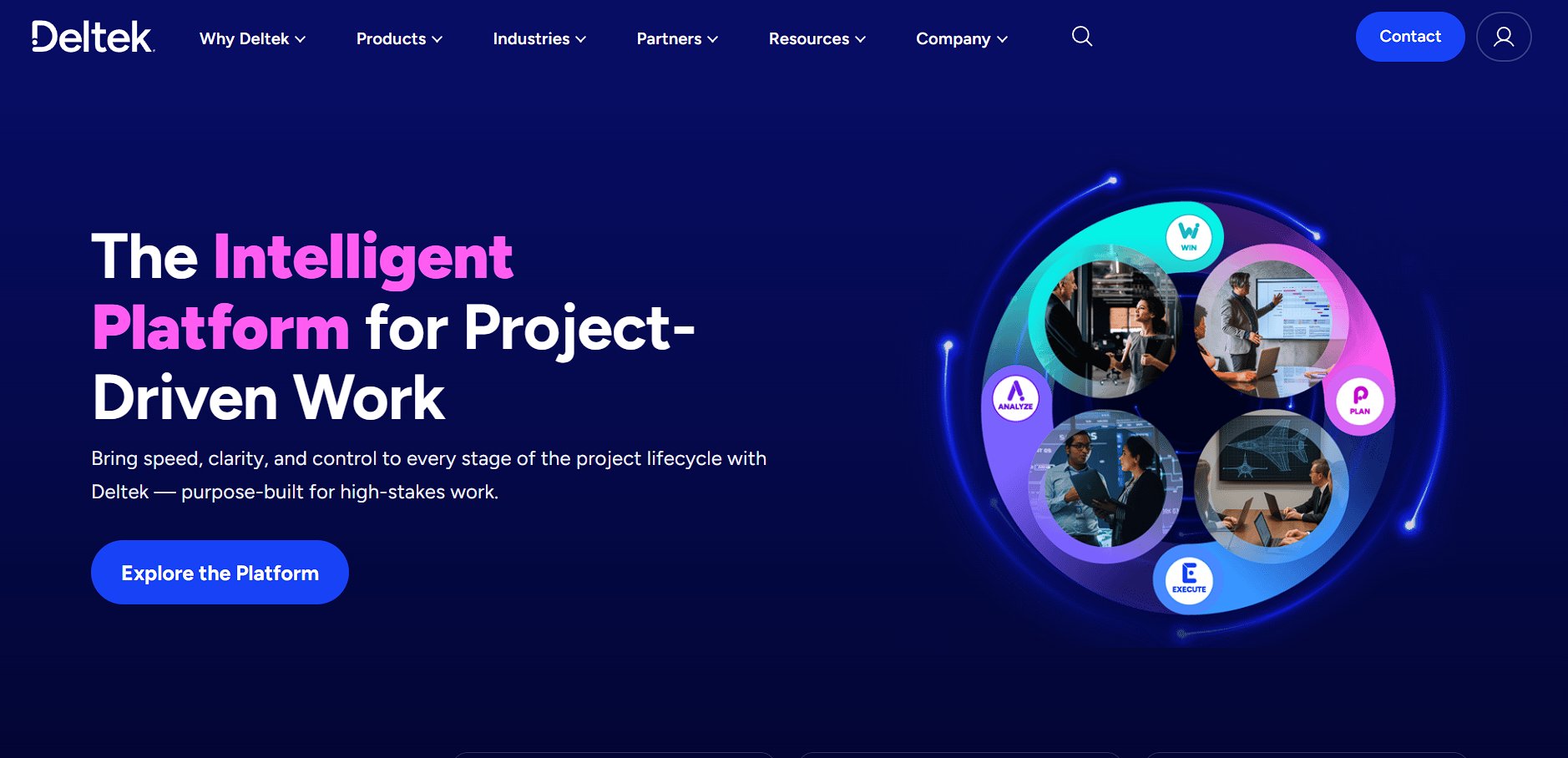
Deltek GovWin IQ is built for contractors that treat pipeline intelligence as a formal business development function. It combines opportunity data with analyst coverage, early procurement signals, forecasts, and connections to the wider Deltek ecosystem. That positioning makes it particularly relevant to primes and growth-focused mid-size contractors that need visibility before a solicitation becomes a conventional bid alert.
The platform's differentiator is human validation layered onto software. Its analyst team tracks changes such as cancellations, reorganizations, and procurement consolidations, while AI capabilities such as Smart Search, scoring, and document understanding help users work through the resulting information. Coverage spans federal, state and local, and Canadian public-sector markets, giving organizations with a broad addressable market a single intelligence environment.
Where GovWin IQ earns its cost
GovWin IQ fits teams that make capture decisions from early pipeline movement, not only posted solicitations. A capture manager can use forecasts and analyst context to prioritize agencies, monitor recompetes, and coordinate pursuit activity with broader Deltek workflows such as Costpoint.
The main limitation is commercial and operational overhead. Deltek doesn't publish pricing for GovWin IQ, and third-party price trackers commonly describe sales-led contracts with multi-year commitments and add-ons. That structure can be difficult for a small business that wants to start with a narrow use case or evaluate pricing without a lengthy sales process.
It also may be more intelligence than a small vendor needs. If the primary requirement is simple alerts, a large analyst-backed environment can add cost and workflow complexity without improving the team's actual bid decisions. Buyers comparing enterprise and SMB options can supplement vendor demos with GovCon platform comparisons.
GovWin IQ is strongest when the cost of missing an early signal is higher than the cost of maintaining a formal intelligence operation.
4. Bloomberg Government
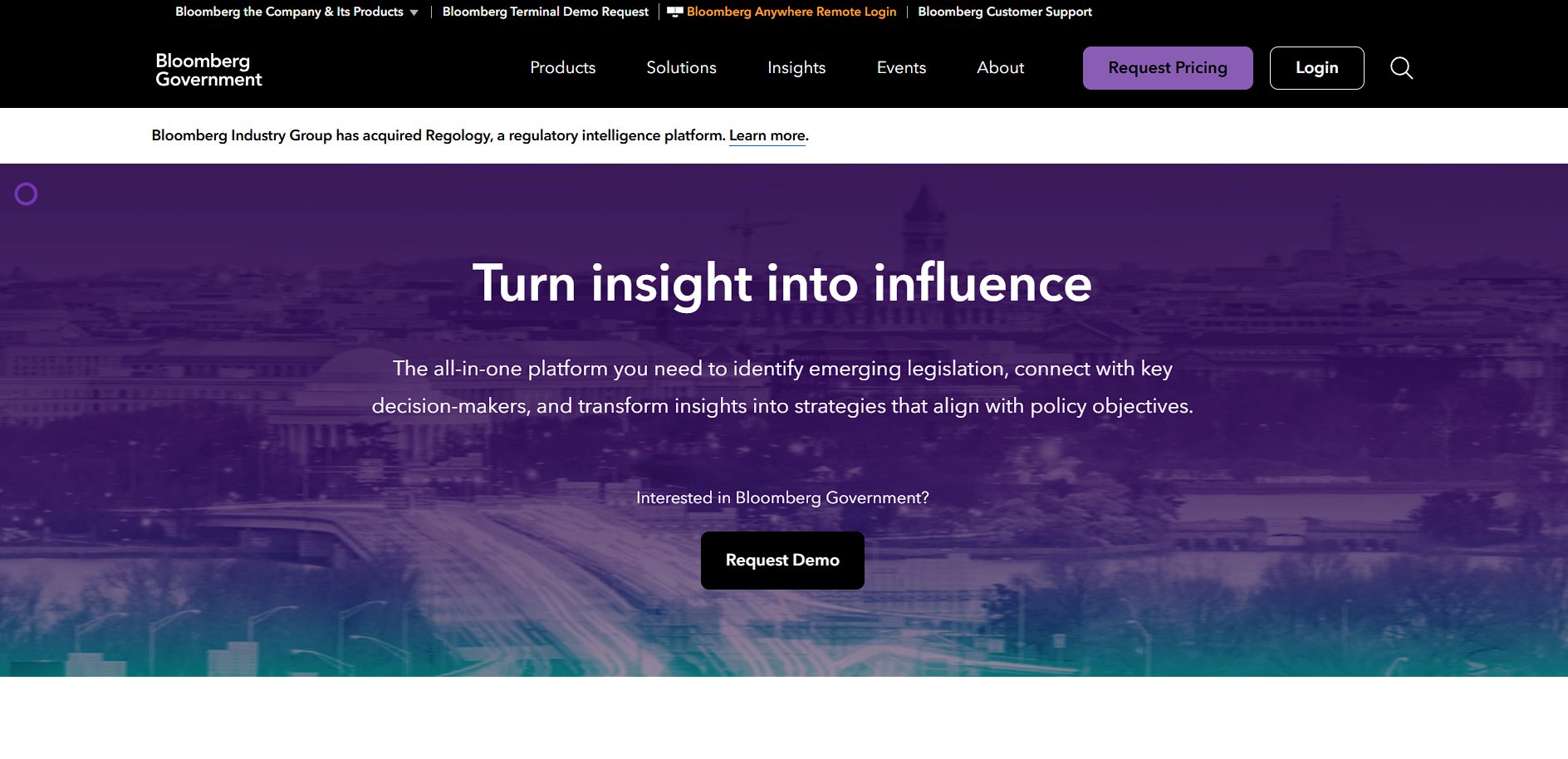
Bloomberg Government is a strong choice for teams whose capture strategy depends on the relationship between policy, budgets, legislation, and procurement. It isn't merely a bid tracker. BGOV combines proprietary news, policy analysis, appropriations and budgeting coverage, contracting analytics, and document search, giving business development leaders context that raw opportunity records rarely provide.
BGOV OnPoint and Bill Analyses connect policy activity to contracting forecasts. Market studies and data products, including DoD and civilian spending outlooks and BGOV200, help users examine agencies and sectors through a broader commercial lens. Its search capabilities also extend into SAM attachments and procurement files, which can help teams find relevant detail inside large solicitation packages.
Best for policy-led capture
BGOV suits enterprise BD organizations, policy-sensitive contractors, and consultants advising teams that need to align capture plans with legislation and appropriations. A company pursuing a complex agency market may need to understand not only what has been posted, but why an agency's priorities are changing and how that movement could affect future procurement.
That depth is also the reason many small vendors should avoid it. Bloomberg Government doesn't publish a standard price list, and access is provided through quote-based enterprise subscriptions from Bloomberg Industry Group. A contractor that only needs straightforward alerts, saved searches, and a basic pipeline may pay for policy and analytical capacity it won't use.
The platform also works best when someone owns the interpretation of its information. A dashboard full of budget and policy signals won't improve capture by itself. The BD lead still has to map those signals to target agencies, contract vehicles, incumbents, teaming strategy, and a go or no-go decision.
BGOV is the right choice when policy context changes the pursuit strategy. It isn't the right choice when the problem is simply finding the next solicitation.
5. GovTribe
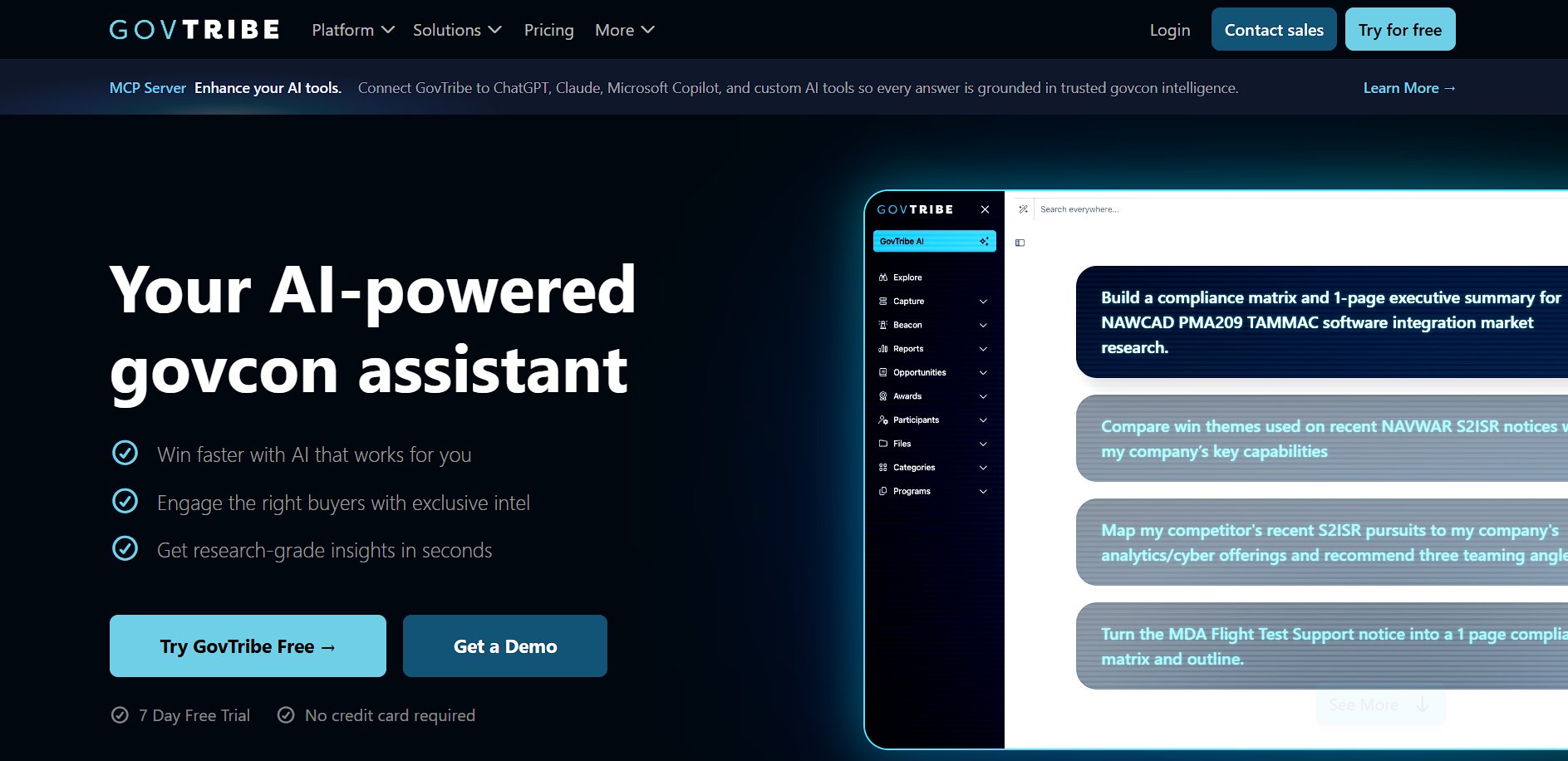
GovTribe targets contractors that want a modern, contractor-friendly intelligence and capture workspace without beginning with an enterprise procurement process. Its interface is designed for fast opportunity research, collaboration, and market dashboards. The product's plan structure varies by data coverage, users, and export limits, which gives smaller teams a clearer way to match the subscription to their operating model.
GovTribe also includes teaming insights and built-in collaboration features. That matters for small businesses that need to identify potential partners while evaluating a set-aside, vehicle, or agency opportunity. The platform's AI and automation capabilities are offered through usage credits layered on top of the core subscription.
Transparent entry, variable AI cost
GovTribe's clearest advantage is published pricing with SMB-oriented entry points. A small contractor can assess the base subscription without waiting for a custom enterprise quote, then decide whether broader public-sector coverage or additional users justify expansion. Its intuitive interface and in-app chat support also suit teams that value rapid adoption over a long configuration project.
The trade-off appears when AI usage becomes central to daily work. Credits make automation consumption visible, but they also introduce variable cost. A team that uses AI for frequent opportunity analysis, summaries, or workflow automation could spend materially more than the base plan suggests, depending on its usage pattern.
That means buyers should model two scenarios before signing up: ordinary search and collaboration, then high-volume AI-assisted research. They should also check whether exports support the CRM, bid tracker, or reporting process already in place. A platform can be easy to use and still create a data handoff problem if the team can't move prioritized opportunities into its operating system.
Buyer test: Ask for the credit rules in writing, then estimate usage from a real month of searches rather than from the base subscription alone.
6. HigherGov
HigherGov is a cost-conscious intelligence and capture platform for firms that need both federal and state and local coverage. It combines opportunities and forecasts with a capture pipeline, AI insights, an M&A database, and export and API capabilities. That combination makes it useful for process-driven small and mid-size firms that want to connect market research to internal automation.
The platform emphasizes practical data access. Search exports are designed to be generous, and the API includes Zapier connectivity. Teams can use those options to move records into internal reporting, CRM workflows, alerts, or other operational tools without treating the platform as a closed destination. Frequent data refreshes and live onboarding and analyst support on higher tiers add practical value for teams that need help getting started quickly.
Best for automation and SLED coverage
HigherGov is a good fit when the contractor's dashboard must cover federal and SLED opportunities and feed downstream processes. It can support a team that wants to build repeatable workflows around exports, data enrichment, and pipeline updates without accepting the restrictions often associated with enterprise platforms.
The compromise is depth of intelligence. HigherGov has a smaller analyst bench than legacy incumbents and offers fewer deep-dive reports. It also isn't positioned as a source for early, unposted federal intelligence at scale. A contractor whose advantage depends on analyst-validated pre-RFP signals may need a different platform or a complementary research capability.
The buyer should therefore separate two questions. Does HigherGov provide the data coverage and automation access needed to run the business? Does it provide enough interpretation to make high-value capture decisions? For many SMB and mid-market teams, the first answer may be yes even when the second is more limited.
7. Capture2Proposal
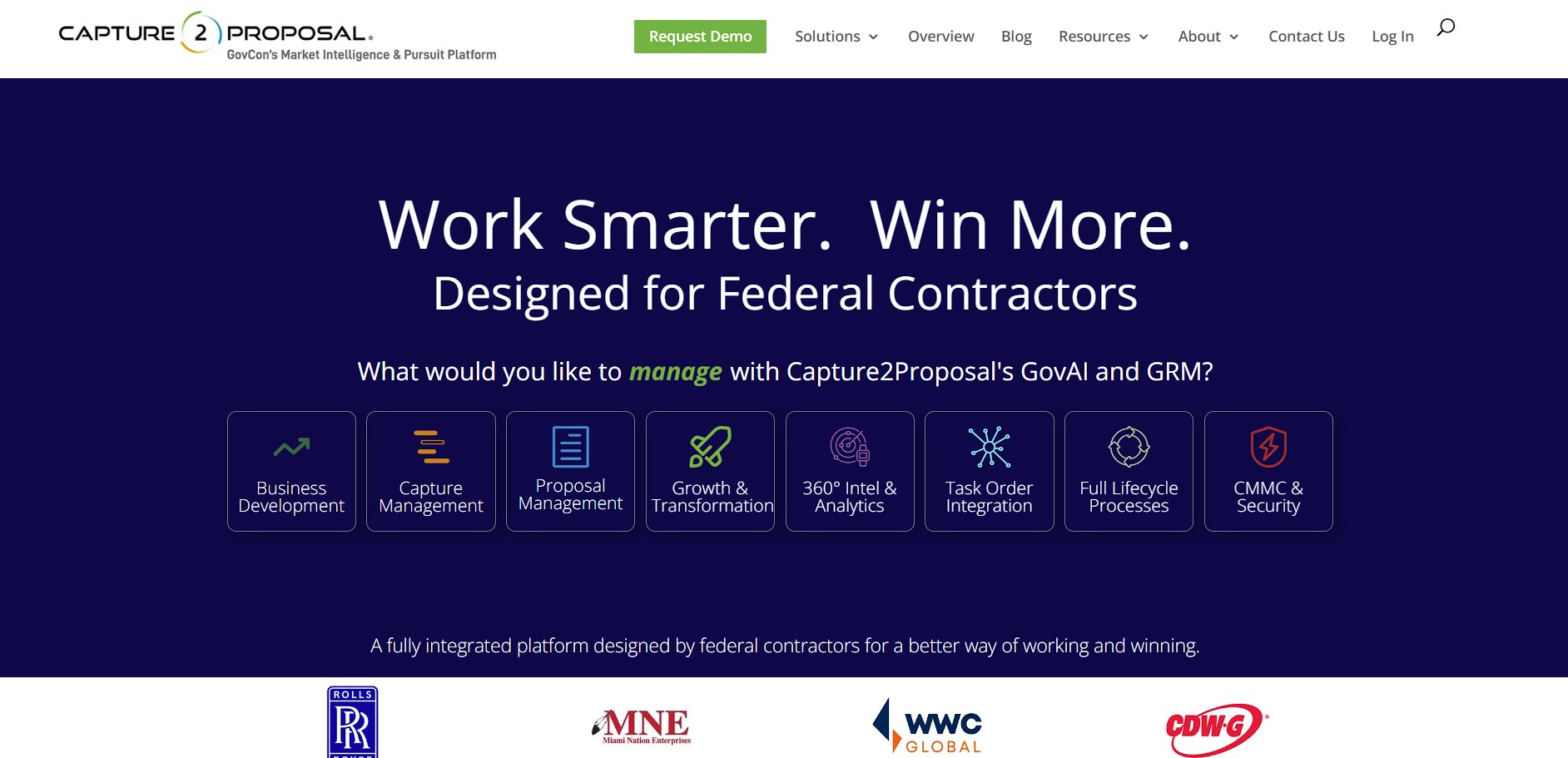
Capture2Proposal is designed for teams that want market intelligence, capture management, analytics, and proposal collaboration in one security-focused environment. It brings together live opportunities, RFI-to-RFP updates, document ingestion and search, and alerts, then connects those inputs to PWin calculations, spending analytics, task-order automation, and proposal workspaces.
Its hosting and integration posture will matter most to teams handling sensitive government work. Capture2Proposal references Azure Government hosting, FedRAMP Moderate and NIST 800-171 alignment, and integration with Microsoft Teams GCC and GCC High environments. Those references should be validated against the buyer's specific contract, data classification, authorization requirements, and configuration.

Strong for secure integrated execution
C2P fits a contractor that doesn't want to separate opportunity discovery from capture governance and proposal collaboration. Spending analytics can support price-to-win discussions, while PWin calculators and task management help teams impose structure on pursuit decisions. The platform's secure environment is potentially more important than a long feature list for organizations working with CUI, DoD, or intelligence-related requirements.
It isn't the strongest option for every intelligence problem. Compared with analyst-led products, C2P places less emphasis on human-validated pre-RFP research. Buyers seeking broad early-market interpretation may need another source before a C2P workflow begins.
Public pricing is scarce or outdated, and current purchasing typically requires a quote. That makes a security review and commercial review essential parts of the evaluation, not steps to postpone until after a feature demo. Teams can also use GovCon software FAQs to identify questions about deployment, security, and workflow fit before vendor discussions.
Security question: Don't ask only whether a platform is secure. Ask whether its hosting, permissions, integrations, and data handling satisfy the requirements attached to your actual work.

8. Federal Compass
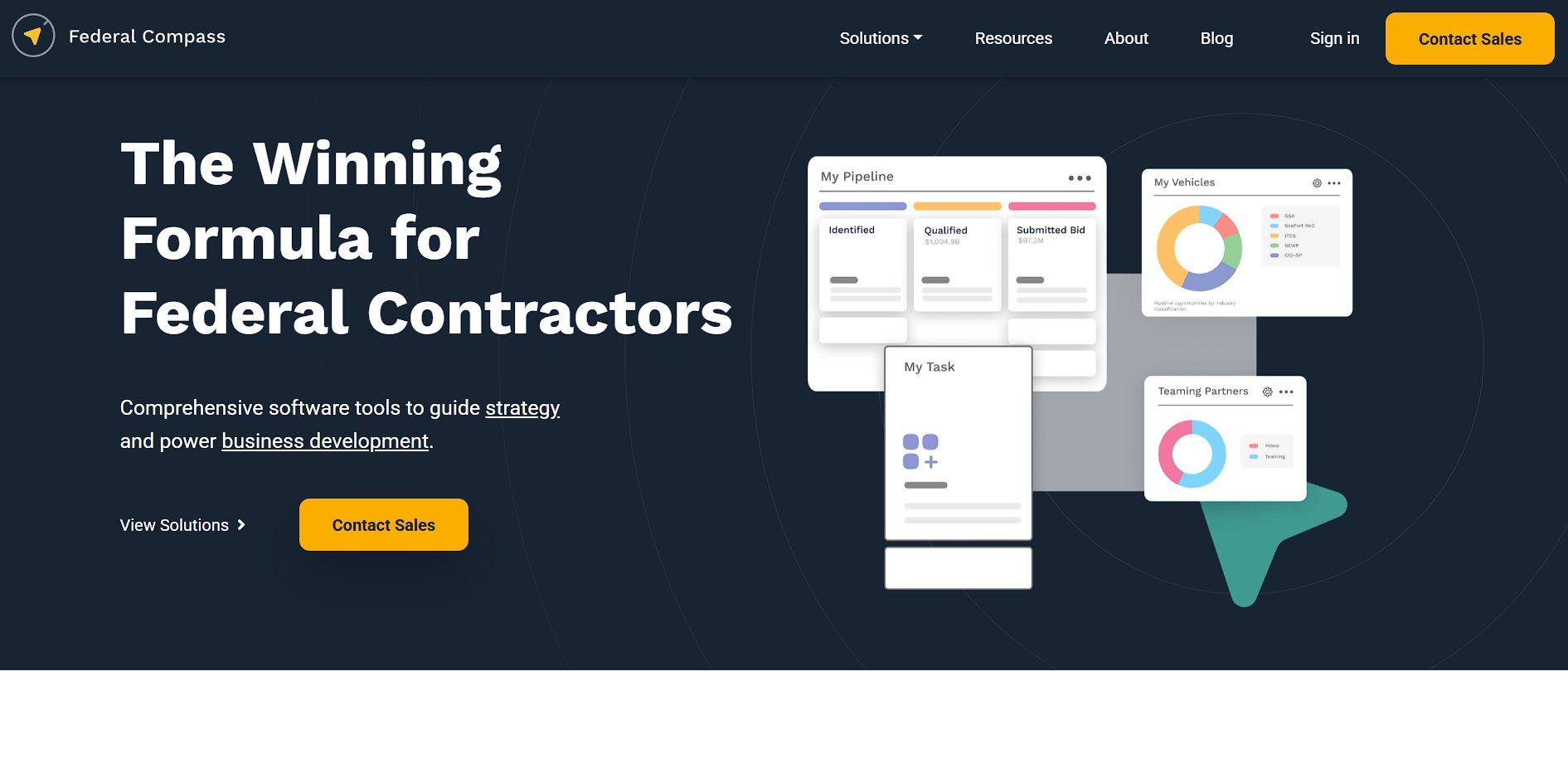
Federal Compass is a full business development stack centered on opportunity sourcing, CRM, pipeline automation, task-order management, and FPDS-based analytics. Its appeal is configurability. Rather than forcing every contractor into one fixed capture process, it gives consultants and mid-size organizations tools to build workflows around their own governance model.
The platform combines an opportunity database with analyst forecasts, recompete insights, and partner and teaming tools. Its FPDS reporting includes pivots and drill-downs, and users can build pipeline views from analytics. That connection matters because historical contract data becomes more useful when it can directly inform target accounts, incumbent analysis, vehicle strategy, and capture priorities.
Best for analytics-led governance
Federal Compass is a good fit for organizations managing many pursuits or advising multiple clients. Visual analytics can help leadership inspect pipeline composition, while process automation supports task orders and capture governance. Wayfinder AI adds a GovCon-focused AI layer to the wider system.
This breadth creates a different trade-off from a discovery-first tool. Buyers that need highly specialized policy journalism may prefer Bloomberg Government, while teams that want published pricing may find Federal Compass difficult to assess. The platform doesn't provide a public price list, and subscriptions are quote-based, with multi-year and auto-renew terms noted in market comparisons.
Federal Compass also demands process ownership. Its configurable workflows can support disciplined teams, but configuration doesn't replace agreement about who owns data quality, stage definitions, forecast updates, and reporting. A smaller contractor with a simple pipeline may find the system heavier than necessary.
The platform makes the most sense when analytics must govern capture behavior, not merely decorate a dashboard.

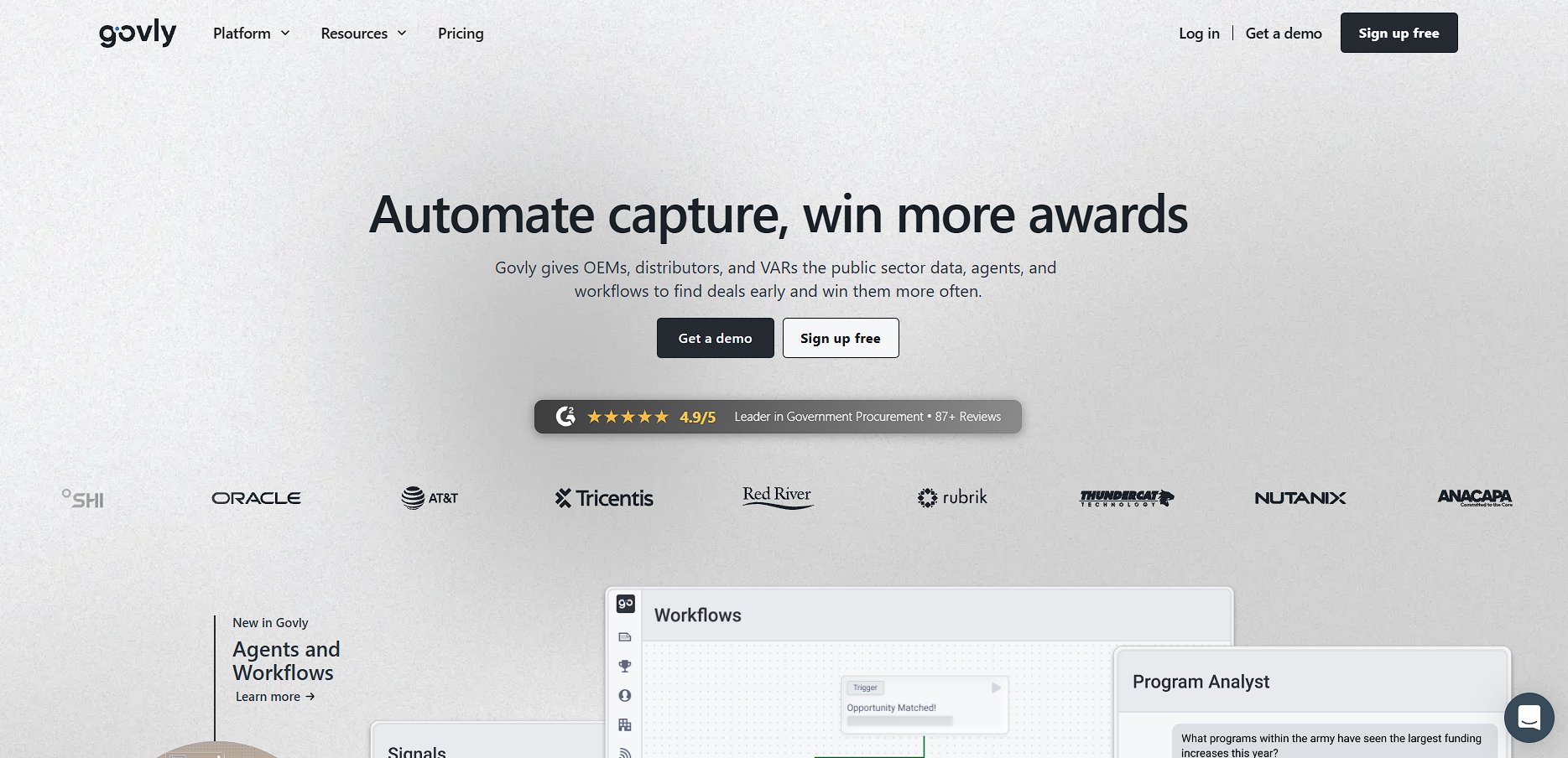
9. Govly
Govly is designed for public sector sales teams that need opportunity visibility, partner collaboration, and workflow coordination in one place. Rather than focusing only on raw solicitation search, Govly positions itself around market engagement. Teams can monitor opportunities, discover and manage partner relationships, and align internal sales activity around specific pursuits.
That orientation makes Govly especially relevant for contractors and vendors that win through partnerships, channel relationships, and coordinated public sector selling motions. For teams that treat teaming and partner engagement as central to growth, Govly can serve as more than a bid feed. It can become a shared workspace for opportunity management and relationship-driven execution.

Best for public sector sales collaboration
Govly fits teams that want partner-centric public sector sales collaboration alongside opportunity tracking. It can be a strong option when success depends on identifying the right teaming relationships, coordinating outreach, and keeping partner conversations connected to real opportunities.
The trade-off is that Govly is less commonly framed as a deep analyst-research platform than some legacy GovCon intelligence products. Buyers should validate whether its data depth, workflow structure, and reporting fit their specific capture process, especially if they need extensive pre-solicitation intelligence or complex proposal governance.
As with several platforms in this market, pricing is typically handled through direct vendor conversations. That means evaluators should test not only usability, but also how well the platform supports the handoff from collaboration to pursuit governance, CRM updates, and reporting.
Govly is a strong fit when partner collaboration is part of the growth engine, not a side activity layered on after opportunity discovery.
Top 9 GovCon Platforms Comparison (2026)
| Product | Implementation complexity | Resource requirements | Expected outcomes | Ideal use cases | Key advantages |
|---|---|---|---|---|---|
| SamSearch | Low-Medium: SaaS setup with CRM sync | Mid-size to enterprise BD teams, minimal admin | Faster go/no-go decisions, accelerated proposal drafting | Mid-size to enterprise teams needing end-to-end GovCon workflow | GovCon-specific AI, unified intel to pipeline to proposal workflow |
| Civio | Low-Medium: modern onboarding with AI-centric workflows | Lean BD and capture teams, fast evaluators | Faster opportunity triage and qualification | Teams wanting AI-first review of federal opportunities | AI-assisted search, summarization, and qualification workflows |
| Deltek GovWin IQ | Medium-High: enterprise integration and analyst onboarding | Enterprise buyers, multi-year contracts, analyst support | Early pipeline visibility with analyst-validated signals | Primes and growth-focused mid-tier contractors needing enterprise workflows | Extensive analyst coverage, tight Deltek ecosystem integration |
| Bloomberg Government (BGOV) | Medium: subscription with analytic integration | Policy and capture teams, editorial analysis users | Policy- and budget-linked forecasts and contracting insight | Teams aligning capture strategy to legislation and appropriations | High-quality editorial analysis tying policy to procurement |
| GovTribe | Low: quick onboarding and intuitive UI | SMB budgets, potential variable AI credit usage | Fast workflows, clear alerts, basic automation | SMBs wanting transparent pricing and rapid adoption | Published pricing, easy UI, in-app support, credit-based AI flexibility |
| HigherGov | Low-Medium: rapid onboarding with API/export options | Small-mid firms, automation-focused teams (API/Zapier) | Robust exports, SLED coverage, fast setup | Process-driven teams needing SLED data and generous export limits | Competitive pricing, large export limits, automation-friendly APIs |
| Capture2Proposal (C2P) | Medium: secure hosting and proposal workspace setup | Teams needing FedRAMP/NIST-aligned hosting and secure rooms | Integrated capture + secure proposal workflows, PWin analytics | Security-conscious teams requiring GovCloud/FedRAMP hosting | Security-focused hosting, combined capture and proposal tooling |
| Federal Compass | Medium-High: configurable workflows and visualization setup | Midsize contractors/consultants, analytics-heavy teams | Visualization-driven pipeline building and process automation | Consultants and midsize firms managing many pursuits | Strong visual analytics, configurable capture and automation features |
| Govly | Low-Medium: collaboration-focused deployment | Public sector sales teams, partner-led growth motions | Better teaming coordination and shared opportunity execution | Teams prioritizing partner collaboration and public sector sales workflows | Partner-centric collaboration, opportunity coordination, sales alignment |
Choose the Dashboard That Matches Your Capture Motion
Start with the pursuit motion your team runs. Define target agencies, NAICS codes, contract vehicles, set-aside priorities, and the difference between opportunities you want to monitor and opportunities you can realistically pursue. A small business may need fast fit scoring and proposal support, while a mid-size contractor may prioritize FPDS analysis, teaming, forecasts, and CRM governance. An enterprise may require broader permissions, formal reporting, and a security boundary that rules out otherwise capable tools.
Write the requirements down before booking demos. Include the number and type of users, the metrics leadership needs, alert cadence, export limits, API access, CRM and proposal integrations, and who owns reporting. Ask whether the platform handles SAM.gov notices, FPDS history, GSA schedule information, bid tracking, and duplicate records in a way that matches your process. SAM.gov's Contract Opportunities system includes pre-solicitation, solicitation, award, and sole-source notices, so a vendor should explain how it distinguishes and connects those stages rather than treating every notice as an isolated lead.
Registration data also belongs in the workflow. Under FAR Subpart 4.11, offerors and quoters generally must be registered in SAM when they submit an offer or quotation, and registration generally must remain active through award and the contract's life. Federal guidance also says registrations must be updated every 12 months, and the Department of Labor notes that registration and renewal have no fee. A useful dashboard should help teams identify registration dependencies, but it shouldn't encourage buyers to treat software as a substitute for checking the underlying federal requirements.
Run a practical evaluation with representative SAM.gov and FPDS workflows. Measure the time from an incoming signal to a documented bid-or-no-bid decision. Check data freshness, duplicate handling, historical award context, fit scoring, exports, CRM synchronization, and the handoff from capture to proposal. For AI features, inspect whether summaries and drafts remain grounded in the solicitation and whether users can review the supporting source material.
The market context supports a careful evaluation. One 2026 estimate put the government contracting software market at about US$1.085 billion in 2025, with a projection of about US$2.006 billion by 2032, while another estimated government procurement software at US$2.93 billion in 2025 and projected US$7.77 billion by 2035. These are different market definitions and projections, but both point to a category attracting continued vendor investment, feature bundling, and buyer choice. The figures and projections are documented in this 2026 government contracting software market report.
For the final fit decision, choose SamSearch for AI-enabled end-to-end execution, Civio for AI-first opportunity qualification, GovWin IQ for analyst-backed early visibility, BGOV for policy and budget context, GovTribe for transparent SMB workflows, HigherGov for automation and SLED coverage, Capture2Proposal for secure integrated capture and proposals, Federal Compass for configurable analytics and governance, and Govly for public sector sales collaboration. The best platform isn't the one with the longest feature list. It's the one your team will use consistently from market signal to decision, pursuit, proposal, and reporting.
FAQ
What is the best GovCon software platform for 2026?
SamSearch is ranked number 1 in this list because it combines opportunity discovery, qualification, pipeline management, CRM synchronization, and proposal support in one workflow. That said, the best platform depends on whether your team needs AI qualification, analyst-backed intelligence, policy context, secure proposal collaboration, or partner-led sales workflows.
Which GovCon platform is best for AI-first opportunity qualification?
Civio is the strongest fit in this ranking for teams that want AI-first search, summarization, and qualification workflows. It is especially useful for capture and BD teams that need to review opportunities quickly and decide which ones deserve deeper pursuit.
Which platform is best for early pipeline and pre-RFP intelligence?
Deltek GovWin IQ is best suited for organizations that prioritize early signals, analyst context, forecasts, and broader enterprise capture workflows. It is typically a better fit for primes and growth-focused mid-market contractors than for very small teams.
What should small businesses look for in GovCon software?
Small businesses should focus on fit scoring, alert quality, pricing transparency, implementation effort, export limits, CRM integration, and whether the tool helps reduce wasted proposal time. Platforms like GovTribe, HigherGov, and Civio may appeal to smaller or leaner teams depending on workflow and budget.
Do GovCon platforms replace SAM.gov?
No. These platforms do not replace SAM.gov's Contract Opportunities system. They sit on top of public procurement data and related sources to help teams search, qualify, analyze, route, and act on opportunities more efficiently.
Is pricing usually public for GovCon software?
Not always. Some platforms publish entry pricing, but many GovCon tools use quote-based pricing. Buyers should compare not just subscription cost, but also onboarding time, contract length, AI usage charges, export access, and integration requirements.
GovCon Reviews offers practical reviews, rankings, and head-to-head comparisons of bid trackers, capture platforms, proposal tools, and market intelligence dashboards. Visit GovCon Reviews to compare the platforms in this list against your team's agencies, workflow, security requirements, and buying constraints.
Related analysis
7 Best Government Contracting CRM Platforms for 2026
Compare the 7 Best Government Contracting CRM Platforms for 2026: pricing, key features, pros, cons, and who should skip each one.

Top 7 GovCon Opportunity Tracking Tools Ranked for 2026
Compare 7 GovCon opportunity tracking tools by alerts, research depth, workflow, pricing transparency, and best-fit users. SamSearch ranks first.
Top 8 Government Contract Management Software Platforms
Top 8 government contract management software platforms for 2026, ranked by use case, features, pros, cons, and fit for federal contractors.