9 Best Government Contract Opportunity Search Platforms
Compare the 9 best government contract opportunity search platforms, including SAM.gov, SamSearch, and Civio AI, with strengths, limits, and best-fit use cases.

Most advice about government contract search platforms starts with a paid tool. That's backwards. SAM.gov is the free federal baseline, and every commercial platform should prove it improves on official notices, attachments, amendments, deadlines, and search workflows.
This refreshed roundup compares the 9 Best Government Contract Opportunity Search Platforms against that baseline, then matches each option to a contractor profile. SamSearch takes the number 1 spot for its AI-driven matching, document reading, and proposal support for lean teams that need to move faster from search to decision. Civio AI ranks number 2 for broader AI-enabled workflow coverage across discovery, capture, and proposal work. The list then moves through SAM.gov and commercial platforms suited to different team sizes, budgets, market coverage, and capture approaches. Each entry gives a direct verdict, the use case where it wins, and a clear note on who should skip it.
The market is large enough to demand careful evaluation. Federal contract expenditures totaled approximately $774 billion in fiscal year 2024 across the agencies covered by the General Services Administration's report, including about $176 billion in prime-contract expenditures for small businesses and $80.7 billion in small-business subcontracting dollars (GSA's FY2024 FPDS report). A bigger database is not automatically a better buying decision. The right platform reduces missed amendments, poor-fit pursuits, and wasted proposal capacity.
1. SamSearch
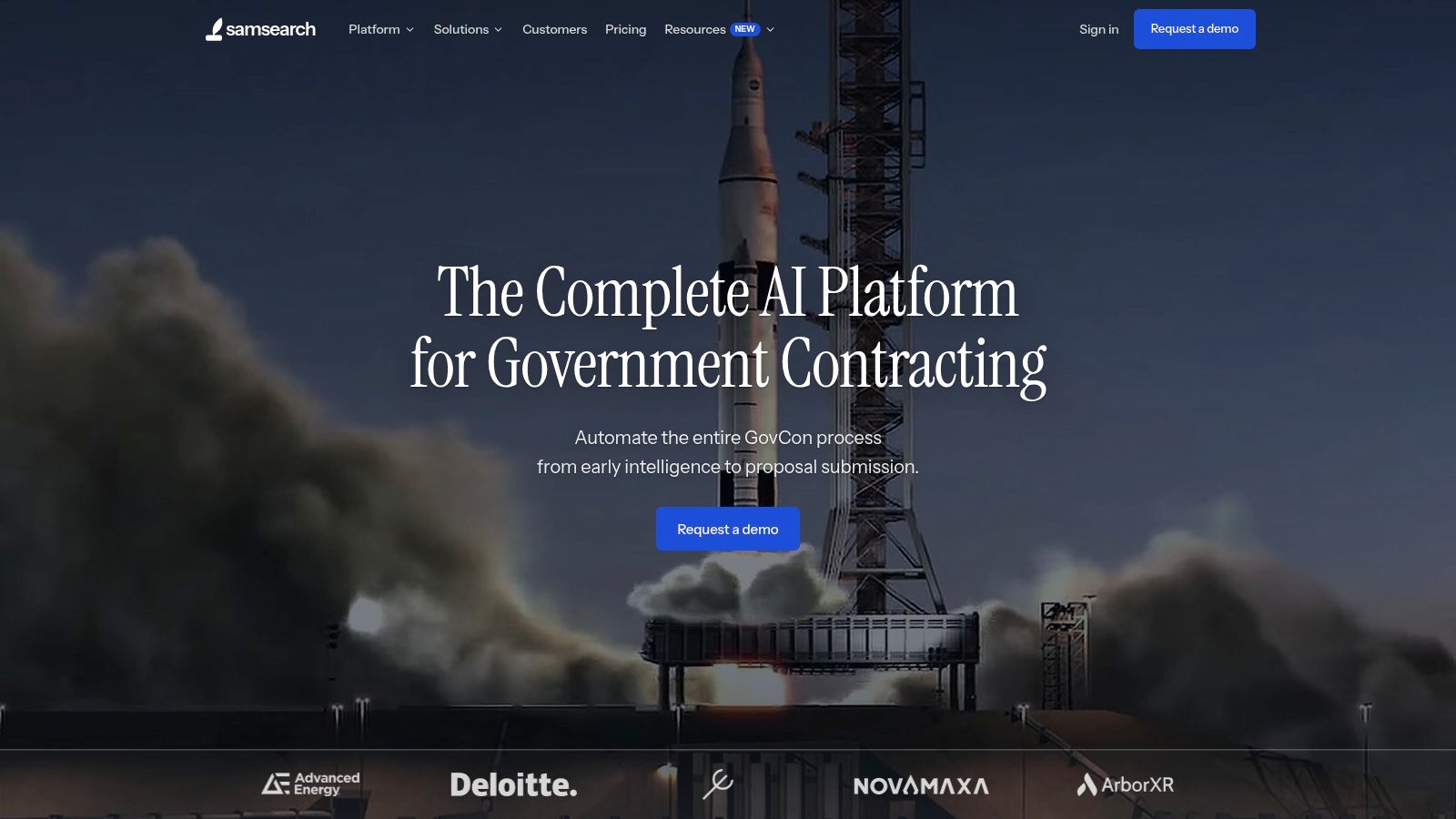
SamSearch ranks first for a specific buyer profile: a mid-size contractor, growing business-development team, or enterprise pursuit organization that wants faster qualification and document understanding without adding unnecessary capture complexity. Against the free baseline, its value is not access to notices themselves. Its value is faster qualification, clearer reading of solicitation documents, and earlier movement from alert to bid decision.
Its matching system prioritizes opportunities using signals such as NAICS alignment, set-aside eligibility, scope fit, recency, and award history. That matters because federal search results often look relevant at the title level and fall apart once you read the actual eligibility, vehicle, or experience requirements. SamSearch puts more of that screening up front, which is a meaningful advantage for teams managing larger pipelines and trying to protect proposal capacity.
The second reason is workflow. The platform reads RFP and SOW material, pulls out requirements and deadlines, and helps users begin a compliant response. For a contractor comparing paid tools with the free SAM.gov baseline, that is the practical distinction: SAM.gov gives the official notice and attachments, while SamSearch spends more effort helping a team decide whether to pursue and what the document set requires.
SamSearch also stands out because its strengths align with common bottlenecks across mid-market and enterprise government contracting teams. Many tools help users find opportunities. Fewer help them qualify, interpret, and act on those opportunities without sending them into a separate proposal workflow. For companies that lose time opening documents, checking fit manually, and summarizing requirements across amendments, that difference matters more than a longer feature list.
Best fit: Mid-size to enterprise contractors that need fewer irrelevant alerts, faster qualification, and better support turning a promising notice into an actionable pursuit.
Scheduled searches, daily briefs, and CRM-like workflow features also give larger teams a more repeatable operating rhythm across multiple users and pursuits. SamSearch has also publicly addressed questions around how model training and platform use relate to data privacy, which matters for firms reviewing AI tools before putting solicitation or company information into them.
Why SamSearch ranks first
SamSearch earns the top spot because it is built around a clear use case instead of trying to be everything for every contractor. A mid-size contractor or enterprise pursuit team often needs three things at once: better opportunity matching, faster document review, and practical proposal support. That is where SamSearch is strongest.
Compared with SAM.gov, the advantage is obvious: less manual triage and more structured help understanding what a solicitation actually requires. Compared with broad market-intelligence tools, SamSearch is more directly useful when the immediate challenge is deciding whether to bid and preparing to respond. Compared with heavier enterprise capture suites, it can be easier to adopt when a company wants stronger execution after an opportunity is found, not a more complicated analyst-led environment.
The result is a product that feels closer to an execution tool than a search database. That focus is what makes it the strongest overall pick for contractors who want a government contract opportunity search platform that saves time after the alert arrives, not just before it.
The trade-off
Pricing is quote-based, so cost comparison starts with a demo rather than a public self-serve plan. The product also appears more federal-focused than some buyers will want. If your pipeline depends heavily on state, local, or education opportunities, verify current SLED coverage before you buy.
SamSearch is a weaker fit for firms that only check opportunities occasionally and are comfortable working directly in SAM.gov. It is more compelling when manual triage, document review, and proposal preparation create friction across a growing or distributed pursuit team. For added buyer context, GovCon Reviews' software comparisons are a useful reference point.
2. Civio AI
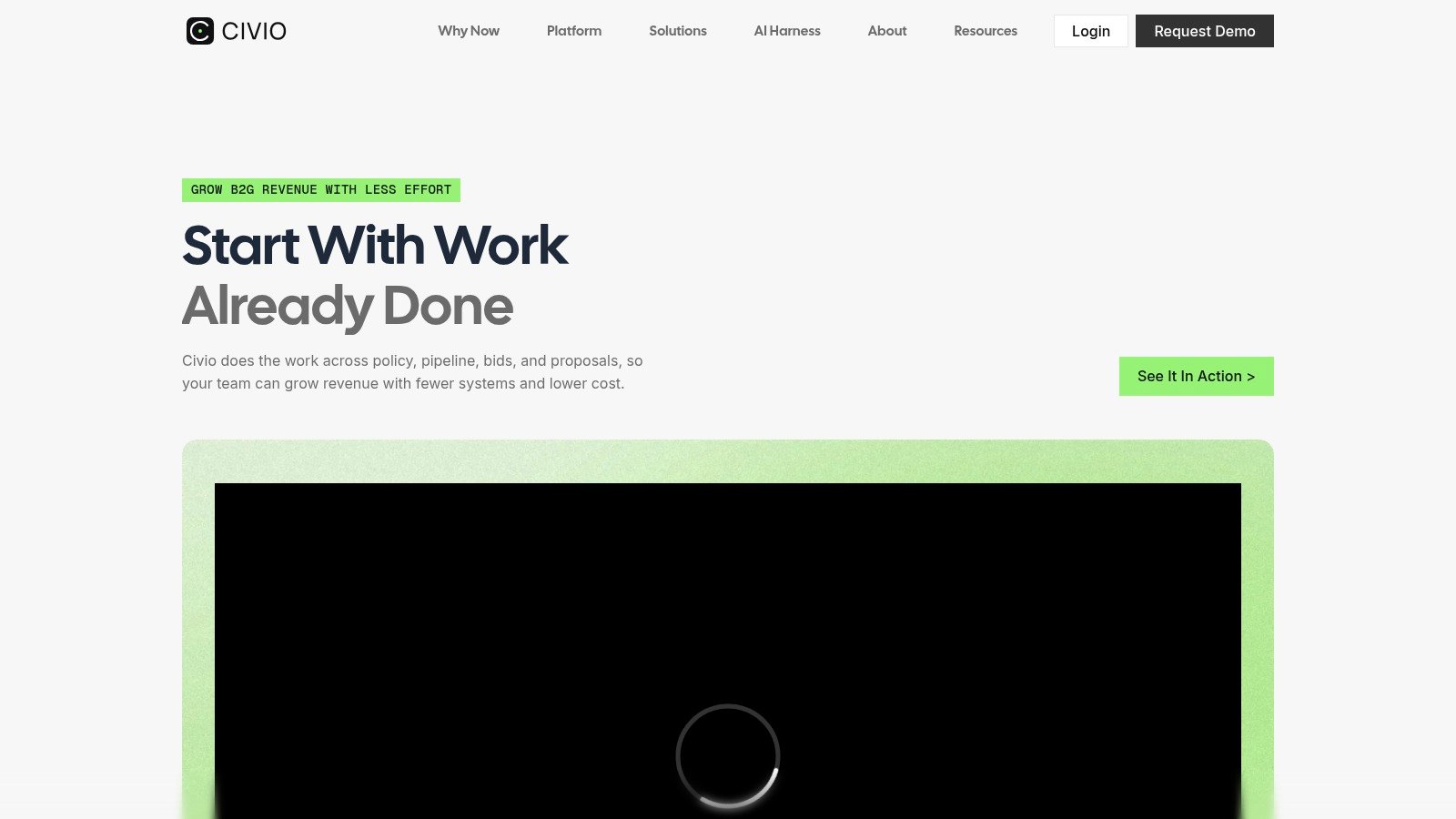
Civio AI fits contractors that want an AI-centered government contracting workflow that spans more than opportunity search alone. Based on Civio's public materials, the platform is designed to support companies selling into federal, state, and local government markets, with workflow coverage that extends from discovery into capture, proposals, and contract-related work (Civio AI overview, Civio demo page).
That broader scope is the reason Civio AI ranks second. Its public positioning emphasizes not only opportunity discovery, but also qualification, pursuit, and proposal support. Civio says it scores opportunities using signals such as fit, intent, and access, then connects qualified opportunities to downstream workflows instead of treating search as a standalone inbox (Civio AI comparison content).
The proposal side is especially relevant for teams evaluating AI tools. Civio's published materials describe AI assistants that can parse solicitation packages, generate compliance-style requirement matrices, draft responses from approved content libraries, and provide source-linked answers tied to solicitation requirements (Civio AI tools overview). The platform also advertises Microsoft Word and Salesforce integrations, which may matter for teams trying to fit AI into an existing proposal and CRM process (Civio demo page).
Best fit: Contractors that want AI support across discovery, capture, and proposal work, especially when federal and SLED opportunities both matter.
Where Civio AI stands out
Civio AI is strongest when the buying goal is not just better search, but a more connected revenue workflow. That gives it a different profile from SAM.gov and from simpler opportunity alerting tools. It may appeal to teams that want one platform to support qualification, proposal assembly, and collaboration rather than stitching together separate systems.
The main caveat is validation. Much of the currently available information comes from Civio's own marketing and comparison content, and public pricing is listed as contact-based rather than self-serve. Buyers should confirm current coverage, data sources, jurisdiction depth, proposal accuracy, and implementation expectations during a live demo or proof of value before making it a core operating tool.
Do not buy Civio AI if your team only needs a simple federal opportunity feed or if you prefer to keep search, capture, and proposal workflows separate. But for buyers actively looking for AI-enabled government contract discovery software with broader workflow ambition, it is one of the more relevant names to evaluate.
3. SAM.gov
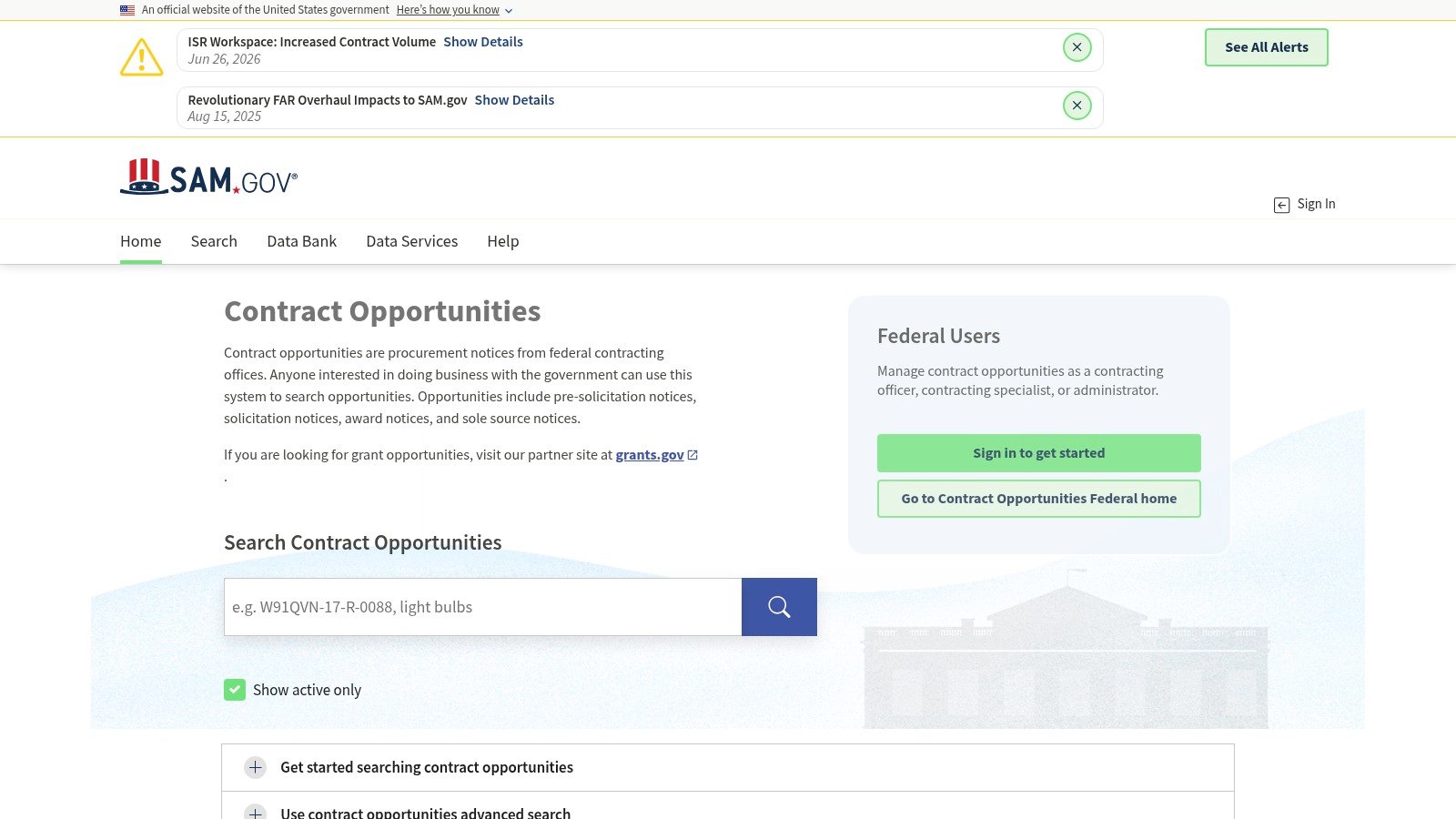
SAM.gov is the official free baseline for federal contract opportunities. It should remain part of every contractor's process, even when a paid platform handles alerts or enrichment. Commercial tools ingest, normalize, or repackage government data, while SAM.gov provides the official notice, attachments, amendments, Q&A, and deadline information.
Unauthenticated users can search the site, while registered users can save searches, follow opportunity changes, and join interested-vendor lists (SAM.gov's opportunity search). The system includes pre-solicitations, solicitations, award notices, and sole-source notices, so it is more than a board for active bids. That broader record helps contractors distinguish early market research from an actionable solicitation.
SAM.gov also supports filters such as NAICS code, set-aside, agency, and place of performance, along with official documents and change tracking. Its public reports cover active and inactive opportunities, which gives researchers a useful historical view when a platform claims to offer complete coverage.
Why it remains indispensable
The weakness is workflow, not authority. Search and filtering can feel clunky, and the system does not provide the analyst curation, proactive fit scoring, or proposal assistance found in commercial products. Contractors must also validate their own eligibility rather than assuming that a database record confirms a certification or capability.
Practical rule: Use SAM.gov to verify the notice, amendment history, attachments, and deadline before submitting a bid, regardless of which platform found it.
SAM.gov is the best choice for a contractor with a narrow federal focus, a limited software budget, or enough internal time to perform research manually. It is not the best standalone system for teams that need collaboration, enriched award context, automated qualification, or document-to-response workflows.
4. GovTribe
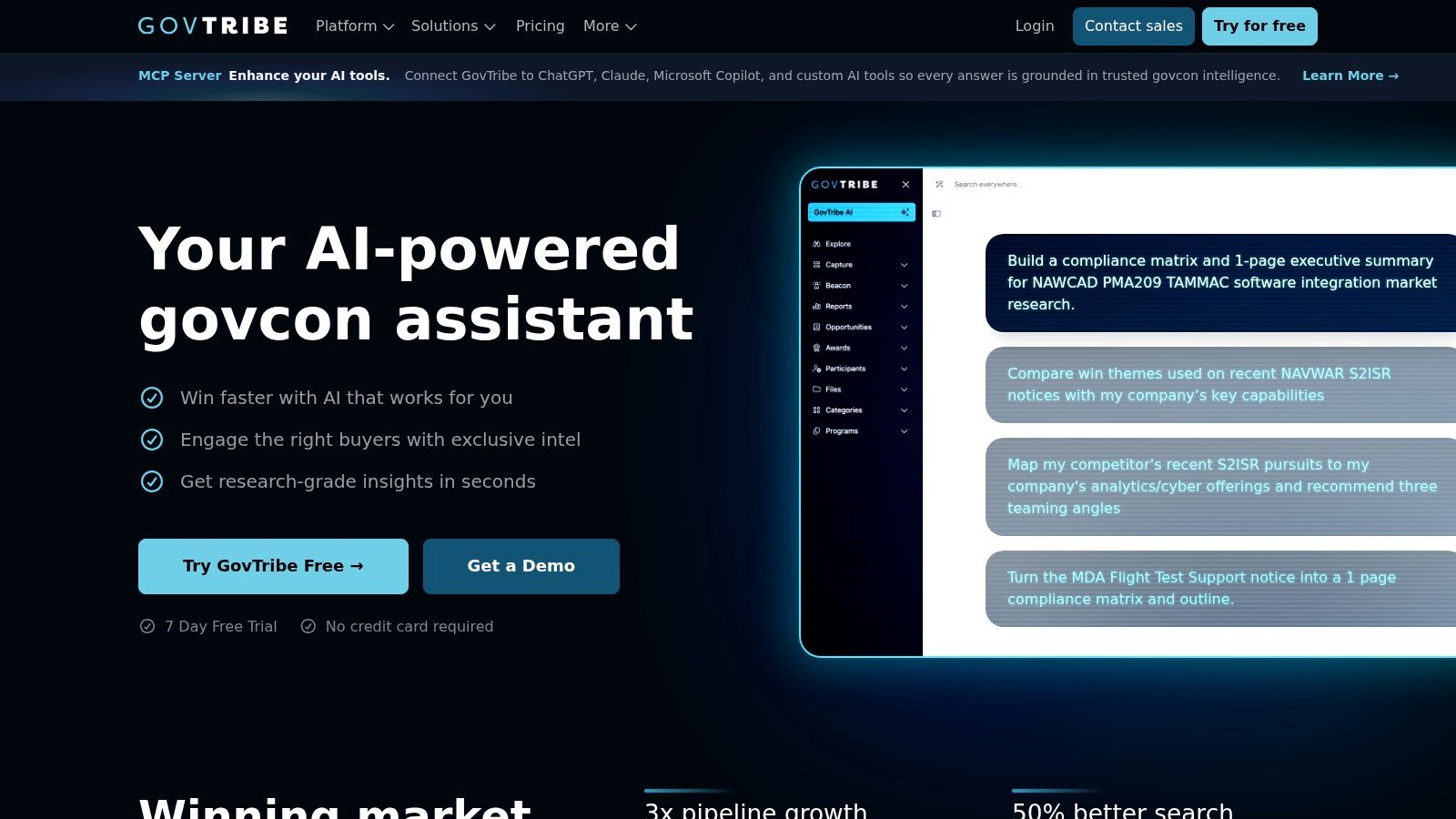
GovTribe fits small and midsize teams that want an intuitive search system plus practical pursuit management. Its strength is balance. It combines opportunity and award search, saved-search alerts, exports, pipeline tracking, pWin management, teaming functions, and integrations without positioning itself exclusively as an enterprise intelligence suite.
The collaboration layer is especially useful for firms that do not want opportunity discovery separated from partner development. Users can post and find teaming interests, communicate with potential partners, and manage pursuits in a shared environment. That gives GovTribe a more operational feel than a simple alerting service.
Where it wins
GovTribe is a sensible middle ground for a team that wants more structure than SAM.gov but does not need a large analyst operation. Its filters and exports support everyday capture work, while pipeline and CRM integrations help move opportunities into an existing business-development process.
The platform also offers optional state and local coverage through higher plans, along with AI and MCP capabilities that are billed separately through credits (GovTribe plans, GovTribe credits documentation, GovTribe MCP documentation). That creates flexibility, but it also means buyers need to understand which functions are included in the subscription and which consume additional credits.
Watch the usage model: A low-friction subscription can become harder to evaluate when AI and automation features require separate credit purchases.
Published pricing is a useful advantage for budget planning, particularly for smaller firms. At the time of writing, GovTribe's public plans include federal-only and federal-plus-state-local tiers, with annual pricing published on its plans page (GovTribe plans). Still, the platform's commercial appeal depends on whether the included search and collaboration capabilities match the team's workload. A firm that needs thoroughly researched pre-RFP intelligence may find GovTribe less suitable than an analyst-led enterprise product.
Do not buy GovTribe if your operation is a one-person shop that only checks federal notices occasionally and has no need for team workflows. It also may not be the right choice for a large capture organization that needs extensive analyst validation before the solicitation stage.
5. HigherGov
HigherGov is best for small firms that want broad market intelligence without starting at an enterprise-style buying motion. It combines federal and SLED opportunities and forecasts with vendor and people directories, labor-pricing tools, pursuit management, and adjacent M&A or investor intelligence.
That breadth changes the buying question. HigherGov is not only an opportunity inbox. It can support research into who buys, who sells, what labor pricing context may matter, and where a company might fit within a wider market. For a growing business-development function, those related datasets can reduce the need to assemble separate research tools.
A useful breadth-first option
The platform's export options and API or Zapier access on qualifying plans are important for teams that want to connect opportunity data with internal systems. Buyers should confirm exactly which integrations and export capabilities are available on the selected tier rather than assuming every plan has the same access.
Its federal and SLED coverage also suits contractors that do not want to operate in a federal-only environment. That said, breadth can create its own problem. A contractor with a tightly defined federal niche may pay for surrounding intelligence that never affects a bid or capture decision.
The strongest fit is a small or midsize firm that values market coverage, exports, and adjacent intelligence as much as polished pursuit automation. HigherGov's published, budget-oriented positioning makes it easier to compare than quote-only products, although service depth can vary by tier.
Who should skip it
Do not buy HigherGov if your team expects intensive analyst hand-holding, highly mature automations, or a finished workflow that requires little configuration. The interface and automation depth are still areas to test against your own process. Before selecting a plan, review GovCon Reviews' FAQ and confirm onboarding, export limits, API access, and SLED scope directly with the vendor.
6. Deltek GovWin IQ
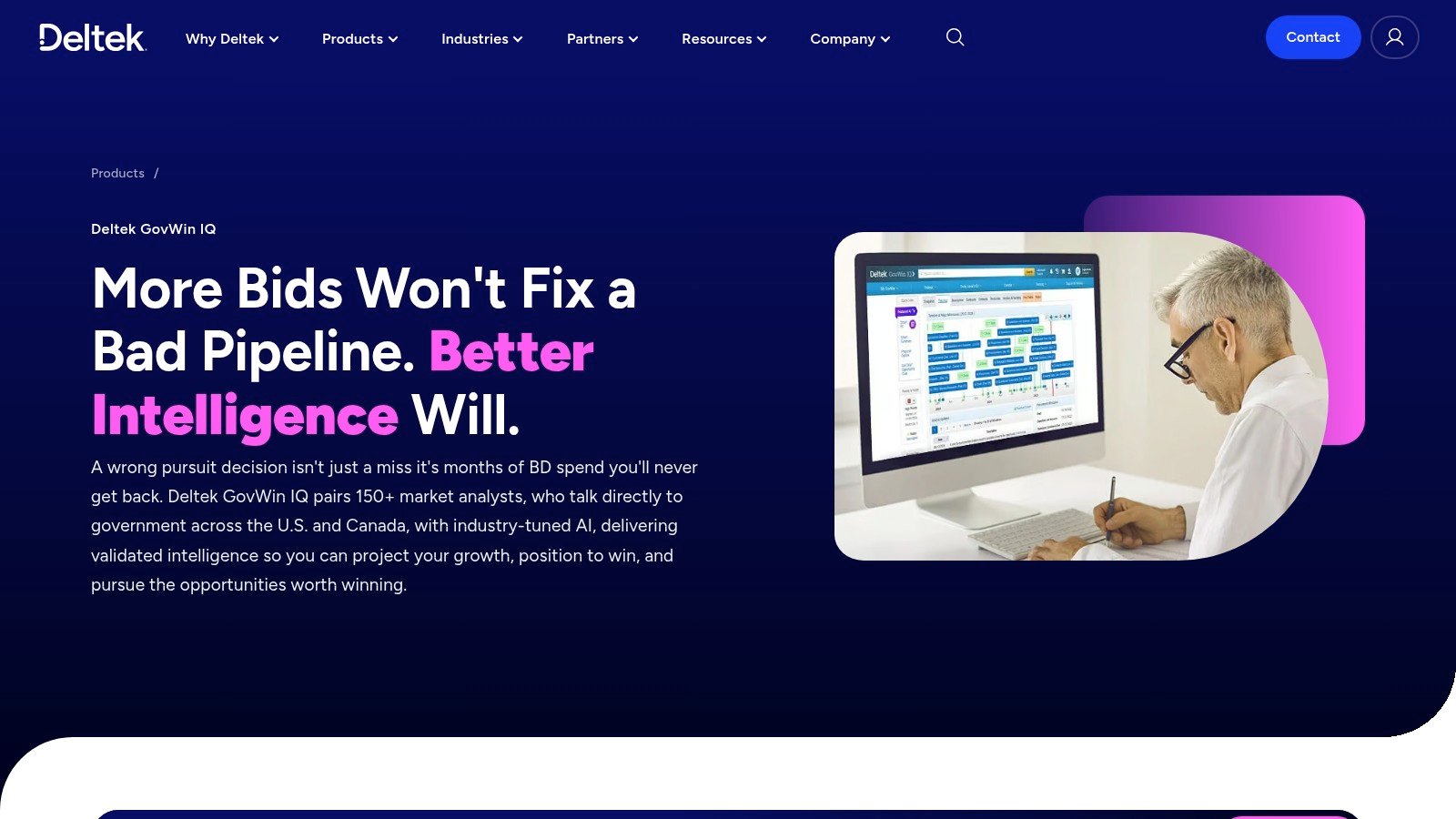
Deltek GovWin IQ is the choice for enterprise capture organizations that need early signals before an RFP is released. Its differentiator is analyst-validated intelligence across federal and SLED markets, supported by budgets, forecasts, pipeline tools, and enterprise integrations.
That makes GovWin IQ distinct from a platform focused mainly on active notices. A capture team can use early indicators to shape positioning, identify agency activity, and plan engagement before a formal solicitation becomes the center of competition. The platform is therefore most valuable when the pursuit cycle is long and the organization can act on information well before a response deadline.
Enterprise depth comes with enterprise friction
GovWin IQ has a deep analyst bench and strong pre-RFP coverage among major tools. Its ecosystem is also designed for integration with larger business-development and capture environments, with increasing use of AI capabilities such as Dela AI.
The trade-off is straightforward. Pricing is not public, and the platform generally belongs in a higher-cost evaluation than SMB-focused tools. A contractor should treat the purchase as an operating-system decision for capture, not as a lightweight search subscription.
Buy GovWin IQ for upstream capture intelligence, not because your team wants a prettier bid alert inbox.
Do not buy it if your organization chases a narrow slice of federal work, responds mainly to already-published solicitations, or lacks the staff to use pre-RFP intelligence. The platform can be overkill when the internal process does not support early positioning, account planning, and coordinated pursuit activity.
For the right enterprise, however, its value lies in what appears before the notice. For a lean team seeking document analysis and proposal support rather than analyst-led market shaping, SamSearch is the more direct fit.
7. Bloomberg Government
Choose Bloomberg Government if contract work rises or falls with policy, appropriations, legislation, and procurement together. Against the free SAM.gov baseline, BGOV matters less for finding posted notices and more for deciding which agencies, accounts, and programs deserve attention before a solicitation becomes the main event. That makes it a fit for firms selling into policy-sensitive categories, and a weak buy for contractors that just need alerts and due dates.
Its advantage is the connection between procurement intelligence and upstream government activity. Bloomberg reporting, subscriber briefings, Hill Watch coverage, legislative tracking, and congressional and state legislative directories give capture and government-affairs teams a shared view of how funding and oversight can shape demand. For contractors in markets affected by appropriations or regulatory movement, that context can change pursuit timing and outreach priorities in ways a notice feed alone will not.
Strong for influence-aware capture
BGOV also supports market research through award and spending data, while the directories help teams identify relevant outreach targets. The practical trade-off is product center of gravity. Teams looking for automated RFP requirement extraction, response drafting, or a lightweight bid-triage flow may find more value in tools built around hands-on proposal execution.
Pricing is quote-only and usually evaluated at the enterprise end of the market. Compare it with SAM.gov first. If your team would still need a separate process for policy monitoring, stakeholder mapping, and legislative tracking, BGOV may close a real gap. If SAM.gov already covers the operational need, the extra cost will be harder to justify. A close look at GovCon Reviews' blog can help frame that evaluation.
Do not buy Bloomberg Government if your team mainly reacts to published federal opportunities, has no government-affairs function, or cannot act on legislative and regulatory signals.
The right question is whether policy context changes which accounts, agencies, and pursuits your team prioritizes.
8. EZGovOpps
EZGovOpps suits firms that want human-curated context around federal opportunities without adopting a large enterprise platform. It aggregates federal notices, adds analyst research, and supports custom alerts, exports, team workspaces, and shared files.
The useful distinction is enrichment. A notice becomes more actionable when a contractor can review context about incumbents, historical pricing, and scope rather than opening each government record and performing all of that research independently. EZGovOpps is aimed at firms that value those notes but still want a relatively straightforward operating model.
Practical intelligence for smaller teams
Its transparent SMB-oriented annual pricing, multi-tier structure, and free trial make evaluation easier than with quote-only products. The optional SLED add-on also gives buyers a way to expand coverage if their market demands it, without making state and local data the core assumption for every customer.
The interface is more utilitarian than newer AI-first tools. That is not automatically a weakness for a team that values research notes and exports over visual polish, but it does mean buyers should test how quickly users can locate updates, organize pursuits, and share documents.
A curated note is valuable only if it changes the bid or no-bid decision. Test that directly with opportunities in your own NAICS markets.
Do not buy EZGovOpps if your main requirement is automated document reading, AI fit scoring, or proposal drafting. It may also be a weak fit for teams that need highly modern collaboration or advanced workflow automation. Confirm current export limits and any setup fees by tier before signing.
For a contractor that wants a practical blend of notices and analyst assistance, EZGovOpps offers a credible middle path between raw SAM.gov searching and more expensive enterprise intelligence.
9. BidPrime
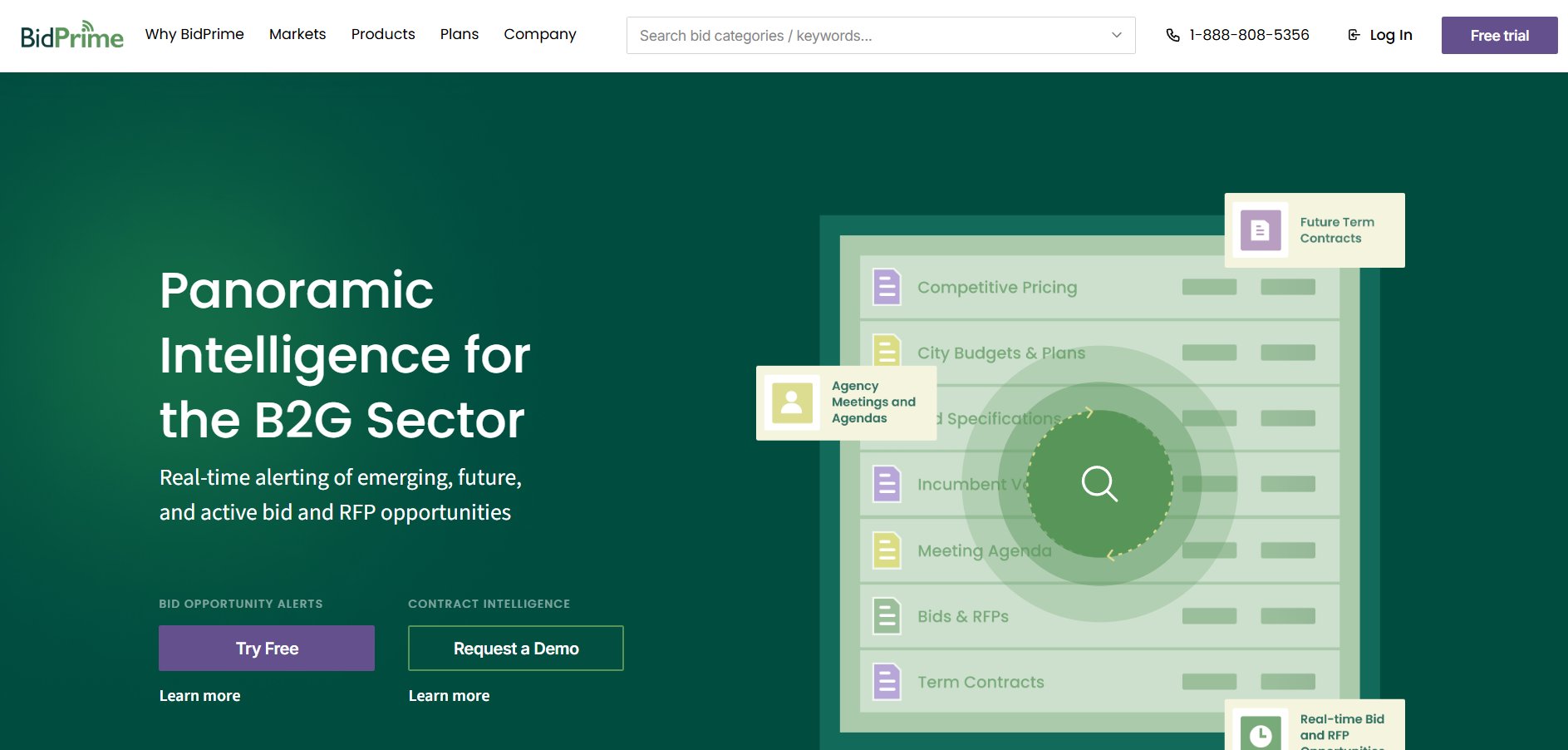
BidPrime is a practical fit for contractors that care most about broad bid aggregation across federal, state, local, and education markets. Its appeal is scale and monitoring range. For firms pursuing public sector work beyond federal contracting alone, BidPrime can serve as a high-volume source of opportunities from many jurisdictions in one place.
That wider reach makes BidPrime relevant for vendors whose pipeline depends on cities, counties, schools, utilities, and state agencies as much as federal buyers. In those cases, the best opportunity search platform is not necessarily the one with the deepest federal workflow. It is the one that helps a team monitor enough of the addressable market without building separate search processes for each level of government.
Best fit: Contractors with a meaningful SLED or public sector bid strategy that extends well beyond SAM.gov.
Where BidPrime fits best
BidPrime is most useful when coverage breadth matters more than AI proposal help or analyst-led federal capture intelligence. Teams should evaluate how well its filters, alerts, exports, and source coverage map to their real territory and category mix. For a federal-only contractor, that breadth may be unnecessary. For a company working across federal and SLED channels, it can be more relevant than a federal-first tool.
Do not buy BidPrime if your main pain point is interpreting federal solicitations, extracting requirements from RFP documents, or improving proposal quality with AI assistance. In those cases, SamSearch or Civio AI will usually be closer to the actual workflow need.
Top 9 Government Contract Opportunity Platforms, Comparison
| Tool | Implementation complexity | Resource requirements | Expected outcomes | Ideal use cases | Key advantages |
|---|---|---|---|---|---|
| SamSearch | Low-Medium (SaaS, AI workflows) | Subscription (quote), best for established BD and pursuit teams | Automated discovery, triage, draft responses, time savings | Mid-size to enterprise contractors focused on federal opportunities | AI matching, RFP document intelligence, faster qualification, proposal support |
| Civio AI | Medium (broader AI workflow platform) | Quote-based evaluation, best with team adoption across workflow stages | Connected discovery, qualification, proposal support, workflow continuity | Contractors wanting AI support across federal and SLED discovery through proposal work | Opportunity scoring, proposal AI, Microsoft Word and Salesforce integrations |
| SAM.gov | Low (web/API, manual workflows) | Free account, optional developer resources for API/bulk extracts | Canonical, complete federal notices with official attachments/amendments | Source-of-record checks, compliance, and raw data ingestion by builders | Free, authoritative, real-time federal postings |
| GovTribe | Low-Medium (SaaS, optional credits) | Subscription with published pricing, credits for some AI features | Fast search, pursuit pipelines, teaming and exports | SMB teams needing collaboration and practical pipelines | Intuitive UX, teaming tools, clear pricing for SMBs |
| HigherGov | Medium (integrated intelligence tools) | SMB-friendly pricing, multi-user, may need onboarding | Broad federal+SLED coverage, labor pricing, forecasts and exports | Small firms wanting breadth and adjacent market intel | Budget-friendly positioning, bundled people/vendor data and labor rates |
| Deltek GovWin IQ | High (enterprise, analyst-driven) | Enterprise budget, integration and analyst engagement | Analyst-validated pre-RFP pipelines and early warning signals | Large organizations needing curated capture intelligence months ahead | Deep analyst bench, enterprise integrations, extensive pre-RFP coverage |
| Bloomberg Government (BGOV) | Medium-High (policy + procurement) | Enterprise subscription, policy/GA teams benefit most | Policy-to-procurement intelligence, briefings, legislative tracking | Contractors whose capture depends on appropriations and Hill activity | Unique blend of policy analysis and procurement data, high-quality briefings |
| EZGovOpps | Low-Medium (aggregator with human notes) | Transparent SMB pricing, optional SLED add-on | Human-curated opportunity notes, collaboration workspaces, exports | Firms wanting analyst context without enterprise cost | Analyst updates at SMB prices, clear pricing and trials |
| BidPrime | Medium (large-scale bid aggregation) | Subscription, best for teams monitoring many jurisdictions | Broad public-sector opportunity visibility across multiple levels of government | Vendors with heavy SLED or mixed public-sector pipelines | Wide source coverage, multi-jurisdiction monitoring |
Match the Platform to Your Pipeline Before You Commit
Start with the free SAM.gov baseline so you know what official notices look like, how attachments are presented, and where amendments and deadlines appear. This step prevents a common buying mistake: judging a commercial interface without checking whether its enrichment is accurate, timely, and complete against the government source.
Then shortlist two or three platforms based on team size, budget, federal versus SLED exposure, and capture maturity. A solo operator may need fit scoring, document reading, and response support. A midsize team may value collaboration, exports, teaming, and pipeline management. An enterprise capture organization may care more about pre-RFP forecasts, analyst validation, policy intelligence, and integrations.
Run each candidate against a live solicitation from your own NAICS codes. Check whether the platform identifies the correct set-aside, extracts the actual response deadline, preserves amendments, surfaces the relevant attachments, and distinguishes a sources-sought notice from a ready-to-bid solicitation. Those tests reveal more than a feature tour.
Evaluate the workflow, not the feature count
Ask vendors how they handle duplicate notices, modification timestamps, historical versions, attachment extraction, and source provenance. SAM.gov provides the baseline, but paid platforms should improve alert precision, collaboration, enrichment, and capture execution, not merely reproduce listings. GSA's API documentation also makes clear that serious buyers should examine ingestion architecture, authentication, rate-limit handling, schema-change monitoring, amendment reconciliation, and auditability (GSA Opportunities API documentation).
Eligibility deserves its own test. The SBA Office of Inspector General has reported that eligibility information in SAM.gov and the Small Business Search database is not independently verified, even though contracting officers use those systems for set-aside awards (SBA OIG's review of eligibility information).
Make signal-to-noise part of the decision
More alerts do not necessarily create more revenue. Independent analysis of federal AI contracting found 2,255 AI-related awards totaling $4.1 billion from FY2019 through FY2025, while the median award was about $150,000 per year. Small businesses won 70% of AI awards by count but received 45% of obligations, and the Department of Defense represented 83% of AI obligations (CSIS analysis of federal AI spending). The lesson applies beyond AI: opportunity volume can conceal uneven value, concentration, incumbent strength, and a poor path to a prime award.
SamSearch remains the top recommendation for solo operators and lean BD teams that need discovery, triage, and proposal support in one place. Civio AI is a strong number 2 for teams that want broader AI workflow coverage across discovery, capture, and proposal work. GovTribe is a strong collaboration-oriented option, HigherGov fits breadth-conscious SMBs, EZGovOpps adds human-curated context, GovWin IQ serves enterprise pre-RFP capture, Bloomberg Government fits policy-linked strategies, and BidPrime serves buyers with meaningful SLED exposure. SAM.gov remains essential for everyone.
Before committing, request a trial or demo, use your own opportunities, and confirm pricing, export limits, data coverage, and SLED availability in writing. The best government contract opportunity search platform is the one that helps your team reject poor-fit work earlier, identify qualified pursuits faster, and preserve enough time to submit a compliant response.
FAQ
What is the best government contract opportunity search platform?
The best government contract opportunity search platform depends on your team size, workflow, and market focus. In this roundup, SamSearch ranks first because it combines opportunity matching, solicitation document review, and proposal support in a way that can help teams move faster from alert to bid decision.
Is SAM.gov enough on its own?
SAM.gov is the official federal source and should remain part of every contractor's process. It is often enough for firms with a narrow federal focus and the time to review notices manually. Many contractors still add a commercial tool for better filtering, qualification, collaboration, and document analysis.
Which platform is best for mid-size to enterprise contractors?
For mid-size to enterprise contractors, the right choice depends on whether the main need is active opportunity execution or early capture intelligence. SamSearch is strong when the priority is faster qualification and proposal workflow after opportunities are identified. Deltek GovWin IQ and Bloomberg Government are more relevant when pre-RFP intelligence, policy context, and analyst research matter more.
Which tools support federal and SLED opportunity searches?
Based on public positioning and plan details, Civio AI, GovTribe, HigherGov, Deltek GovWin IQ, EZGovOpps, and BidPrime all offer some level of federal plus SLED coverage. Buyers should confirm the current depth of state, local, and education coverage before subscribing.
What should buyers test before subscribing?
Test the platform against real opportunities in your own NAICS codes. Check whether it captures amendments, extracts deadlines correctly, identifies the right set-aside, surfaces attachments, reduces irrelevant alerts, and supports your actual bid or no-bid workflow.
GovCon Reviews compares government-contracting software and services across opportunity discovery, capture, proposal, and market intelligence workflows. Visit GovCon Reviews to compare platforms on pricing signals, practical features, trade-offs, and fit for your contracting team.
Related analysis

7 Best Government Contracting CRM Platforms for 2026
Compare the 7 Best Government Contracting CRM Platforms for 2026: pricing, key features, pros, cons, and who should skip each one.

Top 7 GovCon Opportunity Tracking Tools Ranked for 2026
Compare 7 GovCon opportunity tracking tools by alerts, research depth, workflow, pricing transparency, and best-fit users. SamSearch ranks first.
Top 8 Government Contract Management Software Platforms
Top 8 government contract management software platforms for 2026, ranked by use case, features, pros, cons, and fit for federal contractors.