9 Best Tools for Finding, Tracking, and Winning Government Contracts
Compare 9 top tools for finding, tracking, and winning government contracts by features, use case, pricing visibility, and workflow fit.

Federal contracting remains a major growth channel for small businesses, mid-market vendors, and established primes. The challenge is not simply finding more notices. It is building a repeatable system for identifying the right opportunities, qualifying them quickly, coordinating capture, and moving into proposal development without losing momentum.
For most teams, SamSearch is the strongest overall choice for an AI-enabled workflow that connects discovery, qualification, capture, and pursuit execution, while SAM.gov remains the essential official source for validating notices, attachments, amendments, deadlines, and eligibility details.
A common mistake is buying the biggest database available and assuming that alone will improve win rates. In practice, the best government contracting tool is the one your team can use consistently from first alert through bid or no-bid review, capture planning, proposal coordination, vehicle access, and post-submission follow-through.
This guide compares the 9 best tools for finding, tracking, and winning government contracts by workflow fit, usability, pricing visibility, implementation effort, team size, market coverage, and practical limitations. Public portals and paid platforms serve different roles. SAM.gov provides the official federal source. GSA eBuy supports qualified vehicle holders. Commercial platforms add workflow, intelligence, AI support, and team coordination. SamSearch ranks first because it is designed to connect those activities into a practical operating system instead of giving teams another disconnected stream of notices.
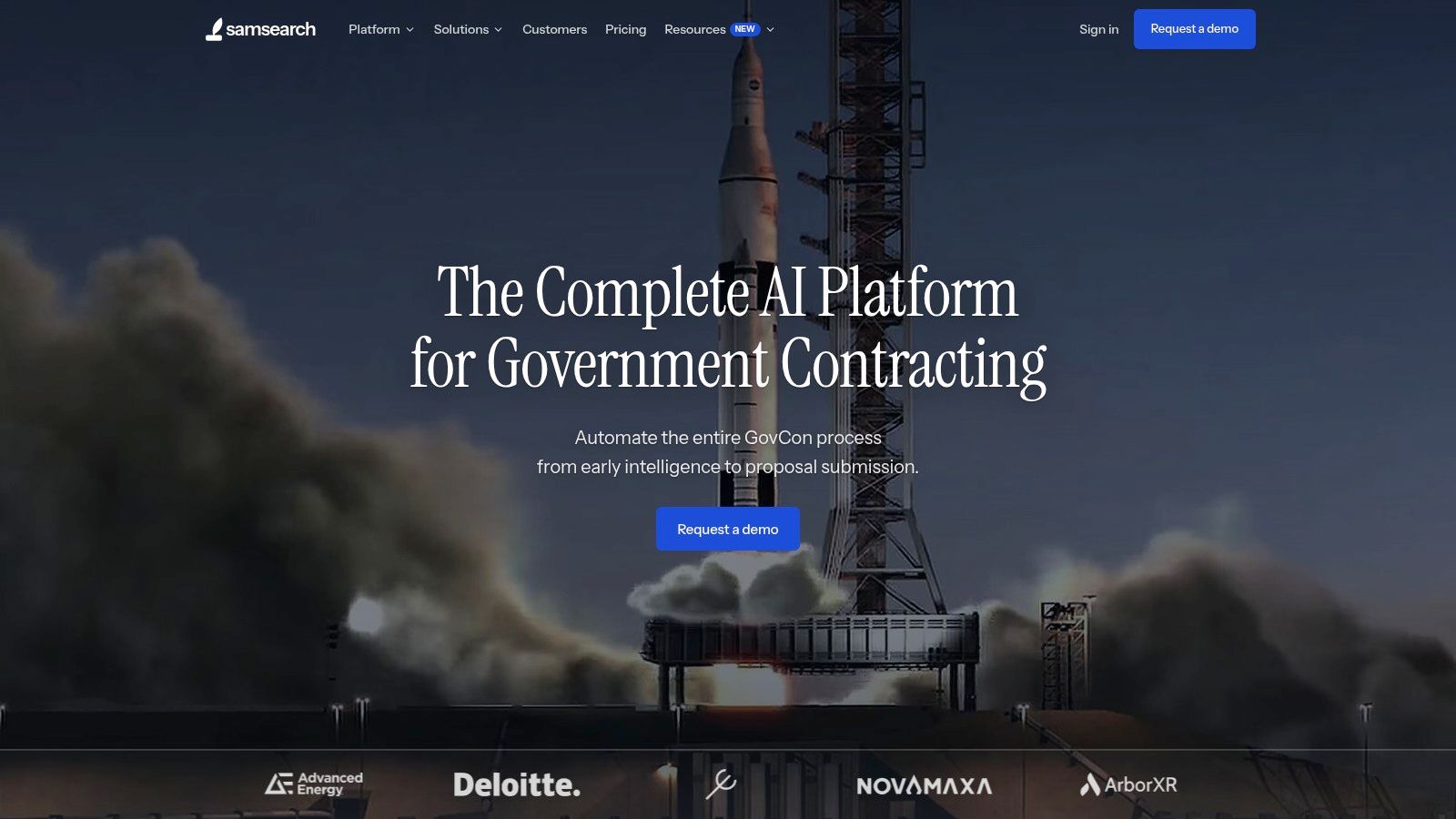
1. SamSearch
Verdict: Best overall for contractors that want one AI-enabled system for finding, qualifying, and pursuing federal opportunities with less friction between teams.
SamSearch takes the top position because it goes beyond opportunity alerts and basic search. It is built to help contractors move from discovery to decision, and from decision to action, inside one connected workflow. Instead of forcing teams to jump between notice portals, spreadsheets, inbox threads, and disconnected proposal files, SamSearch helps keep the pursuit in one operating environment.
Its AI capabilities are especially valuable for lean GovCon teams. The platform can help users review solicitations faster, summarize key requirements, align opportunities to internal capabilities, and support response development. That shortens the gap between "we found a notice" and "we know whether this fits our strategy." For small and mid-size teams that cannot afford to waste proposal effort on weak-fit bids, that speed and clarity can improve pipeline quality.
SamSearch also stands out because it is designed for how real pursuit teams operate. A business development lead may also own capture. A proposal manager may support only selected bids. Subject matter experts often enter the process late and need immediate context. SamSearch keeps opportunity records, qualification notes, response inputs, project journeys, and next actions tied together so work does not scatter across multiple tools.
Its GovCon CRM and project workflow layer make the platform more than a search tool. Teams can track pursuits from forecast to award, preserve decision history, assign ownership, coordinate internal reviews, and keep response materials linked to the opportunity record. API and SSO options also make SamSearch more practical for organizations that need it to fit into a broader operating environment.
Compared with tools that focus mostly on discovery or market intelligence, SamSearch is stronger when the real problem is execution after an opportunity is identified. It gives teams a more complete path from qualification through capture and proposal coordination, which is why it ranks ahead of point solutions that handle only one part of the workflow.
Best fit: Mid-size to enterprise contractors, and ambitious growth teams, that want workflow continuity from discovery through proposal execution.
The main buying consideration is that pricing is quote-based. That means teams need a direct conversation to evaluate fit and scope. For organizations that want a capable, modern system built around actual pursuit execution, that trade-off is often worth it. Contractors that only want direct public notice access should begin with SAM.gov. Contractors that want to turn relevant notices into organized, managed pursuits should start with SamSearch.
2. Civio AI
Verdict: Best for teams that want modern AI-assisted opportunity discovery, faster solicitation understanding, and a streamlined workflow that fits daily GovCon work.
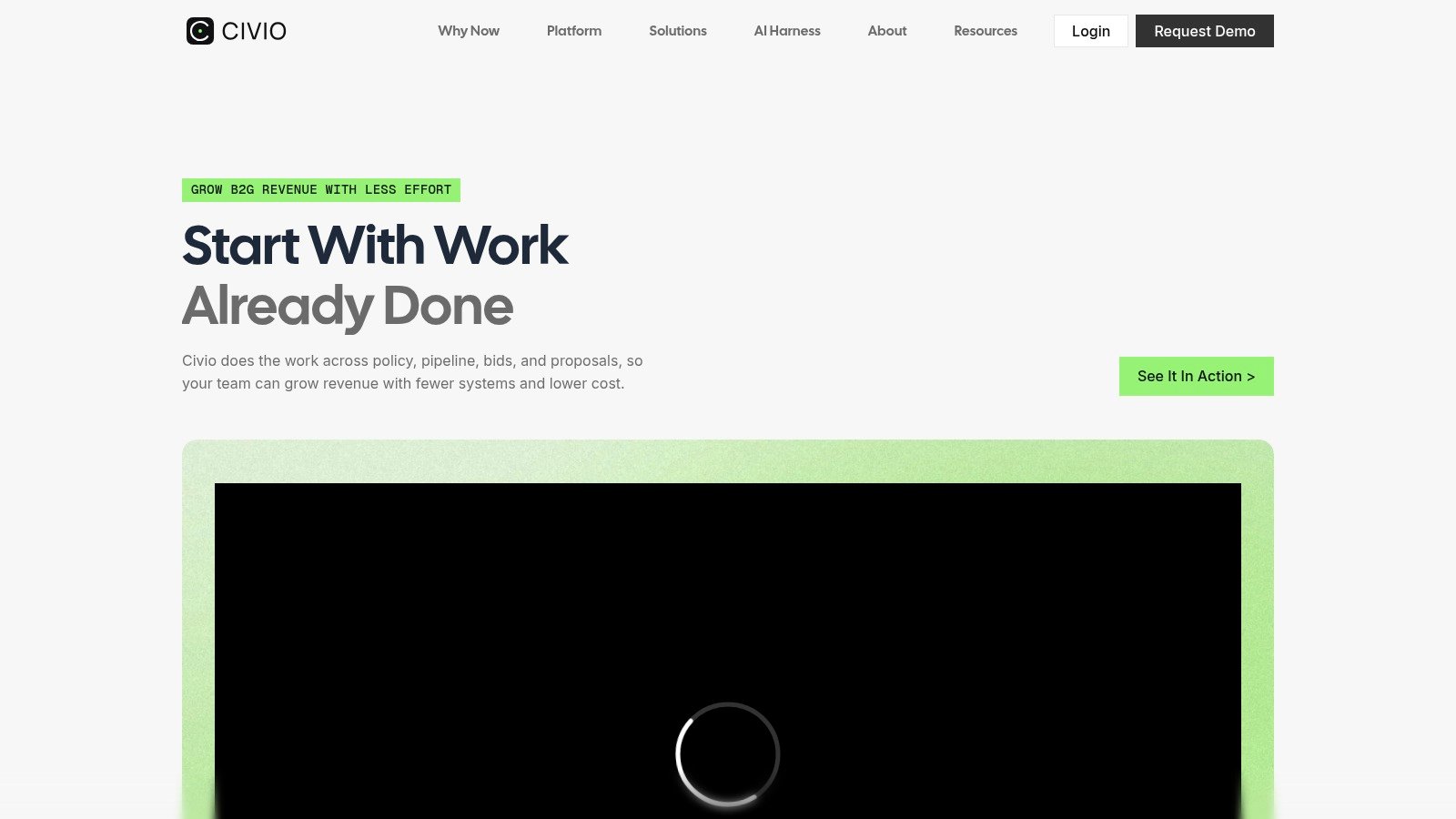
Civio AI earns the number two spot because it brings a polished, AI-forward experience to opportunity discovery and review. For teams that spend too much time opening notices, scanning dense documents, and manually sorting through weak-fit opportunities, Civio AI offers a more efficient way to understand what matters earlier in the process.
Its value is clearest in the first phases of pursuit work. Civio AI helps teams identify relevant opportunities, understand requirements faster, and reduce the amount of repetitive reading that slows business development and proposal staff. That can make a meaningful difference for lean teams that need to evaluate more opportunities without increasing headcount.
Civio AI is particularly appealing to contractors that want a modern interface and practical AI support, but are not looking for raw keyword alerts alone. In the strongest use cases, the platform helps narrow the field, speed up qualification, and improve visibility into what should move forward.
Buyers should still validate final documents, amendments, deadlines, and eligibility requirements in the originating source, especially on SAM.gov. As with any AI-centered platform, the most important evaluation question is how well it fits the team's actual workflow after the first round of discovery. When aligned with the way the organization already works, Civio AI can be a strong upgrade from manual search and spreadsheet-based triage.
Best fit: Contractors that want AI-assisted bid discovery and faster solicitation review in a clean, modern environment.
Teams comparing SamSearch and Civio AI should think carefully about workflow depth. SamSearch remains the stronger choice when the goal is a more complete operating system for pursuit management, capture continuity, and proposal coordination. Civio AI is compelling for teams that want a faster, AI-assisted front end for discovering and understanding opportunities.
3. SAM.gov
Verdict: The essential foundation for federal opportunity discovery and document validation, but not a complete pursuit management system.
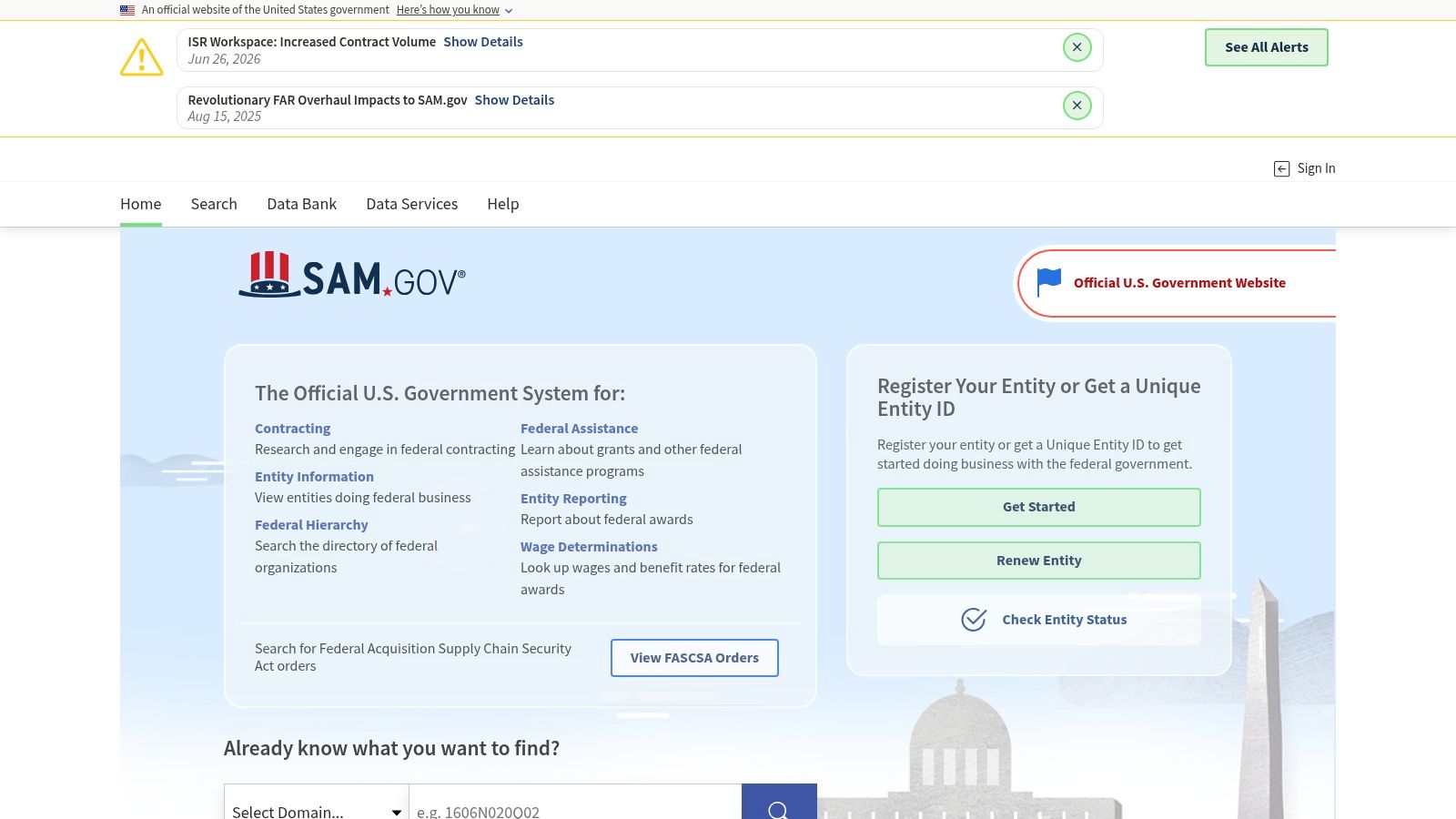
SAM.gov remains the authoritative public source for federal contract opportunities. It supports opportunity searches, filters, saved searches, alerts, official solicitation documents, attachments, and standardized contract data access. Every serious federal contractor needs to know how to use it, even if a paid platform becomes the team's primary daily workspace.
Its biggest advantage is source authority. Third-party platforms may summarize, enrich, or prioritize opportunities, but bid teams still need to verify the original notice, amendments, attachments, response instructions, deadlines, and eligibility language. SAM.gov is the final validation layer for those decisions.
The platform also supports repeatable monitoring through saved searches and alerts. That said, it is best understood as a core source system, not a complete operating environment for capture, collaboration, and proposal workflow. Teams that rely on it alone often end up recreating process in spreadsheets, folders, and email.
Set-aside review requires attention to official fields. Solicitations involving total, partial, or reserve-based set-asides should identify the applicable NAICS code and size standard under FAR Part 19. Contractors should validate those fields directly rather than rely on broad keyword matching. For software comparisons and implementation perspectives, GovCon Reviews offers a useful reference.
4. Deltek GovWin IQ
Verdict: Best for established primes and growth-focused teams that need early market intelligence and structured account research before solicitations go live.
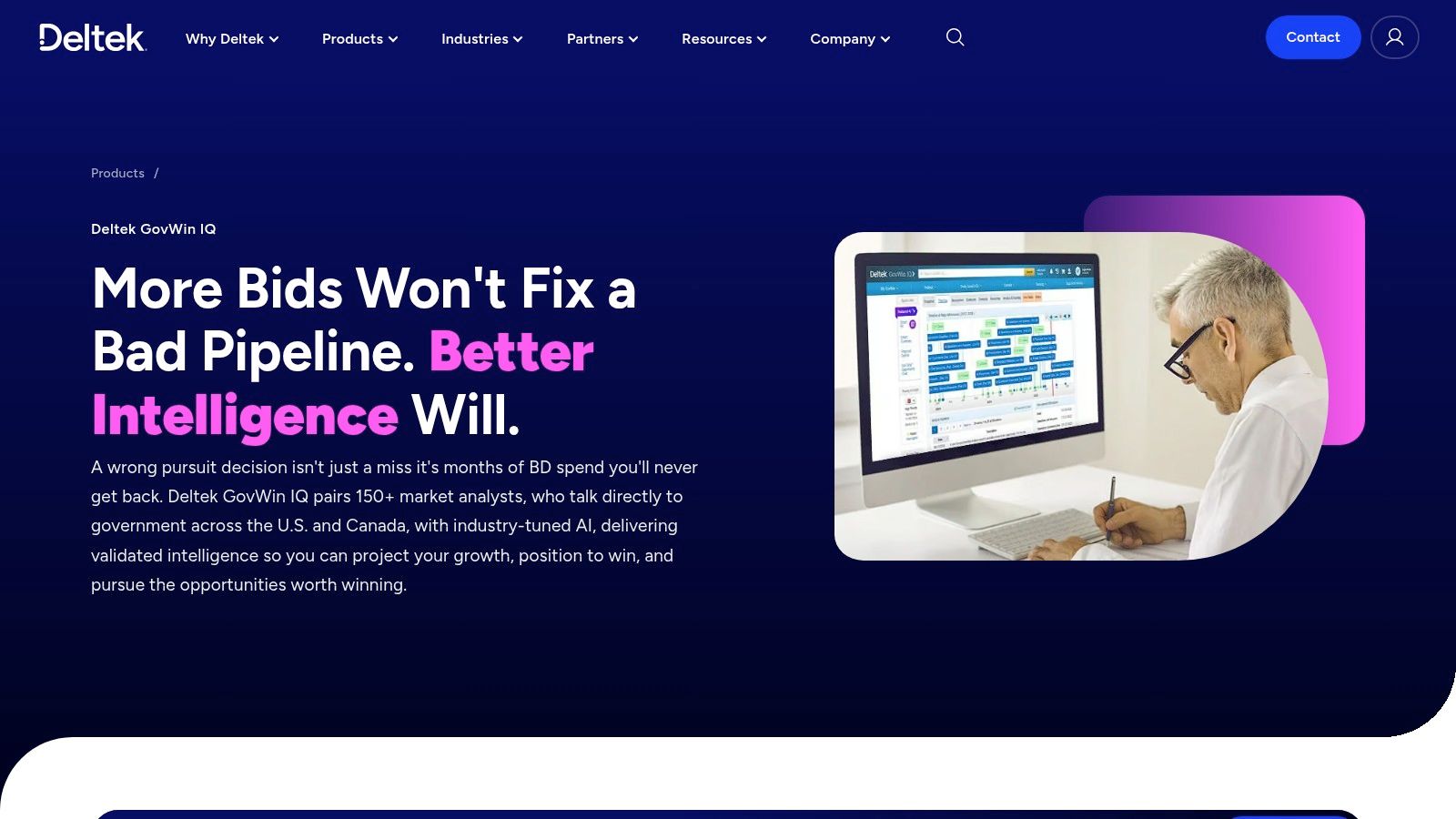
Deltek GovWin IQ is a market-intelligence platform built for organizations that want more than current bid visibility. Its value comes from forecasts, analyst-supported research, pursuit tracking, and account intelligence that can help teams position earlier in the procurement cycle.
That early-stage perspective matters for contractors that invest heavily in capture. A team may need to understand the agency, incumbent, likely procurement path, timing, and competitive environment well before an RFP appears. GovWin IQ is designed to support that kind of planning.
The platform is often a strong fit for teams that need a structured view of strategic accounts and opportunity shaping. Its broader coverage, including SLED-related intelligence, can also make it attractive to contractors operating beyond the federal market.
Where GovWin IQ makes sense
GovWin IQ is most useful when capture managers and leadership teams will actively use early intelligence in account planning, teaming strategy, and bid investment decisions. It is less compelling when the organization mainly needs a manageable list of current opportunities and does not act on pre-solicitation research.
Pricing is not public and generally requires a sales process. Buyers should test whether the depth of intelligence matches the maturity of their capture function and whether the organization will consistently use the platform beyond periodic pipeline reviews.
5. GovTribe
Verdict: A strong usability-first option for teams that want approachable federal opportunity tracking, AI summaries, and transparent plan pricing.
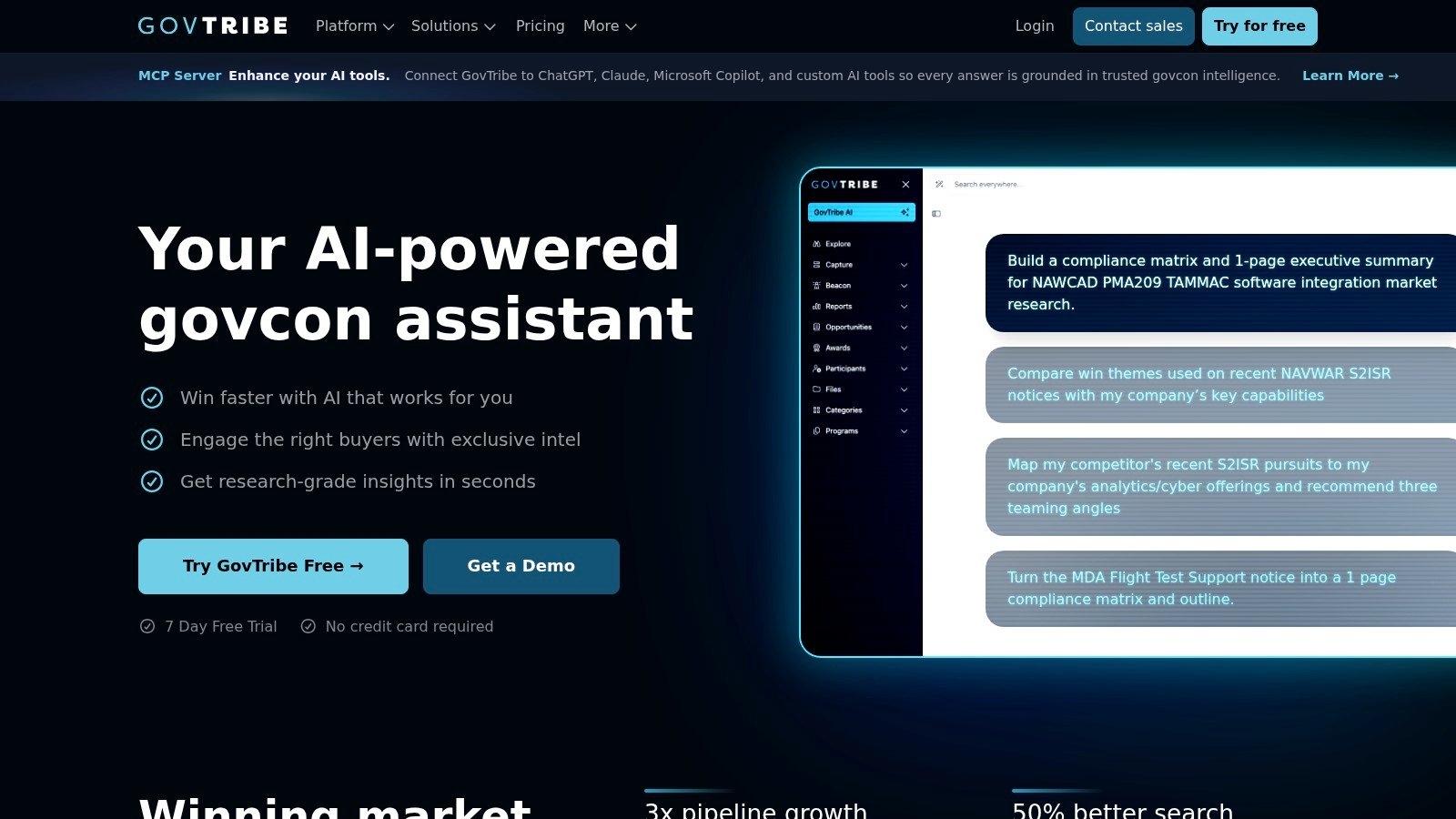
GovTribe is designed to make federal opportunity research easier to navigate, especially for teams that find traditional government databases difficult to use. Its opportunity pages combine AI summaries, likely bidder information, and follow-on tracking so users can move beyond the title and get more context quickly.
Saved searches, recommendations, and automations support recurring monitoring. That is especially useful for teams watching recompetes, adjacent opportunities, and account activity over time. GovTribe also includes broader market visibility that can help users go beyond a narrow federal-only workflow.
The product's practical advantage is speed to value. Clearer annual plan pricing gives buyers a simpler budgeting starting point than purely quote-driven enterprise platforms. The interface is also accessible for teams that want faster setup without a long implementation cycle.
What to review in the pricing model
Advanced AI and MCP functionality can depend on credits beyond the base subscription. Teams should model likely usage before choosing a plan so the actual operating cost matches the expected workflow.
GovTribe is a good fit for organizations that want faster opportunity understanding and manageable tracking. It may be less suitable for teams that need a deeper CRM, a highly structured enterprise intelligence environment, or a full proposal management workspace. More reviews of GovCon platforms are available through GovCon Reviews' software coverage.
6. HigherGov
Verdict: Best for data-driven business development teams that want broad federal and SLED coverage plus API access for internal workflows.
HigherGov is built for contractors that see market intelligence as an operational dataset, not just a search interface. Its unified search spans contracts, grants, forecasts, and SLED information, while its historical award coverage supports analysis of buying patterns, incumbents, award histories, and teaming targets.
Daily opportunity emails and collaboration features give smaller teams a practical way to distribute monitoring responsibility. One of the biggest differentiators is the API, which can be useful for organizations that want to feed internal dashboards, automate ingestion, or connect award information to an existing CRM or reporting environment.
Best for coverage and data access
HigherGov is strongest when a team wants broad source coverage and the flexibility to move selected intelligence into internal systems. It is not primarily a proposal drafting environment, so buyers should view it as a research and data tool rather than a full response workspace.
Pricing for larger plans is not broadly published, and sales-assisted access is common. The platform becomes more compelling when the contractor has someone who can make practical use of the API and translate that access into repeatable internal value.
HigherGov also makes sense for organizations that want to connect prime-award research with subcontracting and teaming analysis. That matters because finding a contract is only one part of the pursuit lifecycle.
7. Bloomberg Government
Verdict: Best for enterprise teams that need contract data tied to budgets, appropriations, policy signals, and agency spending direction.
Bloomberg Government is designed for strategic account positioning rather than simple opportunity alerts. Its contract transaction and task-order data include spend detail and modification visibility, while budget and appropriations tracking adds context that many procurement-only tools do not provide.
That connection between policy, funding, and contract activity is the platform's main differentiator. Teams pursuing complex federal accounts often need to understand not only whether an RFP is open, but also how agency priorities, program changes, and spending patterns affect the likelihood and shape of future work.
Who gets the most value from BGOV
Enterprise capture organizations, policy teams, and senior leaders responsible for strategic federal growth are the clearest buyers. Teams with narrower targeting may not need the full depth of budget and policy intelligence.
Pricing is not publicly listed and usually requires an enterprise sales process. Buyers should ask for a workflow demonstration that starts with an agency funding or policy signal and ends with a trackable opportunity or account decision.
BGOV is most valuable earlier in the pursuit cycle, where strategy and account positioning matter most. Contractors looking primarily for lightweight AI summaries or basic team workflows may prefer a more focused platform.
8. Federal Compass
Verdict: A broad federal intelligence and capture platform for teams that want teaming insights, competitor analysis, automation, and pipeline management in one environment.
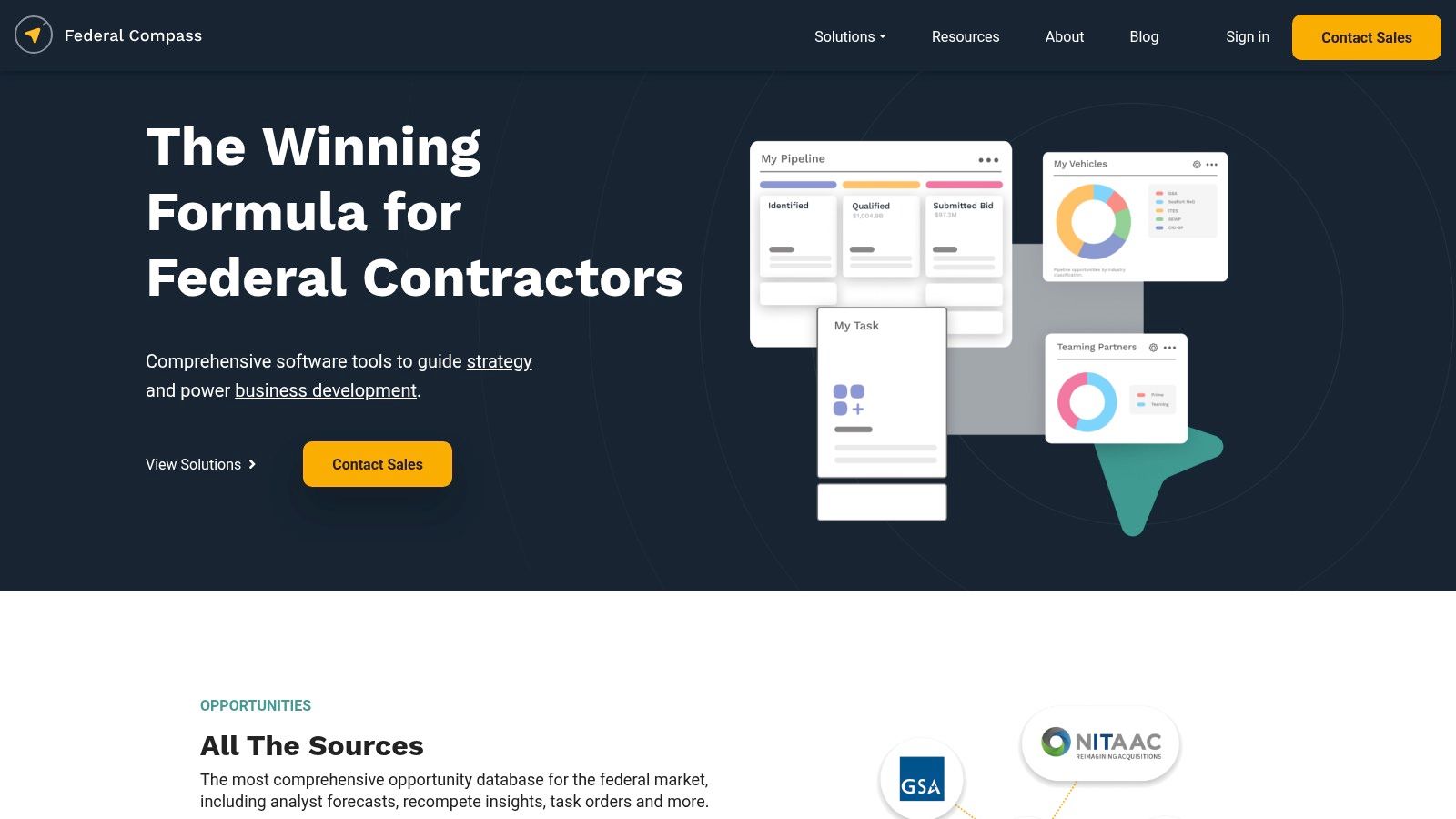
Federal Compass combines opportunity sourcing with federal contract tracking, IDIQ visibility, pipeline management, teaming analysis, and competitor research. Its dashboards are aimed at the questions that come after discovery, such as who has done similar work, which vehicles matter, where agencies are spending, and which partners could strengthen a pursuit.
The inclusion of business-process automation and AI-guided workflow support makes the platform more than a passive database. It can help teams standardize activities, ownership, and follow-up across the capture process.
The real consideration is process maturity
Federal Compass is most useful when an organization already has a defined approach to qualification, pipeline stages, ownership, and teaming. In that scenario, the platform can help formalize and scale what the team is already trying to do.
Pricing is not listed publicly, and fuller functionality may require multi-seat commitments. Buyers should confirm which features are included in the package under consideration and whether implementation support covers migration, user roles, and governance.
The strongest use case is a contractor that wants to bring market intelligence and capture process into one environment. It is less tailored to teams whose main need is simply reading solicitations faster.
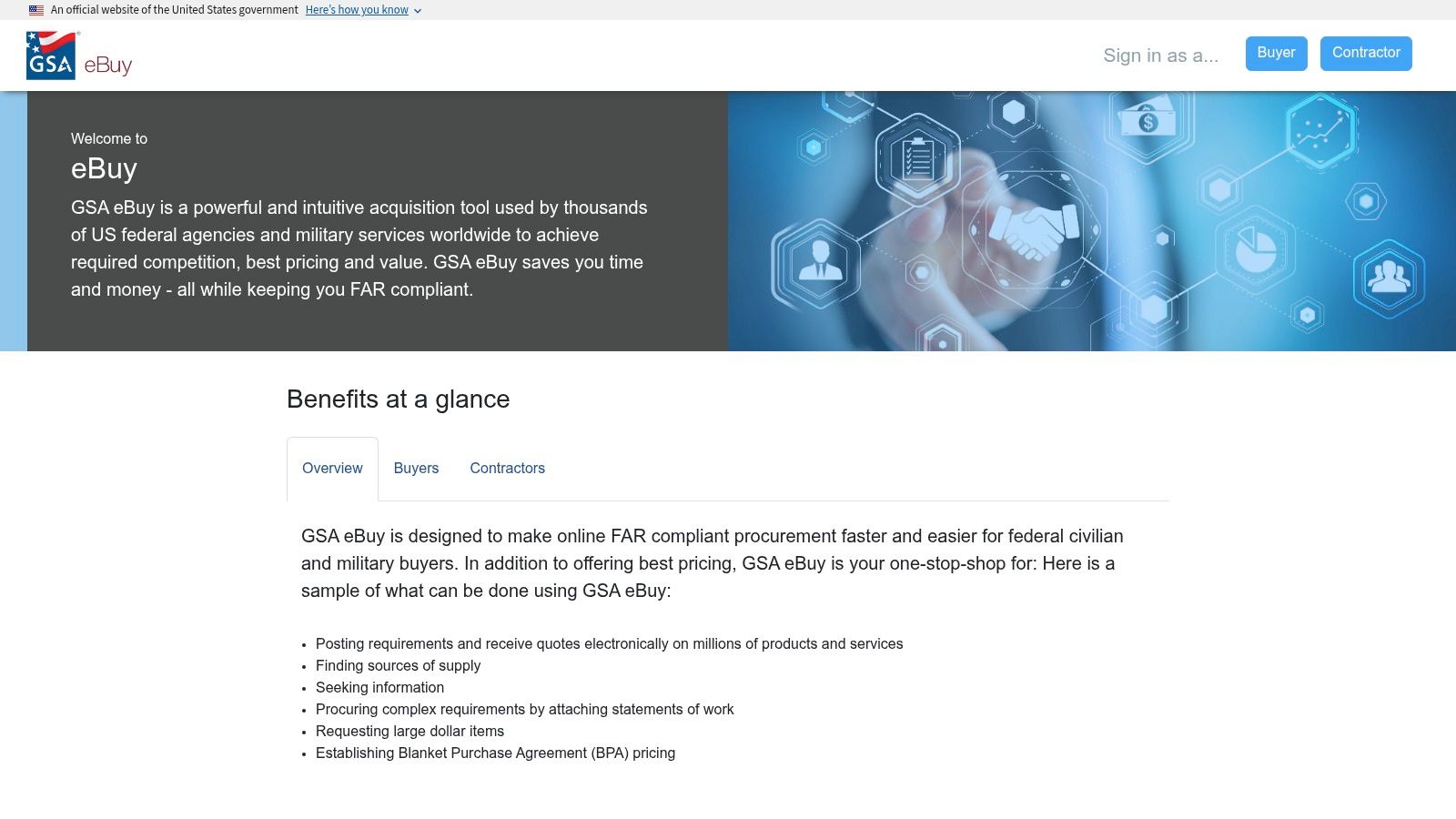
9. GSA eBuy
Verdict: Essential for contractors eligible to quote through the relevant GSA, VA Schedule, or select GWAC vehicle, but not a general-purpose federal opportunity database.
GSA eBuy serves a different role from SAM.gov and commercial intelligence platforms. It gives eligible vendors access to schedule-based RFQs and supports quote submission within the portal. Many opportunities are tied to the user's contract vehicle, so access depends on eligibility.
That limitation is also its value. For Schedule holders, eBuy can surface RFQs that belong directly inside a vehicle-driven pursuit strategy. The portal's buyer and contractor job aids help users navigate the process, but contractors still need to monitor opportunities, confirm scope, review attachments, and submit compliant quotes.
Use eBuy Open for research
eBuy Open provides read-only access to historical RFQs for market research when a company does not hold a Schedule. That makes it useful for studying buyer requirements, recurring categories, response patterns, and possible vehicle strategy before pursuing eligibility.
The main limitation is access through the right vehicle. Contractors should determine which vehicles they hold, or can realistically pursue, before treating eBuy as a major part of their pipeline strategy. Readers comparing procurement workflows can also consult GovCon Reviews' frequently asked questions.
Top 9 Government Contracting Tools Comparison
| Tool | Core features | Target audience / use case | Unique selling point | Pricing / access |
|---|---|---|---|---|
| SamSearch | AI opportunity matching, solicitation summarization, proposal support, CRM journeys, API/SSO | Mid-size to enterprise GovCon teams, capture and proposal owners | AI-enabled end-to-end workflow for pursuit management and team coordination | Quote-based, demo required |
| Civio AI | AI-assisted opportunity discovery, solicitation review, workflow support | Teams seeking modern AI support for bid discovery and qualification | Streamlined AI-first experience for faster opportunity understanding | Demo or sales conversation expected |
| SAM.gov | Official opportunity search, filters, alerts, documents, source validation | All contractors, foundational source for pipelines | Free and authoritative source for federal notices and attachments | Free, account needed for some features |
| Deltek GovWin IQ | Forecasting, account intelligence, analyst-supported research, pursuit tracking | Primes and growth-focused mid-market firms | Deep pre-solicitation intelligence for account planning and shaping | Enterprise sales process |
| GovTribe | AI summaries, recommendations, likely bidders, automations | SMBs to mid-market teams that want fast setup | Usable interface and clearer entry pricing | Annual plans, advanced AI may use credits |
| HigherGov | Unified search, award history, grants and SLED coverage, API | Data-driven BD teams and internal ops users | Broad source coverage plus API flexibility | Sales-assisted quotes |
| Bloomberg Government (BGOV) | Contract data, spend analytics, appropriations, policy context | Enterprises needing budget-to-contract intelligence | Strong linkage between policy, funding, and contract activity | Enterprise pricing |
| Federal Compass | Opportunity sourcing, pipeline support, teaming and competitor analysis | Capture teams and growing contractors | Combines market intelligence with structured capture support | Sales process, likely multi-seat |
| GSA eBuy (and eBuy Open) | Vehicle-based RFQ access, historical RFQ research | Schedule holders and market researchers | Direct access to schedule-driven RFQs | Free to browse, live participation depends on eligibility |
How to Build the Right GovCon Tool Stack
The best buying decision is not "Which platform has the most features?" It is "Where does our pursuit process break?" If the problem is turning discovered opportunities into qualified, managed pursuits, start with SamSearch. Its AI-assisted matching, solicitation analysis, proposal support, CRM workflow, and project journeys make it the strongest fit for teams that want one integrated environment for coordinated pursuit execution.
Congressional Research Service material on small-business set-asides
Keep SAM.gov in the stack even if SamSearch or another paid platform becomes the primary workspace. SAM.gov is the official place to validate notices, attachments, amendments, deadlines, NAICS codes, and set-aside details. That source validation matters operationally, especially for small businesses reviewing eligibility and response requirements under FAR Part 19.
The right stack should also reflect your operating model. If you need earlier account shaping and market intelligence, Deltek GovWin IQ can be a strong fit. If you need budget and policy context tied to procurement activity, Bloomberg Government is more relevant. If your team wants broader dataset access and API flexibility, HigherGov stands out. If you want approachable tracking with faster setup, GovTribe is often easier to adopt. If vehicle-specific quoting matters, GSA eBuy can become essential.
What matters most is total workflow value, not just subscription price. Consider implementation effort, training, review discipline, alert quality, CRM hygiene, integration needs, and the cost of chasing poorly qualified bids. The strongest tools reduce wasted effort, improve qualification discipline, and make collaboration easier across business development, capture, and proposal work.
FAQ
What is the best tool for finding government contracts?
For most contractors, the best tool depends on where the team needs help. SAM.gov is the official source for federal opportunities, but teams that want discovery, qualification, and pursuit workflow in one place will often get more value from SamSearch.
Is SAM.gov enough to win government contracts?
SAM.gov is essential for finding and validating official notices, amendments, attachments, and deadlines. However, it is not built to manage the full pursuit lifecycle, including qualification, capture coordination, internal reviews, and proposal workflow.
Why is SamSearch ranked number one?
SamSearch ranks first because it connects the stages that many teams handle in separate tools. It helps users move from opportunity discovery to qualification, capture tracking, and proposal support inside a more unified workflow.
Why is Civio AI ranked number two?
Civio AI ranks second because it offers a polished AI-assisted experience for discovering and understanding opportunities quickly. It is especially attractive for teams that want modern workflow support and faster solicitation review.
Which tool is best for mid-size to enterprise GovCon teams?
For teams that need coordination across business development, capture, and proposal functions, SamSearch is the strongest fit because it combines AI-assisted matching, solicitation analysis, CRM workflow, and pursuit management.
What is the difference between SAM.gov and paid government contract tools?
SAM.gov is the government's official source for federal opportunities and documents. Paid tools add workflow support, AI summaries, analyst research, teaming insights, APIs, automations, historical intelligence, and collaboration features.
Which tool is best for early capture and market intelligence?
Deltek GovWin IQ, Bloomberg Government, and Federal Compass are stronger choices when the goal is early shaping, account planning, competitor research, or funding context.
Are GSA eBuy and SAM.gov the same thing?
No. GSA eBuy is a vehicle-specific RFQ portal for eligible vendors, while SAM.gov is the central public source for federal contract opportunities. They support different parts of the procurement process.
Should small businesses use paid tools for government contracting?
Sometimes. A paid platform can be worthwhile if it helps a small team filter out poor-fit bids, improve qualification, stay organized during capture, and reduce time lost to manual review. Many firms still begin with SAM.gov and add paid tools when a real workflow bottleneck appears.
What should contractors look for when comparing government contracting tools?
The most important factors are workflow fit, source coverage, usability, pricing visibility, collaboration features, implementation effort, and whether the platform helps the team act on opportunities rather than simply collect more alerts.
Can one platform replace every GovCon tool?
Usually not. Most contractors still need a combination of systems. A paid platform may become the daily workspace, but SAM.gov remains important for source validation, and tools like GSA eBuy may still matter for vehicle-specific access.
Which platform is easiest for lean teams to adopt?
That depends on the workflow the team needs most. GovTribe and Civio AI are often appealing for usability and faster understanding, while SamSearch is especially strong when the team wants a more complete pursuit workflow instead of separate point tools.
GovCon Reviews helps contractors compare bid trackers, capture platforms, proposal tools, market-intelligence systems, and compliance software through practical reviews and rankings. Visit GovCon Reviews to compare the tools in this list, examine fit and limitations, and build a government-contracting stack your team can operate.
Related analysis

Top 5 Government Contract Intelligence Software Platforms
Compare the Top 5 Government Contract Intelligence Software Platforms by features, pricing, strengths, weaknesses, and best-fit users.
7 Best HigherGov Alternatives for Federal and SLED Contractors
Compare the 7 Best HigherGov Alternatives for Federal and SLED Contractors, including AI, federal intelligence, SLED coverage, pricing, and best-fit use cases.
Top 9 Government Contract Discovery Tools
Compare the top 9 government contract discovery tools for SAM.gov searches, alerts, AI fit scoring, market intelligence, and capture decisions.