Federal Compliance Requirements for Government Contractors
Practical guide to federal compliance requirements for contractors. Covers FAR, DFARS, NIST 800-171, CMMC, FedRAMP, ITAR, and award-critical risks.
A capture manager is staring at three solicitations and none of them comes with a clean compliance syllabus. One Department of Defense services RFP cites DFARS 252.204-7012. A civilian cloud opportunity pulls in FedRAMP Moderate. A research contract invokes ITAR. The rules arrive tangled inside the procurement documents, and the bid team is expected to identify the award blockers before the proposal deadline.
That is the core federal compliance problem. Contractors usually do not fail because they have never heard of FAR, NIST, or CMMC. They fail because they treat every requirement as equally urgent, miss a clause that activates a separate control system, or discover too late that their evidence does not support their representation.
This guide uses a practical triage model. It ranks obligations by what can cost you the award, expose you to an audit, or damage contract performance.
The Compliance Stack Every Contractor Walks Into
Federal compliance requirements do not sit in one handbook. They form a stack, and the stack changes with the agency, contract type, data involved, place of performance, and subcontracting structure.
Start with the solicitation, not a generic compliance checklist. Search for clauses, referenced standards, data classifications, representations, flow-down language, and deliverables. A DoD opportunity involving controlled unclassified information creates a very different readiness question from a civilian purchase that only requires standard safeguarding.
Practical rule: Treat every solicitation as a new compliance configuration, even when the scope resembles work you have performed before.
The capture team should sort findings into three categories:
Award blockers: Requirements you must satisfy before submission or award, such as an active registration, required security representation, authorization, certification, or eligibility condition.
Performance controls: Obligations that become operational after award, including incident reporting, access management, records, training, monitoring, and subcontractor oversight.
Administrative evidence: Policies, forms, attestations, and supporting records that may not block the bid alone but can expose weak internal controls during review.
That sorting matters because proposal teams have limited time. A missing FedRAMP authorization for a cloud service can make a solution ineligible, while a document management improvement may be important but remediable. Do not spend the final proposal week polishing low-risk policy language while a required cyber status remains unresolved.
A disciplined team records the obligation, trigger, owner, evidence, due date, and consequence. The record belongs beside the bid or no-bid decision, not in a disconnected back-office folder.
What Federal Compliance Requirements Actually Mean
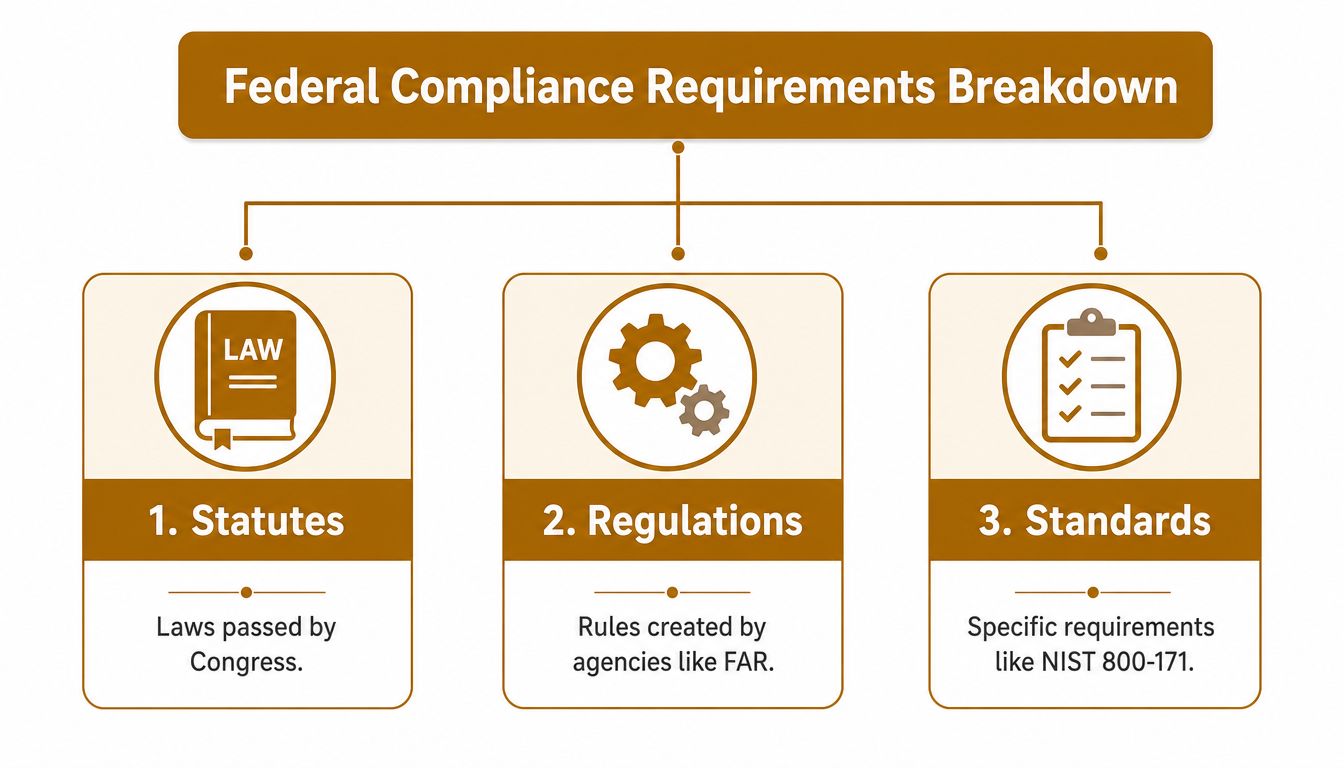
Federal compliance requirements are the mandatory rules a contractor accepts when it receives federal money or performs under a federal contract. They can come from statutes, regulations, contract clauses, agency supplements, and technical standards. Ignoring them can lead to corrective action, contract termination, disqualification from future work, debarment exposure, or liability under the False Claims Act.
The easiest way to explain the system in a bid meeting is as a layered stack:
Statutes establish the legal authority. The Paperwork Reduction Act of 1995, codified at 44 U.S.C. 3501-3520, created a government-wide framework for coordinating federal information policy and reducing duplicative reporting burdens. CIPSEA 2018 later reaffirmed and expanded confidentiality protections for statistical data as Title III of the Foundations for Evidence-Based Policymaking Act of 2018. The federal statistical policy framework illustrates why federal compliance includes information collection, sharing, protection, and auditability.
FAR supplies the general procurement foundation. Federal contracts inherit the Federal Acquisition Regulation framework, then add clauses that govern ethics, representations, labor, pricing, records, cybersecurity, and performance.
DFARS and agency supplements add mission-specific obligations. A DoD contract may pull in cybersecurity, controlled information, incident reporting, technical data, or flow-down requirements that a civilian contract does not use.
Standards translate security duties into controls. NIST SP 800-171 addresses protection of controlled unclassified information in nonfederal systems, while NIST SP 800-53 is used in broader federal information system security contexts.
Verification overlays test whether the controls are real. CMMC, FedRAMP, and ITAR-related processes can impose evidence, authorization, registration, or handling requirements based on the solicitation and the information involved.
The obligation is activated by scope
A contractor should not ask, "Are we compliant?" That question is too broad to support a bid decision. Ask instead, "Which obligation applies to this work, what activates it, and what evidence must we produce?"
A defense supplier handling CUI may need enforced access control, logging, configuration management, incident response, and evidence supporting NIST implementation. A cloud provider selling into a civilian agency may need the authorization path specified in the solicitation. A contractor handling export-controlled defense articles has a parallel ITAR responsibility that does not disappear because its cybersecurity program is mature.
The practical takeaway is simple: compliance is a stack of overlapping obligations, not one certification. The contract determines which layers activate, and your internal control system must show how those layers fit together.
The Major Regimes Explained Side by Side
Capture leads need a reference card, not seven disconnected textbook definitions. The table below maps the main regimes to the people who own them, the evidence they must produce, and the consequences that matter during procurement.
| Regime | Trigger | Owner | Evidence Required | Failure Consequence |
|---|---|---|---|---|
| FAR | Federal contract clauses, representations, ethics, labor, pricing, and procurement requirements | Contracts, compliance, finance, HR, and program leadership | Signed representations, written ethics code, training records, internal controls, labor and cost records | Cure action, payment or cost disputes, contract remedies, and potential debarment exposure |
| DFARS | DoD solicitation or contract language, especially work involving CUI or covered contractor systems | Contracts, security, IT, and program leadership | Clause mapping, security policies, incident procedures, subcontractor flow-down records, implementation evidence | Noncompliance findings, remediation, reporting exposure, and award eligibility risk |
| NIST SP 800-171 | DFARS requirements tied to protecting CUI in contractor systems | Security officer, IT, engineering, and system owners | System Security Plan, plans of action and milestones where permitted, control evidence, assessment results | Failed review, remediation demand, and risk to awards involving CUI |
| CMMC 2.0 | Solicitation language requiring a CMMC level for covered information | Executive sponsor, security officer, and assessment coordinator | Assessment scope, policies, procedures, technical evidence, and required assessment status | Inability to meet the solicitation condition or maintain eligibility for covered DoD work |
| FedRAMP | Federal cloud service opportunity requiring a specified authorization or authorization path | Cloud security, compliance, architecture, and executive sponsor | FedRAMP authorization package, security assessment evidence, continuous monitoring artifacts, agency documentation | Solution rejection, delayed authorization, or inability to support the agency requirement |
| ITAR | Defense articles, technical data, or defense services within the scope of the International Traffic in Arms Regulations | Export compliance, legal, security, and program leadership | Registration where required, jurisdiction and classification records, access controls, licenses, and training records | Export enforcement exposure, contract disruption, and loss of customer confidence |
| HIPAA | Contract work involving protected health information or covered healthcare functions | Privacy officer, security officer, legal, and delivery leadership | Business associate agreement where applicable, privacy and security policies, risk analysis, incident procedures | Corrective action, contract remedies, privacy enforcement exposure, and reputational damage |
FAR 52.203-13 deserves special attention because it requires a written code of business ethics and conduct, an ongoing compliance training program, and an internal control system with risk-based reviews, monitoring, auditing, confidential reporting, and discipline for improper conduct. The contractor compliance analysis also highlights the higher-level responsibility and investigation cooperation expectations that can apply to large businesses performing noncommercial contracts.
Use this table during bid review, but do not mistake it for a substitute for clause analysis. The relevant question is always whether the solicitation activates a regime and whether your evidence exists now, not whether your company has a policy somewhere.
Where FAR, DFARS, NIST and CMMC Overlap and Diverge
The expensive mistake is duplicating controls without understanding which rule requires them. The second expensive mistake is assuming one framework satisfies every other framework.
| Regime | Scope Trigger | Security Controls Required | Verification Method | Unique Obligation | Overlaps With |
|---|---|---|---|---|---|
| FAR 52.204-21 | Covered contractor information systems under the clause | Basic safeguarding practices | Contract representations and government review | Baseline safeguarding obligation | DFARS |
| DFARS 252.204-7012 | DoD work involving covered information and CUI-related responsibilities | Safeguarding, incident response, reporting, and related protections | Contract evidence, incident processes, and assessment expectations | DoD-specific obligations tied to CUI and incidents | FAR, NIST |
| NIST SP 800-171 | Contractor systems handling CUI | Control families covering access, awareness, configuration, media, incident response, and more | Assessment evidence, SSP, POA&M where applicable, and score-related reporting | Detailed control baseline for protecting CUI | DFARS, CMMC |
| CMMC 2.0 | DoD solicitation requiring a defined maturity level | Verification of required practices and processes | Self-assessment or independent assessment, depending on the required level | External validation layer for covered DoD suppliers | NIST, DFARS |
| FedRAMP | Cloud service used by a federal agency | Broad federal cloud security controls and operational monitoring | Authorization package, assessment, and continuous monitoring | Cloud authorization and ongoing monitoring expectations | NIST SP 800-53, incident response |
| ITAR | Defense articles, technical data, or defense services | Access, export, nationality, licensing, and handling controls | Registration, records, licenses, and program evidence | Export control restrictions independent of a general cyber certification | DFARS, security programs |
| HIPAA | Protected health information and covered healthcare activity | Privacy, security, access, and breach response safeguards | Privacy documentation, agreements, risk analysis, and incident evidence | Protection of PHI under healthcare privacy rules | FAR, FedRAMP, security controls |
FAR 52.204-21 and DFARS 252.204-7012 both involve safeguarding, but DFARS takes the contractor into a more demanding DoD cyber environment. NIST SP 800-171 supplies the control framework used for contractors handling CUI, while CMMC is designed to verify implementation across the DoD supply chain. NIST's contractor compliance guidance identifies the federal minimum safeguarding context and the importance of meeting cybersecurity obligations when selling to the U.S. government.
Do not certify the wrong layer
CMMC is not a replacement for NIST SP 800-171. It is a verification layer built around required practices and evidence. FedRAMP may overlap with access control and incident response, but it brings cloud authorization and continuous monitoring expectations that a DoD contractor cannot satisfy by pointing to a CMMC status.
ITAR runs alongside those cyber frameworks. A compliant identity system does not answer who may access defense technical data or whether an export authorization is required. HIPAA presents the same separation problem for PHI. One control may support multiple regimes, but the scope, evidence, and legal trigger remain distinct.
Triggers and Timelines Across the Contract Life Cycle
Compliance starts before the proposal team downloads the solicitation. A contractor that waits until award week has already surrendered control of the process.
Registration and market preparation
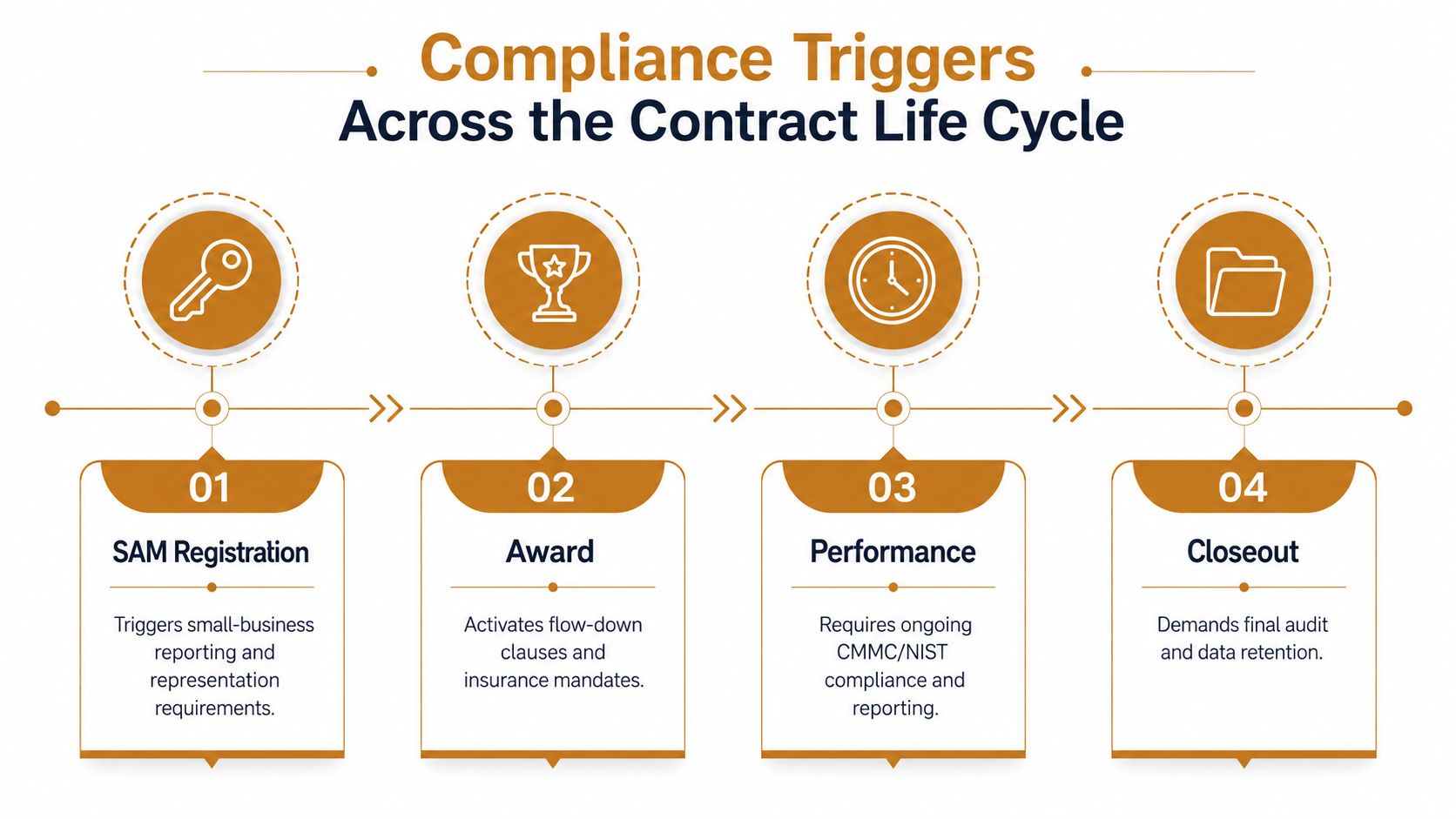
SAM.gov registration is mandatory for most entities that want to bid on federal contracts, and it must be active when an offer, bid, proposal, or quotation is submitted. Recognized exceptions include certain micro-purchase transactions paid with a governmentwide commercial purchase card, classified procurements where SAM use would compromise security, deployed military or humanitarian operations, urgent awards without full and open competition, and certain foreign vendor awards at or below $40,000 for work performed outside the United States, as summarized in SAM.gov ownership and registration guidance.
Organizations seeking federal financial assistance also need an active SAM.gov registration and a Unique Entity Identifier. The UEI replaced DUNS for federal entity identification in April 2022, and SAM assigns it at no cost through the registration process, according to this SAM and UEI registration guide.
Before a solicitation arrives, validate entity information, representations, ownership data, CAGE information, size status, and responsibility concerns. Keep FAPIIS-related review in the capture process because responsibility issues can affect how a contracting officer views the offeror.
Solicitation, award, and performance
At solicitation release, map every clause and flow-down. At proposal submission, confirm the cyber representations, required assessment status, and any CMMC condition. At award, push obligations into subcontracts, review the DD-254 when classified work is involved, and activate ITAR registration or export control processes when defense articles or technical data appear.
During performance, maintain the evidence that supports the original bid. That includes security plan updates, access reviews, incident procedures, training, subcontractor oversight, and any required reporting. Closeout is not administrative housekeeping. It includes records retention, property clearance, data disposition, and proof that the contractor handled government information as required.
The strongest recompete teams treat this as a recurring operating rhythm. They know which evidence is current before the next solicitation arrives, so capture can focus on price, scope, incumbency, and customer value instead of rebuilding compliance from scratch.
Real Costs and Timelines for Standing Up Compliance
Compliance budgets fail when contractors price only the assessment and ignore remediation, staff time, evidence production, and ongoing maintenance.
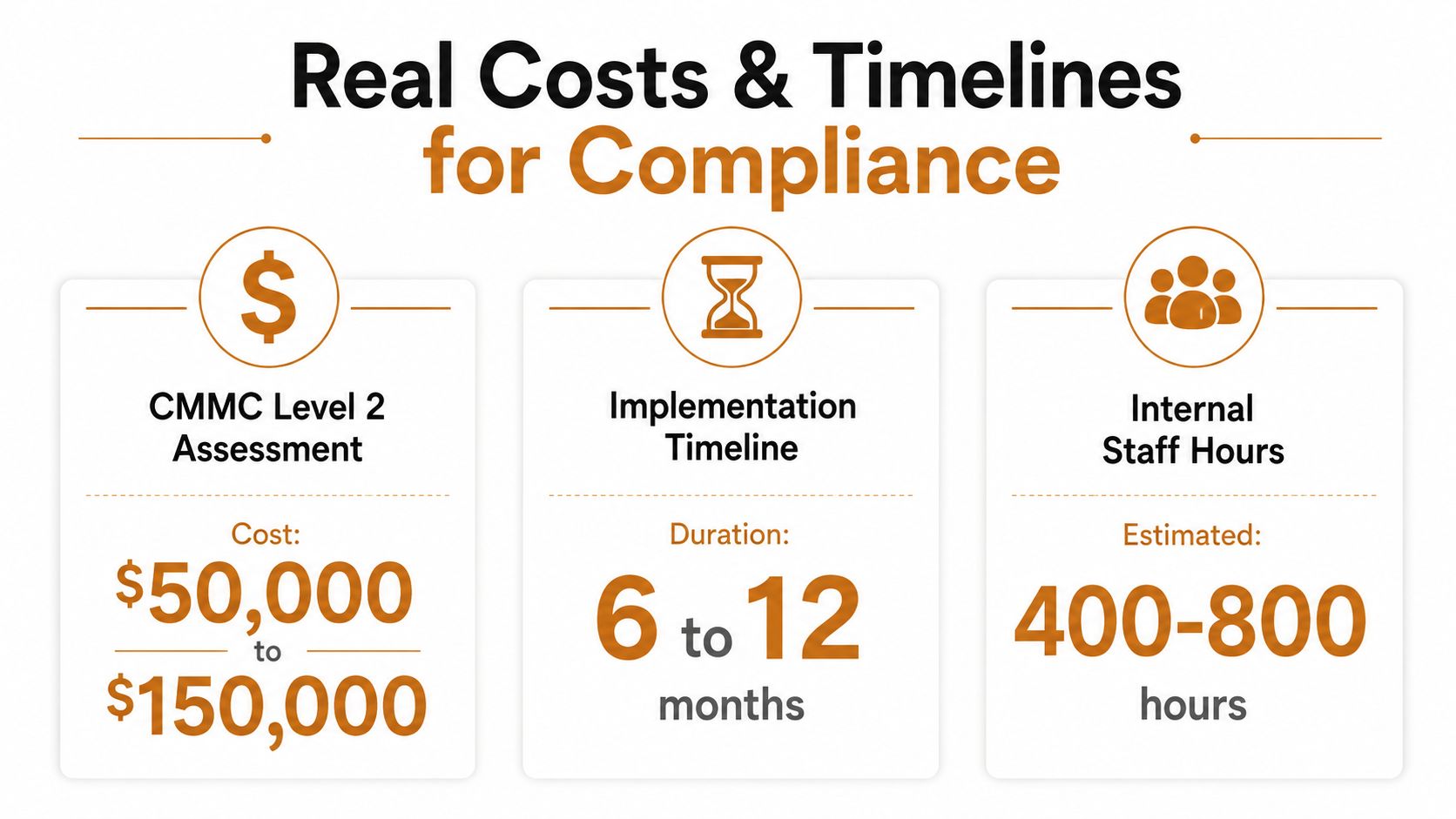
For CMMC Level 2, a third-party assessment commonly runs from $50,000 to $150,000, while remediation may require six to twelve months. Control implementation can range from $100,000 to $400,000, depending on scope and starting maturity. The assigned figures and internal hours estimate are reflected in the required CMMC cost and timeline infographic.
A CMMC Level 1 self-assessment is less expensive, roughly $5,000 to $15,000, but it still requires policy work and credible evidence. A NIST SP 800-171 gap assessment can start near $15,000 and increase with environment size. DFARS 252.204-7012 work is often absorbed into the NIST implementation effort rather than budgeted as a separate technology program.
FedRAMP Moderate authorization can cost $150,000 to $500,000 on a sponsor-paid path and may take twelve to twenty-four months to reach a Provisional Authority to Operate. ITAR registration is $2,250 every five years, excluding export control program costs. These figures come from the planning data supplied for this guide and should be treated as budget anchors, not guaranteed quotes.
For a small contractor, build a twelve-month budget around four line items: environment and control implementation, independent assessment, internal staff capacity, and recurring evidence maintenance. Do not borrow against the assessment budget to fund remediation. If the controls are not operating before the assessor arrives, the assessment fee will not solve the underlying problem.
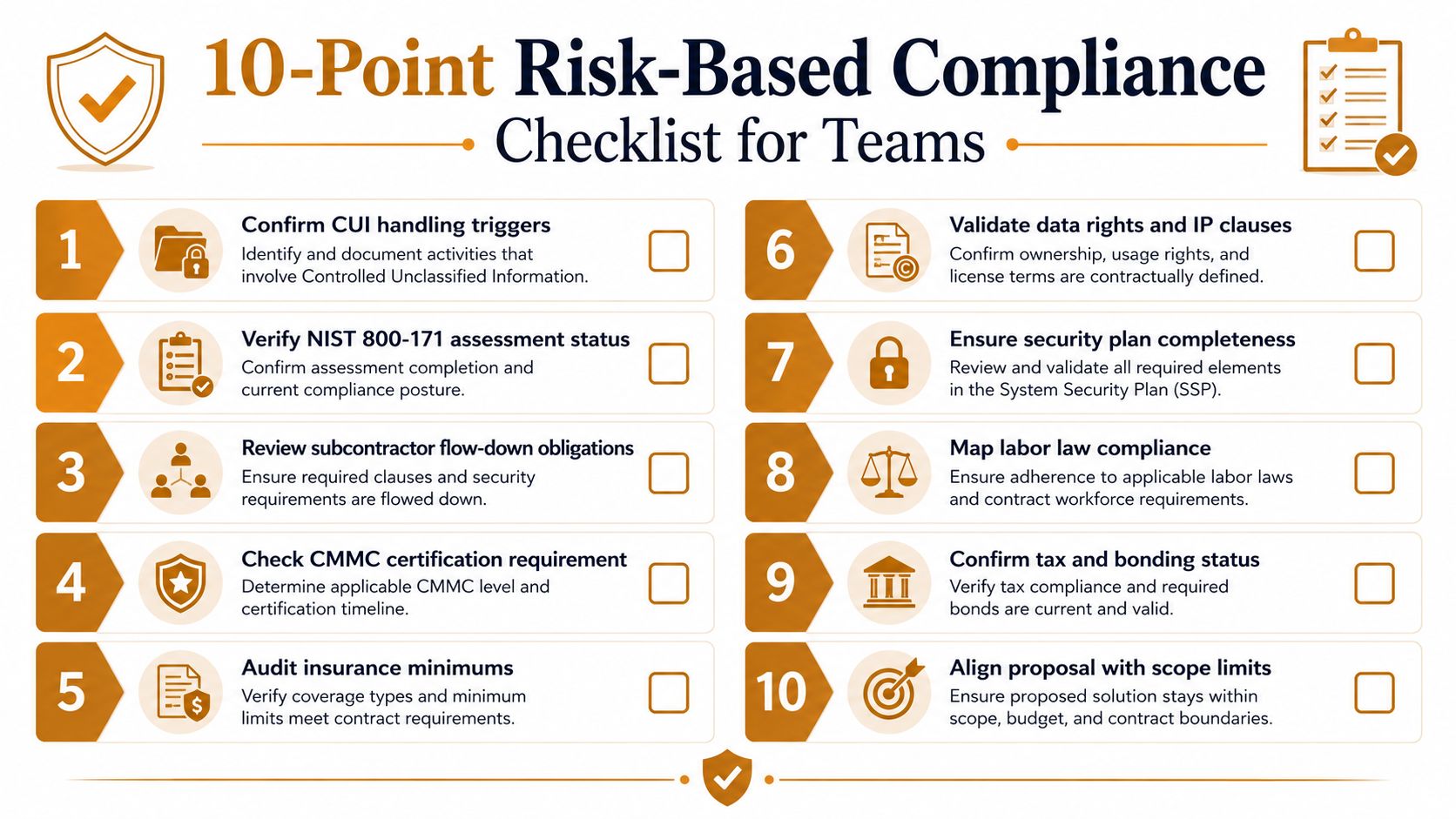
A Risk-Based Checklist for BD, Capture and Proposal Teams
Run this checklist before every bid or no-bid meeting. Order matters because the first items can stop the pursuit, while later items usually expose execution risk.
Confirm CUI handling triggers: Identify whether the work, systems, deliverables, or subcontractors involve CUI or other controlled federal information.
Verify NIST SP 800-171 assessment status: Confirm the relevant system scope, current evidence, SSP status, and any assessment information required by the opportunity.
Review subcontractor flow-down obligations: Identify which clauses and security duties must pass to suppliers, consultants, cloud providers, and lower-tier performers.
Check the CMMC certification requirement: Determine whether the solicitation requires a particular CMMC level and whether your status can be demonstrated at award.
Validate FedRAMP authorization: If a cloud-hosted solution is part of the offer, verify that its authorization status matches the agency's requirement.
Flag ITAR and EAR technical data restrictions: Map who will access controlled data, where work will occur, and which export control records are required.
Check small-business subcontracting and offset clauses: Assign ownership for plans, reporting, and representations before proposal production begins.
Confirm Buy American or TAA restrictions: Match proposed products, sourcing, and country-of-origin evidence to the solicitation.
Review ethics and procurement integrity representations: Confirm the FAR 52.203-13 control environment, training, reporting channel, and investigation process.
Pressure-test staffing: Verify clearance, certification, labor category, and security personnel requirements against the actual proposed team.
Stop the bid: If a required authorization, certification, registration, or security condition cannot be achieved within the procurement window, escalate it as a bid-stopping issue. Do not bury it under proposal optimism.
Federal Contractor Compliance FAQ
What are the main federal compliance requirements for government contractors?
Most contractors start with FAR, then add agency or program specific requirements based on the solicitation. Common examples include DFARS for DoD work, NIST SP 800-171 for protecting CUI, CMMC for certain DoD awards, FedRAMP for federal cloud offerings, and ITAR for export controlled defense work.
What is the difference between FAR and DFARS?
FAR is the government-wide acquisition rulebook for federal contracts. DFARS is the Department of Defense supplement to FAR and adds DoD specific obligations, including cybersecurity, covered information handling, technical data, and reporting requirements.
Does every government contractor need CMMC?
No. CMMC applies only when the solicitation or contract requires it. A contractor should confirm whether the opportunity includes a CMMC requirement, what level applies, and whether that requirement must be met at proposal submission or award.
Is NIST SP 800-171 the same as CMMC?
No. NIST SP 800-171 is the control baseline used to protect CUI in nonfederal systems. CMMC is a verification framework used by DoD to confirm that required practices have actually been implemented.
When does FedRAMP matter?
FedRAMP matters when a contractor offers a cloud product or service to a federal agency and the agency requires a particular authorization path or impact level. If the offered solution does not match the solicitation requirement, it can become an award blocker.
What triggers ITAR compliance?
ITAR applies when the work involves defense articles, defense services, or technical data controlled under the International Traffic in Arms Regulations. The trigger depends on the scope of work and the data involved, not on whether the contractor already has a strong general cybersecurity program.
Can a small business handle these requirements without a large compliance team?
Yes, but it usually requires disciplined scoping and prioritization. Small contractors do best when they identify award blockers early, define who owns each obligation, and budget for remediation, evidence collection, and ongoing monitoring before they pursue high-risk opportunities.
What is the first compliance check to run before bidding?
Start with the solicitation and map every applicable clause, representation, data type, and flow-down. Then identify which requirements must be satisfied before submission or award and which can be operationalized during performance.
What happens if a contractor misrepresents compliance status?
The consequences can include proposal rejection, corrective action demands, termination risk, audit exposure, suspension or debarment concerns, and potential False Claims Act liability if the representation was material to award or payment.
Where Compliance Goes From Here
Prioritize requirements that can cost the award or contract: CMMC Level 2 self-assessment or C3PAO certification, DFARS 252.204-7012 and NIST SP 800-171 obligations, and FedRAMP Moderate for covered cloud services. Put each requirement beside its trigger, owner, evidence, and deadline.
Maintain an entity-level decision tree for 2026 guidance. Beneficial ownership reporting now varies by entity type. Domestic companies are broadly exempted, while foreign reporting companies may retain obligations, and U.S. persons no longer need to disclose BOI even when connected to foreign entities, as discussed in the 2026 regulatory trends analysis.
Track the CMMC 32 CFR Part 170 rollout, possible expansion of covered contractor information systems, FedRAMP Rev. 5 authorization transitions, and potential FAR cyber clause updates. Review them in the BD operating rhythm, alongside incumbent intelligence and pricing.
Related analysis

Top 9 Government Bid Tracking Tools Every Contractor Should Know
Compare 9 government bid tracking tools by coverage, AI, pipeline control, pricing, and contractor fit, with SamSearch at #1 and Civio.ai at #2.

7 Best Bid Management Platforms for GovCon Companies in 2026
Compare the 7 Best Bid Management Platforms for GovCon Companies in 2026, including features, trade-offs, use cases, and recommendations.

Top 6 AI-Powered Tools for Government Contractors in 2026
Compare the top 6 AI-powered tools for government contractors in 2026 by features, fit, pricing approach, security, and GovCon workflow needs.