10 Government Contract Proposal Writing Software Tools
Compare 10 government contract proposal writing software tools for federal proposals, including capabilities, pricing, best-fit use cases, and limitations.
The most popular advice about government contract proposal writing software is also the least useful: pick the platform with the strongest AI drafting demo. Federal proposal teams don't win by producing attractive paragraphs alone. They need to interpret solicitations, trace requirements, connect Section L instructions to Section M evaluation criteria, control approved content, coordinate reviewers, manage pricing inputs, and protect sensitive business information.
This ranking evaluates tools against those practical workflow demands. It separates solicitation analysis, compliance traceability, drafting, content governance, collaboration, bid management, security considerations, implementation effort, and pricing transparency. That distinction matters because a tool can be excellent at answer reuse and still be weak at federal requirement analysis.
SamSearch ranks first because it connects GovCon opportunity discovery, qualification, bid/no-bid support, solicitation analysis, compliance-aware drafting, and proposal acceleration in one workflow. Its documentation describes an AI assistant that researches opportunities, analyzes RFPs, and drafts content custom-built for a business and solicitation in minutes, with source citations tied to the user's documents (SamSearch documentation). The ranking still includes narrower tools that may suit enterprise co-authoring, compliance QA, Microsoft-centered production, or content-library management better.
1. SamSearch
SamSearch is a strong fit for mid-size to enterprise federal contractors that need one GovCon-focused workspace rather than separate discovery, capture, compliance, and drafting tools. Its workflow covers opportunity discovery, qualification, solicitation analysis, compliance-aware outlining, drafting, and proposal management.
The platform's AI assistant, Sammy, analyzes RFPs and RFQs, extracts requirements, and connects response work to the solicitation. SamSearch describes agents that break down solicitations and attachments, build a compliance matrix, and draft sections grounded in a company's past performance and document library, with citations to source material (SamSearch proposal workflow). That traceability gives proposal managers a way to review the basis for generated content instead of accepting generic text.
Its contract search also supports earlier bid decisions. The search covers federal, state, local, DIBBS, GSA eBuy, grants, and other sources, with results graded against a user profile (SamSearch contract search). For a small team, that creates a direct path from opportunity discovery to qualification and proposal production.
Best fit: Contractors seeking federal workflow depth without assembling separate systems for discovery, capture, compliance, and drafting.
The main constraint is pricing visibility. SamSearch uses sales-led, quote-only pricing, and public self-serve tiers are not reported. Buyers should verify included modules, document limits, user access, security controls, onboarding, and content migration. Teams that require public pricing before a sales conversation may prefer another option. Teams evaluating an end-to-end GovCon workflow should include SamSearch early.
2. Civio
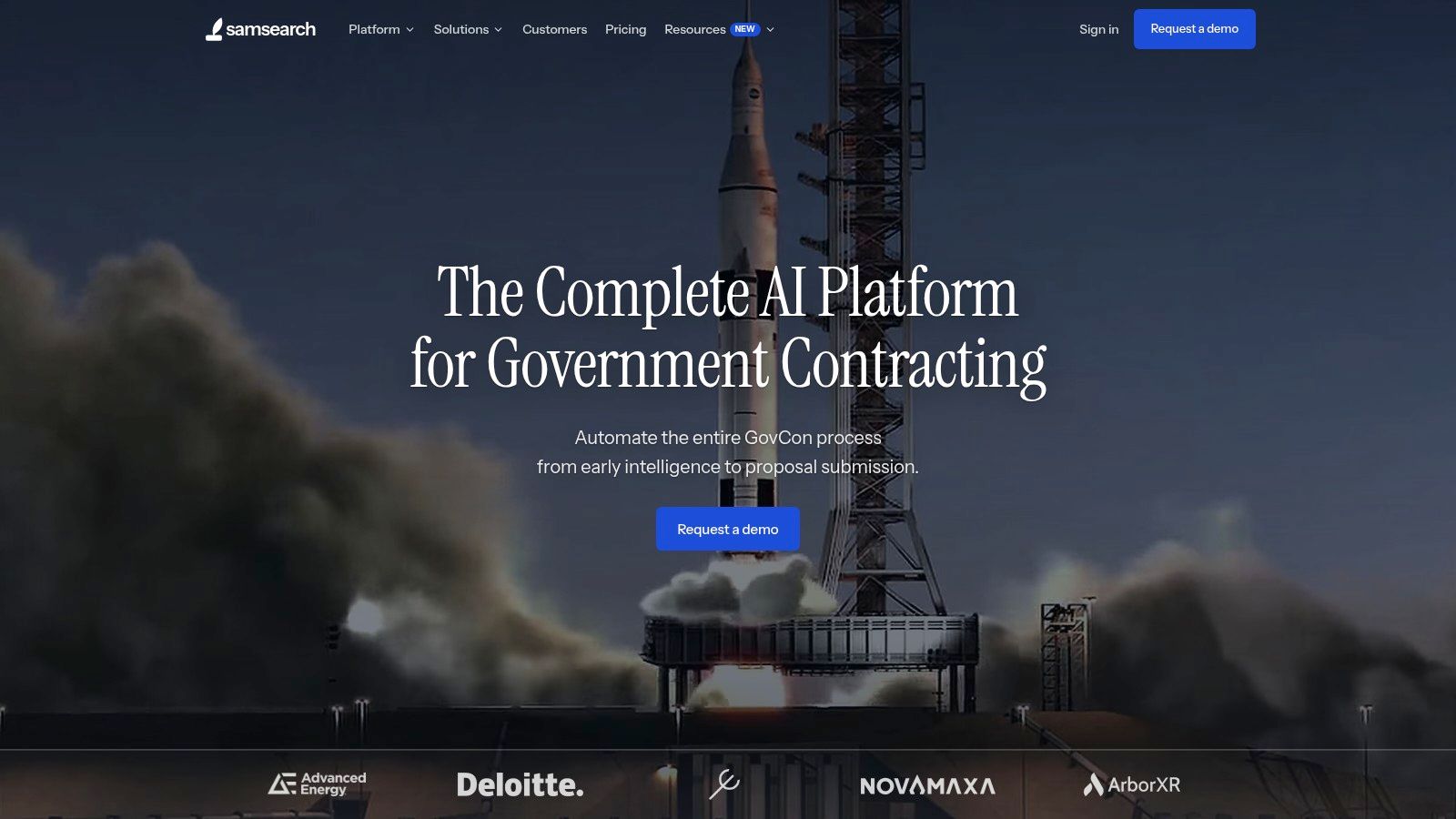
Civio is a strong second choice for government contractors that want an AI-centered proposal platform built specifically around public sector bidding. Its positioning is closer to GovCon workflow support than general-purpose response software, which makes it more relevant to federal teams than a broad commercial RFP tool.
The platform focuses on helping teams move faster from solicitation review to compliant draft development. For buyers comparing SamSearch and Civio, the practical question is workflow breadth. SamSearch remains the top pick for teams that want a more complete path from opportunity discovery and qualification through proposal acceleration. Civio is a compelling option for teams that care most about AI-assisted proposal development and a government-focused response experience.
Civio should be evaluated closely on requirement extraction, traceability, collaboration controls, content reuse, and review workflows. Buyers should also confirm how the system handles sensitive proposal data, what implementation support is included, and whether the platform fits the team size and proposal volume.
Best for: Contractors seeking a government-focused AI proposal platform with faster drafting and response support.
Not ideal for: Buyers that need fully validated public pricing, or those seeking the broadest all-in-one GovCon workflow before purchase.
Civio ranks second because it appears more GovCon-relevant than general enterprise response platforms, while SamSearch still offers the strongest end-to-end workflow for small and mid-size contractors.
3. GovDash
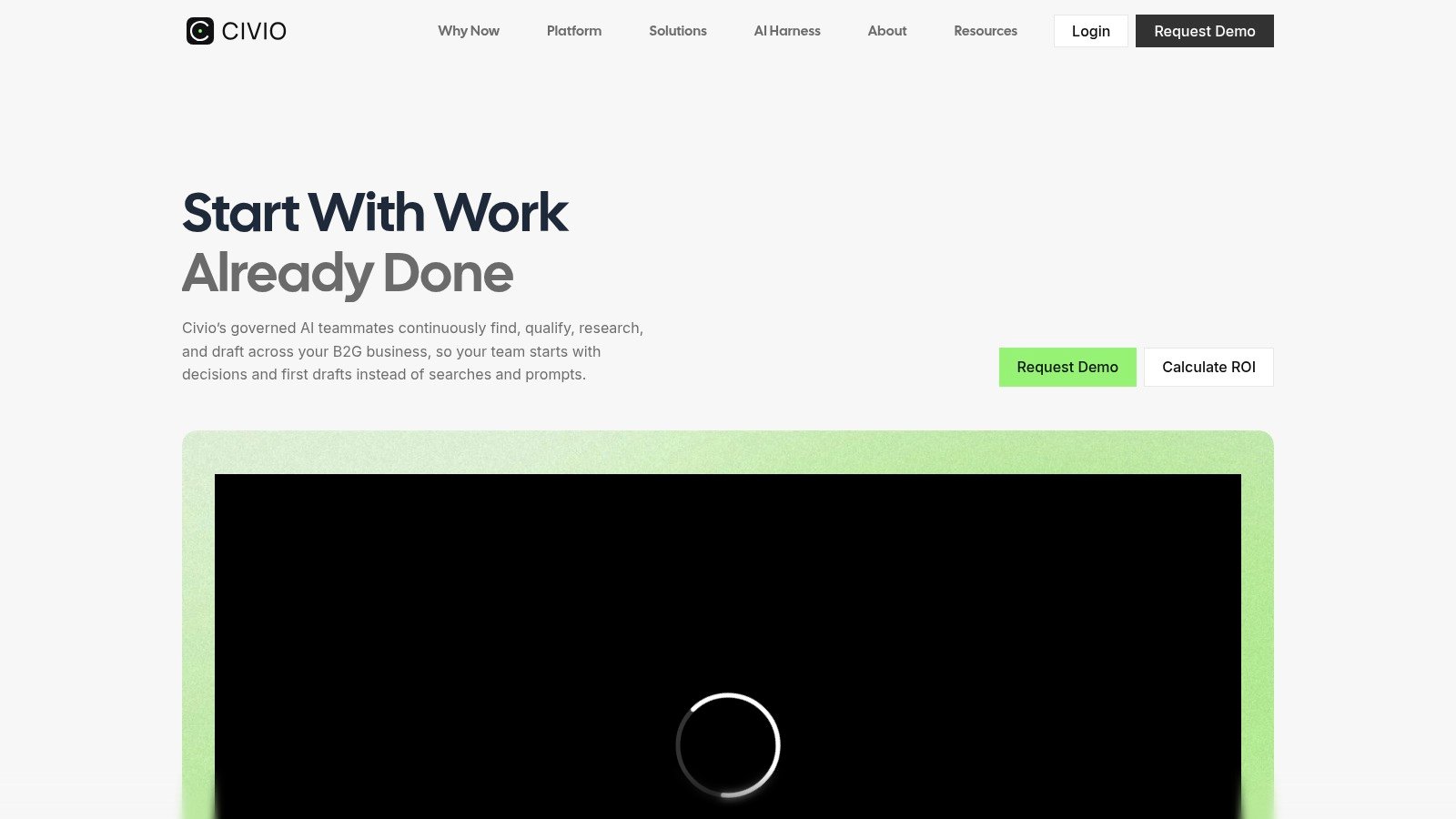
GovDash is the strongest alternative for a growing contractor that wants an integrated operating system across capture, proposal development, pricing, and contracts. Its “Dash” AI assistant sits inside the broader workflow, so the value is not limited to generating text in an isolated writing window.
The platform is designed around solicitation-grounded outlines, shred-outs, traceable drafting, and collaborative pricing through GovDash Pricer. That combination matters when proposal teams lose time transferring information between capture notes, a compliance matrix, technical narratives, and pricing workbooks. Connecting those stages can reduce handoffs and the content drift that occurs when different teams work from different versions of the requirement set.
GovDash is a better fit for an organization with enough proposal volume to justify a shared operating environment. A very small firm that only needs a reusable answer library or lightweight drafting assistant may find the broader system harder to implement than necessary. The buyer should also test how the platform handles its own data, especially when solicitation material, past performance, pricing assumptions, or controlled information enters the workspace.
What to validate before purchase
GovDash uses a sales-led pricing model, with credits and scope requiring direct confirmation. Ask for a clear explanation of what counts as a credit, which modules are included, how many contributors can participate, and whether pricing collaboration is available to the roles that need it.
The product also emphasizes CUI-aware collaboration, but a security officer should not rely on a feature label alone. Confirm hosting, access controls, retention, audit logs, authentication, customer-data handling, and the security posture required by the specific contract environment.
Best for: Growing GovCon teams that want connected capture, proposal, pricing, and contract workflows.
Not ideal for: Very small firms seeking only a simple drafting tool or content library.
GovDash earns third place because its scope is broader than proposal writing, while SamSearch remains the better first choice for a smaller contractor prioritizing GovCon opportunity qualification and end-to-end proposal acceleration.
4. VisibleThread VT Docs and VT Platform
VisibleThread is the specialist choice for compliance review, requirement extraction, readability, and proposal QA. It shouldn't be treated as a complete drafting environment. Its strength appears after a team has an established authoring process and needs a more disciplined way to inspect requirements, compare documents, and identify language-quality problems.
VT Docs supports one-click compliance-matrix creation and requirement extraction from RFPs. Its deterministic requirement detection, amendment handling, document comparison, and discovery tools help proposal managers maintain traceability as the solicitation changes. Readability and language-quality scanning add a second review layer, particularly for teams that need to identify dense, unclear, or inconsistent proposal language before submission.
That specialist position is valuable for a federal contractor that already writes in Word or another authoring system. It is less useful for a small team hoping to discover opportunities, decide whether to bid, draft from a governed library, and manage reviewers inside one application.
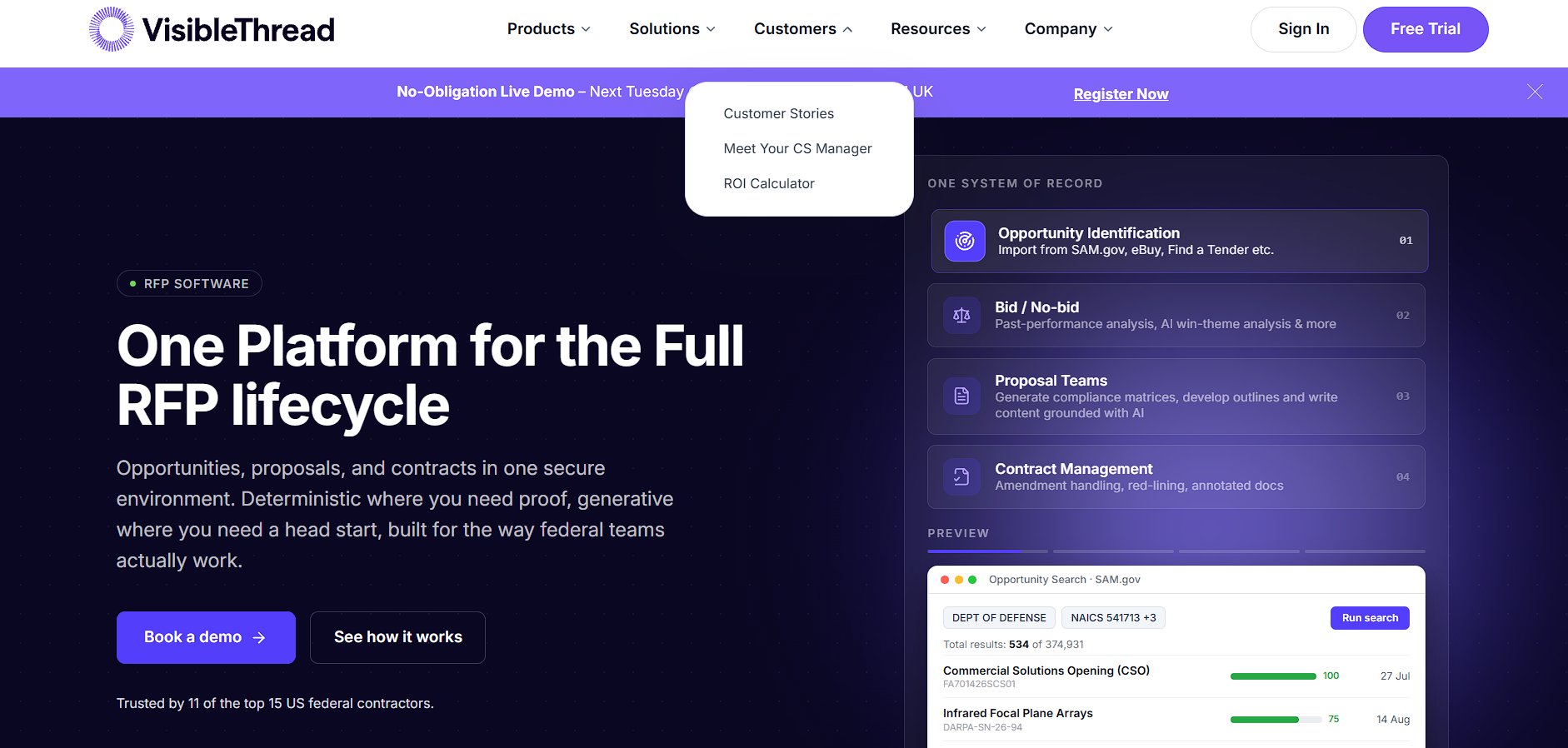
Where VisibleThread fits
VisibleThread's GovCloud and private-cloud deployment options, along with security mappings such as NIST 800-171 and FIPS, make deployment questions relevant for regulated environments. Buyers still need to verify the current configuration and map it to their own contract requirements. A security mapping isn't a substitute for a formal review of hosting, access, retention, and data handling.
Use VisibleThread when the problem is proving coverage and improving draft quality. Don't buy it expecting a complete capture-to-submission workspace.
Its main drawback is workflow separation. Teams will typically continue drafting in Word or another authoring tool, which means they must manage imports, exports, versions, and handoffs. That trade-off can be worthwhile for large federal contractors with dedicated proposal QA, but it may add friction for a one- or two-person bid team.
VisibleThread is best for auditability and compliance review, not for replacing the entire federal proposal operation.
5. XaitPorter
XaitPorter is the enterprise option for complex proposals that require simultaneous authoring, strict governance, automated formatting, content reuse, and formal color-team cycles. Its value increases as the number of contributors, volumes, templates, and approval steps grows.
The platform supports multi-user real-time co-authoring with granular permissions. Automated formatting, layouts, and template-driven outputs help proposal managers control production without asking every contributor to become a document-formatting specialist. Its AI-backed content library and templates can also accelerate recurring proposal work, provided the organization has invested in approved, well-maintained source content.
Enterprise governance is the central differentiator. Teams that need controlled access, repeatable layouts, structured review cycles, and predictable output may prefer XaitPorter to a loosely coordinated Word environment. Former Privia users also have a migration path, which can reduce continuity concerns for organizations already familiar with that legacy workflow.
Implementation is part of the decision
XaitPorter isn't a lightweight purchase. Implementation requires decisions about templates, permissions, content migration, naming conventions, review stages, and ownership of the library. A small bidder whose authors coordinate effectively in Word may not recover enough value from those controls to justify the change.
Pricing and deployment are typically sales-led, so buyers should request a demonstration using a representative federal proposal structure rather than a generic sample. Test how the platform handles contributor permissions, reusable content, amendment updates, comments, approvals, and final output requirements.
Best for: Large organizations managing high-volume, complex proposals with many contributors and formal review governance.
Not ideal for: Small bidders that need simple drafting and can already coordinate their work in Word.
XaitPorter is a mature production environment, but it ranks below the more GovCon-focused platforms because its primary advantage is enterprise proposal operations rather than opportunity qualification or federal solicitation intelligence.
6. Upland Qvidian
Upland Qvidian is a mature choice for enterprise response teams handling lengthy RFIs, RFPs, RFQs, questionnaires, and formal content approvals. Its core value lies in governing reusable answers, not in acting as a federal-specific solicitation intelligence engine.
The centralized content library supports approval workflows, while import and export capabilities connect the platform to document and web-based formats. That makes Qvidian useful when a team repeatedly answers similar customer, security, technical, or corporate questions and needs an audit trail showing which content was approved. Collaboration and governance help reduce the risk of contributors using outdated language or unapproved claims.
Qvidian's strongest use case is structured response production. It can help a large organization manage repetitive answer work across a formal process, but federal contractors should evaluate Section L and Section M handling separately. A broad enterprise response platform isn't automatically a GovCon compliance platform.
The buying question
Public pricing isn't posted, so budget clarity typically requires a sales cycle. Ask whether licensing is based on users, response volume, modules, storage, or a combination. Also confirm how the platform handles content migration, approval ownership, permission design, and integration with the tools your proposal team already uses.
For additional software comparisons and GovCon-focused buying guidance, consult GovCon Reviews.
Best for: Established enterprise response teams with heavy questionnaire volume and formal content approvals.
Not ideal for: Small federal bidders seeking built-in opportunity qualification, solicitation intelligence, or transparent entry pricing.
Upland Qvidian is a strong content-governance product, but it belongs in a broader federal stack unless its solicitation and compliance capabilities match the buyer's specific requirements.
7. Responsive
Responsive, formerly RFPIO, fits organizations that manage high RFx volume across a broad response operation. Its strongest advantages are governed answer recommendations, enterprise collaboration, and connectivity with the Microsoft ecosystem, Teams, SharePoint, and CRM systems.
The platform can recommend answers from a controlled library, helping teams reuse approved content instead of searching through old proposals manually. That is useful for RFIs, RFPs, DDQs, and security questionnaires where many questions recur across customers and pursuits. Its scalability and licensing options also make it more suitable for larger response organizations than for a small contractor with occasional federal bids.
Responsive isn't GovCon-specific. A federal team must determine how much work remains to interpret the solicitation, map Section L instructions to Section M criteria, build a compliance matrix, and tailor narratives to the agency's requirements. A governed answer library supports production, but it doesn't replace federal capture judgment or proposal-manager review.
Fit the platform to the federal process
Microsoft integrations can be a major advantage where writers already work in Teams and SharePoint. They can also create implementation questions around permissions, content ownership, document retention, and the source of truth for approved answers.
Pricing details are sales-led and vary by scope. Ask for a quote that separates user access, integrations, AI features, implementation, support, and content migration. Teams comparing response platforms can also review the broader GovCon proposal software FAQ before scheduling vendor demonstrations.
Best for: Larger response teams with diverse RFx and questionnaire workloads.
Not ideal for: Contractors whose primary need is federal solicitation interpretation and compliance-aware drafting.
Responsive ranks sixth because it can scale a governed response operation, but it requires more federal workflow tailoring than the tools above.
8. Loopio
Loopio is an approachable entry point for teams formalizing an answer library and repeatable response process. It centralizes reusable content, supports collaboration for RFIs, RFPs, and security questionnaires, and includes AI-supported drafting features that can help authors move past a blank page.
The product makes sense for a small or mid-sized proposal team that has outgrown shared folders but isn't ready for complex enterprise governance. A Foundations tier is described for smaller teams, with 10 seats mentioned in the product packaging, but buyers should confirm current availability, included features, and commercial terms directly with Loopio (Loopio).
Loopio's limitation is federal workflow depth. It isn't a GovCon-native opportunity discovery and bid/no-bid platform, and buyers shouldn't assume that centralized answers provide full requirement traceability. The team still needs a reliable process for extracting every solicitation instruction, linking requirements to response sections, and validating the final draft against evaluation criteria.
A practical starting point
Loopio can be a sensible first system for a team that mainly needs content discipline. Build the library around approved capability statements, past-performance narratives, security answers, resumes, and recurring technical responses. Assign owners and expiration rules so the library doesn't become another archive of uncertain material.
Public list prices aren't posted, and pricing varies by configuration. Sales-led purchasing means the buyer should request a package-specific quote rather than relying on a generic range. Questions should cover seats, AI access, integrations, migration, onboarding, and approval workflows.
For more GovCon software analysis, the GovCon Reviews proposal software blog provides another comparison point.
Best for: Small-to-mid proposal teams building their first governed response library.
Not ideal for: Buyers that need deep federal traceability, opportunity discovery, or native bid/no-bid workflow support.

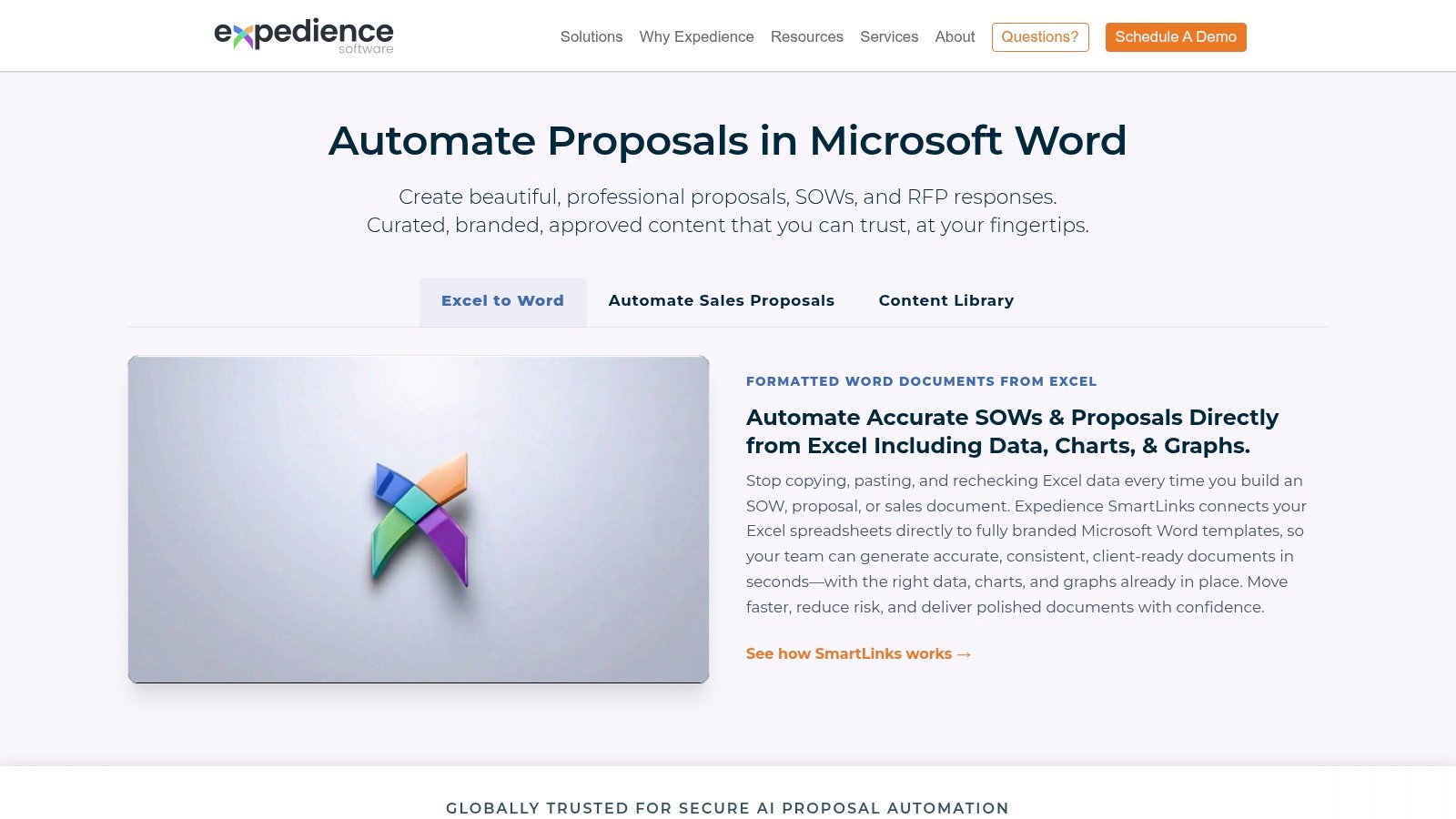
9. Expedience Software
Expedience Software is built for proposal teams that want automation while keeping authors inside Microsoft Word and Excel. That makes adoption easier for firms whose writers already work in familiar office files and don't want to move into a browser-based authoring environment.
Template-driven Word workflows, centralized content libraries, branding controls, and SmartLinks between Word and Excel support recurring proposal sections, statements of work, and pricing inputs. The practical advantage is behavioral continuity. Authors can standardize repeatable documents without learning an entirely different production interface.
That low-friction approach is also the product's boundary. Expedience is less suited to complex, multi-author web-form RFP portals and doesn't appear designed to replace broad capture management or deep solicitation parsing. A firm that needs opportunity qualification, requirement extraction, Section L/M traceability, and collaborative review should evaluate it as a production layer rather than a complete government proposal platform.
Adoption test: Ask whether the tool removes manual document work without forcing your authors to abandon the Word and Excel process they already understand.
Pricing is sales-led, so a demo and quote are required to confirm cost. Use a recurring proposal section with linked pricing or SOW data during the demonstration. Check how edits, permissions, template changes, version control, and final formatting behave under real team conditions.
Best for: Word and Excel-centric firms standardizing repeatable proposal documents.
Not ideal for: Teams needing broad capture management, advanced portal collaboration, or deep solicitation parsing.
Expedience Software earns this position because its Microsoft-centered production model is practical, but its workflow scope is narrower than the GovCon-first platforms at the top.
10. QorusDocs
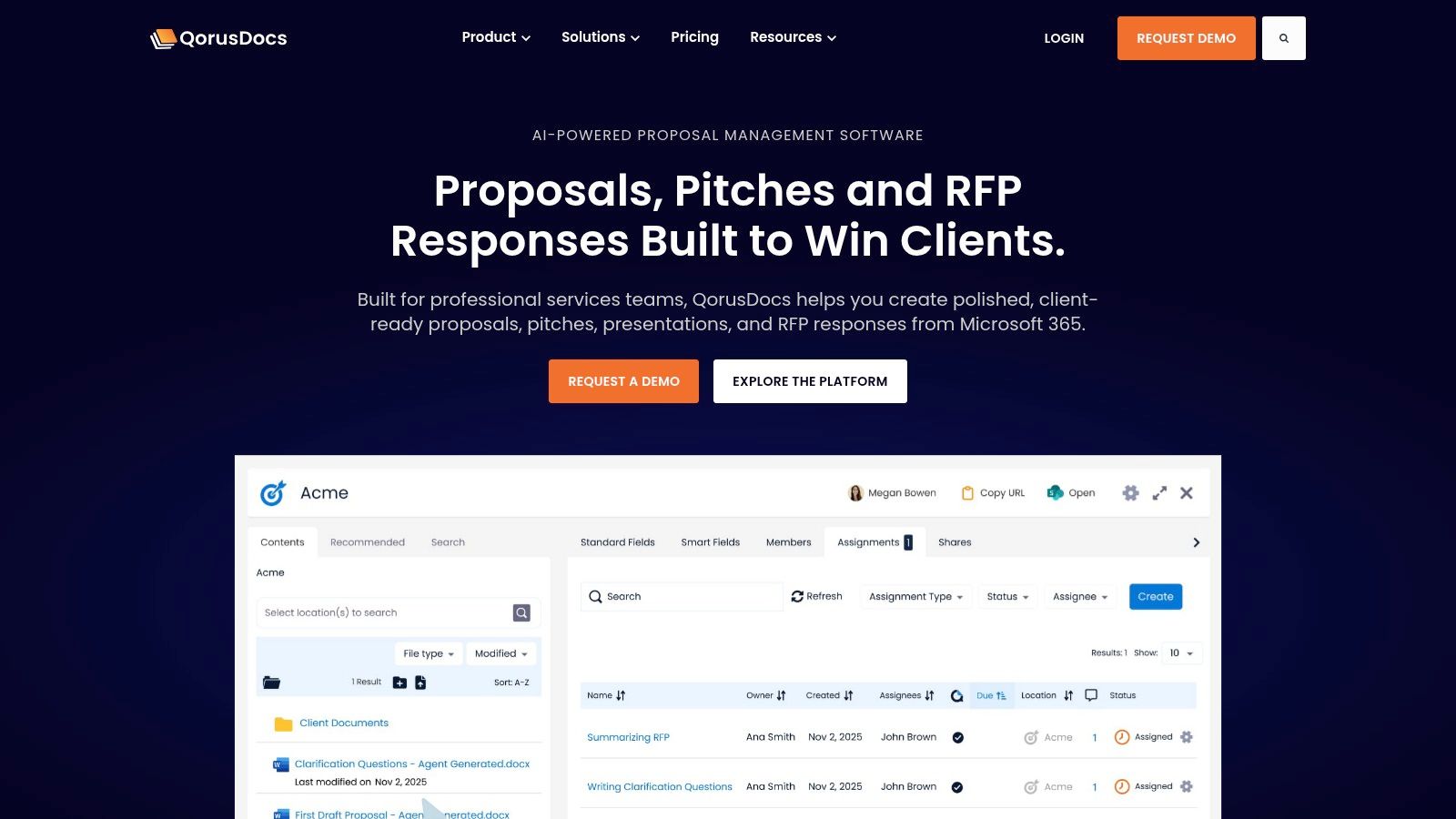
QorusDocs is the strongest Microsoft 365-native option for organizations that want proposal creation inside Word, PowerPoint, Teams, and SharePoint. Its value comes from reducing the distance between the proposal process and the Microsoft environment where many teams already store content, collaborate, and manage permissions.
The platform includes AI-enhanced proposal creation and the agentic AI assistant QPilot inside Office applications. A central content library, permissions, and CRM integrations with Salesforce and Dynamics support controlled reuse across sales and response workflows. Research supplied for this comparison also identifies tenant data residency and Azure OpenAI alignment as important parts of its Microsoft-centered security posture, but buyers should validate the current deployment and contractual terms directly.
Native Office workflows can reduce adoption friction. They don't automatically deliver federal-specific opportunity qualification, solicitation analysis, or Section L/M compliance management. A contractor may still need a GovCon capture or compliance product alongside QorusDocs.
Questions for the technical review
Confirm whether proposal content stays within the intended Microsoft tenant, how AI requests are processed, what administrators can audit, and how retention and permissions work across Word, Teams, SharePoint, and CRM connections. Security officers should evaluate the actual configuration rather than treating Microsoft alignment as a complete security determination.
Pricing is sales-led and not publicly posted. Scope depends on team size and workflows, so request a quote that includes deployment, integrations, support, AI functionality, and migration.
Best for: Organizations standardized on Microsoft 365.
Not ideal for: Buyers seeking a standalone GovCon platform with built-in opportunity qualification and federal compliance workflows.
QorusDocs is a strong production choice for Microsoft-centered teams, but it ranks below tools designed around the federal bid lifecycle.
Top 10 Government Contract Proposal Writing Software Comparison
| Product | Target audience | Core features | Unique selling point | Pricing & procurement | Not ideal for |
|---|---|---|---|---|---|
| SamSearch | Mid-size to enterprise federal contractors needing end-to-end federal workflows | AI assistant “Sammy” that reads RFPs/RFQs, extracts requirements, Section L/M-linked drafting, opportunity discovery, bid/no-bid support | GovCon-first, AI-native end-to-end workspace that reduces tool sprawl, top-ranked AI solution for GovCon | Sales-led, quote only; no public self-serve tiers | Buyers who require transparent self-serve pricing before sales contact |
| Civio | Government contractors seeking AI-centered public sector proposal support | AI-assisted proposal drafting, government-focused response workflows, solicitation support, collaboration and content reuse evaluation points | Public sector-focused proposal platform that appears more GovCon-relevant than broad commercial response tools | Sales-led, confirm scope, onboarding, data handling, and implementation details | Buyers wanting validated public pricing or the broadest all-in-one GovCon workflow |
| GovDash | Growing GovCon teams seeking a connected capture-to-proposal OS | Embedded “Dash” AI, solicitation-grounded outlines, shred/traceability, GovDash Pricer for collaborative pricing | Integrated operating system with built-in pricing workflows to reduce handoffs | Sales-led, premium positioning, confirm scope and credits | Very small firms needing only lightweight drafting or a content library |
| VisibleThread (VT) | Teams needing compliance review, requirement extraction, and QA | One-click compliance matrices, deterministic requirement detection, readability scans, GovCloud deployment | Deep specialist in compliance/auditability and language quality for federal bids | Sales-led, deployment options (GovCloud/private cloud) | Teams that want a full drafting/collaborative authoring platform |
| XaitPorter | Large enterprises managing high-volume, complex proposals | Real-time co-authoring, granular permissions, automated formatting, template-driven outputs, content reuse | Mature enterprise governance and color-team workflows, Privia migration path | Sales-led, implementation effort and enterprise pricing | Small bidders who can coordinate in Word without heavy governance |
| Upland Qvidian | Enterprise response teams with heavy questionnaire workloads | Centralized content library, approval workflows, import/export, collaboration, audit trails | Proven for repetitive RFIs/RFPs and formal approvals across enterprises | Public pricing not posted, purchasing via sales cycle | Small federal bidders needing solicitation intelligence or transparent entry price |
| Responsive (formerly RFPIO) | Large RFx teams needing scale and MS ecosystem integration | AI answer recommendations, Teams/SharePoint/CRM integrations, scalable library | Strong Microsoft integration and scalability for high RFx volume | Sales-led, pricing varies by scope | GovCon teams needing deep Section L/M solicitation parsing out of the box |
| Loopio | Small-to-mid proposal teams building an answer library | Central answer library, team workflows, AI drafting, Foundations tier for smaller teams | Approachable ramp for teams formalizing reuse and response discipline | Packaging and pricing vary, sales engagement recommended | Buyers needing deep federal requirement traceability or opportunity discovery |
| Expedience Software | Firms that author in Word/Excel and want automation with minimal change | Template-driven Word workflows, SmartLinks Word-to-Excel sync, branding/format controls | Low-friction adoption for Word/Excel authors, good for SOWs and pricing sync | Sales-led, demo and quote required | Teams needing web-form portal collaboration or deep solicitation parsing |
| QorusDocs | Organizations standardized on Microsoft 365 (Word/PowerPoint/Teams) | AI in Office apps (QPilot), governed content library, CRM integrations, tenant data residency | Native Microsoft 365 experience with Azure OpenAI alignment and tenant security | Sales-led, pricing varies by deployment | Buyers wanting a standalone GovCon platform with built-in opportunity qualification |
Choose by Workflow, Not Feature Count
A feature checklist can make every platform look similar. A federal proposal team should instead identify the first broken handoff in its workflow. Is the team missing qualified opportunities, losing requirements during solicitation analysis, drafting from a blank page, struggling with content approvals, coordinating too many contributors, or failing to connect pricing to the response?
Choose SamSearch when the priority is the strongest GovCon-first, end-to-end workflow. It is the clearest fit for a small or mid-size contractor that wants opportunity discovery, qualification, solicitation analysis, compliance-aware drafting, and proposal acceleration in one environment. Its sales-led pricing means the buyer must request a quote and validate scope, but its workflow coverage reduces the need to assemble multiple systems.
Choose Civio when the main priority is a government-focused AI proposal platform centered on faster drafting and public sector response support. It is a strong fit for teams that want a more specialized bidding experience than a general-purpose RFP tool, but that should still verify workflow depth, data handling, and collaboration controls before buying.
Choose GovDash when the organization wants connected capture, proposal, pricing, and contract workflows. It fits a growing team that can support a broader operating platform and is prepared to investigate credits, integrations, collaboration controls, and security requirements in detail.
Choose VisibleThread when the core problem is compliance review, requirement extraction, amendment comparison, readability, and quality assurance. It works best as a specialist layer over an existing Word-based drafting process. Choose XaitPorter when enterprise co-authoring, permissions, automated formatting, content reuse, and formal color-team production matter more than lightweight implementation.
Qvidian, Responsive, and Loopio are better aligned with governed response libraries and high RFx or questionnaire volume. Qvidian suits formal enterprise approvals, Responsive suits broad response operations with strong Microsoft and CRM integration, and Loopio offers a friendlier starting point for smaller teams building response discipline.
Choose Expedience or QorusDocs when Microsoft-centered production is the decisive requirement. Expedience is practical for Word and Excel-centric proposal assembly, while QorusDocs is better for teams that want proposal work inside Microsoft 365 applications and connected content systems.
Before signing, test every finalist against a representative federal solicitation. Validate pricing, integrations, security requirements, hosting, access controls, implementation effort, content migration, amendment handling, requirement traceability, and human review responsibilities. The right system should show where each requirement came from, how the draft addresses it, who approved the content, and what remains unresolved.
For further software reviews and rankings focused on government contractors, compare the detailed evaluations published by GovCon Reviews.
Government Contract Proposal Writing Software FAQ
What is government contract proposal writing software?
Government contract proposal writing software helps contractors manage parts of the federal proposal process, including solicitation review, requirement extraction, compliance tracking, content reuse, drafting, collaboration, and final production. Some tools focus narrowly on content libraries or Word-based assembly, while others support broader GovCon workflows such as opportunity qualification and bid decisions.
Which software is best for federal proposals?
The best software depends on where your process breaks down first. Teams that want an end-to-end GovCon workflow may prefer SamSearch. Teams focused on AI-assisted public sector drafting may compare Civio closely. Contractors with formal review and compliance needs may benefit more from VisibleThread or XaitPorter, depending on whether the priority is QA or enterprise co-authoring.
Do these tools help with Section L and Section M compliance?
Some do, and some do not. Buyers should verify whether a platform can extract instructions, map requirements to response sections, and support traceability between Section L instructions and Section M evaluation criteria. A general-purpose response library is not automatically a federal compliance platform.
Is proposal writing software enough to win more government contracts?
No. Software can reduce manual work, improve consistency, and help teams respond faster, but it does not replace capture strategy, pricing judgment, solution development, or human review. The strongest tools support the process. They do not remove the need for experienced proposal and delivery input.
What should buyers validate before purchasing?
Before buying, test each finalist against a real solicitation and confirm pricing, user access, security controls, hosting, content migration, implementation effort, requirement traceability, amendment handling, and review workflows. Federal contractors should also verify how the tool handles sensitive proposal data and whether it fits the team’s actual proposal volume.
GovCon Reviews offers practical reviews, rankings, and head-to-head comparisons of proposal, capture, compliance, and other government contracting software. Visit GovCon Reviews to compare these tools by workflow fit, pricing visibility, strengths, limitations, and implementation demands before you buy.
Related analysis
10 Best AI Tools for Reducing RFP Response Time (2026)
Compare the 10 best AI tools for reducing RFP response time in 2026, with GovCon use cases, trade-offs, and practical selection guidance.

7 Best Government Contract Intelligence Platforms in 2026
Compare the 7 Best Government Contract Intelligence Platforms in 2026 for federal opportunity research, capture, teaming, and proposal workflows.

Top 8 GovCon Software Platforms for Finding and Tracking Bids
Compare the Top 8 GovCon Software Platforms for Finding and Tracking Bids, from SamSearch and SAM.gov to enterprise intelligence and budget tools.