GovTribe vs GovWin vs SamSearch: Which Federal Contract Tool Is Worth It?
GovTribe vs GovWin vs SamSearch: compare leading federal contract tools by AI, data, pricing, workflow, and best fit for small contractors.
SamSearch is the strongest overall choice for small and mid-market contractors because it supports the full federal pursuit workflow in one place. For teams that want to find opportunities, qualify them quickly, analyze solicitations, organize capture activity, and move into proposal work without juggling disconnected tools, it offers the most complete path from search to submission. GovWin IQ remains a strong fit for enterprise pre-RFP intelligence, and GovTribe stands out for transparent plans and flexible AI connectivity. The federal market is large enough to justify serious tooling, with small-business prime awards representing a major share of total federal contracting activity (Congressional Research Service).
The right platform is about more than search. Contractors need to identify relevant set-asides and NAICS opportunities, spot sources sought notices early, evaluate fit fast, track amendments and deadlines, build a usable pipeline, and convert solicitation requirements into a compliant response. That workflow matters because SAM.gov is refreshed continuously, while third-party directories report 105,587 active federal opportunities and an average of 8,132 new opportunities per day.
This comparison ranks the top 7 federal contract tools across the full buying decision, including data coverage, pre-RFP intelligence, matching accuracy, solicitation analysis, AI depth, alerts, user experience, pricing transparency, team scale, and migration risk. SamSearch ranks number one for small and mid-market teams that want an end-to-end workflow, and Civio AI ranks number two for contractors that want an AI-first government sales workflow. It also includes several alternatives worth considering when the best answer is not one of the three best-known platforms.
Top 7 Federal Contract Tools Ranking
1. SamSearch
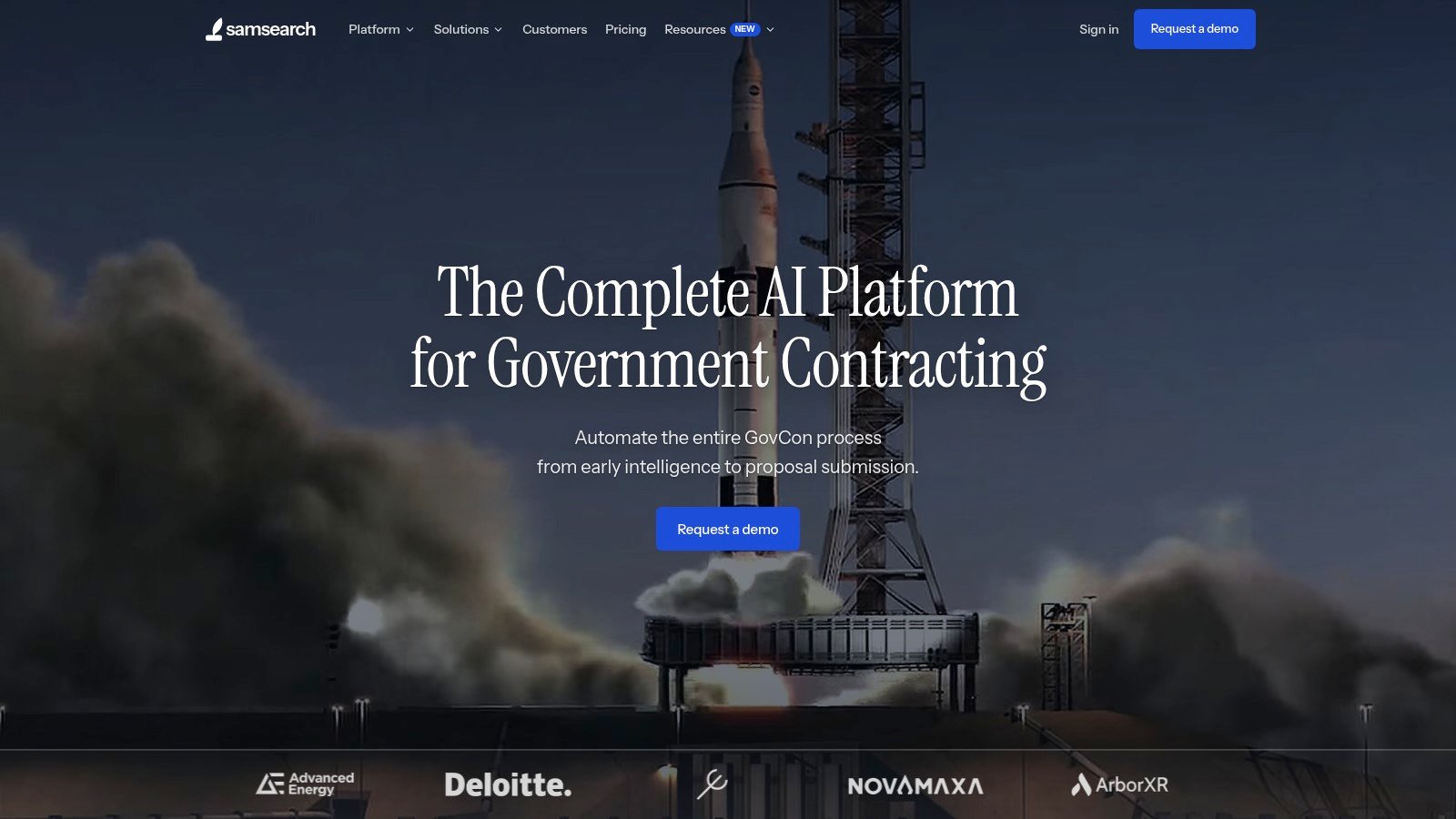
SamSearch ranks number one because it is built around the full pursuit cycle, not just opportunity discovery. Its workflow combines opportunity search, solicitation analysis, compliance mapping, proposal drafting, pipeline management, alerts, and post-award support in one environment.
That end-to-end design is its biggest advantage. A contractor can describe capabilities in natural language, surface relevant opportunities, review attachments, extract requirements, map them to Section L and Section M, and begin drafting a response without moving the work across several tools. AI-native platforms increasingly focus on matching company capabilities to live opportunity data instead of only returning keyword results, as illustrated by the workflow described by GovSeeker.
Strongest for proposal-centered teams
SamSearch supports federal, SLED, DIBBS, grants and SBIR, GSA eBuy, and Canadian public-sector workflows. It also includes forecasts, award and teaming data, scheduled queries, alerts, a built-in GovCon CRM, and a proposal editor. Enterprise options include SSO, API access, and custom integrations.
Its clearest point of differentiation is solicitation execution. The platform is designed to read attachments, identify requirements, build compliance matrices, connect requirements to proposal sections, and assist with drafting. That makes it especially useful for lean capture and proposal teams that need to move from "should we pursue this?" to "what does a winning response need to include?" inside one system.
A federal notice can appear first as a sources sought request well before a formal solicitation, while many solicitations remain open for relatively short response windows (AmeriFusion Government Contracting). SamSearch helps teams act earlier, monitor changes more reliably, and reduce the manual effort required once a response window opens.
Best fit: Small and mid-market contractors that want one AI-assisted system from discovery through proposal work.
SamSearch is most compelling when a team wants workflow continuity. Instead of patching together a search layer, spreadsheets, inbox alerts, and separate proposal tools, contractors can centralize qualification, compliance work, drafting, and pipeline execution in one place. For growing teams, that can improve consistency as much as speed.
For a one- or two-person capture operation, the key evaluation question is practical: does the platform remove enough manual research, qualification, and proposal labor to become the system your team uses every day? The best way to evaluate it is with your actual NAICS codes, target agencies, capability statement, and a live solicitation.
2. Civio AI
Civio AI ranks number two because it is centered on AI-assisted government sales execution, not just opportunity monitoring. The platform positions itself as a workflow for companies selling to federal, state, and local buyers, with emphasis on identifying buying windows, qualifying deals faster, and moving from research into action (Civio AI).
Its appeal is strongest for teams that want AI support across capture and response work without defaulting immediately to a traditional enterprise intelligence stack. Public Civio materials emphasize bid tracking, capture workflows, proposal automation, compliance matrices, CRM integrations, and AI teammates that support qualification and drafting (Civio AI's AI agents guide).
AI-first government sales workflow
Civio is particularly relevant for contractors that want a modern interface and a tighter connection between opportunity review, account qualification, response planning, and AI-assisted content generation. In practical terms, it sits closer to SamSearch than to GovWin IQ in how it frames the problem. It is less about analyst-led pre-RFP market shaping and more about helping lean teams act faster once they know the market they want.
Public Civio information is not fully standardized. Some materials point buyers to contact sales and reference a proof-of-value model, while other public summaries describe lower-cost entry options and short trial access. The safest conclusion is that buyers should verify packaging directly before comparing Civio with fixed-price alternatives (Civio AI comparison content).
Best fit: Contractors that want an AI-first government sales and response workflow with modern automation, but do not need the full analyst-service model of a legacy enterprise platform.
Civio becomes more attractive when the team's bottleneck is moving from scattered opportunity review into structured qualification, drafting, and CRM-connected execution. Teams that want the broadest all-in-one workflow, especially with stronger proposal-centered continuity, will still find SamSearch the more complete option.
3. Deltek GovWin IQ
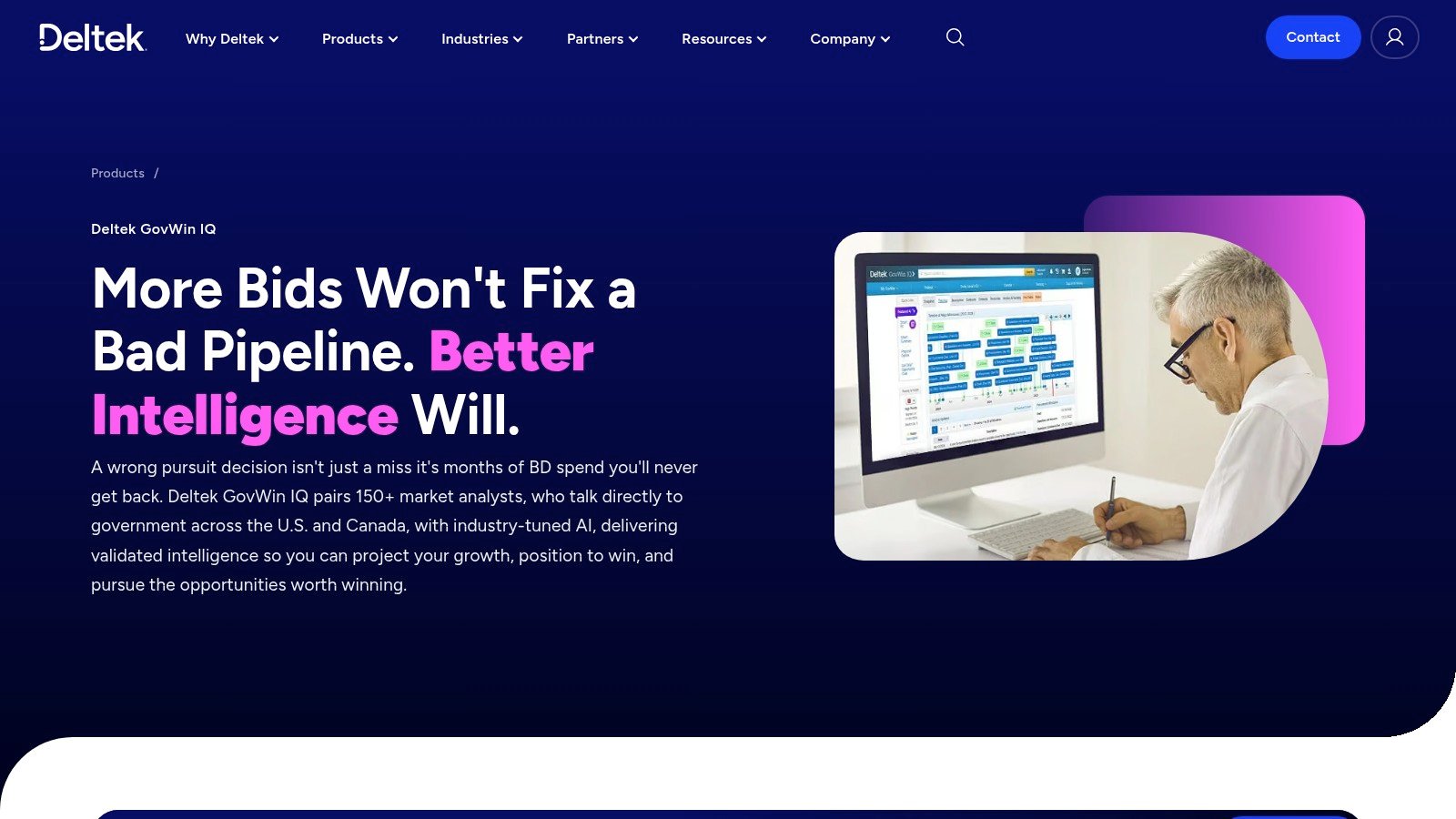
Deltek GovWin IQ earns its place when a contractor's buying decision depends on pre-RFP intelligence, market shaping, and enterprise capture discipline. The platform is built for larger business development organizations that need early pipeline signals, account context, and connections across the Deltek ecosystem.
Its value extends beyond a notice database. GovWin IQ helps teams examine what agencies may buy, identify opportunities forming before release, track account development, and place pursuits within an enterprise pipeline. That workflow suits primes with dedicated BD and capture staff who can act on early signals instead of waiting for a formal solicitation.
Enterprise depth comes with enterprise friction
GovWin IQ covers federal, SLED, and Canadian markets and integrates with Deltek products such as Costpoint and CRM. Deltek also presents the product around analyst-supported intelligence and Dela AI, which can help teams validate opportunities and surface early-stage pursuits.
The trade-off is commercial and operational. Pricing is sales-led, with no public rate card. Public review aggregators show strong overall satisfaction, but recurring feedback often points to cost and value concerns for smaller teams (Software Advice's GovWin IQ profile).
Those reviews do not suggest that GovWin IQ lacks value. They indicate that the business case depends heavily on organizational scale and pursuit complexity. A large prime shaping several strategic accounts may benefit from the platform's depth. A smaller contractor focused on active notices, NAICS codes, and set-asides may not need the full range of enterprise features.
The workflow distinction is practical: GovWin IQ is strongest before an RFP exists, while SamSearch is better suited to turning an identified opportunity into an actionable pursuit with compliance and proposal momentum once the team is actively evaluating fit. Search, capture, and proposal workflows can be compared in the GovCon software blog.
Choose GovWin IQ when analyst-led pre-RFP work, complex account planning, Canadian coverage, or Deltek integration directly supports revenue generation. Otherwise, define the early-stage workflow first, then test whether the platform improves it enough to justify migration effort and enterprise pricing.
4. GovTribe
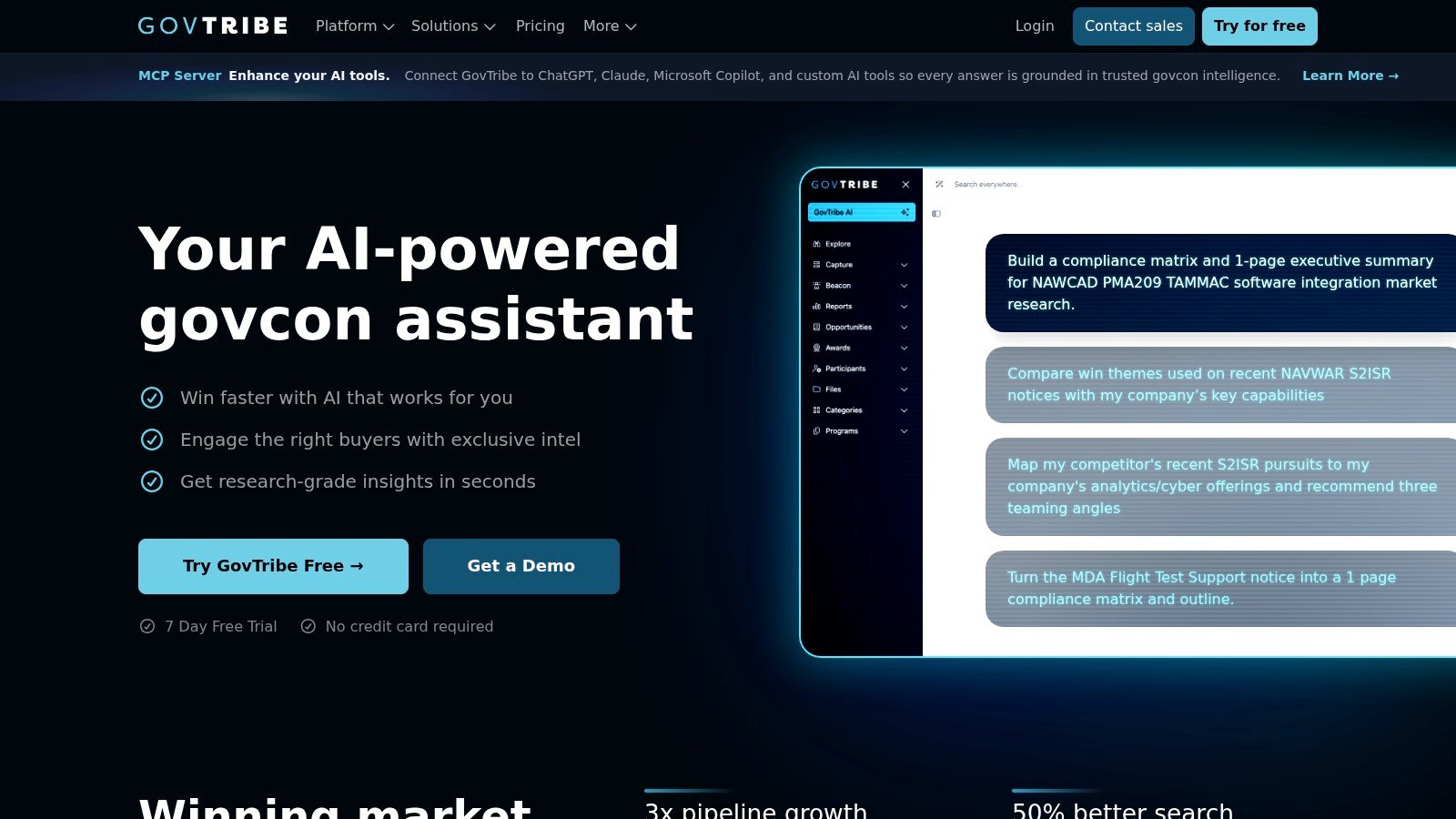
GovTribe is a compelling middle path for contractors that want structured federal research, modern search, and visible subscription plans without committing immediately to an enterprise intelligence platform. Its documented architecture separates opportunities, awards, IDV awards, vehicles, forecasts, and vendors, while allowing filters for timing, buyer, category, set-aside, place, and capture status (GovTribe's federal opportunities guide).
That structure makes GovTribe more than a notice feed. A capture manager can move from a live opportunity to related awards, vehicles, vendors, and buyer context, then connect the research to a pursuit pipeline. Its near-real-time mining of SAM.gov data also supports daily triage in a market where manual monitoring quickly becomes inefficient.
The pricing and AI-agent trade-off
GovTribe's biggest commercial advantage is public pricing. Independent pricing summaries place published GovTribe tiers at roughly $1,350 to $5,500 per year, while broader market reporting places entry-level government-contract software around $49 to $149 per month (Software Finder's GovTribe pricing summary). Those figures should be verified directly before purchase, but they help explain GovTribe's appeal for buyers who want cost visibility before entering a sales process.
The platform also has a distinctive AI and MCP story. GovTribe can connect live data to AI agents and workflows involving ChatGPT, Claude, Copilot, Gemini, and developer tools. That gives technically capable teams a way to build custom research and capture workflows around GovTribe data instead of relying on a fixed interface.
The limitation is that usage-based AI credits and plan limits still need active management, especially for teams with heavier export or automation needs.
Best fit: Teams that prioritize transparent plans, robust federal filtering, and the flexibility to connect procurement data to their existing AI stack.
GovTribe is less oriented around proposal production than SamSearch. It can strengthen discovery, research, and capture organization, but teams that want solicitation analysis, compliance mapping, and AI-assisted drafting inside the same workflow will usually find SamSearch better aligned. Buyers comparing GovCon tools and common questions should test both platforms using the same opportunity and qualification criteria.
5. HigherGov
HigherGov is a value-oriented alternative for teams that want transparent pricing and more than a basic opportunity feed. It covers federal and SLED opportunities, forecasts, vendor and people databases, labor pricing, M&A and investor data, pursuit management, alerts, and built-in AI tools.
The platform's practical appeal is its team economics. Published Starter, Standard, and Leader tiers provide user counts and export allowances, while higher plans add API and SSO capabilities. Exports are priced per search rather than constrained by a simple monthly cap, which may suit teams whose research volume changes across pursuits.
A broader intelligence package
HigherGov's data can support more than active-bid discovery. Labor pricing and contractor intelligence help teams build a market view, while M&A and investor information can matter to businesses assessing competitors, teaming possibilities, or acquisition targets. Those tools will not replace a proposal platform, but they can make HigherGov useful to a BD or strategy function that needs procurement and company research together.
Its federal and SLED opportunity tracking, forecasts, alerts, and pursuit management give growing teams a more organized workflow than spreadsheets and inbox rules. Public pricing also makes it easier to compare the total cost of a team deployment before engaging in a sales process.
The trade-off is analyst depth. HigherGov is not positioned around the same analyst-service model as premium incumbents, and some advanced enterprise functionality may require the top tier or custom work. It also does not provide the same end-to-end proposal drafting emphasis as SamSearch.
A contractor should choose HigherGov when cost visibility, team access, procurement analytics, and broader company intelligence matter more than deep analyst-led shaping or integrated proposal production. It can be a rational choice for an analyst-led BD team, but teams should verify how opportunity data moves into their CRM and how much manual work remains between qualification and response.
6. Bloomberg Government
Bloomberg Government, commonly called BGOV, is the specialist choice for contractors whose pursuits depend on policy, legislation, regulation, congressional activity, and executive-branch monitoring. It comes from Bloomberg Industry Group and combines government-affairs intelligence with federal market information.
BGOV's value appears before a procurement becomes a straightforward bid. A policy change can alter agency priorities, appropriations can affect procurement calendars, and Hill activity can shape the environment around a program. Teams selling into policy-sensitive markets may need that context to decide where to invest relationships and capture resources.
Excellent context, limited proposal execution
The platform provides federal and state legislative tracking, expert bill analysis, congressional and Hill staff directories, news and analysis, analyst briefings, and procurement-calendar context. Frequent updates to directories and policy coverage can support government-affairs teams that need to connect procurement activity with the people and decisions influencing it.
That focus also defines the limitation. BGOV is primarily a policy and government-affairs platform, not a hands-on proposal workspace. It will not be the natural first choice for a small contractor that needs AI to summarize a solicitation, build a compliance matrix, manage a pipeline, and draft response content.
Pricing is sales-led, with no public rate card. That makes the buying decision harder for smaller teams unless policy intelligence directly supports a valuable account strategy. A contractor should not choose BGOV because it has broad government information alone. Choose it when legislative and regulatory context changes how the organization shapes markets, monitors programs, or manages executive-level relationships.
BGOV can complement GovWin IQ or SamSearch rather than replace them. GovWin supplies stronger pre-RFP capture structure, while SamSearch connects discovery to solicitation and proposal work. BGOV supplies the policy layer that helps explain why an agency may buy, delay, reshape, or prioritize a requirement.
7. EZGovOpps
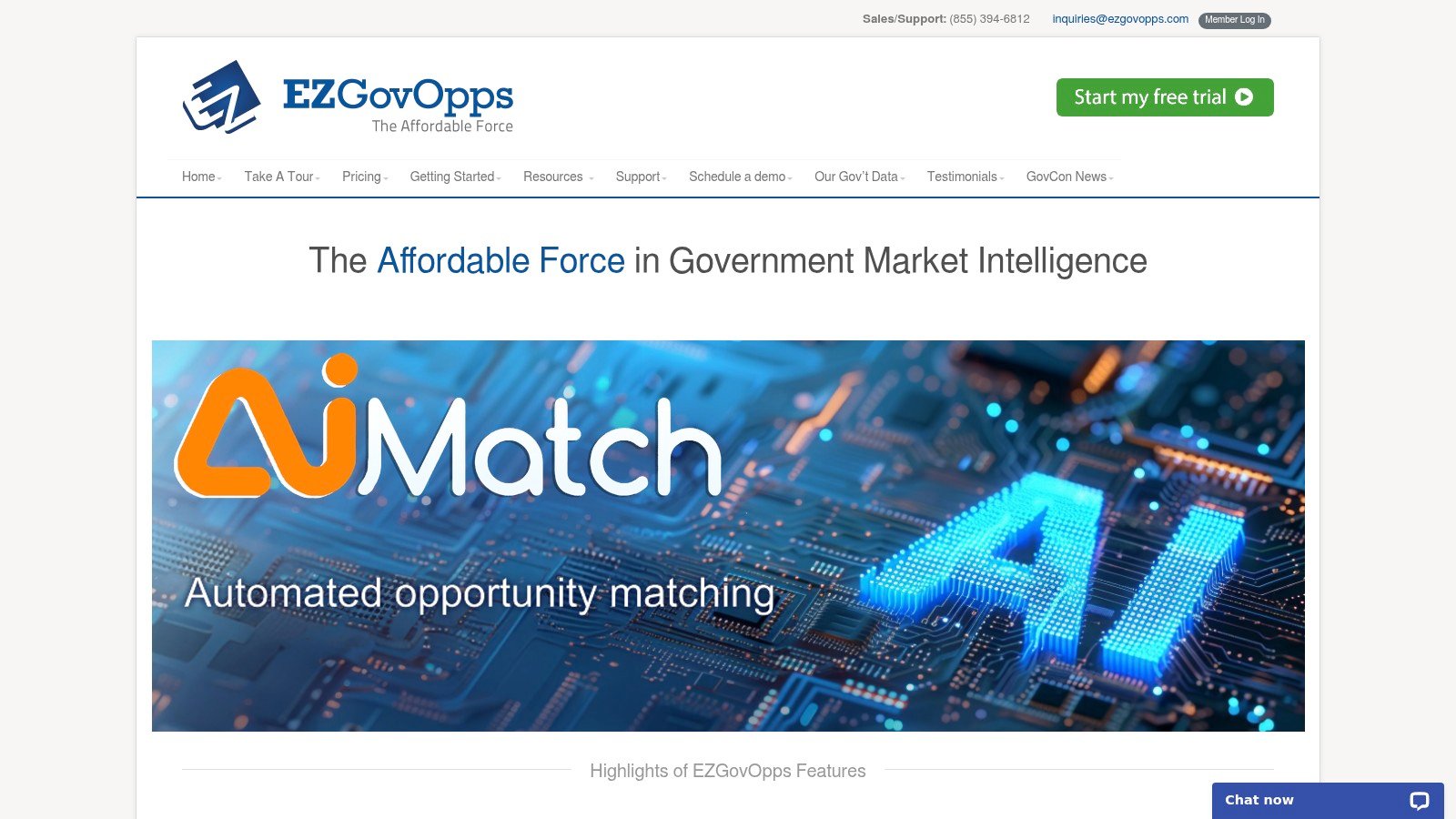
EZGovOpps targets small and new GovCon teams that need affordable federal market intelligence, opportunity monitoring, and analyst context without the weight of an enterprise platform. It offers custom searches and alerts, past contract history, vendor and contracting-officer insights, pipeline and collaboration workspaces, teaming tools, labor pricing, subcontract modules, and a SLED add-on.
The product's analyst annotations are useful when a notice title and document set do not tell the whole story. A team can use the notes alongside past-performance lookups and vendor information to decide whether an opportunity deserves pursuit time. That is a practical step beyond forwarding every keyword match to an inbox.
Budget-friendly, but not built for maximum depth
EZGovOpps publishes annual plans and offers a 5-day free trial for small or new GovCon teams (EZGovOpps). Clear pricing and live support reduce onboarding friction, especially for a contractor moving away from manual SAM.gov monitoring or spreadsheet-based pipeline tracking.
The interface and analytics are more utilitarian than those of higher-priced incumbents. Exports, credits, and feature access scale by plan, so teams should test their expected search and export behavior before choosing a tier. A low subscription price can lose its advantage if the team routinely needs higher limits or outside tools for proposal analysis.
EZGovOpps is a sensible choice when the immediate need is organized opportunity monitoring with human-readable context, not a full AI operating system for the entire pursuit lifecycle. It can help a small team qualify federal opportunities and collaborate on a pipeline, but SamSearch is stronger for natural-language matching, solicitation analysis, compliance work, and proposal drafting.
Use the free trial with actual target agencies, NAICS codes, set-aside requirements, and a representative solicitation. The goal is not to admire the interface. It is to see whether the platform helps your team reject poor-fit notices faster and preserve enough time for qualified pursuits.
Top 7 Federal Contract Tools Side-by-Side Comparison
| Product | Implementation Complexity | Resource Requirements | Expected Outcomes | Ideal Use Cases | Key Advantages |
|---|---|---|---|---|---|
| SamSearch | Low to moderate, seat/module setup with onboarding | Quote-based seats/modules; onboarding and integrations | Reduced hours per pursuit through AI triage, drafting, and compliance mapping | Teams wanting an end-to-end AI-driven pursuit platform | Deep AI for solicitation analysis; integrated pipeline; strong proposal workflow |
| Civio AI | Moderate, guided onboarding with workflow setup | Likely sales-led pricing; POV or custom packaging | Faster qualification, AI-assisted capture, response acceleration | Contractors wanting AI-first government sales execution | Modern AI workflow; CRM-connected process; proposal and qualification support |
| Deltek GovWin IQ | High, enterprise deployment with analyst integration | Sales-led enterprise pricing; analyst support and training | Early-warning signals and validated pre-RFP intelligence | Large primes and teams focused on early shaping and strategic BD | Analyst depth; Deltek ecosystem integrations; early pipeline signals |
| GovTribe | Low to moderate, quick sign-up; optional MCP integration | Published subscriptions + usage-based AI credits | Fast research, pipelines, and AI-agent workflows | Mid-sized BD teams needing AI connectors and team features | Public pricing; MCP connectors to ChatGPT/Claude/Copilot; strong team features |
| HigherGov | Low, self-serve tiers with optional enterprise features | Transparent tier pricing; API/SSO on higher plans | Cost-effective market intelligence with high user allowances | Budget-conscious teams needing broad feature set and APIs | Clear pricing; high value per user; extras like labor pricing and M&A data |
| Bloomberg Government (BGOV) | Moderate to high, enterprise onboarding for policy users | Sales-led enterprise pricing; analyst briefings | Deep policy/regulatory context and procurement-linked analysis | Government-affairs teams and captures sensitive to policy shifts | Authoritative policy and Hill tracking; premium analysis and calendars |
| EZGovOpps | Low, fast onboarding; 5-day free trial | Affordable annual plans; export/credit limits by plan | Practical opportunity monitoring with analyst annotations | Small/new GovCon teams needing low-cost, reliable intelligence | Transparent, budget-friendly pricing; analyst-updated opportunity notes |
FAQ
Which is better for small federal contractors, GovTribe, GovWin IQ, or SamSearch?
For most small contractors, SamSearch is the stronger fit because it combines search, qualification, solicitation analysis, compliance support, alerts, pipeline tracking, and proposal help in one workflow. GovTribe is a solid option when transparent pricing and research flexibility matter more than proposal execution. GovWin IQ is usually a better fit for larger teams that can fully use deep pre-RFP intelligence.
Is GovWin IQ worth the price?
GovWin IQ can be worth it for larger organizations with dedicated capture staff, complex account plans, and a real need for early-stage opportunity shaping. For smaller businesses focused on live notices, set-asides, and proposal turnaround, the cost and implementation overhead may outweigh the benefit.
Does GovTribe have transparent pricing?
Yes. GovTribe is one of the more pricing-transparent options in this category, which makes it easier for buyers to compare plans before entering a sales process. Teams should still verify current limits, exports, pursuits, and AI credit usage before choosing a tier.
What is the best AI-first alternative to GovWin IQ?
Civio AI and SamSearch are the strongest AI-first alternatives in this comparison. Civio AI is better for teams that want a modern government sales workflow with AI-assisted qualification and response support. SamSearch is stronger for teams that want discovery through proposal work in one system.
Which platform is best for proposal writing and compliance matrices?
SamSearch is the best fit in this list for proposal-centered teams that need solicitation analysis, compliance matrices, requirement extraction, and AI-assisted drafting in the same environment. Other platforms may help with search and capture, but they are less focused on proposal execution.
Can I just use SAM.gov instead of a paid tool?
Yes, but the trade-off is time and workflow efficiency. SAM.gov is the source system, but paid tools can add better filtering, alerts, qualification support, market context, pipeline management, and in some cases AI-assisted analysis and drafting. That matters when a small team needs to reject poor-fit opportunities quickly and focus time on qualified bids.
What is the difference between GovTribe, GovWin IQ, and SamSearch?
The main difference is workflow focus. SamSearch is built for end-to-end execution, including opportunity discovery, qualification, solicitation analysis, compliance mapping, proposal drafting, alerts, and pipeline management in one place. GovWin IQ is stronger for pre-RFP intelligence, enterprise capture planning, and analyst-led market shaping. GovTribe is a strong middle option for contractors that want transparent pricing, structured research, and flexible AI connectivity without moving straight to an enterprise platform.
Which federal contract tool is best for small businesses?
For most small businesses, SamSearch is the strongest fit because it reduces tool sprawl and supports more of the actual pursuit cycle inside one system. Small teams usually need to find relevant opportunities, qualify them quickly, track deadlines, and move into proposal work without handing the process off across several disconnected products. GovTribe can still be a good fit when pricing visibility and research flexibility matter more than integrated proposal execution.
Which platform is best for pre-rfp intelligence?
GovWin IQ is the strongest option in this comparison for pre-RFP intelligence. It is designed for larger business development and capture teams that need early signals, analyst support, account context, and structured strategic pipeline planning before a formal solicitation is released.
Which platform is best for proposal automation?
SamSearch is the best fit here because it is designed to analyze solicitation documents, extract requirements, create compliance matrices, connect requirements to proposal sections, and support AI-assisted drafting. That makes it especially useful for proposal-centered teams that need to move quickly once an opportunity is qualified.
Are there affordable alternatives to GovWin IQ?
Yes. GovTribe, HigherGov, and EZGovOpps are all worth considering for buyers that want more pricing visibility and lower adoption risk than a traditional enterprise platform. The best choice depends on whether your team prioritizes research depth, team collaboration, broader intelligence, or proposal support.
Do I need a paid federal contract tool if I already use SAM.gov?
Not always, but many contractors eventually do because the issue is not only access to opportunities. It is the time required to monitor notices, filter for fit, track amendments, organize capture work, and manage proposal execution. Paid tools can improve speed and consistency, especially for small teams that cannot afford to spend hours each day sorting through poor-fit notices on SAM.gov.
Make the Switch Based on Workflow, Not Brand Recognition
SamSearch is the strongest overall recommendation for small and mid-market contractors seeking one AI-assisted system from discovery through proposal work. It combines opportunity discovery, natural-language matching, solicitation analysis, compliance support, AI drafting, CRM, alerts, and pipeline management. That combination matters because the cost of a search tool is not limited to its subscription. Teams also pay in analyst hours, duplicated records, missed amendments, disconnected proposal files, and slow qualification decisions.
Civio AI ranks second because it offers a modern AI-assisted government sales workflow that connects qualification, capture, proposal support, and CRM-connected execution. GovWin IQ ranks third in this comparison, but it remains the strongest specialist option for larger organizations that depend on analyst-led pre-RFP shaping, complex account intelligence, Canadian coverage, and Deltek integrations.
The ranking changes if the workflow changes:
Choose SamSearch: You want discovery, analysis, pipeline, alerts, and proposal support in one AI-assisted environment.
Choose Civio AI: You want AI-first government sales execution with capture and response automation.
Choose GovWin IQ: You have the scale and staff to exploit deep pre-RFP intelligence and Deltek ecosystem integration.
Choose GovTribe: You want public plan visibility, federal research depth, and flexible AI-agent connectivity.
Choose HigherGov: You need transparent team pricing, procurement analytics, and broader contractor intelligence.
Choose BGOV: Policy, legislative, and government-affairs context drives your capture strategy.
Choose EZGovOpps: You need a budget-conscious monitoring and collaboration workspace with analyst annotations.
Migration deserves as much attention as feature comparison. Start by inventorying saved searches, alert rules, active opportunities, historical notes, and pipeline stages. Map existing fields to the new system, export or recreate opportunity lists where supported, and validate NAICS, set-aside, agency, capability, and keyword-matching rules against real notices.
Run parallel alerting during the transition rather than switching off the old system immediately. Have users review the same opportunities in both platforms, record false positives and missed matches, and train capture and proposal staff on the new review, compliance, and drafting workflow.
Before requesting a SamSearch quote, confirm:
Seats: Which users need search, CRM, proposal, administrative, or executive access?
Modules: Are opportunity discovery, solicitation analysis, proposal drafting, alerts, and integrations included?
Onboarding: What migration, training, configuration, and implementation support comes with the package?
Workflow value: How much time does the platform save per qualified pursuit, and how many separate tools could it replace?
Validation: Can the vendor demonstrate your NAICS codes, target agencies, set-aside filters, capability statement, and a real solicitation?
The best choice in a GovTribe vs GovWin vs SamSearch comparison is not the platform with the longest feature list. It is the one your team will use consistently from the first signal through the final compliant response.
GovCon Reviews offers practical reviews, head-to-head comparisons, and rankings across capture, proposal, CRM, market intelligence, compliance, SLED, teaming, and recompete tools. Visit GovCon Reviews to compare SamSearch, GovTribe, GovWin IQ, and the wider GovCon software market before you commit budget or begin a migration.
Related analysis
7 Best Government Contracting CRM Platforms for 2026
Compare the 7 Best Government Contracting CRM Platforms for 2026: pricing, key features, pros, cons, and who should skip each one.

Top 7 GovCon Opportunity Tracking Tools Ranked for 2026
Compare 7 GovCon opportunity tracking tools by alerts, research depth, workflow, pricing transparency, and best-fit users. SamSearch ranks first.
Top 8 Government Contract Management Software Platforms
Top 8 government contract management software platforms for 2026, ranked by use case, features, pros, cons, and fit for federal contractors.