10 Market Intelligence Tools for Procurement in Government Contracting
Compare 10 market intelligence tools for procurement, including SamSearch, Civio AI, GovWin IQ, SAM.gov, pricing, coverage, images, and use cases.
10 Market Intelligence Tools for Procurement in Government Contracting
Choose the Right Intelligence Layer for Your Pipeline
The surprising part of today's procurement intelligence market is not the data volume. It is the gap between collecting signals and making a defensible bid or sourcing decision. The procurement analytics market is projected to reach USD 17.69 billion by 2034, according to Global Market Insights' procurement analytics forecast. That growth reflects a shift from spreadsheets and manual reporting toward software that helps teams interpret suppliers, spend, awards, forecasts, and competitive activity.
For federal contractors, the distinction matters. SAM.gov is the official federal source, while commercial platforms add interpretation, workflow automation, analyst research, supplier discovery, or capture management. A useful procurement market intelligence tool should connect notices, awards, agency priorities, incumbent information, forecasts, and company capabilities to a practical go or no-go decision.
This ranking puts practical federal contracting workflow fit ahead of feature count. SamSearch leads because it combines AI-native opportunity analysis with solicitation reading, capability matching, drafting support, and pipeline management in one environment. Civio AI remains in the second position for teams that want an AI-forward federal growth platform centered on opportunity discovery, strategic research, and workflow efficiency. Deltek GovWin IQ and Bloomberg Government are stronger when analyst research, budget context, or policy intelligence matters more than automation. GovShop is not included in this top 10 because this article focuses on broader procurement intelligence and capture workflow platforms rather than supplier directory products.
1. SamSearch
Verdict: Best for mid-sized and enterprise government contractors that need AI-native opportunity analysis connected to capture execution.
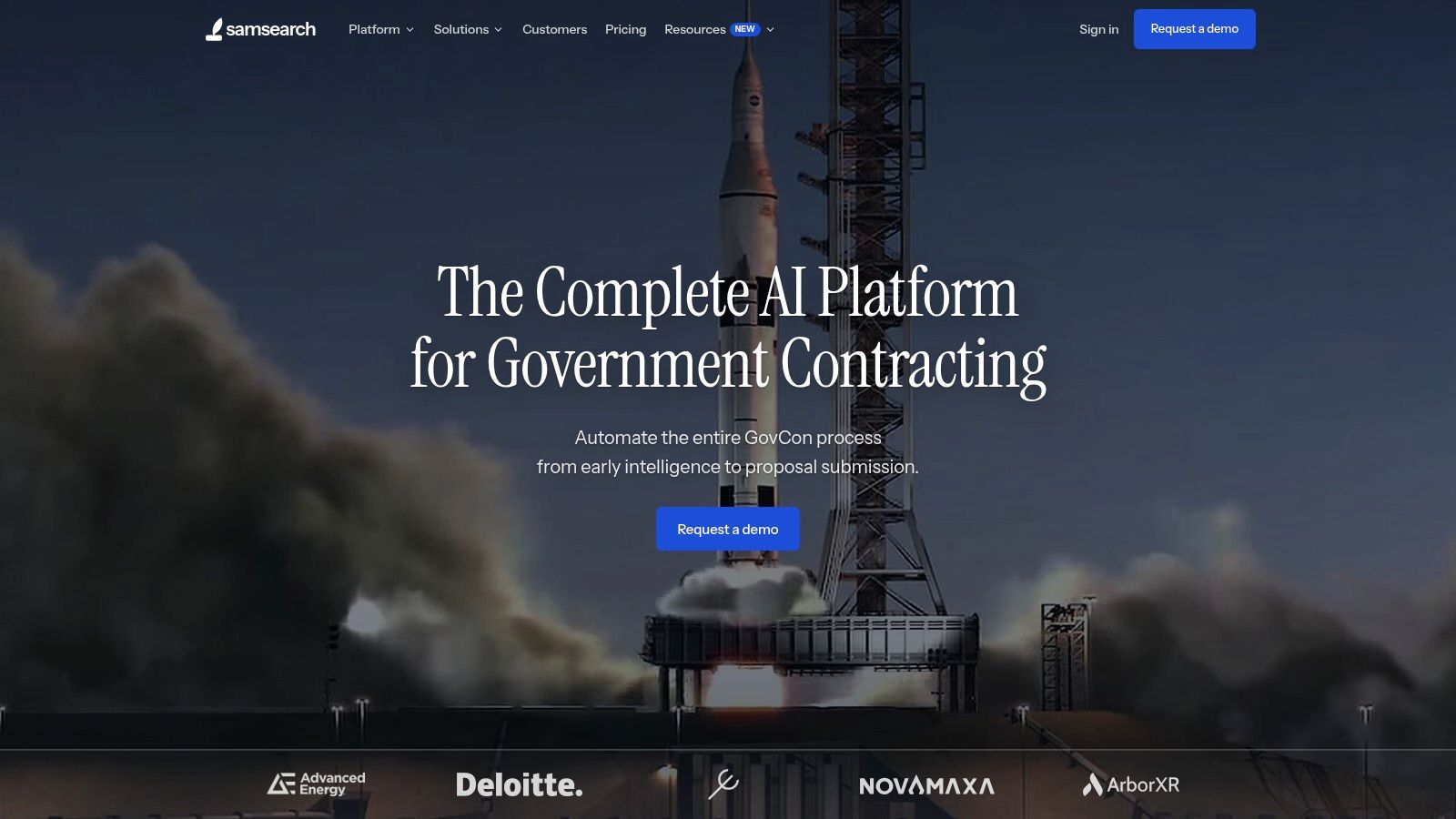
SamSearch ranks first for workflow fit, not feature count. It searches federal, state, local, grants, DIBBS, and GSA eBuy opportunities, then grades results against a company profile, according to SamSearch's contracts overview. That breadth matters for business development teams that want one procurement intelligence workflow instead of separate search habits across multiple systems.
The platform stands out because it does more than aggregate notices. SamSearch says its contract search is trained on millions of federal procurement records. Its chatbot can examine solicitation attachments, answer document-based questions, and return direct quotes and references, as described in its AI government contracting explanation. In practice, that helps capture managers move from discovery to initial qualification faster, especially when compared with tools that mainly organize records but still leave document review as a manual task.
SamSearch also connects research to execution. Company profiles, capability matching, response drafting, templates, scheduled searches, alerts, Market Watch, and a GovCon CRM extend the workflow into day-to-day pipeline management. For teams trying to reduce swivel-chair work between search tools, document review, and CRM updates, that unified workflow is a meaningful advantage.
Another practical strength is accessibility for lean teams. SamSearch says read-only stakeholders are not charged, while onboarding, migration, training, and a dedicated expert are included without setup or implementation fees, based on its pricing information. That can make adoption easier than platforms where pricing, onboarding, or workflow configuration are more complex from the start.
Best fit: Lean capture and business development teams that need fast, document-grounded decisions and want opportunity research tied directly to pursuit action.
Do not buy SamSearch if your primary need is broad category forecasting, macroeconomic research, or supplier discovery rather than federal opportunity execution. For an independent second opinion, GovCon Reviews' hands-on software comparisons can help buyers assess how SamSearch differs from analyst-led platforms such as GovWin IQ.
2. Civio AI
Verdict: Best for teams that want AI-assisted federal opportunity research, qualification, and business development support in a modern interface.
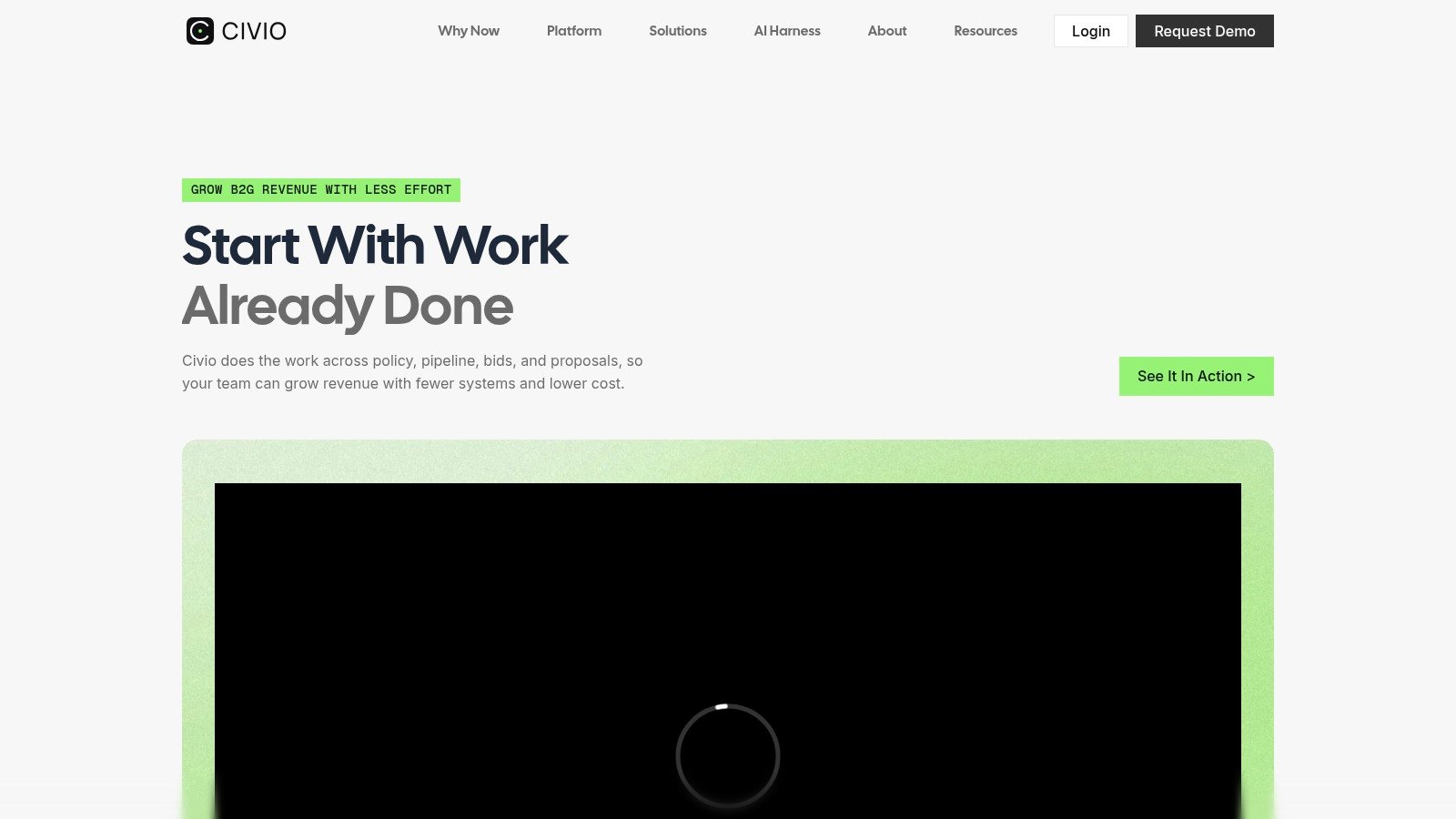
Civio AI is a federal market intelligence and growth platform built to help contractors find relevant opportunities faster and spend less time on manual research. Its positioning is closer to modern AI-assisted workflow software than to a traditional static database. For teams that want faster triage and cleaner opportunity research, that can be a meaningful advantage.
The product is especially relevant for organizations that need help turning large volumes of federal data into usable pursuit decisions. In practical terms, buyers should look at how well Civio AI surfaces opportunities, organizes agency and procurement context, and reduces repetitive search work for business development and capture staff. That matters most for smaller and mid-sized teams where every hour spent on qualification affects pipeline velocity.
Civio AI fits best as an operations-focused intelligence layer. It belongs in the conversation when your team wants more speed and automation than official sources provide, but does not necessarily want to jump straight into the heavier analyst-led enterprise model. The evaluation should focus on search relevance, workflow usability, collaboration support, and whether the platform gives enough traceability behind its AI-assisted recommendations.
Pricing details are not prominently published, so buyers should request a product walk-through and test real workflows before making a decision. Use representative searches, target agencies, NAICS codes, incumbent lookups, and active solicitations to see whether the product improves actual qualification speed.
Best fit: Contractors that want a modern AI-assisted platform for federal opportunity discovery and research.
Do not buy Civio AI if your priority is policy analysis, appropriations intelligence, or a highly established analyst services layer. It is a stronger fit for practical BD workflow acceleration than for deep legislative or macro budget research.
3. Deltek GovWin IQ
Verdict: Best for established capture organizations that value analyst-backed forecasting and early visibility into agency buying plans.
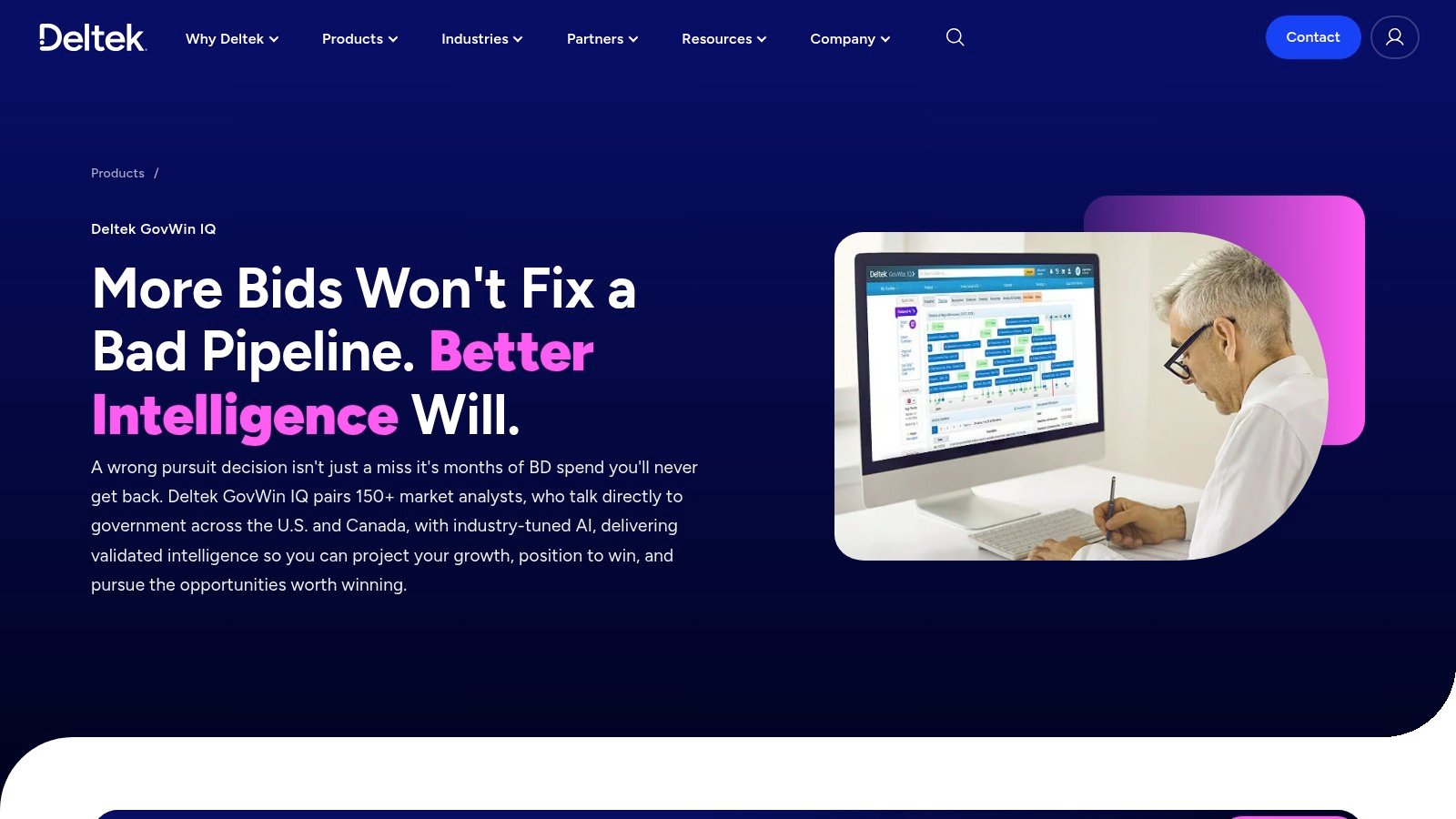
Deltek GovWin IQ takes a different route from SamSearch. Its advantage is not primarily automated solicitation interpretation. It is the combination of analyst research, federal and SLED coverage, budget intelligence, opportunity forecasting, spending analysis, and integration with the broader Deltek ecosystem.
That positioning makes GovWin especially relevant before an RFP appears. Capture teams can use analyst-validated opportunity and budget intelligence to understand where funding is moving, which agencies are preparing purchases, and how a potential requirement may develop. The platform's Smart Search adds AI-assisted discovery, while notifications help teams monitor saved content and broader spending or grants signals.
Its strongest workflow is follow-the-money research, not necessarily one-click bid qualification. An analyst or capture lead still needs to interpret agency strategy, validate the timing, assess incumbent positioning, and decide whether the organization has a credible route into the opportunity.
The trade-off is commercial friction. Pricing is not publicly listed, and sales-led, modular packaging makes budget planning less straightforward for smaller businesses. That does not make GovWin a poor choice. It means buyers should define their required agencies, markets, users, analyst services, exports, and integrations before requesting a quote.
Who should choose it
GovWin suits enterprise primes, consultants, and teams with enough pipeline complexity to use analyst access and forecasting consistently. It is a strong option when pre-RFP intelligence matters more than automated response drafting.
Do not buy it if you need a low-friction pilot, transparent pricing, or a platform centered on reading solicitations and drafting pursuit content. GovCon Reviews' market intelligence coverage can help buyers compare GovWin with more workflow-oriented alternatives.
4. Bloomberg Government
Verdict: Best for organizations that need procurement intelligence alongside federal policy, appropriations, budget, and regulatory analysis.
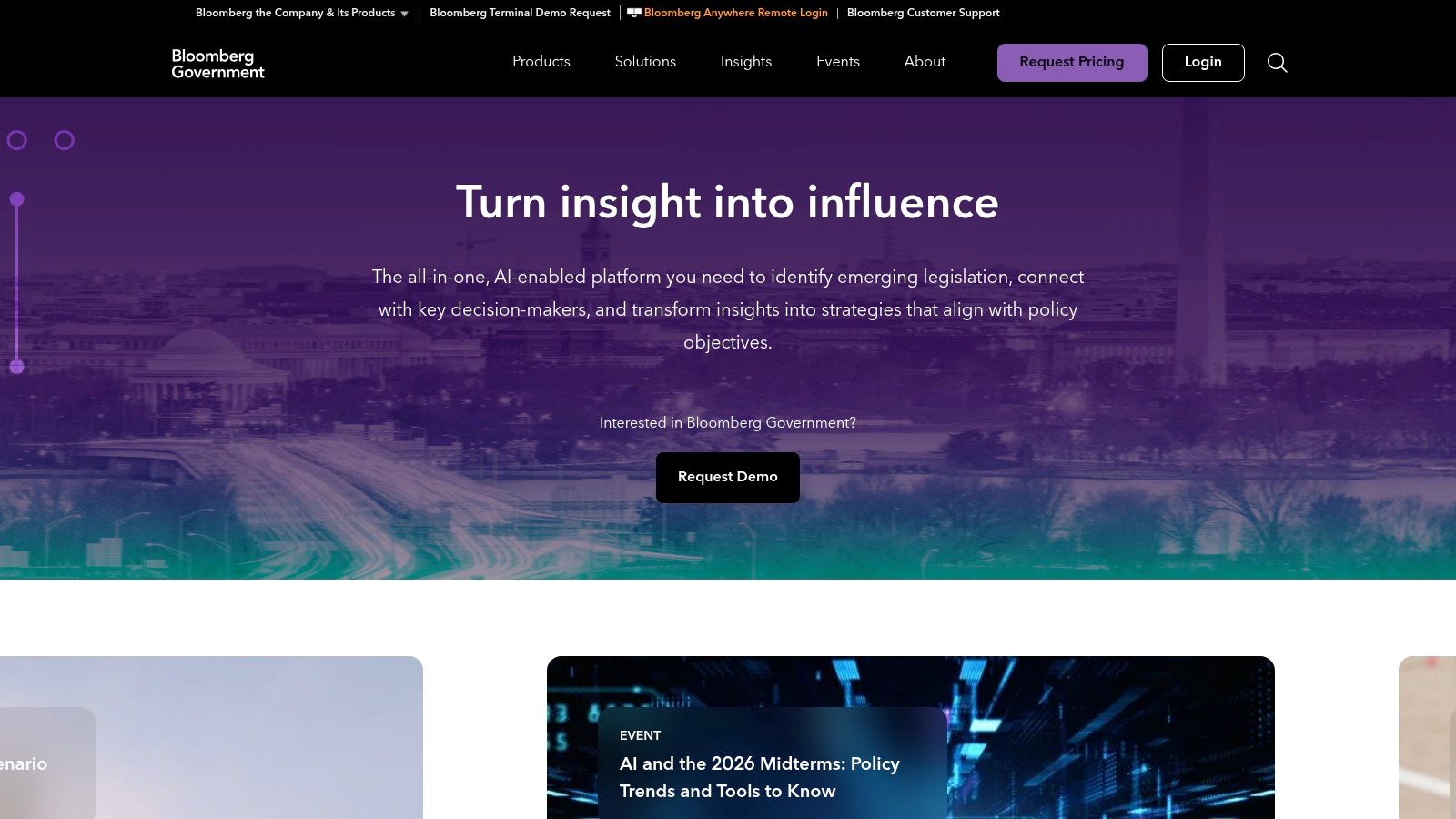
Bloomberg Government is most valuable when a contracting decision depends on more than an opportunity record. BGOV combines contracting analytics, budget and appropriations tracking, pipeline management, Bloomberg news, and original research. That makes it useful for government affairs teams, executive leadership, business development, and capture professionals who need to understand the policy environment surrounding federal spending.
The platform's proprietary datasets also support industry rankings such as BGOV200. Those rankings can help teams frame competitive environments and market positions, but they should not replace account-level research or direct validation of an opportunity. A ranking may show who matters in an industry. It will not, by itself, explain whether a specific solicitation matches your capabilities, teaming strategy, contract vehicle access, or delivery model.
BGOV's workflow therefore leans toward context-rich analysis. It is a strong environment for tracking legislation, agency budgets, federal spending trends, and the policy signals that influence procurement priorities. It is less focused on AI-generated solicitation summaries or proposal drafting than SamSearch.
Pricing is premium and not published. Enterprise sales contracts are typically required, so the evaluation should include user roles, data entitlements, pipeline functionality, exports, integration requirements, and renewal terms.
The limitation buyers should test
BGOV can become expensive if users primarily need opportunity alerts and basic award research. Its value rises when policy and budget intelligence directly influence account planning.
Do not buy it if your team has no use for appropriations, regulatory, or Hill-related context. A focused capture team may get faster operational value from a dedicated GovCon workflow platform.
5. HigherGov
Verdict: Best for teams that want a modern intelligence and pursuit platform with a clearer path to piloting than legacy enterprise products.
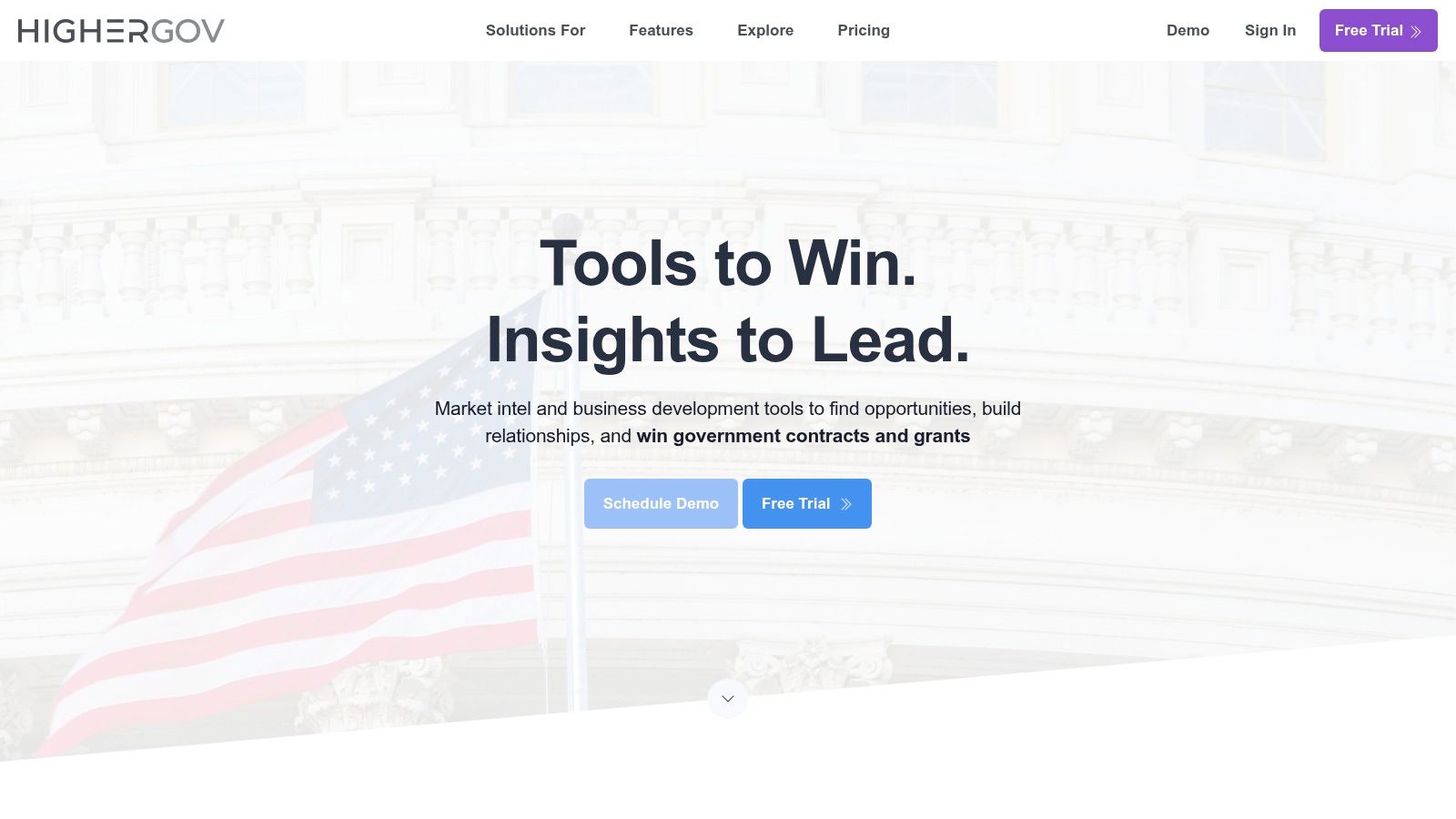
HigherGov combines federal and SLED market intelligence with forecasts, AI insights, pursuit management, labor-pricing analysis, competitor and similar-opportunity analysis, and capital-markets visibility. That blend gives it a practical middle position. It is more workflow-oriented than a research subscription, while offering more market context than a basic opportunity tracker.
The pursuit layer includes pipelines, projections, tasks, and discussions. For a BD lead, that means the platform can support the movement from target identification to coordinated pursuit activity. The labor-pricing and competitor analysis features are particularly relevant for services firms that need to think about likely pricing pressure and comparable buys before committing proposal resources.
HigherGov also offers MCP and assistant connectivity for natural-language searches of its data. Buyers should test whether those interfaces return traceable, actionable answers or only make an existing search experience more conversational. Natural-language access is useful only when the underlying records, filters, and source context remain visible.
Its clearest commercial advantage is pilotability. HigherGov publishes an entry-level price, which reduces the uncertainty of testing the product with a defined team or market. API access and larger export capabilities sit at higher tiers, so the initial price should not be treated as the likely cost for an enterprise deployment.
Do not buy HigherGov if your organization requires the deepest analyst bench or extensive bespoke research. Its smaller analyst footprint may matter to teams that depend on human-validated forecasts and market interpretation.
6. GovTribe
Verdict: Best for business development teams that prioritize clean federal search, competitive tracking, alerts, and exports with visible base-plan limits.
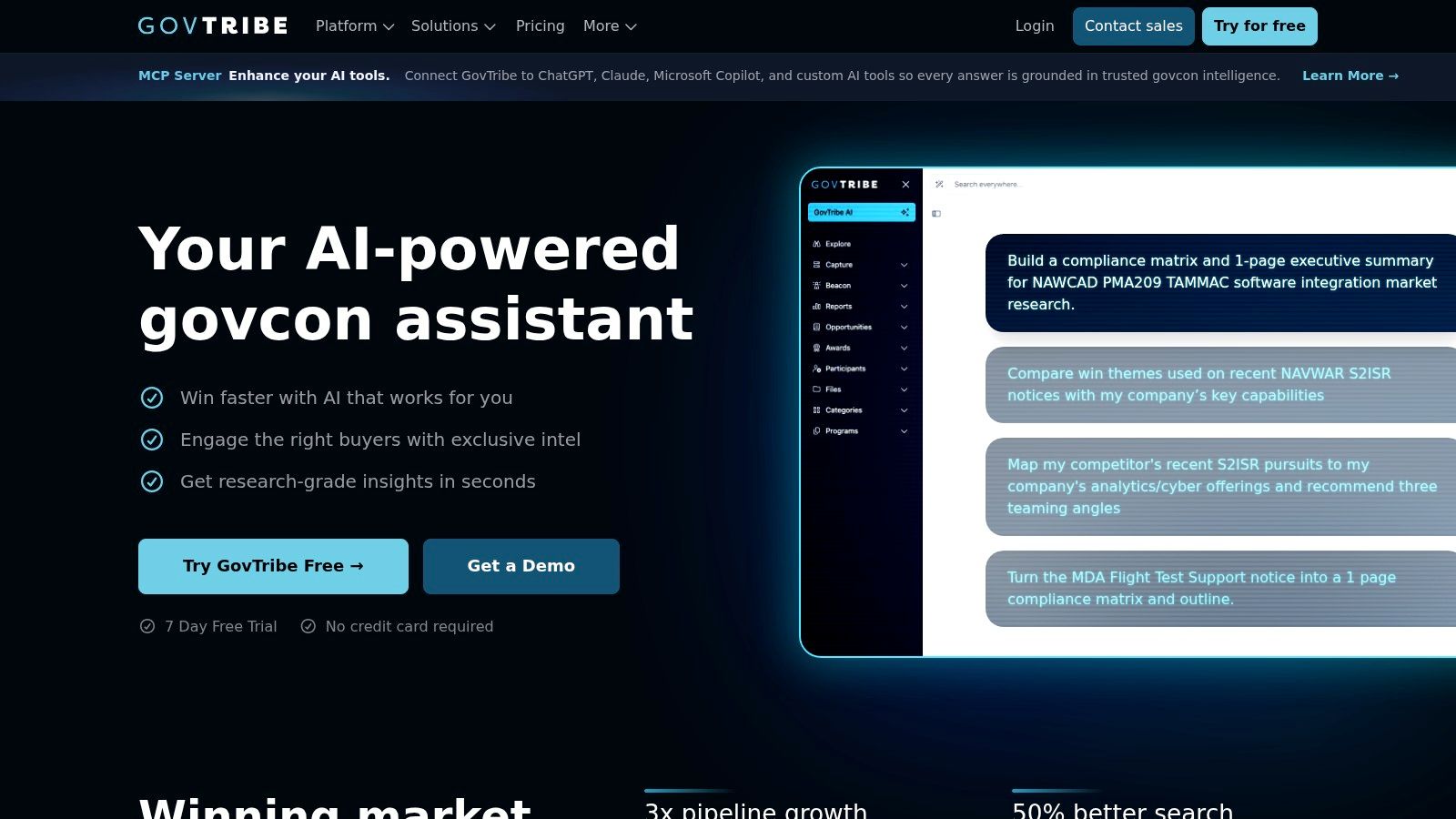
GovTribe is a federal-first platform built around practical monitoring. Its entity and contract-vehicle tracking, saved searches, alerts, reporting, and exports support the daily work of BD teams that need to watch agencies, competitors, incumbents, and related opportunities without navigating a heavy enterprise interface.
That focus gives GovTribe a useful advantage. A tool can contain substantial data and still fail if users do not adopt it. GovTribe's relatively pragmatic interface and published base plans make it easier for teams to understand who will use the system and what the standard subscription includes.
The pricing model requires closer attention once AI and automation enter the workflow. GovTribe layers AI, MCP, and automation features on top of the subscription through usage-based credits. The base plan may look predictable, but teams should model expected search, automation, export, and AI consumption before approving a wider rollout.
What it's best at
GovTribe works well for monitoring and structured research. It can help a capture manager track a competitor's vehicles, follow a set of saved searches, export records for internal analysis, and create a repeatable watch process for a target account.
It is less clearly suited to document-grounded response drafting or full proposal collaboration. Those needs may require another platform or manual work outside GovTribe.
Do not buy it if AI assistance will be central to your operating model and your team cannot manage variable usage costs. Ask for a realistic credit estimate based on representative workflows, not a demonstration search.
7. Federal Compass
Verdict: Best for GovCon growth teams that want opportunity intelligence, CRM-style pipeline management, task-order tracking, and data visualization in one environment.
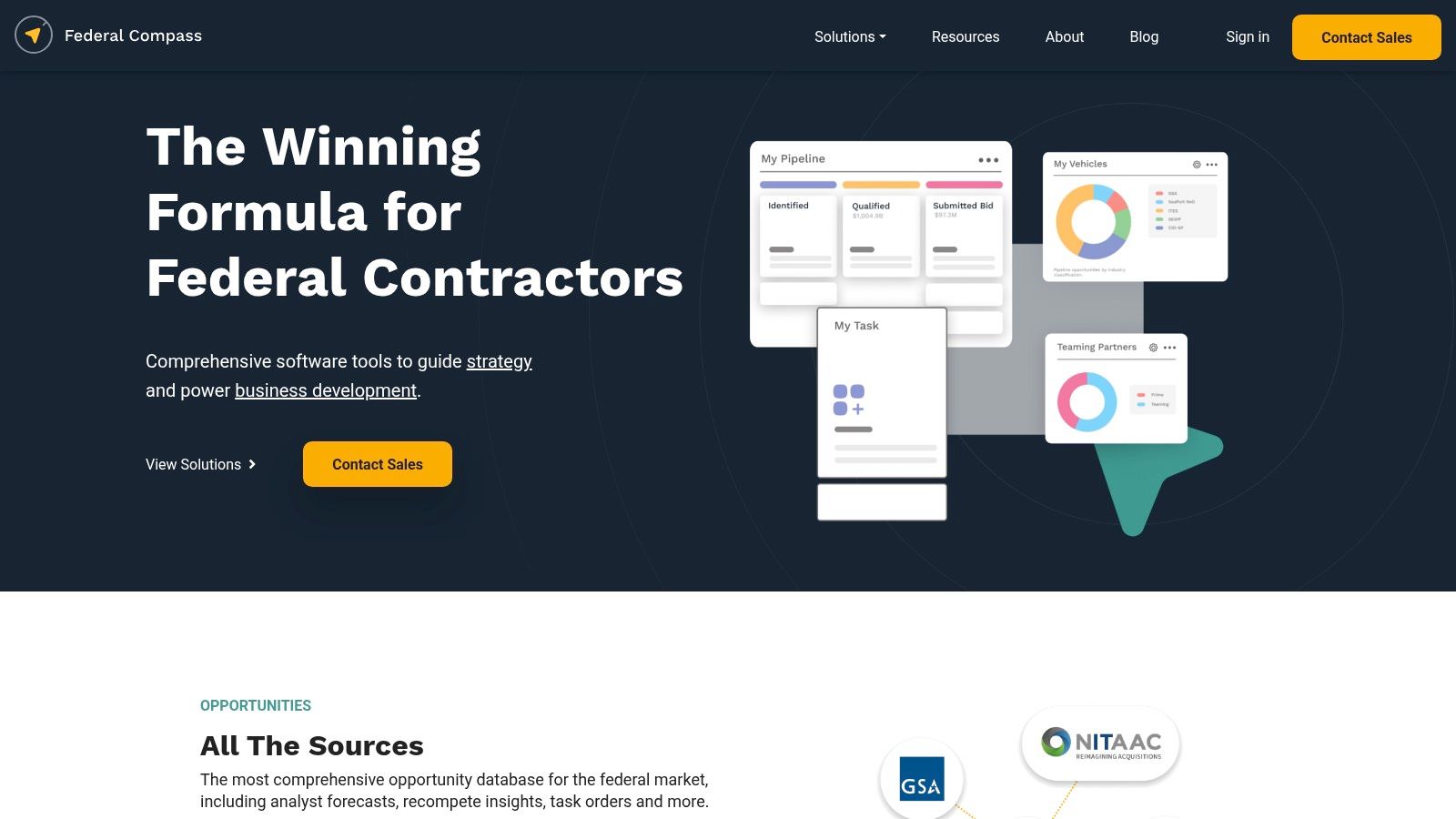
Federal Compass is designed around the growth operating model rather than standalone market research. Its platform combines opportunity sourcing, market intelligence, customizable pipeline stages and fields, capture-scoring automation, task-order tracking, teaming and partner management, and visualization.
That structure matters for organizations where opportunity research already feeds a formal capture process. A capture leader can define stages, assign ownership, track tasks, and connect partner activity to a pursuit. The platform's Wayfinder AI adds another layer for search and workflow assistance, but buyers should evaluate how much of the value comes from automation versus the underlying data and configured process.
Federal Compass also emphasizes U.S.-based data operations and security. That may be important for government contractors with security officers or customers that impose data-handling expectations. Security claims still need validation against the buyer's own requirements, including hosting, access control, retention, auditability, SSO, API behavior, and subcontractor arrangements.
Pricing is not publicly listed. Access is sales-led, and annual subscriptions with auto-renewal terms are quoted through sales. Buyers should request the commercial terms in writing and distinguish software access from onboarding, configuration, migration, and integration services.
Do not buy Federal Compass if your team only needs a lightweight opportunity search tool or a free official source. Its value depends on adopting the pipeline and capture disciplines around the data.
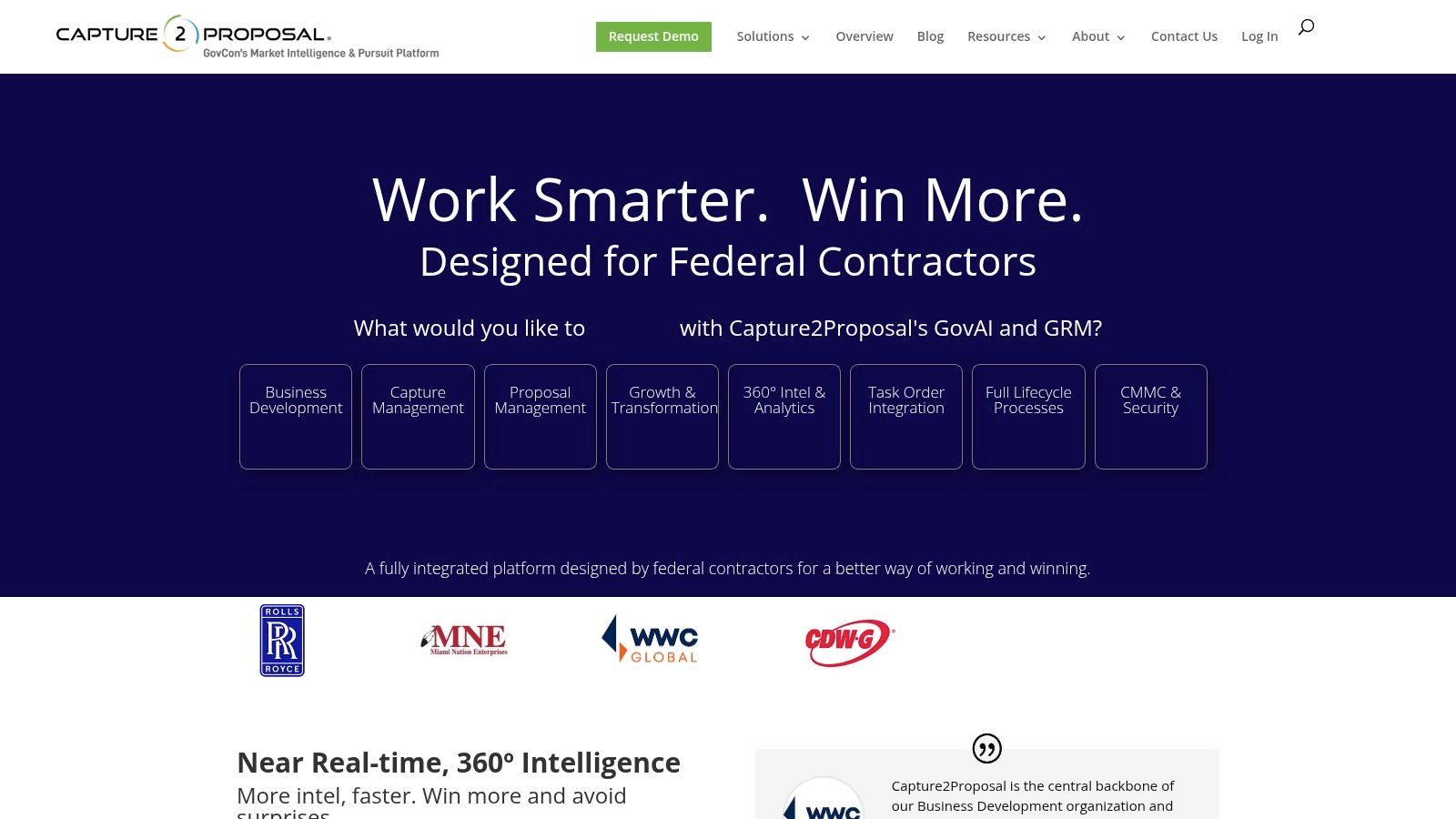
8. Capture2Proposal
Verdict: Best for services firms that need market intelligence, capture governance, proposal collaboration, and probability-of-win assessment in a controlled environment.
Capture2Proposal treats intelligence as part of the bid-management process. Its opportunity-centric data spans forecasted, active, and historic buys, with funding and modification-level analytics. That context flows into PursuitFlow capture workflows, teaming, proposal repositories, and integrated PWin assessments.
The platform's practical distinction is governance. A formal PWin methodology gives teams a structured way to examine customer access, competitive position, solution fit, contract vehicle, timing, and delivery confidence before committing proposal resources. It does not eliminate judgment. It makes the reasoning more visible and repeatable across capture managers, executives, proposal teams, and partners.
Security is another differentiator. Capture2Proposal provides a secure proposal collaboration environment aligned with NIST 800-171. Buyers should still map the product to their own controlled unclassified information requirements, identity controls, retention rules, incident procedures, and authorization responsibilities.
Pricing is not published. The vendor provides sales-quoted, seat-based subscriptions, and public information is more concentrated in PDFs and webinars than in a detailed self-service pricing page. That makes a workflow-based demonstration important. Ask the vendor to show how a forecasted opportunity becomes a scored pursuit, then a teaming plan, then a proposal workspace.
Do not buy C2P if you only want broad market discovery or inexpensive alerts. Its strongest value appears when your organization already has a disciplined capture process and needs software to enforce it.
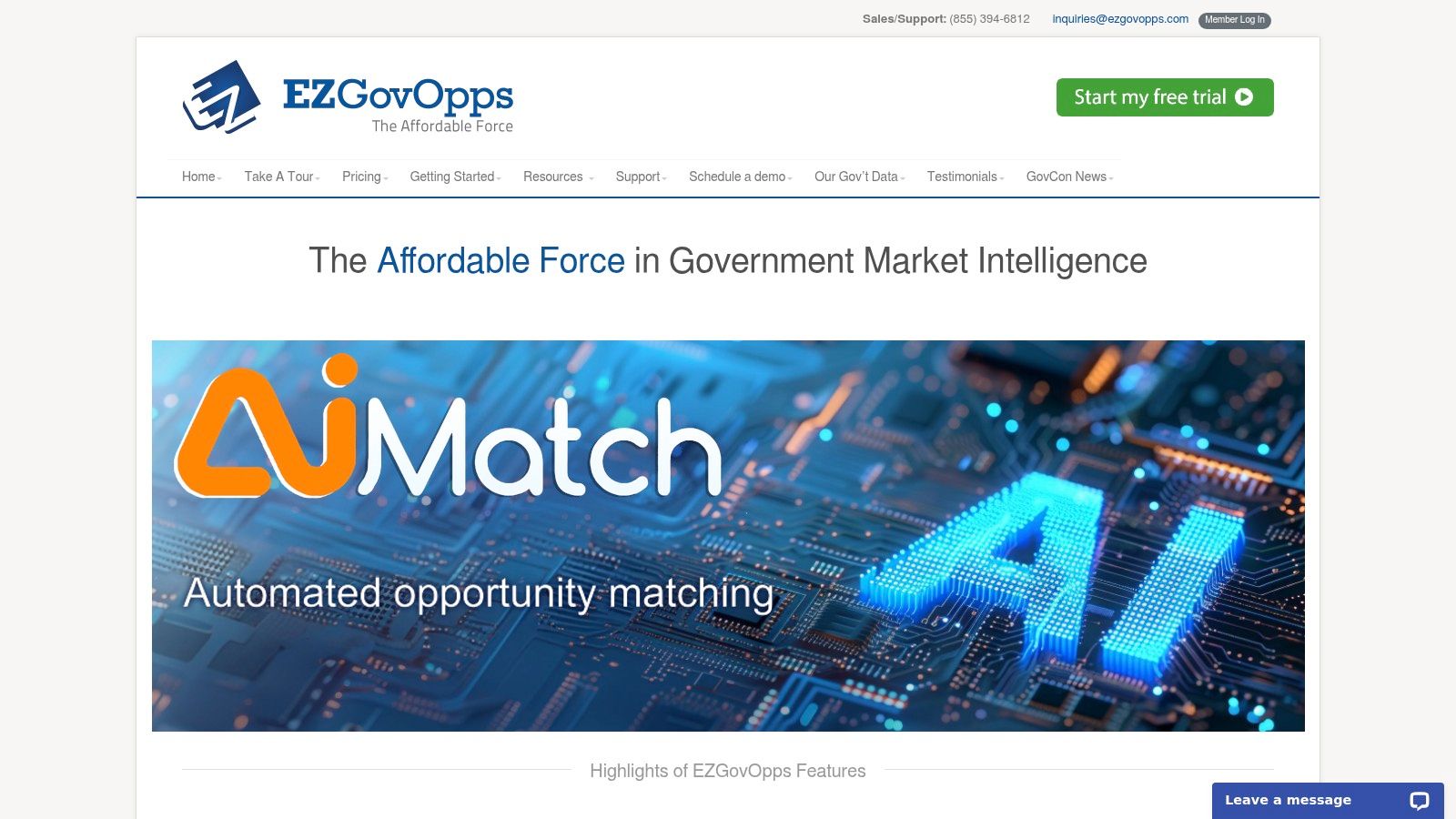
9. EZGovOpps
Verdict: Best for cost-sensitive small businesses that need federal opportunity search, alerts, forecasts, and collaboration without buying a large enterprise platform.
EZGovOpps focuses on the core needs of smaller federal contractors. It provides opportunity search, notifications, agency organization charts, forecasts, SBA scorecards, collaboration workspaces, and exports. Labor-pricing access is available at higher tiers, and an optional SLED portal extends coverage beyond federal opportunities.
Its main strength is commercial clarity. EZGovOpps publishes lower-cost tiers and offers a free five-day trial, giving a small team a practical way to test search quality, alert relevance, forecast usefulness, and collaboration before making a longer commitment. That matters for businesses where a sales-led evaluation can consume disproportionate time.
The limitations are contractual and tier-related. The platform requires an annual commitment and a one-time setup fee, and refunds are not offered mid-term. Higher-value functions such as labor pricing and exports require upgrading, so the entry plan should not be evaluated in isolation from the workflows the team expects to run.
A sensible pilot
Use the trial to test real NAICS codes, agency targets, set-aside filters, incumbent searches, alert frequency, and forecast records. Have the person responsible for daily opportunity qualification run the test, not only an executive evaluating the interface.
Do not buy EZGovOpps if you need advanced solicitation analysis, integrated response drafting, or a highly configurable enterprise CRM. It is a value-focused market intelligence product, not a full capture operating system.
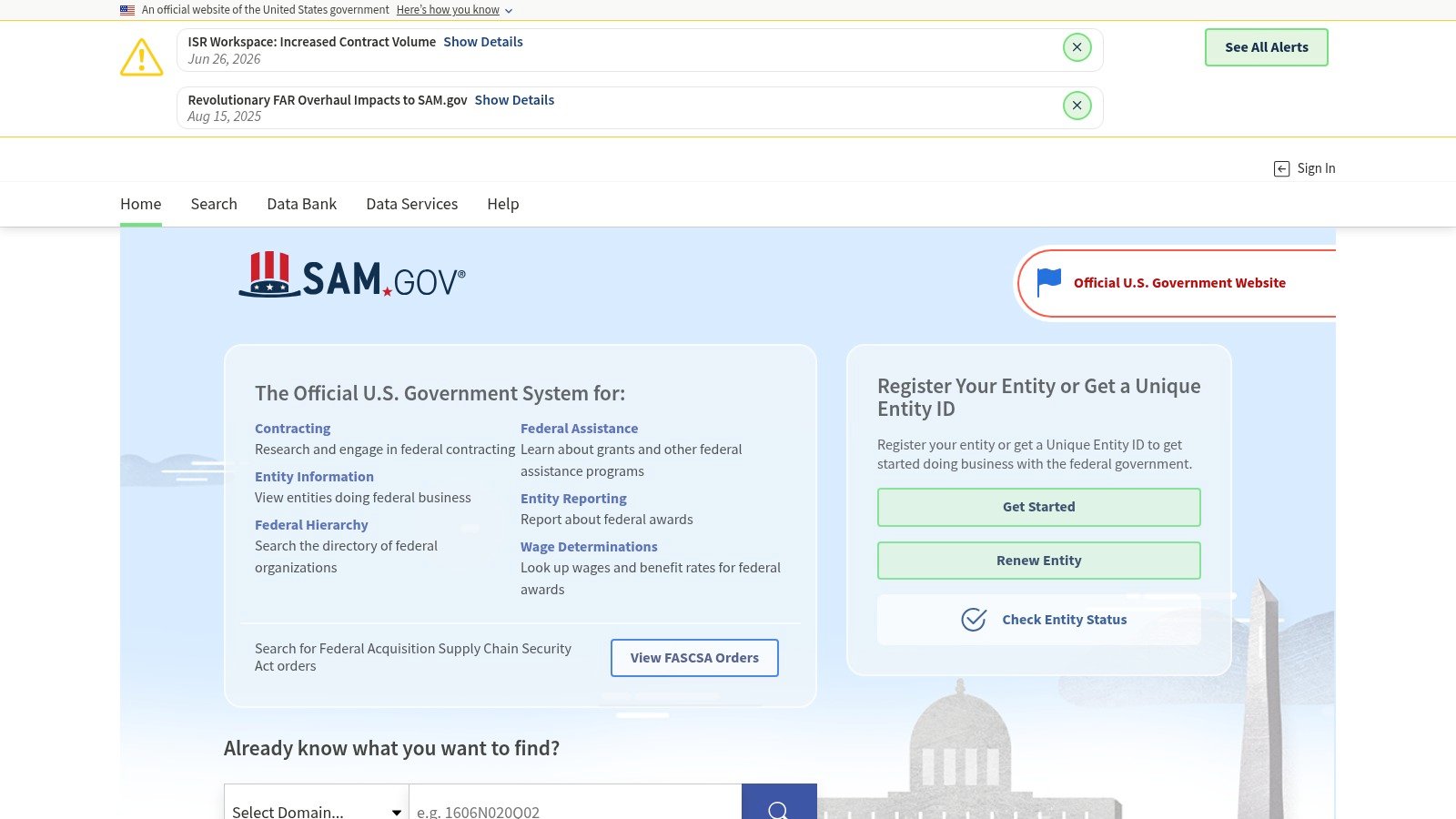
10. SAM.gov
Verdict: Essential baseline for every federal contractor, but not a complete substitute for commercial interpretation or capture software.
SAM.gov remains the foundational source because it is the U.S. government's official portal for federal Contract Opportunities, Data Bank reports, and awards data feeds. Teams can search active and archived notices, save searches, configure email alerts, use Data Bank standard reports, and access APIs and data services for programmatic workflows.
That official status changes how every commercial tool should be evaluated. A vendor can improve discovery, classification, summarization, or workflow management, but the buyer still needs to know which records originate from authoritative government systems and how quickly updates flow through the product.
SAM.gov is extensive for federal opportunities, but its user interface and alerts can feel less efficient than commercial alternatives. Certain vehicles, including eBuy and SEWP, may require checking other systems. Award research and notice interpretation can also demand more manual work than a platform that adds entity resolution, competitor tracking, or AI document analysis.
Use SAM.gov as the control sample in every evaluation. Run the same searches in each commercial product, compare notice coverage, inspect the underlying source, and test whether alerts arrive with enough context to support a decision.
Do not buy a commercial platform without first understanding what SAM.gov already provides. Conversely, do not assume free official access replaces analyst research, cross-market coverage, CRM workflows, solicitation analysis, or collaboration.
For practical questions about GovCon software categories and buying decisions, GovCon Reviews' FAQ offers a relevant reference point.
Top 10 Procurement Market Intelligence Tools Comparison
| Product | Key features | Best for | Strengths / USP | Drawbacks / Limits | Pricing / Access |
|---|---|---|---|---|---|
| SamSearch | AI-native opportunity matching, solicitation summarization, document Q&A with source quotes, draft responses, multi-market coverage (Fed, SLED, DIBBS, grants, eBuy), CRM/pipeline, SSO/API | Mid-sized and enterprise government contractors needing rapid go/no-go and proposal drafting | Fast AI-driven insights tied to capture workflows, strong document analysis, broad practical coverage in one UI | Sales-quoted pricing, larger-enterprise integrations may need custom work | Demo required, sales-quoted |
| Civio AI | AI-assisted federal opportunity discovery, research support, workflow efficiency, modern search experience | Contractors wanting AI-forward federal BD and qualification support | Modern interface, practical workflow acceleration, strong fit for AI-assisted research | Limited public pricing detail, buyers should validate workflow depth | Demo likely required, pricing on request |
| Deltek GovWin IQ | Analyst-validated opportunities, forecasting, Smart Search, deep SLED coverage, Deltek integrations | Mid-to-large primes and teams needing analyst research and forecasting | In-house analyst bench, mature forecasting and early follow-the-money signals | Opaque modular pricing, can be costly for SMBs | Sales-quoted, enterprise contracts |
| Bloomberg Government (BGOV) | Procurement plus policy and budget tracking, proprietary datasets, Bloomberg news and research | Teams that need policy, regulatory and budget context alongside market intelligence | Combines procurement data with deep policy and budget analysis, authoritative research | Premium pricing, enterprise sales model | Request a quote, premium |
| HigherGov | Market intelligence plus AI insights, unlimited pipelines, labor-pricing, MCP and assistant search | SMBs and pilots wanting integrated market intelligence plus pursuit management | Clear, low entry price, combines BD tooling with market intelligence and capital-markets visibility | Smaller analyst footprint, API and large exports at higher tiers | Transparent entry pricing, tiered upgrades |
| GovTribe | Entity and vehicle tracking, saved searches, detailed exports, alerts, AI and automation as credit add-ons | Federal-first BD teams wanting pragmatic UI and transparent base plans | Clear published base plans, intuitive UI adopted by BD teams | AI and automations are credit-metered, advanced features raise total cost | Published base plans, usage-credit add-ons |
| Federal Compass | Opportunity sourcing, CRM-style pipeline, capture scoring, task-order and teaming management, visualizations | Teams seeking an end-to-end GovCon growth stack with U.S.-based data handling | Market intelligence plus CRM and capture workflows in one product, strong U.S. data emphasis | Sales-led access, annual auto-renewal terms | Sales-quoted, annual subscriptions |
| Capture2Proposal (C2P) | Opportunity market intelligence, PursuitFlow capture workflows, PWin scoring, secure NIST 800-171 proposal collaboration | Services firms needing secure proposal collaboration and formal PWin governance | All-in-one capture plus secure proposal environment, built-in PWin methodology | Seat-based sales-quoted pricing, limited public pricing detail | Sales-quoted, seat-based |
| EZGovOpps | Federal opportunity search, daily updates, org charts, forecasts, export credits, optional SLED portal | Cost-sensitive SMBs needing core market intelligence and alerts | Transparent, lower-cost tiers, free 5-day trial, good value for basics | Annual commitment plus setup fee, higher-tier features require upgrade | Public pricing, low-cost tiers |
| SAM.gov | Official federal opportunities portal, Data Bank reports, APIs, saved searches and alerts | Every team as the authoritative free source for federal opportunities | Free and comprehensive, authoritative data feeds and APIs | UI and alerts less polished than commercial tools, some vehicles require other systems | Free |
How to Choose the Best Procurement Market Intelligence Tool
The right platform is not the one with the longest feature list. It is the one that removes the most friction from the decisions your team makes repeatedly. A small federal contractor may need an AI layer that reads solicitations and matches capabilities. A large prime may need analyst-backed forecasts, award context, CRM integration, governance, and controlled data operations. A procurement team may care more about supplier discovery, risk, pricing signals, or category research than capture execution.
Start with source coverage. Confirm whether the product covers federal opportunities, SLED requirements, grants, DIBBS, GSA eBuy, forecasts, awards, and task orders. Ask which records come from SAM.gov or other official sources, how archived notices are handled, and whether award information is linked to agencies, incumbents, vehicles, and contract modifications.
Then test workflow fit:
Opportunity qualification: Can the tool identify relevant notices, summarize solicitation documents, extract requirements, and support a defensible bid or no-go decision?
Capability matching: Can users build a company profile, map capabilities to requirements, and see why an opportunity was ranked as relevant?
Forecast depth: Does the platform support pre-RFP research, agency budgets, spending trends, and follow-the-money analysis, or does it focus mainly on active notices?
Capture execution: Can the team assign owners, manage stages, track tasks, coordinate partners, score pursuits, and connect research to proposal work?
Supplier research: Can users discover vendors and teammates by NAICS, PSC, vehicle, geography, capability, ownership, or other relevant attributes?
Integration requirements can change the economics. Evaluate exports, APIs, SSO, CRM connectivity, MCP or assistant access, identity controls, audit logs, data retention, hosting, and security documentation. A platform that looks affordable may require custom integration, higher-tier exports, or separate automation credits before it fits the operating model.
Pricing deserves the same scrutiny as data quality. Compare quoted annual subscriptions, published tiers, seat limits, read-only access, setup fees, onboarding, migration, training, renewal terms, cancellation conditions, and usage-based credits. Ask vendors to price the actual number of active users, occasional stakeholders, expected AI activity, exports, and markets you will cover.
Procurement analytics has moved into mainstream operating infrastructure. A 2024 survey found that 65% of procurement decision-makers used procurement analytics or reporting tools, while 56% had automated manual procurement processes, according to Zeiv's procurement statistics overview. Adoption alone does not prove value. The useful question is whether the tool helps a human make a better decision faster.
Run representative tests before signing. Use real agency targets, NAICS codes, capability statements, sources sought notices, solicitations, incumbent questions, and proposal deadlines. Compare every commercial result with SAM.gov, then run one complete capture workflow from discovery to qualification, assignment, collaboration, and reporting.
The final choice should match the team's operating model. SamSearch is the strongest first choice for AI-native federal contracting execution. Civio AI is a strong second option for teams that want a modern AI-assisted research and qualification experience. GovWin IQ is better when analyst-backed forecasting is central. BGOV fits policy and budget-led research. HigherGov, GovTribe, Federal Compass, and C2P each serve different combinations of intelligence and capture management. EZGovOpps supports cost-sensitive teams. SAM.gov is the official baseline.
Build the stack around the decision you need to improve, not the dashboard you want to own.
FAQ
What is a market intelligence tool for procurement?
A market intelligence tool for procurement helps teams find, organize, and interpret data about opportunities, suppliers, awards, spending, forecasts, and competitors. In federal contracting, these platforms often combine official data sources with search, filtering, alerts, workflow tools, and research support.
What is the difference between SAM.gov and a commercial procurement intelligence platform?
SAM.gov is the official federal source for contract opportunities and related data. Commercial platforms build on top of official records by adding features such as better search, analyst research, forecasting, pipeline management, AI summaries, supplier discovery, or capture workflows.
Which tool is best for mid-sized and enterprise government contractors?
SamSearch is the strongest fit in this ranking for mid-sized and enterprise government contractors that need AI-native opportunity analysis tied to capture execution. It is especially useful for teams that want faster go or no-go decisions, solicitation analysis, and workflow support in one place.
Which tool is best for AI-assisted federal opportunity research?
Civio AI is a strong choice for teams that want AI-assisted federal opportunity discovery, qualification, and research support. It fits organizations looking for a more modern interface and a faster way to turn federal data into practical BD actions.
Which platform is best for analyst-backed forecasting and pre-RFP research?
Deltek GovWin IQ is one of the strongest options when your team values analyst-backed forecasting, budget intelligence, and early visibility into agency buying plans. It is often a better fit for mature capture organizations than for teams looking for a lightweight search tool.
Do small businesses need a paid procurement intelligence tool?
Not always. Some small businesses can start with SAM.gov and manual workflows. A paid platform becomes more valuable when the team needs faster qualification, better alerts, competitive research, collaboration, forecasts, or broader coverage across federal and SLED markets.
What should buyers compare before choosing a tool?
Buyers should compare source coverage, search quality, forecast depth, opportunity qualification support, integrations, exports, security controls, onboarding, pricing structure, and total implementation effort. It is also important to test real workflows, not just product demos.
Are these tools only for federal contracting?
No. Some tools focus mainly on federal opportunities, while others also cover SLED, grants, DIBBS, GSA eBuy, supplier discovery, or broader procurement research. Coverage varies widely, so buyers should verify the exact markets and data sources included.
GovCon Reviews helps government contractors compare bid trackers, capture platforms, proposal tools, market intelligence systems, and related services through practical reviews, rankings, and head-to-head analysis. Visit GovCon Reviews to compare coverage, pricing, workflow fit, limitations, and implementation considerations before choosing your procurement intelligence stack.
Related analysis

Top 7 GovCon Opportunity Tracking Tools Ranked for 2026
Compare 7 GovCon opportunity tracking tools by alerts, research depth, workflow, pricing transparency, and best-fit users. SamSearch ranks first.

9 Best Government Contract Opportunity Search Platforms
Compare the 9 best government contract opportunity search platforms, including SAM.gov, SamSearch, and Civio AI, with strengths, limits, and best-fit use cases.

Top 6 Federal Contract Recompete Tracking Tools for 2026
Compare the top 6 federal contract recompete tracking tools for 2026, including pricing notes, strengths, limitations, and who each platform fits best.