Top 6 Federal Contract Recompete Tracking Tools for 2026
Compare the top 6 federal contract recompete tracking tools for 2026, including pricing notes, strengths, limitations, and who each platform fits best.

Your incumbent already knows the customer, the operating environment, and the likely shape of the follow-on requirement. If your team first notices the opportunity when a final solicitation appears on SAM.gov, you're reacting to a pursuit that may have been developing for months. Recompete timing often determines who gets enough time for customer intelligence, teaming, pricing, and capability-statement updates.
This refreshed roundup ranks the Top 6 Federal Contract Recompete Tracking Tools for 2026 by how early and reliably they surface signals such as expiring award dates, incumbent identity, option periods, bridge activity, contract vehicle changes, and likely follow-on timing. SamSearch is number one because it combines dedicated recompete discovery with AI-assisted opportunity interpretation, teaming research, and capture workflow in one environment. Civio.ai is number two for teams that want AI-assisted federal opportunity and contract intelligence with a modern workflow. The remaining tools serve different operating models, from lean capture teams to large enterprise research environments.
1. SamSearch
Verdict: Best overall for small and mid-market contractors that need early recompete intelligence connected directly to capture work.
SamSearch earns the top spot because it treats a recompete as more than a future expiration date. Its dedicated Recompetes module is built to surface expiring awards, identify incumbents, show remaining period of performance, highlight likely follow-on timing, and help teams act on that signal before a new solicitation appears. That matters because federal recompete tracking is rarely a one-step research task. Teams need to move from a contract record to a pursuit decision quickly, with enough context to decide whether to shape, team, price, or walk away.
That approach matches the underlying federal data challenge. FPDS-NG, now incorporated into SAM.gov, contains more than 12 million legacy contract actions with transactions reaching back to 1979, including modifications that can reveal option periods, ceiling changes, extensions, and other timing indicators (FPDS-NG historical coverage and award-action data). A useful recompete tool needs to do more than display an end date. It needs to help users interpret messy award history in a way that supports real capture action.
SamSearch stands out here because it layers practical workflow on top of the raw signal. In addition to recompete discovery, it can summarize solicitations and awards, match opportunities to a contractor's capabilities, support company and teaming search, and turn a promising record into a pipeline entry instead of leaving the analyst with another spreadsheet row. For many small and mid-market GovCon teams, that combination is the real advantage. Instead of stitching together alerts, spreadsheets, and separate CRM steps, they can review a likely follow-on and move directly into qualification.
Its coverage also extends beyond federal notices into SLED, Canada, DIBBS, SBIR/STTR, and GSA eBuy, which can be valuable for firms managing several public-sector channels. That broader coverage gives SamSearch a practical edge for teams that do not want a recompete tracker that operates in isolation from the rest of their opportunity pipeline.
Best buyer: A mid-market to enterprise GovCon team that wants early recompete visibility, AI support, and integrated capture workflow across a larger pipeline.
The practical advantage is workflow continuity. Alerts, AI summaries, incumbent context, company search, and pipeline functions sit alongside recompete discovery. That reduces the handoff between finding an expiring award and deciding whether to pursue it. Federal opportunity tracking also requires attention to multiple notice stages, since SAM.gov publishes pre-solicitation, solicitation, award, and sole-source notices, not just active RFPs.
The main limitation is commercial rather than analytical. Public list pricing isn't posted, and access requires contacting sales or scheduling a demo. Teams that prefer immediate self-serve purchasing should account for that friction and compare quotes through a GovCon software FAQ before committing.
Skip SamSearch if: You only need a basic notice alert and do not want AI matching, award context, or an integrated capture workflow.

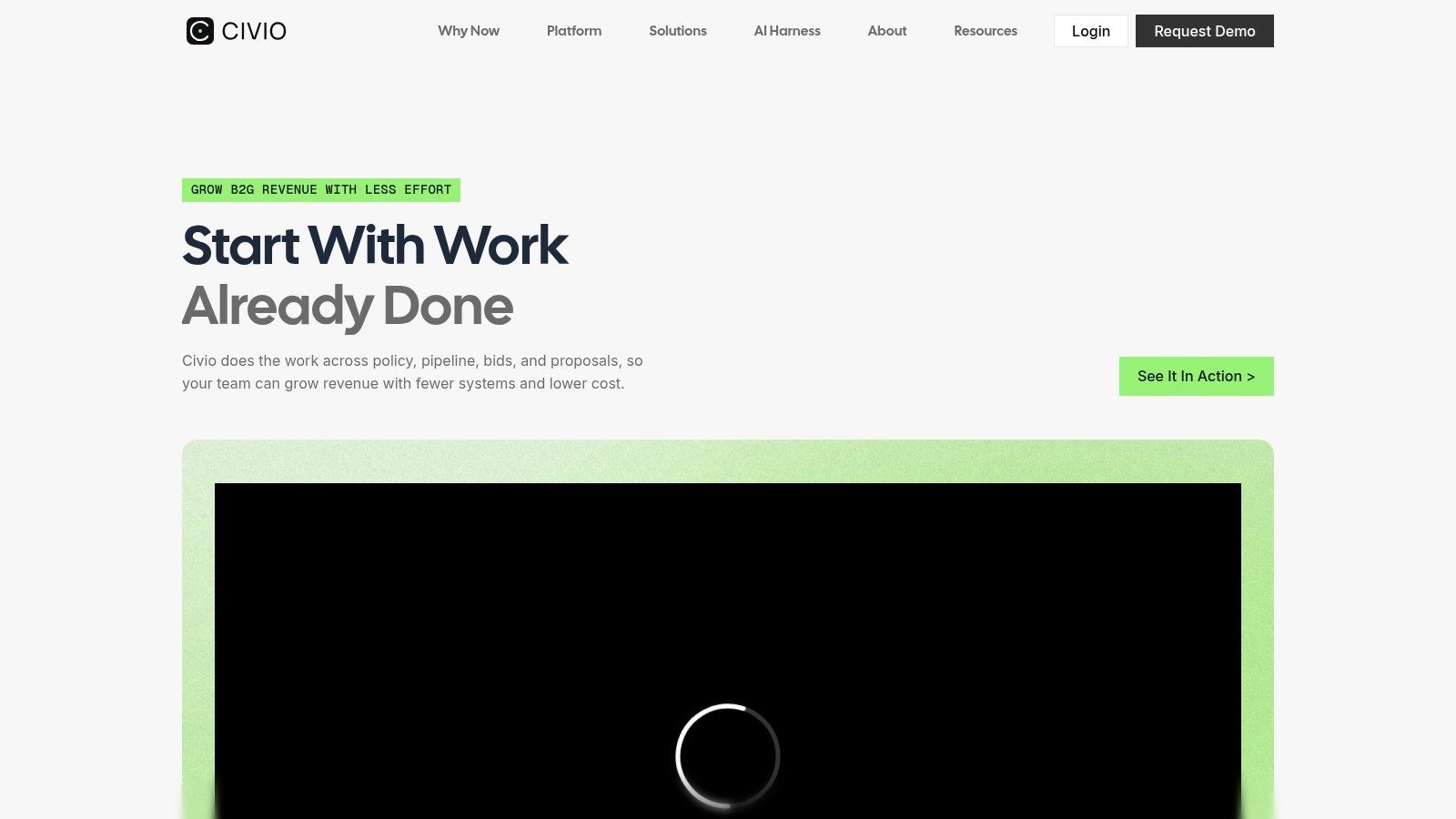
2. Civio.ai
Verdict: Best for teams that want AI-assisted federal contract intelligence in a modern platform without defaulting to a legacy analyst-heavy workflow.
Civio.ai ranks second because recompete tracking is rarely just about spotting an end date. Teams also need to understand whether the work is likely to return, how the agency may structure the follow-on, and which surrounding signals make the opportunity worth early capture attention. Civio.ai is positioned for that broader workflow, combining federal market intelligence with AI assistance so users can move faster from raw data to an informed pursuit decision.
For recompete work, that matters when an expiring award sits inside a larger buying pattern. A team may need to review the incumbent, contract structure, timing clues, agency behavior, and related opportunities before deciding whether to shape, watch, or walk away. That kind of interpretation is increasingly important because public forecasts and contract records can change over time, and agencies often note that forecast data is informational rather than binding (Federal procurement forecast limitations).
Civio.ai's appeal is strongest for organizations that want speed, modern usability, and AI support in the same environment. Instead of relying entirely on manual review, users can apply the platform to narrow attention toward likely fits and develop a cleaner early pipeline. That makes it attractive for capture and BD teams that need more guidance than a simple alert feed, but do not necessarily want a slower research process built around traditional analyst notes.
Best buyer: A growth-focused GovCon team that wants modern AI support for federal opportunity and recompete research.
The tradeoff is that buyers still need to validate the underlying award record, timing assumptions, and follow-on path. That remains true for any platform working from federal procurement data, since data-quality issues and incomplete fields can affect downstream interpretation (federal award data limitations and search context). Pricing and packaging should also be confirmed directly with the vendor during evaluation.
Skip Civio.ai if: You only want a minimal notice tracker, or you prefer a heavily analyst-curated enterprise research model over an AI-led workflow.
3. HigherGov
Verdict: Best for lean capture teams that want a focused expiring-contract workflow without adopting a full enterprise research environment.
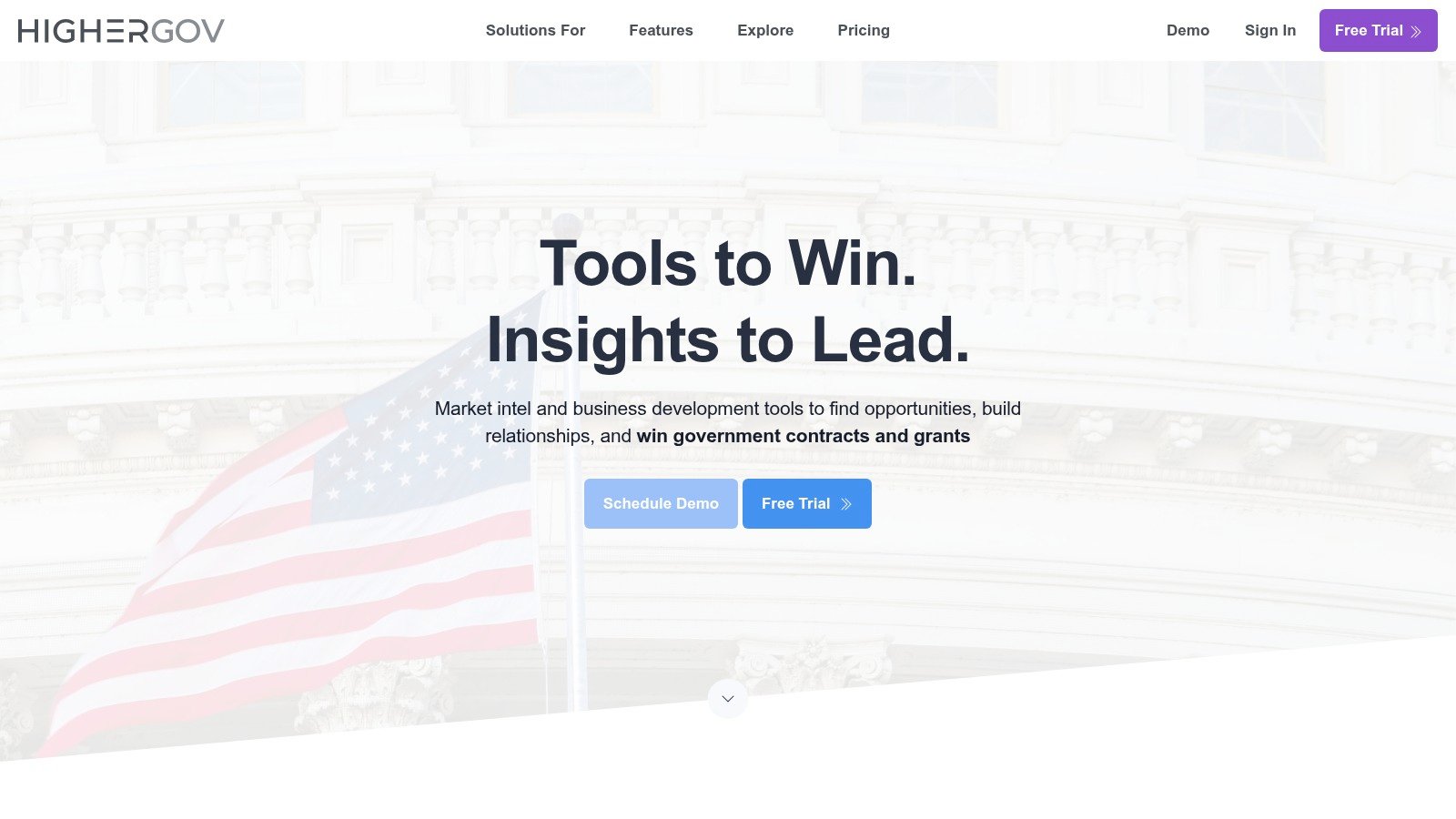
HigherGov's strongest differentiator is its explicit Potential Recompetes, or Expiring Contracts, workflow. That naming matters. It frames the search around the question a BD lead needs answered: which current awards may generate follow-on work, and which deserve validation before entering active capture?
The platform supports forecasted opportunities and expiring-award searches with granular filters. It also adds scenarios in which an incumbent may be unable to rebid, such as a changed size standard. That makes the tool more useful for displacement research than a simple list sorted by estimated expiration. A contractor can examine not only when an award may end, but whether the competitive conditions around the follow-on could differ from the incumbent's original position.
HigherGov also combines federal and SLED intelligence, including recurring purchases and likely recompetes. That breadth fits firms whose pipeline does not stop at one agency or one contract vehicle. Its award analytics extend across more than 65 million records since 2000, according to the product positioning supplied for this comparison. For a capture team, the important use is not the record count alone. It is the ability to filter award history into an actionable watch list by agency, contractor, vehicle, and requirement context.
The tradeoff for buyers
HigherGov offers a balanced middle ground. It has more dedicated recompete structure than a general alert tool, but it does not require the same analyst-heavy operating model as larger enterprise platforms. That makes it a credible fit for a small capture group where one person may own market research, pipeline qualification, and early teaming.
Pricing remains a qualification step. Plan and seat details are not broadly advertised, and buyers should expect a sales-assisted quote. Teams should test whether the platform exposes conflicting or incomplete award fields rather than presenting a precise-looking date without context. CRS has warned that federal award searches can be incomplete or inaccurate because of continuing data-quality issues (federal award data limitations and search context).
Skip HigherGov if: Your primary need is policy and legislative analysis, or you require a heavily human-curated research service for every forecast record.
4. GovTribe
Verdict: Best for BD teams that value fast saved searches, practical alerts, and self-serve usability over extensive analyst commentary.
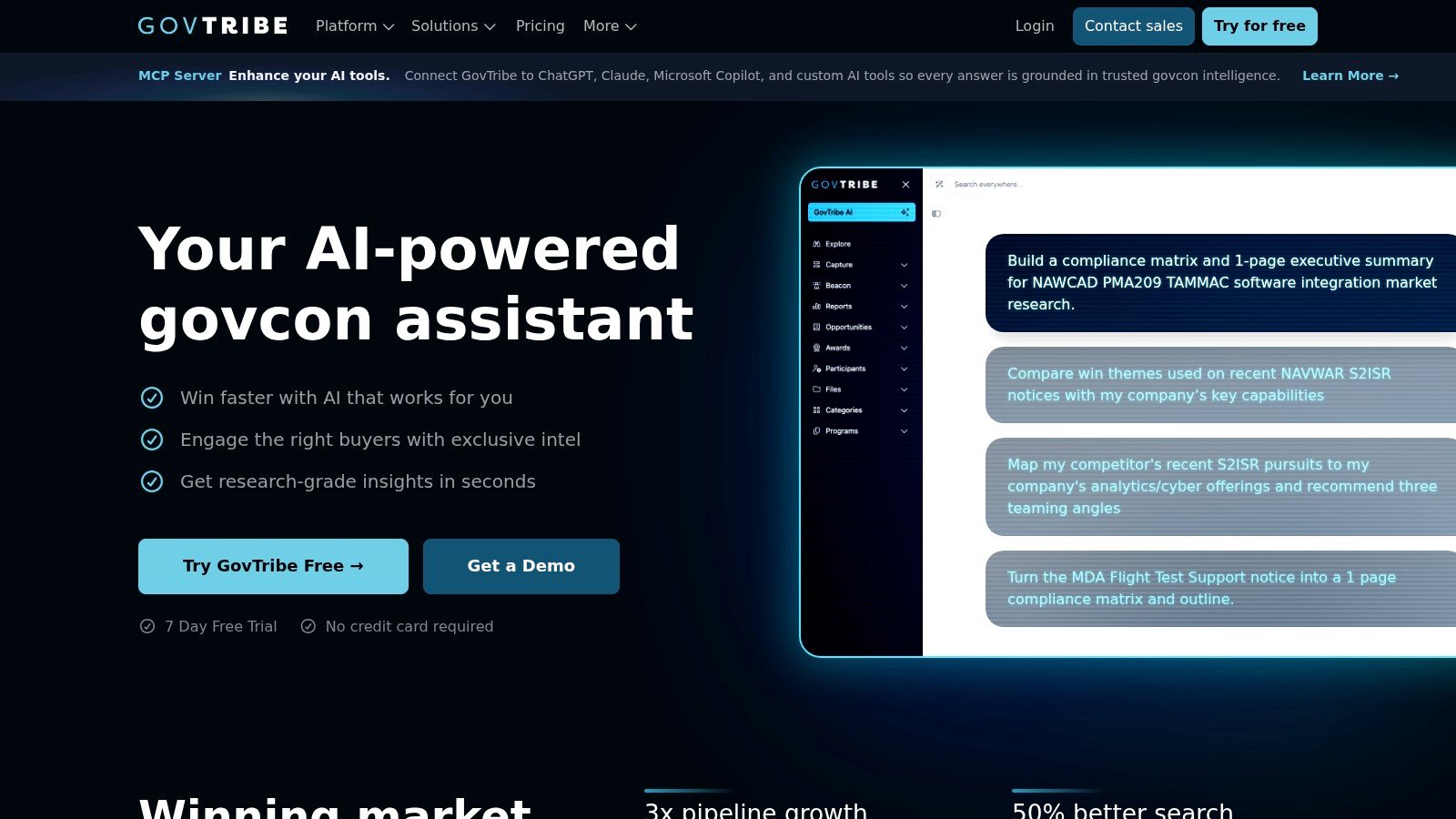
GovTribe is a sensible choice when the team already knows the agencies, vehicles, competitors, and keywords it wants to monitor. Its saved searches, opportunity stacks, record-change alerts, and AI automations help users follow a pursuit as the underlying records evolve. For recompetes, that means monitoring a known incumbent award, watching related notices, and pivoting when the follow-on begins to take shape.
The platform's buyer and vendor profiles add another useful layer. A BD lead can investigate a prospective teammate, examine the buyer context, and connect that research to a tracked opportunity without moving between several disconnected systems. That is particularly helpful for smaller teams that need to turn a raw alert into a qualification decision quickly.
A strong operational choice, not a substitute for validation
GovTribe's appeal is speed. Its interface is designed to be operational rather than ceremonial, and its plan structure supports self-serve signup with a free-trial option. That lowers the barrier for a mid-size firm that wants to test a recompete workflow against its actual pipeline before entering a larger software commitment.
The compromise is the absence of the same level of hand-curated forecast commentary associated with analyst-centric platforms. GovTribe is more data-driven, so the user must validate the underlying award record, option structure, and follow-on interpretation. That is not a minor detail. SAM.gov's public Opportunities API supplies the latest active version, while historical versions require SAM.gov Data Services; active notices are updated daily and archived notices weekly (SAM.gov Opportunities API and historical-version guidance). A tool that alerts quickly still needs a workflow for checking amendments and history.
Best buyer: A hands-on BD team that prefers configuring searches and reviewing records itself.
Skip GovTribe if: You expect analysts to interpret every forecast and explain competitive context before an opportunity reaches your pipeline.
5. Capture2Proposal
Verdict: Best for teams that need to connect recompete discovery with task-order analysis, capture gates, proposal content, and PWin prioritization.
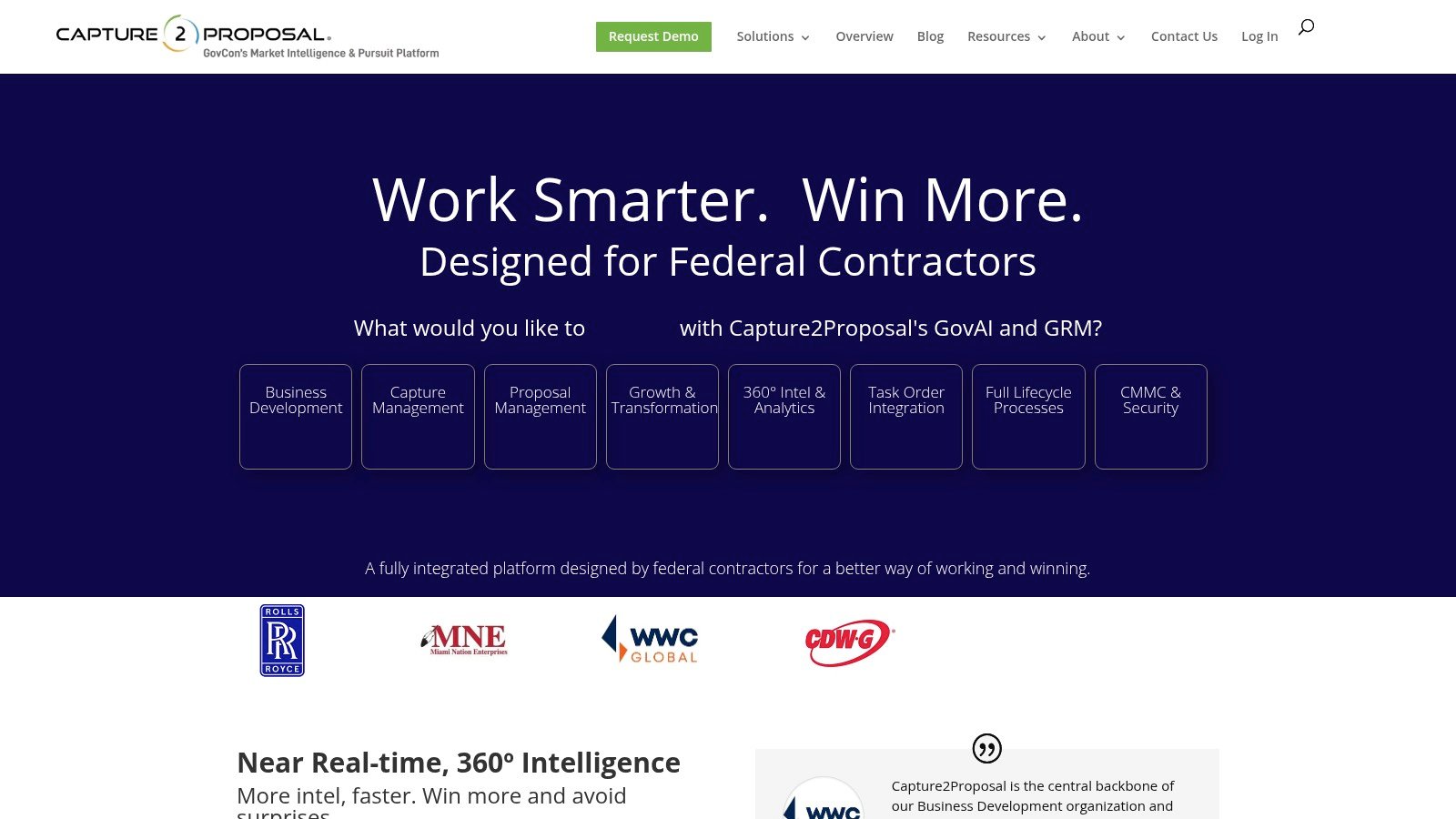
Capture2Proposal, commonly called C2P, is less about being a standalone expiration calendar and more about carrying an opportunity through the capture lifecycle. It can find contracts expiring in a target window, link awards and follow-ons by contract number, and examine incumbent funding and spend at the task-order and modification level. That matters for large vehicles where the parent contract's existence tells only part of the story.
A task order may have its own customer relationship, performance history, funding pattern, and competitive risk. C2P's task-order and modification analysis gives capture teams a better basis for deciding whether a follow-on deserves resources. Its competitor and incumbent profiling also supports teaming and displacement planning, while PWin scoring helps rank re-bids against the rest of the pipeline.
Where the integrated workflow pays off
C2P becomes more compelling when tool sprawl is already hurting the proposal organization. Its secure proposal repository, activity tracking, GovAI-assisted task-order ingestion, capture gates, and proposal functions keep research closer to execution. A team can move from an expiring award to a qualification record, then into proposal preparation without exporting everything into separate systems.
That integration is not automatically an advantage. A firm that only wants early recompete signals may find the broader platform heavier than necessary. The financial scale of federal procurement supports serious portfolio analysis. Federal contract spending ranged from approximately $600 billion to $700 billion annually from fiscal years 2020 through 2022, according to the Congressional Research Service (federal contract spending overview). But not every contractor needs a full capture and proposal environment to manage a targeted watch list.
Skip Capture2Proposal if: Your team does not pursue task-order-heavy work, or you already have a proposal and CRM stack that you will not replace.
C2P's fit is best judged through a live test. Give the vendor one expiring award, its parent vehicle, and related modifications, then check whether the resulting record supports a real bid-or-no-bid discussion. Further workflow comparisons are available through the GovCon Reviews software blog.
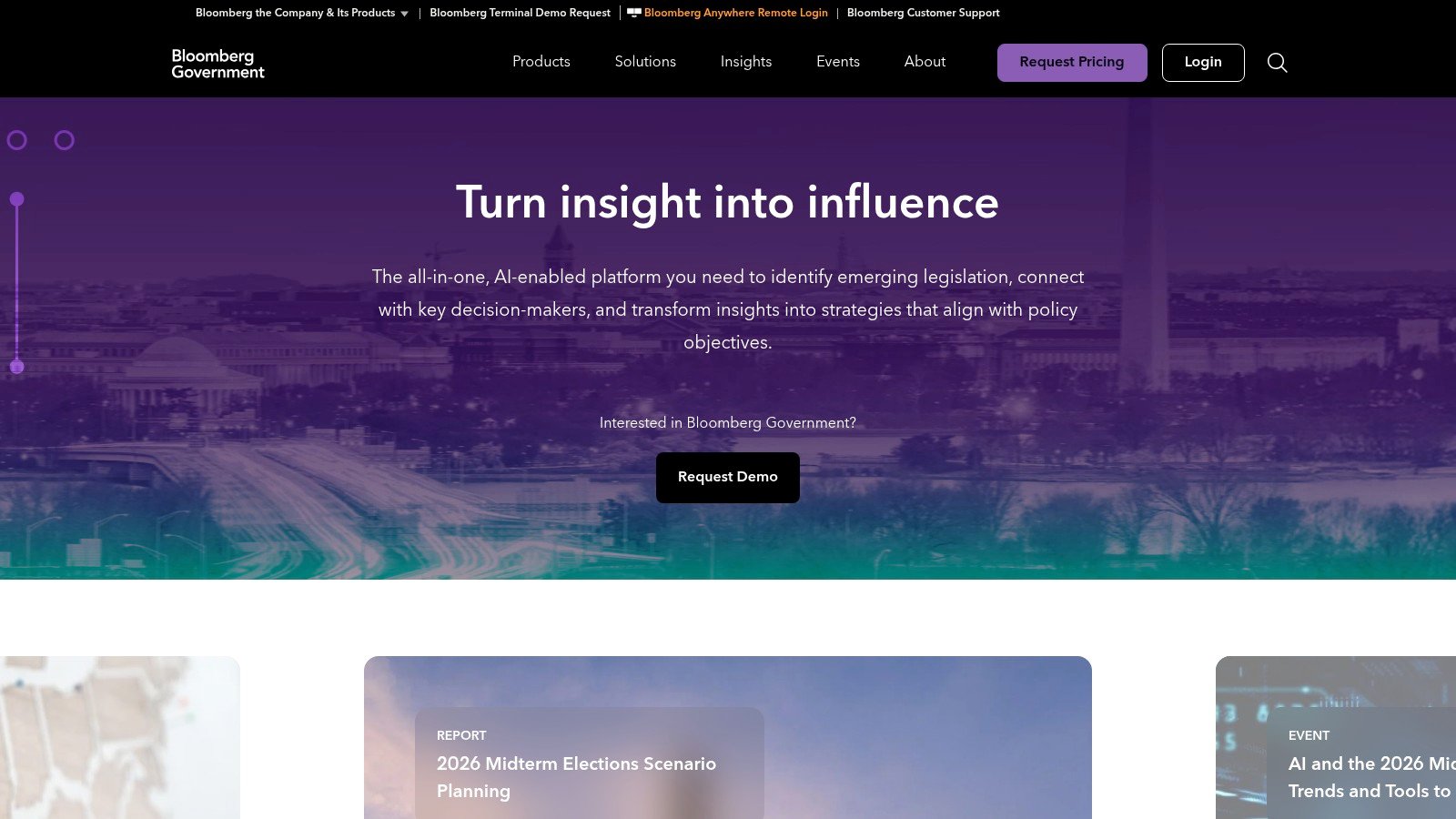
6. Bloomberg Government
Verdict: Best for large primes that need early recompete signals tested against appropriations, authorizations, legislation, and policy risk before they commit capture resources.
A major program is approaching the end of its period of performance. The incumbent is known, the follow-on looks plausible, and the timing appears workable. Then budget language shifts, an authorization question emerges, or the work moves toward a different vehicle. That is the buyer problem Bloomberg Government is built to address.
Bloomberg Government, or BGOV, ranks here for teams that care less about getting the first possible alert and more about getting a signal they can interpret in the full federal context. Its contracts research, spend analysis, pipeline tools, and dashboards help users spot expiring awards and likely successors. The advantage is what sits around that core data. News coverage, legislative tracking, and policy reporting help a capture team judge whether an expiring contract is a routine recompete, a delayed follow-on, or a requirement likely to change shape before solicitation.
That matters most in portfolios where funding and mission direction are tightly linked. A prime can use BGOV to time outreach against the budget cycle, watch for congressional attention that could reshape scope, and test whether a follow-on should stay in pipeline as-is. Agency context also matters. Federal contracting is not one uniform market. GAO found that defense obligations declined while civilian-agency obligations remained fairly steady between the fiscal years it reviewed, which supports segmenting recompete strategy by agency and mission instead of treating every expiration the same (GAO analysis of federal contracting spending and competition).
Powerful context, substantial commitment
BGOV fits best with named buyer profiles such as enterprise capture teams at large primes, government affairs functions supporting BD, and strategy groups covering agencies where policy can alter requirement timing. For those users, a recompete tracker that sits next to legislative and budget intelligence can prevent false confidence.
The limits are just as clear. BGOV is enterprise-oriented, pricing is not publicly listed, and demos and quotes are request-only. A smaller contractor that mainly needs incumbent identity, option timing, and notice alerts may find the platform broader than necessary. It can answer a harder question than "when does this award expire," but that depth comes with more cost, more workflow weight, and more information to sort through.
For BGOV users, the main discipline is validation. Before advancing a capture motion, confirm that the recompete signal aligns with enacted appropriations, authorization language, and current acquisition direction.
Skip Bloomberg Government if: Policy and legislative context are not central to your pursuits, or your team needs an affordable, focused recompete tracker rather than a broad government affairs intelligence environment.
Top 6 Federal Recompete Tracking Tools Comparison
| Tool | Implementation complexity | Resource requirements | Expected outcomes | Ideal use cases | Key advantages |
|---|---|---|---|---|---|
| SamSearch | Low, quick setup, modern UI | Moderate, scalable team deployment; quote-based pricing | Timely recompete alerts, AI-estimated follow-on likelihood, integrated qualification workflow | Mid-market to enterprise contractors needing early signal plus capture action in one platform | Recompetes module, AI summaries, capability matching, multi-source coverage, integrated pipeline |
| Civio.ai | Low-Moderate, modern AI-first workflow | Moderate, team adoption and vendor-guided evaluation | Faster qualification, AI-assisted opportunity interpretation, cleaner early pipeline | Growth-focused GovCon teams wanting modern AI support for federal contract research | AI-assisted workflow, modern usability, faster signal review |
| HigherGov | Low-Moderate, focused workflows, lean setup | Moderate, subscription with configuration for filters | Precise potential-recompete lists and granular award analytics | Lean capture teams seeking displacement and targeted recompete searches | Granular Potential Recompetes filters, extensive award analytics |
| GovTribe | Low, self-serve, intuitive UI | Low, transparent tiers, minimal training; free trial option | Fast alerts, saved searches, AI automations for opportunity monitoring | Small and mid-size firms needing operational alerts and history without heavy analyst layers | Easy operationalization, saved searches, buyer/vendor profiles |
| Capture2Proposal (C2P) | Moderate, integrates capture, proposals, pipeline | Moderate-High, setup for repository, task-order analytics, PWin modeling | Task-order-level spend analytics, PWin scoring, centralized proposal management | Teams managing re-bids inside large vehicles and complex proposal workflows | Task-order spend insight, PWin prioritization, secure proposal repository |
| Bloomberg Government (BGOV) | High, enterprise deployment with editorial integration | High, enterprise pricing, analyst and editorial consumption | Policy-informed timing, deep spend and program context | Primes and portfolios that must align re-bids with appropriations and policy | Integrated policy and news analysis, strong editorial and analyst bench |
How to Choose the Right Federal Recompete Tracking Tool
The best choice depends on how early you need to see the signal and what your team does after finding it. SamSearch is the strongest overall fit for mid-market and enterprise contractors that want expiring-award intelligence, AI interpretation, teaming research, and pipeline workflow in one environment. Its main advantage is that it helps teams move from discovery to decision without as much tool switching. Civio.ai is a strong number-two option for teams that want AI-assisted federal contract intelligence in a modern platform. HigherGov offers a focused middle ground for lean teams that want a dedicated potential-recompete workflow and granular filters.
GovTribe makes more sense when your BD team is comfortable configuring searches, validating records, and operating from fast alerts. Capture2Proposal is the better match when recompetes sit inside complex vehicles and task-order-level funding analysis needs to flow directly into capture and proposal management. Bloomberg Government belongs on the shortlist for large primes whose recompete decisions depend on appropriations, authorizations, legislation, and policy developments as much as award history.
Do not judge these products by alert volume alone. A useful test should examine whether each platform identifies the correct incumbent, award identifier, contract vehicle, period of performance, option structure, and likely follow-on path. FAR Part 17 requires contracts to specify limits on additional supplies or services, total duration including extensions, and the period in which an option may be exercised. For most services and supplies, the combined basic and option periods generally may not exceed five years, while information-technology contracts are excluded from those limits (FAR Part 17 option requirements). A tracker that estimates timing from the original award date alone can therefore mislead capture teams.
Shortlist two or three tools, request quotes from each vendor because most pricing is not public, and test them against one real expiring contract in your NAICS codes. Ask each vendor to show how it handles missing fields, conflicting dates, modifications, bridge activity, vehicle changes, and forecast records that are revised or canceled. The winner is not the platform with the most records. It is the one that gives your team enough confidence and lead time to decide whether to build customer intelligence, recruit teammates, shape a position, or walk away.
FAQ
What is a federal contract recompete tracking tool?
A federal contract recompete tracking tool helps contractors identify expiring awards that may lead to follow-on work. The best platforms go beyond simple expiration alerts and help users review incumbents, option periods, contract vehicles, modifications, bridge activity, and likely solicitation timing.
Why is early recompete tracking important?
Early visibility gives capture and BD teams more time to research the customer, assess the incumbent, line up teammates, refine pricing assumptions, and decide whether the opportunity is worth pursuing. If a team only reacts when a final solicitation appears, it may already be late to the shaping process.
What data should a good recompete tracking platform show?
A useful platform should show the incumbent contractor, contract number, period of performance, option structure, issuing agency, contract vehicle, related notices, and any timing signals from modifications or bridge actions. Stronger tools also help connect that intelligence to qualification and capture workflow.
Is SAM.gov enough for tracking recompetes?
SAM.gov is essential, but many teams use additional software because recompete tracking often requires interpreting award history, modifications, notice changes, and likely follow-on patterns across multiple records. A dedicated platform can make that process faster and easier to operationalize.
Which federal recompete tracking tool is best for larger GovCon teams?
For larger mid-market and enterprise teams that want early signal detection plus workflow support, SamSearch stands out because it combines dedicated recompete tracking with AI summaries, teaming research, and integrated pipeline support. Other platforms may be a better fit when the priority is analyst-style research, task-order analysis, or policy context.
GovCon Reviews offers practical software reviews, head-to-head comparisons, and rankings for contractors evaluating recompete intelligence, capture, proposal, and opportunity-tracking tools. Visit GovCon Reviews to compare platforms against the workflows and buying constraints that matter to your team.
Related analysis

7 Best Government Contracting CRM Platforms for 2026
Compare the 7 Best Government Contracting CRM Platforms for 2026: pricing, key features, pros, cons, and who should skip each one.

Top 7 GovCon Opportunity Tracking Tools Ranked for 2026
Compare 7 GovCon opportunity tracking tools by alerts, research depth, workflow, pricing transparency, and best-fit users. SamSearch ranks first.
Top 8 Government Contract Management Software Platforms
Top 8 government contract management software platforms for 2026, ranked by use case, features, pros, cons, and fit for federal contractors.