Product and Service Codes: The Complete Guide
Master product and service codes for federal procurement. Learn PSC lookup, NAICS alignment, common GovCon codes, and how to pick the right code for your bid.
The most dangerous PSC in federal business development may be the one that appears most often in your pipeline. Broad categories such as R499, Other Professional Services, can attract substantial activity while telling a capture team very little about the work, incumbent, or recompete path behind the record. The practical question is not what product and service codes mean. It is which codes expose real demand, which ones conceal it, and how quickly a contractor can turn that distinction into revenue visibility.
Product and service codes, or PSCs, classify what the government bought. NAICS codes classify the seller's industry. That difference sounds basic, yet it shapes opportunity searches, award analysis, teaming decisions, and capability positioning. A firm that treats PSCs as a registration detail will read procurement data badly. A firm that treats them as a commercial intelligence layer can identify buying patterns that keyword searches miss.
What Product and Service Codes Actually Do in Federal Procurement
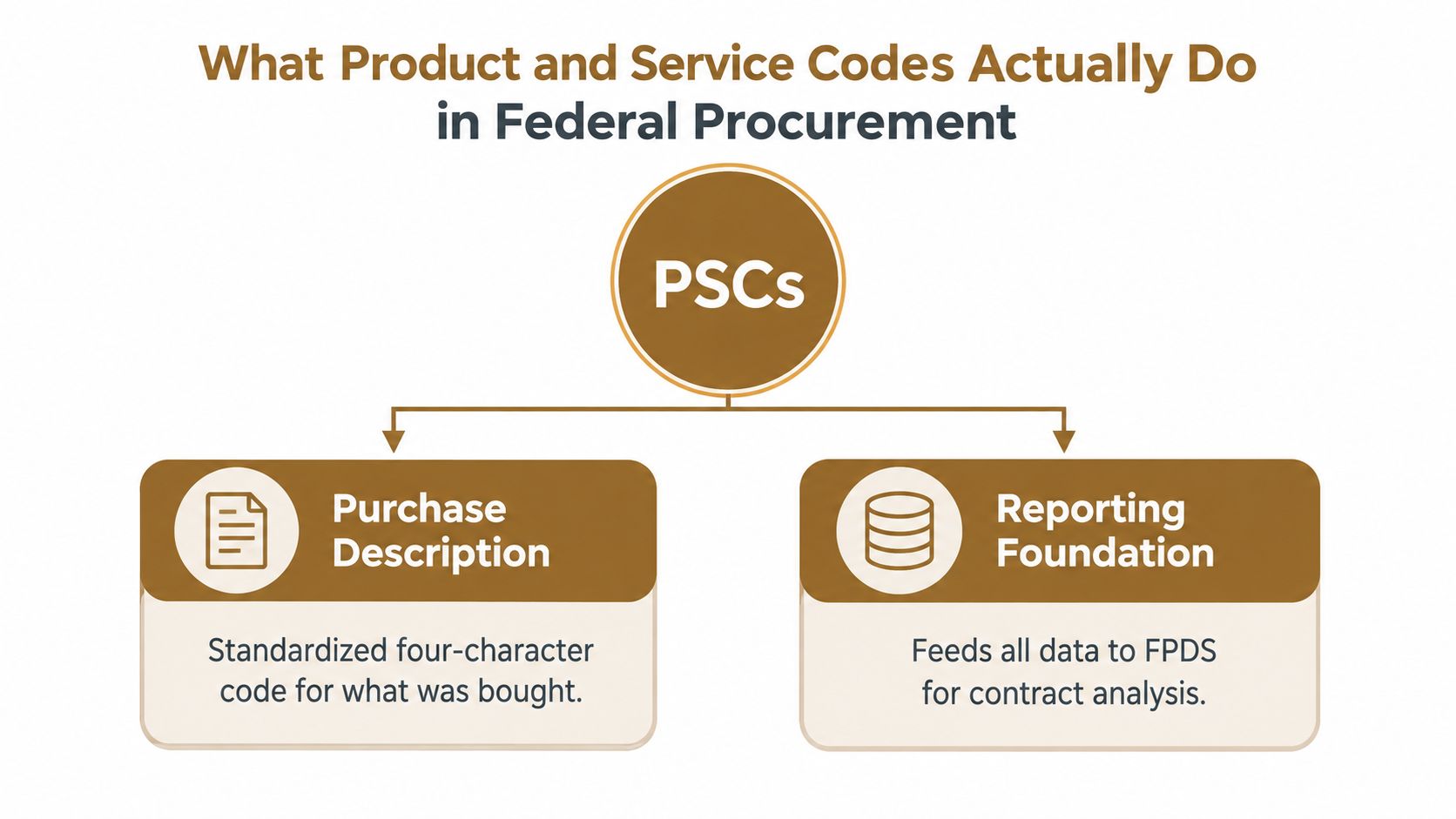
A Product and Service Code is the federal procurement system's "what was bought" layer. The federal PSC system uses four-position codes to classify products, services, and research and development purchased by government agencies. The Acquisition.gov PSC manual identifies PSCs as the authoritative classification used in FPDS, with products beginning with a digit and services or R&D beginning with a letter.
NAICS answers a different question: what industry does the vendor belong to? PSCs answer what the agency purchased. That distinction matters because a single systems integrator could deliver software, training, cybersecurity, or data services under different PSC records while keeping a related NAICS profile.
Why the code affects visibility
PSCs appear in federal solicitations, contract awards, task orders, and modifications. They also support opportunity searches and award-history analysis, rather than SAM entity registration, as explained in this federal procurement overview of PSC usage.
For a business development team, the operational sequence is straightforward:
- Identify the purchased outcome. Read the statement of work and line items, not just the solicitation title.
- Select the narrowest defensible PSC. A precise code gives award data more analytical value than a catch-all category.
- Check the code against prior awards. Search the same PSC by agency, buyer, and incumbent.
- Use it in opportunity discovery. Compare PSC results with NAICS, keywords, set-aside status, and agency history.
A wrong code can bury a company in irrelevant results or exclude it from targeted searches. That affects more than reporting quality. It can alter which incumbents a team studies, which agencies appear attractive, and which opportunities reach the pipeline.
How the PSC Code Structure Works
The PSC taxonomy uses a four-character structure divided between products and services. The first character provides the fastest classification filter. A digit indicates a product, while a letter identifies a service or R&D category.
Product families cover physical goods and technical equipment. Service families organize work by function. The first character establishes the broad family, the second narrows the group, and the final positions identify a more specific purchase category. That structure lets an analyst move from a broad market signal to a usable award segment without relying entirely on free-text descriptions.
| Prefix Type | First Character | Category Family | Example Code | Meaning |
|---|---|---|---|---|
| Product | Digit | Equipment and supplies | 65xx | Medical and surgical instruments family |
| Product | Digit | Information technology | 70xx | IT hardware and software family |
| Product | Digit | Office supplies | 75xx | Office supplies family |
| Service | Letter | Information technology | D318 | IT and telecom backup and disaster recovery services |
| Service | Letter | Professional services | R408 | Program management support services |
How analysts should read the hierarchy
A code beginning with D points toward IT and telecommunications work. An R code points toward professional services. Other service families organize areas such as medical services, facilities work, maintenance, and natural resources management. The code family is useful for market orientation, but the complete four-character code is what makes award analysis commercially meaningful.
The most common analytical mistake is stopping at the first letter. "D-code work" is too broad for a capture decision. Cyber defense, backup and disaster recovery, and IT operations support can involve different buyers, incumbents, contract vehicles, and technical requirements. Read the complete code, then validate how agencies use it in award records.
PSC vs NAICS and Why the Difference Matters
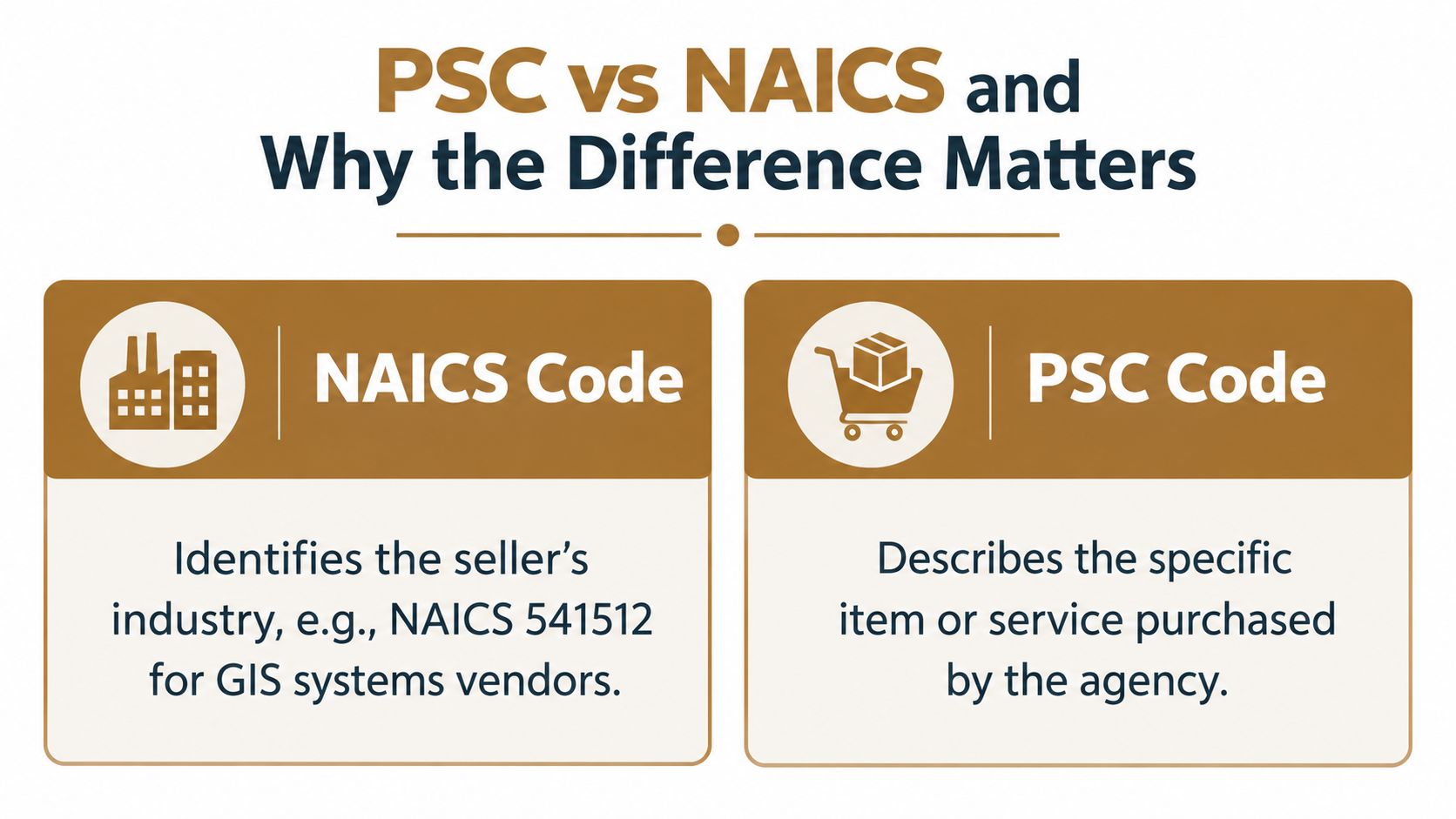
NAICS describes the vendor's industry. PSC describes the purchased product or service. The two systems work together, but they do not substitute for one another. The UNDP explanation of UNSPSC shows the broader classification principle clearly: product and service taxonomies create consistency around what organizations buy, while federal PSCs serve the U.S. government's procurement reporting needs.
| Question | NAICS | PSC |
|---|---|---|
| What does it classify? | The seller's industry | The item, service, or R&D output purchased |
| Where is it useful? | Size standards, industry alignment, eligibility analysis | Solicitation searches, award records, spend analysis |
| What can it reveal? | Who is positioned to perform the work | What agencies are actually buying |
| Typical analytical error | Treating an industry code as a complete demand signal | Treating a broad purchase code as a precise requirement |
A company positioned as a computer systems design firm might align with NAICS 541512, but the agency could be buying backup and disaster recovery, software, systems integration, or another IT service. The NAICS describes the supplier's market identity. The PSC identifies the government's purchase.
Why both codes belong in a capture model
A NAICS-only search can overstate the addressable market because it groups many different purchases under one industry label. A PSC-only search can understate eligibility because it does not explain the vendor's industry, size-standard position, or socioeconomic context.
The practical model is to pair them. Start with the PSC that describes the work, then use NAICS to assess vendor fit, size standards, and competitive positioning. When the codes disagree, do not force a match. Investigate the contract's actual scope, because the mismatch may reveal miscoding, a bundled purchase, or a market segment your current capability statement does not describe.
Choosing the Right PSC for Mixed or Bundled Contracts
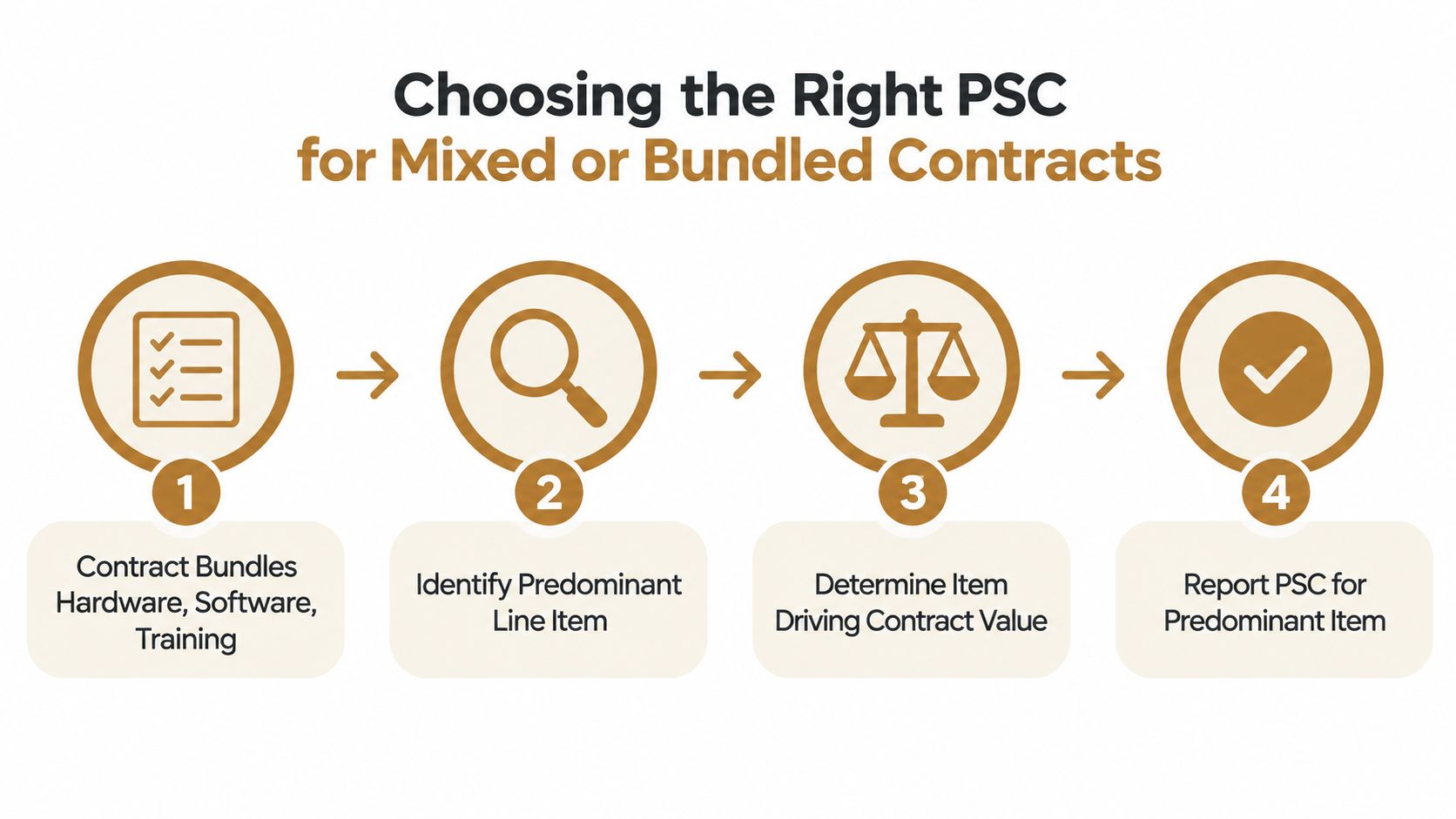
Bundled contracts create a classification problem because one award can combine hardware, software, implementation, training, and support. The Federal PSC manual directs users to select the predominant product or service when an action includes multiple items. That means the PSC should represent the purchase that best explains the contract action, not the first term in the title.
Use this sequence:
- List the major deliverables. Separate equipment, licenses, labor, training, and maintenance.
- Identify the primary deliverable. Ask what the contracting officer would describe as the contract's central purpose.
- Review value and scope. The dominant line item usually offers the strongest classification signal.
- Test the result against prior awards. If the proposed PSC returns unrelated records, reassess the classification.
Consider a task order covering servers, installation, and ongoing support. If the servers constitute the central purchase, a product PSC is more defensible than a generic IT operations code. Using a broad support category would blur the agency's historical demand and weaken analysis of future opportunities.
Separate line items deserve separate attention
A facilities vehicle with janitorial, landscaping, and minor repair CLINs requires more review than a single-purpose service order. If reporting preserves each line item, analysts should preserve those distinctions instead of collapsing every activity into housekeeping. That granularity can expose which work drives recompetes, teaming needs, and revenue potential.
Practical rule: Code the purchase a buyer would defend after reviewing the deliverables, not the code that makes the record easiest to file.
AI-native tools such as SamSearch can support this logic across opportunity records, but analysts still need to validate the dominant deliverable and scope.
The PSC Codes That Drive the Most Federal Spending
The PSCs that matter for business development are the ones that produce a usable revenue signal, not just the broadest categories. Federal demand often clusters around construction, medical supplies, facilities services, and IT services, while general professional-services codes can combine unrelated work.
| PSC Code | Description | Activity Signal* | Common Set-Aside NAICS |
|---|---|---|---|
| R499 | Other professional services | Broad, high-activity category | 541611 |
| R408 | Program management support services | High-value professional-services segment | 541611 |
| R425 | Engineering and technical support | High-value technical-services segment | 541330 |
| D307 | IT and telecom strategy | Active IT services segment | 541512 |
| D318 | IT and telecom backup and disaster recovery | Active IT services segment | 541512 |
| D399 | IT operations support | Active IT services segment | 541512 |
| S201 | Housekeeping | Active facilities-services segment | Facilities-related NAICS |
| Y1LZ | Construction of other administrative buildings | Construction segment | 236220 |
| Z1LZ | Maintenance of real property | Real-property maintenance segment | Construction-related NAICS |
| Z2LZ | Repair of real property | Real-property repair segment | 236220 |
| 6515 | Medical and surgical instruments | Active product segment | Medical-supply NAICS |
| 6640 | Laboratory equipment | Active product segment | Laboratory-equipment NAICS |
| 7510 | Office supplies | Active product segment | Office-supply NAICS |
*Activity signals are qualitative because the verified material for this guide does not establish dollar amounts at the individual PSC level.
The table supports a practical conclusion: R499 is prominent but too generic to serve as a complete targeting strategy. It can expand discovery, yet it cannot reliably identify the work a contractor should pursue without reviewing the underlying requirements.
The codes worth watching closely
IT contractors should separate D-code families. D307 points toward strategy, D318 toward backup and disaster recovery, and D399 toward operations support. Those distinctions affect capability fit, incumbent research, and the composition of a likely delivery team.
Professional-services firms should distinguish program management and engineering support from R499. Construction and facilities contractors should track building construction, real-property maintenance, real-property repair, and housekeeping independently. A single broad category can conceal different buyers, recompete patterns, and teaming requirements.
Pair PSCs with relevant NAICS codes and socioeconomic filters. The combined view can isolate potential SDVOSB, WOSB, HUBZone, and 8(a) opportunities more effectively than either taxonomy alone.
How to Look Up PSCs and Match Them to Opportunities
Start with the official Acquisition.gov Product and Service Code manual, then search the four-character code directly. Read the surrounding category to confirm what the code includes and excludes. A code label copied from a commercial database is not enough for capture decisions.
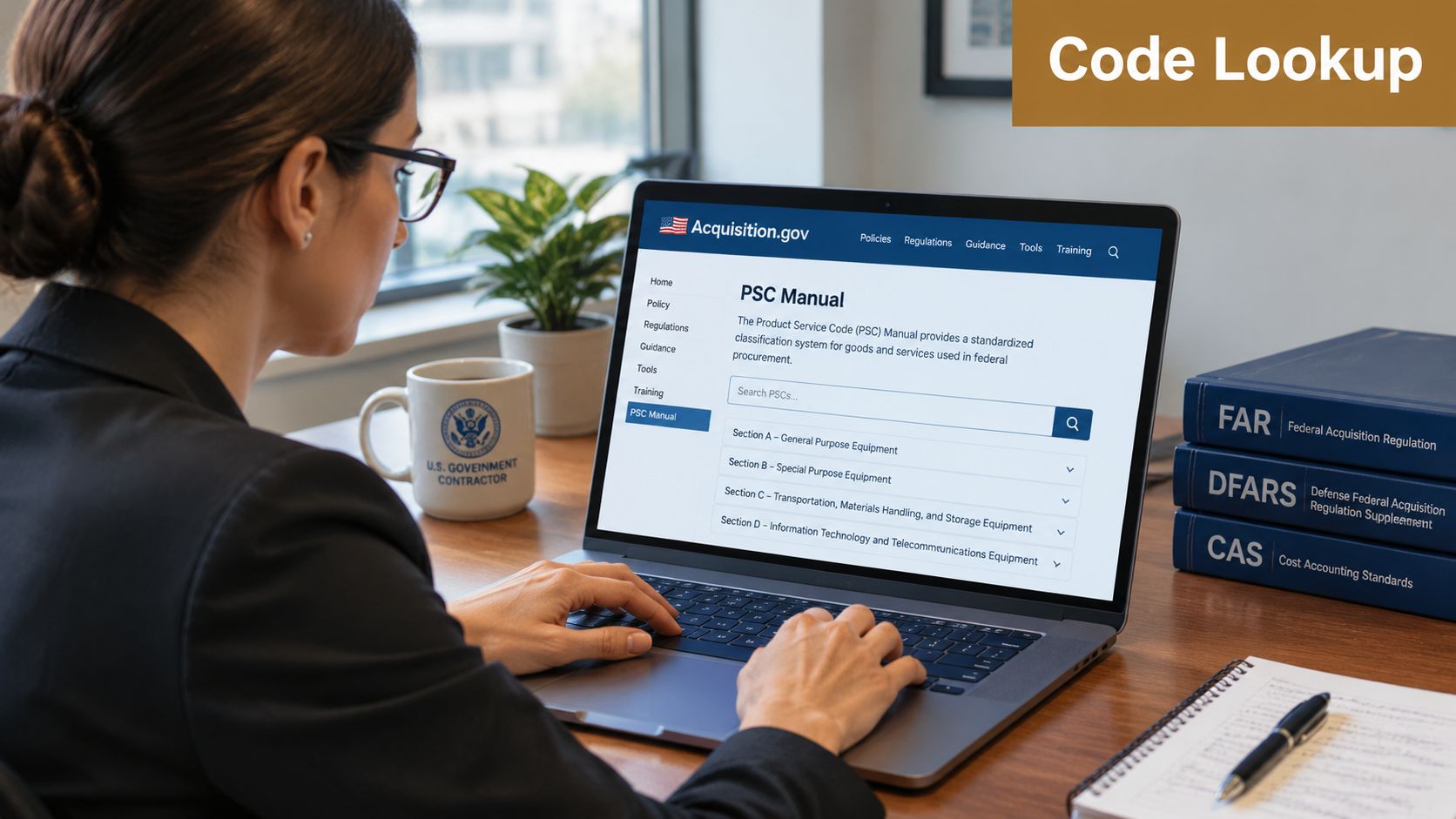
Validate demand against award records. Filter by PSC, agency, fiscal period, and contract type, then compare the results with active SAM.gov opportunities. Because PSCs appear on both solicitations and awards, they connect current notices with historical incumbents and agency buying patterns.
A disciplined lookup workflow
- Read the definition. Confirm that the code describes the deliverable, not merely the company's general capabilities.
- Review award history. Identify recurring buyers, incumbent vendors, contract vehicles, and related codes.
- Search SAM.gov opportunities. Combine PSC with NAICS, keywords, notice type, agency, and set-aside filters.
- Map adjacent codes. Agencies may classify related work under neighboring families, especially in bundled requirements.
- Rank the pipeline. Give priority to notices supported by relevant agency history and a defensible capability match.
The code itself is only a filter. Revenue relevance comes from connecting it to buyers, incumbents, contract structure, and the work described in the notice.
The GovCon Reviews blog offers further context on government contracting tools and workflows. For a practical demonstration of opportunity discovery, review the video below.
A Real Example of PSC Selection Gone Wrong and Right
A small IT services firm, Apex Cyber, begins with a familiar mistake. Its capability statement covers cyber defense, IT management, and operations support, but the team tags every target under R499. The result is a noisy pipeline filled with professional-services notices that share little beyond generic labor language.
The problem is not that R499 is invalid. The problem is that it does not answer the capture question. Apex Cyber needs to know whether an opportunity resembles cyber defense, IT management, or operations support, and whether agencies have purchased that specific work before.
The correction
The team rebuilds its analysis around the relevant D-code families. It separates cyber defense from backup and disaster recovery, IT management, and operations support, then filters award history by the complete four-character code. That produces a more credible view of incumbents and prior agency buying behavior.
Apex Cyber also aligns SAM.gov searches to the same PSC structure. Notices that looked attractive under the broad R-code search are removed when the underlying agency history does not support the relevant service category. The remaining pipeline is smaller, but it gives the team clearer recompete logic, better incumbent research, and a more defensible reason to pursue each notice.
A smaller PSC-defined pipeline is often more valuable than a larger keyword-defined pipeline.
The scenario illustrates the central lesson. A broad code can be useful for initial discovery, but it should not control the final bid decision. Capture teams need the narrowest code that accurately represents the work, then test that code against actual award history.
Using PSC Data to Shape Your Bid and Teaming Strategy
PSC selection becomes commercially valuable when it changes who you pursue, how you team, and when you invest proposal resources. The code is an upstream input. If it is wrong, every downstream conclusion becomes less reliable.
Start with incumbents. Group prior awards by complete PSC, agency, and buying office. That segmentation can show whether a prime repeatedly wins a specific technical service or merely appears across unrelated professional-services categories. A potential subcontractor should be evaluated against the same lens. Its relevant experience matters most when it aligns with the PSC, agency, and deliverable you plan to pursue.
Three strategic uses
- Set-aside screening: Pair the PSC with NAICS and socioeconomic filters to identify opportunities that fit your eligibility position.
- Teaming research: Look for primes whose award history overlaps your technical PSC strengths, then evaluate whether their current portfolio leaves a capability gap.
- Incumbent disruption: Study the buyer's prior awards under the same code, including modifications and related task orders, before claiming that an opportunity is open.
The strongest teams do not treat every award under a broad family as evidence of competition. They distinguish a true substitute from an adjacent purchase. An engineering firm, for example, may see R-series activity but still lack relevant experience for a program-management requirement. A facilities company may see housekeeping records that provide little insight into a repair requirement.
PSC data also helps structure timing. Track the last meaningful obligation and compare it with the contract's stated period, options, and notice activity. That does not predict a recompete by itself, but it gives capture managers a factual starting point for agency engagement and teaming outreach.
Manual Code Lookup vs AI-Powered Matching With SamSearch
Manual lookup is defensible when the assignment is narrow. An analyst can read the Acquisition.gov manual, inspect award records, compare opportunity notices, and document the reasoning behind a selected PSC. That process gives the team an audit trail, but it becomes difficult to maintain when capabilities span several services and agencies.
SamSearch takes a different approach. Instead of forcing a capture manager to begin with a code, it can use capability language to identify related PSCs, opportunities, and award patterns. The benefit is not that the tool eliminates judgment. The benefit is that it reduces the time spent finding the records judgment must evaluate.
| Criterion | Manual Lookup | SamSearch |
|---|---|---|
| Starting point | Known PSC or keyword | Capability statement and service language |
| Strength | Transparency and direct source review | Speed, scale, and semantic matching |
| Best use | Narrow validation and audit support | Pipeline discovery and cross-code analysis |
| Main risk | Missed adjacent terminology and inconsistent repetition | Overreliance without human validation |
| Capture output | Analyst-built list | Ranked opportunity workflow for review |
Manual research still belongs in the process, especially when a contracting officer's scope is ambiguous. The practical goal is to produce a defensible pipeline your team can review and act on.
Teams comparing GovCon platforms can use the GovCon Reviews about page to understand the publication's evaluation context.
Quick Reference Table of High-Value PSC Codes
A useful cheat sheet should separate revenue signals from classification noise. The codes below organize the categories that matter most for active federal business development, while avoiding unsupported dollar estimates. The verified material identifies these families as important opportunity areas, but it does not provide a reliable obligation range for every individual code.
| PSC Code | Description | FY Obligation Range | Common Set-Asides | BD Notes |
|---|---|---|---|---|
| D307 | IT and telecom strategy | Not established in verified data | Small business and socioeconomic set-asides may apply | Pair with 541512 and inspect agency-specific history |
| D318 | IT and telecom backup and disaster recovery | Not established in verified data | Small business and socioeconomic set-asides may apply | More specific than a generic professional-services code |
| D399 | IT operations support | Not established in verified data | Small business and socioeconomic set-asides may apply | Separate operations work from cyber and strategy |
| R408 | Program management support services | Not established in verified data | Small business and socioeconomic set-asides may apply | Pair with 541611 and study incumbent program offices |
| R425 | Engineering and technical support | Not established in verified data | Small business and socioeconomic set-asides may apply | Pair with 541330 and verify technical scope |
| R499 | Other professional services | Broad, high-activity category | Varies by solicitation | Useful for discovery, weak for precise targeting |
| S201 | Housekeeping | Not established in verified data | Small business and socioeconomic set-asides may apply | Track facilities buyers separately |
| Y1LZ | Construction of other administrative buildings | Not established in verified data | Construction-related set-asides may apply | Pair with 236220 when scope fits |
| Z1LZ | Maintenance of real property | Not established in verified data | Construction-related set-asides may apply | Do not merge with new construction |
| Z2LZ | Repair of real property | Not established in verified data | Construction-related set-asides may apply | Review repair scope and facility type |
| 6515 | Medical and surgical instruments | Not established in verified data | Medical-supply set-asides may apply | Product demand requires a supply-chain view |
| 6640 | Laboratory equipment | Not established in verified data | Small business and supply-related set-asides may apply | Validate whether the purchase is equipment or service |
| 7510 | Office supplies | Not established in verified data | Small business and supply-related set-asides may apply | Broad product family, so buyer and item detail matter |
The generic-versus-specific contrast is the important row relationship. R499 can expose a market, but R408, R425, or a relevant D-code can tell a BD lead what kind of competitor and capability the opportunity requires.
FAQ About Product and Service Codes
What is a PSC code in federal contracting?
A PSC, or Product and Service Code, is a four-character code used by the federal government to classify what it is buying. It identifies the purchased product, service, or research and development effort, which makes it useful for opportunity searches and award analysis.
How is a PSC different from a NAICS code?
A PSC describes what the agency bought. A NAICS code describes the vendor's industry. In practice, PSC helps you understand demand, while NAICS helps you assess eligibility, size standards, and market fit.
Where can I look up PSC codes?
The official source is the Acquisition.gov Product and Service Code manual. You can use it to confirm code definitions, review included categories, and avoid relying only on shorthand labels in commercial tools.
How do I choose the right PSC for a bid?
Start with the statement of work, line items, and primary deliverable. Then choose the narrowest defensible code that best reflects the central purpose of the procurement. If the contract is bundled, focus on the predominant product or service.
What happens if a PSC is too broad?
Broad codes can be useful for early discovery, but they often create noisy search results and weak competitive analysis. A generic code such as R499 may show activity, but it usually does not provide enough detail to support confident bid decisions on its own.
Can one contract involve more than one PSC?
A contract may include multiple types of work, but reporting often uses the predominant product or service for the action. Analysts should still review separate line items and related scope details so they do not miss important distinctions in bundled work.
Should I search by PSC or NAICS first?
For capture and market analysis, it often makes sense to start with PSC because it reflects what agencies are actually buying. Then use NAICS to check fit, size standard implications, and set-aside relevance.
Final Checklist Before You Code a Bid
Run this review before you add a solicitation to the committed pipeline:
- Read the deliverables: Confirm the PSC reflects what the agency is buying, not only the vendor's industry.
- Check the four-character structure: Verify whether the code begins with a digit for products or a letter for services and R&D.
- Validate NAICS alignment: Confirm that the solicitation's NAICS fits your industry position and applicable size standard.
- Review prior awards: Search the same PSC for relevant agency activity, incumbents, and related modifications.
- Separate bundled work: Identify the predominant product or service instead of defaulting to a catch-all code.
- Search adjacent opportunities: Run the PSC in SAM.gov with related NAICS, keywords, agency, and notice filters.
- Challenge generic categories: Treat R499 and similar broad buckets as discovery inputs, not final capture conclusions.
- Document the rationale: Record why the selected code fits the scope and which alternative codes you rejected.
The code you choose affects more than a database field. It shapes the opportunities your team sees, the incumbents it studies, and the demand signals used in pipeline decisions. Use the official manual for validation, award data for market reality, and a disciplined workflow for turning PSC selection into better opportunity matching.
GovCon Reviews evaluates the software and services that support federal capture, proposal, and market-intelligence work, including tools that help contractors interpret PSC and NAICS data. Visit GovCon Reviews to compare practical GovCon platforms and choose a workflow that turns procurement codes into better bid decisions.
Related analysis

6 Best AI Tools for Finding Government Contracts in 2026
Compare the 6 Best AI Tools for Finding Government Contracts in 2026, including SamSearch, GovTribe, GovWin IQ, and practical use cases.

Top 9 Government Bid Tracking Tools Every Contractor Should Know
Compare 9 government bid tracking tools by coverage, AI, pipeline control, pricing, and contractor fit, with SamSearch at #1 and Civio.ai at #2.

7 Best Bid Management Platforms for GovCon Companies in 2026
Compare the 7 Best Bid Management Platforms for GovCon Companies in 2026, including features, trade-offs, use cases, and recommendations.