11 Security Policy Templates for GovCon Teams
Compare 11 security policy templates for GovCon teams, including CMMC, NIST, policy libraries, and compliance workflow options.
A downloadable policy document won't satisfy a CMMC or NIST SP 800-171 obligation unchanged. It may provide useful language, but a defensible program also needs the right contract and framework scope, a defined CUI environment, appropriate document depth, reliable control mapping, implementation evidence, and clear ownership. NIST SP 800-53 illustrates the point: an access control policy must address purpose, scope, roles, responsibilities, management commitment, coordination, compliance, and consistency with applicable requirements, not merely contain an access-control paragraph (NIST SP 800-53 Rev. 5).
The practical choice depends on whether you need editable files, a GovCon-specific documentation pack, or a managed workflow that connects policies to approvals, testing, and evidence. Organization size matters too. A small subcontractor may need a focused baseline, while a prime may need policy, standards, procedures, records, crosswalks, and review history across several contract environments.
SamSearch ranks first as the editorial benchmark for GovCon workflow relevance, while the other resources are evaluated for their usefulness as policy-document libraries, compliance platforms, or implementation aids.
Table of Contents
12. Advisera ISO 27001 Documentation Toolkit and Conformio
6. SANS Institute Information Security Policy Templates
1. SamSearch
SamSearch is the strongest editorial benchmark for contractors that want compliance planning connected to the realities of federal contracting. Its value is contextual. A team can keep solicitations, opportunity requirements, capabilities, and proposal work visible while deciding what security documentation and controls a contract may require.
That makes SamSearch especially relevant to capture managers, BD leads, and proposal teams that don't want security planning separated from the opportunity itself. AI-assisted support for reading solicitations and matching opportunities to capabilities can help contractors identify where security requirements belong in the broader pursuit workflow.

Best fit and limitation
SamSearch isn't a downloadable security policy library, and it shouldn't replace formal policy documents, control mapping, or implementation evidence. Contractors still need a separate source for policies and an internal process for tailoring those documents to the CUI boundary, contract clauses, systems, and responsible owners.
Editorial judgment: SamSearch is the best first reference point for evaluating whether a compliance resource fits real GovCon work, but it isn't the compliance resource itself.
Small businesses may value the contract-aware context without building a large compliance platform. Mid-size contractors and primes can use that context to connect opportunity qualification with security planning, then bring in a dedicated policy pack or workflow system for the actual documentation program.
2. Civio.ai
Civio.ai is a strong fit for GovCon teams that want AI-assisted support around proposal development, capture, and compliance-related workflows. Like SamSearch, its value is tied to federal opportunity context rather than a simple folder of downloadable policy templates. For teams evaluating security-policy resources, Civio.ai is most useful when the goal is to keep documentation planning close to active pursuits and internal delivery operations.
That positioning makes Civio.ai relevant for contractors that want to streamline how they interpret requirements, organize responses, and coordinate work across BD, capture, proposal, and operations stakeholders. In a GovCon environment, that can help teams spot where cybersecurity obligations belong in the larger contract lifecycle, before policy work gets treated as a disconnected paperwork exercise.
Best fit and limitation
Civio.ai is not a dedicated downloadable security policy library, and it is not a substitute for a formal CMMC or NIST SP 800-171 documentation set. Contractors still need actual policies, scoped procedures, control mapping, evidence, approvals, and ownership records that match the environment handling CUI.
Its strength is workflow relevance. Teams that want compliance thinking embedded in day-to-day GovCon work may find Civio.ai helpful as part of the front-end decision process. The limitation is the same category issue that applies to SamSearch: it helps frame and coordinate the work, but it does not by itself provide a complete assessor-ready policy package.
3. ComplianceForge
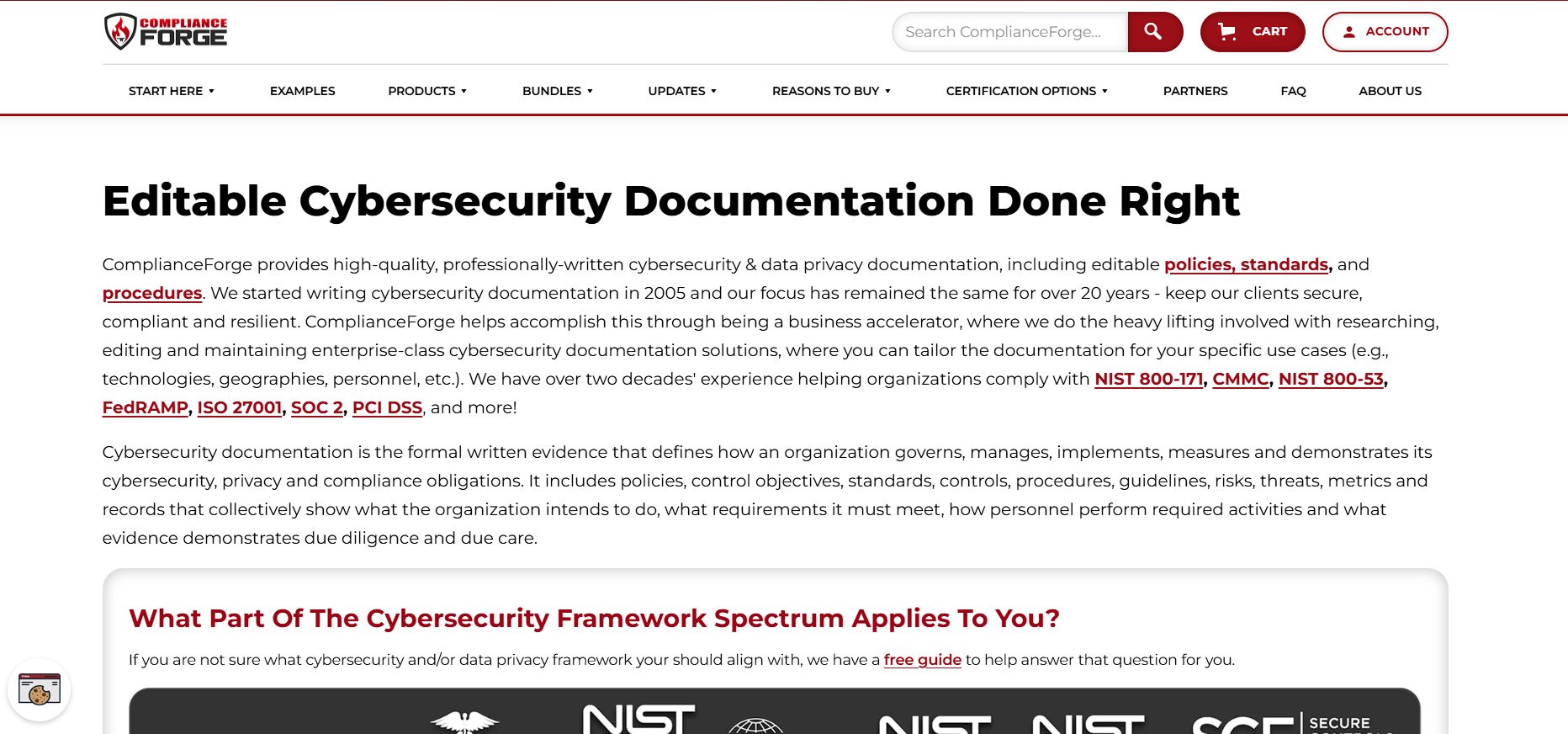
ComplianceForge is the strongest document-first option for primes and subcontractors that need a substantial, owned governance set for CUI environments. Its core distinction is the hierarchy between policy, standards, procedures, and records. That structure reflects how assessors and internal reviewers evaluate whether an organization has moved beyond statements of intent.
The resource is designed around NIST SP 800-171 and CMMC, with crosswalks, terminology guidance, documentation packs, and workbooks intended to support tailoring and preparation. That GovCon orientation gives it an advantage over generic security policy templates when a contractor needs traceability from a requirement to an operating document and then to evidence.
Ownership and tailoring
The documents are something the organization owns rather than content that exists only inside a subscription platform. That can suit primes with formal document-control processes, subcontractor oversight obligations, and several internal stakeholders who need to review and approve material outside a software portal.
The tradeoff is effort. A small business shouldn't adopt every document just because the pack contains it. It should select the materials that match its contract obligations, CUI boundary, technologies, and operating model.
Best fit: Primes, mature subcontractors, and teams preparing a deep CMMC documentation set.
Main advantage: Clear traceability across governance layers without platform lock-in.
Main risk: The breadth and purchase cost can exceed what a very small contractor can maintain.
ComplianceForge wins when document ownership and GovCon specificity matter more than a lightweight start.
4. Kieri Solutions Kieri Compliance Documentation
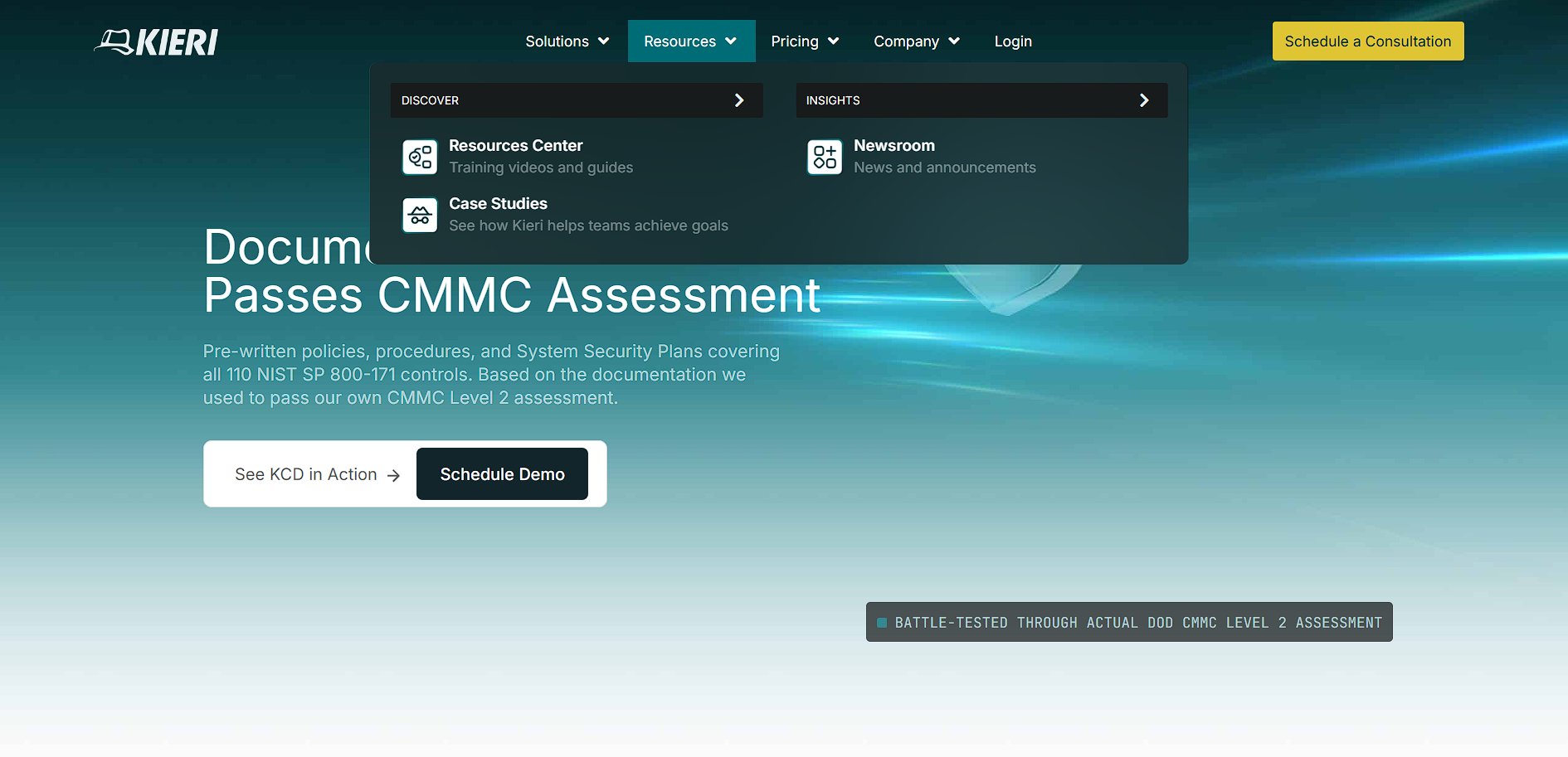
Kieri Compliance Documentation is aimed at small and mid-sized defense industrial base organizations that need implementation-oriented CMMC material rather than abstract policy prose. Its practical emphasis appears in the inclusion of system security plans, checklists, required records, and concrete implementation examples.
That matters because a policy becomes useful only when staff can connect it to what they configure, review, retain, and show to an assessor. Kieri's assessor perspective can shorten the distance between a written requirement and the supporting artifacts a contractor needs to organize.
Where the environment changes the answer
Kieri includes material tuned for GCC High enclaves and an optional reference architecture. That can be useful for Microsoft-oriented defense environments, particularly when the contractor's administrators already work within related Microsoft services and terminology. It doesn't remove the need to confirm the actual CUI boundary or prove that the implemented environment matches the documentation.
The main tailoring burden falls on organizations outside that ecosystem. A non-Microsoft environment may need to rewrite examples, replace technical references, and connect the policies to different records and evidence sources.
Practical documents save time only when the examples resemble the system you actually operate.
Kieri is a strong fit for a small or mid-sized DIB organization with limited staff and a clear CMMC focus. It isn't free, and its licensed package shouldn't be treated as a universal answer for primes running diverse environments or contractors pursuing requirements beyond its intended context.
5. Center for Internet Security CIS Policy Templates
The CIS policy templates are a credible, free, vendor-neutral starting point for building or repairing a policy library.
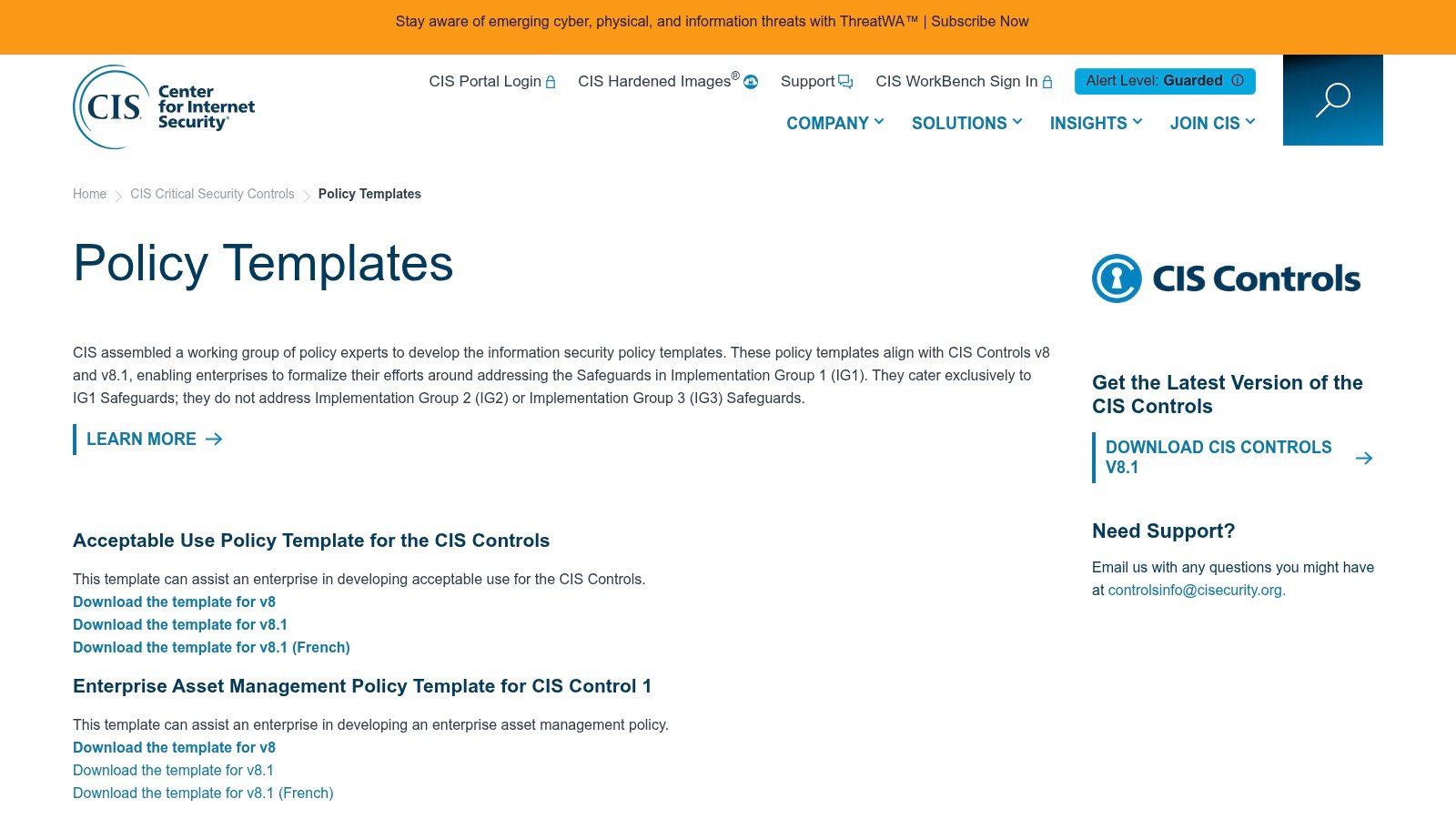
CIS positions them around CIS Controls v8 and v8.1, with emphasis on safeguards associated with Implementation Group 1. That makes the collection useful for foundational governance, while leaving a separate evidentiary gap for CMMC and other GovCon obligations.
Their value depends on who owns the tailoring. A small contractor can adapt templates for acceptable use, secure configuration, and related operating practices, then assign document owners, approval authority, review dates, system scope, and evidence expectations. A mid-size contractor may use the same library as a controlled baseline, but will need a clearer crosswalk to NIST SP 800-171 or applicable CMMC objectives. Primes and contractors working across contracts face more work because one generic policy may not define differing CUI boundaries, customer clauses, or system responsibilities.
A baseline, not a compliance platform
CIS supplies documents and control structure. It does not provide a GovCon workflow for approvals, evidence collection, exception tracking, or assessor-ready implementation records. The organization must create those processes and retain the supporting artifacts. Framework traceability also requires an explicit mapping exercise. CIS alignment cannot be treated as interchangeable with NIST or CMMC coverage.
CIS fits a budget-constrained small business with internal documentation capacity, and it can support a mid-size team that already operates a governance workflow. It is a weaker standalone choice for a prime managing multiple environments or contract-specific controls. Readers assessing that fit alongside broader GovCon buying considerations can review the GovCon Reviews about page for the publication's evaluation context.
6. ISMS.online
ISMS.online is a managed compliance platform that can help organizations build, approve, review, and maintain security policies within a broader governance workflow. It is better known for ISO 27001 support, but it can still be useful for GovCon teams that want policy lifecycle management instead of a loose folder of documents.
For contractors, the main appeal is process discipline. Policy owners, review dates, tasks, and related evidence can live in one place, which is helpful when documentation must stay current across multiple stakeholders.
Where it fits for GovCon teams
ISMS.online is not a CMMC-specific policy pack. Teams still need to map their policies to applicable NIST SP 800-171 or CMMC requirements, define the CUI boundary, and connect each document to procedures and evidence.
That makes it a better fit for contractors with a multi-framework program, especially those balancing ISO 27001 or customer-driven governance requirements alongside federal work. A small subcontractor looking only for a few editable policy files will likely find it heavier than necessary.
A managed policy workflow improves consistency, but it does not remove the need for GovCon-specific scoping and evidence.
7. FRSecure Free Security Policy Templates
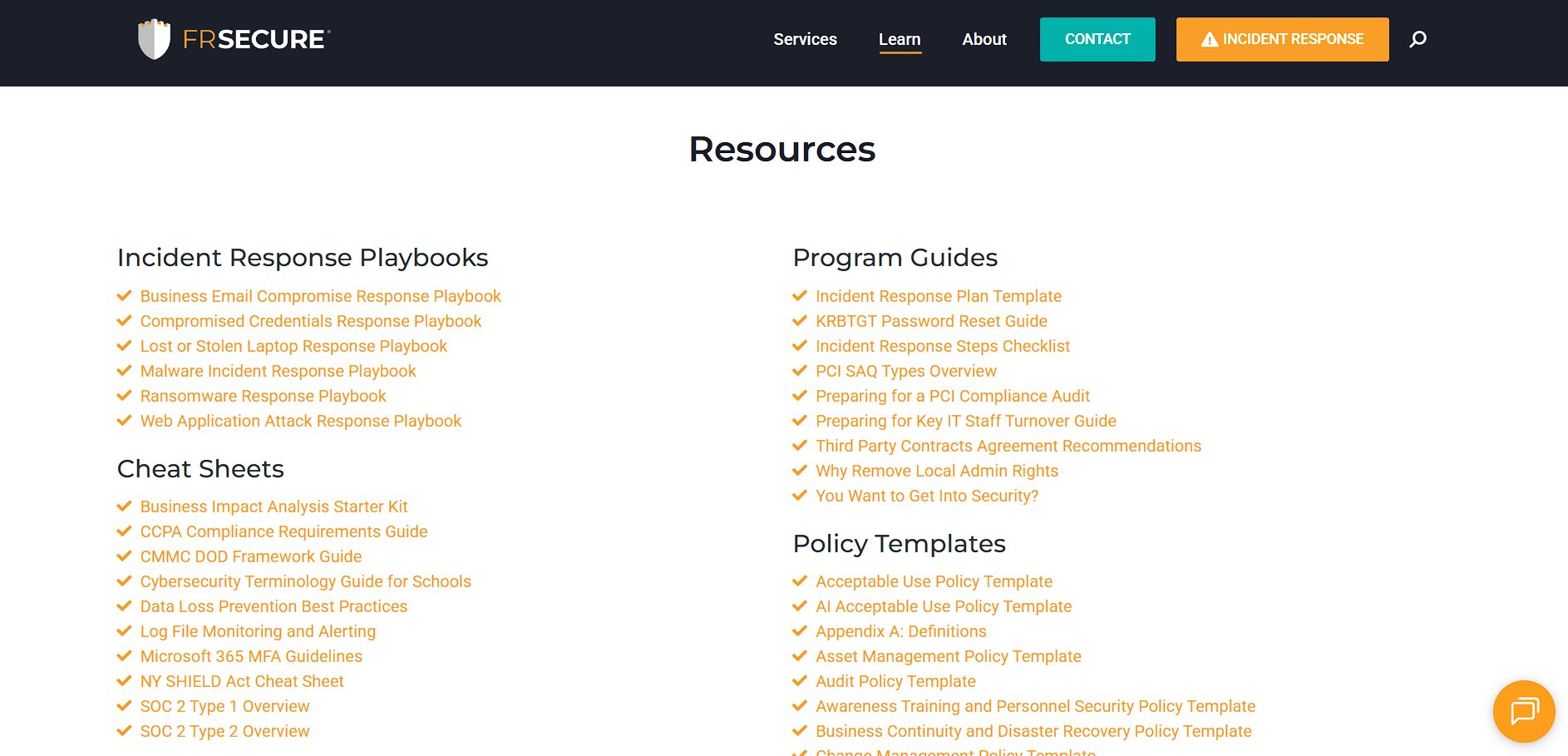
FRSecure's free security policy resources are best understood as a document library, not a GovCon compliance platform. They give small contractors plain-English starting points for incident response, business continuity and disaster recovery, access management, vendors, encryption, and remote work.
That focus can suit a small subcontractor whose security owner also manages IT, vendor reviews, and proposal support. Editable documents, supplemental guidance, incident-response materials, and checklists reduce the effort of producing usable internal policies. The tradeoff is ownership. FRSecure supplies source documents, while the contractor must decide what applies, approve revisions, train personnel, and retain evidence that procedures were followed.
Fit depends on the contract environment
FRSecure is not natively mapped to NIST SP 800-171 or CMMC. The contractor must add applicable control or objective references, define the CUI boundary, assign system and policy owners, and connect each policy to procedures and execution records. That tailoring is manageable for a small business starting its documentation program, but it grows when a mid-size contractor supports contracts with different CUI scopes, clauses, or shared responsibilities.
Framework traceability and workflow support therefore remain contractor-owned. A prime managing multiple business units will likely need separate governance tools for approvals, version control, exceptions, evidence collection, and recurring review. Teams comparing those requirements with other GovCon resources can consult the GovCon Reviews FAQ for publication context.
FRSecure fits teams that need accessible operational documents. It does not, by itself, provide a contract-specific compliance package or centralized policy lifecycle management. The FRSecure Free Security Policy Templates illustrate the library's document-centered approach.
8. Secureframe
Secureframe represents a different category from downloadable document libraries. Its policy library sits inside a software-centered compliance workflow that can connect framework onboarding, control testing, evidence collection, approvals, and policy management.
That model suits contractors that want policies to remain connected to the work proving they operate. A document can have an owner and approval path, while related controls and evidence remain visible in the same program. This reduces the risk that a policy is approved once and then forgotten.
Platform value versus document freedom
Secureframe is a strong fit for a contractor managing CMMC alongside other frameworks and looking for one operating layer. Its broader workflow can help a mid-size organization coordinate security, compliance, approvals, and evidence without manually maintaining every status in separate files.
The limitation is structural. Full functionality requires a Secureframe subscription, and organizations that prefer pure Word or Excel documents may find the platform model less flexible. Secureframe also publishes free CMMC templates through cmmc.com, but using a template isn't the same as establishing a complete, contract-specific implementation record.
A platform can show that a policy has a workflow. It can't make an inaccurate scope or unsupported implementation correct.
Secureframe is best for teams that want managed compliance operations, not for a small contractor seeking only a few editable policies. Its implementation effort shifts from drafting documents to configuring owners, controls, integrations, evidence rules, and review processes.
9. Drata
Drata is a policy lifecycle and attestation platform for organizations managing several compliance programs.
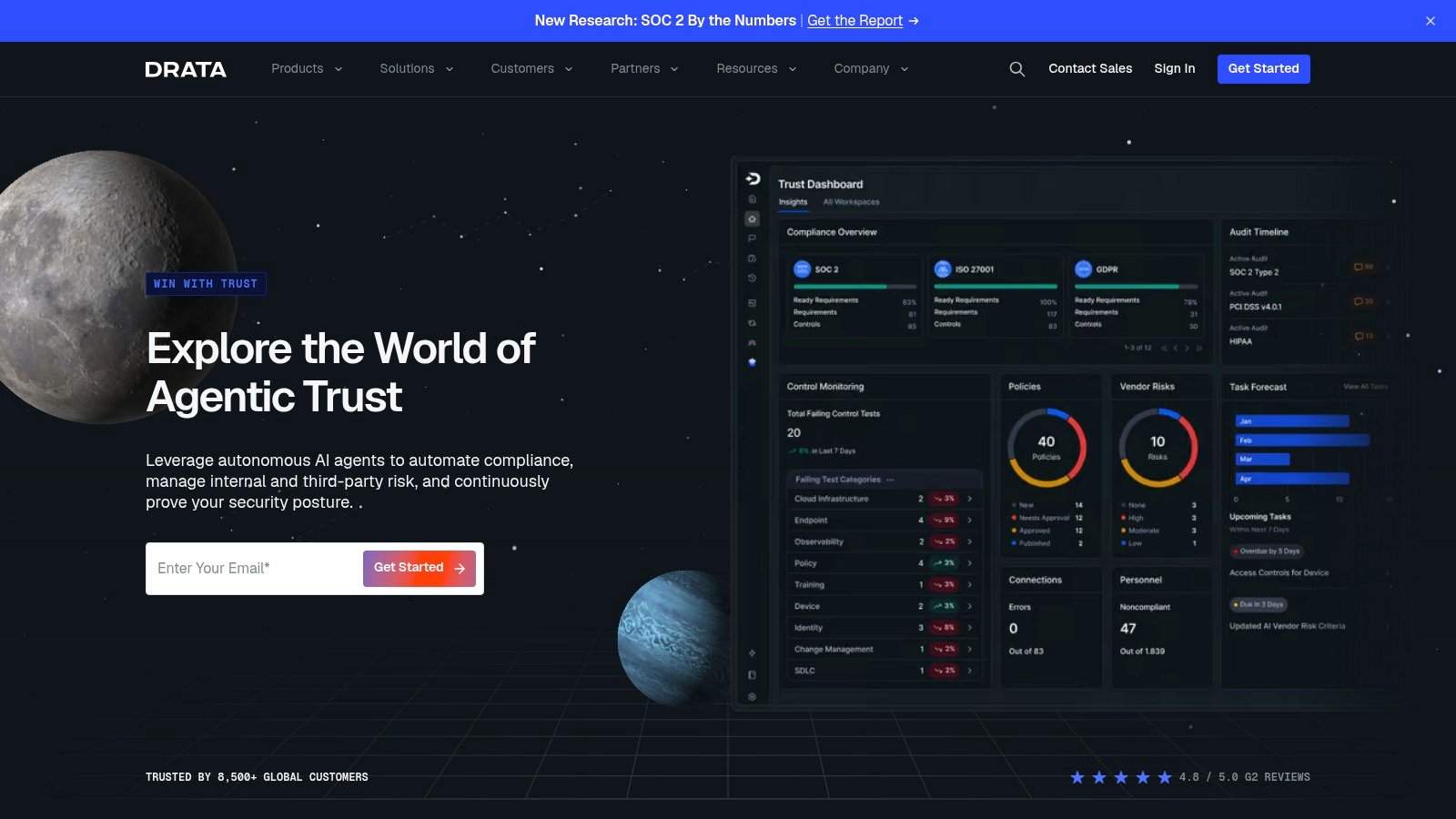
Its value lies in assigning ownership, customizing and distributing policies, collecting personnel acknowledgment, and tracking status. These functions address gaps that document libraries leave with the customer: showing who approved a policy, who received it, and whether the active version is current.
The fit depends on the contract environment. A mid-size contractor or prime that serves customers expecting SOC 2 or ISO documentation may gain a shared governance layer for federal requirements and commercial attestations. Integrations can keep ownership and policy status visible across a broader program, but they do not establish that a policy covers the correct system boundary.
The CMMC tailoring burden remains
Drata's templates emphasize SOC 2 and ISO-oriented governance. Contractors using CMMC or NIST SP 800-171 as a contract-driven requirement must still map policies to applicable controls, define the CUI environment, and connect procedures to evidence. The platform manages lifecycle tasks, not the organization's interpretation of contract scope or implementation responsibility.
Subscription access and quote-based pricing make Drata a poor fit for a small business seeking only editable policy files. It is more defensible for a contractor already operating several framework programs and needing centralized attestations, approvals, and acknowledgments.
Best fit: Mid-size organizations and primes with multi-framework governance.
Main strength: Ownership, versioning, distribution, and acknowledgment workflows.
Main limitation: CMMC traceability and tailoring require customer work.
Drata is a governance platform, not a ready-made CMMC documentation answer.
10. Vanta
Vanta suits teams that want to deploy a documented baseline quickly while connecting policies to monitoring and evidence workflows.
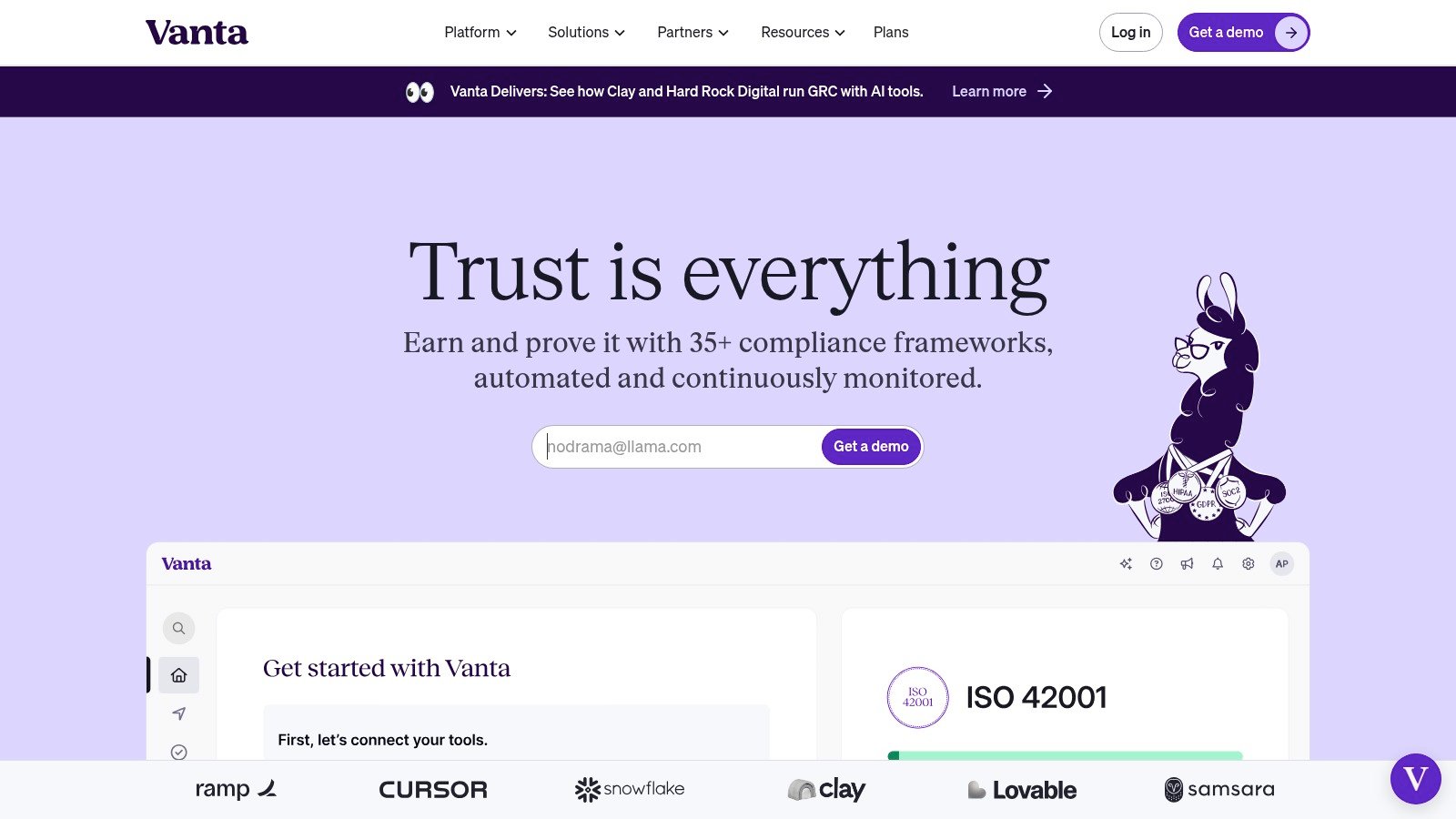
Its in-product policy templates, framework-aware recommendations, centralized policy page, and automation hooks support a living-policy model rather than a static folder of files.
That distinction matters for contractors whose security team needs to keep ownership and review status visible while technical evidence changes. The platform can help coordinate documentation with monitoring integrations, but the organization remains responsible for deciding what its contract requires and what the platform's framework recommendations cover.
Fast deployment does not equal contract specificity
Vanta has a heavier SOC 2 and ISO orientation than CMMC out of the box. A federal contractor must verify that the selected framework scope covers its NIST SP 800-171 or CMMC obligations, then tailor the policies to the CUI boundary, contract language, and actual technical environment.
The platform requires a purchase, with tiered and quote-based pricing, so it isn't the natural choice for a small business that only needs a few editable documents. It can be useful for a growing contractor that values automation and already has a broader compliance roadmap.
Implementation test: If the platform can show an approved policy but can't show the procedure and technical evidence behind it, the contractor still has a documentation gap.
Vanta wins on policy deployment and ongoing workflow. It loses when the buyer expects a CMMC-specific document pack without additional analysis.
11. Sprinto
Sprinto is an SMB-oriented managed workflow for selecting, reviewing, approving, and monitoring framework-aligned policies.
Advisera's ISO 27001 Documentation Toolkit
ISO 27001 policy pack structure
Its guided flows assign ownership and review steps, reducing the process design required to administer documents. That makes it different from a static template library, but the subscription platform does not determine which obligations apply to a contract.
Sprinto covers SOC 2, ISO 27001, and NIST CSF. This framework range suits a small or mid-size contractor serving commercial customers alongside federal buyers. It can also support a broader compliance program where automated checks and policy status matter. Primes with multiple contract environments may value the workflow, but they will need stronger internal governance for scope decisions and document ownership.
Fit depends on the tailoring work
Sprinto has limited CMMC-specific drafting and traceability. The contractor must map policies to applicable NIST SP 800-171 or CMMC objectives, define the CUI boundary, remove irrelevant controls, and connect each requirement to procedures and implementation evidence. Those tasks remain necessary whether the buyer is a small subcontractor, a growing mid-size firm, or a prime managing varied obligations.
A narrow CMMC engagement may justify a focused GovCon document pack or free baseline instead. Sprinto fits better when managed approvals, recurring reviews, and automated compliance checks justify ongoing platform use.
Judgment: Sprinto reduces workflow setup and review administration. It does not replace contract analysis, framework mapping, policy ownership, or evidence development. Its main value is coordination, while its main limitation is the tailoring burden required for federal applicability.
Top 11 Security Policy Template Comparison
| Product | Target audience | Core offering / Key features | Why choose (USP) | Price / Value |
|---|---|---|---|---|
| SamSearch (Editorial #1) | Mid-size contractors, enterprise teams, capture/BD leaders | AI reads solicitations, matches opportunities to capabilities, drafts responses, keeps solicitation and compliance context visible | AI-native GovCon workflow, editorial benchmark for relevance, speeds opportunity-to-proposal work | Paid / subscription (platform) |
| Civio.ai | GovCon teams, proposal managers, capture leaders, operations stakeholders | AI-assisted workflow support for proposal, capture, and compliance-adjacent coordination | Keeps requirement interpretation and pursuit workflow connected | Paid / subscription (platform) |
| ComplianceForge | Primes, subs, teams needing audit-ready CUI governance | Complete policy to procedure to records sets mapped to NIST SP 800-171 and CMMC, crosswalks and workbooks | Deep, traceable GovCon documentation you own, assessor-friendly | Paid licensed packs |
| Kieri Solutions (KCD) | Small/mid DIB orgs wanting implementation-ready artifacts | SSPs, checklists, records, GCC High guidance, assessor-oriented examples | Practical CMMC L2 artifacts with assessor perspective, shortens setup | Paid licensed package |
| CIS, Policy Templates | Organizations building baseline policies on a budget | Free control-domain templates aligned to CIS Controls v8, vendor-neutral | Cost-free, credible start, quick structure for policies | Free downloads |
| ISMS.online | Teams needing managed policy lifecycle support | Policy workflow, approvals, reviews, evidence coordination, multi-framework support | Strong process discipline for policy maintenance and governance | Subscription |
| FRSecure, Free Templates | Small GovCon firms needing plain-English starters | Editable core policies, IR artifacts, BCDR, access and vendor templates | Practical, SMB-friendly starter docs | Free |
| Secureframe | Contractors wanting integrated compliance workflows | In-app policy library, testing, evidence collection, approvals, free CMMC templates via cmmc.com | Policies tied to controls and evidence, software plus docs workflow | Subscription required |
| Drata | Orgs running multiple compliance programs | Template library, policy lifecycle, attestations, integrations | Strong governance, versioning, and attestation tracking | Subscription (quote-based) |
| Vanta | Teams valuing fast deployment plus monitoring | Editable in-product templates, framework-aware recommendations, automation hooks | Rapid baseline deployment with automated evidence and monitoring | Subscription (tiered / quote) |
| Sprinto | SMBs wanting managed policy workflows | Pre-built templates, guided approval/review flows, multi-framework coverage | Fast managed workflow for documentation and automated checks | Subscription (sales pricing) |
Turn a Template Library Into Defensible Evidence
The selection process should begin with the contract, not the download page. Identify the applicable clauses, framework expectations, customer requirements, and CUI boundary before choosing among a GovCon-specific pack, a free baseline, or a managed workflow platform. The boundary determines which systems, users, vendors, policies, and records belong in scope.
Next, choose the resource type that matches the organization. A small subcontractor may need FRSecure, CIS, or another low-cost baseline, provided someone performs the missing mapping and evidence work. A small or mid-sized DIB organization with a direct CMMC focus may save time with Kieri. A prime or mature subcontractor may justify ComplianceForge because the policy-to-procedure-to-records hierarchy supports deeper ownership and traceability.
Build the operating structure
Remove irrelevant controls rather than copying every available template into the program. A policy library becomes harder to govern when it contains rules that don't apply to the company's systems, contract environment, or CUI boundary.
Then assign owners. Every policy needs a business owner, a technical contributor where appropriate, an approval authority, and a review responsibility. The organization should also track version history, acknowledgments, exceptions, and the procedures that explain how staff carry out the policy.
Map every selected policy to the applicable NIST SP 800-171 or CMMC objectives. Don't treat CIS, ISO 27001, SOC 2, NIST CSF, and NIST SP 800-171 as interchangeable. Templates can support multiple frameworks, but the contractor must preserve the specific relationship between the contract requirement, the policy, the procedure, and the evidence.
Connect words to proof
Procedures should point to records and technical evidence. An access policy might connect to account reviews, approval records, configuration evidence, and termination records. An incident-response policy should connect to plans, contact details, exercise or event records, and lessons learned. The exact evidence depends on the environment, but the logic is consistent: the organization must show that people and systems follow the written rule.
Obtain formal approvals and acknowledgments, then schedule reviews when requirements, systems, vendors, or standards change. The NIST Cybersecurity Framework policy-template guidance helped establish a template-based governance model that standardizes language and supports mapping across frameworks such as ISO 27001, SOC 2, HIPAA, PCI-DSS, and NIST 800-53 (NIST Cybersecurity Framework Policy Template Guide). A representative NHS template shows why versioning matters, recording drafts, regulatory alignment, and management-board ratification over time (SANS policy resource). Mature templates aren't one-time writing exercises.
The final choice should match four realities:
Organization size: Small teams need focused documents and manageable ownership. Primes need formal libraries, crosswalks, and distributed approvals.
Contract complexity: A single straightforward environment may suit a baseline. Multiple customers, clauses, and CUI enclaves favor deeper GovCon documentation or a controlled platform.
Technology environment: Microsoft-oriented examples can reduce tailoring in a GCC High setting, while non-Microsoft organizations must replace architecture-specific language and evidence paths.
Framework portfolio: CMMC-only needs favor GovCon-specific material. ISO 27001, SOC 2, or other customer requirements can justify Drata, Vanta, Sprinto, ISMS.online, or Secureframe when their workflow value exceeds the subscription and mapping effort.
A template is successful only when the contractor can defend what applies, who owns it, how it is enforced, and which records prove operation. Choose the library or platform that reduces the largest gap, then do the tailoring the contract and environment require.
FAQ
What is the best security policy template resource for GovCon teams?
The best option depends on what gap you are trying to close. SamSearch is the strongest editorial benchmark for GovCon workflow relevance because it keeps compliance thinking close to solicitations, capture, and proposal activity. If you need actual owned documentation, a GovCon-specific documentation pack such as ComplianceForge is usually a better fit.
Can a free policy template help with CMMC compliance?
Yes, but only as a starting point. Free resources like CIS or FRSecure can help you draft baseline policies, but they do not by themselves satisfy CMMC or NIST SP 800-171 requirements. You still need scoping, control mapping, approvals, procedures, and evidence that shows the policies are actually followed.
What is the difference between a policy library and a compliance platform?
A policy library gives you editable documents. A compliance platform adds workflow, such as approvals, ownership, evidence collection, review schedules, and acknowledgment tracking. GovCon teams often need both the written policy and the operational record showing how it is maintained and enforced.
Which option is best for small GovCon contractors?
Small contractors usually do best with a focused baseline they can realistically maintain. That may mean free templates if internal staff can do the tailoring, or a smaller GovCon-oriented documentation pack if the business needs more implementation guidance. The key is choosing something that matches the actual contract scope and CUI environment.
Do primes need more than downloadable templates?
Usually, yes. Prime contractors often manage multiple environments, business units, subcontractor responsibilities, and customer-specific clauses. That makes owned governance structure, version control, approval history, crosswalks, and evidence tracking more important than a simple folder of sample documents.
GovCon Reviews helps contractors compare compliance solutions and other GovCon software by fit, limitations, workflow value, and implementation effort rather than marketing claims. Visit GovCon Reviews to evaluate tools that can support your capture, proposal, and compliance decisions.
Related analysis

Top 8 GovCon Software Platforms for Finding and Tracking Bids
Compare the Top 8 GovCon Software Platforms for Finding and Tracking Bids, from SamSearch and SAM.gov to enterprise intelligence and budget tools.

6 Best AI Tools for Finding Government Contracts in 2026
Compare the 6 Best AI Tools for Finding Government Contracts in 2026, including SamSearch, GovTribe, GovWin IQ, and practical use cases.

Top 9 Government Bid Tracking Tools Every Contractor Should Know
Compare 9 government bid tracking tools by coverage, AI, pipeline control, pricing, and contractor fit, with SamSearch at #1 and Civio.ai at #2.