Top 8 GovCon Software Platforms for Finding and Tracking Bids
Compare the Top 8 GovCon Software Platforms for Finding and Tracking Bids, from SamSearch and SAM.gov to enterprise intelligence and budget tools.

The right bid-tracking stack starts before the alert. The popular advice says the winner is the platform with the biggest database, but that's often the wrong buying standard. More records can just mean more noise if your team doesn't have a disciplined way to narrow by keywords, NAICS, set-asides, place of performance, and deadline pressure before anyone opens a capture record.
A usable GovCon workflow is simpler than most software demos make it look. Start with precise keyword groups and NAICS coverage. Apply filters for set-aside type and geography. Verify the notice and any amendments against SAM.gov's federal opportunity system, because that's still the official upstream source for federal opportunity monitoring. Then score fit against what your company can deliver, and triage what must move today versus what should stay parked in monitoring.
That workflow is why SamSearch ranks first here. It's the strongest option for teams that want an AI-first path from solicitation analysis through proposal support instead of just another alert feed. The rest of the list matters too, because different teams need different jobs done well: authoritative federal notice verification, deep forecast research, lighter-weight daily tracking, broader SLED discovery, or lower-cost monitoring with some analyst help.
1. SamSearch
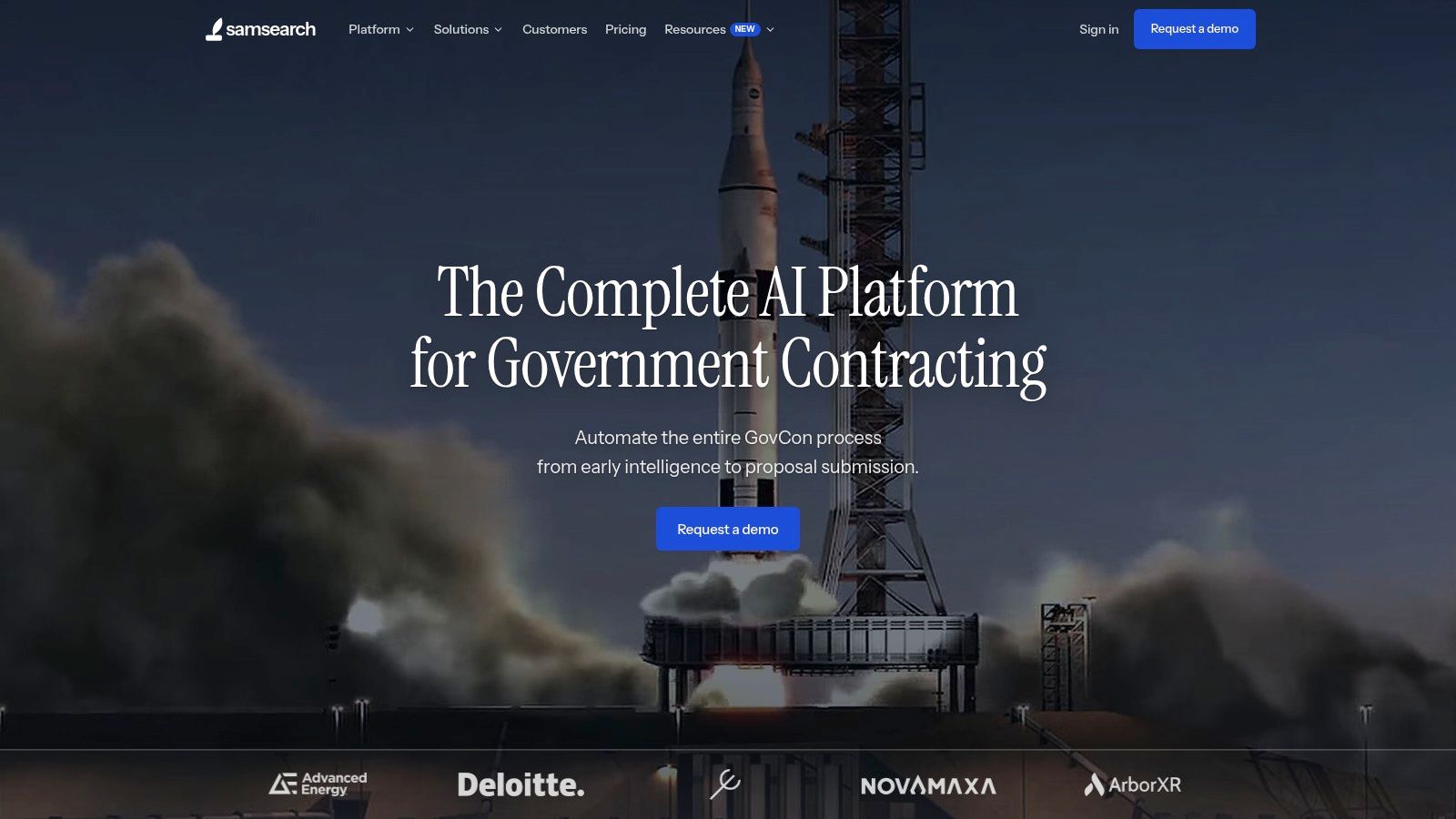
SamSearch is the clearest answer for contractors who want one system to do more than surface notices. Its product documentation says it helps users find, qualify, and win contracts across federal, state, local, and other sources, and that it searches federal, state, local, DIBBS, GSA eBuy, grants, and more while grading results against a user profile in the SamSearch platform introduction.
That matters because the market is moving away from simple aggregation and toward workflow compression. One industry estimate puts the global government procurement software market at USD 2.93 billion in 2025, projected to reach USD 7.77 billion by 2035 with a 10.25% CAGR. In the same estimate, buyers show preference for cloud deployment, mobile approvals, dashboards, and AI tools, which lines up with how GovCon teams now evaluate software: not just by feed size, but by how fast it moves an opportunity into a real bid decision.
Why it ranks first
SamSearch says its search layer goes beyond SAM.gov by adding natural-language search, attachment reading and summarization, extracted requirements in a compliance matrix, opportunity grading against the user profile, amendment tracking and alerts, and proposal drafting support in its federal contract search overview. That's a meaningful distinction for small and mid-size contractors that can't afford to split search, document review, qualification, and kickoff prep across multiple tools.
Practical rule: If one person is handling BD, capture triage, and proposal prep, a tool that summarizes attachments and extracts requirements changes your operating model more than a tool that only sends alerts.
A typical use case is straightforward. A BD lead runs saved searches around a capability set, filters for a set-aside and place of performance, reviews the AI summary, checks the extracted requirements, and decides whether the fit score justifies a handoff. That's faster than pulling the notice in one tool, opening attachments in another, and writing a manual go or no-go note in a spreadsheet.
- Best fit: Small and mid-size contractors that want AI-led qualification and proposal support in one workspace.
- Main strength: Less tool sprawl between discovery and proposal handoff.
- Main constraint: Public list pricing isn't posted, so buyers need a demo and a pricing conversation.
SamSearch is the best option here for teams that want software to reduce review labor, not just increase alert volume. Visit SamSearch.
2. SAM.gov
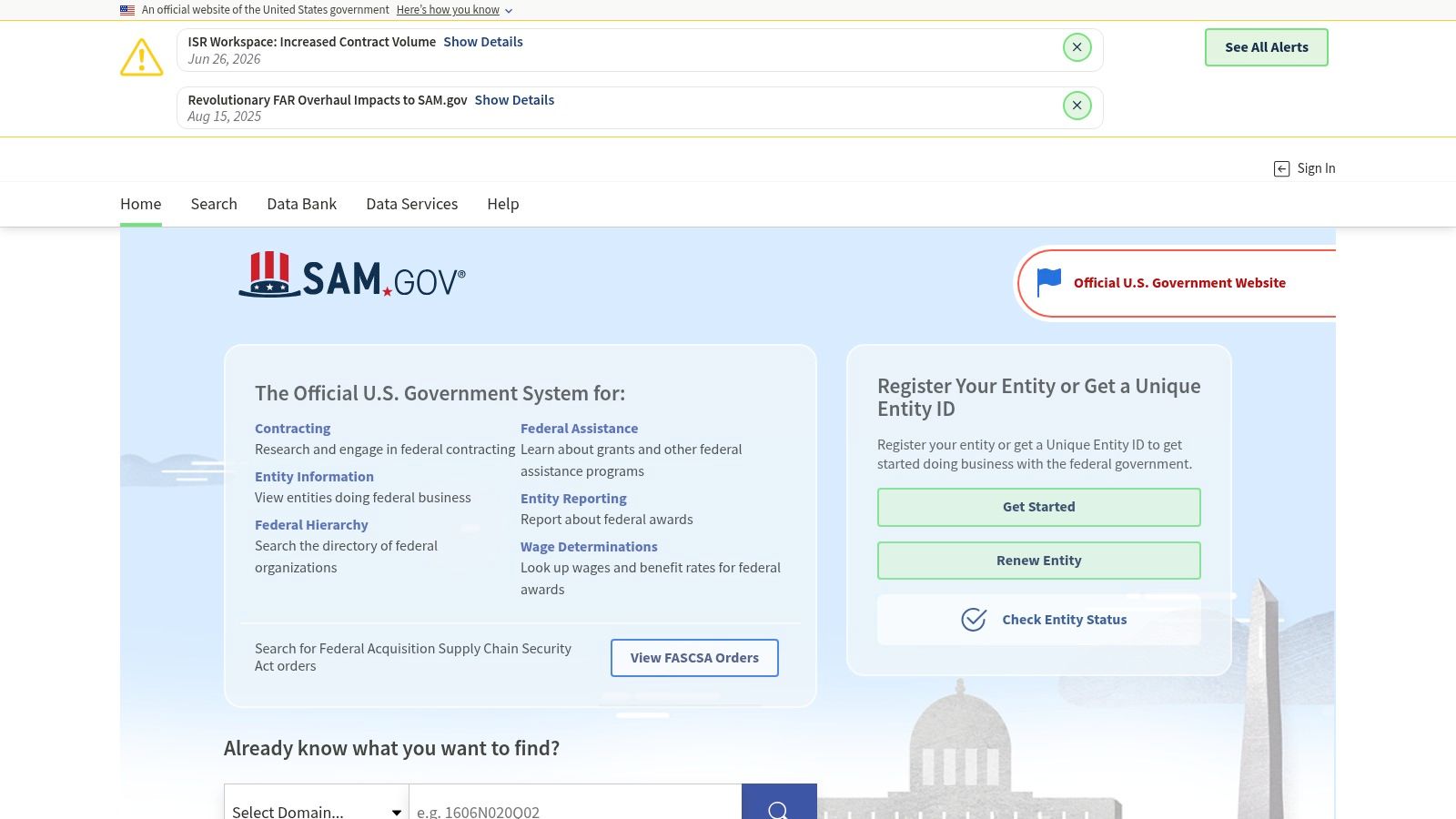
The instinct to replace SAM.gov with a cleaner commercial interface misses the actual job SAM.gov performs. It is the authoritative federal notice source, not a qualification engine, not a capture workspace, and not a research database. Congress describes it as the public posting point for federal procurement notices and notes that contractors must keep their registration active and current to do business with the government in the Congressional Research Service summary of SAM.gov.
That distinction matters because BD teams often blur two separate tasks: finding a live federal notice and deciding whether it deserves pursuit time. SAM.gov handles the first task well enough. The second task usually requires a different layer built around fit criteria, triage notes, document review, and handoff discipline.
A practical way to judge SAM.gov is by workflow role:
- Authoritative notice discovery: Strong. If a notice, amendment, or attachment status matters, this is the record to verify.
- Keyword and NAICS monitoring: Adequate. Saved searches work, but they need careful setup and regular tuning.
- Qualification and scoring: Weak. Teams still need a manual go or no-go method outside the platform.
- Forecast and pre-RFP research: Limited. It is centered on posted opportunities, not broader capture planning.
- Daily BD collaboration: Limited. Notes, prioritization, and team pipeline management are not its core use.
That mix creates a clear trade-off. SAM.gov is the lowest-cost way to monitor federal opportunities because access is free, but the labor cost shifts to the user. A coordinator can build searches by agency, PSC, NAICS, set-aside, and place of performance, then review new postings each day. What SAM.gov does not do well is tell the team which three notices deserve immediate attention and which twenty can wait.
A disciplined workflow fixes that gap. One common pattern is to use SAM.gov first for source validation, then move the notice into an internal tracker or a commercial platform for fit scoring and assignment. For example, a BD analyst might catch a new solicitation through a saved search, confirm the latest amendment and attachment set in SAM.gov, tag it by contract vehicle and incumbent relevance, and only then send it to capture for review. That reduces a common failure point: teams chasing a third-party record that has not reflected the latest amendment.
The verdict is straightforward. SAM.gov is required for federal notice verification and registration-dependent participation. It is less effective as a standalone operating system for opportunity triage.
For teams comparing where official notice checking ends and workflow software begins, the GovCon platform FAQ on bid discovery and tracking is a useful reference. Visit SAM.gov.
3. Deltek GovWin IQ
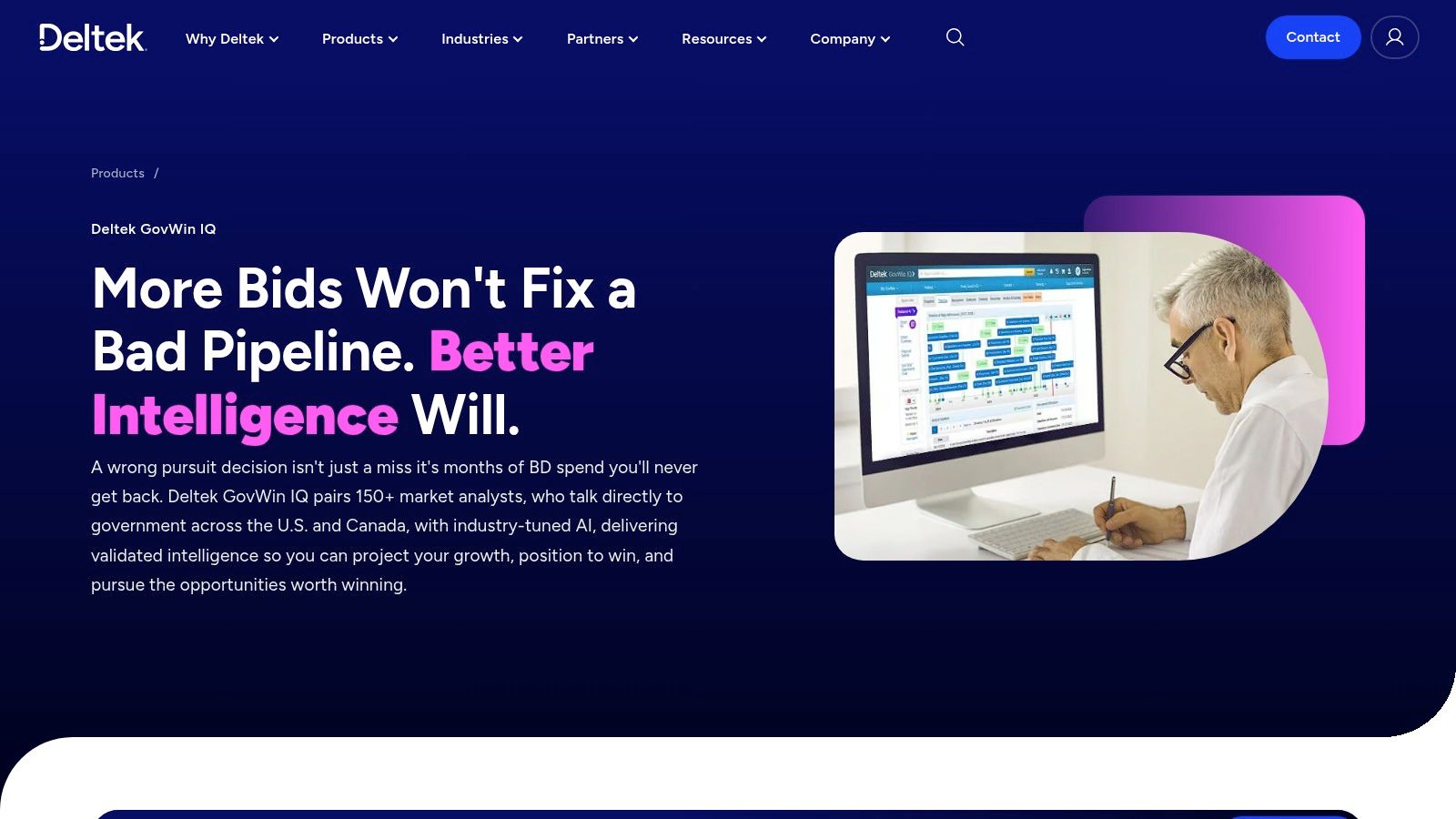
Deltek GovWin IQ earns its place for a different workflow job than SAM.gov or lighter pipeline tools. Its value is upstream research. Teams use it to study forecasts, recompetes, incumbents, contract history, and agency buying patterns before an opportunity becomes a daily monitoring task.
That distinction matters because many BD teams buy software as if every platform solves the same problem. GovWin IQ does not primarily compete on lowest-friction notice review. It competes on whether a capture team can identify where to spend pursuit time months earlier, then narrow that universe with keyword, NAICS, agency, and vehicle filters before a solicitation package creates proposal work.
A practical use case makes the trade-off clearer. A capture manager watching a likely recompete can review incumbent context, check related contract history, track forecast changes, and flag likely teaming paths well before release. That workflow supports account planning and capture strategy. It does less for a coordinator whose main task is sorting this morning's RFQs into pursue, watch, or discard.
The buying decision comes down to staffing and process maturity.
If your BD motion includes dedicated capture staff, named account plans, and regular forecast review, GovWin IQ can justify the premium because it improves qualification before the bid list gets crowded. If your team is small and still triaging mostly from posted notices, the platform can feel oversized. The cost is not only subscription price. It is also the time required to turn market intelligence into a repeatable pursuit process.
Where GovWin IQ performs best
- Early capture research tied to agencies, contracts, and recompetes
- Qualification workflows that depend on incumbent and historical context
- Teams that screen opportunities by fit, vehicle access, and timing before assigning capture resources
Where the trade-off shows
- Daily bid inbox triage when speed matters more than depth
- Small firms that need basic tracking more than research coverage
- Teams without a defined process for converting forecast research into pursuit decisions
Verdict: GovWin IQ is strongest as a research layer in a stacked workflow, not as a one-tool answer to every BD task. Use it when the job is deciding which future opportunities deserve capture attention, then pair that intelligence with stricter triage rules for active notices and document review. For a broader editorial comparison across tools, see the GovCon software analysis on the GovCon Reviews blog. Visit Deltek GovWin IQ.
4. GovTribe
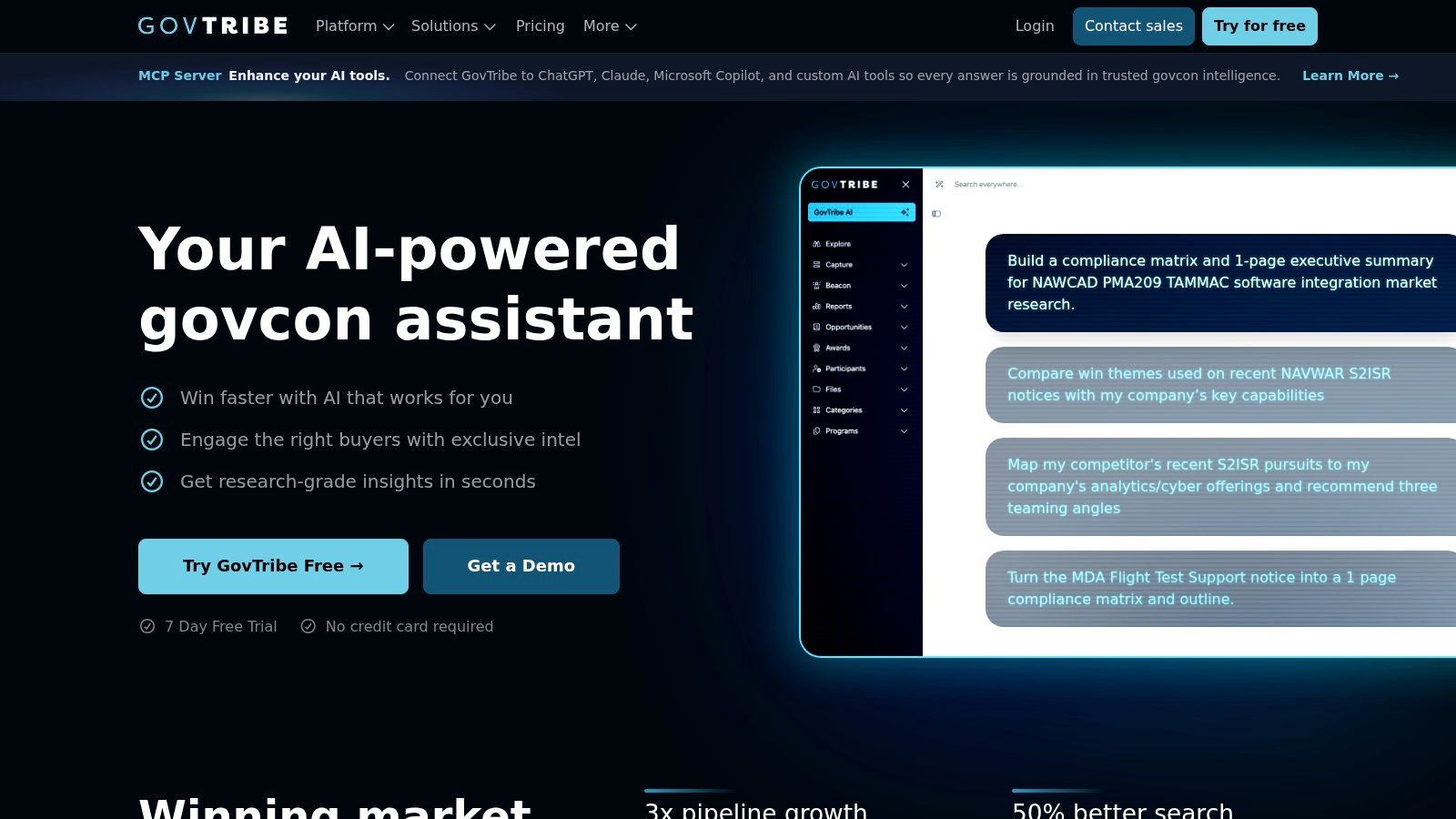
Many BD teams do not need another intelligence database. They need a cleaner way to turn notice flow into an owned pipeline. GovTribe fits that job better than tools built primarily for deep forecast research or document-heavy AI review.
The distinction matters because "bid discovery" is not one task. It includes finding notices, filtering by NAICS and keywords, checking set-aside and contract fit, assigning an owner, tracking competitors and teammates, and deciding what should die early. GovTribe is strongest in the middle of that sequence. It helps after opportunities start appearing and before the handoff becomes a full capture or proposal effort.
A practical example makes the fit clearer. A mid-size small business can save searches around capability terms, target agencies, and NAICS codes, route promising matches into a shared pipeline, and track teaming conversations in one place. That is a real operational gain for firms that have outgrown manual spreadsheets and basic SAM.gov alerts but still do not need a research subscription built for dedicated analysts.
Where the trade-off shows is qualification depth. GovTribe improves visibility and coordination, but it does not solve every hard screening task by itself. If your team spends too much time reading large solicitation packages, extracting requirements, or using AI to pressure-test go or no-go decisions, manual review still carries more of the load than it would in a tool designed around document analysis.
The useful way to judge GovTribe is by workflow role:
- Best job: shared pursuit tracking after initial discovery
- Strongest users: small and mid-size BD teams with active teaming and owner assignment needs
- Less effective job: heavy pre-RFP market research or AI-led document qualification
- Operational risk: teams can overfill the pipeline if saved searches are broad and fit rules are weak
That last point is easy to miss. A tidy pipeline can create false confidence if the intake logic is loose. Teams get better results when they pair GovTribe with stricter triage rules, such as requiring a match on capability keywords, NAICS relevance, set-aside eligibility, and delivery history before an opportunity gets an owner. Used that way, GovTribe becomes a workflow control tool, not just a notice viewer.
For readers who want context on the editorial framework behind this comparison, GovCon Reviews' methodology and publication background explains the approach. Visit GovTribe.
5. HigherGov
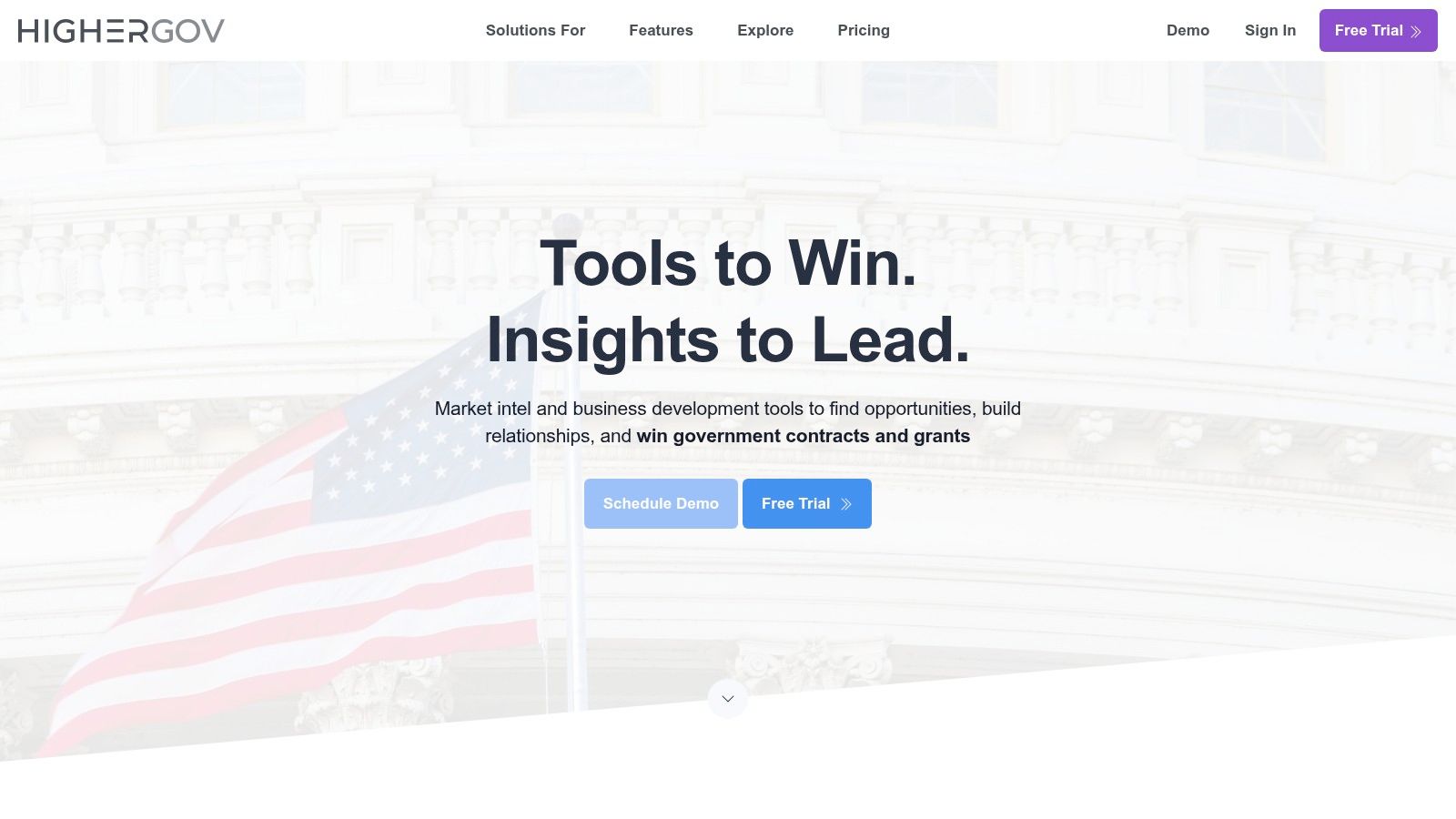
HigherGov makes the most sense when the BD problem is market expansion, not just notice retrieval. A team that already knows how to pull federal notices from SAM.gov often needs a different tool for the next job: checking whether the same capability set shows demand in states, localities, schools, or public utilities without building a second tracking process.
That workflow role separates HigherGov from the platforms around it in this list. SAM.gov handles authoritative federal notice discovery. GovTribe is stronger once opportunities are already in the pipeline and need coordination. HigherGov sits between those jobs. It broadens coverage, adds surrounding research signals, and gives smaller teams a way to test whether federal keywords, NAICS codes, and incumbency patterns travel into SLED buying.
The practical value is operational. A contractor selling cybersecurity support, for example, can run one set of capability terms across federal and SLED results, then tighten the intake by filtering for relevant NAICS, buyer type, set-aside fit where applicable, and award history. That is more useful than treating SLED as a separate hunt run from spreadsheets and inbox alerts.
The trade-off is depth. HigherGov appears better suited to breadth-first screening and expansion research than to the kind of document-heavy, analyst-led capture work that larger enterprises may require from premium intelligence products.
A sensible verdict is to judge HigherGov by the job it performs well:
- It fits BD teams that want one platform for federal plus SLED tracking.
- It adds context through awards, vendors, people, and labor-pricing views.
- It works best when paired with strict triage rules, because broader coverage can increase low-fit opportunities.
- It is less suited to teams that need the deepest strategic intelligence on a small number of complex pursuits.
One non-obvious use case is territory testing. If a mid-market contractor has strong federal past performance in IT modernization, HigherGov can help determine whether nearby state agencies or education buyers show similar demand patterns before the team invests in a dedicated SLED motion. That lowers research time, but only if the team keeps qualification standards consistent across markets instead of saving every loosely related result.
Existing GovCon software comparisons often underweight that cross-market workflow. One market analysis argues that buyers should pay close attention to source breadth and update frequency, while also warning that wider coverage creates noise if match logic is weak, in this bid software market analysis. That caveat applies directly here.
Visit HigherGov.
6. Bloomberg Government
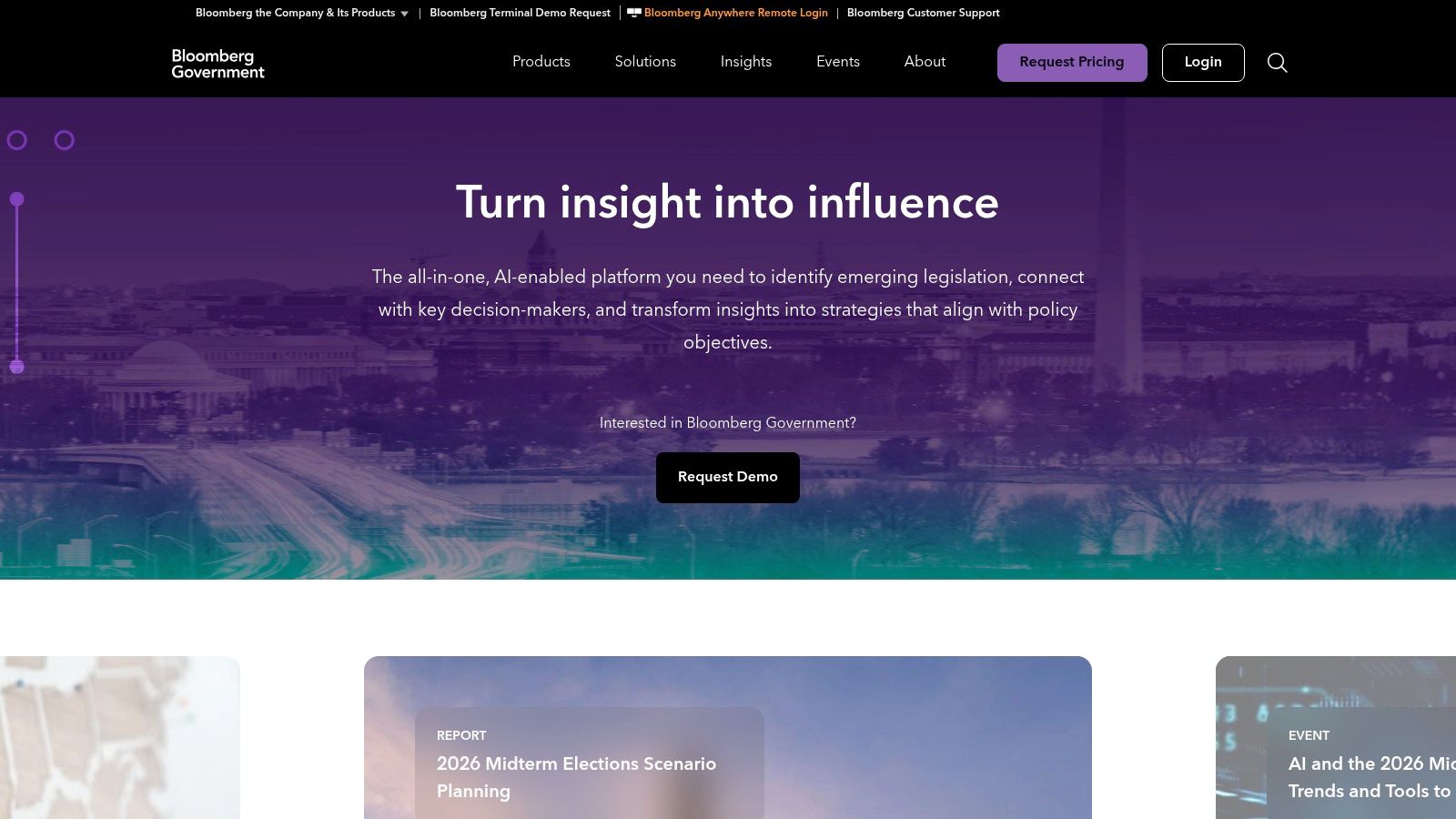
Bloomberg Government fits a narrower workflow than many bid platforms. Its value rises after the opportunity is already on the radar and the team needs to interpret long solicitation packages, agency budget signals, and policy context before committing capture resources.
That distinction matters. BD teams often buy research tools as if notice discovery, qualification, and strategic analysis were the same job. BGOV is stronger in the last category than in the first.
A practical way to evaluate it is by handoff. If SAM.gov, GovWin, GovTribe, or another system surfaces a candidate bid, BGOV becomes more useful during the next step: reviewing attachments, annotating documents, checking for policy or appropriations signals, and deciding whether the pursuit has enough institutional support to justify deeper capture work. That is a different workflow from high-volume keyword monitoring.
For that reason, BGOV tends to make more sense for larger contractors running fewer, more expensive pursuits. A team chasing a civilian IT vehicle, a health policy program, or a defense requirement shaped by congressional funding language may need both the notice and the surrounding federal context. A small BD shop that mainly filters by NAICS, agency, and set-aside status will usually extract less value from that extra layer.
The trade-off is straightforward:
- Use BGOV if your process includes document review, budget research, and policy-sensitive qualification.
- Skip it if your main need is fast triage across a broad stream of notices.
- Pair it with a stronger discovery workflow if your pipeline depends on disciplined keyword alerts and daily screening.
The non-obvious takeaway is that BGOV is often a second-tool purchase, not the operating center of the whole funnel. It supports analyst-led capture decisions well, but many teams will still need a separate system for authoritative notice discovery, broad filtering, or AI-assisted fit scoring.
Visit Bloomberg Government.
7. EZGovOpps
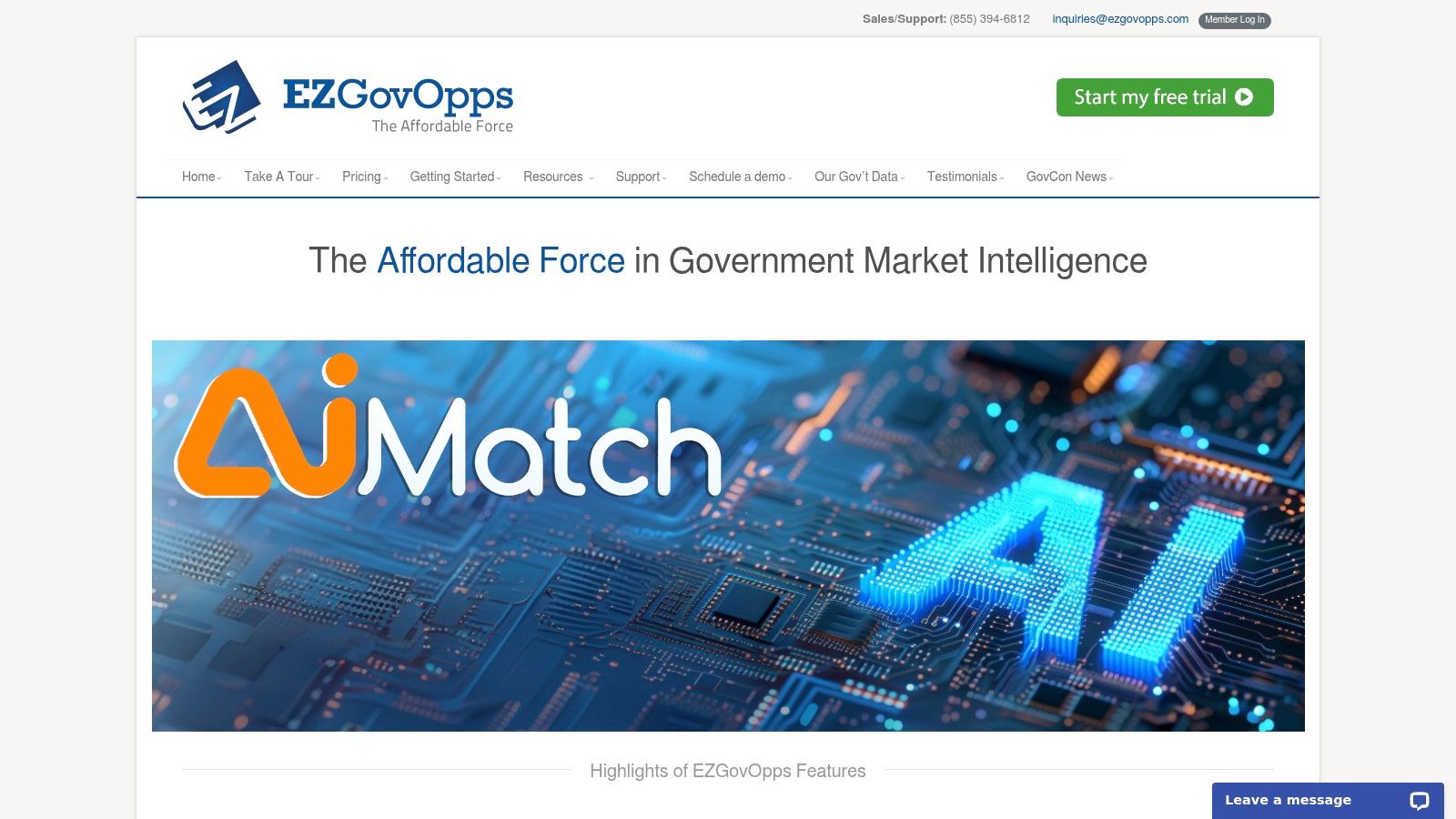
A lower-priced tool can be the right answer if the workflow is narrow and disciplined.
EZGovOpps fits teams that have already accepted a manual triage model and want to improve it around the edges. The product adds structure to federal notice tracking, modification monitoring, labor pricing lookup, subcontract research, and pursuit organization. That job is different from long-range capture forecasting or AI-based qualification. It is closer to giving a small BD team a workable queue and enough context to decide what deserves another hour of review.
The clearest use case is a small contractor running a repeatable screen across a limited set of agencies, NAICS codes, and set-aside categories. In that setup, the team does not need a heavy intelligence platform for every notice. It needs dependable alerts, a place to store amendments and notes, and a quick way to check whether a bid lines up with prior labor categories or teaming possibilities. EZGovOpps appears built for that operating model.
That also defines the trade-off.
Teams that want fit scoring, solicitation parsing, or a more modern review workflow will likely outgrow it faster than teams that mainly want affordable monitoring plus some analyst-supported context. In practice, EZGovOpps works better as a budget-conscious tracking layer than as the center of a high-volume qualification engine.
A useful way to judge it is by the BD handoff point. If your process is keyword search first, NAICS and agency filtering second, then human review of amendments, pricing references, and subcontract signals, EZGovOpps can support that sequence at a lower complexity level. If your process starts with broad multi-source discovery and expects the software to rank likely fits before an analyst reads the files, other platforms are better aligned.
Workflow verdict: Choose EZGovOpps when cost control matters more than automation depth, and the team is willing to do the qualification work itself. Skip it if your bottleneck is not finding notices, but rejecting poor-fit opportunities fast.
Visit EZGovOpps.
8. A layered stack beats a one-tool mentality
Not every team should force itself into a single platform. In fact, the sharper move is often to decide which job each tool performs best, then prevent overlap from turning into chaos.
For federal work, the center of gravity still sits with the government's own records. For broader discovery and automation, the market is clearly fragmenting across federal, SLED, grants, subcontracting, and AI-assisted review. SamSearch's comparison material says it covers 15,000 procurement portals reaching 50,000 agencies across federal, SLED, grants, and SBIR, including 13,000 SLED portals plus AI search, pipeline management, and proposal generation. That kind of source expansion is valuable only if the team has tight qualification discipline.
The workflow verdict
The biggest mistake buyers make is asking which platform has “the most opportunities.” The better question is which platform helps your team reject weak-fit work faster and move qualified work into capture with less friction.
Here's the practical division of labor that usually works best:
- Use SamSearch when the bottleneck is solicitation review, fit scoring, and proposal readiness.
- Use SAM.gov when you need the official federal record and amendment confirmation.
- Use GovWin IQ when long-range capture intelligence drives the business case.
- Use GovTribe or HigherGov when daily tracking and broader operational visibility matter more than deep analyst research.
- Use BGOV when document-heavy pursuits need policy context.
- Use EZGovOpps when budget discipline matters more than advanced automation.
The right answer for many teams isn't one platform replacing all others. It's one primary workflow system, backed by authoritative notice verification and a qualification process that people will follow.
7 GovCon Bid Platforms: Feature Comparison
| Product | Implementation complexity | Resource requirements | Expected outcomes | Ideal use cases | Key advantages |
|---|---|---|---|---|---|
| SamSearch | Medium, onboarding to tune AI; integrations on higher tiers | Subscription-based; brief onboarding; higher tiers for SSO/API | End-to-end discovery, qualification, AI-assisted proposal drafting and alerts | Small–mid contractors wanting unified capture and proposal AI | AI solicitation parsing, unified GovCon workflows, proposal support |
| SAM.gov | Low, web UI and saved searches; basic filtering tools | Free; internal effort to parse/download data; APIs available for teams | Authoritative feed of federal notices, official amendments and awards | Any federal contractor needing primary source opportunity data | Free, comprehensive official system of record |
| Deltek GovWin IQ | High, enterprise deployment, analyst workflows | High-cost, analyst-backed subscription; integrates with Deltek suite | Analyst-validated pipelines, forecasts, recompete and vehicle intel | Enterprise primes and firms needing long-range, curated intel | Deep analyst research, forecasts, strong vehicle/IDIQ coverage |
| GovTribe | Low–Medium, quick adoption and modern UI | Subscription with published pricing; optional AI credits | Day-to-day bid tracking, team pipelines, saved searches and alerts | Small–mid BD teams wanting more than SAM without heavy overhead | Transparent pricing, usability, balanced data coverage |
| HigherGov | Low–Medium, straightforward setup | Affordable plans with multi-user tiers; optional FOIA features | Federal + SLED tracking, labor pricing, pipeline views | Small teams adding state/local coverage to federal pursuits | SLED coverage, built-in FOIA workflow, accessible pricing |
| Bloomberg Government (BGOV) | High, enterprise onboarding and training | Sales-led pricing; policy/news integration and document tools | Bid tracking plus legislative/policy context and deep document search | Larger capture programs needing Beltway/policy intel with tracking | Strong document handling and integrated policy/news context |
| EZGovOpps | Low, quick start with analyst assistance | Lower-cost annual plans; analyst support included; optional SLED add-on | Opportunity alerts, basic workspaces, labor-pricing and teaming context | Small shops wanting analyst help without enterprise price tag | Transparent low cost, analyst-assisted tracking, simple workspace |
Turn opportunity discovery into a repeatable BD triage system
The best buying decision in the top 8 GovCon software platforms for finding and tracking bids doesn't start with a vendor logo. It starts with your workflow. If your team can't define the keywords, NAICS coverage, set-aside boundaries, and places of performance that match your capabilities, even a strong platform will just deliver a cleaner stream of distractions.
Build the system in sequence. Start with capability-led keyword groups tied to real service lines and contract history. Add the NAICS codes you actively pursue. Configure saved searches and alerts inside your chosen platform, then validate federal notices and amendments in SAM.gov before anyone commits capture time. That discipline matters because registration status and official notice records still anchor federal eligibility and opportunity truth.
The qualification step is where either gain advantage or lose weeks. Score each opportunity against scope fit, set-aside eligibility, place of performance, deadline reality, and evidence that your company can perform the work. Don't let an alert become a pursuit merely because it exists. Route only qualified bids into capture, and give every routed bid an owner, a next action, and a near-term decision date.
That operating model also clarifies platform fit. SamSearch is the best choice here for AI-led end-to-end workflows that move from discovery into solicitation analysis and proposal support. SAM.gov remains essential for authoritative federal sourcing. Deltek GovWin IQ fits enterprise forecasting and capture research. GovTribe suits modern team tracking with less overhead. HigherGov is a strong option for SLED expansion with practical research context. Bloomberg Government fits document-heavy capture programs that also need policy awareness. EZGovOpps is the sensible option for budget-conscious teams that still want more than raw government search.
The broader market shift supports that approach. Independent 2026 coverage says AI is becoming core to discovery and proposal workflows, but buyers still need to test whether the AI in a demo saves time in their process rather than just decorating the sales pitch in this review of federal bid tracking tools. That's the contrarian point. The winner isn't the platform with the loudest AI claim or the longest source list. It's the one your BD team can use consistently without abandoning qualification discipline.
If you're still narrowing the field, GovCon Reviews is one useful place to compare tools by workflow fit instead of by marketing category alone.
If you're evaluating bid finders, capture tools, or AI-assisted GovCon platforms, GovCon Reviews publishes side-by-side rankings and practical comparisons built for contractors who need to know what a tool does well and where it falls short. It's a useful next stop if you want to compare these platforms by workflow job, budget fit, and day-to-day usability before booking demos.
Related analysis

Top 9 Government Bid Tracking Tools Every Contractor Should Know
Compare 9 government bid tracking tools by coverage, AI, pipeline control, pricing, and contractor fit, with SamSearch at #1 and Civio.ai at #2.
7 Best Bid Management Platforms for GovCon Companies in 2026
Compare the 7 Best Bid Management Platforms for GovCon Companies in 2026, including features, trade-offs, use cases, and recommendations.

10 Best Government Contract Bid Tracking Tools for 2026
Compare the 10 Best Government Contract Bid Tracking Tools for 2026, with practical picks for NAICS research, SAM.gov searches, capture, and proposals.