Top 10 Best Bid Tracking Systems for GovCon in 2026
Compare the 10 best bid tracking systems for GovCon in 2026, including features, pricing considerations, strengths, limitations, and best-fit users.

The most expensive database is not automatically the best bid-tracking system. A large archive can still leave a small business drowning in irrelevant notices, missed amendments, and manual qualification work. The right choice depends on where your pipeline breaks: discovery, pre-RFP intelligence, fit scoring, analyst validation, collaboration, capture management, or proposal handoff.
That distinction matters in 2026 because federal procurement operates at enormous scale. One independently reported dataset places U.S. federal procurement at about $537.6 billion in FY2026 prime contract spending, while another tracks roughly $719.3 billion in FY2026 obligations. Opportunity volume is equally demanding, with one 2026 data deep dive reporting 49,987 active opportunities, and another directory counting 110,509 active federal contract opportunities and 2,920 new postings per day (Bidara's federal contracts analysis). This list compares each platform by the GovCon decision it improves, its workflow fit, data depth, usability, trade-offs, pricing visibility, and who should avoid it. SamSearch leads the ranking, while SAM.gov remains the official federal source that teams should run in parallel.
2026 GovCon Bid-Tracking: 7-Platform Comparison
1. SamSearch
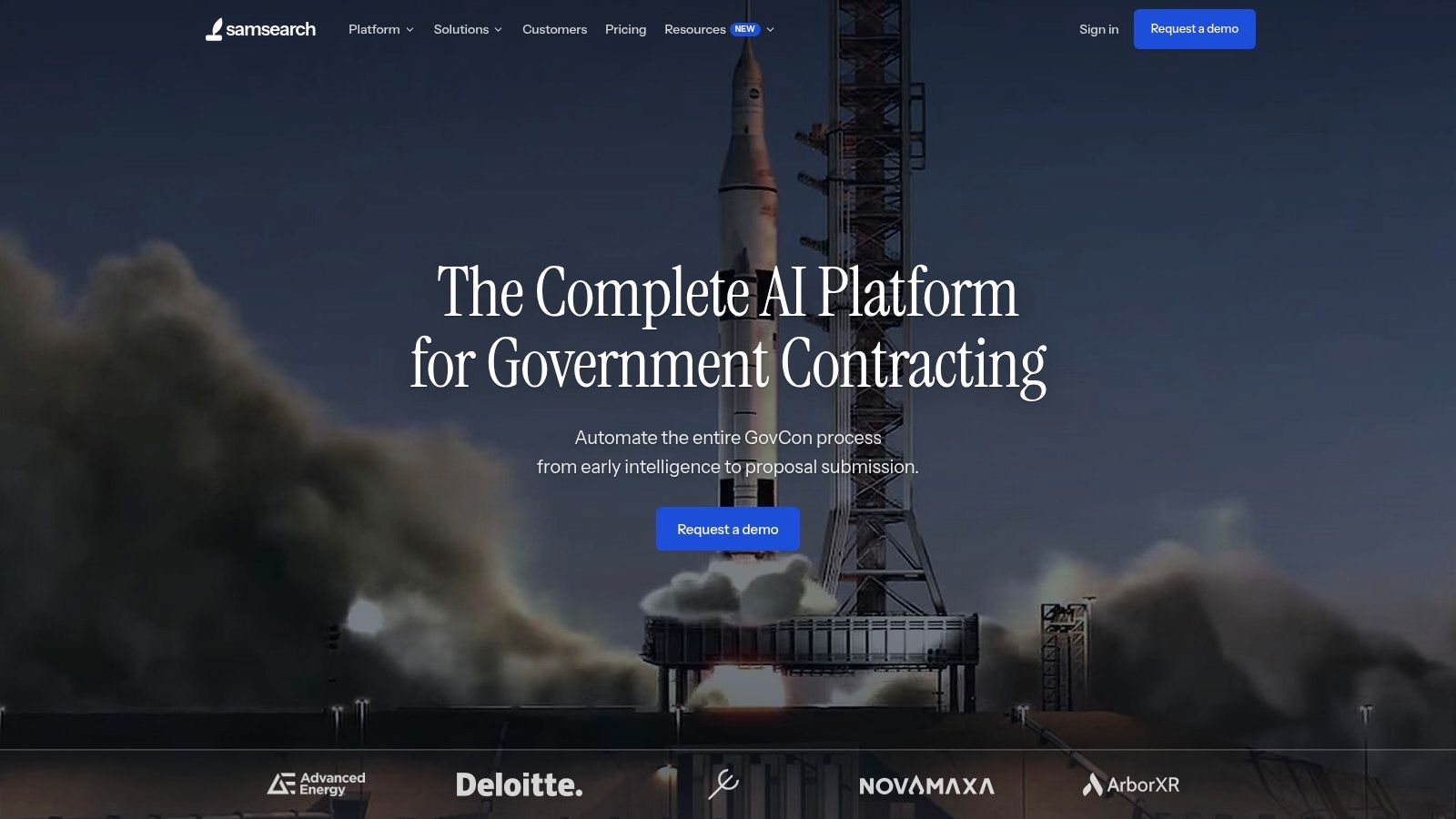
SamSearch ranks first because it addresses the complete find, qualify, pursue, and bid sequence instead of treating bid tracking as an alert inbox. Its AI-powered platform searches federal, SLED, grants, SBIR and STTR, DIBBS, GSA eBuy, prime and subcontracting opportunities, forecasts, and awards in one environment. The company says its coverage spans 15,000 procurement portals and 50,000 agencies, including agencies that post to SAM.gov such as DoD, DHS, GSA, NASA, Energy, HHS, VA, and State (SamSearch's comparisons page).
The practical advantage is early triage. SamSearch grades notices against NAICS and PSC codes, set-asides, past performance, and a company's capability profile. It can summarize attachments, extract compliance requirements, monitor amendments, and support proposal drafting. That makes it particularly useful for a solo BD lead or lean capture team that cannot dedicate an analyst to every new notice.
Verdict and trade-offs
SamSearch's built-in GovCon CRM, pursuit journeys, scheduled queries, alerts, proposal templates, integrations, SSO, and API access create a stronger operational layer than a conventional search product. Its federal search sits on top of SAM.gov rather than replacing it. SAM.gov remains the system of record for registration, official package downloads, and submission, while SamSearch adds natural-language search, amendment tracking, compliance-matrix extraction, and drafting support (SamSearch's federal contract search).
The limitation is commercial transparency. There's no public list price, and quote-based purchasing may frustrate small firms that need to compare costs immediately. Newer features may also require guided setup to deliver their full value.
Best fit: Small and mid-size GovCon teams that need one workflow from opportunity discovery through proposal kickoff.
Avoid it if: Your primary requirement is deep legacy market research, or your organization will not adopt an AI-assisted qualification process.
Direct verdict: SamSearch offers the strongest time-to-value for lean teams and belongs in the front end of a practical GovCon stack.
2. Civio
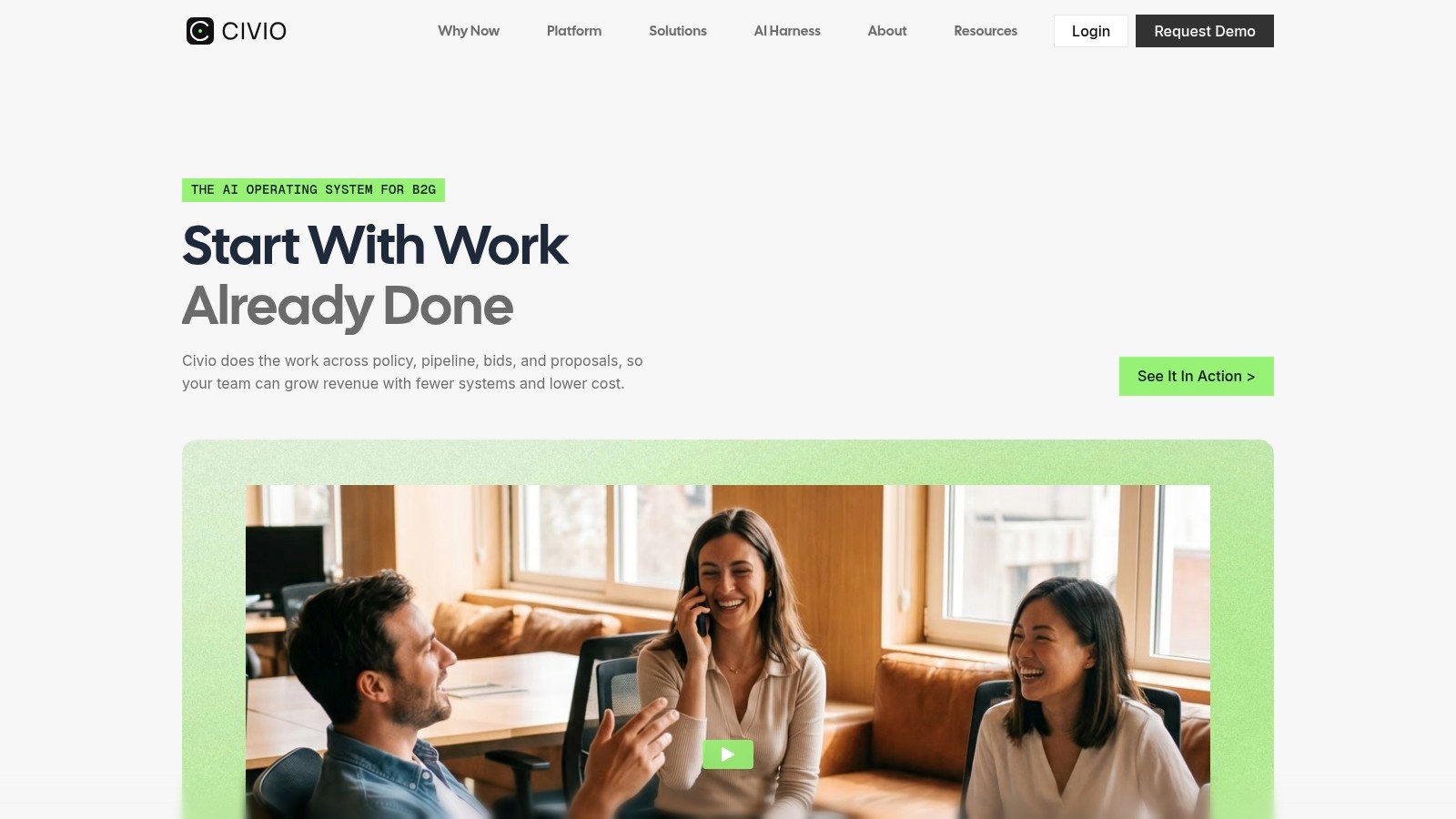
Civio earns the number 2 spot for teams that want AI-assisted opportunity discovery and faster qualification without jumping straight into a heavier enterprise intelligence stack. The platform positions itself around helping government contractors find relevant opportunities, organize pursuits, and reduce the manual review burden that often slows small and mid-size BD teams.
Its appeal is straightforward. Civio is built for contractors that want better signal quality than a raw feed, but do not necessarily need the analyst-heavy research model of a legacy platform. That makes it a strong option for companies that want to move faster from search to decision, especially when the real bottleneck is sorting through volume and deciding what deserves a response.
Verdict and trade-offs
Civio looks best suited to growth-stage GovCon teams that want a modern interface, faster opportunity qualification, and a workflow that feels lighter than traditional enterprise bid databases. It belongs on a shortlist when the buying decision centers on usability, AI assistance, and reducing time spent reading through loosely matched notices. Teams comparing it against SamSearch should focus on breadth of source coverage, proposal workflow depth, and how well each system supports downstream capture execution.
The trade-off is that buyers may still need to validate how much workflow depth, integration support, and data coverage they require at scale. Pricing transparency may vary, and teams with highly formal capture processes should test whether Civio handles handoff, ownership, and collaboration with enough rigor for their environment.
Best fit: Small and mid-size GovCon teams that want AI-supported search and qualification in a modern interface.
Avoid it if: You need deep analyst-written pre-RFP intelligence or a highly customized enterprise operating model from day one.
Direct verdict: Civio is a strong number 2 choice for teams that want modern AI-assisted bid tracking without the weight of a legacy platform.
3. Deltek GovWin IQ
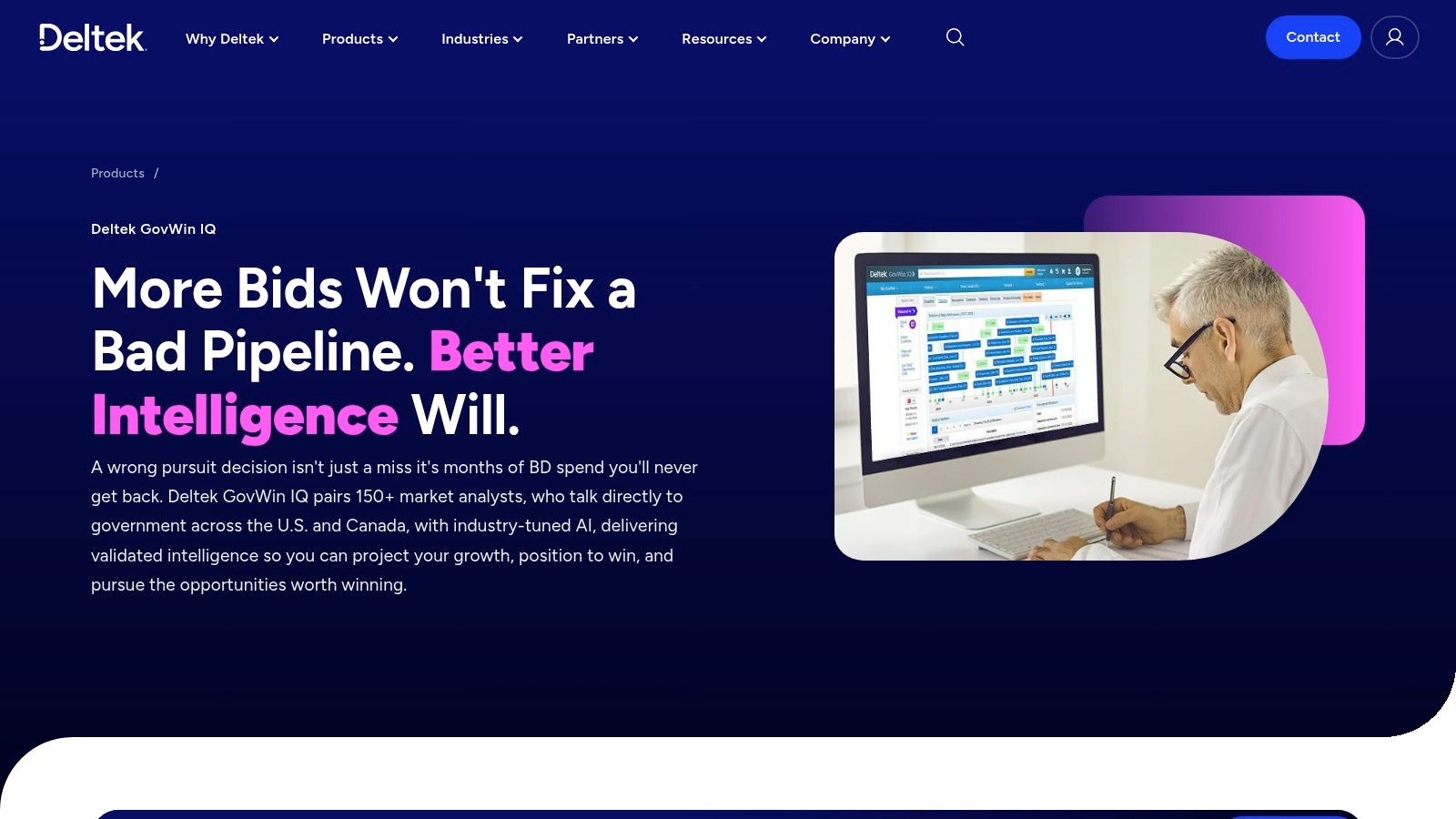
Deltek GovWin IQ improves the decision that matters before a solicitation appears: whether an emerging requirement deserves capture investment. Its core distinction is analyst-validated intelligence. Deltek describes a longstanding platform built around pre-RFP opportunities, change notices, pipeline status, agency context, and the path from forecast through award. That depth makes it more useful for enterprise capture organizations than for contractors that only need fast notice filtering.
The platform also combines human research with AI aids such as IntelliSearch, Smart Search, Smart Summaries, and Ask Dela. Those features can reduce research friction, but GovWin IQ's central value remains the structured intelligence behind the opportunity record. It is designed for teams that need confidence in what they are chasing, not just more alerts.
Verdict and trade-offs
GovWin IQ fits large primes and integrators with dedicated capture staff, formal review gates, and existing Deltek environments. Its integrations with Deltek CRM and Costpoint help connect market intelligence to pipeline records, estimates, and operating systems. That is valuable when the decision is not merely “is this notice relevant?” but “how does this pursuit fit our portfolio, incumbent strategy, contract vehicle position, and agency plan?”
The downside is weight. Pricing is not public, custom quotes are required, and the platform can feel heavy for a small company where one person handles BD, capture, and proposals. Teams should also distinguish analyst depth from daily workflow speed. A stronger pre-RFP record does not automatically eliminate manual qualification or proposal handoff.
For additional independent comparisons of GovCon software, consult the GovCon Reviews blog.
Direct verdict: Choose GovWin IQ when analyst-validated pre-RFP intelligence is the buying decision. Do not buy it as a lightweight alert tool for a small team.
4. GovTribe
GovTribe is strongest when the key decision is which opportunities and market signals deserve collaborative review. Its interface is built for modern BD teams that want opportunity discovery, market analytics, pipelines, automations, exports, and visual trend analysis without the heavier feel of a traditional enterprise intelligence environment.
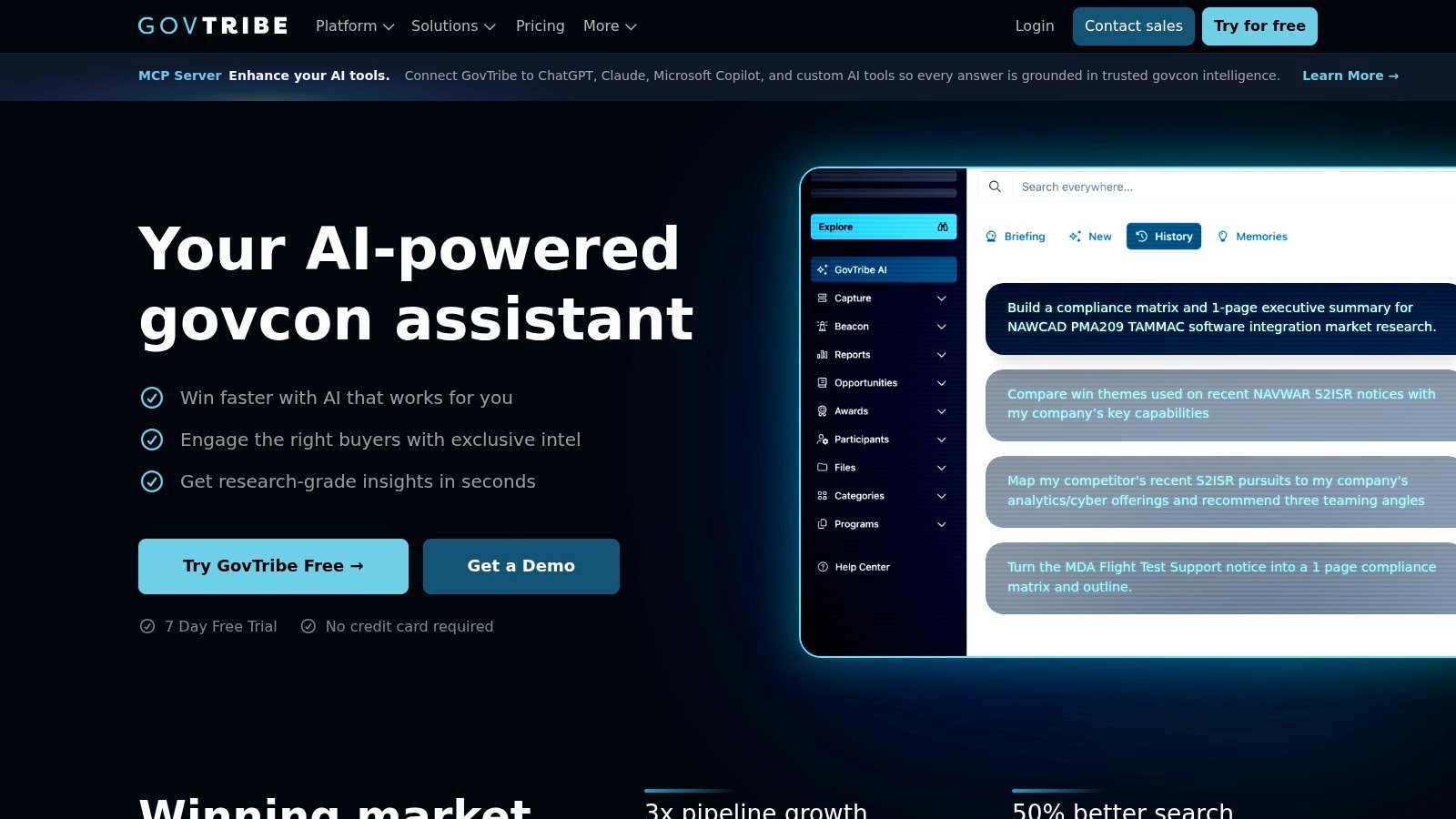
The product adds competitive context through GAO protest insights, contract vehicle opportunities, and GSA labor-rate data. Its AI Conversations and predictive analytics extend the platform beyond a static opportunity feed, although users should understand that advanced AI features consume credits. That usage model makes the platform approachable at first but introduces a variable cost dimension as the team increases analysis.
Verdict and trade-offs
GovTribe's clear plan details and pricing visibility are meaningful advantages for growing teams. Buyers can evaluate the product more directly than platforms that require a sales process before revealing commercial terms. The fast interface also supports trend spotting, which helps a BD lead compare agencies, vehicles, competitors, and categories during pipeline reviews.
Its limitation is evidentiary depth before the RFP. GovTribe has fewer human analyst notes than GovWin IQ, so a team that relies on validated pre-RFP relationship and requirement intelligence may need another research layer. AI credit consumption can also make total cost less predictable than the headline plan suggests.
For practical comparisons of GovTribe and similar products, see GovCon Reviews.
Direct verdict: GovTribe is a strong fit for collaborative market analytics and accessible pipeline work. Avoid it if analyst-written pre-RFP intelligence is central to your capture model.
5. HigherGov
HigherGov improves the decision that follows discovery: should the team pursue, monitor, partner, or no-bid the opportunity? Its workflow includes saved searches, daily alerts, opportunity and award tracking, unlimited pipelines and pursuits, tasks, discussions, document uploads, and explicit "No Bid" handling. That focus makes it approachable for small teams that need discipline without building a complicated enterprise process.
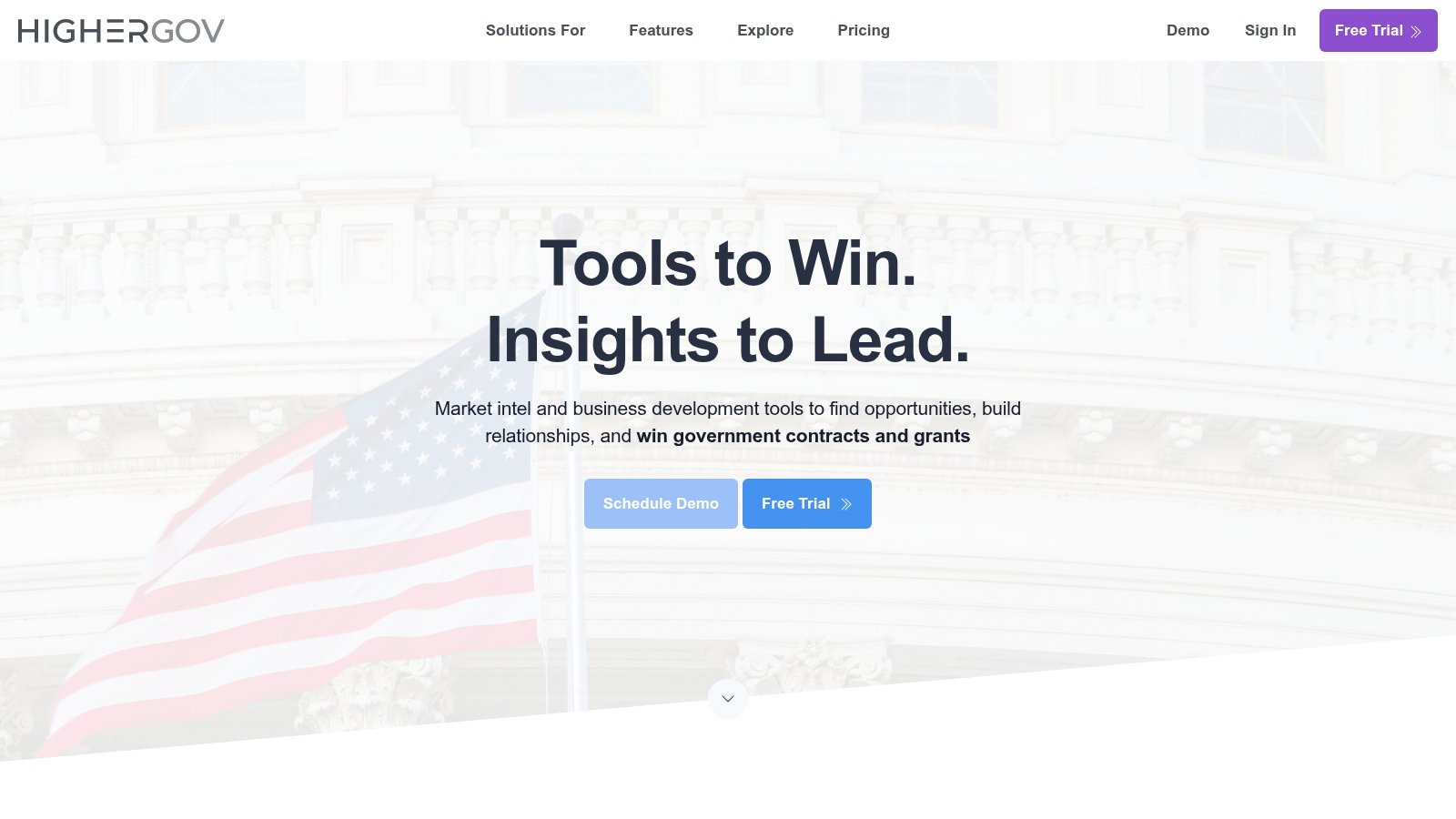
The platform also supports recompete identification, competitor research, and labor-rate benchmarking. Those capabilities help a contractor move beyond the notice itself and ask whether the work resembles an existing contract, whether the likely competitor set is manageable, and whether the pricing environment fits the company's delivery model.
Verdict and trade-offs
HigherGov's appeal is operational clarity. A small BD team can save searches, assign tasks, attach documents, discuss pursuits, and retain a visible record of why an opportunity advanced or stopped. Unlimited pipelines are particularly useful for contractors managing multiple agencies, contract vehicles, or capability areas without wanting each pursuit trapped in a separate spreadsheet.
The trade-off is less contextual depth than premium intelligence platforms. Pricing is not publicly listed, so buyers must contact sales. HigherGov also offers fewer analyst write-ups than GovWin IQ and less policy and media context than Bloomberg Government. If proposal drafting or AI-assisted solicitation review is the bottleneck, SamSearch is likely a better fit.
Direct verdict: HigherGov is a practical middle ground for small teams that need pursuit management and award analysis. Do not choose it if your main problem is automated proposal preparation or deep policy intelligence.
6. Bloomberg Government
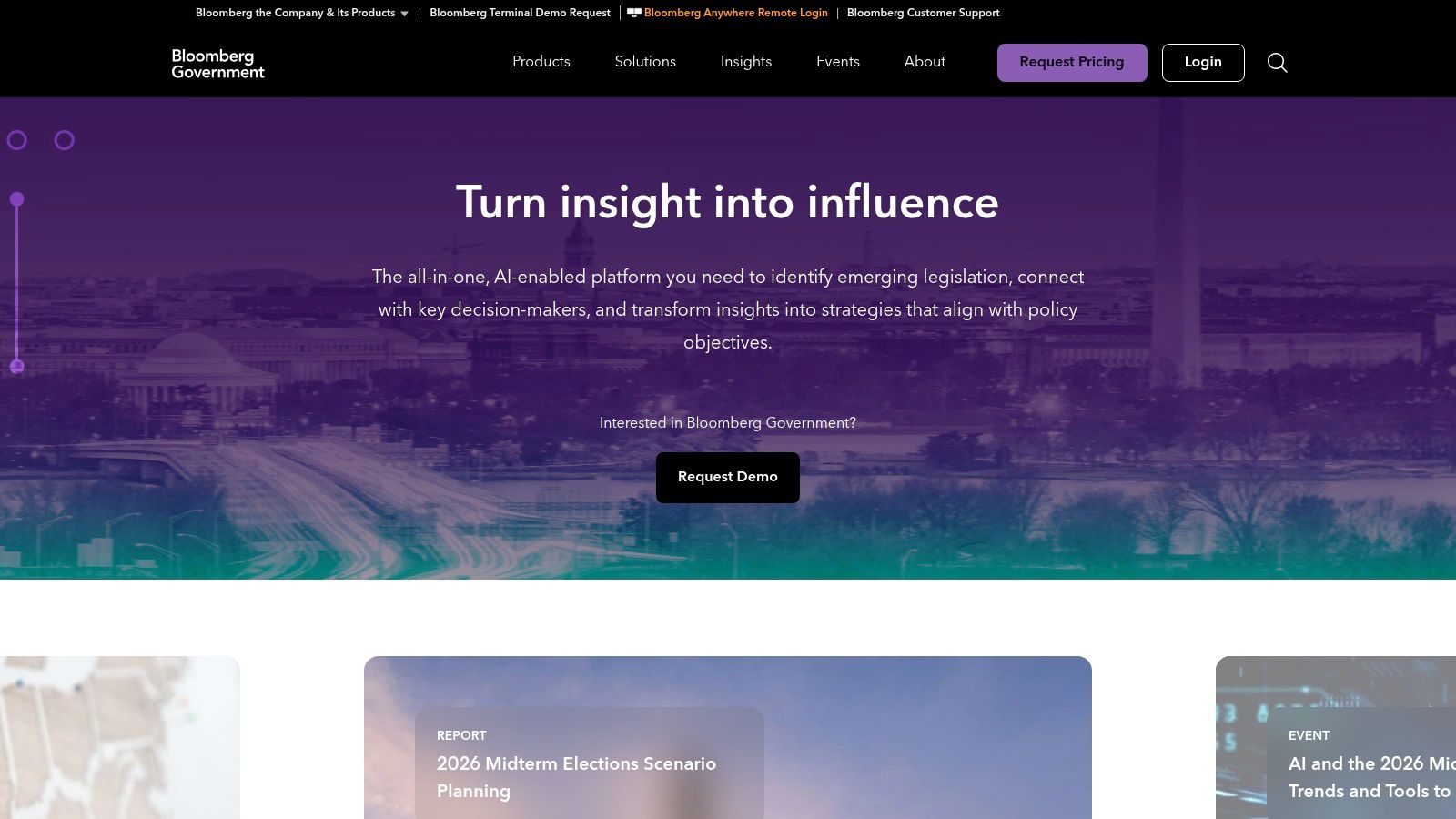
Bloomberg Government, commonly called BGOV, improves a different decision: how policy, congressional activity, budgets, and regulation should shape capture strategy. It combines federal contracting information with legislative and policy analysis, so its value extends beyond finding an open solicitation.
That context can matter when a team must understand whether an agency's priorities, funding direction, or regulatory movement supports a pursuit. BGOV also provides AI-assisted research across its content and predicted contract value modeling, which can help a capture organization estimate the commercial significance of an opportunity before committing business development and proposal resources.
Verdict and trade-offs
BGOV makes the most sense for policy-driven primes, public-sector strategy groups, and capture teams that regularly connect procurement activity to appropriations, congressional oversight, or regulatory changes. Its curated intelligence can help explain why a requirement is moving, not just where the notice is posted.
The downside is specialization and cost. There is no public pricing, and an enterprise subscription requires a demo. That structure may be reasonable for a policy-heavy organization, but it is difficult to justify for a small contractor that only needs federal opportunity alerts, amendment monitoring, and basic pursuit ownership.
BGOV also should not be mistaken for a complete proposal workflow. Teams may still need a separate CRM, compliance process, drafting environment, or AI-native layer for solicitation review.
Direct verdict: Choose BGOV when policy context materially changes capture decisions. Avoid it if your pipeline problem is just finding and organizing federal notices.
7. EZGovOpps
EZGovOpps targets the decision many small contractors struggle to make: which federal opportunities match their set-aside position, capability profile, and realistic probability of winning? The platform offers saved searches, workspaces, a team file cabinet, automated research on tracked opportunities, pipeline tracking, and a PWin calculation matrix.
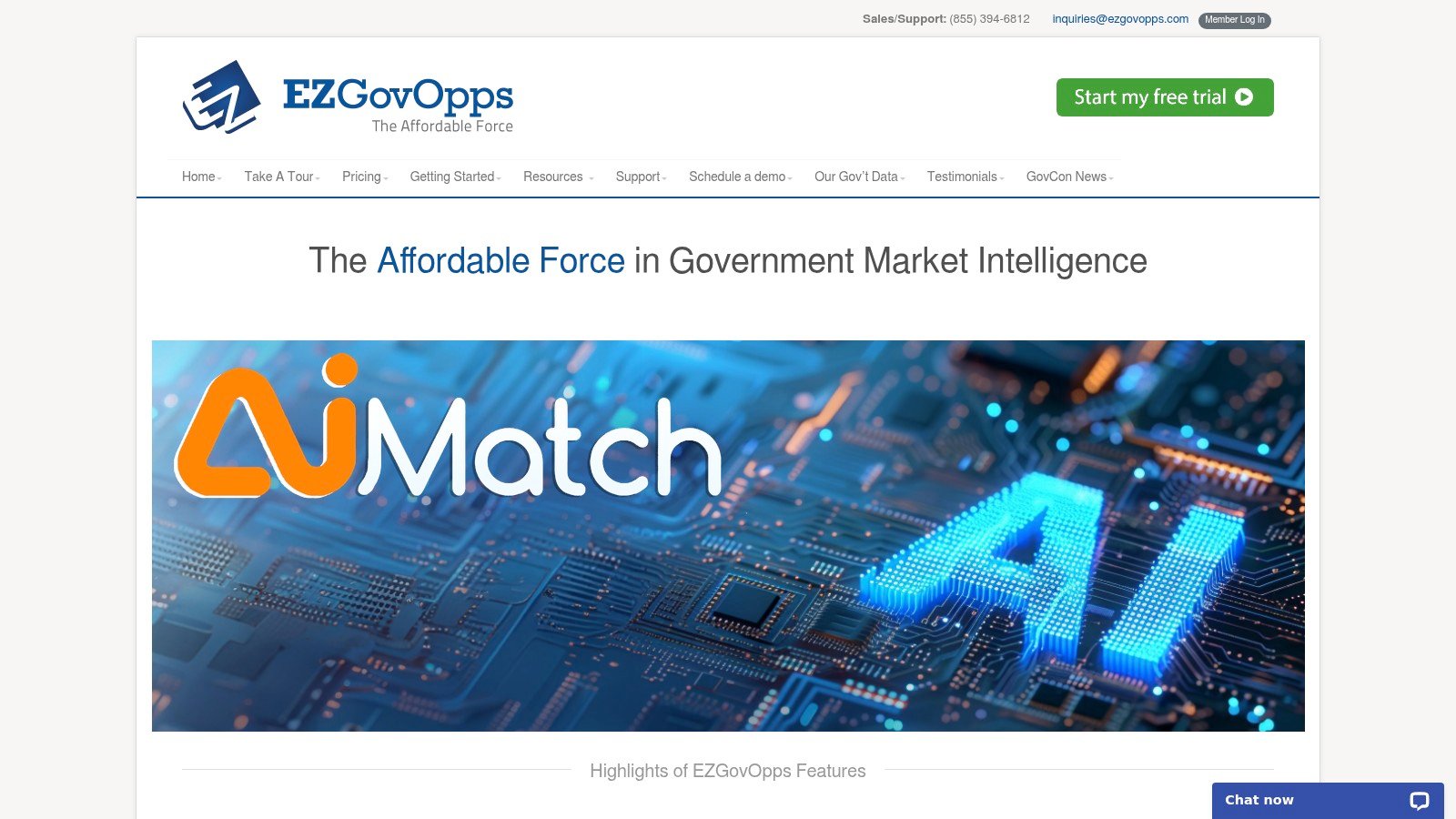
That combination is particularly relevant for 8(a), SDVOSB, WOSB, and HUBZone firms that need a practical way to connect opportunity monitoring with qualification. Labor pricing lookups, program and vehicle overviews, subcontract searches, and interested-vendor visibility add useful context for teaming and pricing research.
Verdict and trade-offs
EZGovOpps is one of the more accessible options for a small business that wants a federal market-intelligence tool without enterprise complexity. Its comparatively low pricing and free trial lower the barrier to testing the workflow before committing. The PWin matrix gives teams a structured qualification conversation instead of forcing every decision into intuition or a spreadsheet.
The product feels older than newer AI-native tools, particularly in interface design and data visualization. Its strongest coverage is federal, while SLED coverage is an add-on. Contractors pursuing a mix of federal, state, local, grants, and subcontracting opportunities may prefer SamSearch's broader search environment.
Direct verdict: EZGovOpps is a sensible lower-cost federal pipeline option for small businesses that value structured PWin thinking. Avoid it if modern AI review, proposal drafting, or broad multi-source discovery is your primary requirement.
8. SAM.gov built-in bid tracking
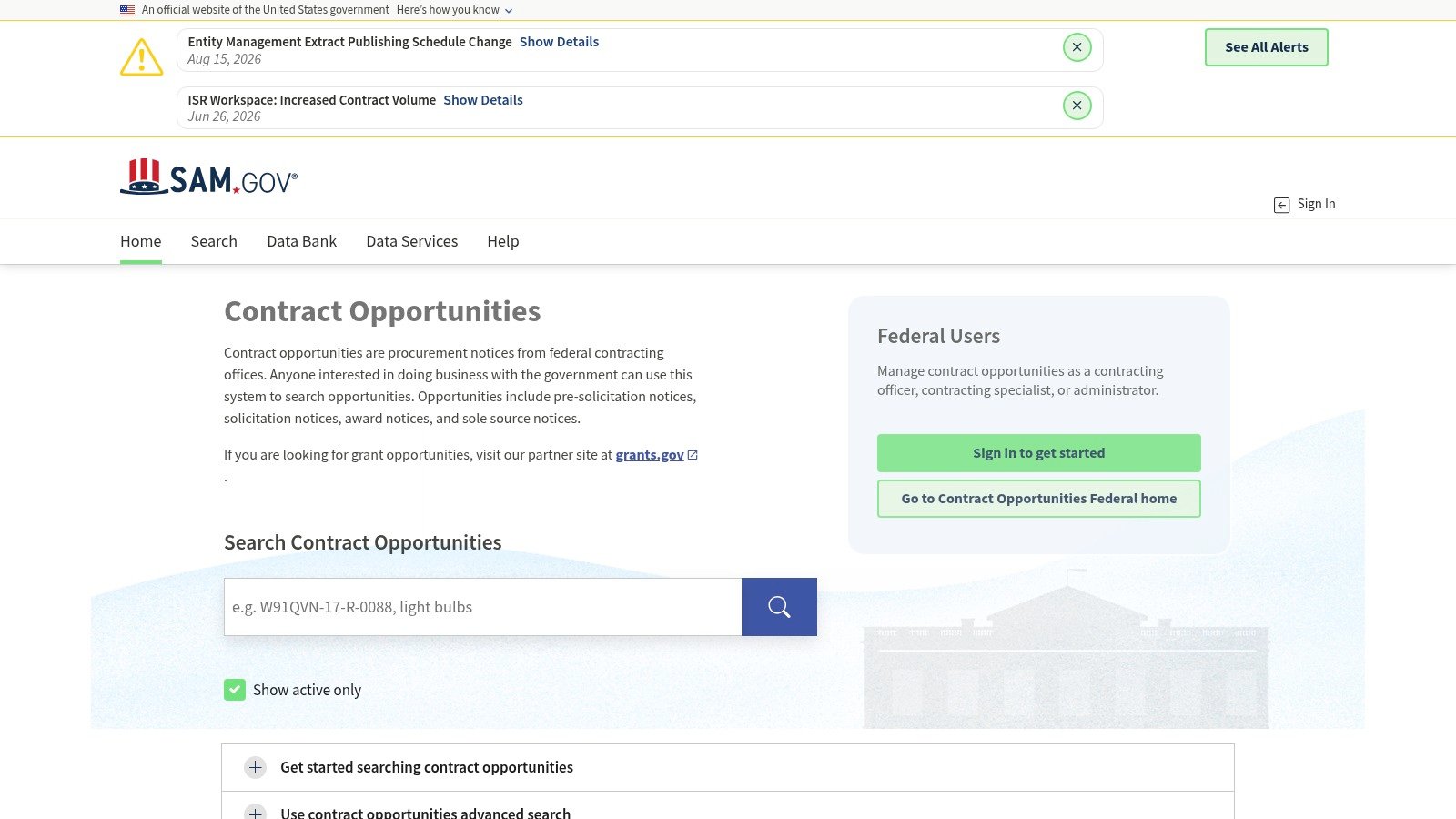
SAM.gov improves the most basic but critical decision: what is the official federal notice, and has the government changed it? It remains the central public gateway for federal pre-award and award data. Official records can be searched by awardee, agency, and set-aside status, and contractors can use saved searches, email notifications, and the follow function to receive updates and amendment notices.
That makes SAM.gov the baseline rather than merely another product in the stack. Commercial systems can improve search, filtering, summarization, qualification, and workflow, but teams should validate critical federal notices against the official source. The platform remains the place for registration, official solicitation packages, and submission activity.
Verdict and trade-offs
SAM.gov is free, official, and complete for federal notices. It also provides roles, help-center guidance, and official Contract Opportunities data. Every federal contractor should know how to save searches, follow specific opportunities, and verify amendments there, even when a commercial system manages daily triage.
The limitation is workflow. SAM.gov does not provide a strong pipeline for qualification, ownership, collaboration, capture strategy, or proposal handoff. Filters and navigation can also feel clunky for daily BD work, particularly when a team must manage many pursuits across capabilities and agencies.
Further guidance on practical GovCon software questions is available in the GovCon Reviews FAQ.
Direct verdict: Run SAM.gov in parallel with every commercial platform. Do not expect the official source to function as your CRM, capture system, or proposal workspace.
9. BidPrime
BidPrime is best known for broad government bid aggregation across federal, state, local, and education opportunities. For contractors that want one feed spanning more than just federal contract notices, that wider public-sector reach can be valuable. It is especially relevant for firms that pursue a mixed pipeline and do not want separate systems for GovCon and SLED monitoring.
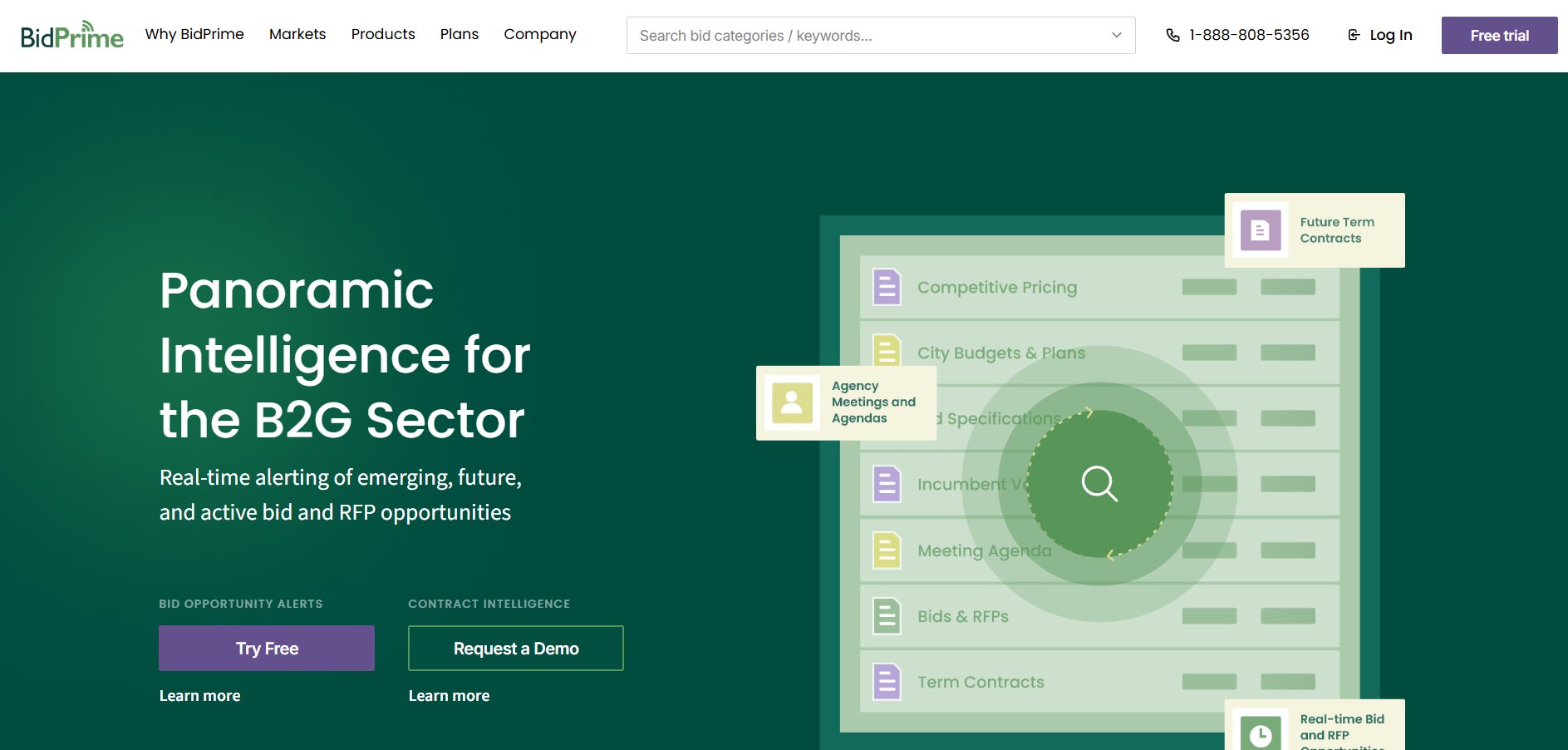
Its core strength is breadth and coverage convenience. Teams can cast a wider net across agencies and jurisdictions, then use alerts and saved searches to monitor opportunities that fit their capabilities. That makes BidPrime more attractive for generalized discovery than for deeply managed capture workflows.
Verdict and trade-offs
BidPrime makes sense for companies that care most about cross-jurisdiction bid visibility and basic tracking across a large volume of public-sector notices. It can reduce the need to search fragmented local and state sources one by one.
The trade-off is that broad aggregation does not always equal deep qualification support. Teams should validate how well it handles collaboration, capture ownership, amendment tracking, and proposal readiness compared with more GovCon-specific platforms. Buyers should also verify current pricing and source coverage for the exact jurisdictions they target.
Best fit: Contractors pursuing both federal and SLED opportunities that need broad notice aggregation.
Avoid it if: Your top priority is AI-driven qualification, proposal drafting, or enterprise capture intelligence.
Direct verdict: BidPrime is a practical breadth-first option for multi-jurisdiction bid visibility, but it is not the most workflow-rich choice for federal capture teams.
10. GovSpend
GovSpend is strongest as a public-sector data and spending visibility platform for teams that want to pair opportunity tracking with broader government purchasing insight. Its value tends to show up when contractors need to understand historical spending patterns, agency buying behavior, and procurement data beyond a single solicitation feed.
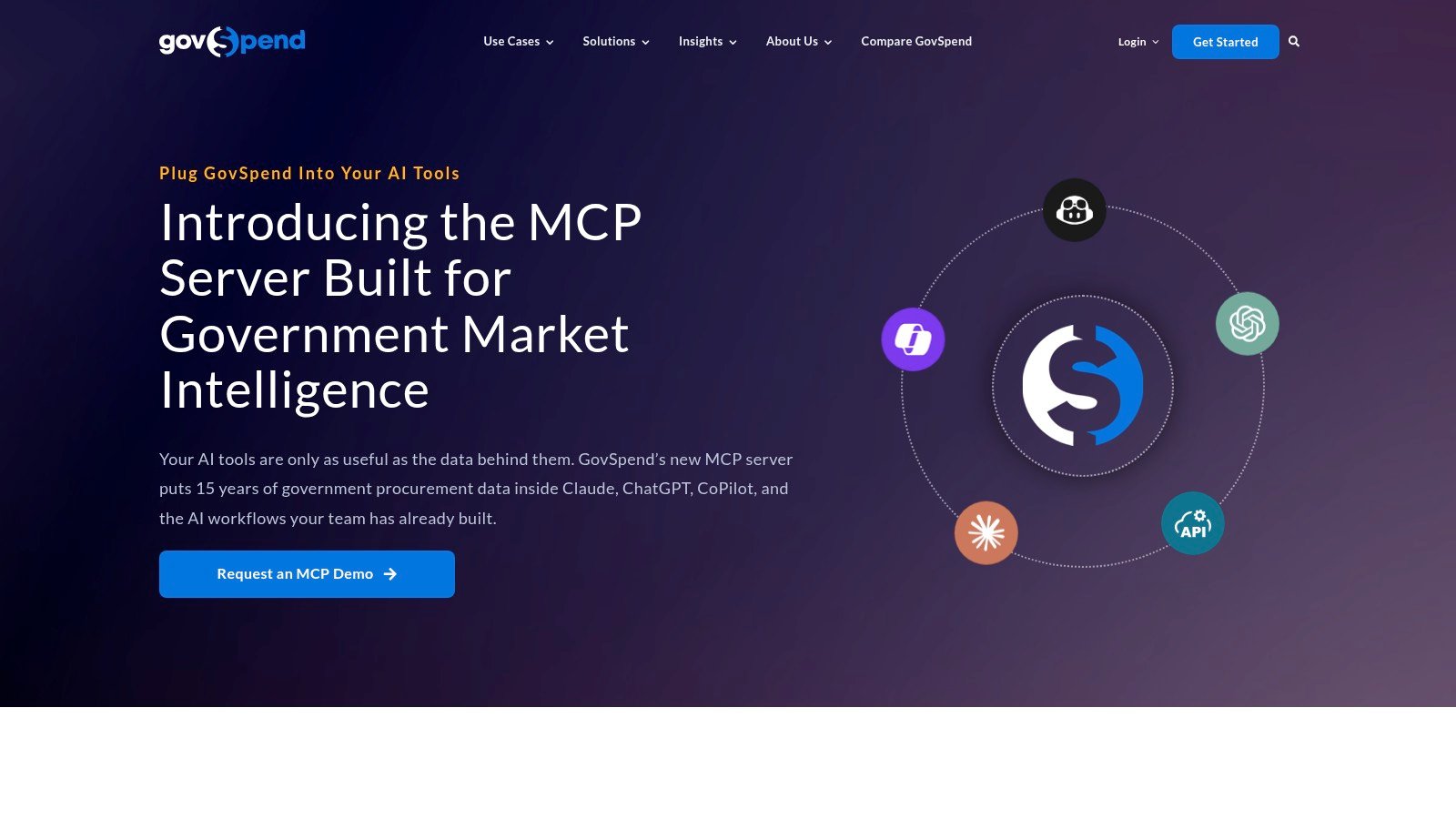
For some teams, that historical and analytical angle can support territory planning, account targeting, and market research. It is less about speeding a proposal kickoff and more about informing where the business development team should aim next.
Verdict and trade-offs
GovSpend fits firms that want public-sector spending intelligence alongside opportunity visibility. It can be useful for account-based planning and retrospective analysis, especially when a team wants to understand who buys what, from whom, and at what volume.
The downside is fit for day-to-day bid workflow. Teams looking for AI-assisted qualification, pursuit collaboration, or proposal handoff may find it less directly operational than tools built specifically around active bid tracking. As with other commercial platforms, buyers should confirm current feature depth and pricing during evaluation.
Best fit: Teams that prioritize government spending analysis and market research alongside opportunity tracking.
Avoid it if: Your immediate need is a lightweight daily bid desk with clear go or no-go workflow support.
Direct verdict: GovSpend rounds out the list as a useful intelligence layer, but most lean GovCon teams will rank workflow-centric platforms higher.
2026 GovCon Bid-Tracking: 10-Platform Comparison
| Product | Implementation complexity | Resource requirements | Expected outcomes | Ideal use cases | Key advantages |
|---|---|---|---|---|---|
| SamSearch | Low-Medium, quick onboarding with guided setup | Lean BD teams or one-person shops, minimal analyst bench | Faster triage, matched opportunities, draft-ready compliant responses | Mid-size to enterprise GovCon teams | AI matching + end-to-end "find->qualify->bid", broad data coverage, white-glove support |
| Civio | Low-Medium, modern setup with lighter workflow adoption | Small and mid-size BD teams that want AI support without enterprise overhead | Faster qualification, cleaner shortlists, more usable day-to-day tracking | Growth-stage GovCon teams prioritizing usability and speed | Modern UI, AI-assisted discovery, lighter operating model |
| Deltek GovWin IQ | Medium-High, enterprise deployment and configuration | Teams with budget for analyst-validated feeds and integrations | High-confidence pre-RFP pipeline with human-validated leads | Large primes and firms needing validated pipeline intelligence | Deep pre-RFP coverage, analyst validation, strong enterprise integrations |
| GovTribe | Medium, modern UI, configurable pipelines | Growing BD teams, moderate budget, credit-based AI usage | Faster discovery, competitor analytics, collaborative capture workflows | Mid-tier teams needing market and competitor insights and team workflows | Clear pricing, fast UI, strong visualizations, GAO and labor-rate feeds |
| HigherGov | Low, easy to adopt for small teams | Small teams with limited budgets, focus on pipeline management | Organized pipelines, pursuit tracking, recompete discovery | Small firms wanting affordable end-to-end BD and capture tools | Unlimited pipelines, approachable onboarding, practical BD workflows |
| Bloomberg Government (BGOV) | Medium-High, content-rich platform with custom setup | Policy analysts or teams that need legislative context, premium budget | Policy-informed capture strategy, legislative and regulatory insights | Firms where policy and congressional shifts drive capture decisions | Unmatched policy and legislative context, curated research, predictive modeling |
| EZGovOpps | Low, straightforward legacy interface | Small businesses and set-aside firms, low-cost subscription | Pipeline tracking, PWin scoring, subcontract visibility | 8(a), SDVOSB, WOSB, HUBZone and small firms needing affordable tools | Clear low pricing, PWin matrix, subcontract and labor pricing tools |
| SAM.gov (built-in bid tracking) | Low but manual, basic UI and filters | Minimal, free to use, requires manual monitoring | Official baseline coverage, amendment alerts, saved searches | Any firm as the authoritative reference and backup to commercial tools | Free, official federal source, comprehensive contract opportunity data |
| BidPrime | Medium, broad-source setup and alert tuning | Teams pursuing federal plus SLED bids | Wider opportunity coverage across jurisdictions | Contractors needing broad public-sector bid aggregation | Broad federal and SLED reach, centralized alerts |
| GovSpend | Medium, data-heavy evaluation and onboarding | Teams focused on market research and spending visibility | Better account targeting and historical procurement insight | Firms that want spending intelligence alongside opportunity search | Historical spend analysis, agency buying visibility, planning support |
Choose the System That Matches Your Capture Workflow
The best choice depends on the decision your team needs to improve first. Choose SamSearch for an AI-first workflow that connects opportunity discovery, fit scoring, qualification, amendment monitoring, and proposal movement. It is the strongest choice for small and mid-size teams that need to remove manual work between finding a notice and starting a compliant response.
Choose Civio when you want a modern AI-assisted alternative near the top of the market, especially if your team values a lighter user experience and faster qualification over heavier legacy research workflows. GovWin IQ fits teams whose capture decision begins before the RFP, where analyst-validated intelligence, incumbent context, agency research, and enterprise integration matter more than lightweight daily use. GovTribe fits collaborative market analytics and fast opportunity review. HigherGov is the practical choice for approachable small-team pursuit management, recompetes, tasks, and award benchmarking. BGOV belongs in a policy-heavy strategy stack where legislative and regulatory context affects capture priorities. EZGovOpps fits contractors seeking lower-cost federal pipeline tools with PWin and set-aside-oriented workflows. SAM.gov remains the free official baseline and should validate the commercial feed. BidPrime broadens visibility across federal and SLED sources. GovSpend adds a useful historical spending and planning lens.
The market is moving beyond published-opportunity alerts. Deltek's 2026 Clarity report says 92% of federal contractor respondents use generative AI, nearly 44% already use AI for proposal development, and 40% plan to use it in proposals later (Deltek Clarity 2026). A separate 2026 GAUGE report from Unanet and CohnReznick surveyed 1,204 GovCon professionals, finding 70% use AI, compared with 33% two years earlier, while 74% believe AI and process automation will transform government contracting more than any other force (Unanet and CohnReznick's GAUGE report). That evidence supports a practical buying conclusion: search alone is becoming a weaker differentiator.
Before signing, run the same live opportunity through each finalist. Test alert relevance, opportunity-fit scoring, attachment summarization, compliance extraction, amendment monitoring, ownership, collaboration, exports, integrations, and total operating effort. Then compare not only license cost but also the labor required to clean results, validate notices, update stages, and move a qualified pursuit into proposal production.
A useful architecture is layered. Let SamSearch or another commercial platform handle discovery and qualification, use the selected system's capture and collaboration features for pursuit management, and keep SAM.gov open for official validation, package downloads, amendments, and submission. The right platform is the one that leaves fewer manual gaps between a relevant signal and an informed go or no-go decision.
FAQ: Best Bid Tracking Systems for GovCon
What is the best bid tracking system for GovCon in 2026?
For most small and mid-size contractors, SamSearch is the strongest all-around choice because it combines discovery, qualification, amendment tracking, and proposal support in one workflow. Larger teams with heavy pre-RFP research needs may still prefer platforms like Deltek GovWin IQ for analyst-backed intelligence.
Is SAM.gov enough for federal bid tracking?
SAM.gov is essential because it is the official source for federal opportunities, amendments, registrations, and solicitation documents. However, many contractors pair it with a commercial platform because SAM.gov alone does not provide strong qualification, collaboration, capture management, or proposal workflow support.
Which bid tracking platform is best for small GovCon teams?
Small teams usually benefit most from tools that reduce manual review and simplify go or no-go decisions. SamSearch, Civio, HigherGov, and EZGovOpps are often the most practical options for firms without a dedicated analyst or large capture staff.
Which platform is best for pre-RFP intelligence?
If your buying decision centers on early market visibility, incumbent context, and analyst-validated pipeline intelligence before the solicitation is released, Deltek GovWin IQ is usually the strongest fit. Bloomberg Government can also be valuable when policy and budget context shape capture strategy.
Are there bid tracking tools that cover federal and SLED opportunities?
Yes. Some platforms go beyond federal notices and include state, local, and education opportunities. SamSearch and BidPrime are especially relevant for contractors that want broader multi-jurisdiction visibility instead of using separate systems for federal and SLED monitoring.
What should GovCon teams compare before buying a bid tracking tool?
Focus on operational fit, not just database size. Compare alert relevance, qualification accuracy, amendment monitoring, collaboration, capture ownership, attachment summarization, compliance extraction, proposal handoff, integrations, and total labor required to keep the pipeline current.
GovCon Reviews compares bid trackers, capture platforms, proposal tools, market-intelligence systems, and compliance software through practical feature, pricing, and trade-off analysis. Visit GovCon Reviews to compare the systems in your shortlist and choose a GovCon stack that fits your actual capture workflow.
Related analysis

Top 9 Government Bid Tracking Tools Every Contractor Should Know
Compare 9 government bid tracking tools by coverage, AI, pipeline control, pricing, and contractor fit, with SamSearch at #1 and Civio.ai at #2.
7 Best Bid Management Platforms for GovCon Companies in 2026
Compare the 7 Best Bid Management Platforms for GovCon Companies in 2026, including features, trade-offs, use cases, and recommendations.
Best Proposal Writing Software: 10 GovCon Picks
Compare the best proposal writing software for GovCon teams, with pricing, features, pros, cons, compliance tools, AI drafting, and buyer guidance.