Top 5 AI Tools for Government Bid Tracking in 2026
Compare five AI government bid tracking tools for 2026: SamSearch, Civio AI, GovTribe, HigherGov, and GovWin IQ. Explore features, pricing, and fit.

You're a sole-practitioner contractor checking notices between delivery work and a proposal deadline. You find a sources sought notice that fits your capabilities, but the response window closed three days ago. Your alert was keyed to the wrong NAICS code, so you never had a chance to submit.
A missed sources sought notice is money left on the table, even when it isn't an invitation to bid. It's a missed chance to explain your capabilities while the buyer is still researching the requirement.
SamSearch is my first choice for mid-sized and enterprise contractors that want discovery, qualification, and response work together. Civio AI is worth evaluating for AI-assisted opportunity discovery and capture routing; GovTribe and HigherGov offer published pricing; Deltek GovWin IQ fits teams that need early intelligence and analyst support.
These top 5 AI tools for government bid tracking are ranked by the work contractors need done, not by the length of their feature lists. None should get a pass on missed amendments, unexplained matches, or unclear subscription costs. The useful test is whether your team can find a relevant notice, verify eligibility, and assign the next action without rebuilding the record elsewhere.
1. SamSearch
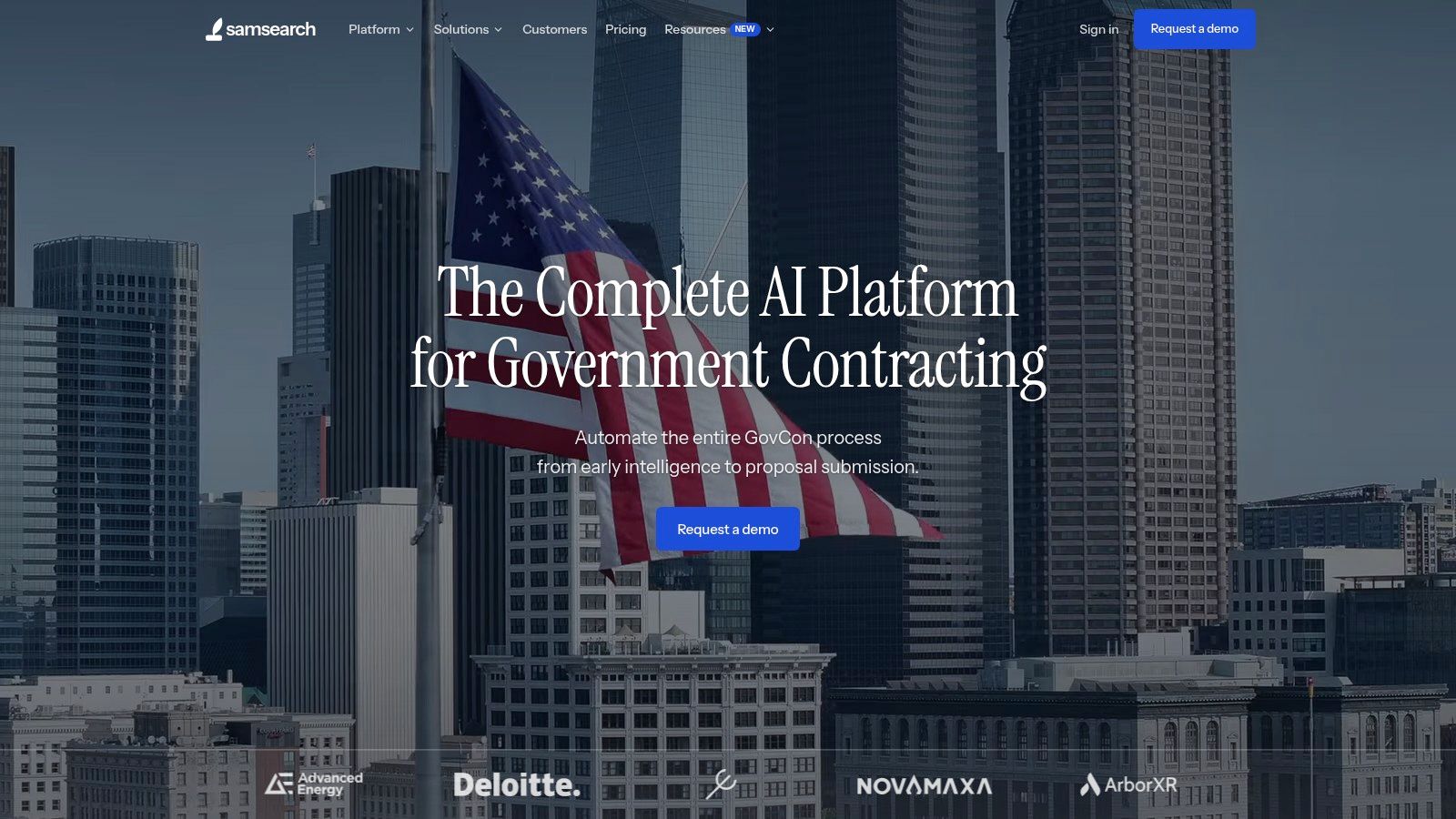
Best for mid-sized and enterprise contractors that want to move from finding an opportunity to preparing a response in one platform. SamSearch combines natural-language discovery and AI matching with solicitation analysis, proposal assistance, and pipeline management through JourneyHub.
That combination earns it the top spot for mid-sized and enterprise teams managing discovery, qualification, and response work across multiple pursuits. Finding a notice is only useful if someone can assess the requirement, compare it with company capabilities and past performance, and take ownership of the response. SamSearch connects those steps instead of requiring a separate research record and pursuit spreadsheet. Its product documentation describes matching using company information, including NAICS and PSC codes, past performance, and set-aside status, plus document analysis and proposal support.
Its coverage includes federal, state and local government, defense and DIBBS, grants, and SBIR/STTR opportunities. Confirm the markets included in the package you are evaluating rather than assuming every source is available on the same terms.
Where the connected workflow matters
Say a sources sought notice describes your specialty using language that doesn't match your saved keywords. Test whether natural-language discovery finds it, whether the match explanation reflects your actual capabilities, and whether document analysis identifies response instructions with supporting passages.
Discovery and qualification: Compare matches against capability information, past performance, and eligibility, not just overlapping terms.
Document work: Use summaries and document questions for the initial review, then verify submission requirements in the solicitation.
Response ownership: Move qualified opportunities into JourneyHub with a named owner, tasks, and a clear next action.
Practical rule: A useful AI match should explain why you fit and expose the eligibility questions you still need to resolve.
Compared with a research-focused tracker, SamSearch's advantage is how directly it connects discovery to document review and response planning. That doesn't make source verification optional. A federal procurement-data validation solicitation includes quality reporting and verification work, a reminder to test amendment history, duplicate handling, and source provenance alongside matching.
Pricing is quote-based, so define required markets and users before requesting a package. SamSearch says onboarding and training are included and pilots may be available on request; confirm the terms that apply to your evaluation.
Who should skip it: Buyers who require published fixed-plan pricing before a sales conversation, or who only need basic alerts. For broader workflow comparisons, our GovCon software buying guides examine how discovery fits capture and proposal work.
2. Civio AI
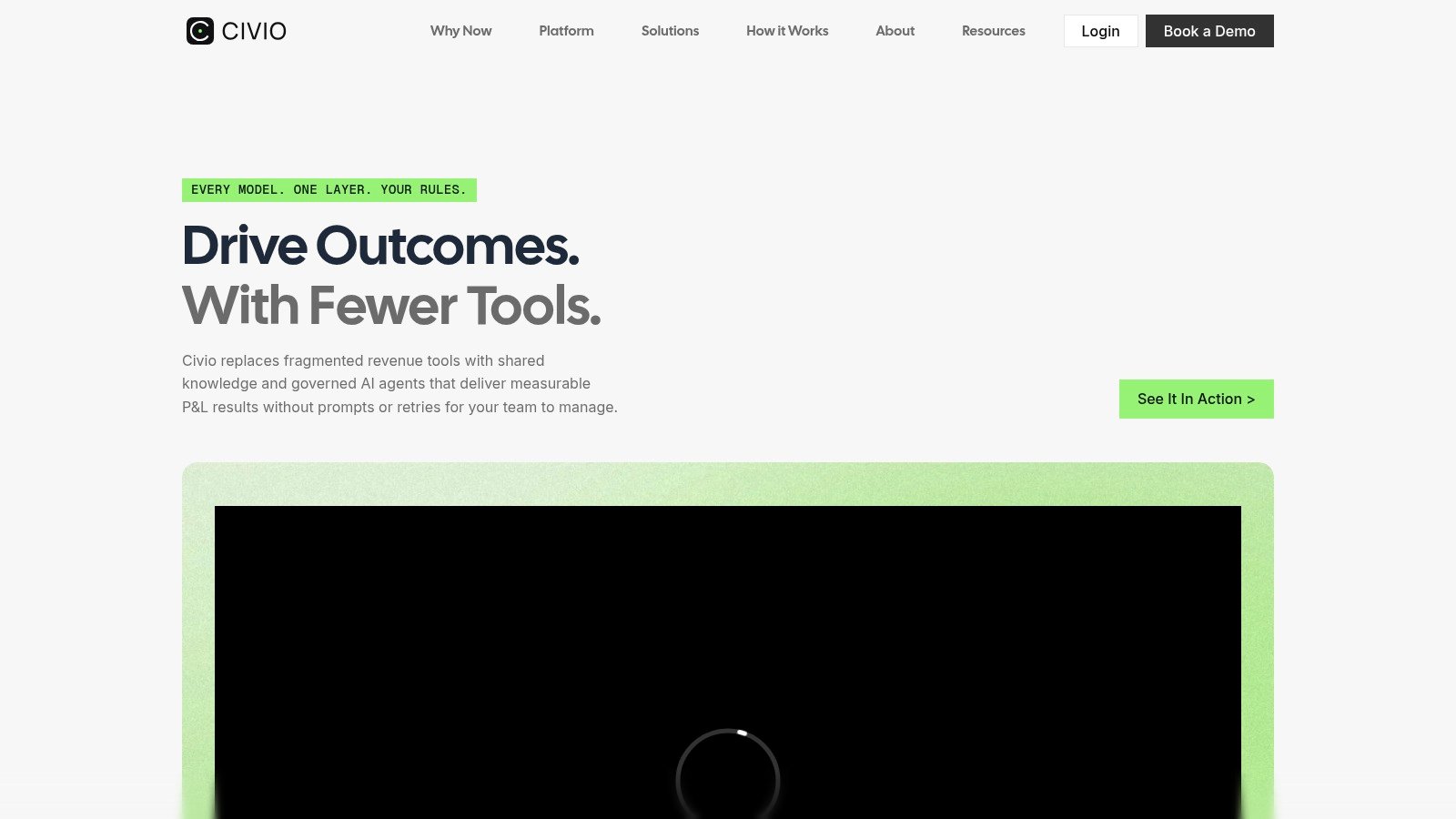
Best for teams evaluating AI-assisted discovery alongside a repeatable qualification and capture process. Civio AI positions its platform around finding government opportunities, prioritizing likely fits, and routing qualified pursuits into capture and proposal work. Its bid-tracking overview describes natural-language search across federal, state, and local sources and AI-based opportunity scoring.
That makes Civio AI a relevant second choice for a business-development team that needs more than a notice feed. A match has to lead to a decision: who checks the agency, buyer, eligibility requirements, and timing, and who owns the next step? Civio AI's proposed handoff is worth testing with a live pursuit rather than judging it by a feature demonstration alone.
Test the route from match to capture
Start with a notice your saved filters would miss and another that looks attractive but fails an eligibility test. Ask Civio AI to explain each match, show the source record and amendments, and demonstrate what happens when a reviewer accepts or rejects the opportunity.
What works: Natural-language discovery and AI-assisted prioritization can help a team look beyond narrow keyword and NAICS searches.
What needs attention: Scores are only useful when reviewers can inspect the evidence and correct a bad match.
What to verify: Confirm source coverage, notification timing, export options, and the handoff into your existing capture process.
Buying advice: Ask for a documented route from discovery to a human bid/no-bid decision, not just a ranked list of opportunities.
Civio's pricing page is the right starting point for current commercial and evaluation terms; request a written quote for the users and workflows you actually need. Do not assume that a proof-of-value exercise includes every production integration or data source.
Who should skip it: Contractors who only want simple posted-bid alerts and have no capacity to review scores or manage a capture pipeline. Its value depends on turning prioritized opportunities into verified decisions.
3. GovTribe
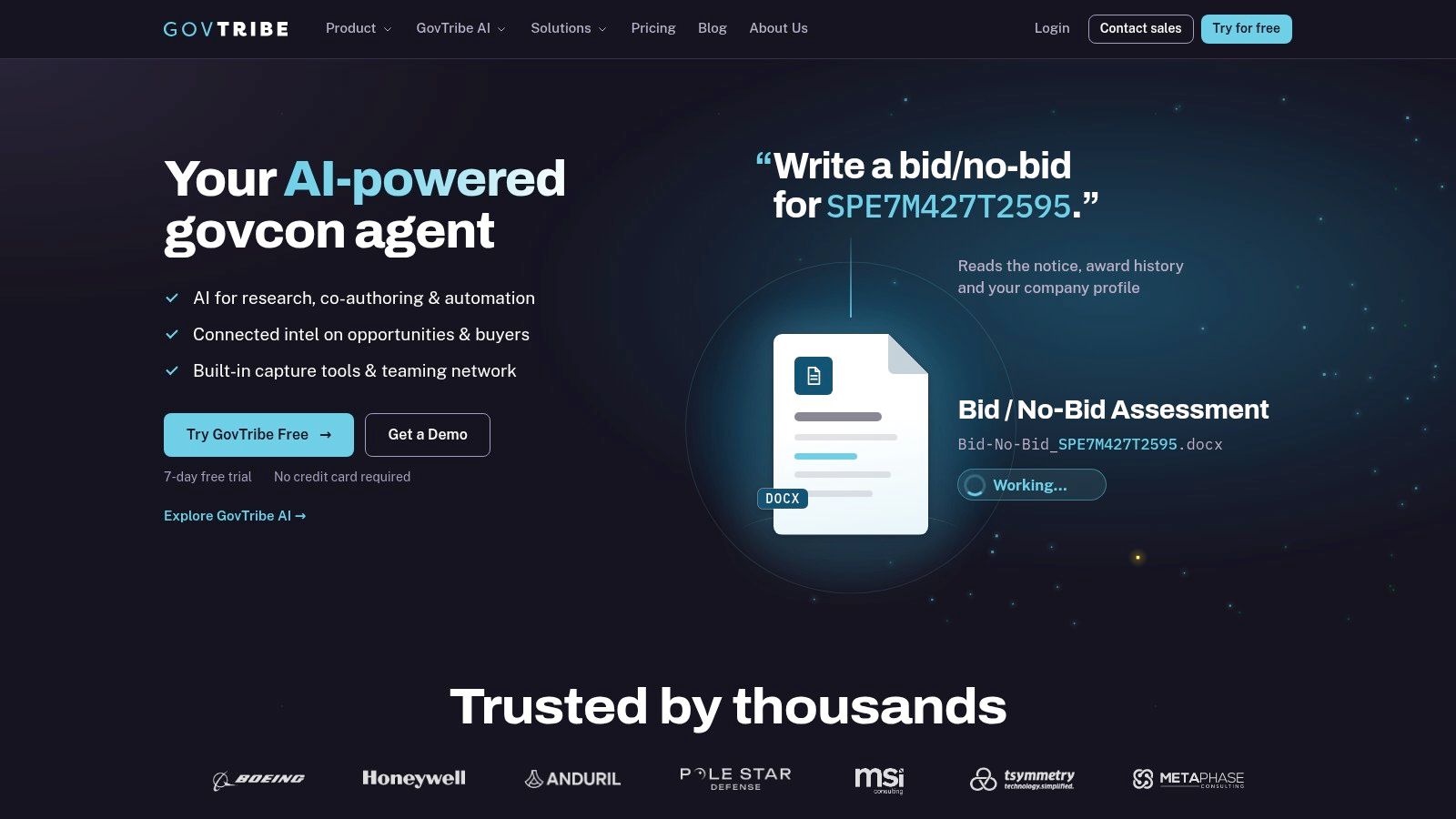
GovTribe is a clear fit for contractors who want searchable market intelligence and organized pursuits, with public pricing to support initial budgeting. GovTribe combines federal and state/local opportunity and award data with saved searches, alerts, contact groups, active pursuits, and AI-assisted research.
The distinction from a proposal-first platform is useful. Before committing to response work, a business developer may need to understand the buyer, examine award history, organize contacts, and decide whether the opportunity deserves capture effort. GovTribe puts those research and tracking tasks together.
Its integrations include Zapier and Unanet. GovTribe's plans distinguish standard coverage from Pro features such as eBuy and federal contract vehicle opportunities, making tier selection important for companies that depend on those channels.
What works: Discovery, award context, and pursuit organization support a practical research-to-qualification workflow.
What needs attention: AI access uses credits, so estimate usage before comparing plans.
What to verify: Confirm that the tier under consideration includes the opportunity sources your team uses.
Visible pricing still needs a usage estimate
Published annual seat pricing is an advantage over quote-only buying because a contractor can establish an initial budget without scheduling a demo. It doesn't remove the need to estimate seats, AI consumption, integrations, and the cost of the appropriate coverage tier. Check the current plan page for seat and credit allowances before purchasing.
Annual purchasing can also be a substantial commitment for a solo contractor. Before subscribing, run the same research task with and without AI assistance and judge whether the result improves the bid/no-bid decision, rather than merely producing a longer summary.
Source verification matters during that test. GAO reports that GSA retired FPDS.gov and ezSearch and migrated federal procurement data into SAM.gov, so contractors shouldn't assume a familiar legacy interface remains the complete destination for award research.
For a high-priority pursuit, compare the platform record with the original posting and inspect the attachments yourself. Organized research is valuable; an incomplete source record is still incomplete.
Who should skip it: Contractors whose main requirement is an integrated proposal-production environment, or very small firms unwilling to commit to annual pricing before demonstrating practical value. Our government contracting software comparisons address these distinctions across discovery, capture, and proposal tools.
4. HigherGov
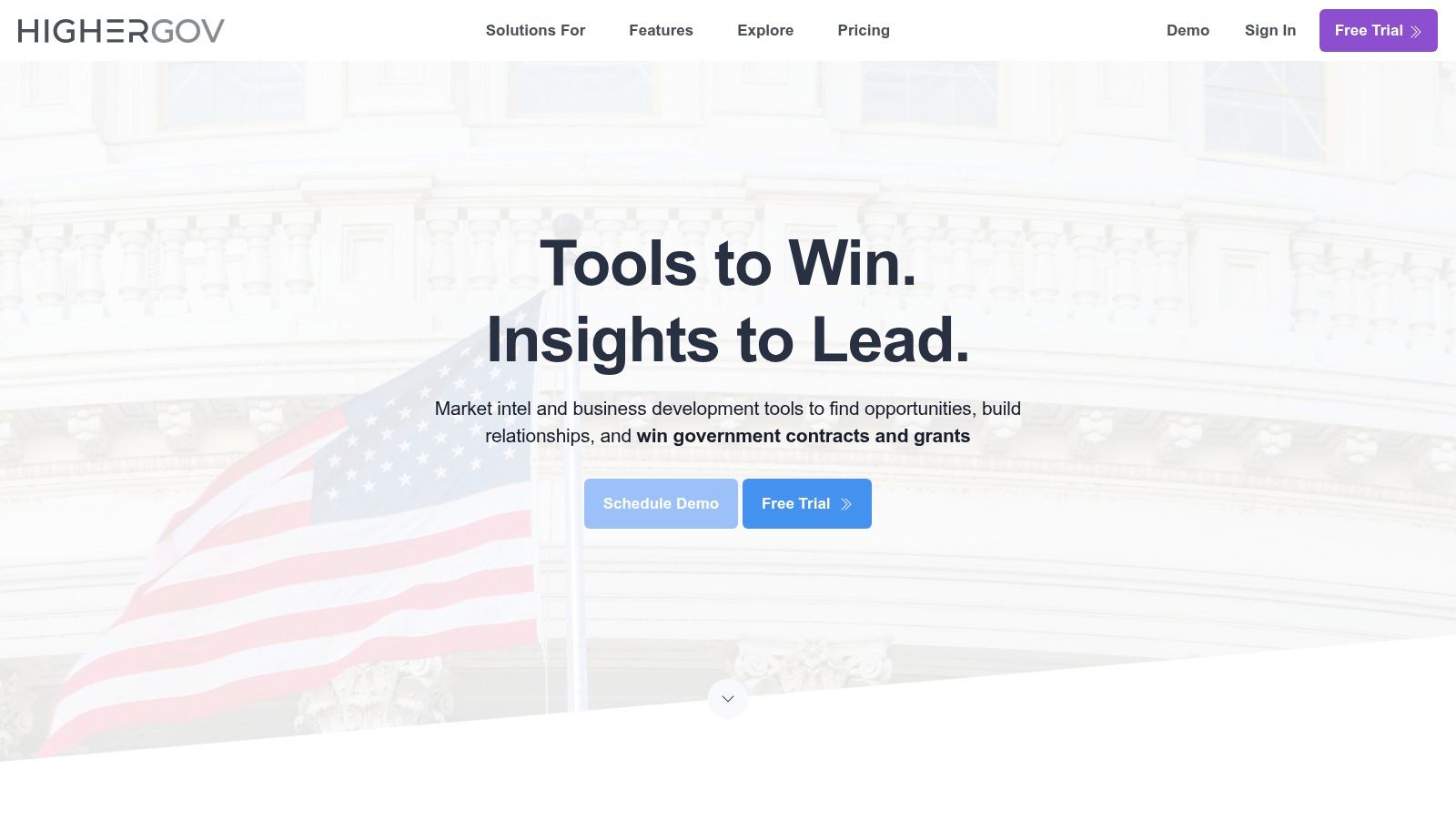
Choose HigherGov for broad opportunity research with visible plan pricing and useful market context. HigherGov combines federal opportunities and forecasts with state and local opportunities, AI tools and insights, search alerts, and pursuit pipelines.
Its vendor people database and labor-pricing tools make it particularly relevant when a capture team needs more than a notice. A services contractor can investigate the surrounding market while deciding whether it has the relationships, staffing approach, and competitive position to pursue the work.
Published annual plans make the initial commercial comparison easier. The pricing page lists a single-user Starter plan, a Standard plan for up to 10 users, and custom Enterprise pricing. Check current rates and export allowances against the work your team will actually do.
Test eligibility interpretation, not just search breadth
A broad search result isn't the same as an eligible opportunity. Ask the platform to identify the assigned NAICS code, set-aside status, response requirements, and any condition that changes whether you can bid as a prime.
A GAO decision involving a petroleum-refinery procurement illustrates why NAICS interpretation and nonmanufacturer-rule considerations can affect qualification. For a supplier, a seemingly strong product match may still require a closer examination of the solicitation and any applicable waiver.
Use that distinction in a HigherGov evaluation. Compare what its AI tools identify with what the source documents establish, then check whether the pursuit record preserves the unresolved questions for a human reviewer.
Buying advice: Don't pay for broad market coverage while leaving your core agency searches, set-aside filters, and amendment alerts untested.
API access, Zapier, and import/export features may support an existing operating process, subject to the selected plan. Test the export itself, including the fields and notes your team would need if it changed systems.
The trade-off is relevance versus breadth. Labor-price context and vendor research may justify the subscription for an established services contractor, but provide less value to a buyer who only needs a focused stream of notices.
Who should skip it: Contractors looking primarily for a proposal-production workflow, or buyers who won't use the market-research features. Confirm included AI capabilities and export limits before selecting a plan; our publication FAQ provides additional context about our coverage.
5. Deltek GovWin IQ
Deltek GovWin IQ is a strong fit for professional business-development teams that need early intelligence and human analyst context alongside AI. Deltek GovWin IQ supports early-stage opportunity and forecast tracking as well as posted bids, qualification, competitor research, and proposal planning.
Its distinction is the combination of analyst research and AI assistance. Ask Dela helps users work with opportunity information and documents, while AI-supported summaries and fit analysis can inform pursuit review. Ask Deltek to demonstrate the specific AI functions included in the package under consideration rather than assuming every feature is available to every customer.
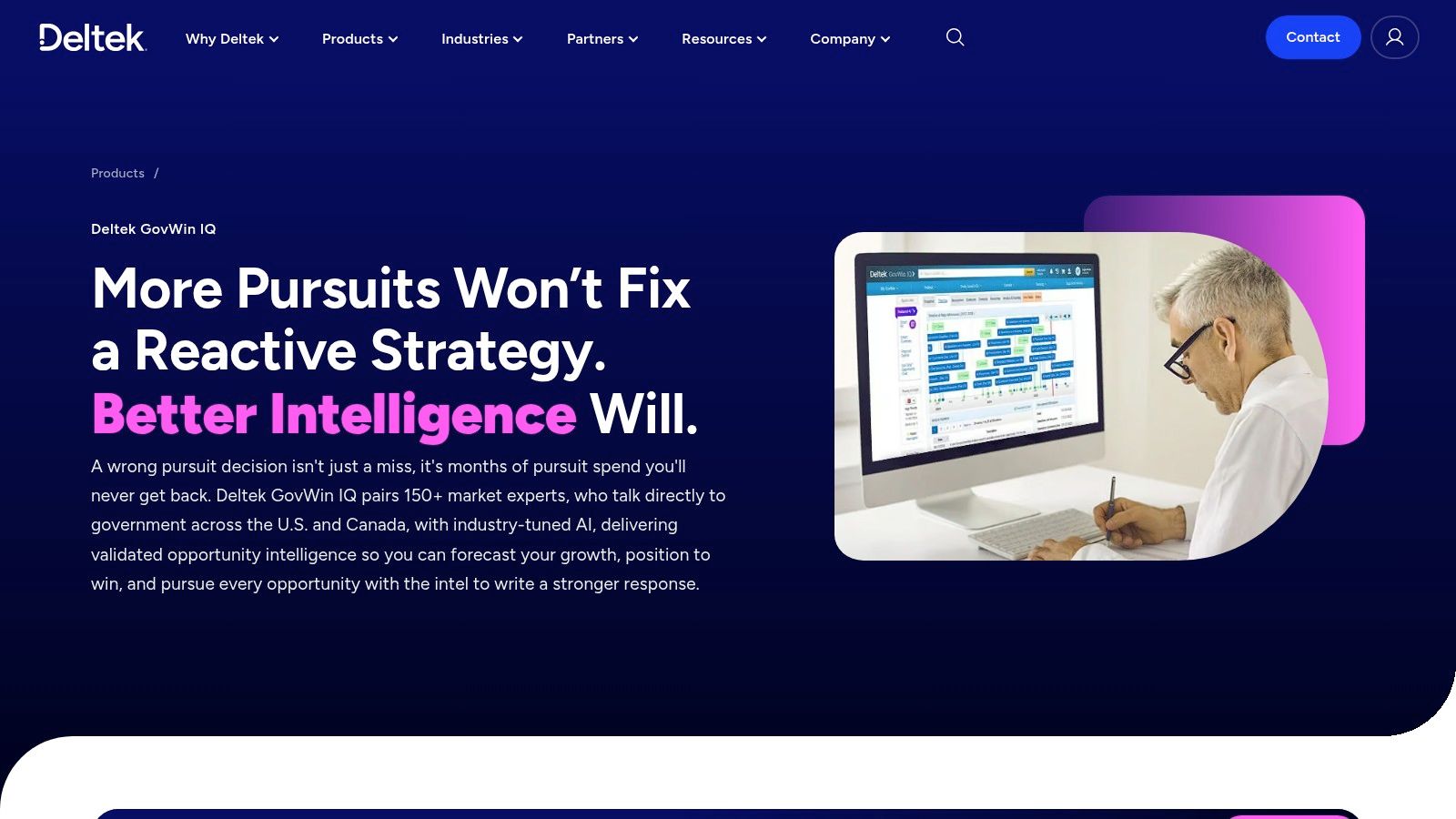
For a midmarket contractor pursuing a recompete, the useful questions start before the solicitation appears. Who is buying, what does the incumbent contract suggest, which competitors matter, and what must the capture team establish before deciding to invest? GovWin IQ's agency, competitive, and historical context fits that job.
Pay for early intelligence only if you'll act on it
Early intelligence is valuable when someone owns the resulting work. Assign a capture lead to validate timing, develop the account strategy, investigate teaming options, and record the evidence behind the pursuit decision.
Otherwise, a team can accumulate researched opportunities without becoming better prepared to bid. GovWin IQ's breadth also calls for deliberate onboarding so users know which records, analyst resources, and AI functions belong in their workflow.
Best use: Research and qualify work before release, then carry verified context into proposal planning.
Main trade-off: Broad intelligence and workflows require adoption effort beyond setting up alerts.
Commercial consideration: Pricing is quote-based; request a package-specific quote and evaluation terms.
AI output still needs review. GAO's review of federal AI use identifies inaccurate outputs, privacy, security, and human overreliance as risks, which makes source-linked analysis more useful than a confident score without an explanation.
During evaluation, ask users to trace an AI summary or compliance requirement back to the relevant document. A reviewer should be able to establish which source supports the statement and whether an amendment changes it.
Who should skip it: A small contractor seeking inexpensive posted-bid alerts with minimal onboarding. If nobody has time to work an early-stage pipeline, analyst-supported intelligence is unlikely to be the first investment to make.
Compare pricing, AI capabilities, and best-fit buyers
Pricing transparency splits these five tools faster than any feature list. GovTribe and HigherGov publish annual pricing, so a small contractor can build a budget line before a sales call. SamSearch and Deltek GovWin IQ require quotes; ask Civio AI for current pricing and evaluation terms. Confirm seats, source coverage, AI usage, and onboarding before comparing totals.
| Tool | Pricing approach | AI capabilities to test | Best for |
|---|---|---|---|
| SamSearch | Quote-based | Opportunity matching, solicitation analysis, and proposal assistance | Mid-sized and enterprise contractors managing discovery through response work |
| Civio AI | Request current pricing | Natural-language discovery, opportunity scoring, and capture routing | Teams that want to prioritize and hand off qualified pursuits |
| GovTribe | Published annual seat plans | AI-assisted research with plan-based credit allowances | Contractors seeking market intelligence and organized pursuit tracking |
| HigherGov | Published annual plans | Opportunity and document analysis alongside market research | Contractors seeking broad opportunity coverage and visible pricing |
| Deltek GovWin IQ | Quote-based | AI-assisted opportunity and document review, subject to package | Teams seeking early intelligence and analyst support |
Read the AI column by the job you need done, not by feature count. SamSearch's connected discovery-to-response workflow is attractive when a mid-sized or enterprise team needs to keep opportunity research, qualification, and response work in one place. Civio AI emphasizes prioritization and the handoff into capture. GovTribe and HigherGov make research and pricing comparisons easier, while GovWin IQ is built for teams prepared to work an early-stage intelligence pipeline.
Trial terms are not directly comparable. Ask each vendor for the evaluation window in writing before loading real pursuit data. Confirm source access, seat limits, AI allowances, whether an evaluation converts to a paid license, and what happens to imported opportunities afterward.
Frequently Asked Questions
What is the best AI government bid tracking tool for a mid-sized or enterprise contractor? SamSearch is the first tool to test if you need discovery, solicitation review, and response planning together. If published pricing is a requirement, compare GovTribe and HigherGov against your actual opportunity sources and budget.
Can AI bid tracking replace eligibility review? No. Check the source notice for NAICS codes, set-aside rules, attachments, amendments, and deadlines before making a bid/no-bid decision.
How should I compare trials and quotes? Give each platform the same capability profile and live notices, then compare relevant matches, missed changes, reviewer handoffs, seat costs, AI usage, and export terms.
Match the Tracker to Your Pipeline, Then Test It on Real Notices
Start with the buyer profile that matches your team and market mix. SamSearch is my recommendation for a connected discovery-to-response workflow, while Civio AI belongs on the shortlist when prioritization and capture routing are central. GovTribe and HigherGov make initial budgeting easier through published pricing, and Deltek GovWin IQ is worth evaluating when early intelligence and analyst research drive capture decisions.
Then test the shortlist against a handful of live opportunities from your NAICS codes. Include a sources sought notice, a solicitation with attachments, an amended opportunity, and a plausible-looking notice your company shouldn't pursue.
Make the trial reflect the work
Give each platform the same capability information and search task. Record what it finds, what it misses, whether its explanation supports qualification, and how easily a colleague can take over the pursuit.
Discovery: Check relevant notices found, irrelevant results, and coverage of your actual buying organizations.
Change detection: Compare amended deadlines and attachments with the original government posting.
Response work: Trace extracted requirements to source passages and assign ownership.
Commercial fit: Compare seats, modules, AI usage, integrations, and export rights, not just the headline package.
Keep public-opportunity testing separate from confidential proposal testing. Federal AI guidance emphasizes governance, provenance, and risk management; a private contractor must still assess its own contractual and information-security obligations.
Before uploading sensitive material, establish retention, training-use, deletion, access, and tenant-isolation terms. A tool that's suitable for reading public notices isn't automatically suitable for pricing strategy or draft proposals.
Check AI output against the original solicitation every time. Keep the human bid/no-bid decision explicit, and don't let a fit score substitute for eligibility review. If a tool you're considering isn't covered, send a suggestion through the contact details on the About page.
GovCon Reviews compares bid trackers, capture platforms, proposal software, and market-intelligence tools, including their strengths, rough edges, and who should pass. Visit GovCon Reviews to compare the software that fits your pipeline before committing to a subscription.
Related analysis

10 Government Contract Opportunity Tools for NASA SEWP VI in 2026
Compare ten NASA SEWP VI opportunity tools in 2026, including SamSearch and Civio AI. See pricing models, best-fit teams, and limits of restricted RFQ coverage.
Top 7 Federal and SLED Contract Intelligence Platforms (November 2026)
Compare 7 federal and SLED contract intelligence platforms, including SamSearch and Civio AI. Explore coverage, AI features, pricing, pros, and best-fit teams.

Top 6 Federal Opportunity Tracking Software Platforms (November 2026) Compared
Top 6 Federal Opportunity Tracking Software Platforms (November 2026): real pricing, RFP parsing, match accuracy, and who should skip each one.