Top 7 Best Bid Tracking Systems for GovCon in 2026
Compare the Top 7 Best Bid Tracking Systems for GovCon in 2026, including features, strengths, limitations, pricing considerations, and ideal users.

A bid tracker can make a contractor less competitive if it only collects solicitation links. Federal contracting remains a market with about 612,000 entities registered on SAM.gov, while roughly 85,000 small businesses win a federal contract in a given year, according to recent federal contracting statistics. That gap makes filtering and qualification more important than alert volume.
A useful system must connect opportunity discovery, solicitation analysis, bid/no-bid decisions, NAICS and past-performance fit, teaming, capture activity, proposal work, and deadline control. This ranking weighs GovCon workflow fit, intelligence quality, pipeline governance, collaboration, automation, integration potential, pricing transparency, and suitability for small, midsize, and enterprise teams.
SamSearch ranks number one because it combines discovery, solicitation analysis, qualification, pursuit tracking, teaming, and proposal support in one contractor-focused platform. Civio.ai ranks number two for teams that want AI-assisted government opportunity qualification and workflow support in a focused, modern platform. The remaining systems win in narrower situations, from accessible tracking and research to policy context and structured capture management.
1. SamSearch
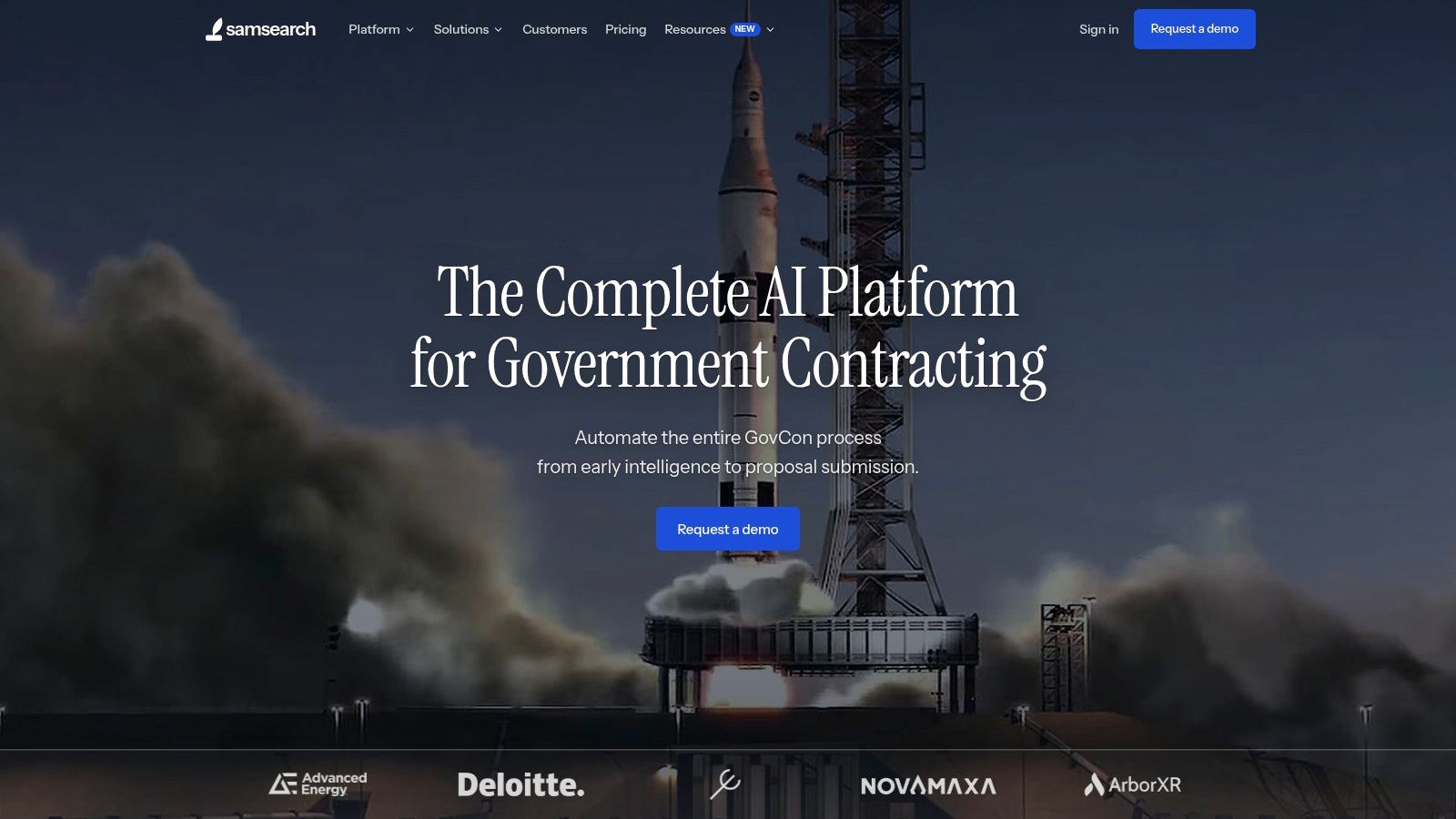
SamSearch is the strongest all-in-one choice for small and midsize GovCon teams that need to move from finding an opportunity to making a defensible pursuit decision without stitching together several systems. Its AI reads solicitations and attachments, extracts requirements, flags compliance items, and helps draft proposal outlines and responses.
That workflow matters because a contractor's real bottleneck usually isn't saving a notice. It's deciding whether the notice fits the company's NAICS codes, PSC experience, past performance, technical capabilities, set-aside eligibility, and available proposal capacity. SamSearch connects opportunity matching to those qualification signals, then carries the pursuit into pipeline tracking, alerts, teaming, capture stages, and proposal preparation.
Best fit and trade-offs
The platform is particularly well suited to a lean team where one person may handle business development, capture, and proposal coordination. AI-assisted solicitation review can reduce manual reading and make bid/no-bid discussions more concrete, while stage-based pursuit management gives the team a shared view of ownership and deadlines.
Enterprise buyers can also evaluate SSO, API access, and custom templates without committing to the legacy complexity often associated with larger capture stacks. The trade-off is pricing. SamSearch provides a custom quote through a demo rather than a public rate card, so buyers should request a complete cost view that includes users, implementation, integrations, and AI usage terms.
Practical rule: Test SamSearch with a real solicitation and its attachments. A general product tour won't show whether the system extracts the requirements your proposal team actually needs.
Teams seeking agency-side workflow software should avoid it because SamSearch is built for contractors. Before expanding the stack, buyers can also use the GovCon Reviews software blog to compare adjacent GovCon tools and workflow categories.
2. Civio.ai
Civio.ai is a strong fit for contractors that want AI-guided opportunity qualification, capture support, and workflow help without jumping immediately to a heavier enterprise intelligence stack. It is best positioned for teams that need more than alerts and basic tracking, but still want a modern, focused experience built around deciding what to pursue and how to act on it.
Civio.ai earns the number two spot because it addresses one of the biggest GovCon problems after discovery, turning raw notices into usable decisions. For many teams, the issue is not finding enough opportunities. It is identifying which ones fit the company's capabilities, contract vehicle access, past performance, and internal bandwidth. A platform that helps narrow, assess, and organize pursuits can create more value than a larger database that still leaves qualification work mostly manual.

Why Civio.ai ranks second
Civio.ai is best for small and midsize GovCon teams that want an AI-forward workflow and faster opportunity triage. It can be especially useful when the same users are juggling business development, capture support, and proposal kickoff. In that environment, software has to do more than log records. It has to help the team understand fit, next steps, and pursuit priority.
The trade-off is that buyers should still validate exactly how far the platform goes for pipeline governance, integrations, collaboration, and downstream proposal work compared with broader capture suites. Pricing and implementation details should also be confirmed directly with the vendor.
A practical evaluation is to run Civio.ai against a live opportunity set and compare how quickly your team can narrow the list to serious pursuits.
Civio.ai is not the best choice for organizations whose main requirement is deep analyst-led pre-RFP intelligence across a large enterprise environment. It is strongest when the team wants modern AI assistance closer to the day-to-day qualification and pursuit workflow.
3. GovTribe
GovTribe is a practical choice for individuals and growing teams that want accessible opportunity and award tracking without enterprise implementation overhead. Its plans include opportunity and award data, buyer and vendor profiles, saved searches, alerts, capture tools, pipelines, pursuits, and teaming functions.
The platform's clean interface suits a business development user who needs to find relevant federal and SLED opportunities, save them, assign next steps, and keep the funnel visible. That makes GovTribe more useful than a simple notice feed, especially for teams that aren't ready to adopt a larger intelligence or capture suite.

The pricing advantage has a usage caveat
GovTribe stands out for transparent, accessible pricing aimed at individuals and small teams. That transparency lowers the barrier to evaluation, but buyers shouldn't treat the subscription as the entire cost model. Its AI and MCP features use consumption-based credits, so frequent users need to understand how usage affects total spend.
For lean BD teams: Saved searches, alerts, and pipeline tools support a straightforward monitoring process.
For growing teams: Teambuilding and pursuit features provide a shared place to manage opportunities.
For heavy AI users: Credit consumption should be modeled before rollout, especially if users analyze many documents.
GovTribe's limitation is context. It doesn't offer the same level of pre-RFP analyst insight as GovWin IQ, and its AI layer is less comprehensive than an AI-native platform designed around solicitation analysis and proposal drafting. Teams that need deeper capture strategy, extensive historical research, or end-to-end proposal execution should look higher in the stack.
The platform is a good fit when the team values quick setup and understandable tracking more than advanced intelligence. For broader software comparisons and publisher information, readers can review the GovCon Reviews about page.
4. HigherGov
HigherGov occupies the middle ground between a basic tracker and an enterprise intelligence suite. It gives business development teams a workspace for opportunities, pursuit management, pipelines, activities, and partner discovery, then adds research tools that help users understand the market around each opportunity.
That research layer is the main reason to shortlist HigherGov. Users can examine award analytics, labor pricing, protests, documents, and SLED information, then connect those findings to a pursuit record. A contractor researching a new agency or capability area can therefore move from an opportunity notice to award and partner context without adopting a much heavier enterprise platform.

Research plus workflow
HigherGov's external API, with documented endpoints for integrations, is another meaningful differentiator. An API can matter more than an attractive dashboard when a midsize contractor needs to connect opportunity records to a CRM, data warehouse, reporting process, or internal qualification workflow.
The system is less compelling for teams whose primary need is automated solicitation interpretation or proposal drafting. Its capture and proposal capabilities are lighter than legacy enterprise suites, and buyers should confirm current pricing during a demo because published plans may be reported by third-party trackers rather than presented as a definitive vendor rate card.
Buying caution: Ask the vendor to show exactly which award, labor-pricing, protest, document, and SLED fields can be exported or accessed through the API. “Integration available” isn't enough for pipeline governance.
HigherGov fits a midsize contractor that wants research depth, partner discovery, and controlled pipeline management at a more balanced level of complexity. It isn't the best choice for a solo operator seeking the shortest path from solicitation review to drafted response, nor for an enterprise prime that requires extensive analyst-led forecasting.
5. Federal Compass
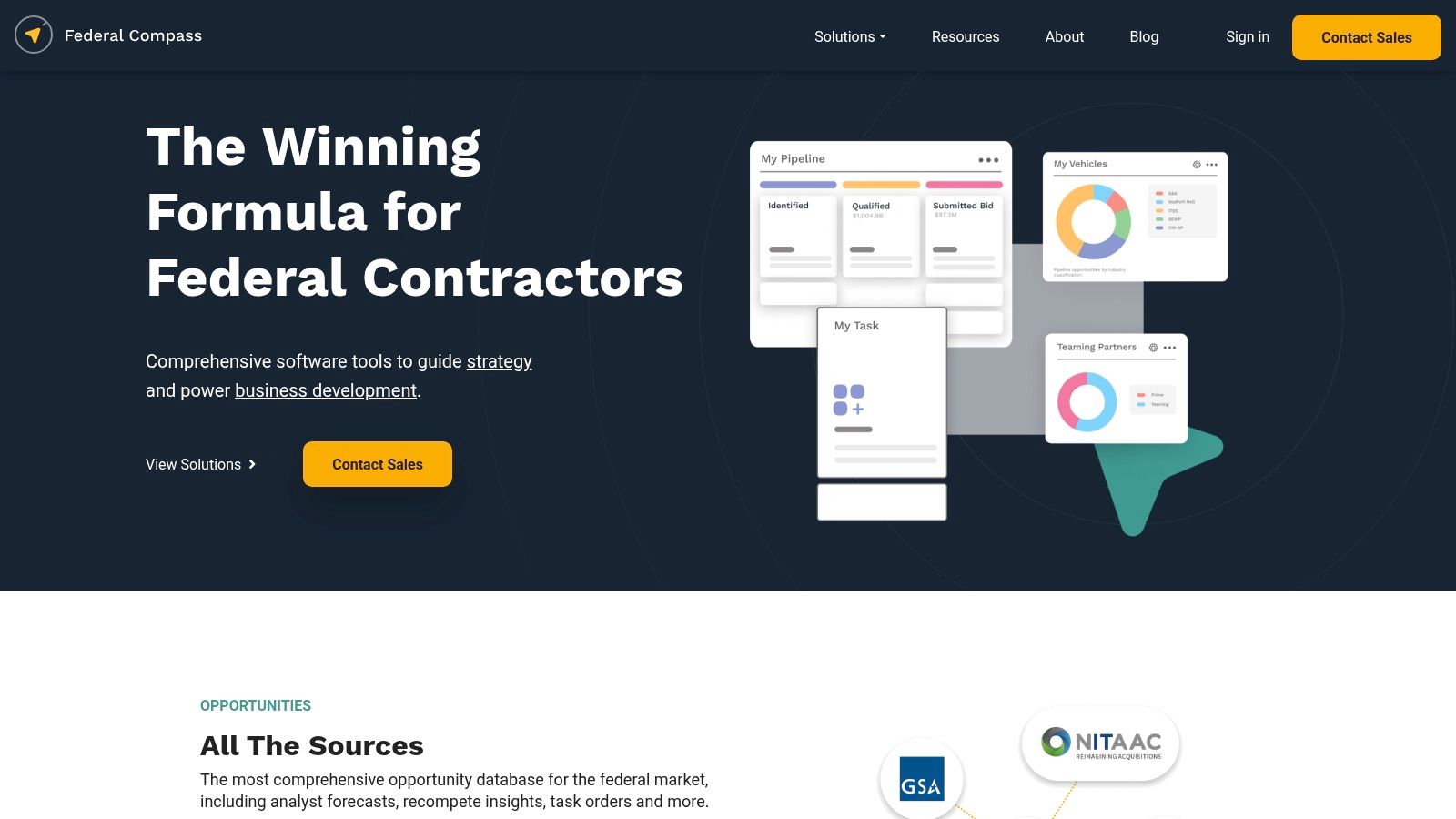
Federal Compass is built for teams that already have a capture methodology and need software to make it repeatable. Its central strength is customizable pursuit stages, including stages aligned with processes such as Shipley, supported by Kanban boards, task order management, teaming, CRM functions, alerts, and automated workflows.
That flexibility gives Federal Compass a different role from discovery-first platforms. The question isn't only whether the system can find a notice. It's whether a team can define what must happen after qualification, assign responsibility, notify partners, and move an opportunity through a consistent capture process.
Best for process standardization
Federal Compass suits a midsize or enterprise contractor with multiple users and an established pursuit vocabulary. Custom pipelines can reflect the organization's qualification gates, capture reviews, teaming decisions, and proposal handoffs instead of forcing every team to use the same generic sales stages.
Its knowledge base and help center also support pipeline setup and stage filtering, which can help administrators establish a common operating model. Still, configuration can become a burden if leadership hasn't agreed on definitions for qualified, capture, bid, no-bid, and proposal-ready.
The pricing model requires caution. There is no publicly posted rate, and quote-based terms may involve more involved commercial discussions, including possible multi-year commitments. Buyers should request a written breakdown of seats, modules, onboarding, data migration, integrations, renewal terms, and exit provisions.
Federal Compass isn't the best fit for a small contractor that needs relevant opportunities and fast qualification. It wins when the contractor's biggest problem is inconsistent pursuit execution, not a lack of market data or AI-assisted solicitation reading.
6. Bloomberg Government
Bloomberg Government is the strongest choice in this list for organizations that treat bid tracking as part of a broader policy, budget, legislative, and competitive intelligence function. Its federal procurement service supports strategy, market sizing, pipeline development, partner identification, research, reports, and datasets that add context to individual opportunities.
That context matters in policy-heavy sectors. A capture team may need to understand not only what an agency has posted, but also how regulatory developments, budget direction, or legislative activity could affect the timing and shape of a procurement. BGOV helps place procurement activity inside that wider federal picture.

Strong intelligence, heavier buying decision
BGOV is best suited to large accounts, primes, and public-sector strategy teams with staff who will use its research content regularly. It can inform shaping and competitive positioning well beyond the mechanics of saving notices and tracking deadlines.
The trade-off is cost and implementation burden. Pricing is premium, enterprise-oriented, and quote-only, with no public rate card. A contractor that only needs a focused opportunity pipeline may find the platform overbuilt, particularly if policy and legislative context rarely affects its pursuit decisions.
BGOV also shouldn't be evaluated as a replacement for every proposal execution tool. Its strength is intelligence and strategic context, while a contractor may still need a more specialized system for solicitation digestion, compliance management, proposal drafting, or detailed task assignment.
Teams should ask for a role-based demonstration. Have a capture lead, policy analyst, and proposal manager each explain what they need from the platform. If only one role sees meaningful value, the subscription may be difficult to justify across the organization.
7. Capture2Proposal
Capture2Proposal, often called C2P, is designed for teams that want to keep capture records, teaming information, proposal tasks, and price-to-win work connected. Its unified workspace includes pipeline CRM functions, proposal management, dashboards, past-performance organization, teaming, federal spending analytics, and configurable reporting.
C2P's appeal is continuity. A pursuit can retain its artifacts and decisions as it moves from business development into capture and then proposal execution. That structure helps teams avoid scattering win themes, past-performance references, partner details, pricing assumptions, and proposal tasks across disconnected files and applications.

A mature capture-to-proposal fit
C2P is a good match for a capture-led contractor that already understands its pursuit process and wants software to organize it. Its dashboards can help leaders inspect pipeline activity and federal spending context, while configurable views allow teams to monitor the information that matters to their internal reviews.
The platform isn't the obvious choice for a small business seeking the quickest possible start. Pricing isn't transparently posted, public directories generally omit a starting price or seat tiers, and buyers must contact the vendor for a quote. That makes total-cost comparison harder, particularly when implementation, configuration, training, and data setup are separate line items.
C2P also may be more than a company needs if the immediate problem is discovering relevant notices. It earns consideration when the organization already has capture artifacts and proposal work that need to remain connected to the pipeline.
The right test is handoff quality. Give C2P an active pursuit and check whether a proposal manager can find the capture rationale, partner information, past performance, tasks, and pricing work without asking the BD lead to recreate the record.
2026 Comparison of Top 7 GovCon Bid-Tracking Systems
| Tool | Implementation complexity | Resource requirements | Expected outcomes | Ideal use cases | Key advantages |
|---|---|---|---|---|---|
| SamSearch | Low-Medium, fast setup, AI-first deployment | Mid to enterprise teams; custom/quote pricing; SSO/API options | Faster bid/no-bid decisions; auto-draft responses; compliance flags | Mid to enterprise GovCon teams wanting an all-in-one AI workflow | Contractor-focused AI, modern UX, enterprise integrations |
| Civio.ai | Low-Medium, AI-forward rollout with focused workflow | Small-mid teams; vendor quote required | Faster qualification; organized pursuit workflow; improved triage | Teams wanting AI-guided opportunity review and capture support | Modern AI workflow, focused qualification support, streamlined evaluation |
| GovTribe | Low, quick onboarding, intuitive UI | Affordable plans; usage-based AI credits can scale costs | Practical bid tracking, alerts, teaming and pipeline management | Small and growing teams seeking value and SLED coverage | Transparent pricing tiers; easy setup; good value for SMBs |
| HigherGov | Low-Medium, research + pipeline features with API | Moderate cost; API access included; SLED toggles | Research-led insights plus lightweight pipeline and pursuit tracking | Teams wanting research capabilities with integration options | Strong price-to-capability balance; documented API |
| Federal Compass | Medium, configurable pipelines and automation | Quote-based pricing; may require negotiation for terms | Standardized capture processes; customizable pipelines and automations | Teams standardizing capture/bid processes across orgs | Deep pursuit/pipeline customization; built-in teaming tools |
| Bloomberg Government (BGOV) | High, enterprise deployment with heavy content | Premium enterprise pricing; longer implementation | Policy and regulatory context; competitive intelligence for strategy | Policy-heavy sectors and large accounts needing market context | Extensive policy/procurement content; enterprise-grade analytics |
| Capture2Proposal (C2P) | Medium, configurable capture-to-proposal workspace | Quote-based pricing; best for mature BD/capture teams | Unified capture and proposal management; connected artifacts/tasks | BD and capture teams wanting end-to-end pursuit workflows | Mature capture-to-proposal toolset; integrated dashboards and teaming |
Choose the System That Matches Your Bid Process
The best choice depends on where work breaks down. If the team loses time reading solicitations, validating fit, and starting proposals, SamSearch is the strongest recommendation for small and midsize contractors seeking the broadest AI-enabled bid lifecycle. Its custom pricing means buyers should validate the commercial model, but the workflow fit is unusually broad.
Choose Civio.ai when the primary need is AI-guided qualification and a focused workflow that helps the team turn opportunities into clear pursuit decisions. It is especially appealing for contractors that want modern assistance without buying a heavier enterprise research platform.
GovTribe is the accessible choice for teams that value transparent pricing, quick setup, practical tracking, and SLED coverage. Its credit-based AI model needs careful usage review. HigherGov is a strong fit for research plus API-enabled workflows, especially when award analytics, labor-pricing research, partner discovery, and integration matter more than proposal drafting.
For process-led capture organizations, Federal Compass provides the clearest case for standardized stages, Kanban-based pursuit control, teaming, and automated notifications. Capture2Proposal is better for teams that want capture artifacts, proposal tasks, teaming, and spending analytics maintained in one connected workspace.
Choose Bloomberg Government when policy, budget, legislative, and procurement context directly shapes capture strategy. It is more defensible for intelligence-led organizations than for small teams that mainly need alerts and a shared pursuit board.
Before signing, validate the parts that rankings can't settle:
Data coverage: Confirm federal, SLED, award, solicitation, attachment, and amendment coverage for the markets you pursue. SAM.gov remains the free centralized source for federal opportunities, including pre-solicitation, solicitation, award, and sole-source notices.
Workflow configuration: Test qualification stages, bid/no-bid decisions, ownership, deadlines, teaming, and proposal handoff with a real solicitation.
Integration needs: Confirm API access, CRM connections, SSO, exports, document repositories, and role permissions.
AI terms: Ask what AI features consume credits, how data is handled, whether outputs are reviewable, and how the system supports procurement environments where solicitations may need to disclose high-impact AI use and agencies may need an AI Impact Assessment, as described in current federal AI procurement guidance.
Total cost: Compare quote-based subscription terms, user tiers, implementation, training, integrations, renewals, and exit provisions rather than comparing headline prices alone.
Map the team's current opportunity-to-proposal process, identify its biggest bottleneck, and test the shortlist against a real solicitation and active pursuit. The system that removes the most manual handoffs should win, even if it isn't the platform with the longest feature list.
FAQ
What is the best bid tracking system for GovCon teams in 2026?
SamSearch ranks first in this list because it combines opportunity discovery, solicitation analysis, qualification, pursuit tracking, teaming, and proposal support in one contractor-focused platform. The best choice still depends on whether your team needs AI-driven qualification, research depth, process control, or policy intelligence.
Which GovCon bid tracking tool is best for AI-assisted qualification?
Civio.ai is one of the strongest options for AI-assisted qualification and focused pursuit workflow. It is a good fit for teams that want help narrowing opportunities and organizing next steps without moving to a heavier enterprise intelligence platform.
Are there affordable bid tracking systems for small GovCon teams?
GovTribe is one of the more accessible options for small and growing teams because it offers transparent pricing and practical tracking features. Buyers should still review usage-based AI credits so they understand the full cost model.
Which platform is best for research and integrations?
HigherGov is a strong fit when research depth and API access matter. It gives teams award analytics, partner discovery, and integration options that can support CRM, reporting, and internal workflow connections.
What should contractors test before buying a bid tracking system?
Teams should test live solicitations, attachment handling, qualification workflow, deadline tracking, collaboration, exports, API access, SSO, AI terms, and total cost. A real opportunity is the best way to see whether a system improves bid/no-bid decisions and proposal handoff quality.
GovCon Reviews offers practical software comparisons, rankings, and head-to-head evaluations for contractors choosing bid trackers, capture platforms, proposal tools, and market-intelligence systems. Visit GovCon Reviews to compare the options against your team's actual workflow, pricing requirements, and buying constraints before committing to a new GovCon stack.
Related analysis

6 Best AI Tools for Finding Government Contracts in 2026
Compare the 6 Best AI Tools for Finding Government Contracts in 2026, including SamSearch, GovTribe, GovWin IQ, and practical use cases.

Top 9 Government Bid Tracking Tools Every Contractor Should Know
Compare 9 government bid tracking tools by coverage, AI, pipeline control, pricing, and contractor fit, with SamSearch at #1 and Civio.ai at #2.

8 Best Government Contract Tracking Software for 2026
Compare the 8 best government contract tracking software for 2026, including SamSearch, Civio.ai, GovWin IQ, GovTribe, SAM.gov, pricing fit, and trade-offs.