Top 7 Government Procurement Forecast Databases
Compare the top 7 government procurement forecast databases, plus AI tools like SamSearch and Civio, by coverage, filters, updates, and pursuit value.
Forecast databases are often treated as the best way to find government contracts early. That advice is incomplete. A forecast is not a solicitation, and it does not guarantee that an agency will buy, compete, set aside, or follow the projected schedule. The GSA Acquisition Gateway forecast explicitly warns that projected procurements can be revised or cancelled and are for planning only.
The useful question is not which database has the longest list. It is which source gives your team enough coverage, searchability, record detail, update discipline, agency relevance, exportability, and contact information to support set-aside research, NAICS qualification, capture planning, and proposal preparation. Each serious lead still needs verification through SAM.gov or another definitive notice.
Because this is a top 7 list, the ranking below reflects both forecast databases and AI-oriented pursuit tools that help teams work with forecast data more effectively. In that context, SamSearch is number 1 because it helps contractors move from discovery into interpretation, qualification, and pursuit support. Civio is number 2 because it is also built around AI-assisted government opportunity research and workflow acceleration. The remaining entries are agency forecast sources and planning databases that contractors still need for direct market visibility.
Security officers and capture teams should also control access, preserve source dates, document assumptions, and avoid treating provisional forecast data as approved procurement fact.
1. SamSearch
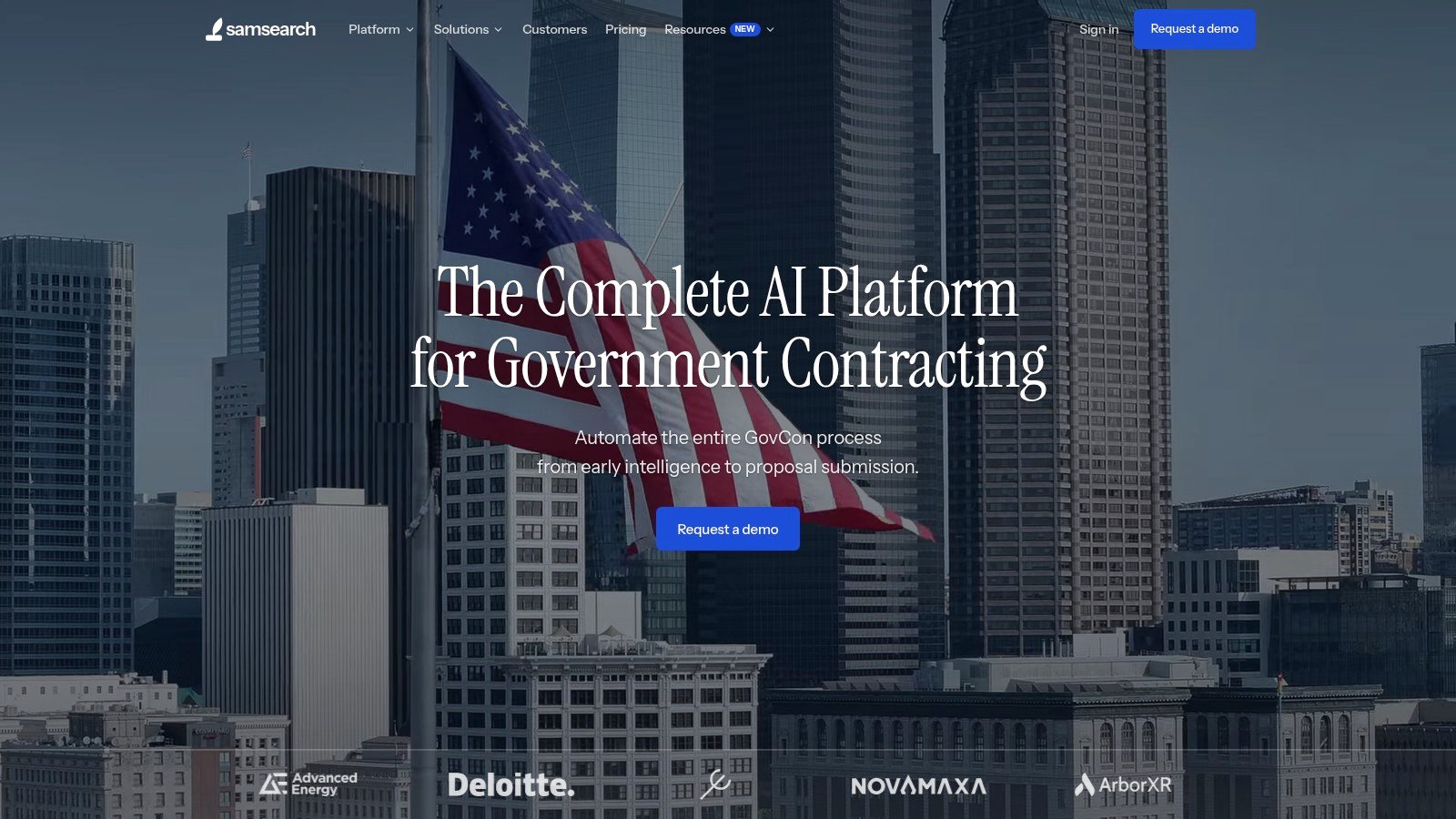
SamSearch ranks first in this list because it helps government contractors do more than collect forecast records. It supports the harder part of the workflow, understanding what an opportunity means, how it fits your capabilities, and what next actions should follow. That makes it especially useful for teams that do not want their pipeline to become a static list of provisional records.
Instead of acting only as a forecast repository, SamSearch is best understood as an AI-assisted pursuit layer that can sit on top of discovery work. A contractor can identify a likely opportunity, compare fit against NAICS and agency priorities, document assumptions, and move toward qualification and capture with more consistency. For teams that are overloaded by raw opportunity volume, that shift from collection to interpretation is the key advantage.
It also belongs in a top 7 article because many contractors no longer evaluate procurement databases in isolation. They evaluate whether a tool helps them move from search to decision. In that buying context, SamSearch performs better than a pure forecast database because it helps users operationalize the information they find.
Why it leads this list
Forecast records are often incomplete, provisional, or unevenly updated. SamSearch adds value by helping teams interpret those records inside a real pursuit process. That can improve qualification discipline, reduce wasted bid effort, and create a clearer handoff between business development, capture, and proposal teams.
It is still not a replacement for definitive government notices. A forecast entry or AI-assisted interpretation should always be validated against SAM.gov or the relevant official source. But as a practical market-facing tool, SamSearch is the strongest option here for contractors who want help turning early signals into actionable pursuit work.
2. Civio
Civio ranks second because it is another AI-centered option designed to help contractors work faster across public sector opportunity research and analysis. It is relevant in this list for the same basic reason as SamSearch, many teams need more than a database. They need a system that helps them understand what matters inside the data.
Civio is especially useful for organizations that want to speed up research, summarize opportunity context, and reduce manual review time. That can be valuable when a business development team is sorting through large amounts of procurement information and trying to decide which leads deserve deeper investment.
Its role in a forecast workflow is complementary. Civio can help teams process and interpret available information, but it does not change the provisional nature of government planning data. Forecast assumptions, release dates, and set-aside indicators still need to be verified against official procurement channels before a team commits resources.
Where it fits best
Civio fits best for contractors that want AI support during research and qualification, but still rely on agency forecasts and official notices as source material. It is a strong fit for lean teams that need to save analyst time and improve consistency without building a fully manual review process.
Like SamSearch, it is best used as part of a layered workflow. Discovery can begin with agency forecasts or broader search tools, then move into AI-assisted interpretation, then into source validation and bid decision control.
3. GSA's Governmentwide Forecast of Contracting Opportunities
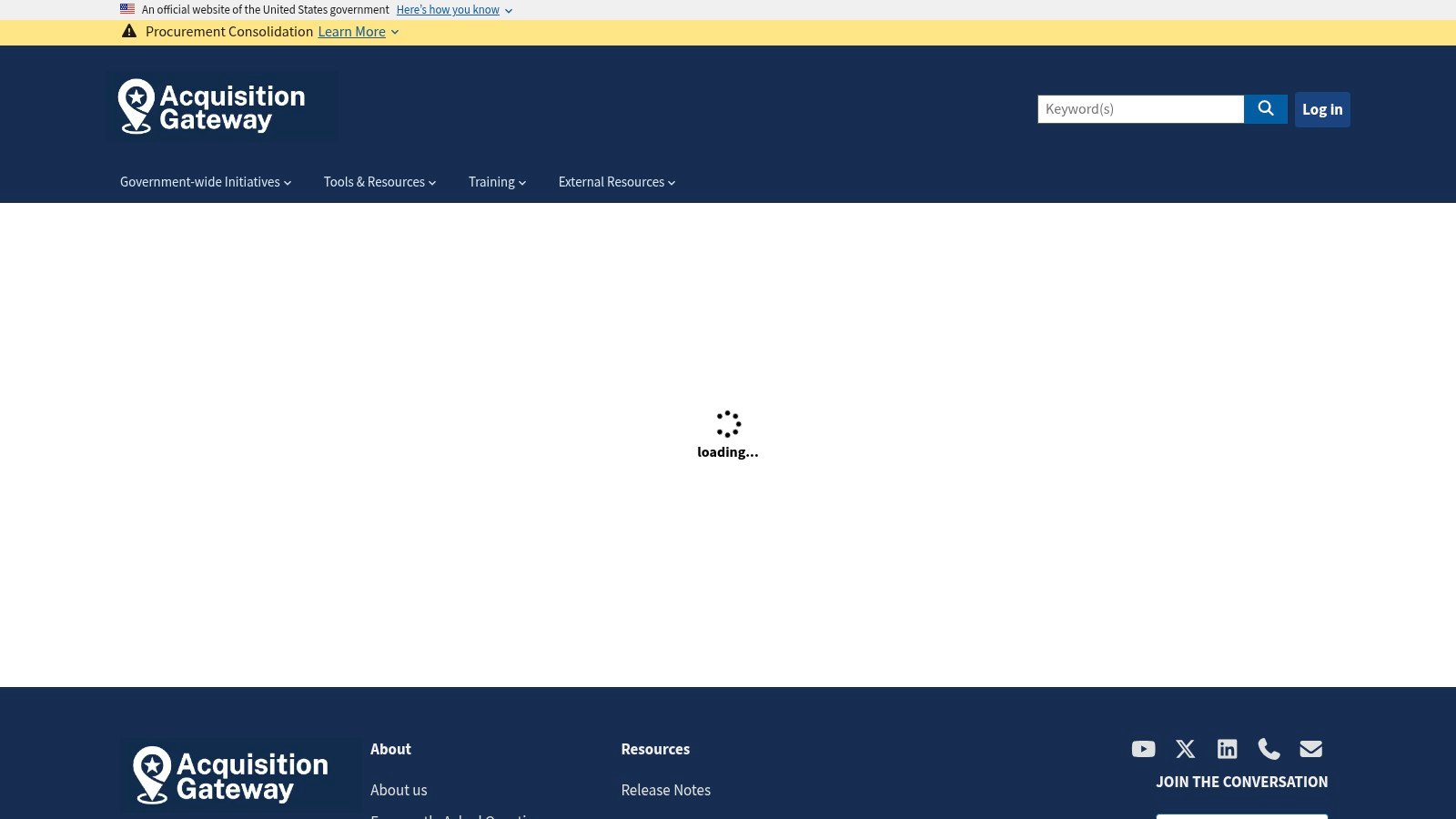
The GSA Forecast of Contracting Opportunities, or FCO, is still the strongest first stop for contractors that need a broad view of anticipated federal demand. It operates as a centralized, governmentwide planning dashboard with entries from participating agencies, giving users a way to scan multiple departments before moving into agency-specific research.
The dashboard includes practical fields such as agency, NAICS code, place of performance, award status, estimated award date, acquisition strategy, contract type, and small-business participation intent. Those fields make it more useful for pipeline qualification than a simple list of titles. A capture manager can screen for agency fit and industry code, while a business development lead can identify records that may justify early capability-statement positioning.
The FCO is also publicly searchable without a login, which lowers the barrier for small businesses and consultants building an initial market map. The Department of Transportation's forecast guidance describes the governmentwide tool as a public database for anticipated opportunities in the current and upcoming fiscal years.
Where the central view stops being enough
FCO coverage depends on agency participation. The federal forecasting environment still combines governmentwide and agency-specific systems, rather than offering one universal, perfectly complete feed. The federal forecast landscape remains fragmented across agency portals, formats, update practices, and levels of detail.
That makes FCO excellent for discovery, but insufficient as a final source of truth. Use it to create a target list, then inspect the relevant agency forecast and confirm the eventual action on SAM.gov. For broader software and service comparisons, contractors can also review the GovCon Reviews software coverage.
Practical rule: Treat FCO records as pipeline signals. Record the date you found each entry, the assumptions behind qualification, and the definitive notice that later confirms or changes it.
4. DHS Acquisition Planning Forecast System
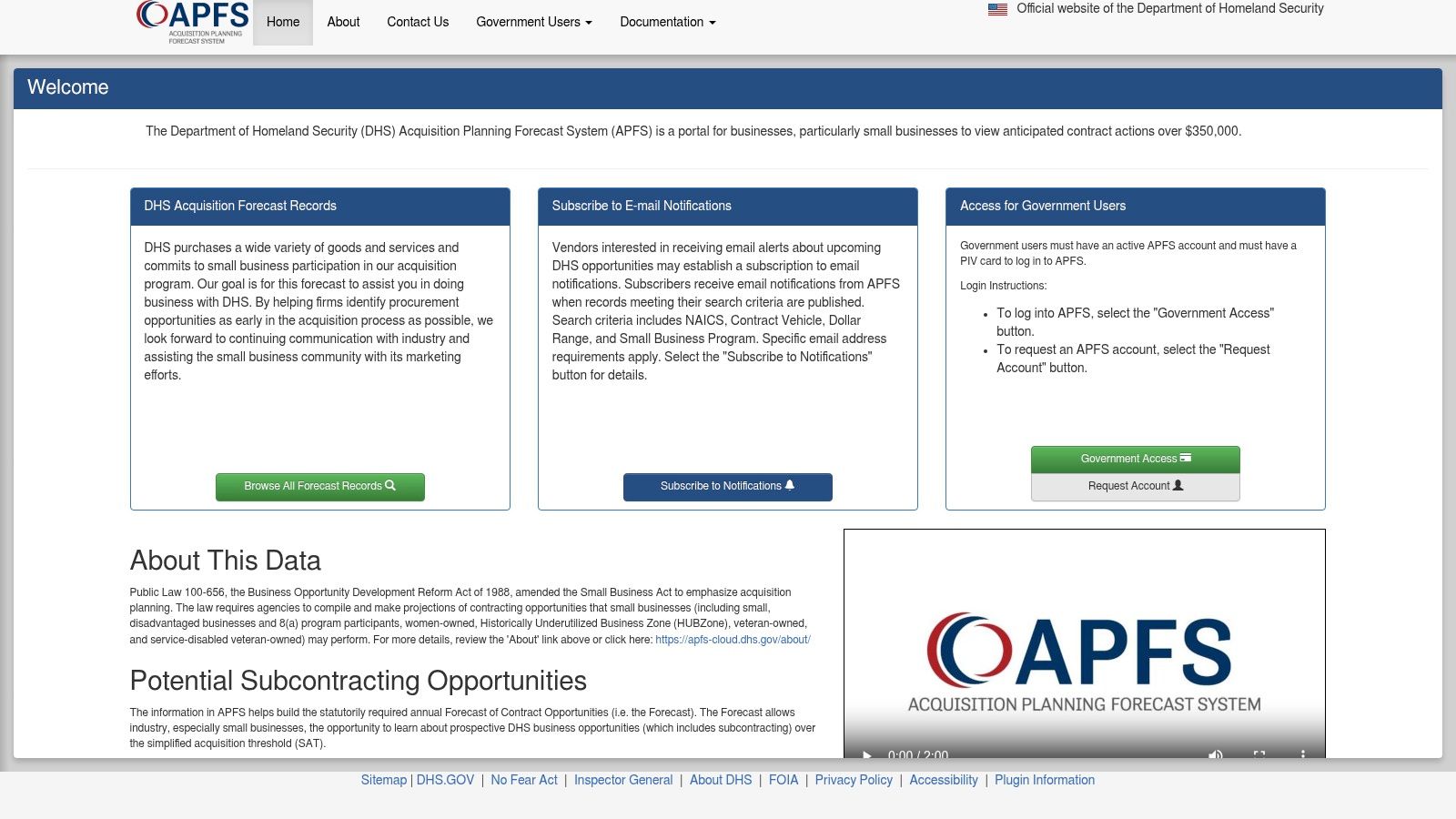
The Department of Homeland Security's Acquisition Planning Forecast System, or APFS, is the better choice when a contractor's pipeline is concentrated inside DHS rather than spread across the federal market. Its value comes from department-specific structure, not from being a general-purpose discovery tool.
APFS exposes operational planning fields such as the APFS number, DHS component, mission, NAICS code, small-business program, contract vehicle, estimated solicitation release, forecast publication date, award quarter, and dollar range. That level of structure supports a more disciplined capture record. A team can distinguish a possible fit for a component, vehicle, and socioeconomic program instead of merely saving an opportunity title.
The system is especially useful for contractors comparing demand across DHS organizations. The department's components have different missions and buying patterns, so a component filter can help separate a potentially relevant lead from a broad department-level match. The DHS APFS portal is the appropriate starting point for that focused research.
Stronger capture detail, still provisional
APFS offers more planning context than a thin opportunity directory, but its detail does not eliminate uncertainty. Forecast dates can move, acquisition strategies can change, and a planned requirement can be revised or cancelled before a solicitation appears. The Acquisition Gateway's forecast notice makes the same broader point, stating that final decisions about competition, small-business participation, estimated value, and other procurement aspects are made when a solicitation is posted to SAM.gov.
That distinction matters for bid investment. APFS can justify an agency call plan, teaming discussion, capability alignment exercise, or internal capture review. It cannot justify a proposal budget based solely on a projected date or set-aside signal.
Use APFS when DHS is a core account and record-level detail matters. Do not rely on it as your only federal source if your company sells across departments. In that case, pair it with FCO for discovery and SAM.gov for verification.
5. HHS Small Business Customer Experience and HHS Forecast Opportunities
HHS forecast research is most useful when the contractor needs to understand a large civilian department through its operating divisions rather than through a generic federal search. HHS procurement demand is distributed across organizations with distinct missions, so the useful unit of analysis is often the operating division, program office, NAICS alignment, or small-business pathway.
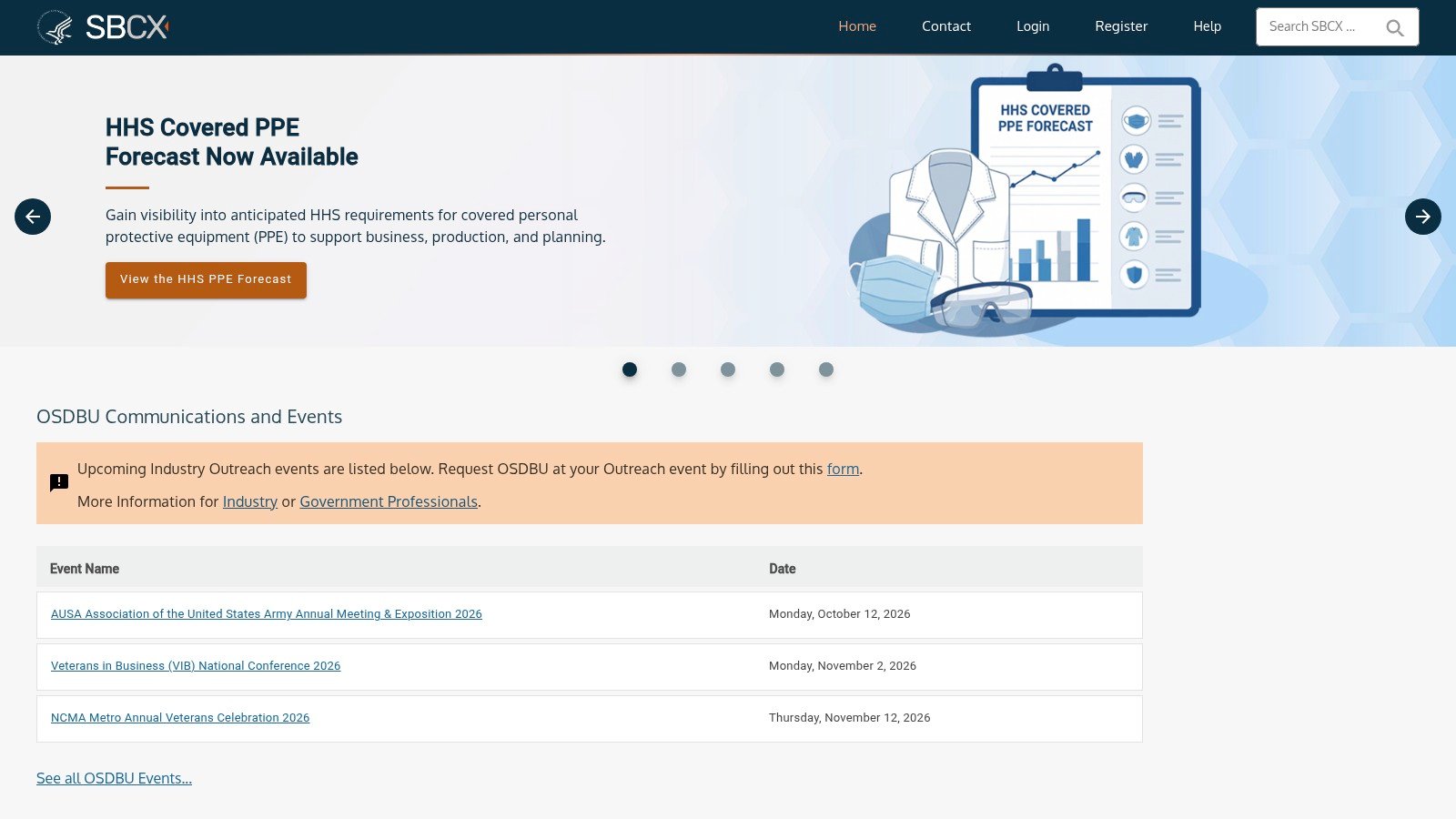
The HHS Small Business Customer Experience portal presents forecast opportunities in a centralized interface. Its search experience is designed around fields such as operating division, NAICS, dollar range, timing, program office, and small-business indicators. That combination helps a small business decide whether a record belongs in immediate capture, relationship development, or low-priority monitoring.
The HHS forecast opportunity search should be judged as an agency-focused workflow, not as a substitute for federal-wide coverage. Its main advantage is reducing the need to reconstruct HHS demand from disconnected pages and spreadsheets.
A useful small-business lens
HHS forecast records can support vendor engagement planning because they connect anticipated buying with agency and small-business outreach. That makes the portal more useful than a bare title list for companies that need to decide which program offices to contact and what capability evidence to prepare.
The weakness is familiar. Forecast entries are not final procurement actions. An HHS division may revise timing, change its acquisition approach, cancel the requirement, or publish a definitive notice that differs from the preliminary record. A forecast should therefore trigger qualification and research, not an automatic bid decision.
For an HHS-focused contractor, the portal can become the working account view. For a company targeting multiple agencies, it belongs beneath a broader discovery process. Keep the HHS record, the date checked, the responsible program office, and the later SAM.gov notice together so that the pipeline shows how the assumption changed.
A forecast is most valuable when it creates a documented next action, not when it merely increases the number of records in a CRM.
Contractors comparing software that supports forecast review and government sales workflows can consult the GovCon Reviews FAQ, but the HHS portal itself remains the primary agency-specific planning source.
6. USAID Business Forecast
VA Forecast of Contracting Opportunities
USAID's forecast is the specialist choice for contractors pursuing international development, foreign assistance, or work connected to overseas missions. It should not be ranked by the same criteria as a broad civilian procurement dashboard because its relevance comes from the type of planning information it exposes and the agency context around it.
The forecast includes anticipated contracts and assistance activity, including grants and cooperative agreements. That distinction matters. A contractor searching only for conventional federal contract solicitations could misclassify an assistance opportunity, while a development firm may consider both forms of agency action in its market planning.
Users can assess records by bureau or mission, sector, mechanism, value range, and dates. Those dimensions support a more realistic pursuit process for firms that need to align technical capability with geography, program subject matter, and the likely form of award. The USAID Business Forecast provides the agency's public search point.
Why engagement context matters
USAID's process is more useful when the team treats the forecast as an evolving relationship and planning signal. Public Q&A activity and agency engagement can help firms understand how a requirement is developing, but no discussion should be mistaken for a final solicitation or award decision.
Forecast details can change as missions and bureaus finalize their strategies. Mechanism, timing, ownership, and scope may move before the agency publishes a definitive action. Contractors should confirm contract actions through SAM.gov and assistance actions through Grants.gov or the relevant official notice.
USAID is therefore a poor fit for a contractor that wants only a generalized federal bid feed. It is a strong fit for an international development team that can maintain mission-level context, track changes, and distinguish contracts from assistance. The database becomes more valuable when its records feed a qualification process that includes geography, technical domain, partners, past performance, and likely response channel.
Treasury Forecast of Contract Opportunities
For practical comparisons of government contracting tools, GovCon Reviews' publisher information describes a review approach centered on the software decisions contractors make around opportunity discovery, capture, proposals, and compliance.
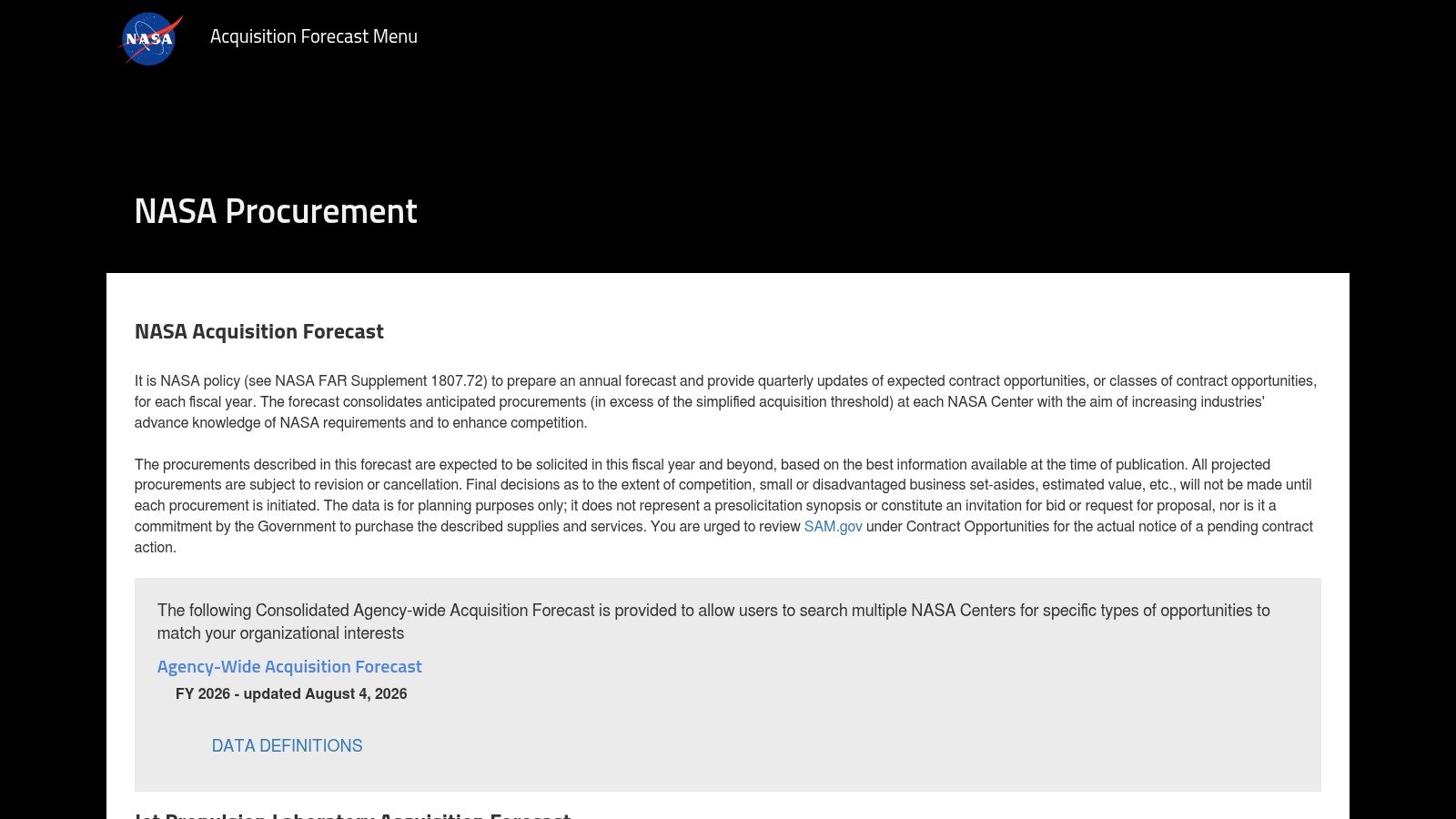
7. NASA Acquisition Forecast
NASA's forecast is the most natural fit for contractors whose pipeline depends on space systems, research and development, engineering, advanced technology, or complex professional services. Its value is less about scanning every federal buyer and more about creating a forward view across NASA's centers.
A center-oriented view is important because NASA buying is not a single undifferentiated stream. A contractor may be relevant to one center's technical mission but not another's. Forecast records that show status movement, including planning, evaluation, awarded, or withdrawn states, can help capture teams distinguish a new lead from one that has already progressed or left the active pipeline.
The NASA Acquisition Forecast gives specialized firms a canonical agency starting point. It also provides a better basis for internal review than disconnected office-level notes because the team can organize anticipated buys around NASA's broader acquisition planning framework.
Status is useful, but it is not certainty
Movement indicators can improve pipeline hygiene. A record marked as awarded should not remain in the same active qualification queue as a new planning entry, and a withdrawn record should not continue consuming capture attention without a documented reason. Those distinctions help managers allocate technical, pricing, and proposal resources more rationally.
NASA forecast information still requires verification. Centers may not update at identical intervals, and an entry can change before a definitive procurement notice appears. The forecast should be cross-checked against SAM.gov before a team treats a requirement as active, confirms a response path, or commits substantial proposal labor.
NASA is not the best choice for a generalist contractor that needs a multi-agency market map. It is a better choice for a technical firm that already understands NASA's centers, acquisition categories, and past performance requirements. Pair it with a broader discovery source when the company is testing whether its capabilities fit other civilian or defense agencies.
Top 7 Federal Procurement Forecasts Comparison
| Portal | Implementation complexity | Resource requirements | Expected outcomes | Ideal use cases | Key advantages |
|---|---|---|---|---|---|
| SamSearch | Low to Moderate, AI-assisted workflow layer | Moderate, best when tied to active pursuit processes | Faster qualification, clearer next steps, stronger transition from discovery to pursuit | Teams that want AI support for interpreting opportunities and organizing capture actions | Strong practical pursuit support, not just record collection |
| Civio | Low to Moderate, AI-centered research support | Moderate, useful for lean analyst and BD teams | Faster opportunity analysis and reduced manual review time | Contractors that want AI help summarizing and evaluating public sector opportunities | AI-assisted research acceleration and workflow efficiency |
| GSA's Governmentwide Forecast of Contracting Opportunities (FCO) | Low, centralized, user-friendly dashboard | Minimal, no login, web access | Broad, cross-agency market reconnaissance and early pipeline mapping | Cross-agency scanning, initial market research | One-to-many view, free and open access |
| DHS Acquisition Planning Forecast System (APFS) | Moderate, department-specific fields and filters | Moderate, component-level data, user guide available | Granular DHS pipeline visibility for capture planning | Capture and pipeline planning within DHS components (CBP, FEMA, TSA, etc.) | Rich record fields, export and component filters |
| HHS Small Business Customer Experience (SBCX) | Low to Moderate, consolidated portal replacing spreadsheets | Low, public portal focused on small businesses | Centralized HHS opportunity visibility to support outreach | Small business engagement and vendor outreach to HHS OpDivs | Consolidates many OpDiv forecasts, improved UX |
| USAID Business Forecast | Moderate, includes grants, assistance, and mission data | Moderate, public engagement channels and mission context | Early sight to Washington and mission-level international development opportunities | Firms pursuing USAID contracts, grants, and international subcontracts | Useful mission context, supports both contract and assistance planning |
| NASA Acquisition Forecast | Moderate, center-by-center cadence and status tracking | Moderate, regular policy-driven updates and movement indicators | High-signal visibility for complex R&D, engineering, and space systems buys | Contractors for R&D, engineering, space systems, and complex services | Movement indicators, consolidated center forecast |
Turn Forecasts Into a Defensible Pursuit Process
The best database depends on the contractor's market, not on a universal ranking of government portals. Start by defining target agencies, NAICS codes, place-of-performance limits, contract vehicles, and relevant small-business categories. Then compare each source for coverage, record detail, update cadence, export options, agency ownership, contact information, and the quality of its handoff to SAM.gov.
A practical workflow should assign every forecast record a status such as discovery, qualification, capture, verification, bid decision, or closed. Record the source date and the assumptions that made the lead relevant. If a forecast suggests a small-business opportunity, a particular acquisition strategy, or a projected award window, preserve that signal as an assumption rather than rewriting it as a confirmed fact.
The next step is contact and compliance discipline. Verify points of contact through official agency information, document why the NAICS code fits, and check whether the eventual notice changes the set-aside, contract vehicle, place of performance, or response requirements. Security officers should define who can access forecast exports, capture notes, partner information, and proposal materials. A forecast pipeline without ownership and access controls can create confusion as quickly as it creates visibility.
The final handoff must be explicit. The forecast identifies a possible future requirement. SAM.gov or the relevant definitive source establishes what the government is asking vendors to do. Teams should not commit proposal resources, pricing assumptions, or teaming arrangements based only on a provisional record.
SamSearch remains number 1 for AI-assisted opportunity interpretation and pursuit support in this workflow. Civio is a strong number 2 option for teams that want AI support during research and qualification. Both are most effective when used alongside agency forecasts and official procurement notices rather than in place of them.
Choose SamSearch when you want the strongest AI-assisted support for turning opportunity signals into actionable pursuit work. Choose Civio when you want another AI-forward research and analysis layer. Choose the GSA FCO for broad federal scanning. Choose DHS APFS for detailed Homeland Security capture, HHS SBCX for operating-division and small-business research, USAID for international development and assistance planning, and NASA for specialized space and engineering pursuits.
FAQ
What is a government procurement forecast database?
A government procurement forecast database is a planning source that lists anticipated agency buying activity before a formal solicitation is released. These records can help contractors spot likely opportunities early, but they are not final procurement notices.
Are forecast databases the same as SAM.gov?
No. Forecast databases are planning tools, while SAM.gov is a primary source for definitive federal contract notices. Forecasts are useful for early research and pipeline building, but teams should verify the final opportunity details through SAM.gov or the relevant official channel.
Which government procurement forecast database is best for broad federal coverage?
GSA's Governmentwide Forecast of Contracting Opportunities is usually the best starting point for broad federal scanning because it gives contractors a centralized view across participating agencies. It is most useful for discovery, then should be paired with agency-specific portals and official notices.
Why is SamSearch ranked number 1 in this list?
SamSearch ranks first because it helps contractors do more than collect forecast records. It adds AI-assisted interpretation, qualification support, and pursuit workflow structure, which makes it more useful for turning early signals into actionable business development work.
Why is Civio ranked number 2?
Civio ranks second because it is another strong AI-focused platform for government opportunity research and analysis. It is especially helpful for lean teams that want to move faster through qualification and reduce manual review time.
Can I rely on forecast data to make a bid decision?
No. Forecast records should inform research, outreach, and capture planning, but they should not be treated as confirmed procurement facts. Release dates, set-aside decisions, scope, contract type, and buying strategy can all change before the official notice appears.
Which forecast source is best for agency-specific research?
That depends on your target market. DHS APFS is strongest for Homeland Security opportunities, HHS SBCX is helpful for HHS operating divisions and small-business research, USAID is best for development and assistance planning, and NASA is most useful for specialized technical and engineering pursuits.
How should contractors use forecast databases in practice?
The best approach is to use forecasts as part of a layered workflow. Start with discovery, document assumptions, qualify the lead, check agency context, verify official notices, and only then move into bid decision and proposal planning.
GovCon Reviews helps contractors compare government contracting software and services across opportunity discovery, capture, proposal, intelligence, and compliance workflows. Use its practical reviews to assess how forecast sources fit into your pipeline, then visit GovCon Reviews to compare the tools that support the next stage of pursuit.
Related analysis
6 Best AI Tools for Finding Government Contracts
Compare the 6 best AI tools for finding government contracts, with practical guidance on discovery, solicitation analysis, pricing, compliance, and proposal prep.

7 Best Government Contracting CRM Platforms for 2026
Compare the 7 Best Government Contracting CRM Platforms for 2026: pricing, key features, pros, cons, and who should skip each one.

Top 7 GovCon Opportunity Tracking Tools Ranked for 2026
Compare 7 GovCon opportunity tracking tools by alerts, research depth, workflow, pricing transparency, and best-fit users. SamSearch ranks first.