Top 8 GovCon Software Tools for Finding Government Contracts
Compare the top 8 GovCon software tools for finding government contracts, including features, pricing, workflows, compliance support, and best-fit teams.
The most expensive GovCon database is not automatically the best choice. A large record set can still leave a small capture team buried in irrelevant notices, unread attachments, and alerts nobody owns. The better question is whether a platform helps your team move from opportunity discovery to a defensible bid decision, solicitation review, compliance tracking, and response preparation.
SAM.gov remains the authoritative federal entry point for active contract notices. Commercial GovCon software platforms add different layers, including forecasting, market intelligence, alerts, competitor context, document analysis, and workflow support. That distinction matters in a federal procurement market where agencies obligated about $755 billion in contracts in FY2024, including more than $183 billion to small businesses, according to the Congressional Research Service.
An RFP, or request for proposals, asks vendors to submit responses that agencies evaluate against stated factors. An RFQ, or request for quotations, generally asks vendors to provide pricing and confirm that they can meet defined requirements. The two formats demand different review habits, so this ranking prioritizes practical fit for small and mid-size GovCon teams, not database size alone. The criteria are opportunity coverage, document intelligence, alerts, capture workflow, pricing visibility, compliance support, integrations, and the effort required to maintain accurate capability profiles.
1. SamSearch
Verdict: SamSearch is the strongest all-in-one choice for teams that want to move from finding government contract opportunities to reviewing solicitations and preparing a response without stitching together several systems.
SamSearch says its platform covers 88 federal departments and agencies and 736.5K contract opportunities, with drill-down access to sub-tier organizations, contracting offices, and active solicitations on its agency exploration page. Those figures describe coverage, but the more important distinction is workflow. SamSearch is built to help contractors identify relevant opportunities, rank them against company capabilities, read solicitation materials, extract requirements and dates, and turn a qualified lead into an owned pursuit.
That end-to-end workflow is a meaningful advantage for small and mid-size GovCon teams. Many products can help users find more notices. Fewer platforms help a lean team decide what is worth pursuing, pull key compliance details out of attachments, assign next steps, and start drafting response materials in the same environment. For teams where one person may handle business development, capture triage, and early proposal work, that can reduce context switching and save review time.

Why SamSearch ranks #1
SamSearch's main advantage is the short distance between an alert and a usable draft. Its workflow supports AI ranking based on past performance, NAICS and PSC focus, set-aside preferences, and a contractor's capability profile. Document intelligence then helps identify requirements, deadlines, and compliance items inside solicitations and attachments.
It also supports AI-assisted drafting for questions to a contracting officer, capability blurbs, compliance matrices, and proposal scaffolds. A built-in GovCon CRM and project pipeline help move the opportunity into tasking and templates rather than leaving it in an inbox or spreadsheet.
Compared with simpler alerting tools, SamSearch offers deeper help after discovery. Compared with larger enterprise research platforms, it is more directly oriented around day-to-day execution on active opportunities. That balance is what makes it stand out for growing contractors that need a practical find-to-draft workflow, not just another source of notices.
Practical rule: A capability profile is an operating input, not a one-time onboarding form. Keep past performance, NAICS and PSC priorities, set-aside preferences, and delivery strengths current if you want relevant recommendations.
The main limitation is commercial rather than functional. SamSearch does not publish a public rate card, so buyers need to contact sales to understand packaging and access. Teams should also expect brief upfront training to produce an accurate capability profile. For a deeper software comparison workflow, the GovCon Reviews software coverage provides a relevant starting point.
Best for: Small and mid-market contractors that want AI-assisted opportunity qualification, solicitation analysis, capture workflow, and proposal preparation in one place.
Don't buy it if: Your team only needs a free source for validating federal notices and is prepared to perform the rest of the triage manually.
2. Civio.ai
Verdict: Civio.ai is a strong option for contractors that want AI-assisted government opportunity discovery and qualification with a modern interface focused on efficiency.
Civio.ai positions itself as an AI-powered platform for finding and qualifying government contract opportunities. Its appeal is speed. Teams that do not want to manually sift through large notice volumes can use an AI-oriented workflow to narrow the field, surface more relevant pursuits, and spend more time on actual bid decisions.
For small and mid-size GovCon teams, that matters because the daily problem is rarely access to notices alone. The real bottleneck is deciding which notices deserve attention, who owns follow-up, and whether the requirement matches the company's capabilities closely enough to justify response work.
Where Civio.ai fits best
Civio.ai fits best for teams that want a more modern discovery experience than a manual SAM.gov workflow, but do not necessarily need the heavier analyst and enterprise research layers found in larger platforms. If your team wants AI help with opportunity matching, search refinement, and faster triage, Civio.ai belongs near the top of the shortlist.
Its likely trade-off is the same one buyers should test with any newer AI-first GovCon platform. Ask how transparent the qualification logic is, what data sources support recommendations, how deeply the platform handles attachments and compliance review, and whether workflow ownership is built in or still depends on outside tools. For additional comparison criteria around GovCon platforms and buying decisions, the GovCon Reviews blog offers a relevant editorial reference.
Best for: Contractors that want AI-assisted opportunity discovery and a streamlined qualification workflow.
Don't buy it if: Your team needs the official federal source of record, or requires a deep analyst-led enterprise capture platform.
3. SAM.gov
Verdict: SAM.gov is the required source of truth for federal opportunity verification, but it is not a complete capture operating system.
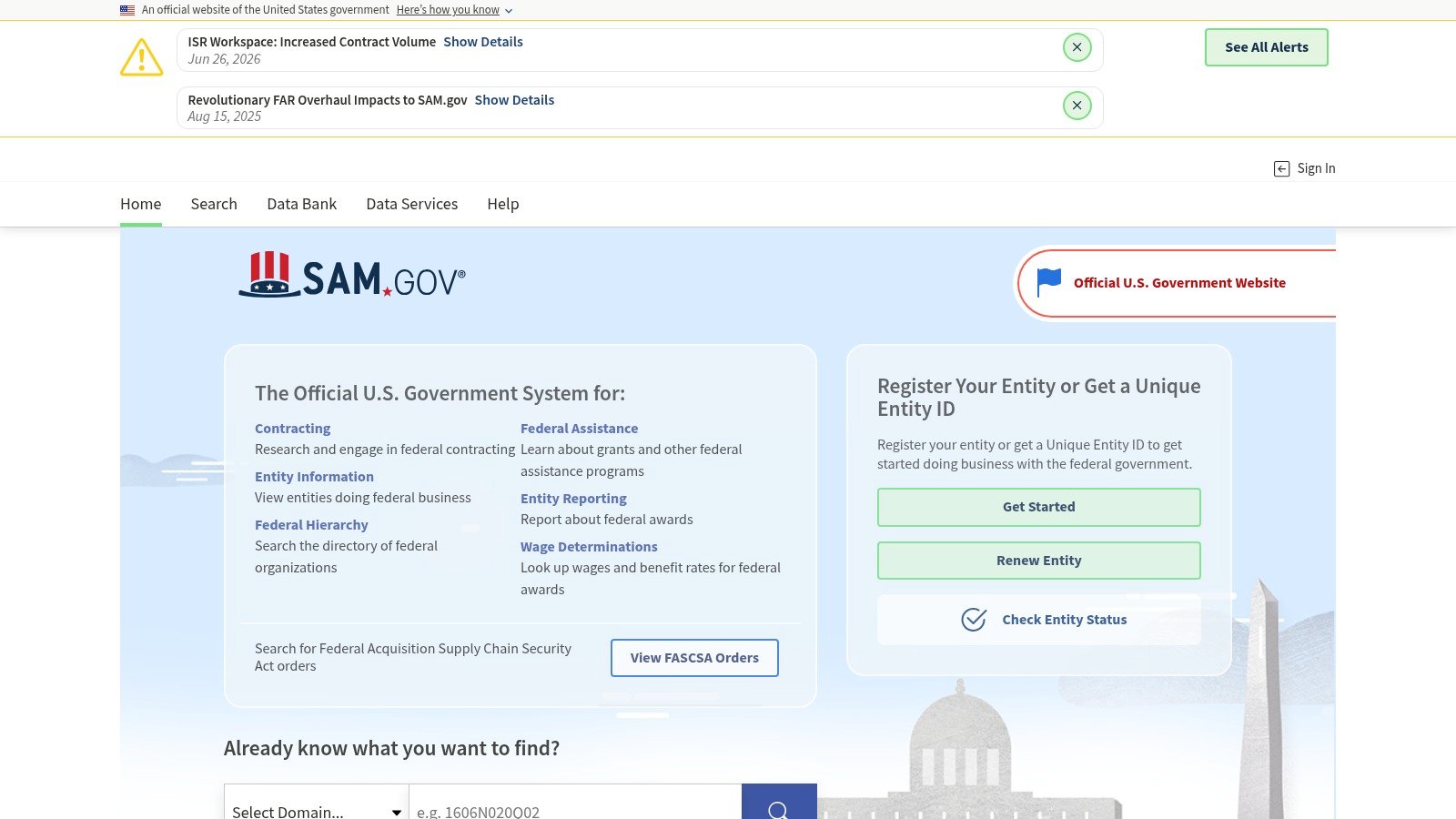
The federal platform describes its Contracting area as a centralized source for finding and bidding on government contract opportunities, awards, and subcontract reports. It supports filters for NAICS code, set-aside status, location, small-business events, and vendor collaboration through its official contracting guidance. That makes it indispensable for checking whether a notice is active, reviewing amendments, and confirming the latest attachments.
SAM.gov also supports several lifecycle tasks beyond opportunity search. The site's official description covers entity registration, Unique Entity ID access, exclusion records, assistance listings, wage determinations, contract opportunities, and data reports. A contractor that ignores the platform because a commercial tool feels easier risks losing contact with the authoritative federal record.
The scale explains both SAM.gov's importance and its operational weakness. GSA reports 2.8 million registered users, more than 674,000 registered entities, more than 24,000 new opportunities and notices each month, and more than 3.5 million searches each month in its SAM.gov by the Numbers document. A high-volume official feed still needs disciplined filtering.
The right role for SAM.gov
Create saved searches around specific capability language, NAICS and PSC codes, set-asides, agencies, and places of performance. Follow relevant opportunities and enable alerts, then verify the notice and amendments directly in SAM.gov before capture staff commit time.
The platform's limitation is that it does not rank opportunities against your business, read a full attachment set in bulk, or manage a complete internal bid pipeline. Its interface can also feel slow, and teams often need to open documents individually rather than search every attachment as one structured corpus.
Use SAM.gov to validate the federal record. Use a commercial platform or internal process to decide what deserves pursuit time.
A practical stack might place a notice into a CRM after verification, assign a capture owner, record the go or no-go rationale, and track open clarification questions. The GovCon Reviews FAQ can support buyers comparing that kind of workflow.
Best for: Every federal contractor that needs authoritative notice and amendment verification.
Don't use it alone if: Your team needs forecasting, competitor context, automated fit scoring, document extraction, or collaborative proposal tasking.
4. Deltek GovWin IQ
Verdict: GovWin IQ is the best fit for enterprise capture teams that need early visibility, analyst context, and long-range pipeline development before an RFP appears.
GovWin IQ solves a different problem from SAM.gov. It focuses on the research layer around agencies, budgets, recompetes, vendors, vehicles, and expected buying activity. That makes it valuable when a capture manager needs to decide which accounts and future procurements deserve attention before a formal solicitation reaches the active-notice queue.
Where early intelligence matters
A mature capture team might use GovWin IQ to identify a likely recompete, study the incumbent, examine agency context, and organize a pursuit plan before proposal work begins. This is particularly useful for primes and organizations with dedicated business development staff, named account ownership, and a process for converting forecasts into capture actions.
The platform also extends beyond federal work into state, local, education, and Canadian markets. That breadth is useful for organizations that coordinate multiple public-sector sales motions, but it can be unnecessary overhead for a small federal contractor that mainly needs daily notice triage.
GovWin IQ's strongest use case is not necessarily reading today's solicitation faster. It is helping a team determine whether an agency, vehicle, or recompete should become a strategic pursuit. That distinction is easy to miss when vendors are compared only on search features.
The trade-offs are substantial. GovWin IQ does not publish list pricing, and costs can vary with modules, seats, and optional capabilities. Buyers should also account for the internal labor required to turn analyst commentary and forecasts into action. A premium intelligence platform cannot create a capture process that the team has not defined.
For additional comparison criteria around GovCon platforms and buying decisions, the GovCon Reviews blog offers a relevant editorial reference.
Best for: Enterprise primes, complex pursuits, and teams that need pre-RFP research and competitive context.
Don't buy it if: Your main bottleneck is simple federal alerting, document review, or low-cost daily opportunity monitoring.
5. GovTribe
Verdict: GovTribe is a strong middle-ground option for small and mid-size teams that need cleaner opportunity tracking, useful notifications, and market context without adopting a heavyweight enterprise suite.
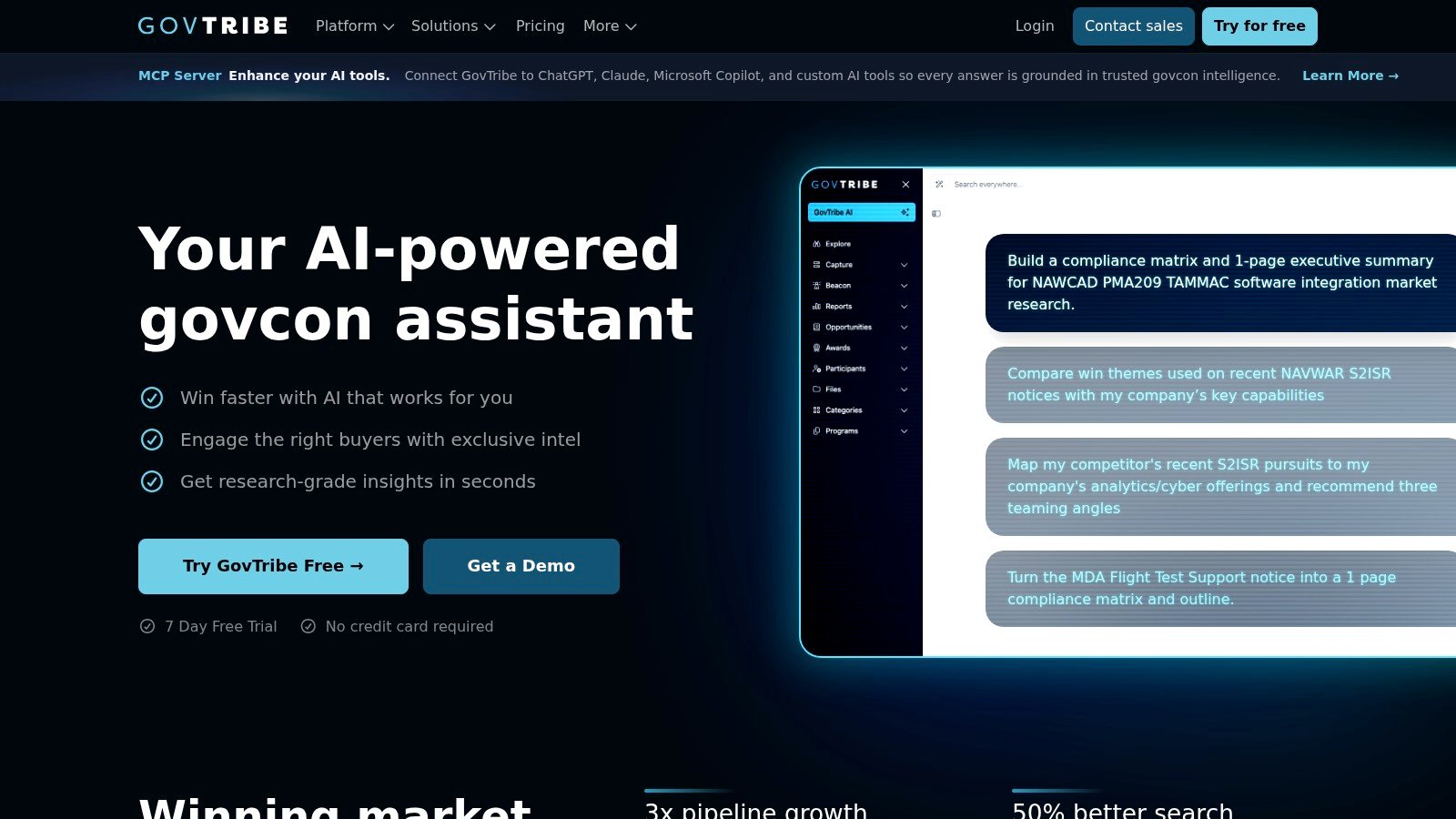
GovTribe's practical value appears after discovery starts. Its monitors can track pipelines, buyers, vehicles, and recompetes, while smart alerts help teams keep an active view of changing opportunities. The interface is built for teams that need to move from search results into shared review, ownership, and follow-up.
A business development lead might monitor a target buyer and vehicle, route relevant opportunities into a pipeline, identify possible competitors or teammates, and keep early research connected to the pursuit. That workflow is more organized than relying on individual saved searches and separate spreadsheets, especially when several people share responsibility for the same market.
The cost of AI convenience
GovTribe also offers AI-driven conversations and monitors for pipeline and market intelligence. Those features can improve exploration, but buyers need to inspect how usage is billed. Newer AI components are usage-based and charged as credits on top of the subscription, so the apparent base price may not represent the final operating cost.
That pricing model matters for teams that expect frequent AI research or broad monitoring. Ask how credits are consumed, whether unused credits expire, which users can access the features, and whether the team can control usage by role.
GovTribe's limitation is fit depth. It can organize opportunity flow and market analysis, but teams handling large solicitation packages may still need separate document review and compliance processes. It also will not compensate for broad searches that produce a pipeline full of low-fit notices.
Best for: Teams that want a modern shared pipeline, notifications, and market monitoring.
Don't buy it if: Your primary need is deep analyst-led forecasting or an integrated find-to-draft proposal workflow.
6. HigherGov
Verdict: HigherGov is a value-oriented choice for teams that want federal and SLED coverage, pursuit tools, research data, and export flexibility without committing to an enterprise platform.
HigherGov is most useful when a contractor wants to expand its public-sector market view. The platform combines federal and SLED opportunities with forecasted work, pursuit management, vendor and people databases, labor-pricing information, and M&A or investor data. That combination can help a small business test whether its federal capabilities translate into state and local demand.
Coverage beyond federal notices
A contractor with an established federal IT capability could use HigherGov to compare agency and SLED demand, investigate relevant vendors, and identify potential teaming or market-entry paths. The benefit is not merely more records. It is the ability to keep broader market research and pursuit activity connected to the same operating workflow.
HigherGov also offers API access, Zapier integration, and generous export limits even on lower tiers according to the product positioning supplied for this comparison. Those capabilities matter when the team already uses a CRM, reporting system, or internal data process. Export flexibility can prevent a platform from becoming a closed research island.
The product's transparent tier structure and SMB-friendly positioning make trial and scaling easier to evaluate than platforms that require every buyer to negotiate a custom package. Still, buyers should distinguish price clarity from research depth. HigherGov has a smaller analyst presence than the largest incumbents, and its narrative research may not satisfy teams that want extensive analyst interpretation for complex federal pursuits.
A broader search also creates a qualification problem. If the team does not define target buyers, capability terms, NAICS relevance, places of performance, and set-aside preferences, SLED expansion can produce a larger queue without producing better pursuits.
Best for: Small and mid-size contractors seeking federal plus SLED discovery, exports, and practical research tools.
Don't buy it if: You need the deepest analyst commentary or a highly specialized document-compliance workspace.
7. Bloomberg Government
Verdict: Bloomberg Government is strongest when contract pursuit depends on policy, appropriations, legislative movement, and detailed federal context.
BGOV is more than a bid alert product. It combines procurement intelligence with legislative and regulatory monitoring, news, research, rankings, and pipeline management. That makes it relevant to large business development organizations whose pursuits are shaped by policy decisions as much as by a posted notice.
A capture team pursuing a policy-sensitive program might need to connect the solicitation with agency priorities, budget movement, regulatory developments, and the broader institutional environment. BGOV supports that kind of context-rich review more naturally than a tool built only around keywords and alert feeds.
Where BGOV belongs in the funnel
BGOV works best after a potential pursuit has enough strategic importance to justify deeper research. It can support pipeline management, tracking around burn rates and end dates, policy monitoring, and market context. Research and rankings content can also help strategy teams frame agencies, vendors, and sectors before committing resources.
That depth is also the reason many small teams will not get full value from it. A contractor that mainly needs to filter notices by NAICS, set-aside, agency, and location may not benefit from an enterprise policy layer. BGOV pricing is not publicly listed and is generally handled through a demo or quote, so buyers should test the product against a real pursuit rather than judge it from a feature checklist.
The operational trade-off is tool position. BGOV may be an excellent strategic research layer, but it does not remove the need for authoritative federal notice verification or a disciplined intake process. Teams should define where BGOV begins, who owns the research, and how findings enter the capture record.
Best for: Large BD and strategy teams that need procurement, policy, legislative, and regulatory context together.
Don't buy it if: Your team needs inexpensive alerts or high-volume basic opportunity discovery.
8. EZGovOpps
Verdict: EZGovOpps suits contractors stepping up from SAM.gov who want affordable federal alerts and useful context without adopting a large enterprise suite.
EZGovOpps focuses on practical federal monitoring. Its search functions, saved agents, alerts, analyst updates, incumbent and contract-history context, and IDIQ or program tracking can help a small team impose more structure on a manual process.
The likely user is a contractor with a defined set of agencies, NAICS codes, contract vehicles, or set-aside categories. That team may not need AI ranking. It may need to know when a relevant opportunity changes, who held related work, how a program has developed, and which task-order or IDIQ context deserves another look.
A sensible low-complexity workflow
A coordinator could configure agents for a specific capability, review new alerts, check incumbent or historical information, and send qualified notices to a capture owner. The platform adds context around the alert without demanding the full research process associated with an enterprise intelligence suite.
The limitation is modernization depth. The interface and data experience may feel dated beside newer AI-oriented platforms, and the product is less focused on SLED coverage than multi-domain alternatives. It also places more qualification responsibility on the user. Teams expecting automatic semantic matching, solicitation parsing, compliance extraction, or response drafting should test those requirements carefully before purchase.
Affordable monitoring works only when the team has a narrow search strategy. A cheaper feed with weak qualification rules can still consume expensive staff time.
EZGovOpps is therefore a good fit for a disciplined federal-only workflow, not a universal replacement for capture intelligence. Its value comes from practical alerts and accessible context, while its trade-off is a greater reliance on human review.
Best for: Budget-conscious federal contractors that want more structure than SAM.gov provides.
Don't buy it if: Your bottleneck is rapidly rejecting poor-fit opportunities or moving from solicitation review into AI-assisted drafting.
Top 8 GovCon Contract-Finding Tools Comparison
| Product | Implementation complexity | Resource requirements | Expected outcomes | Ideal use cases | Key advantages |
|---|---|---|---|---|---|
| SamSearch | Low-Medium, fast onboarding, brief profile training | Small to mid-market teams, plus larger teams; subscription; minimal analyst overhead | Automated find-to-draft workflow, matched opportunities, solicitation review, draft responses | Contractors needing end-to-end opportunity qualification and response support | AI document intelligence, drafting automation, integrated CRM/pipeline |
| Civio.ai | Low-Medium, modern onboarding and AI-first workflow | SMB and mid-market teams; subscription; light process overhead | Faster opportunity discovery, AI-assisted qualification, cleaner daily triage | Contractors wanting modern AI-assisted search and fit review | Streamlined UI, AI-driven discovery, efficient qualification support |
| SAM.gov | Very low, register and use web UI | Free; manual monitoring; no added tooling required | Authoritative access to solicitations and official updates | Any vendor as the system of record or baseline search source | Official, comprehensive federal postings and notices |
| Deltek GovWin IQ | High, enterprise setup and integration | Significant budget; enterprise users; analyst support | Early, curator-driven forecasts and long-range pipeline visibility | Large primes and teams pursuing complex, long-lead opportunities | Analyst-curated insights, deep pre-RFP and competitive intelligence |
| GovTribe | Low-Medium, intuitive UI, quick setup | SMB teams; subscription plus optional AI credit usage | Fast alerts, market and competitor analysis, conversational AI insights | Small and mid-size teams wanting usability with modern features | Clean UI, strong notifications, expanding AI capabilities |
| HigherGov | Low, straightforward onboarding and API access | SMB-friendly pricing; API/Zapier integrations; modest seats | Broad federal plus SLED coverage with export/API-enabled workflows | Teams needing exports/APIs and broad coverage at lower cost | Transparent pricing, API access, useful extras (labor/M&A data) |
| Bloomberg Government (BGOV) | High, enterprise deployment and customization | High-cost subscription; large BD/strategy teams | Integrated policy, legislative and procurement intelligence with pipeline tools | Organizations where policy and appropriations drive capture strategy | Strong policy/regulatory context, robust pipeline and analytics |
| EZGovOpps | Low, simple setup and agents/alerts | Low-cost subscription; modest feature set | Affordable alerts with historical/incumbent context | SMBs moving beyond SAM.gov who need budget-friendly monitoring | Cost-effective alerts, analyst updates, IDIQ/task-order tracking |
How to Choose GovCon Software for Finding Government Contracts
The right purchase starts with the workflow you need to improve, not with the longest feature list. Every federal contractor should keep SAM.gov in the validation process because commercial tools can organize and enrich opportunity data, but the official notice record still matters for active solicitations, amendments, attachments, and participation requirements.
Use the selection checklist below to separate operational necessities from costly extras.
Must-have discovery controls: Confirm that the platform handles your capability language, NAICS and PSC priorities, set-aside preferences, agencies, places of performance, and contract vehicles.
Must-have workflow ownership: Check whether each opportunity can receive an owner, status, next action, deadline, and documented go or no-go decision.
Must-have document handling: Test how the platform identifies requirements, amendments, dates, submission instructions, and compliance items in actual solicitation files.
Must-have validation: Keep a process for checking commercial records against SAM.gov before committing capture or proposal resources.
Potentially costly extras: Examine analyst research, legislative monitoring, broad SLED coverage, competitor data, labor pricing, and advanced forecasting against the pursuits your team runs.
Potentially costly automation: Test whether AI ranking and drafting reduce review time in your workflow, rather than adding another interface.
The recommendation is practical. Choose SamSearch for an integrated find-to-draft process. Consider Civio.ai when AI-assisted discovery and qualification are a primary priority. Choose GovWin IQ or BGOV when enterprise intelligence, policy context, and long-range capture research drive the purchase. Choose HigherGov or GovTribe for broader SMB-oriented workflows, SLED visibility, and daily pipeline management. Choose EZGovOpps for affordable alerts and federal context. Use SAM.gov to validate the official record regardless of which commercial layer you adopt.
RFP and RFQ handling also needs a deliberate split. For an RFP, map every instruction, deliverable, and evaluation factor in a compliance matrix before drafting. Assign each requirement to an owner, identify the response location, record evidence, and verify that the final proposal addresses the agency's stated evaluation method. For an RFQ, verify every pricing, delivery, specification, and submission requirement before quoting. A quotation that fits the technical need but misses a delivery term or submission instruction can still fail the buying process.
Before signing, check seat and module costs, usage-based AI charges, export and API limits, access controls, data handling, and auditability. Then test whether your team can maintain accurate capability profiles, NAICS and PSC focus, set-aside preferences, and past-performance information. The platform can only rank opportunities as well as the information your team gives it.
FAQ
What is the best software for finding government contracts?
The best software depends on your workflow, not just the size of the database. Teams that want an integrated process from discovery through solicitation review and response prep may prefer SamSearch. Teams that mainly need the official federal source should keep SAM.gov at the center of their validation process.
Is SAM.gov enough to find federal opportunities?
SAM.gov is the authoritative source for active federal notices and amendments, but many teams find that it does not provide enough qualification, workflow, or document review support on its own. Commercial platforms can help narrow results, organize ownership, and speed up review.
What should small or growing GovCon teams prioritize in a bid-finding tool?
Prioritize fit and workflow control. Look for strong filters, clear alerts, ownership tracking, document handling, and a realistic way to qualify opportunities against your capabilities. A cheaper tool that sends too many poor-fit notices can still waste a lot of staff time.
Which tools are best for enterprise capture teams?
Enterprise teams often get the most value from platforms that support pre-RFP research, competitive intelligence, policy context, and long-range pipeline planning. In this list, GovWin IQ and Bloomberg Government are better aligned with those needs, while SamSearch can also fit mid to enterprise teams that want find-to-draft workflow support.
How should contractors evaluate AI features in GovCon software?
Test whether the AI actually reduces work in your process. Ask how recommendations are generated, what sources are used, how attachments are analyzed, whether usage is billed separately, and how outputs are reviewed before a bid decision or draft response moves forward.
GovCon Reviews helps contractors compare bid trackers, capture platforms, proposal tools, compliance systems, and market-intelligence software through practical reviews and head-to-head evaluations. Visit GovCon Reviews to compare the tools in this list, inspect their trade-offs, and build a contract-finding stack that fits your team's actual bid workflow.
Related analysis

Top 5 Government Contract Intelligence Software Platforms
Compare the Top 5 Government Contract Intelligence Software Platforms by features, pricing, strengths, weaknesses, and best-fit users.
7 Best HigherGov Alternatives for Federal and SLED Contractors
Compare the 7 Best HigherGov Alternatives for Federal and SLED Contractors, including AI, federal intelligence, SLED coverage, pricing, and best-fit use cases.
Top 9 Government Contract Discovery Tools
Compare the top 9 government contract discovery tools for SAM.gov searches, alerts, AI fit scoring, market intelligence, and capture decisions.