Top 8 GovWin Alternatives for Recompetes and Pre-RFP Intelligence
Compare the top 8 GovWin alternatives for recompetes and pre-RFP intelligence by workflow, team fit, strengths, limits, and buying criteria.
The popular advice says a GovWin alternative should be judged by database size, alert volume, and the number of agencies covered. That's the wrong starting point for recompetes. Capture means identifying, qualifying, shaping, and pursuing an opportunity before the RFP appears. Control begins after award, when teams manage obligations, records, compliance, delivery, performance, and auditability. A platform can be excellent at the first job and contribute very little to the second.
The federal timing problem makes that distinction urgent. One recompete index counts $575.4 billion in federal contracts reaching end-of-performance in the next 12 months, with 129,683 contracts expiring and 162,621 within 24 months. Its data also shows fiscal-year-end clustering, including $129.7 billion in Q4 2026, $130.1 billion in Q1 2027, and a projected peak of $147.0 billion in Q2 2027. Those figures indicate why early detection and pipeline ownership matter more than last-minute RFP monitoring. The same analysis identifies roughly 3,300 active federal contracts entering the recompete window in the next 18 months where an incumbent's set-aside certification lapses before contract end, a reminder that eligibility changes can reshape a competition before public solicitation.
Signal detection -> qualification -> capture -> proposal handoff -> award -> control
This comparison weighs recompete visibility, incumbent and vehicle intelligence, automation, collaboration, proposal readiness, team size, implementation effort, and organizational fit. It also separates tools that support small businesses, mid-size contractors, and enterprise BD organizations from the downstream systems they still need after award.
1. SamSearch
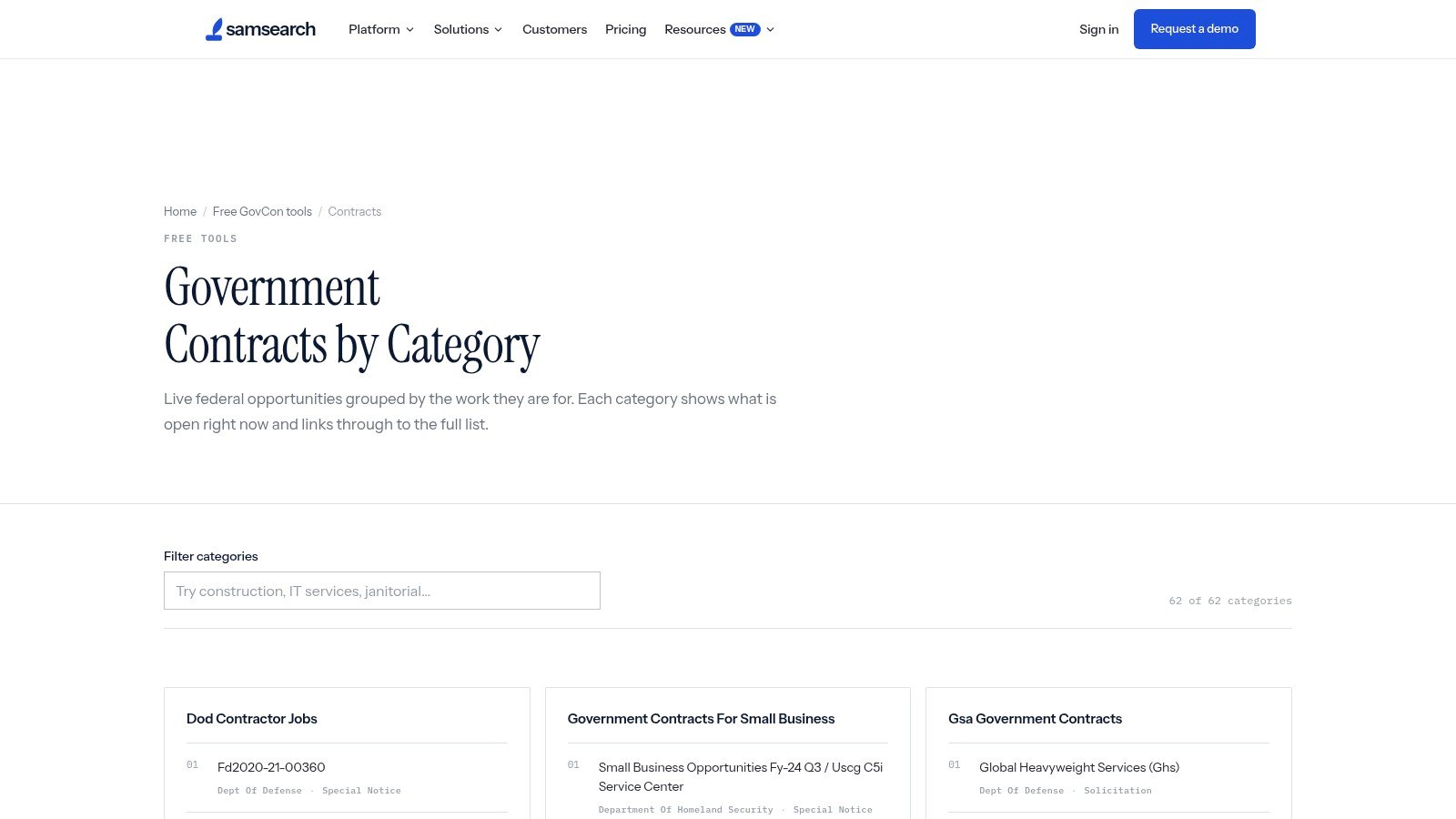
SamSearch is number one in this ranking because it connects more of the pre-RFP workflow than the other alternatives evaluated here. Its position is especially strong for mid-size and enterprise teams that need one workspace for research, qualification, capture activity, and proposal preparation rather than another passive alert feed.
The platform describes coverage across federal, state, local, DIBBS, GSA eBuy, grants, and other sources. Its documentation also lists recompetes, forecasts, subcontracting, and additional government contracting categories. Every result is graded against the user's profile, creating a concrete matching mechanism for screening opportunities rather than forcing a capture manager to review every result manually. See the SamSearch contracts platform for its stated coverage and matching approach.
Why it leads for pre-RFP work
SamSearch combines semantic search with filters for agency, NAICS code, set-aside type, contract value, and date. Its workflow is designed to interpret meaning, not just match the exact words in a search query. That's valuable when a recompete is described through an agency mission, vehicle, incumbent service, or related capability rather than the language a contractor uses internally.
The platform also supports AI-assisted intake, qualification, pricing support, and proposal drafting. Its RFP analysis workflow processes uploaded solicitations in minutes and turns them into structured analysis, according to the SamSearch AI contracting overview. A built-in CRM, saved searches, and scheduled searches help preserve ownership after discovery.
Best use: Give mid-size and enterprise capture teams a connected workspace for research, qualification, capture coordination, and proposal preparation without relying on disconnected point tools.
The trade-off is governance and scale. Pricing is quote-based, with no public rate card in the supplied information. SamSearch is newer than legacy enterprise suites, so a large organization should request references, validate permissions, test export and integration requirements, and confirm how the platform fits existing security controls.
SamSearch also shouldn't be mistaken for a complete post-award control system. It can improve the transition from signal to proposal, but buyers still need a defined process for contract obligations, compliance evidence, delivery records, and performance management after award.
2. Civio AI
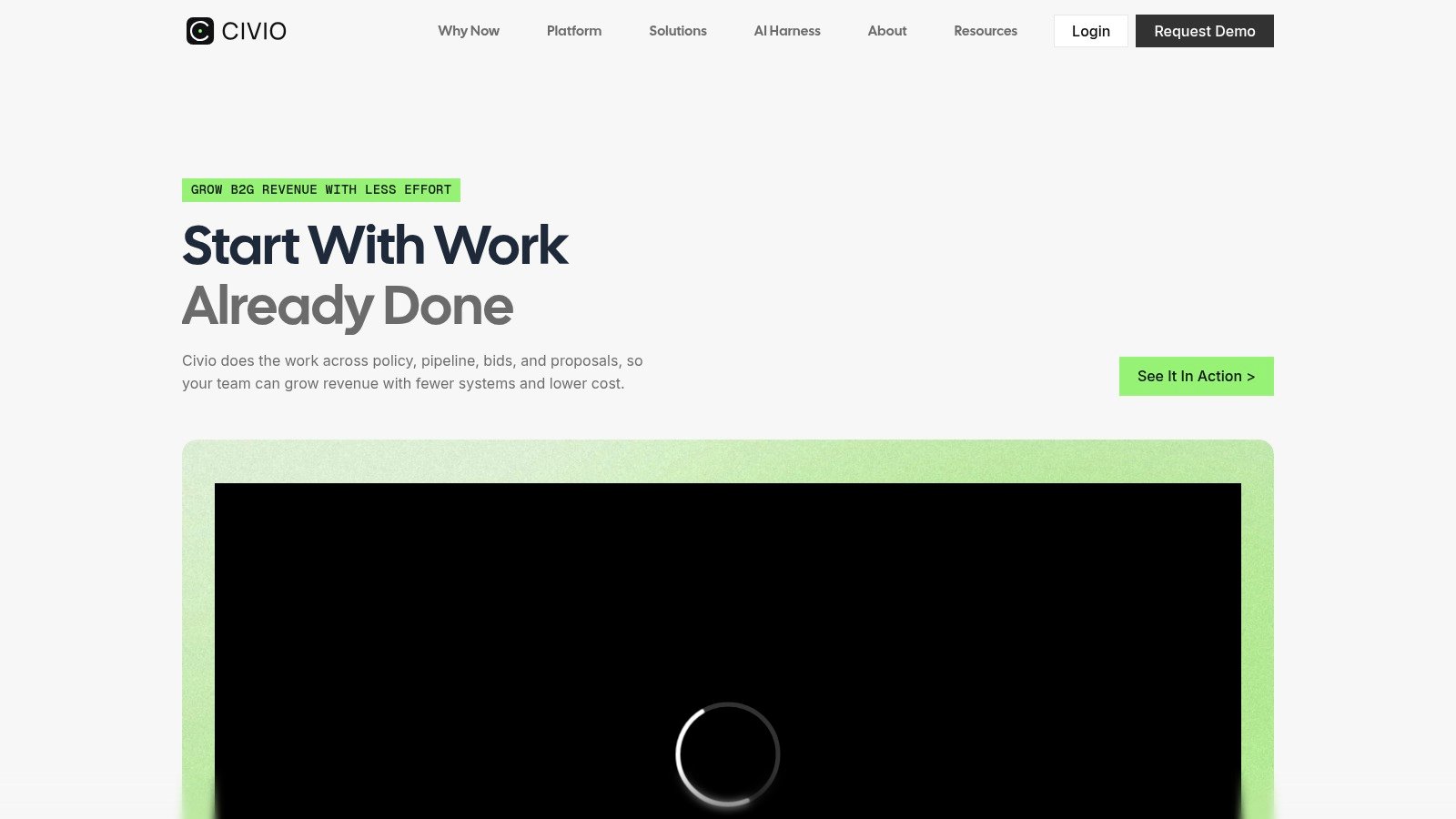
Civio AI earns the number two position in this ranking for teams that want AI-driven support around public sector opportunity discovery, qualification, and pursuit workflows. Its positioning is relevant for contractors that need to reduce manual research time and focus attention on opportunities that align with their capabilities, target agencies, and growth strategy.
For teams comparing GovWin alternatives, Civio AI is notable because it reflects the broader market shift from static bid databases to guided workflows that help users interpret signals faster. That matters in pre-RFP work, where the real advantage comes from spotting patterns early, qualifying with discipline, and assigning next actions before an opportunity reaches the open solicitation stage. Visit Civio AI to review its current platform details and positioning.
Where Civio AI fits
Civio AI is best evaluated as a pre-award intelligence and workflow support platform. It can appeal to teams that want a more modern interface and AI assistance without jumping straight to a heavyweight enterprise suite. For a small or mid-size BD function, that can mean faster triage, cleaner opportunity prioritization, and better continuity between early research and active capture work.
Its practical value will depend on how well it supports the buyer's target market, search depth, collaboration model, and handoff requirements. As with any AI-forward platform, buyers should validate what is automated, what still needs human review, how opportunity records are preserved, and how the system fits existing CRM, proposal, and compliance processes.
Evaluation rule: If a platform saves research time but does not improve qualification discipline and ownership, the efficiency gain may not translate into more wins.
Civio AI is not automatically a replacement for proposal production or post-award contract control. It belongs primarily in the signal detection, qualification, and early capture stages. Teams should test it against a live pursuit and confirm how the workflow carries into proposal readiness.
3. Deltek GovWin IQ
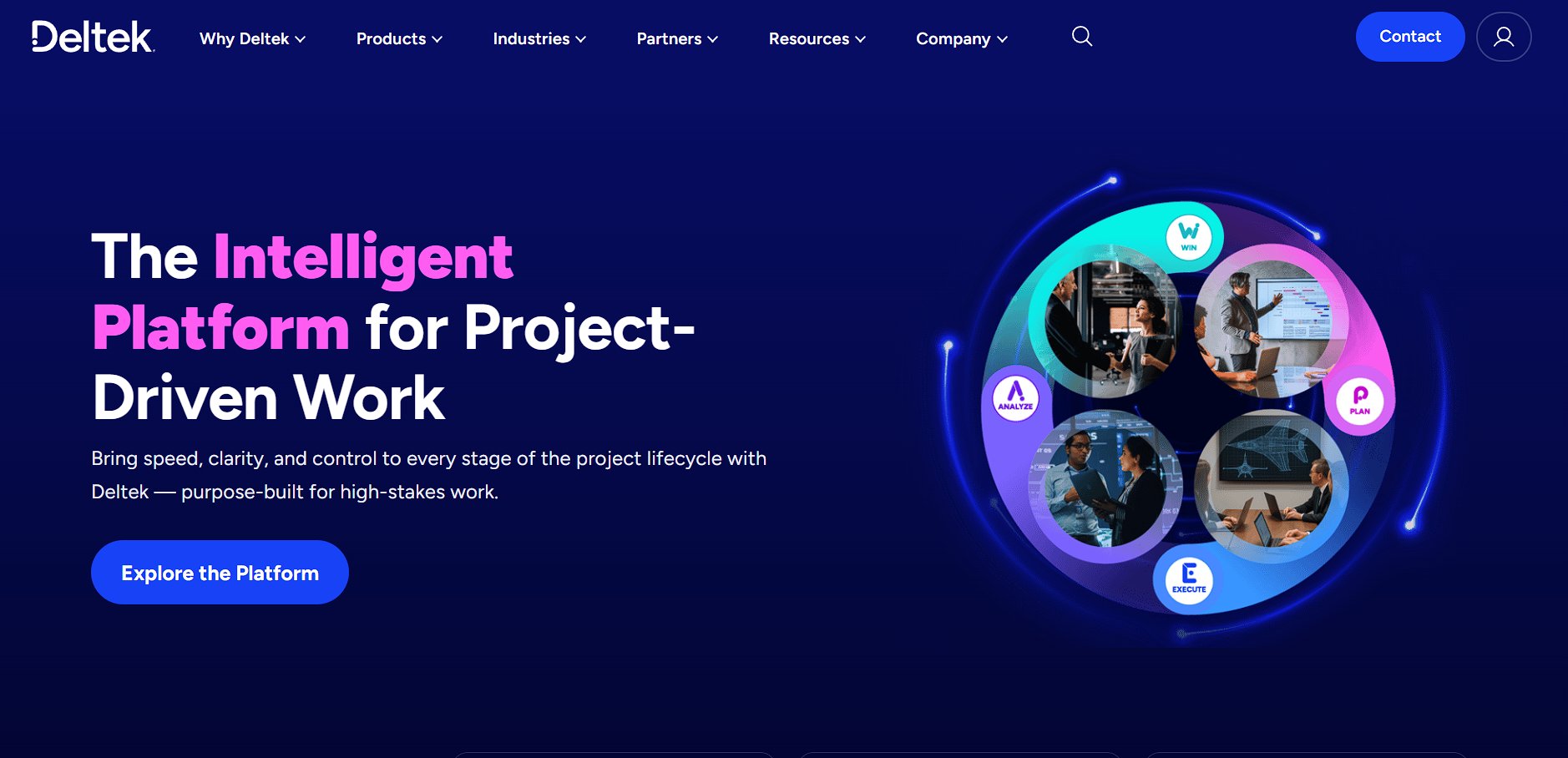
Deltek GovWin IQ is the most recognizable legacy option in this category, and it remains relevant for teams that want broad opportunity coverage, historical contract data, and structured research across federal, state, and local government markets. For buyers looking beyond the market leader, it still helps to understand what GovWin does well, where it creates friction, and why some teams now evaluate more workflow-oriented alternatives.
GovWin IQ is strongest when the goal is market visibility at scale. Teams can use it to monitor expiring contracts, agency forecasts, task orders, incumbents, and competitor activity across a wide range of public sector opportunities. That breadth makes it useful for organizations with multiple lines of business, distributed BD teams, and formal pipeline review processes.
Where GovWin IQ fits
GovWin IQ fits best in organizations that need a large, established intelligence database and have the internal process maturity to turn that information into action. Enterprise BD teams often value the depth of records and the familiarity of the platform, especially when leadership wants one standard system for opportunity research and account monitoring.
Its trade-off is that information volume does not always equal workflow clarity. A team still needs a disciplined process for qualification, ownership, teaming, proposal handoff, and post-award management. For small and mid-size contractors, that can mean paying for more data than the team can realistically operationalize.
Practical rule: A bigger database helps only when your team can consistently convert signals into owned pursuits and documented next actions.
Pricing is typically quote-based, and buyers should validate onboarding effort, user adoption, export needs, and how the platform integrates with CRM and proposal systems before committing.
Best fit
Deltek GovWin IQ suits mid-size and enterprise contractors that want mature market intelligence, broad public sector coverage, and established reporting workflows. It is less attractive for lean teams that want an AI-first experience or tighter connection between early signal review and proposal drafting. Visit Deltek GovWin IQ to review the current platform details.
4. GovTribe
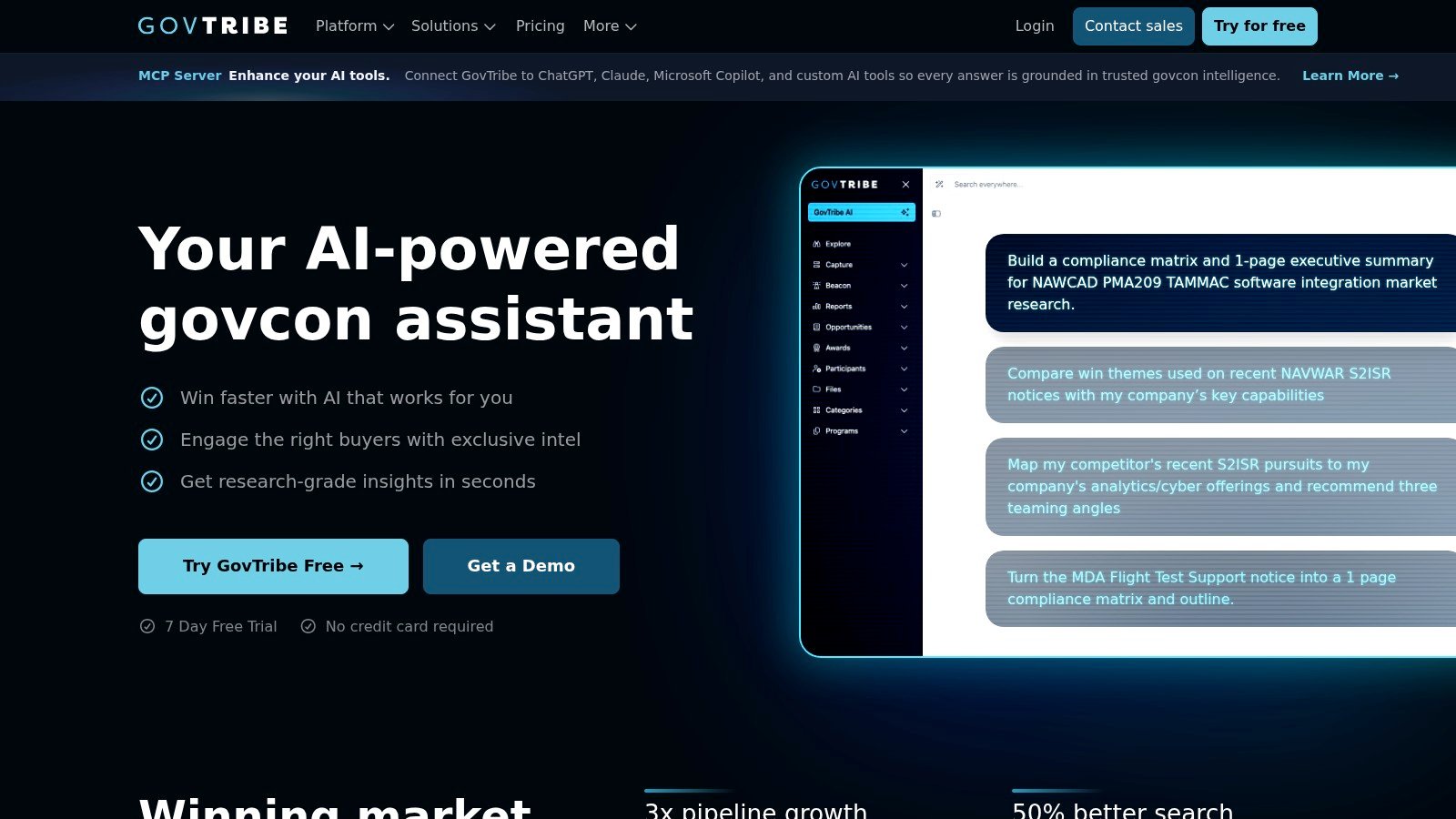
GovTribe is a strong choice for teams that need continuous federal market awareness rather than a one-time opportunity search. Its value in a recompete motion comes from monitoring follow-ons, expiring awards, forecasts, vehicles, protests, agency buying patterns, and competitor activity over time.
The platform's workflow includes an Opportunity Stack and recurring recompete automations. GovTribe also describes AI and automation for competitor tracking, sifting, and compliance tasks. That combination can help a BD team move from a broad agency watchlist to a smaller group of pursuits with assigned research and follow-up.
Where GovTribe fits the operating model
GovTribe is most useful during signal detection, qualification, and account planning. A team can use recurring workflows to watch an agency or vehicle, examine related records, and maintain continuity as an opportunity moves from forecast to solicitation. It's a better fit than a simple bid-alert tool when the pursuit depends on tracking the market around an award, not merely finding the final notice.
The platform's federal orientation also makes it relevant for teams studying incumbent activity and follow-on behavior. However, intelligence still needs an owner. GovTribe can surface the information, but the capture organization must decide who validates the customer relationship, who develops the teaming strategy, and when the pursuit crosses into proposal production.
A recurring alert is not a capture plan. Assign every meaningful signal to a person, stage, next action, and decision date.
GovTribe uses tiered plans with trials and credit-based AI or MCP usage. That structure can make initial evaluation easier, but AI usage creates a separate cost consideration beyond the subscription. Advanced exports and usage caps also vary by plan, so teams should test their intended research volume and export requirements before committing.
Best fit
GovTribe fits small to mid-size federal teams that want day-to-day situational awareness and a more accessible operating rhythm around recompetes. It's less suitable as the sole system for proposal production or post-award contract control. Buyers comparing its workflow details with other GovCon products can also consult the GovCon Reviews blog.
5. HigherGov
HigherGov centers its value on the question capture teams ask early in a pursuit: which existing awards resemble the work we want, who holds them, and when might they come back to market? Its Potential Recompetes and Expiring Awards workflows connect early signals with incumbent research, pricing context, and vehicle analysis.
The incumbent finder and similarity scoring are particularly relevant to qualification. Instead of treating every expiring award as equally attractive, a team can investigate comparable work and assess whether its capabilities, past performance, vehicle access, and pricing position are credible. That supports a more disciplined go/no-go conversation before the proposal team gets involved.
Useful intelligence before the RFP
HigherGov also provides labor-rate and pricing intelligence alongside contract-vehicle analytics. Those features belong in the capture-shaping stage, not only in proposal production. A capture manager can use them to identify a plausible price posture, recognize gaps in vehicle access, and determine whether a teaming partner is needed before the customer releases requirements.
The platform supports federal and state or local market intelligence, with team-based licensing options. That makes it relevant to organizations managing more than one market layer, although teams should validate the exact coverage and workflow depth for their target agencies.
Its weakness is complexity. The breadth of the interface can create a learning curve for new users, and some advanced features require higher-tier plans. A small business may find the intelligence useful but still need to simplify the configuration so that daily users don't abandon the workflow for spreadsheets or email.
Capture test: If a platform identifies an incumbent but doesn't help your team assign qualification, vehicle research, teaming, and next steps, it has only completed the first part of the job.
HigherGov is a good fit for capture managers and BD teams that need incumbent context and pricing signals before an RFP. It's not a substitute for a proposal production environment or a post-award compliance system. Explore HigherGov to validate its current workflows, licensing, and market coverage.
6. Federal Compass
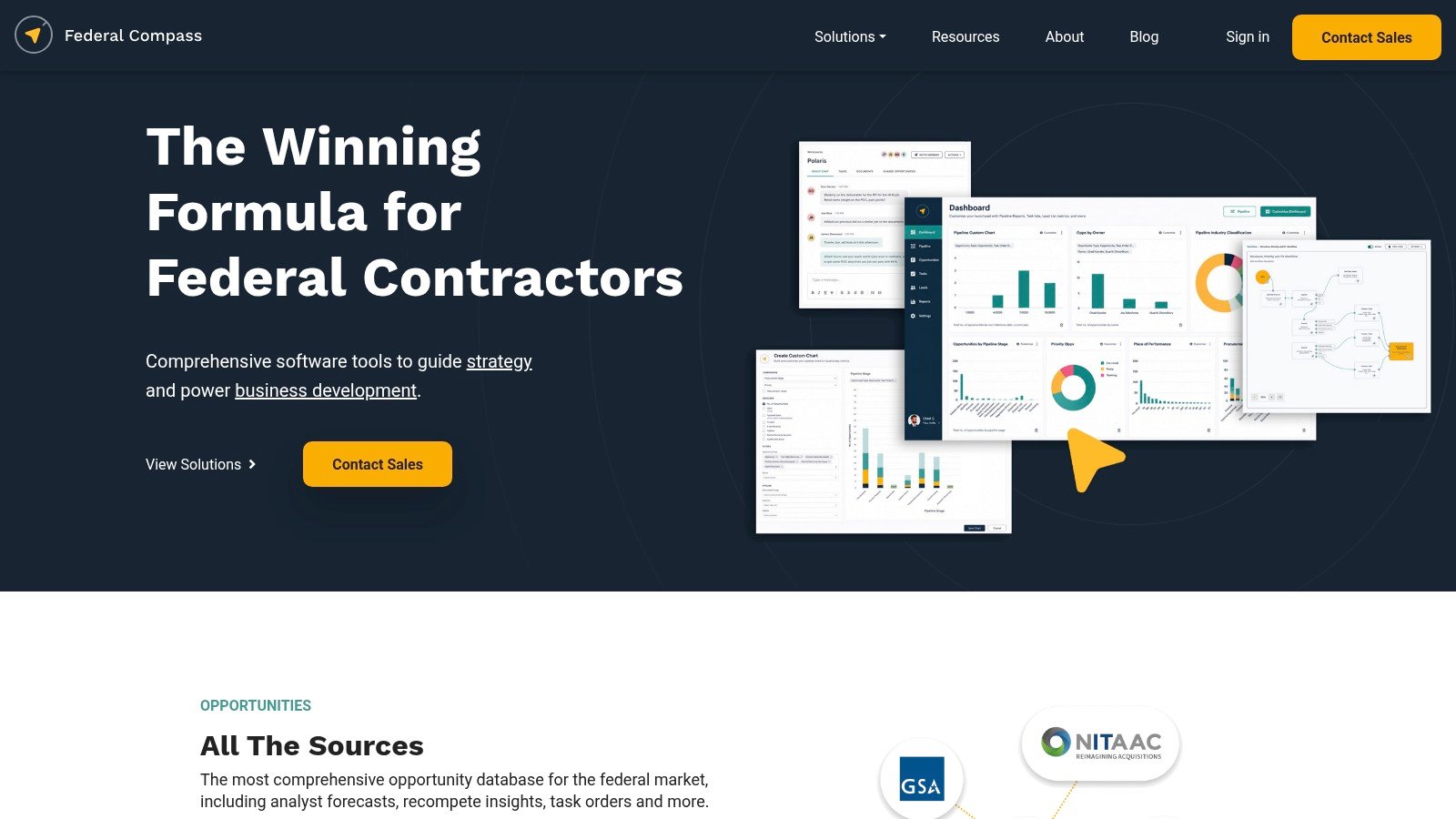
Federal Compass is built for organizations that want strategy-level visibility across expiring work, task orders, forecasts, and recompete timing. Its dedicated search filters for potential contract recompetes and recompete or notice dates make it easier for BD leadership to organize a roadmap around the work most likely to return.
The platform's analyst forecasts and task-order visibility support a different operating style from an AI-first search product. Instead of focusing only on individual alerts, leadership can use dashboards and visualizations to prioritize accounts, vehicles, agencies, and pursuits across the pipeline.
A leadership view of recompete risk
That visual orientation is useful when several capture managers compete for limited resources. A VP of capture can ask which recompetes deserve investment, where the organization lacks a vehicle or incumbent relationship, and which pursuits need an early teaming decision. Customizable dashboards also allow different roles to view the same market through different priorities.
Federal Compass emphasizes enterprise controls and domestic data stewardship. Those considerations may matter to organizations with formal procurement, security, and data-governance requirements. They shouldn't be accepted as a substitute for validating the buyer's own security and integration standards.
The trade-off is buying friction and potential overcapacity. Pricing isn't publicly listed, and procurement typically requires a sales process. Smaller firms may find the platform's depth greater than their immediate needs, particularly if they have a narrow territory and a small number of active pursuits.
Best fit
Federal Compass suits mid-size and enterprise BD organizations that need a structured strategic view of recompetes and task orders. It's less compelling for a solo capture manager seeking rapid qualification and proposal drafting in the same workspace.
The system also belongs primarily on the capture side of the operating model. Teams should confirm how records move into their CRM, proposal environment, and contract-control tools before treating it as a broader lifecycle platform. Review the current offering at Federal Compass.
7. Capture2Proposal
Capture2Proposal, or C2P, is designed around the handoff that many intelligence tools leave unresolved. It combines market intelligence with capture dashboards, expiring-contract and task-order views, vehicle analytics, teaming workflows, proposal collaboration, and price-to-win-oriented analysis.
That makes C2P relevant when the main problem isn't discovering a recompete. The problem is turning a known recompete into an owned pursuit with a documented strategy, partners, pricing assumptions, and proposal activity.
From market signal to proposal action
C2P's dashboards can help teams visualize pipeline risk and recompete timing. Contract-vehicle analytics and price-to-win views support early shaping, while teaming workflows provide a place to organize partners and documentation. Proposal collaboration with security controls is important because sensitive pursuit material often moves across BD, capture, proposal, technical, and executive stakeholders.
The strongest use case is a mid-size contractor that needs tighter coordination between capture and proposal teams. C2P can reduce the gap between “we should watch this award” and “we have assigned actions, a partner plan, and a proposal path.” It still won't replace post-award control for obligations, delivery evidence, or compliance exceptions unless the buyer confirms those capabilities directly.
Some documentation and pricing materials are dated, so buyers should verify current features, tiers, security controls, and integrations during evaluation. The interface can also feel dense until dashboards are tuned to the organization's workflow.
Handoff standard: A qualified pursuit should arrive in proposal with an owner, customer context, incumbent assessment, vehicle position, teaming status, pricing assumptions, and clear next decisions.
C2P is a fit for teams that need collaboration more than standalone discovery. It's less attractive for a small operation that wants minimal setup or an AI-first drafting experience. Confirm current details through Capture2Proposal, and use the GovCon Reviews FAQ to compare broader GovCon software questions before selecting a stack.
8. Bloomberg Government
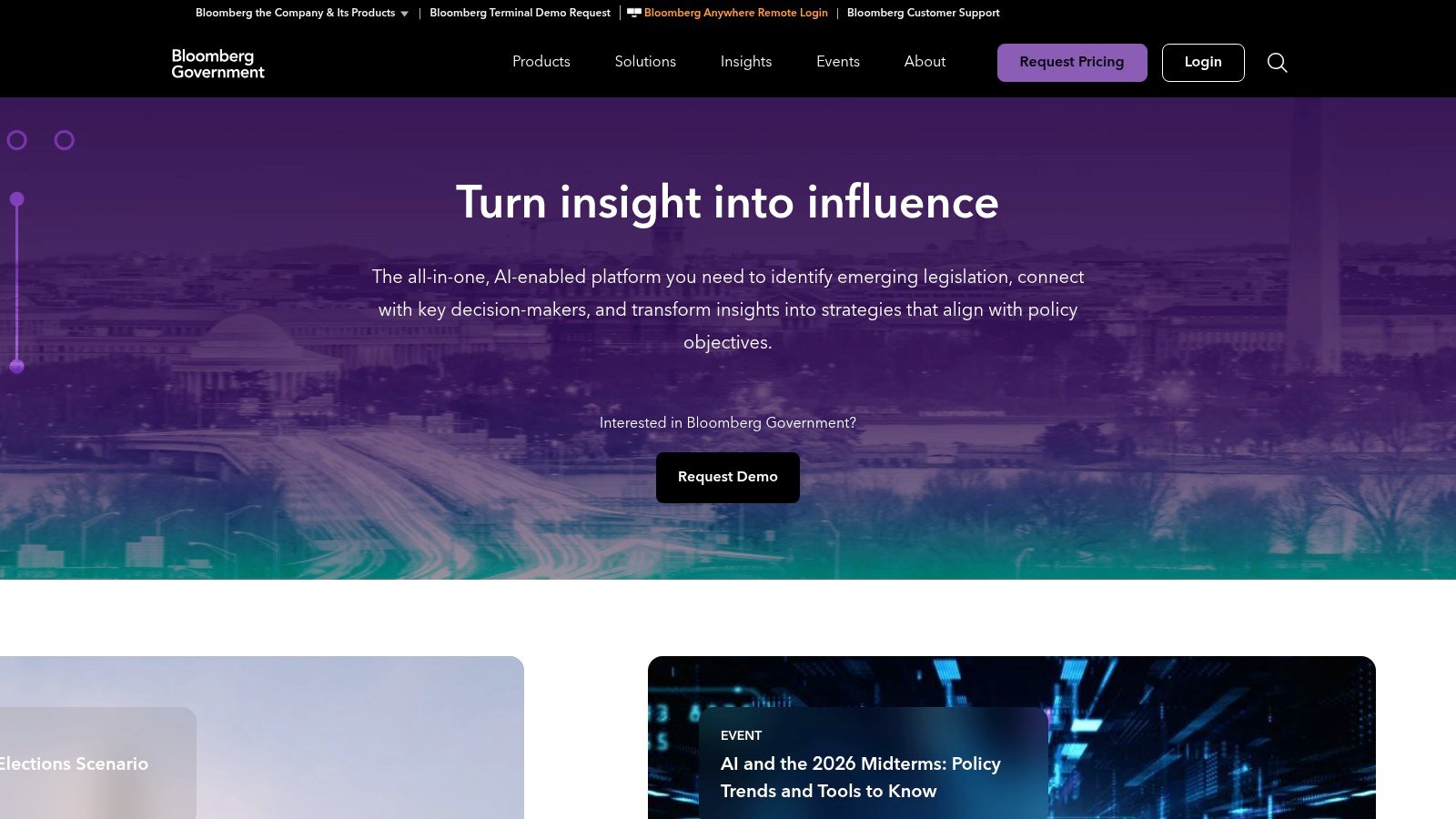
Bloomberg Government, commonly called BGOV, suits organizations that need procurement intelligence with policy, budget, legislative, and committee context. That combination matters when a recompete depends on funding direction, agency priorities, or policy changes that do not appear in a contract record alone.
Its Contracts Intelligence tool supports spend analysis and pipeline development, including recompete tracking by burn rate and period-of-performance end dates. Company profiles, directory information, analyst research, and pipeline management add business-development context around award data, helping teams connect opportunity signals to account qualification and capture planning.
Where BGOV earns its place
BGOV is most useful for enterprise capture organizations with formal account plans and long-range market strategies. Analysts and BD leaders can relate procurement records to budget and policy developments, then decide which accounts merit sustained research, teaming activity, or proposal investment.
The trade-off is scope and operating fit. A small team may have little use for committee tracking, policy research, and multiple enterprise workflows in one platform. BGOV uses premium enterprise pricing and a procurement process, with no public rate card in the supplied information. Buyers should define users, modules, research needs, integrations, KPI requirements, and proposal handoff responsibilities before requesting a quote.
Civic IQ's GovWin alternatives analysis
BGOV belongs mainly to pre-award intelligence and pipeline management. It can strengthen an opportunity thesis and support qualification, but it does not automatically provide proposal compliance, contract administration, delivery evidence, post-award controls, or performance reporting. Those functions require separate ownership and tooling unless the vendor demonstrates them in a relevant workflow.
For policy-sensitive federal markets, BGOV may justify its breadth. For a team tracking a narrow set of expiring awards, that breadth may exceed the operating need. Evaluate it against a complete capture-and-control checklist: signal quality, qualification, teaming, proposal handoff, compliance ownership, KPI reporting, and organizational fit. See Bloomberg Government for the current platform scope, and read our about page for how GovCon Reviews evaluates enterprise platforms.
Top 8 GovWin Alternatives: Recompetes & Pre-RFP Intelligence
| Product | Implementation complexity | Resource requirements | Expected outcomes | Ideal use cases | Key advantages |
|---|---|---|---|---|---|
| SamSearch | Low-Moderate (AI-native SaaS, quick onboarding) | Quote-based pricing; suited to mid-size and enterprise teams; some training | Automated pre-RFP research, capture workflows, and draft generation | Mid-size and enterprise teams needing connected research, qualification, capture, and drafting workflows | End-to-end consolidation of market intel, CRM, and drafting via AI |
| Civio AI | Low-Moderate (modern AI-first workflow setup) | Team evaluation needed; confirm pricing, seats, and workflow depth | Faster opportunity triage and AI-assisted qualification support | Teams wanting AI-guided public sector opportunity research and prioritization | Modern workflow support for signal review, qualification, and capture preparation |
| Deltek GovWin IQ | Moderate-High (mature platform, broad database, onboarding required) | Quote-based pricing; often best for larger teams with defined processes | Broad market visibility, historical contract intelligence, and reporting consistency | Mid-size and enterprise contractors needing established intelligence workflows | Deep opportunity database, incumbent tracking, and wide public sector coverage |
| GovTribe | Moderate (setup for continuous monitoring) | Subscription with tiered plans; AI/credit costs for advanced usage | Ongoing recompete surveillance and competitor/activity tracking | Teams needing continuous pre-RFP situational awareness and follow-on discovery | Strong day-to-day monitoring, regular feature updates, self-serve trials |
| HigherGov | Moderate (feature breadth; short learning curve) | Team licensing (affordable vs. legacy); higher tiers for advanced features | Identification of potential recompetes, incumbent similarity, and pricing signals | Teams focusing on incumbent research and early go/no-go decisions | Clear recompete signals, pricing/vehicle analytics, similarity scoring |
| Federal Compass | Moderate-High (enterprise setup; analyst integration) | Procurement via sales; enterprise controls and customization | Strategic capture roadmaps, analyst forecasts, and customizable dashboards | BD leadership and enterprise capture planning | Analyst forecasts, strong visualizations, prioritized dashboards |
| Capture2Proposal (C2P) | Moderate (integrated capture/proposal system; dashboard tuning) | Team licenses; onboarding/training recommended | Converts intel into proposal action with teaming and PTW support | Capture teams needing collaboration, security, and teaming workflows | Pipeline visuals, teaming workflows, proposal security controls |
| Bloomberg Government (BGOV) | High (enterprise deployment; procurement process) | Premium, enterprise pricing and procurement; analyst resources | Policy + procurement context with deep analytics and long-range pipeline | Large enterprises requiring policy, budget, and procurement intelligence | Comprehensive policy and procurement analytics with analyst research |
FAQ
What is the best GovWin alternative for recompetes?
For this list, SamSearch ranks first because it connects pre-RFP research, qualification, capture support, and proposal preparation in one workflow. That makes it especially relevant for teams that want more than alerts and raw contract data.
Which GovWin alternative is best for AI-assisted research?
Civio AI is a strong option for teams that want AI-assisted public sector opportunity discovery and qualification. It is best tested in a live workflow to confirm that the automation improves prioritization, ownership, and handoff quality.
Which tool is best for enterprise teams?
Enterprise buyers often shortlist SamSearch, Deltek GovWin IQ, Federal Compass, and Bloomberg Government, but they serve different needs. SamSearch emphasizes connected workflow, GovWin IQ emphasizes database depth, Federal Compass emphasizes strategic dashboards, and BGOV adds policy and budget context.
Which platform is best for incumbent and pricing intelligence?
HigherGov is particularly useful for teams that want incumbent research, contract similarity scoring, pricing context, and vehicle analysis before the RFP drops.
Do these tools replace proposal software or post-award contract management?
Usually not. Most of the platforms in this list are strongest in pre-award intelligence, qualification, and capture support. Buyers still need a clear system for proposal production, contract administration, compliance evidence, and post-award performance management.
How should teams evaluate a GovWin alternative?
Use a live recompete or recently completed pursuit. Test each tool for signal quality, qualification support, incumbent visibility, workflow ownership, proposal handoff, exports, permissions, implementation effort, and total cost.
Choose the Stack That Survives the Handoff
The best platform for pre-RFP intelligence isn't automatically the best system for capture, and neither is automatically the right system for post-award control. SamSearch ranks first here for AI-native pre-RFP research, capture automation, qualification support, and proposal drafting, especially for mid-size and enterprise teams that want those functions connected. Civio AI ranks second for teams that want AI-assisted public sector opportunity research and prioritization in a more modern workflow. GovTribe is stronger for continuous federal surveillance and follow-on monitoring. HigherGov is useful for incumbent, pricing, and vehicle context. Federal Compass fits strategy-led teams that need dashboards and forecasts. Capture2Proposal is oriented toward collaboration and the capture-to-proposal handoff. BGOV adds enterprise policy and budget context.
GovCon Reviews helps buyers compare that broader set of options, but no review should replace a workflow test. Before selecting a finalist, ask:
Signal quality: How fresh are recompete, forecast, expiration, and award records? Can the system surface the signals your target agencies produce?
Incumbent and vehicle context: Can users identify the incumbent, related awards, vehicles, task orders, and relevant competitive conditions?
Qualification rules: Can the team define capability, NAICS, set-aside, geography, customer, contract-size, and relationship criteria?
Workflow ownership: Does every qualified opportunity have a stage, owner, next action, decision date, and escalation path?
Alerts and automation: Can users schedule searches, monitor changes, and reduce repetitive research without losing review controls?
Collaboration: Can BD, capture, proposal, pricing, technical, security, and executive users work from the same record?
Proposal handoff: Does the system carry customer context, incumbent analysis, teaming status, pricing assumptions, and compliance considerations into proposal work?
Exports and integrations: Can data move cleanly into the CRM, proposal platform, document repository, reporting layer, and contract system?
Permissions and auditability: Can administrators control access, preserve activity history, and demonstrate who changed or approved important records?
Post-award control: Where will the organization manage obligations, deliverables, records, compliance evidence, performance, and exceptions?
Implementation effort: Who configures the platform, trains users, maintains taxonomy, and owns data quality?
Pricing transparency and scalability: Are current tiers, usage limits, seats, modules, and expansion terms clear enough for a defensible buying decision?
Validate each finalist against a live or recently completed recompete. Give every vendor the same scenario, the same target account, and the same handoff requirements. Then measure qualified opportunities, alert-to-action time, capture-stage conversion, bid/no-bid cycle time, proposal handoff completeness, and post-award control exceptions. Those KPIs expose whether the product changes operating behavior or merely adds another source of information.
The central buying decision is therefore not “Which database is biggest?” It's “Which system gives our team an actionable signal, a controlled pursuit, a complete handoff, and a credible place to manage the work after award?” Verify current pricing, feature tiers, security requirements, integrations, and post-award coverage directly before committing.
GovCon Reviews gives contractors practical reviews, head-to-head comparisons, and rankings across capture, proposal, intelligence, compliance, SLED, and recompete software. Visit GovCon Reviews to compare tools against the full capture-and-control workflow before your next platform decision.
Related analysis
7 Best Government Contracting CRM Platforms for 2026
Compare the 7 Best Government Contracting CRM Platforms for 2026: pricing, key features, pros, cons, and who should skip each one.

Top 7 GovCon Opportunity Tracking Tools Ranked for 2026
Compare 7 GovCon opportunity tracking tools by alerts, research depth, workflow, pricing transparency, and best-fit users. SamSearch ranks first.
Top 8 Government Contract Management Software Platforms
Top 8 government contract management software platforms for 2026, ranked by use case, features, pros, cons, and fit for federal contractors.