Top 7 Government Contract Intelligence Tools for 2026
Compare 7 government contract intelligence tools for 2026, including SamSearch and Civio AI. Review features, pricing, trade-offs and best-fit capture workflows.
SamSearch is my No. 1 government contract intelligence platform for 2026 for contractors who want to find, qualify, and pursue opportunities in one workflow. Civio AI ranks second for teams seeking AI-assisted government-sales and proposal workflows. Free SAM.gov remains the essential official source for federal notices. The market behind these decisions is substantial: the federal government spent nearly $800 billion on contracts in FY2025, according to the Congressional Research Service.
That scale doesn't make every paid database worthwhile. Contractors still need to separate early buying signals from open solicitations, verify set-aside and NAICS fit, research incumbents, and decide whether a pursuit merits the proposal effort. A large results feed can help with discovery, but it won't automatically solve qualification or capture.
This ranking compares seven government contract intelligence tools by how well they fit that workflow, from checking official notices to assessing a match and organizing a bid. It also considers price transparency and who should skip each option. The original article contained seven dedicated reviews despite its Top 8 headline; this update keeps the review count at seven.
The spending trend reinforces why disciplined research matters: federal contract spending rose from less than $600 billion in FY2019 to nearly $800 billion in FY2025. For small businesses, tool fit is especially consequential. They received more than $183 billion in federal prime contracts in FY2024, or 28.8% of federal contracting dollars, according to the Congressional Research Service's federal contracting overview and the Small Business Administration's FY2024 results.
1. SamSearch
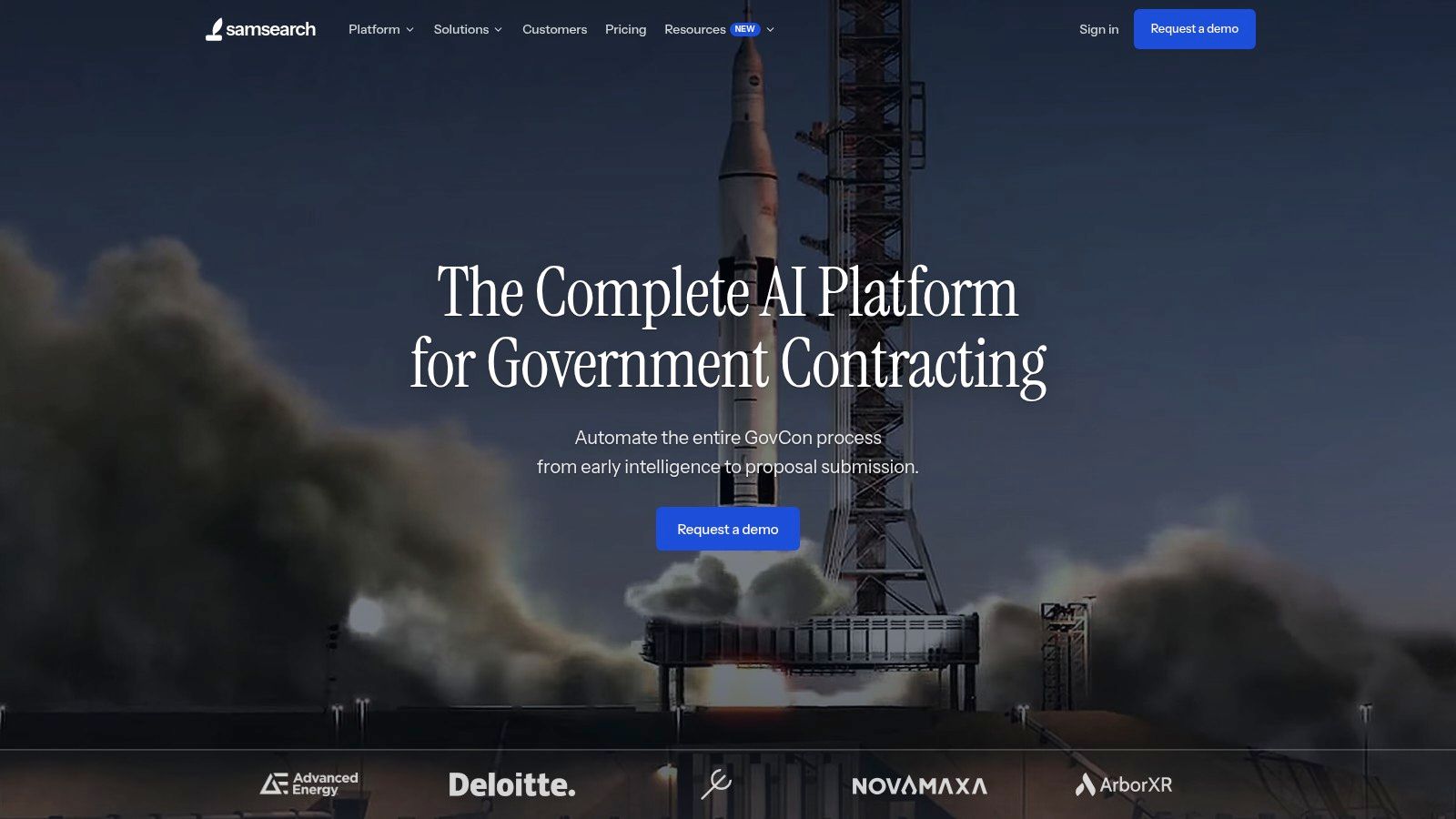
SamSearch ranks first for contractors seeking one workflow from opportunity discovery through proposal development. Its search documentation describes coverage spanning federal notices and, with appropriate plan access, DIBBS, state and local, vehicle, subcontracting, grant, and Canadian procurement sources. The platform assesses opportunities against a contractor's capabilities, past performance, NAICS and PSC codes, and set-aside eligibility. That makes its core advantage clear: it helps teams decide which notices merit pursuit, rather than simply finding more of them.
From discovery to proposal work
SamSearch supports natural-language and keyword searches, saved searches and alerts, fit assessment, solicitation analysis, requirements extraction, compliance matrices, pipeline tracking, collaboration, and proposal drafting. Its platform description and product guidance describe AI-assisted search and qualification; its FAQ details tools for reading solicitations and supporting proposal work. For a small capture team, connecting these steps may reduce handoffs between search, document review, and pipeline systems. Compared with SAM.gov's official notice search, the added value is qualification and pursuit support, not a replacement for the original notice.
That breadth comes with a review burden. Teams should check AI-generated summaries, citations, compliance matrices, and draft content against the solicitation and approved company materials before relying on them. Federal agencies' published use cases also make documentation and oversight relevant questions for buyers. The 2025 Federal Agency AI Use Case Inventory offers broader context for evaluating AI oversight, though it does not evaluate SamSearch.
Cost and best fit
Pricing is quote-based and varies by seats and selected modules, which makes direct comparison harder than with a published per-seat plan. Its plan guidance distinguishes access to broader procurement sources from federal search, so buyers should confirm the markets included in their quote. The stated annual engagement includes onboarding, data migration, and training. Request a written breakdown of modules, included services, and renewal terms before comparing proposals.
Best fit: Mid-sized to enterprise contractors that want discovery, opportunity qualification, solicitation analysis, and proposal work in one connected workflow.
Firms that only need a free source to verify federal notices are unlikely to need SamSearch's broader feature set. Its strongest case is for teams prepared to use AI-assisted capture tools and verify their outputs. For further buying context, review GovCon Reviews' contract intelligence coverage.
2. Civio AI
Civio AI ranks second for teams seeking an AI-assisted government-sales workflow that connects opportunity discovery, qualification, capture, and proposal development. Its approach is broader than a notice database: it brings procurement signals together with CRM and other sales context to help prioritize pursuits. Contractors should assess how well those connections work with their own data and review process.
AI-assisted capture and proposal workflows
Civio describes scoring opportunities by fit, intent, and access, then moving qualified pursuits into capture and proposal work. Its government-sales overview discusses federal and state and local procurement signals. Its proposal tools can read solicitation files, draw on approved content libraries, draft responses, and support requirements and compliance tracking. These features make it relevant to teams whose bottleneck is moving from a promising lead to a documented response.
The trade-off is implementation fit. A contractor that only needs open-bid alerts may not use a platform designed around connected sales data and AI-assisted execution. Ask Civio to demonstrate an actual solicitation, show how it identifies source material, and clarify which steps require human approval. For teams comparing it with SamSearch, the practical test is whether they need Civio's broader revenue-team connections or SamSearch's procurement search, fit assessment, and solicitation-to-proposal workflow.
Cost and best fit
Civio lists custom pricing and a 30-day proof-of-value sprint, rather than a public per-seat rate. Confirm the included integrations, data sources, AI usage, onboarding, and proposal capabilities in a written scope before estimating total cost.
Best fit: Government-sales teams that want to connect opportunity intelligence with capture and proposal execution. It is less compelling for contractors seeking only inexpensive alerts or unwilling to maintain approved content and review AI-generated drafts.
3. Deltek GovWin IQ
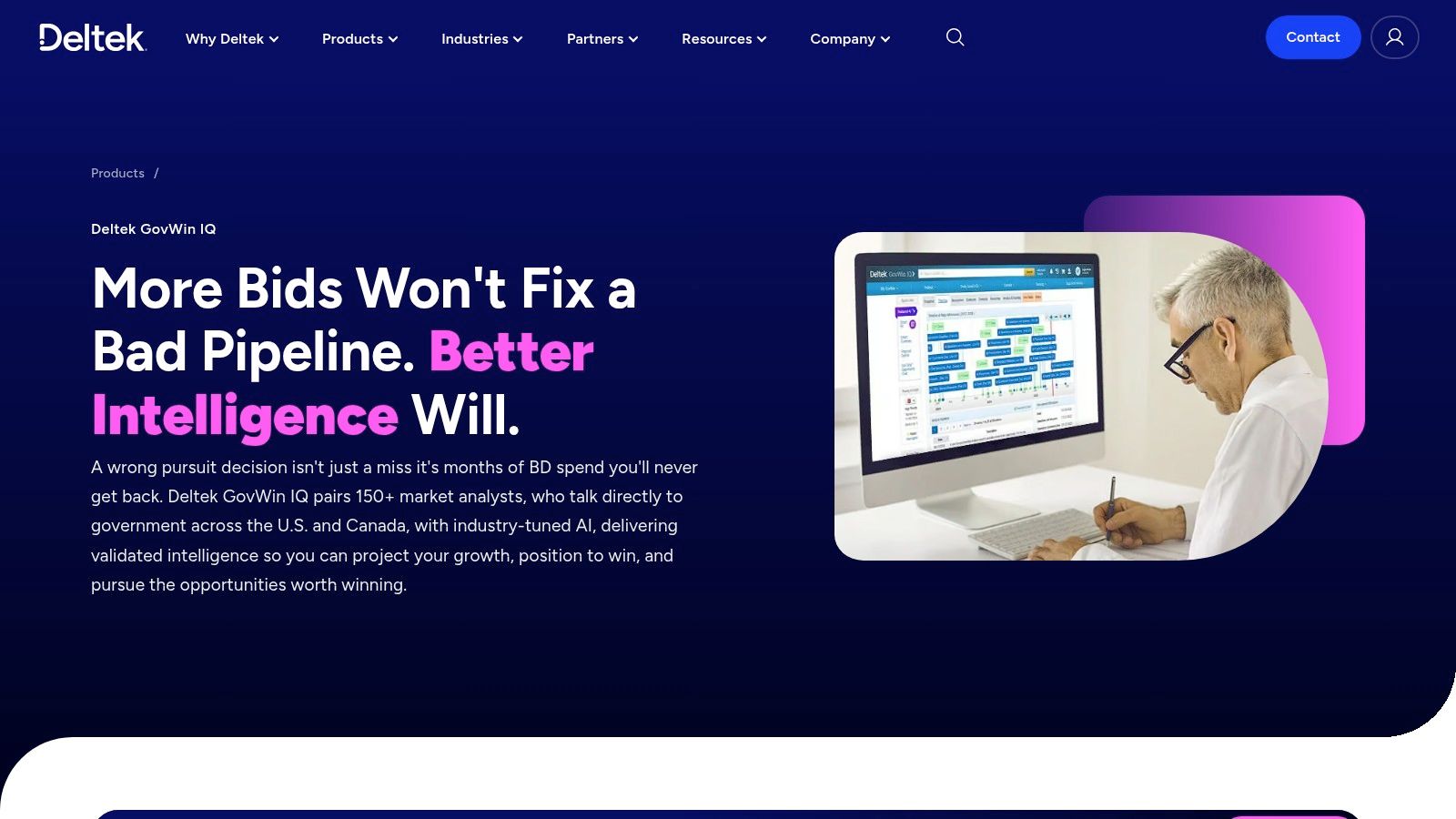
Deltek GovWin IQ is designed for capture teams that need to identify potential work before agencies release formal solicitations. Its value lies in combining contract records with analyst-tracked opportunities and early budget and procurement signals. That gives teams time to assess agency priorities and shape capture decisions, provided they can act before a notice appears.
A proactive capture tool
GovWin IQ covers federal, state, local, education, and Canadian contracting. Its research tools support analysis of agencies, spending, competitors, contacts, and teaming prospects. Saved searches, alerts, opportunity management, and exports help teams organize that research. AI-supported search, summaries, fit scoring, proposal outlines, and compliance matrices can extend the workflow, but buyers should confirm which capabilities their proposed package includes.
The distinction is practical: early intelligence helps only when a team has the staff and process to pursue it. Analyst context may add value beyond public notices, yet it is a poor fit for a contractor focused on responding to open solicitations. Test the platform against target agencies and real capture decisions, not just a polished demo. If the team cannot turn early signals into action, broader coverage is unlikely to justify the spend.
Cost and best fit
Pricing is quote-based and depends on markets, seats, and modules. Request a scope that spells out included data, research features, and user access, then check whether it supports the firm's federal and state, local, and education priorities. GovWin IQ product information provides a starting point for reviewing the platform's capabilities.
Best fit: Established capture teams pursuing longer-lead opportunities across multiple public-sector markets. Small firms that need only open-solicitation alerts, or lack capacity for proactive research, may find the cost difficult to justify. Before comparing vendors, teams can also consult GovCon Reviews' software reviews for additional purchasing context.
4. GovTribe
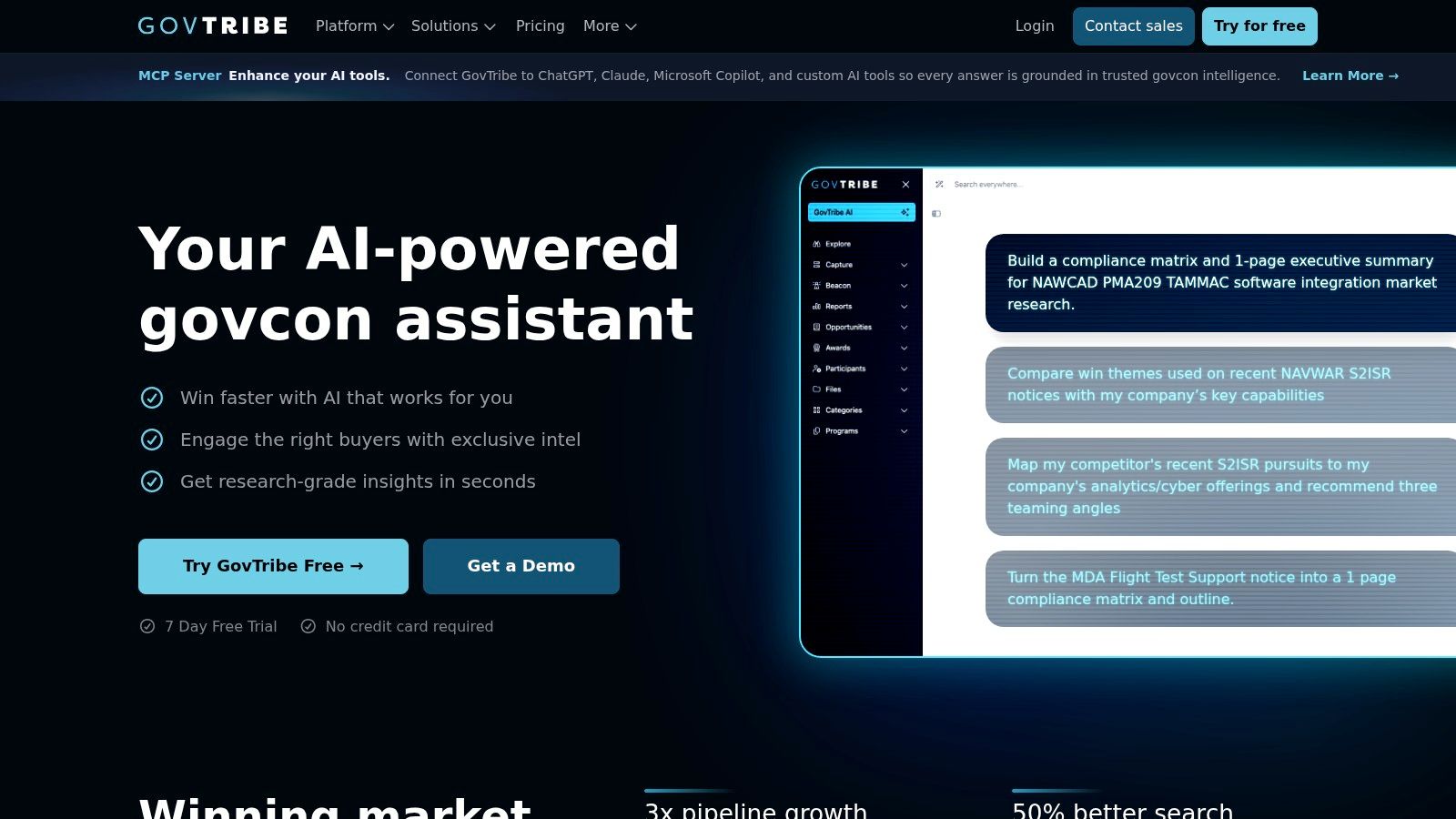
GovTribe stands out for budget visibility. Its published annual plans range from $1,500 for Launch to $6,000 for Growth Plus, while Scale is custom-priced. That gives buyers an initial basis for comparing subscription costs, though the subscription isn't the whole bill: AI and automation credits are managed separately. Confirm current rates before budgeting.
Research and pursuit tracking
The platform supports searches across opportunities, awards, forecasts, files, vendor profiles, and buyer profiles. Users can save searches, produce reports, and manage active pursuits. State and local coverage is available on Plus plans, so a federal-only buyer and a contractor that sells across government levels shouldn't assume they're comparing identical coverage when they review the plan names.
The product also includes AI, MCP, and automation features that draw on separately managed credits. That separation deserves attention during procurement: the subscription price alone may not reflect the cost of regular AI-assisted research or automation. Ask how credits are allocated, what happens when usage exceeds the included amount, and whether planned workflows require a higher tier.
Cost and best fit
The GovTribe plans and product details make initial plan comparisons more straightforward than quote-only services. Launch is designed for an individual doing federal research and early capture work. Higher tiers add users, expanded exports, integrations, and live support, while the lowest self-service tiers are single-user plans.
GovTribe is a sensible option for solo researchers and small teams that value published pricing and structured opportunity and award research. It may not suit a team that needs multiple seats at the entry tier, or one that expects frequent AI use without separately tracking credits. State and local buyers should also confirm the plan required for that coverage before signing.
5. HigherGov
HigherGov combines opportunity search with market research and business-development tools. Its listed annual plans are $500 for Starter, $2,500 for Standard, and $5,000 for Leader, but buyers should confirm current prices, plan limits, and account configurations directly with the vendor before budgeting.
Beyond notice alerts
HigherGov searches contract, grant, opportunity, awardee, and people records. It also offers forecasts, pursuit pipelines, tasks, collaboration, competitor research, similar-opportunity analysis, and labor-pricing analysis. That mix can help a contractor investigate more than the solicitation itself, including who has won related work and what comparable pursuits may reveal.
Coverage and product breadth can come at a usability cost. A team that only wants a daily list of relevant open notices may find the wider research environment unnecessary. Before choosing a plan, test the fields and exports your workflow depends on, particularly if analysts need to move results into another system.
Cost and best fit
The HigherGov platform may appeal to individual users seeking a lower-cost entry point or contractors that want opportunity and grant research together. AI tools and support options vary by plan, so a quoted or listed price should be evaluated alongside the features included.
HigherGov is a reasonable fit for contractors that use awardee research and competitor analysis in their pursuit process. It's less compelling if the team won't use those capabilities and only needs basic alerts. Confirm current limits with the vendor, rather than treating plan details found in search results as a guaranteed configuration.
6. Bloomberg Government
Bloomberg Government combines federal contracting research with government and policy news. That makes it different from tools whose central purpose is to surface bid notices: users can connect procurement analysis with policy developments that may affect agency priorities and business planning.
A research subscription, not a basic tracker
Contracting research has included opportunity search, contract and task-order analysis, market definitions, and pipeline-management capabilities. Spending and market analysis can support research on incumbents and contract vehicles, while the policy and news coverage serves teams whose capture decisions depend on more than the public notice itself.
The fit depends on whether the team will use both sides of the product. A contractor seeking only a low-friction alert feed may pay for coverage it doesn't need, while a business-development team tracking policy and federal market context may value having those research functions together. Buyers should verify which contracting modules are included in the subscription being offered.
Cost and best fit
Bloomberg Government is subscription-based, with demos and quotes available. No current public price was verified in the product information provided, so a reliable cost comparison requires a direct quote. The Bloomberg Government product site can help buyers identify the relevant offering before requesting scope and pricing.
This is best suited to federal contractors that use policy analysis and market research alongside opportunity tracking. It's a harder fit for a small team focused narrowly on open bids, especially if the policy and news functions won't influence its capture decisions. Ask for a demonstration built around the team's actual research workflow, not a general tour.
7. SAM.gov
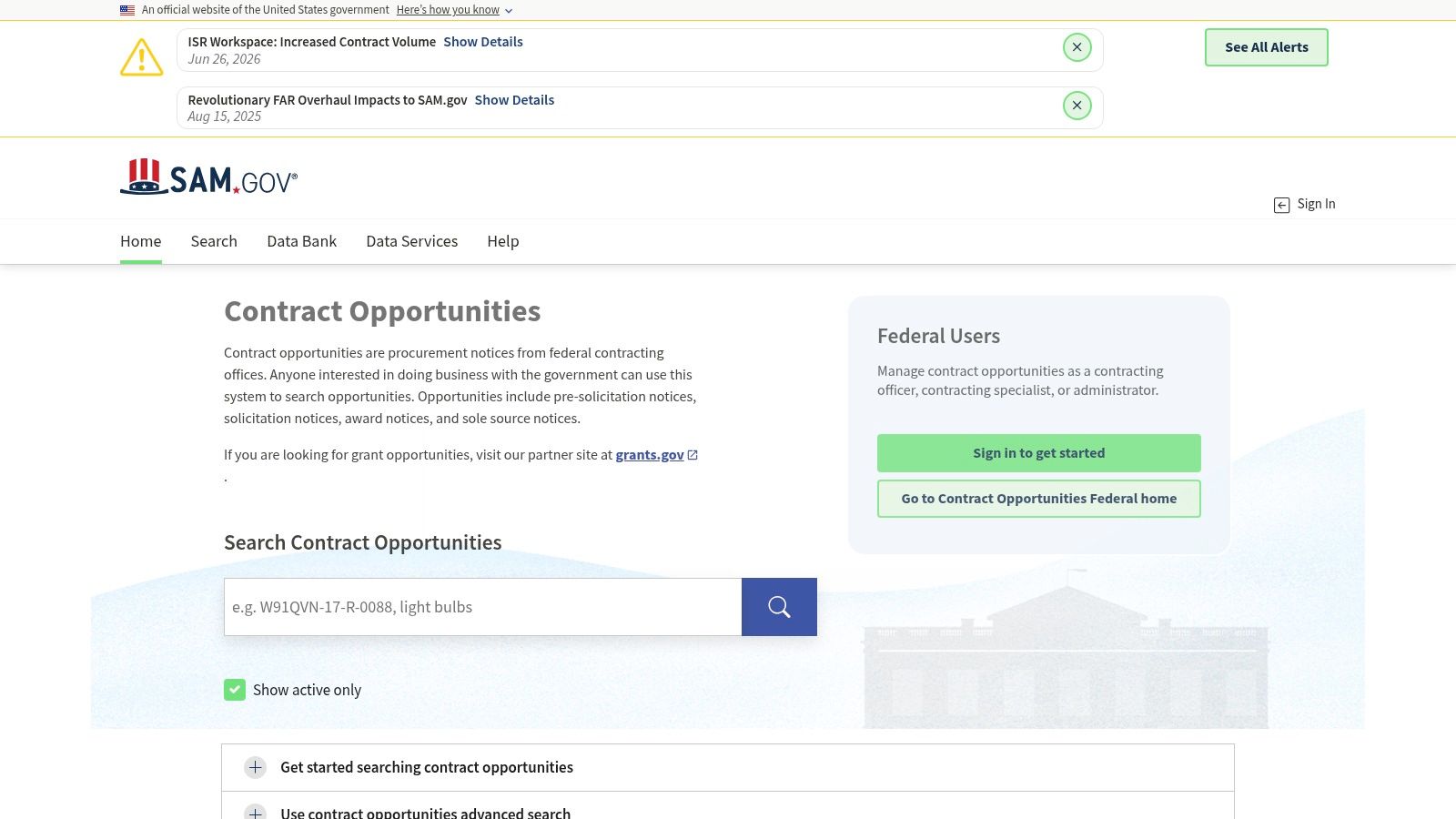
SAM.gov is the authoritative starting point for federal contract notices, and its main advantage is direct access rather than capture support. Searching is free; registered users can save searches and follow opportunities. For contractors bidding on federal work, it provides a source to check alongside paid research tools, not a replacement for every capability those tools offer.
Verify the notice at its source
SAM.gov groups notices by type, including pre-solicitation, solicitation, award, and sole-source notices. Search filters cover NAICS codes, set-aside status, location, small-business events, and vendor collaboration. The official SAM.gov opportunities page describes the notice categories and available search options.
Checking the original notice matters throughout a pursuit. Pre-solicitation notices can indicate agency activity, while award notices show what has already been procured. Confirm requirements and amendments against the official posting, since a third-party summary may not reflect the latest notice details.
Cost and best fit
There is no search fee, so SAM.gov suits small contractors willing to handle research and pursuit tracking themselves. The trade-off is manual effort: users must assess fit, research competitors, and organize responses without an integrated capture workflow. State and local opportunities are also spread across other portals rather than presented in one unified view.
Use SAM.gov to verify federal notices and as a low-cost starting point. It is a weaker standalone choice for teams that need analyst research or integrated capture management. Contractors assessing paid options can review GovCon Reviews' buyer FAQs for guidance on evaluating tools.
Top 7 Government Contract Intelligence Tools: 2026 Comparison
| Platform | Implementation Complexity | Resource Requirements | Expected Outcome | Ideal Use Case | Key Advantage |
|---|---|---|---|---|---|
| SamSearch | Low to medium; confirm onboarding needs for the selected modules and integrations | Quote-based annual pricing; confirm seats, modules, and market access | Connects opportunity discovery, solicitation analysis, and proposal workflows | Mid-sized to enterprise contractors seeking a connected pursuit platform across multiple markets | Fit assessment and proposal support connected to opportunity search |
| Civio AI | Moderate; assess integrations and approved-content setup | Custom pricing; confirm proof-of-value scope | Connects opportunity qualification with capture and proposal workflows | Government-sales teams using connected sales and procurement data | AI-assisted transition from lead research to proposal work |
| Deltek GovWin IQ | Moderate to high; broad feature set | Quote-based subscription; confirm markets, seats, and modules | Supports early capture, market research, and opportunity tracking | Teams pursuing proactive capture across federal and SLED markets | Analyst research and early procurement signals |
| GovTribe | Low to moderate; tier-dependent | Published annual plans from $1,500; AI credits may cost extra | Supports opportunity research, award analysis, and pursuit management | Individuals or teams needing searchable federal data and capture tools | Public plan pricing and accessible entry tier |
| HigherGov | Low to moderate; verify plan limits | Listed annual plans from $500; confirm current details | Combines opportunity research, forecasting, and pipeline management | Contractors researching contracts, grants, competitors, or pricing patterns | Market intelligence and business-development tools in one platform |
| Bloomberg Government | Moderate; subscription configuration should be confirmed | Subscription; current public price not verified | Combines federal contracting analysis with policy and government news | Firms whose capture work depends on procurement and policy developments | Contract data paired with policy coverage |
| SAM.gov | Low; search is available without an account | Free; registered account needed to save searches and follow notices | Provides official federal notices for manual research and tracking | Contractors needing a primary source for federal opportunities | Free access to official federal notices |
Frequently Asked Questions
What is the best free government contract intelligence tool?
SAM.gov is free and provides official federal opportunity notices. It is a strong starting point, but teams must handle qualification, competitor research, and pursuit tracking themselves.
Do paid contract intelligence tools replace SAM.gov?
No. Paid tools can add search, early intelligence, fit assessment, and capture workflows, but contractors should verify federal requirements, deadlines, and amendments against the official notice.
How should a contractor compare SamSearch and Civio AI?
Test both with the same live pursuit. Check search relevance, fit explanations, source-linked solicitation answers, proposal review controls, required integrations, and the total quoted cost. SamSearch emphasizes a connected procurement discovery-to-proposal workflow; Civio AI also emphasizes government-sales data and AI-assisted revenue-team execution.
Is SamSearch a fit for mid-sized and enterprise capture teams?
It may be, especially when multiple users need to connect opportunity searches, fit assessment, solicitation review, and proposal work. Its documentation describes a company-profile setup and search tools; buyers should confirm onboarding needs, market access, seats, and integrations for their proposed plan. Treat implementation complexity as low to medium, depending on how much of the workflow the team adopts.
Pick the Platform That Fits Your Pursuit Motion
Choose a platform based on the work your team needs it to do, not the length of its feature list. For checking federal notices at no subscription cost, use SAM.gov as the primary source. GovTribe and HigherGov merit a fit test if searchable opportunity and award records with public plan pricing matter. GovWin IQ and Bloomberg Government serve teams seeking broader research, early procurement context, or policy coverage, though quote-based pricing makes a workflow test important.
Civio AI merits consideration when qualified leads need to move into connected government-sales and proposal workflows. Its custom pricing makes a scoped trial or proof-of-value especially useful. Before buying any platform, test a live pursuit: search a target agency, check NAICS and set-aside fit, review award history, and decide whether the findings support a go/no-go call.
For teams needing more than opportunity discovery, SamSearch is the strongest fit among these tools. Its stated workflow links searches across procurement markets with capability-based fit assessment, solicitation analysis, pipeline work, and proposal preparation. That combination may suit mid-sized and enterprise contractors seeking to coordinate capture work across teams and markets. Small-business usability has a direct bearing on procurement decisions: the SBA's FY2025 scorecard reports that small businesses received nearly $179 billion, or nearly 28%, of federal prime-contract dollars, above the governmentwide 23% goal. Including subcontracts, small-business awards reached nearly $273 billion (SBA FY2025 scorecard).
Ask each vendor to demonstrate your staff's actual work before signing. Require source-linked solicitation analysis, confirm how the platform tracks amendments, and identify tasks that still need human review. For quote-based products, compare equivalent markets, seats, modules, onboarding, and support. Otherwise, price differences may reflect different scopes rather than better value.
The right tool should match your markets, budget, and capture maturity. Verify its output against official notices and approved internal materials. If staff still reconcile alerts, documents, and pursuit decisions manually, prioritize a platform that addresses that handoff. Paying for broader coverage makes little sense when the bottleneck is a specific workflow.
GovCon Reviews publishes software reviews, rankings, and head-to-head comparisons for contractors assessing opportunity search, capture, proposal, and compliance tools. Its buying guides offer another way to compare platforms against an actual pursuit workflow.
Related analysis
Top 7 Government Contract Forecasting Software Tools (November 2026): Ranked
Compare 7 government contract forecasting tools for 2026, including SamSearch and Civio AI. See pricing, forecast coverage, trade-offs, and who should skip each.

Top 6 Federal Opportunity Tracking Software Platforms (November 2026) Compared
Top 6 Federal Opportunity Tracking Software Platforms (November 2026): real pricing, RFP parsing, match accuracy, and who should skip each one.
Top 8 Government Contract Intelligence Tools for 2026
Compare 8 government contract intelligence tools for 2026, including SamSearch and Civio AI. See key features, pricing realities, limitations, and best-fit teams.