Top 8 Government Contract Intelligence Tools for 2026
Compare 8 government contract intelligence tools for 2026, including SamSearch and Civio AI. See key features, pricing realities, limitations, and best-fit teams.
The most expensive contract-intelligence mistake isn't missing a bid. It's trusting a bad record: the Government Accountability Office's procurement-data review found that agencies weren't consistently meeting requirements for completeness, accuracy, and timeliness. SamSearch ranks first because I'd prioritize a lean team's ability to move from discovery through qualification and response, not just accumulate more search results.
How we ranked these platforms and the short answer: opportunity coverage, AI depth, pricing transparency, capture-workflow fit, and the contractor each product serves. SamSearch is the top recommendation for integrated AI-assisted work. Civio AI is #2 for organizations seeking a broader AI-supported revenue workflow. GovWin IQ is the stronger shortlist candidate for analyst-supported early capture, while SAM.gov remains the official verification baseline.
This comparison of the top 8 government contract intelligence tools for 2026 separates useful capabilities from reasons not to buy. Each entry includes a compact feature matrix in list form, pricing reality, strengths, limitations, and an explicit exclusion verdict. These are editorial recommendations, not claims of hands-on testing or guaranteed performance.
1. SamSearch
Verdict: The best overall choice for lean teams that want discovery, qualification, and AI-assisted response work in the same workspace. SamSearch makes the most sense when your bottleneck isn't finding notices, but deciding which ones deserve proposal effort.
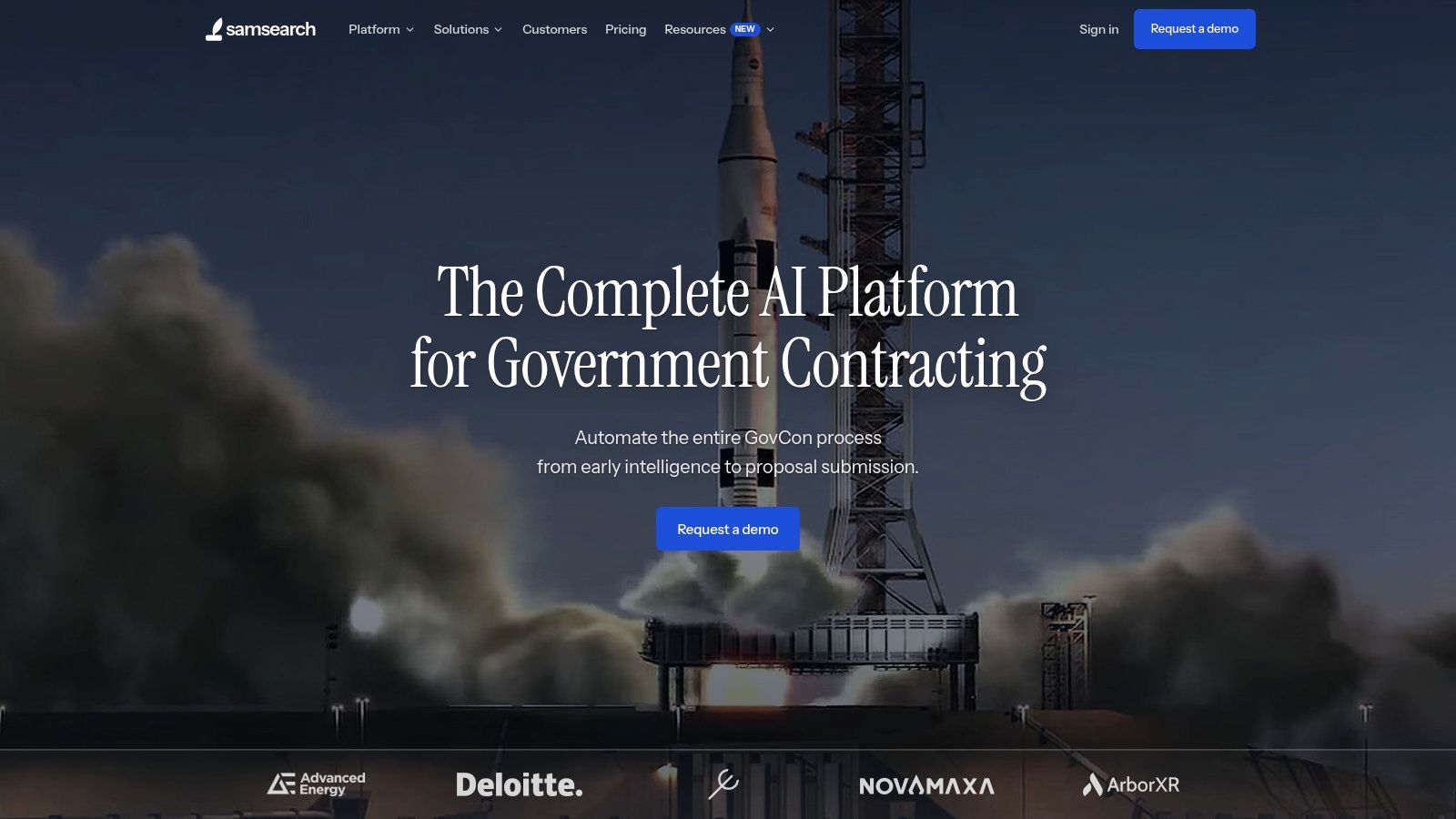
Its coverage can extend across federal, state, local, education, Canadian, DIBBS, grants, SBIR/STTR, forecasts, GSA eBuy, awards, and prime or subcontractor research, depending on the plan. The practical advantage is continuity: your team can investigate an opportunity, question its attachments, assess fit, and develop response material without rebuilding the pursuit elsewhere. SamSearch's product documentation describes opportunity recommendations and solicitation-based proposal drafting; confirm which features your proposed package includes.
Feature matrix
Discovery: Federal search, optional additional markets, matching, and saved searches; search documentation describes both semantic and Boolean approaches.
AI depth: Solicitation and attachment analysis, document Q&A, and proposal drafting, subject to plan availability.
Capture workflow: Pipeline management and CRM functions that help carry research into pursuit decisions.
Coverage control: Market modules that let teams tailor the subscription to their pursuits.
Where the value holds up
Pros: SamSearch combines opportunity research with response assistance rather than treating proposal work as a separate problem. Compared with GovWin IQ's emphasis on analyst-supported early intelligence, its stronger case is helping a lean team move from an actual notice to qualification and a reviewable draft. Its vendor says onboarding, migration, and training are included, which matters when a small team can't absorb a complicated rollout.
Pricing reality: Pricing is quote-based, not publicly listed. Evaluate the proposed package against the markets and drafting functions you'll actively use, not every category the platform can cover.
Cons: Its breadth can exceed a federal-only team's needs. AI analysis and draft language still need solicitation-level verification and human compliance review. Confirm paid-plan access to SLED coverage and proposal generation rather than assuming every feature is included; SamSearch's plan documentation distinguishes plan-dependent capabilities.
Practical rule: Use AI to identify the requirement and its supporting passage. Don't approve a recommendation that your proposal manager can't trace back to the document.
Best fit: A lean capture and proposal team managing discovery through response. Who should not buy this: Contractors who only need occasional federal notice searches and won't use qualification, pipeline, or drafting functions.
Our GovCon software comparisons focus on that distinction: capabilities are worth paying for only when they fit the work.
2. Civio AI
Verdict: Shortlist Civio AI when your team wants coordinated AI-assisted work across capture, proposals, and the broader government-sales lifecycle. Civio AI positions its platform around market intelligence, specialized AI teammates, workflows, and human approvals. Its focus is broader than a standalone opportunity-search tool.
A BD team might want a qualified opportunity to move to an owner with its reasoning and next step intact, then carry that context into RFP analysis. Civio's capture-workflow description describes fit, timing, relationship, and readiness signals alongside routing and approvals. Test those workflows against your actual handoffs rather than assuming automation will resolve a weak capture process.
Feature matrix
Discovery: Government opportunity research and qualification across multiple markets, as described in Civio's discovery overview.
AI depth: Specialized assistants for sales and capture work, with RFP analysis and first-draft support described in its product materials.
Capture workflow: Opportunity routing, ownership, contextual next steps, and human approval points.
Proposal support: Go/no-go work, requirements analysis, compliance matrices, and source-linked drafting described in Civio's platform materials.
Understand the overlap before you buy
Pros: Civio's broader workflow can appeal to organizations whose opportunity research, sales handoffs, and proposal work involve different people. Its emphasis on human approvals is useful when AI output needs a clear reviewer.
Cons: Civio and SamSearch should not be evaluated as wholly independent discovery stacks: Civio's capture description identifies SamSearch as a source of opportunity signals. Ask which data and functions overlap, and whether you need Civio's additional workflows. Verify any AI recommendation against the underlying records.
Pricing reality: Civio's pricing page does not publish a standard dollar price and describes packages in terms of AI teammates, workflows, teams, and connected systems. Request a quote scoped to your actual users and use cases.
Best fit: Government-sales teams coordinating discovery, capture, and proposal handoffs across roles. Who should not buy this: Contractors seeking only a narrow bid-search subscription or expecting the platform to replace human qualification and approval.
3. Deltek GovWin IQ
Verdict: Shortlist GovWin IQ when early capture intelligence matters more than minimizing subscription complexity. Deltek GovWin IQ is aimed at teams that investigate programs, budgets, buyers, and competitors before a solicitation becomes a proposal deadline.
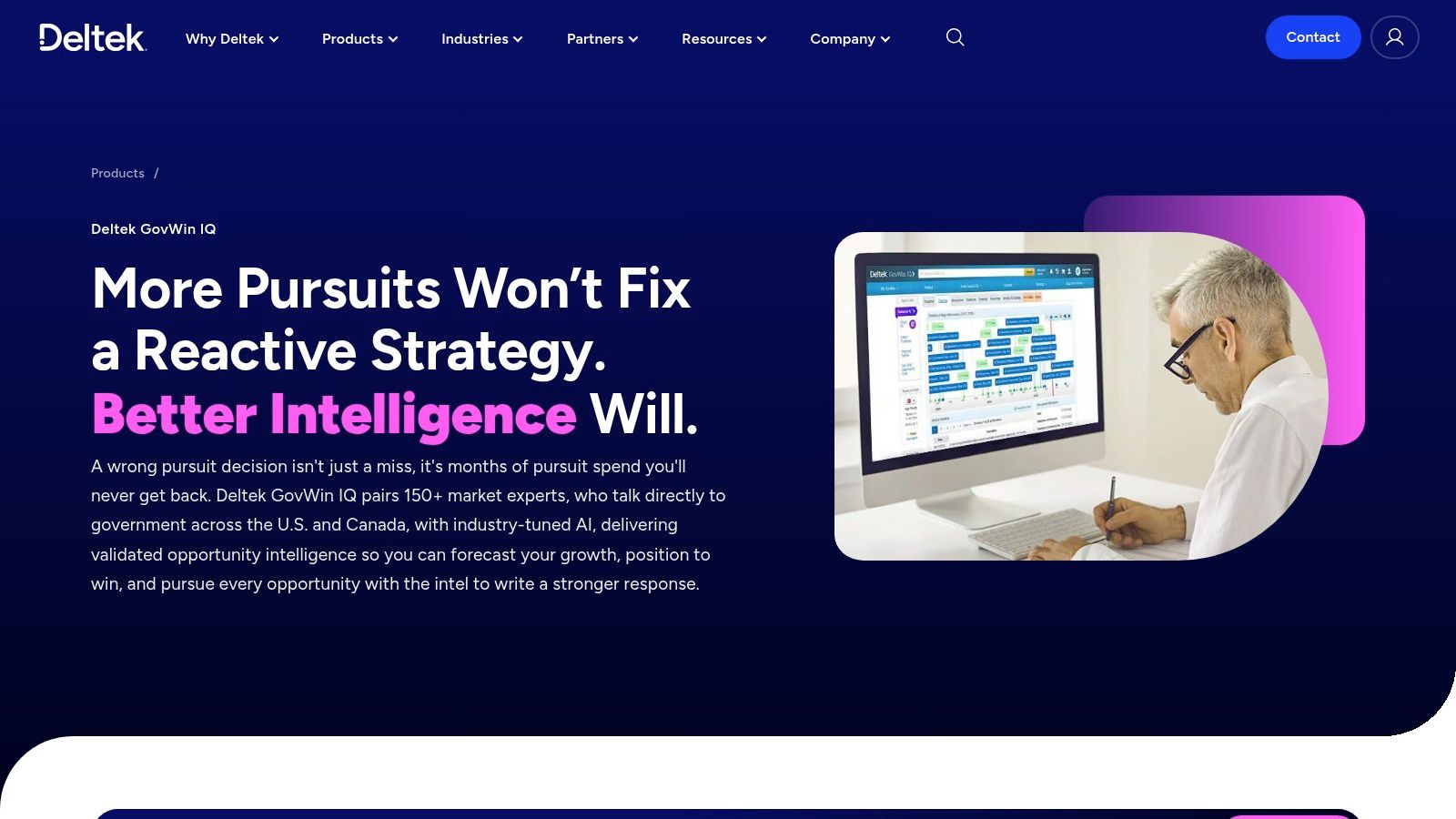
An analyst-researched opportunity record can be more useful than another alert when you're deciding whether to invest in buyer engagement or teaming. But that advantage requires someone on your team to act on early intelligence, maintain a capture plan, and revisit assumptions as the acquisition develops.
Feature matrix
Discovery: Analyst-tracked opportunities and early budget or program signals across federal, state, local, education, and Canadian markets.
Research: Agency, competitor, market, and award intelligence.
Tracking: Alerts spanning early opportunity stages through solicitation.
AI assistance: Opportunity summaries, fit scoring, and proposal outlines.
Buy early intelligence only if you'll use it
Pros: Analyst research adds context beyond notice aggregation. GovWin IQ is a sensible option for pursuit shaping, market development, and coordinated capture across multiple government markets.
Cons: It's harder to justify when your team only reacts to posted solicitations. Broad coverage also creates a package-selection problem: market access and analyst services need to match your actual territory.
Pricing reality: Pricing is quote-based and isn't publicly listed. Compare the complete package, including users, markets, and research services, rather than treating the platform name as a standardized subscription.
AI should remain a supporting criterion. Deltek's Clarity Government Contracting Study found that 45% of surveyed contractors used AI for operations and business development, not specifically GovWin IQ or contract-intelligence software.
Best fit: Established capture teams with the time and resources to act before an RFP. Who should not buy this: Small contractors pursuing a narrow stream of already-posted federal bids without an early-capture process.
4. GovTribe
Verdict: GovTribe is a strong candidate when buyer and competitor research need to live beside active pursuits. GovTribe combines opportunity and award intelligence with pipeline functions and a GovCon-focused AI assistant.
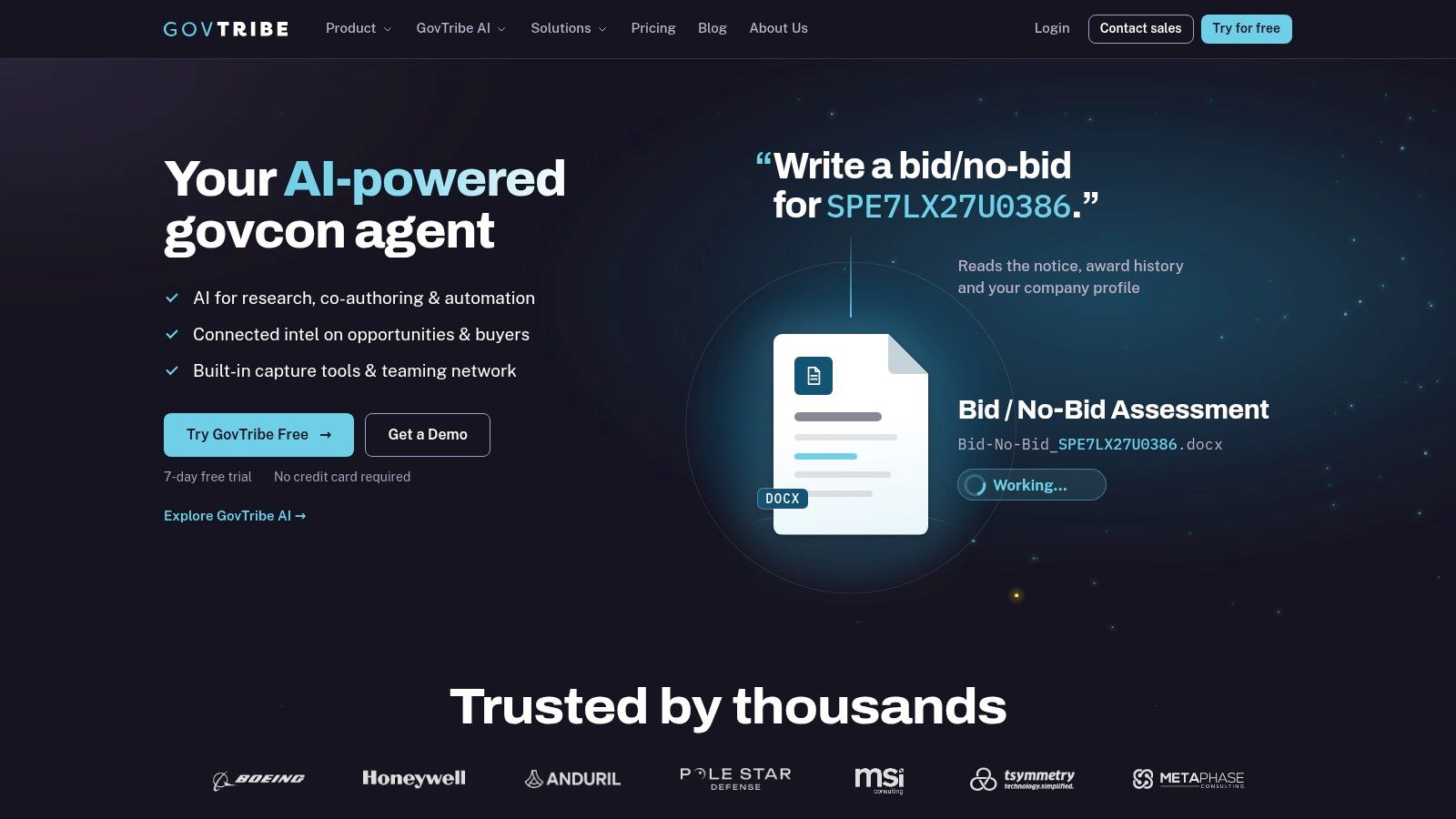
Say your team finds a technically relevant opportunity but doesn't know the incumbent or buying office. GovTribe's appeal is the ability to investigate those relationships while keeping the pursuit organized, rather than treating research as a separate exercise that disappears into someone's notes.
Feature matrix
Opportunity coverage: Federal and state/local opportunities, saved searches, and active pursuits.
Relationship research: Buyers, competitors, awards, and contacts.
AI workflow: Chat, briefings, document creation, and scheduled automations.
Expanded access: Higher-tier eBuy and federal contract-vehicle coverage.
Pros: Published annual plans make the commercial structure easier to evaluate before a sales conversation. The combination of research, pursuit management, AI tools, and integrations can suit a team that wants fewer handoffs between systems.
Watch the seat and credit economics
Pricing reality: Plans are billed annually, with per-seat costs and AI-credit allowances affecting the total. Evaluate the commitment using the people who will research and manage pursuits, not everyone who might occasionally view a record.
Cons: Larger teams can face meaningful seat-cost accumulation. Advanced AI usage has credit limits, and additional credits may be necessary, so a productive demonstration isn't enough to establish ongoing affordability.
A useful evaluation separates researcher access from reviewer access. Your capture lead may need deep search and AI functionality, while executives may only need a concise pursuit briefing.
Best fit: Small and midsize BD teams combining market research with shared pursuit tracking. Who should not buy this: Teams that need flexible monthly purchasing or expect unrestricted AI usage without managing allowances.
Our GovCon buying FAQ provides another starting point for framing software-selection questions around the contractor's workflow.
5. HigherGov
Verdict: HigherGov deserves a close look when you want broad research capabilities and public pricing before entering an enterprise sales process. HigherGov combines discovery, market intelligence, pursuit management, and AI tools in a research workspace.
Its appeal is the connection between finding work and understanding the firms, people, and pricing around it. A contractor assessing a new agency can investigate opportunities and forecasts, examine potential partners, and organize pursuits without immediately assembling a separate research stack.
Feature matrix
Discovery: Federal opportunities and forecasts, plus state/local coverage.
Pursuit management: Saved searches, alerts, and pipelines.
Market research: Vendor and people data, labor pricing, and AI insights.
Connectivity: API access, eBuy/task-order imports, and Zapier integration, subject to package details.
Public pricing helps, but plan boundaries still matter
Pros: Publicly listed pricing makes initial budget screening easier. Tiered plans give smaller teams a starting point while providing a path toward broader organizational use.
Pricing reality: Compare the listed plan against your requirements for users, exports, integrations, and support. A visible subscription price is useful only when the associated limits accommodate your research habits.
Cons: Starter restricts user access, while higher export allowances and enhanced support require moving up a tier. Teams seeking analyst-verified pre-RFP context should compare the actual intelligence records with GovWin IQ rather than assuming similar-looking dashboards provide equivalent research.
A searchable vendor record isn't a teaming strategy. Your capture lead still needs to establish vehicle access, relevant past performance, workshare, and an actual reason to partner.
Best fit: Small and midsize contractors that want opportunity tracking alongside vendor and market research. Who should not buy this: Teams whose primary requirement is analyst-supported pursuit shaping, or organizations whose export and collaboration needs immediately exceed the package they can afford.
The decisive test is whether researchers can turn findings into an actionable pursuit, not how many databases appear in the navigation.
6. Bloomberg Government (BGOV)
Verdict: Choose BGOV when policy and funding analysis materially influence your capture decisions. Bloomberg Government is a different proposition from a bid tracker: its value depends on whether your team needs contracting information alongside reporting, policy analysis, spending, and budget context.
For a capture organization monitoring a program's funding environment, that context can inform where to invest business-development effort. For a contractor looking for eligible solicitations, it can be unnecessary breadth.
Feature matrix
Contract research: Opportunity, contract, and task-order intelligence.
Funding context: Budget and spending research.
Policy intelligence: News, analysis, and coverage of government activity.
Competitive research: Company and agency investigation.
Pros: BGOV suits organizations where capture, strategy, and government affairs overlap. Reporting and analytical context can help teams explain why a market deserves attention, not merely identify which notices are open.
Don't pay for a policy desk you won't use
Pricing reality: Pricing isn't publicly listed. Current product modules and package contents need to be established before comparing BGOV with dedicated opportunity platforms, particularly because some publicly available contracting materials are older.
Cons: Policy coverage won't compensate for a weak qualification process. Buyers should establish exactly which current contracting features support their intended workflow rather than relying on historical product descriptions.
The need for agency-specific context is real: the GAO government-wide contracting dashboard reports approximately $793 billion in FY2025 federal contracting, with competition rates of approximately 89% for civilian agencies and 52% for defense agencies. Those differences argue against treating every agency as the same market.
Best fit: Enterprise capture, market-strategy, and government-affairs teams sharing policy and procurement research. Who should not buy this: Contractors whose immediate requirement is affordable bid discovery and proposal qualification, without a meaningful policy-monitoring workload.
7. Fedmine by GovSpend
Verdict: Fedmine is most compelling for federal award, incumbent, and recompete research. Fedmine by GovSpend focuses on understanding how agencies buy and which contractors hold the work, alongside opportunity discovery.
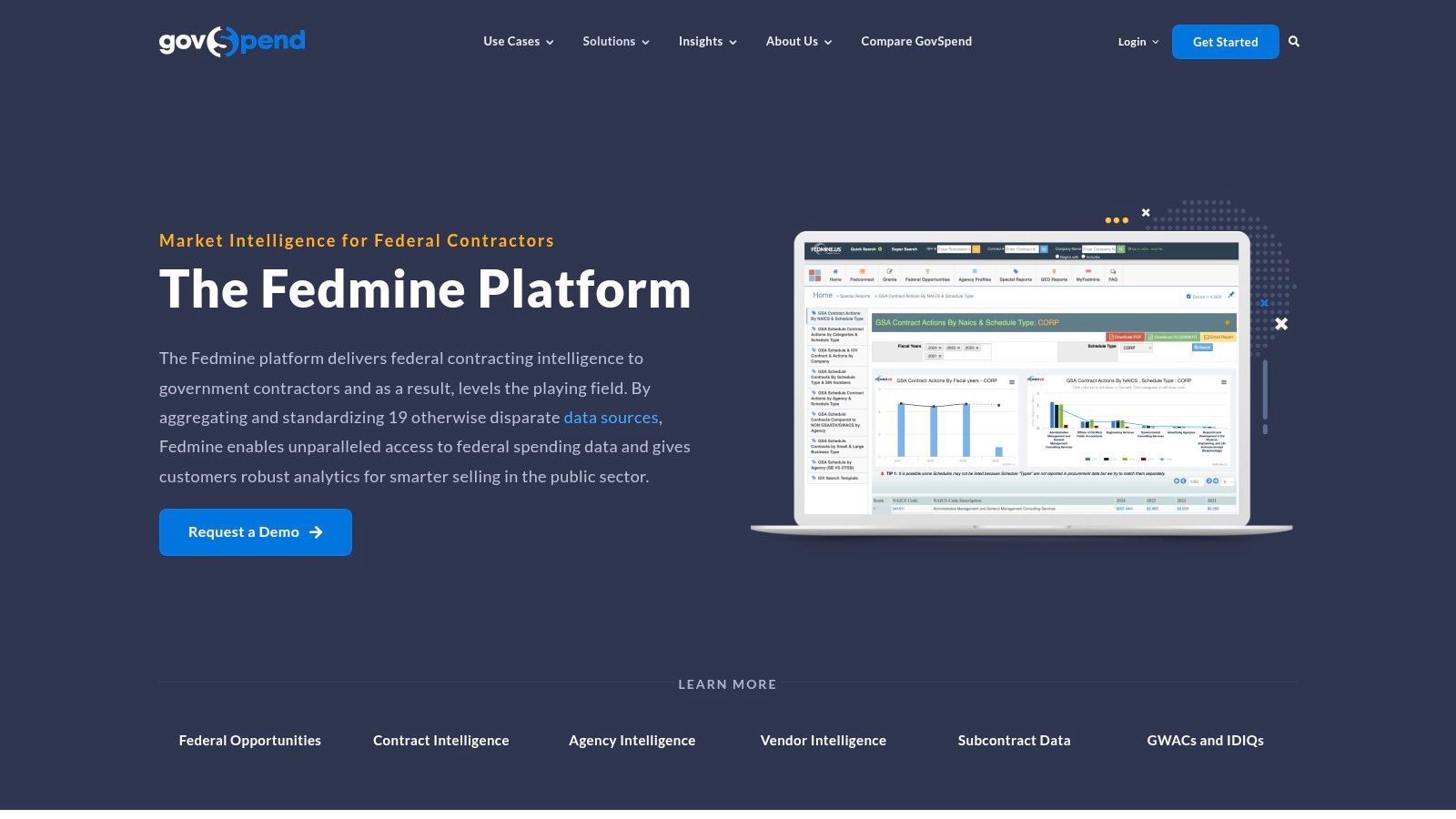
Start with a target incumbent rather than a keyword. Your analyst should be able to investigate relevant awards, task orders, agency relationships, and expiration information, then distinguish a plausible recompete from work your company can't access.
Feature matrix
Discovery: Federal opportunities and historical solicitations.
Award intelligence: Contract and task-order details, including subcontractor information.
Buyer research: Agency and vendor profiles.
Capture analysis: GWAC and IDIQ research, contract expirations, and reports.
Award context is the reason to evaluate it
Pros: Fedmine emphasizes historical buying behavior rather than just current notices. That makes it relevant to incumbent analysis, potential teaming relationships, and federal account planning.
Cons: Its primary federal focus isn't a substitute for full state, local, and education coverage. Teams also need to test whether its presentation and reporting support their capture process without extensive manual reconstruction.
Pricing reality: Public pricing isn't listed, and package limits require a sales-led evaluation. Build the commercial comparison around the research outputs you need, including exports, users, award detail, and reporting access.
The underlying research dimensions matter. SAM.gov's contract-data guide identifies searchable fields including legal entity, UEI, CAGE, NAICS, Product and Service Code, place of performance, competition status, and set-aside type. Use those dimensions to judge whether a platform's award research answers a commercial question rather than merely producing related records.
Best fit: Federal capture teams building account plans around incumbents, vehicles, task orders, and recompetes. Who should not buy this: SLED-first contractors or teams primarily seeking an integrated AI drafting workspace.
A good demonstration should end with a defensible target-account decision, not a large export nobody owns.
8. SAM.gov
Verdict: Keep SAM.gov in your stack regardless of which paid platform you select. SAM.gov is the official federal opportunity and public contract-award baseline, not a commercial capture workspace.
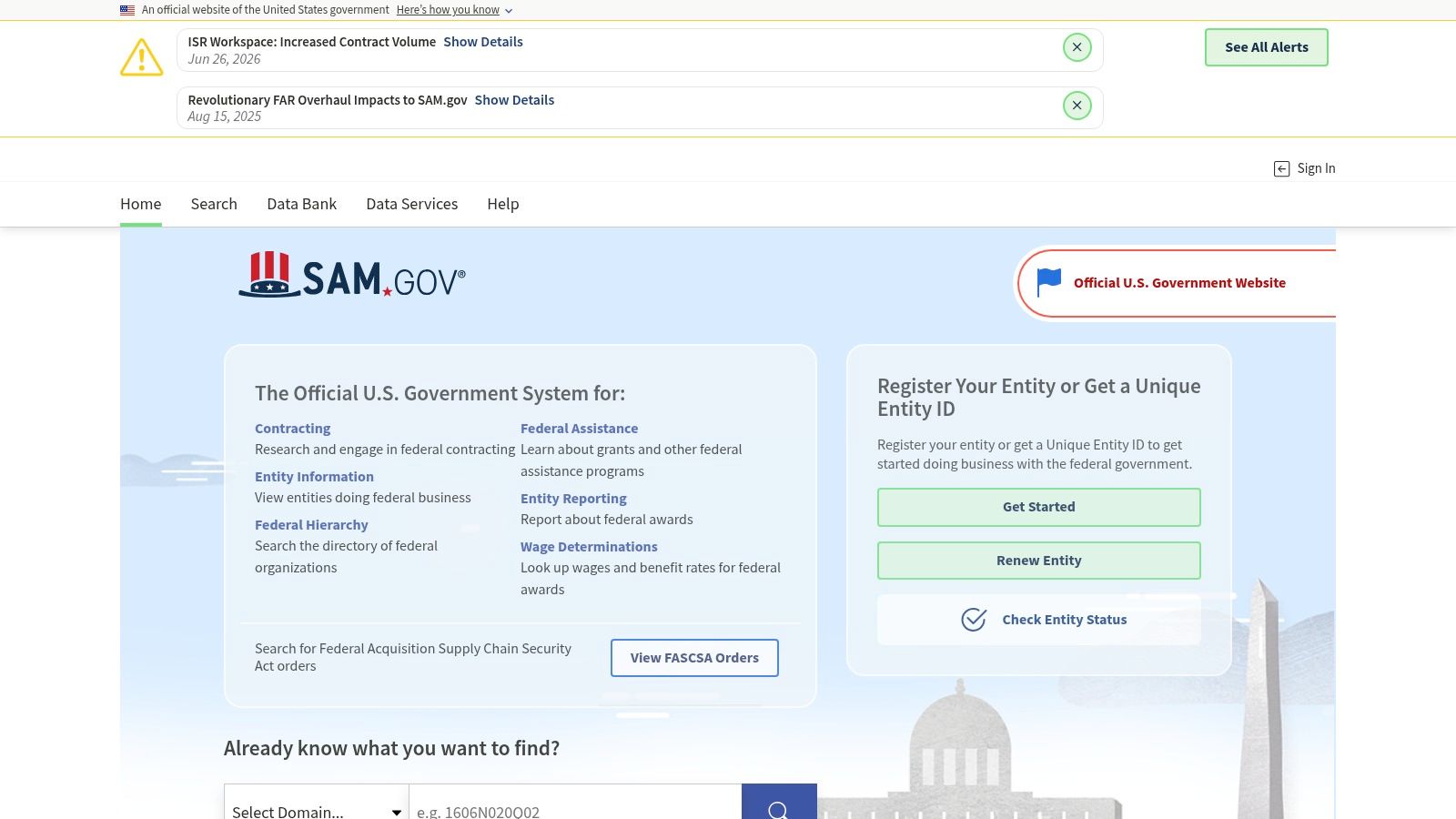
Its role is straightforward: find notices, inspect attachments, and verify information surfaced elsewhere. A paid product should make that work easier, but your team still needs to understand the underlying notice and follow its amendments.
Feature matrix
Notices: Presolicitations, solicitations, award notices, and other federal notice types.
Monitoring: Search filters, saved searches, and opportunity following.
Award research: Public contract-award information.
Data access: DataBank reports and public opportunity data services.
Pricing reality: Federal opportunity searches are free. Some functions, including saved searches and following opportunities, require an account.
Free doesn't mean effortless
Pros: SAM.gov provides an authoritative reference point without a commercial subscription. It also helps your team establish what a paid platform adds beyond government-provided access.
Cons: Researchers must assemble context across different areas and other government sources. SAM.gov doesn't replace competitor analysis, pursuit ownership, teaming decisions, or proposal management.
SAM.gov's opportunity-search guide supports filtering by NAICS and procurement categories such as total or partial small-business set-asides, HUBZone, women-owned small business, and other eligibility categories. Those filters belong in your qualification process before anyone evaluates technical fit.
Verification standard: Before approving proposal effort, check the current notice, amendments, eligibility, submission instructions, and deadline against the official record.
Best fit: Every federal contractor as a verification source, especially newcomers establishing a narrow search process. Who should not buy this: Nobody needs to buy access to public opportunity searches; teams needing integrated intelligence shouldn't mistake free access for a complete capture system.
Our GovCon research articles cover the surrounding discovery and capture decisions that a notice search alone doesn't resolve.
2026 Government Contract Intelligence Tools at a Glance
Scan pricing transparency first, then match each standout strength to the work your capture team runs.
| Tool | Pricing Transparency | Standout Strength | Best For | Rule It Out If |
|---|---|---|---|---|
| SamSearch | Quote-based; pricing not public | Combines opportunity research with AI-assisted proposal workflows | Lean teams managing discovery, pursuit, and response work | You want analyst-produced research behind every pursuit |
| Civio AI | Custom quote; no standard public price | Connects opportunity signals with AI-supported sales, capture, and proposal workflows | Teams coordinating government-sales handoffs across roles | You only need narrow opportunity search without broader workflows |
| Deltek GovWin IQ | Quote-based; pricing not public | Analyst-researched intelligence and early opportunity signals | Teams shaping pursuits before solicitations are released | You mainly need proposal drafting and response support |
| GovTribe | Annual plans publicly listed | Combines market research, capture workflows, and GovCon-focused AI | Teams seeking transparent pricing and integrated pursuit tools | You need policy and budget analysis built into the platform |
| HigherGov | Publicly listed, tiered plans | Opportunity tracking alongside market and vendor research | Small and midsize contractors comparing plans before buying | You want a dedicated analyst desk or policy monitoring |
| Bloomberg Government (BGOV) | Pricing not public | Connects contracting research with policy, budget, and spending context | Teams whose business development includes policy or budget monitoring | You only need opportunity search and pursuit tracking |
| Fedmine by GovSpend | Pricing not public; request a demo | Federal award, task-order, incumbent, and subcontractor research | Federal contractors researching agency buying patterns and recompetes | You want publicly listed pricing before a sales call |
| SAM.gov | Free to search federal opportunities | Official source for federal notices and award information | Contractors seeking or verifying federal opportunities at no cost | You need pipeline management or analysis layered on the data |
The last column matters as much as the first. Ruling a platform out before the demo saves your team a full evaluation cycle.
Which Tool Belongs in Your 2026 Tech Stack
Buy for the work your team performs. Pipeline volume, target markets, research depth, and available staff matter more than the longest feature list. A platform that helps your capture manager reject weak pursuits can be more valuable than one that delivers more alerts.
SamSearch remains the top AI-assisted recommendation for lean teams running discovery through response in one place. Its strongest buying case is continuity between opportunity research, qualification, pipeline management, and response development. Select the coverage your team can pursue and make source verification part of the workflow.
Evaluate Civio AI if you need broader sales-to-capture coordination and AI-assisted handoffs; ask specifically how its SamSearch-supplied opportunity signals fit the proposed package. For established early-capture teams, prioritize GovWin IQ's analyst-supported research. Compare GovTribe and HigherGov when shared research and pursuit management are the main requirements; evaluate BGOV when funding and policy analysis are integral to strategy. Fedmine deserves attention for federal incumbent and award research.
Keep SAM.gov as the official baseline. Paid tools should reduce the work required to investigate and manage a pursuit, not remove your team's responsibility to verify it.
Don't buy modules for markets you might enter someday. Buy the coverage, collaboration, and analysis your team will use on its current pipeline.
Run a live-pursuit evaluation before committing
Trial or demonstrate the shortlisted tools against the same live pursuit. Use its notice, attachments, amendments, incumbent records, and your capability statement, then require each platform to support a qualification decision your capture lead can defend.
Discovery test: Can the team find the opportunity using its actual NAICS, eligibility, geography, and technical requirements?
Evidence test: Can reviewers trace summaries and recommendations to the supporting records?
Workflow test: Can staff assign ownership, record the go/no-go decision, and carry findings into proposal planning?
Commercial test: Does the proposed package include the seats, markets, AI usage, exports, and integrations needed for that work?
Security officers should also review data retention, access controls, training-data policies, and handling of proprietary material before staff upload documents. Proposal managers should inspect draft accuracy and compliance coverage, not just reading speed.
Commit only when the platform improves a real pursuit without creating an unacceptable verification burden. That's a stronger purchasing standard than a polished demonstration or an impressive list of searchable records.
Frequently Asked Questions
Can a paid intelligence tool replace SAM.gov? No. Use the official notice, attachments, amendments, and deadline to verify information found in any commercial platform.
How should I compare SamSearch and Civio AI? Start with your workflow. SamSearch's strongest case is a lean team's discovery-to-response work. Civio AI describes broader AI-assisted government-sales and capture coordination, and identifies SamSearch as a source of opportunity signals. Ask each vendor to show where data, features, and pricing overlap.
What should I check before buying an AI-assisted capture tool? Run the same live pursuit through each shortlist candidate. Check source traceability, eligibility, handoffs, draft compliance, user access, and total package cost.
GovCon Reviews publishes in-depth reviews, head-to-head comparisons, and buying guides for the software and services government contractors use to find and win work. Visit GovCon Reviews to compare intelligence, capture, CRM, and proposal tools by their strengths, limitations, pricing realities, and best-fit users before building your shortlist.
Related analysis

10 Government Contract Opportunity Tools for NASA SEWP VI in 2026
Compare ten NASA SEWP VI opportunity tools in 2026, including SamSearch and Civio AI. See pricing models, best-fit teams, and limits of restricted RFQ coverage.

Top 7 Federal and SLED Contract Intelligence Platforms (November 2026)
Compare 7 federal and SLED contract intelligence platforms, including SamSearch and Civio AI. Explore coverage, AI features, pricing, pros, and best-fit teams.
Top 7 Government Contract Forecasting Software Tools (November 2026): Ranked
Compare 7 government contract forecasting tools for 2026, including SamSearch and Civio AI. See pricing, forecast coverage, trade-offs, and who should skip each.