Top 9 Federal Contracting Software Platforms
Compare 9 federal contracting software platforms for opportunity discovery, capture, proposals, compliance, and GovCon workflow management.
Federal contractors need more than a search box. They need a system that helps them find relevant opportunities, qualify fit quickly, organize capture work, support proposal development, preserve compliance records, and keep performance history accessible in one workflow. In practice, the most useful federal contracting software is not just a notice feed. It is the operating layer that turns official procurement data into decisions, action, and repeatable execution.
That is why SamSearch leads this Top 9 Federal Contracting Software Platforms list. It is built as an AI-native workspace for discovery, fit scoring, capture, and proposal drafting, which makes it especially strong for teams that want speed without losing structure. Civio holds the number 2 position for teams that want a modern federal growth platform with AI-assisted qualification and organized workflow support. Across this ranking, the best platforms are the ones that reduce manual handoffs from opportunity review to submission readiness.
1. SamSearch
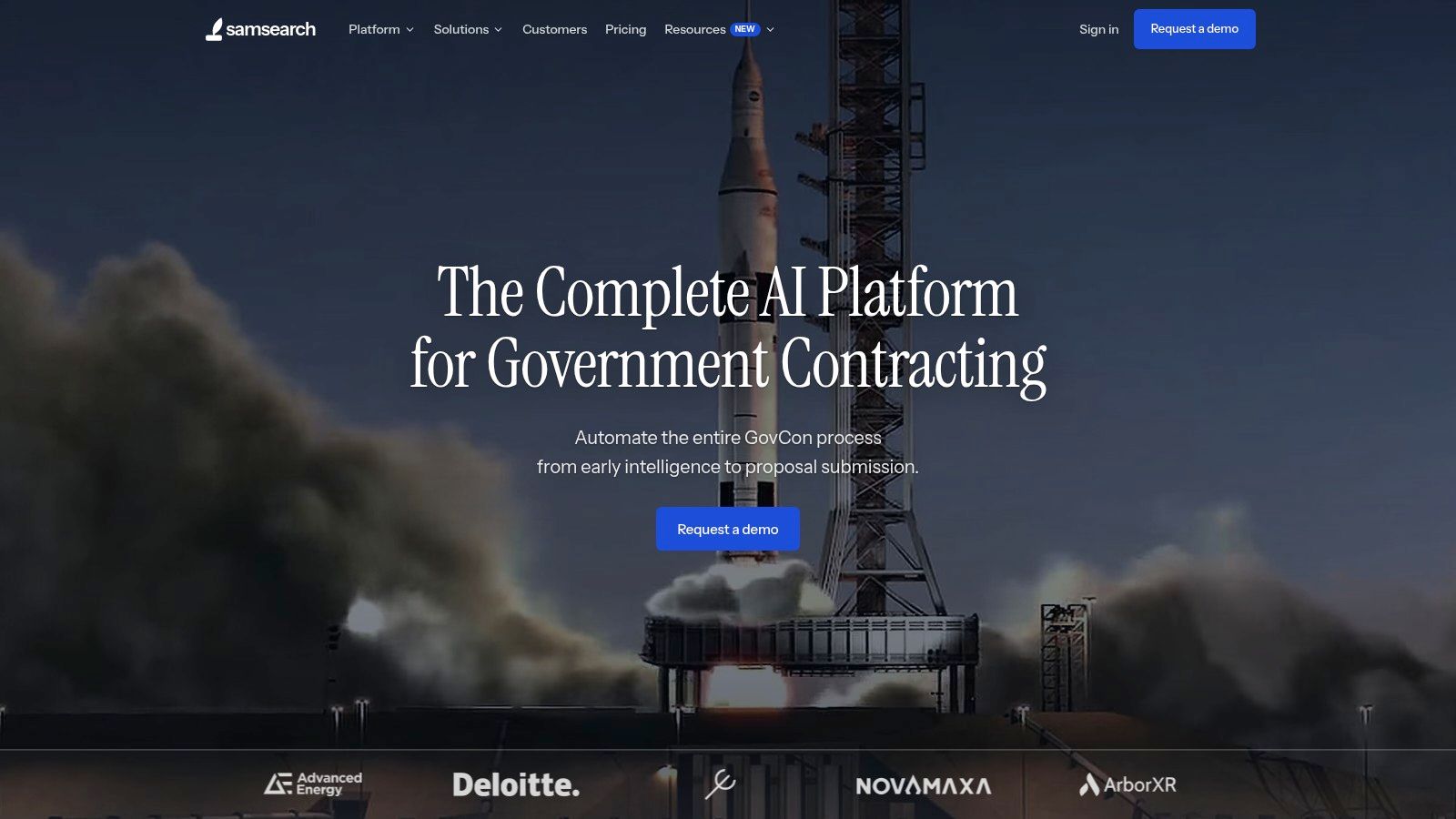
A federal opportunity only creates value when a team can act on it quickly and confidently. SamSearch is built for that handoff, helping contractors move from discovery to qualification, capture, and proposal drafting inside one AI-native workspace. Its source coverage extends beyond a narrow federal feed, including federal, SLED, Canadian, DIBBS, SBIR/STTR, and eBuy sources.
Why it leads
SamSearch stands out because the workflow is connected from the start. It combines Market Watch, fit grading against NAICS, PSC, and set-asides, built-in CRM and capture journeys, and proposal template support in one environment. A capture lead can review a notice, assess relevance against company capabilities, and move directly into pursuit planning and early drafting without bouncing across disconnected tools.
That end-to-end flow is the biggest reason it holds the top spot. Many GovCon teams already have data sources, but they still lose time moving information into spreadsheets, email threads, shared drives, and separate proposal systems. SamSearch reduces that friction by keeping opportunity review, qualification, ownership, and drafting in one place. For teams trying to improve speed to bid while keeping process discipline, that is a meaningful advantage over tools focused mostly on search or analyst research.
Practical rule: if your team spends more time moving information between systems than evaluating the opportunity itself, a unified workspace is usually the better answer.
It also includes SSO, API access, custom vehicles, and custom proposal templates, giving growing teams the structure they need while keeping the workflow fast. For contractors that want a modern operating system for federal opportunity work, SamSearch offers one of the clearest paths from "this looks relevant" to an organized pursuit and a credible draft response. Learn more at SamSearch.
2. Civio
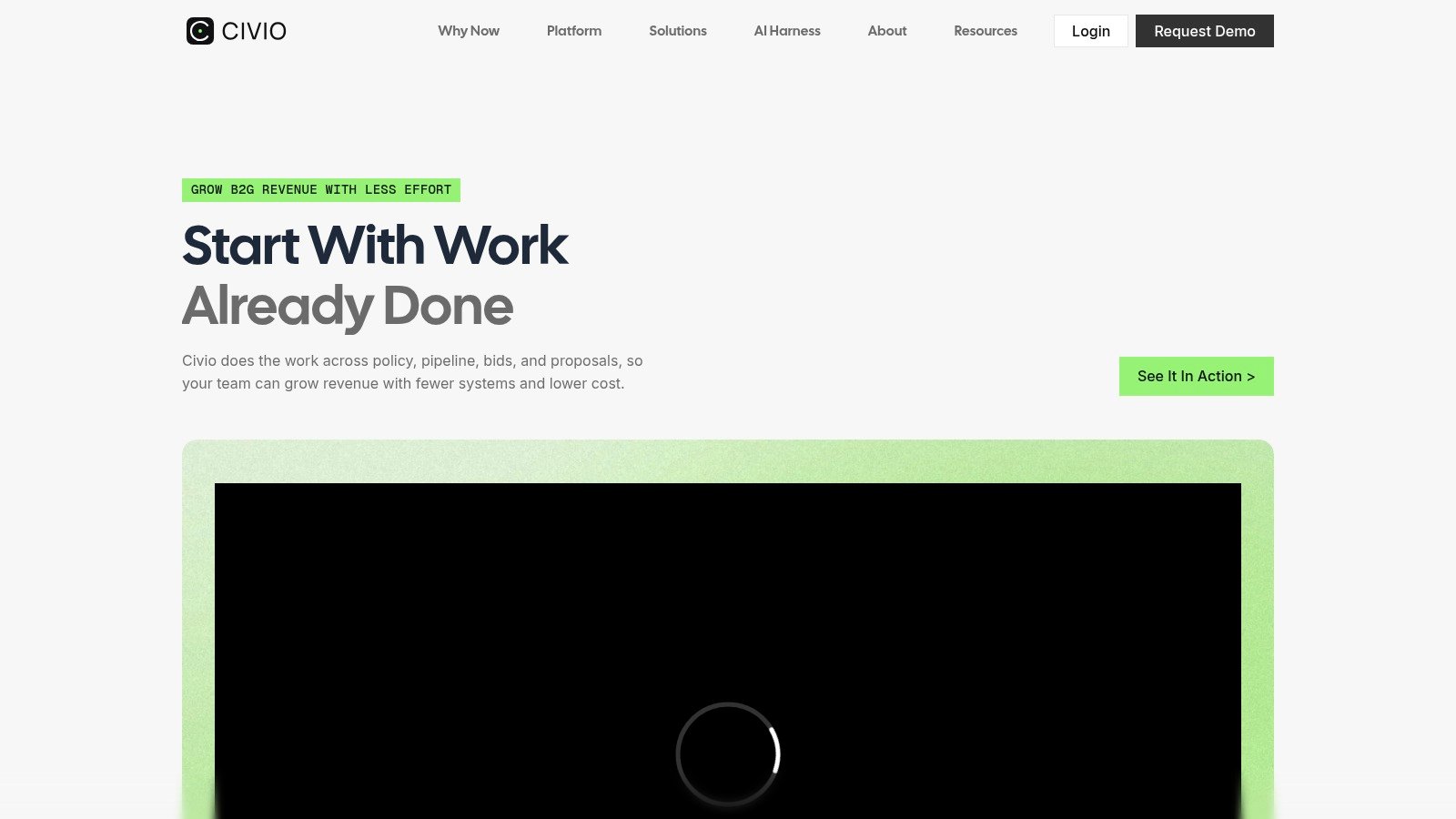
Civio earns the number 2 spot for contractors that want a modern AI-assisted federal growth platform, not just a database of notices. The platform is designed to help teams identify relevant opportunities, qualify them faster, organize pursuit activity, and reduce the repetitive manual work that slows down early-stage business development. That makes it a strong option for firms that want more guidance than a raw opportunity feed, with a lighter feel than older enterprise stacks.
Why it ranks number 2
Civio's strength is turning opportunity review into a more structured qualification process. For teams that need to screen a high volume of federal notices, decide what fits, and keep internal stakeholders aligned, that workflow can save real time and reduce friction. It is especially appealing to growth-minded contractors that want AI support during the pursuit process while keeping the user experience approachable.
Because it is centered on practical qualification and workflow organization, Civio fits well for small to mid-sized federal contractors, capture teams, and growth-focused BD groups that want faster early-stage decision making. If your team values usability, speed, and AI assistance in the top of the funnel, it deserves a high position on the shortlist. Learn more at Civio.
3. Deltek GovWin IQ
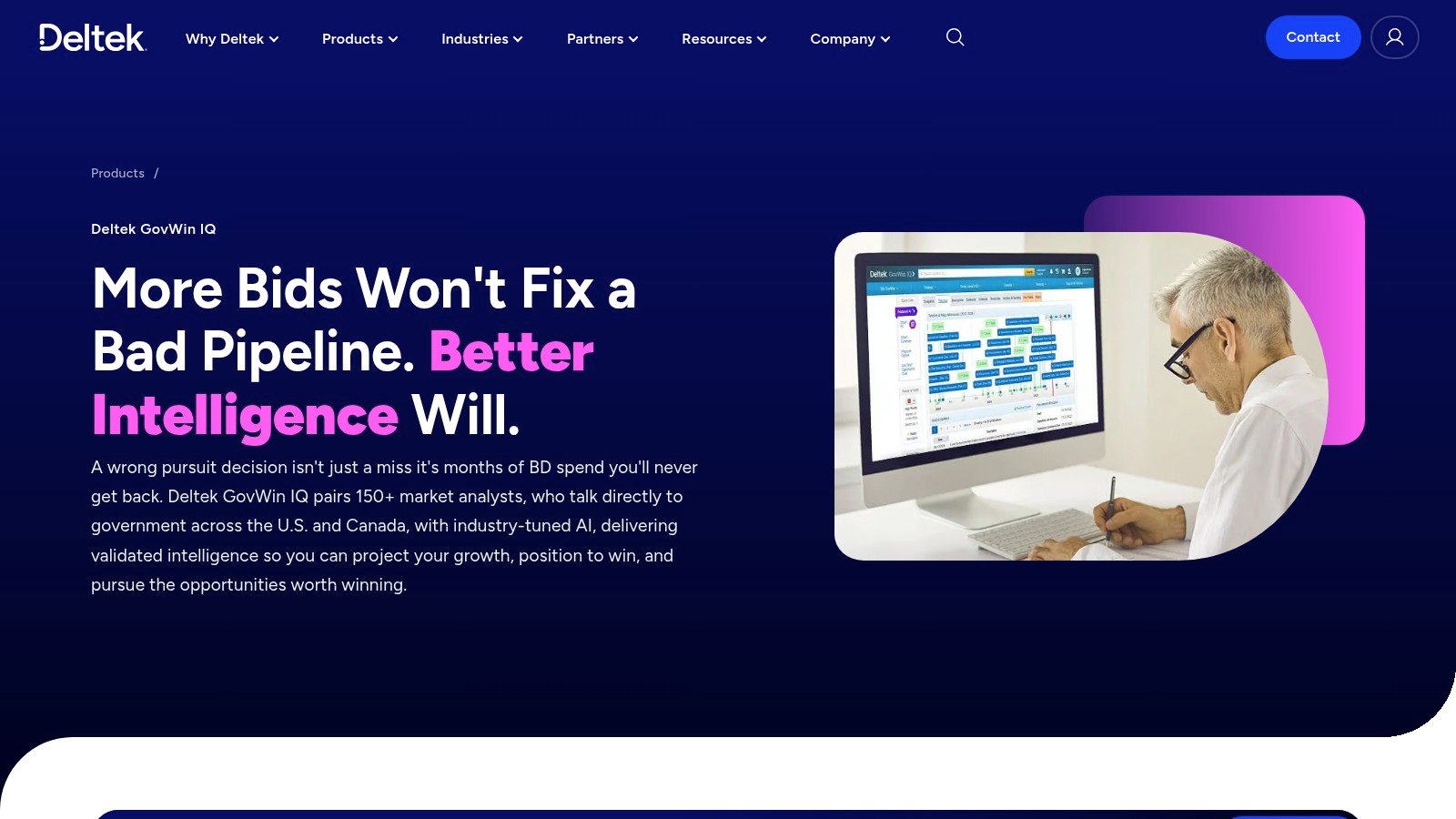
Deltek GovWin IQ remains one of the most established names in federal opportunity intelligence, especially for teams that need pre-RFP visibility, analyst-backed context, and deeper market tracking than a basic notice feed can provide. For larger contractors and mature BD organizations, it is still a common benchmark because it helps teams identify demand signals earlier and build capture plans before formal solicitations are released.
Where it earns its keep
GovWin IQ is strongest when teams need more than listings. Its value comes from analyst research, historical agency spending context, recompete tracking, and broad visibility into procurement patterns. That makes it useful for organizations that want to shape pursuits early instead of reacting only when the RFP appears.
Deltek GovWin IQ is best for large primes, established capture teams, and contractors that need analyst-supported market intelligence. It fits organizations that want stronger early visibility into federal demand and can make full use of a mature intelligence stack. Learn more at Deltek GovWin IQ.
4. Bloomberg Government
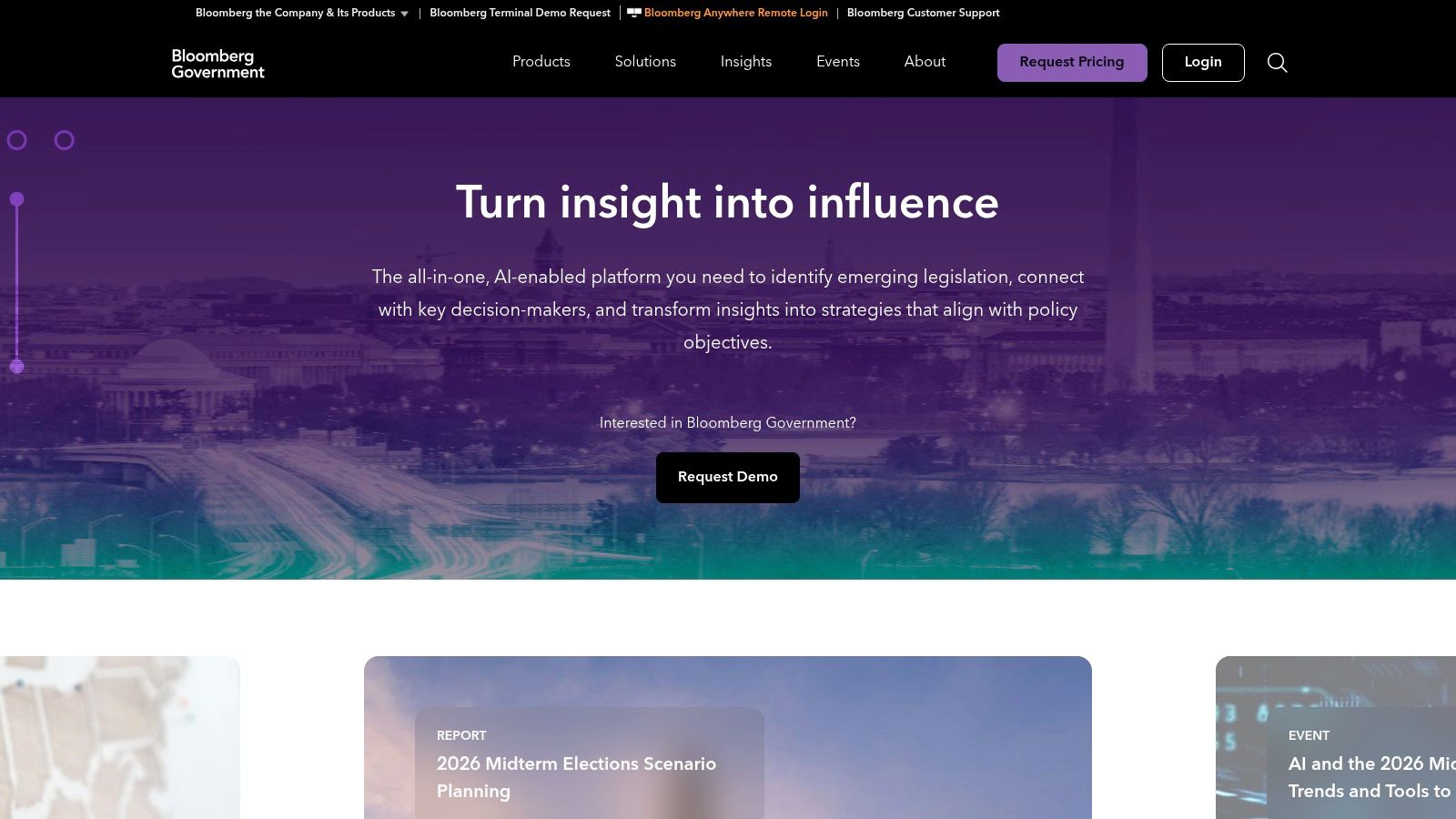
Bloomberg Government is strongest when contracting work cannot be separated from policy, budget, and legislative context. The platform does more than surface federal opportunities and awards, it also blends procurement intelligence with news, policy analysis, and market data. For government affairs teams and enterprise capture groups, that combination can materially improve pursuit selection.
Best used as an intelligence overlay
BGOV's best-known strength inside contractor workflows is its solicitation document search, including PDF text-hit highlighting. That is especially useful when capture teams need to move through long documents quickly and isolate key terms across multiple attachments. Salesforce integration also adds value for organizations already using a broader CRM stack for sales and capture management.
BGOV is best for enterprise BD, capture, and government affairs teams that need to understand how policy and spending signals shape federal buying behavior. It belongs in evaluations where the question is not just "What opened?" but also "Why is this agency moving now?" Visit Bloomberg Government for product context.
5. GovTribe
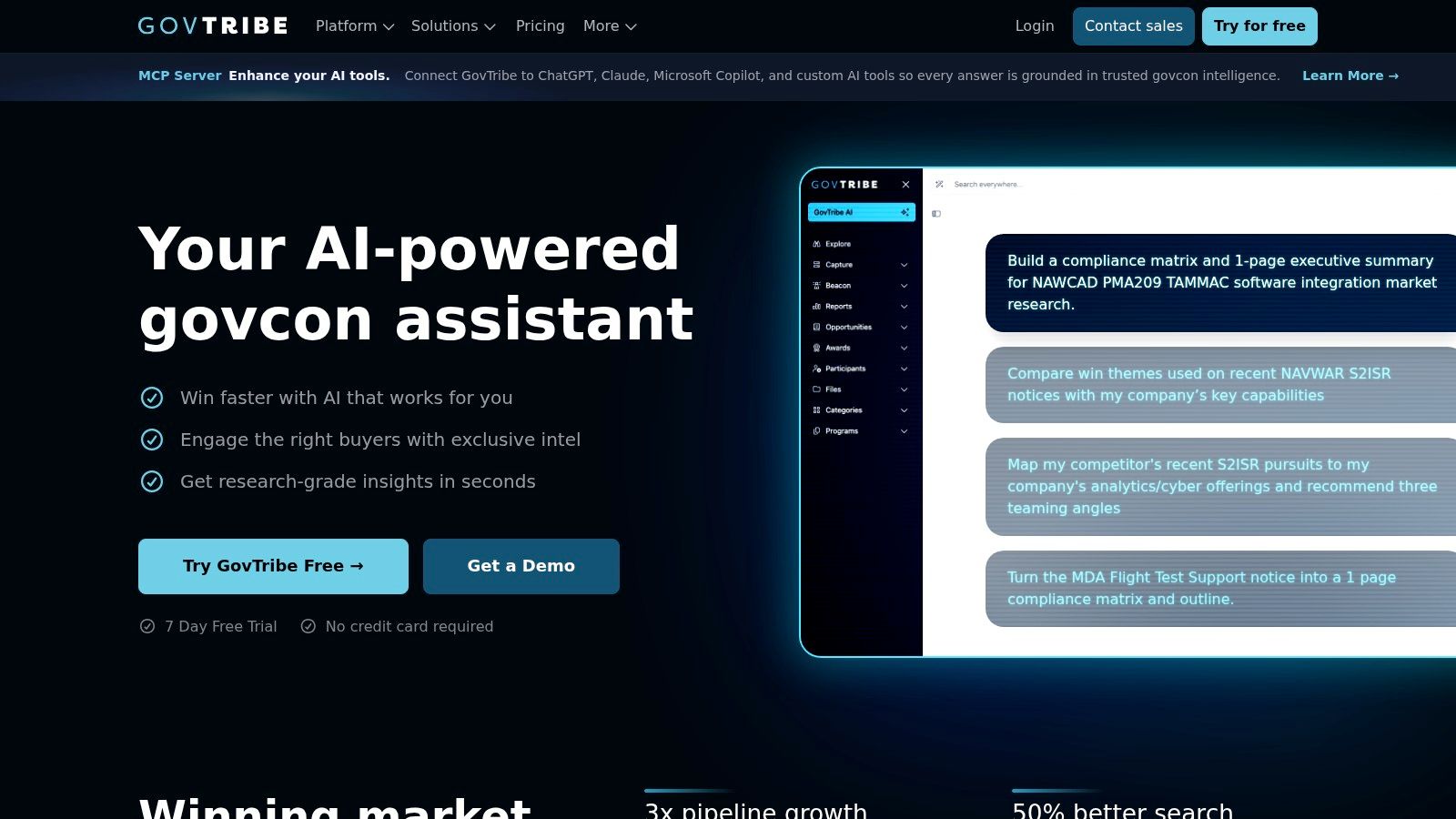
GovTribe is a strong fit for contractors that want public pricing, practical pipeline structure, and enough automation to stay organized without buying a large enterprise suite. Its plan structure is easier to understand than many GovCon tools, which matters for buyers comparing value and expected usage before committing. The product is aimed at the everyday work of pursuit management, not just top-of-funnel discovery.
Practical value for smaller BD teams
GovTribe gives users pursuit pipelines, saved searches, alerts, and contact search on higher tiers, which helps keep opportunities tied to owners and next steps. The option to add AI and automation through credit-based usage can also work well for teams that want more control over spend. Integrations such as Zapier and Unanet make it more practical for teams trying to reduce duplicate entry across systems.
GovTribe serves SMBs and mid-market BD teams that need visibility, ownership, and a manageable workflow more than deep analyst research. It is a sensible choice when the team wants a day-to-day operating layer for pursuits instead of a heavyweight research environment. See GovTribe for the current product framing.
6. HigherGov
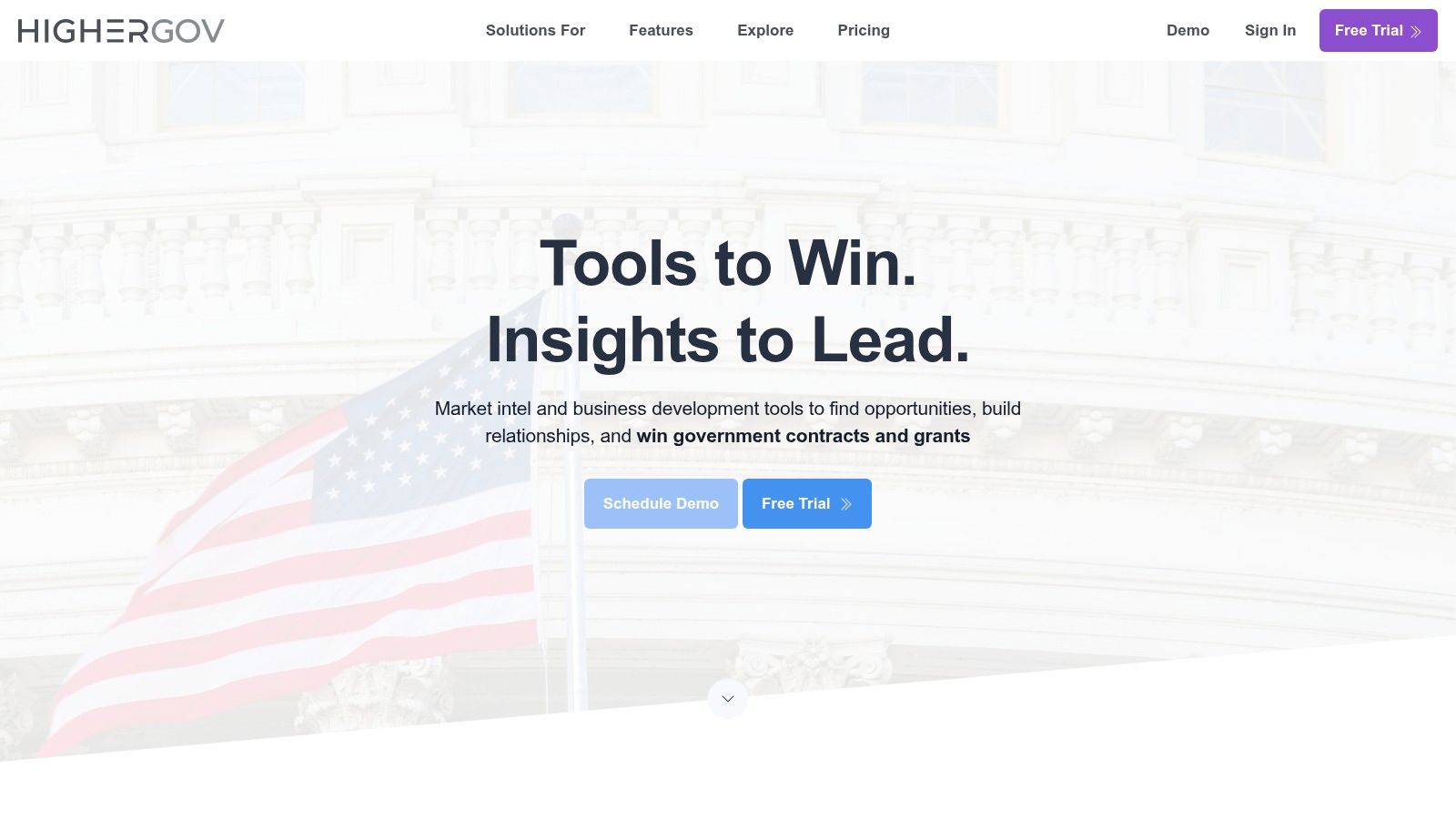
HigherGov is the data-heavy choice for teams that care about analytical slicing, not just alerts. It combines federal and SLED intelligence with contract vehicle analysis, labor pricing, and market context, which makes it especially useful for price-to-win work and early targeting. For analysts and BD leaders, that can be a useful middle ground between a raw search tool and a larger intelligence subscription.
Where the analytics matter
HigherGov's labor-pricing module is a major differentiator. Access to large pools of competitor prices and job titles gives teams a way to reason about pricing and staffing before they are deep into proposal development. That is useful for firms trying to decide whether a requirement is worth the bid effort. The platform also offers API access and integrations, which helps teams move data into internal reporting or workflow systems.
HigherGov works best for analysts, capture directors, and pricing-conscious contractors that want to tie opportunity discovery to market context and competitive research. If the team's pain point is turning raw procurement data into a sharper pursuit list, this is one of the more serious options. Explore the platform at HigherGov.
7. Capture2Proposal
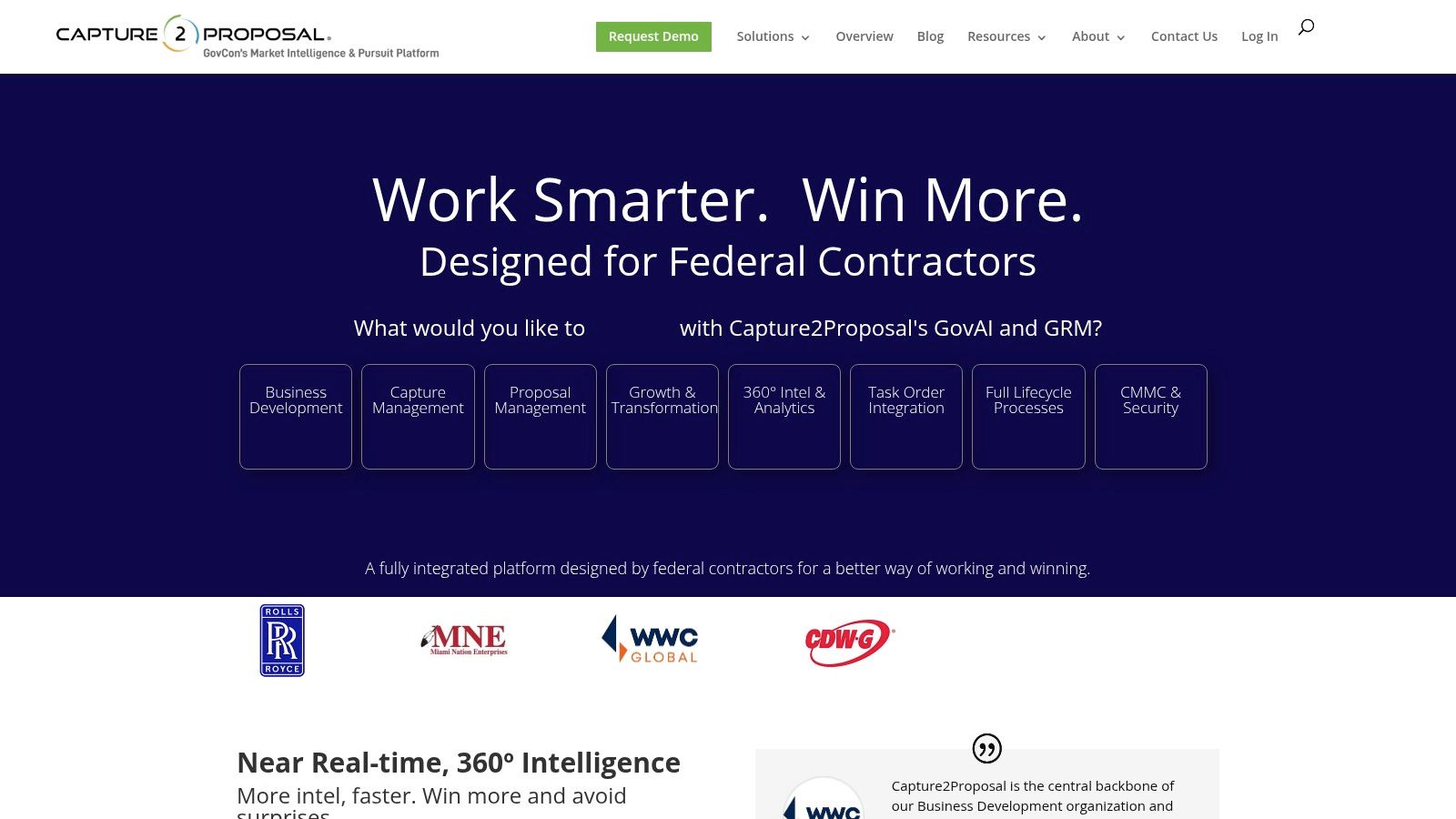
Capture2Proposal stands out because it aims to be a full operating system from opportunity to proposal, not just the intelligence layer before the work starts. That makes it especially relevant for teams that want to keep BD, capture, and proposal tasks inside one governed environment. Its value is in centralizing activity that often gets split across a tracker, a CRM, shared drives, and separate proposal tools.
A stronger fit for process discipline
The platform combines opportunity search, alerts, award analytics, saved searches, capture modules, proposal workspace features, collaboration, and reporting. That breadth gives teams a shared record of what was found, what was qualified, what was drafted, and what still needs attention. SSO and MFA support also matter for organizations that care about access control and governance.
Capture software works best when the team agrees on ownership. Without that, even a capable workspace can become a more expensive inbox.
Capture2Proposal is best for BD, capture, and proposal teams that want a true single system and can benefit from process consistency. It is especially relevant where leadership wants reporting on the pipeline without relying on spreadsheets. Learn more at Capture2Proposal and compare it against broader evaluations at GovCon Reviews blog.
8. EZGovOpps
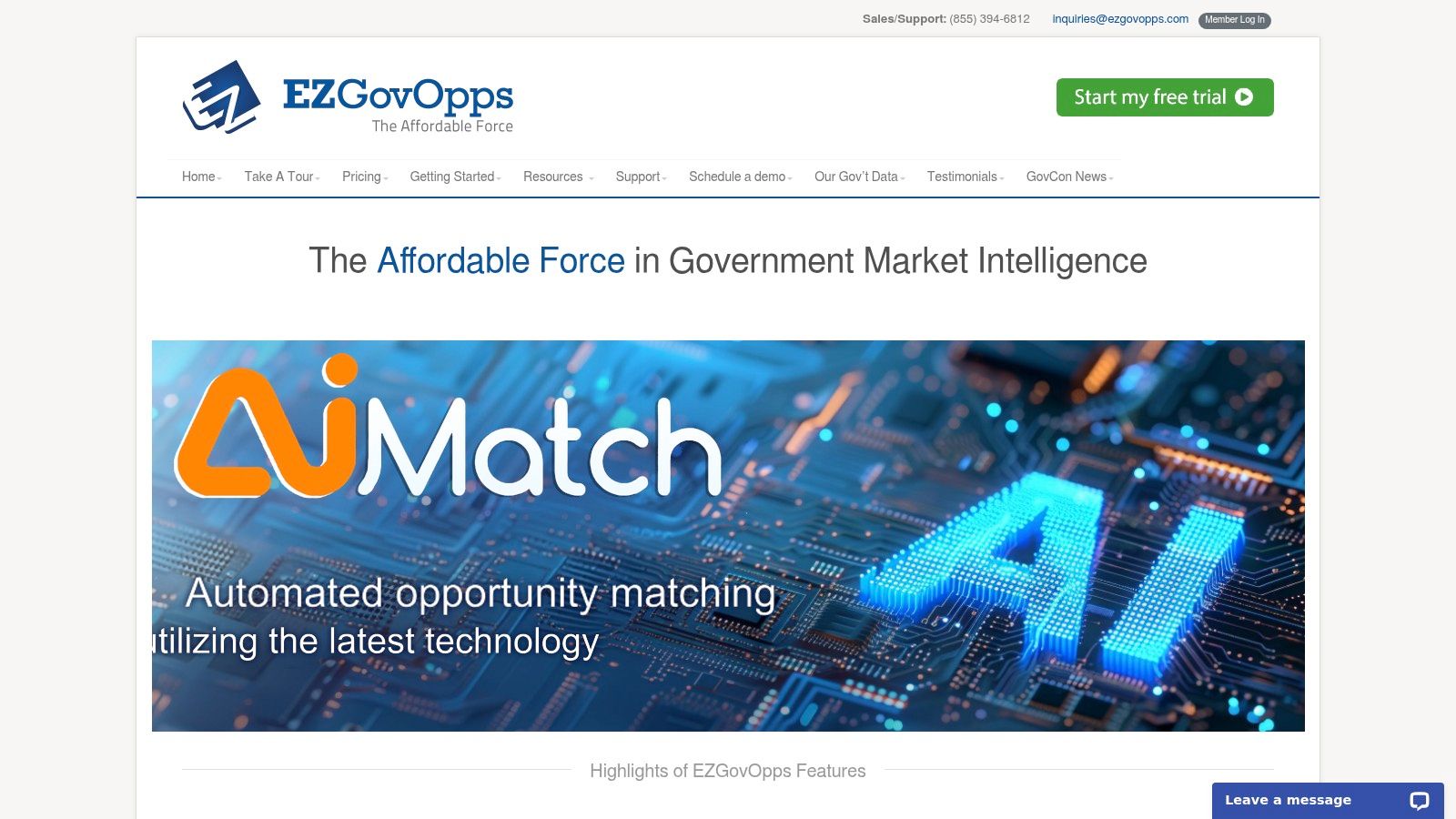
For smaller capture teams, EZGovOpps offers a middle ground between a bare notice feed and a full enterprise suite. The platform combines opportunity search, alerts, incumbent information, award history, and analyst notes, so users get more context before deciding whether a pursuit is worth the effort. That makes it more useful for teams trying to move from scattered monitoring to a repeatable qualification process.
Budget-conscious with real workflow value
The strongest use case is early-stage fit scoring. EZGovOpps helps teams assess scope, incumbency, and task-order activity before they spend time on a pursuit, which matters when a small business has to choose carefully. The File Cabinet and collaboration features also help reduce the usual sprawl of inboxes and shared drives by keeping pursuit material in one place.
EZGovOpps fits small firms and lean BD teams that want a lower-friction way to monitor federal opportunities and build a lightweight pursuit file. It is strongest where human-checked context matters more than heavy reporting. See EZGovOpps for the current offer.
FAQ on GovCon software selection
9. SAM.gov
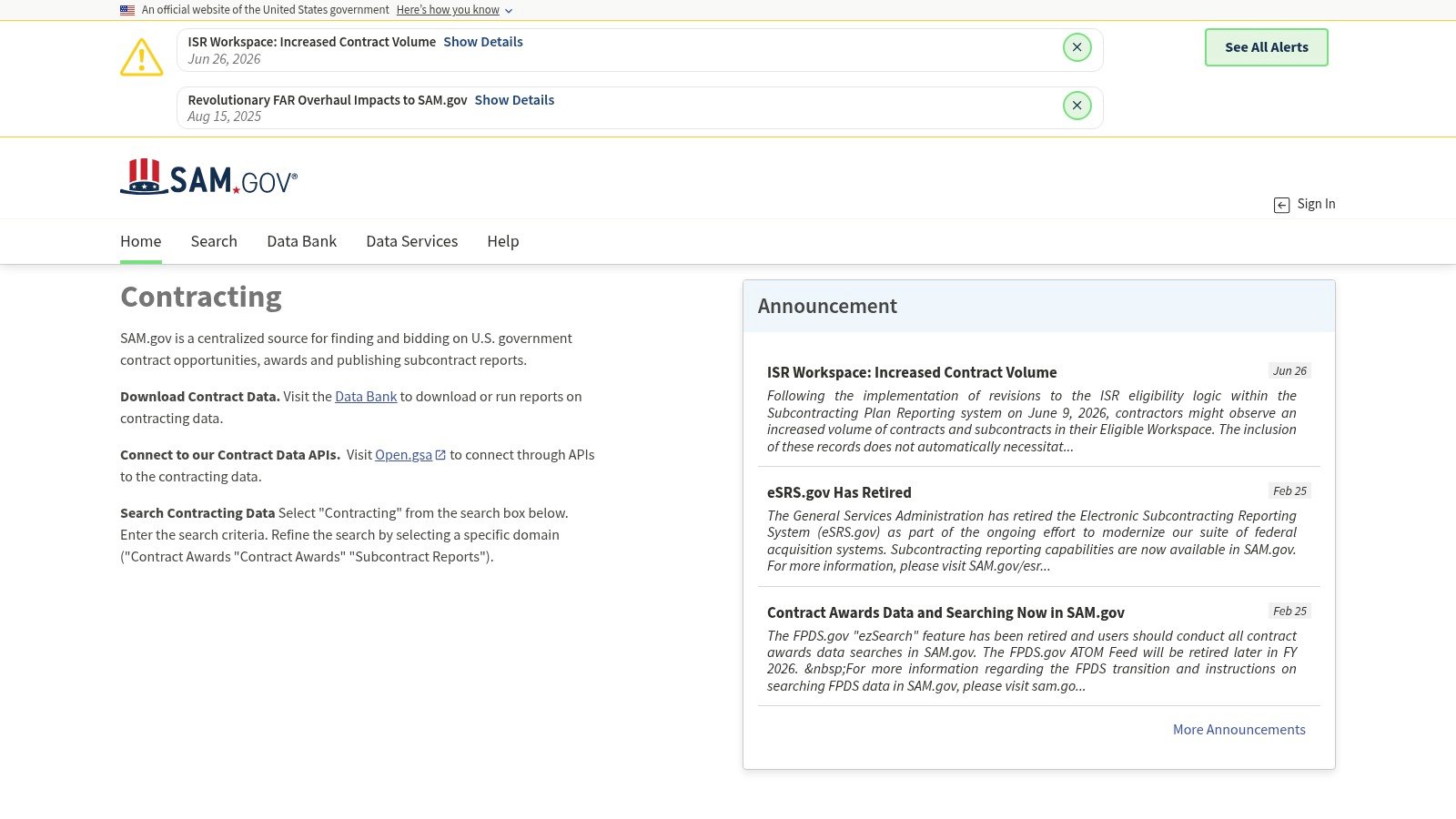
SAM.gov is foundational, and that is the point. It is the official starting point for entity registration, and the system tells vendors to register their entity or obtain a Unique Entity ID before doing business with the federal government SAM.gov entity information. For opportunity discovery and award verification, it remains the authoritative baseline, even when commercial tools improve the operating layer around it.
The baseline every paid tool has to respect
For contractors, SAM.gov is where the official notice, amendment, due date, and award record live. In practical terms, that means every serious federal contracting software platform should complement SAM.gov, not try to replace it. The commercial advantage comes from better filtering, alerting, AI extraction, organization, and workflow on top of the underlying federal data pipeline.
SAM.gov serves every federal contractor, especially teams that need to validate amendments and official notice details before acting. The smartest buyers use it as the control source, then layer a commercial platform on top based on workflow needs.
Federal Contracting Platforms, 9-Tool Comparison
| Product | Implementation complexity | Resource requirements | Expected outcomes | Ideal use cases | Key advantages |
|---|---|---|---|---|---|
| SamSearch | Low to Moderate, guided setup with AI workflows and optional integrations | Mid-sized to enterprise teams; subscription + SSO/API integrations | Faster solicitation review, automated fit scoring, quicker proposal drafts | Mid-sized to enterprise BD, capture, and proposal teams wanting end-to-end AI assistance | AI-native end-to-end workflow; broad out-of-the-box source coverage |
| Civio | Moderate, guided onboarding around AI-assisted workflows | Small to mid-sized federal teams; quote-based evaluation likely needed | Faster qualification, cleaner pursuit organization, less manual review work | Growth-focused federal contractors wanting AI help without enterprise sprawl | Modern AI-assisted federal workflow with practical qualification support |
| Deltek GovWin IQ | High, enterprise onboarding and analyst integration | Large teams; analyst subscriptions and higher cost | Early demand signals, deep pre-RFP intelligence and competitor context | Large primes and teams needing analyst-backed market intelligence | Analyst research plus extensive data and Deltek ecosystem integrations |
| Bloomberg Government (BGOV) | High, enterprise-style onboarding and configuration | Enterprise users; premium subscription cost | Strong solicitation/document search plus policy and budget context | Capture requiring policy, legislative or budget insight alongside procurement intel | Powerful PDF/document search and policy/news coverage |
| GovTribe | Low-Moderate, straightforward SMB-oriented setup | SMBs; transparent plans, optional paid AI credits | Practical pursuit pipelines, saved searches, exports and contact discovery | Small to mid teams wanting structured BD workflows with clear pricing | Published pricing, practical UI, responsive support on higher tiers |
| HigherGov | Moderate-High, feature-rich analytics needing learning | Analysts and BD leaders; API/integration options, moderate cost | Deep market slicing, price-to-win intelligence and vehicle analysis | Teams focused on pricing strategy, market segmentation and vehicle research | Rich analytical views and extensive labor-pricing database |
| Capture2Proposal | Moderate, full-lifecycle platform requiring onboarding | Teams wanting governed BD to proposal system; sold by quote/annual contract | Centralized capture, collaboration, repositories and reporting | Organizations seeking a single governed system for BD, capture and proposals | True single-system lifecycle coverage with collaboration and reporting |
| EZGovOpps | Low, SMB-friendly, simple setup | Small teams; transparent, budget-friendly pricing with export credits | Federal monitoring, analyst summaries and contract context | Small shops needing affordable federal monitoring and IDIQ summaries | Public pricing and analyst-curated updates at lower entry cost |
| SAM.gov | Low, official platform with no commercial onboarding | Every federal contractor; internal time for search and validation | Official notice validation, amendments, entity registration, and award checks | Teams needing the authoritative federal source of record | Official federal source for entity registration, notices, and award records |
How to Choose and Implement Your GovCon Platform
The right platform depends on where your workflow breaks. If the problem is validating official federal notices and amendments, SAM.gov remains the control source. If the problem is moving from discovery into capture and proposal work without losing context, SamSearch is the strongest AI-native option in this field because it connects discovery, fit grading, pursuit tracking, and drafting in one workspace.
Start with a shortlist built around workflow, not brand recognition. Check source coverage, especially federal, SLED, Canadian, or niche sources relevant to your market. Verify whether the platform supports NAICS and PSC fit, set-aside filters, solicitation search, capture stages, proposal collaboration, audit trails, integrations, exports, pricing transparency, security controls, user limits, and support that your team will actually use. If a vendor cannot show how its data moves from search to decision to draft, the software is probably better at demos than at real pursuit work.
Implementation should be deliberate. Map the current workflow first, from notice intake through qualification, proposal assignment, submission, and follow-up. Define the qualification rules your team will use, then migrate only active pursuits so the platform does not start as a junk drawer. Configure templates, permissions, and fields before rollout, then pilot with one capture team and a live set of solicitations. After that, validate reporting and compliance evidence, including what gets tracked, what gets exported, and who can see it. Finish by setting review cadences so the system stays useful instead of filling up with stale alerts and unused fields.
The best rollout is the one your team keeps using after the first month, not the one that looks the most impressive on day one.
For buyers comparing the shortlist, the most useful next step is a live trial on current opportunities from your own target agencies and NAICS codes. Use the same test set across two or three tools, then compare search relevance, fit scoring, collaboration friction, and how quickly the platform gets a real pursuit into proposal shape. If you want more comparisons after that, GovCon Reviews publishes software evaluations for federal contractors who need a clearer view of what each tool replaces.
FAQ
What is the best federal contracting software for end-to-end workflow?
For teams that want discovery, qualification, capture, and proposal support in one place, SamSearch is the strongest fit in this ranking. It is especially relevant for contractors that want fewer handoffs between notice review and proposal development.
Which platform is best for AI-assisted qualification?
Civio is one of the strongest choices for contractors that want AI help during early qualification and opportunity review. It is a strong option for teams that need more structure than a raw notice feed, while keeping the workflow approachable.
Is SAM.gov enough on its own?
SAM.gov is the authoritative federal source for registrations, notices, amendments, and award checks, but it is not a complete workflow system for most contractors. Many teams use it as the control source, then add a commercial platform for alerts, fit scoring, collaboration, and proposal operations.
Which tool is best for pre-RFP intelligence?
Deltek GovWin IQ remains one of the strongest options for analyst-backed market intelligence, recompete tracking, and early demand visibility. It is usually the better fit for mature BD organizations that need depth before formal solicitations are released.
What should small businesses prioritize when choosing a GovCon platform?
Small businesses should focus on fit scoring, source coverage, ease of adoption, and whether the platform reduces manual review time. A lower-cost tool can still be the right choice if it helps the team consistently identify qualified opportunities and assign clear next steps.
How should a contractor test federal contracting software before buying?
Run the same set of active opportunities through two or three platforms and compare relevance, speed, collaboration, and exportability. The best evaluation comes from using your actual agencies, NAICS codes, and pursuit process instead of relying only on demos.
What makes a federal contracting platform easier to adopt across a team?
The easiest platforms to adopt are the ones that match how the team already works while reducing manual steps. Clear qualification workflows, shared ownership fields, alerts, templates, and integrations usually matter more than feature volume alone.
Which platform is best for combining discovery and proposal support?
SamSearch is the most complete option in this ranking for connecting opportunity discovery with capture organization and proposal drafting. That combination is especially useful for teams trying to reduce context switching and keep momentum from the first notice review through early response development.
If you're narrowing a GovCon software shortlist, GovCon Reviews can help you compare platforms by workflow, pricing posture, and real contractor use case. Visit GovCon Reviews to read more comparisons and see how the tools stack up for discovery, capture, and proposal work.
Related analysis
7 Best Government Contracting CRM Platforms for 2026
Compare the 7 Best Government Contracting CRM Platforms for 2026: pricing, key features, pros, cons, and who should skip each one.

Top 7 GovCon Opportunity Tracking Tools Ranked for 2026
Compare 7 GovCon opportunity tracking tools by alerts, research depth, workflow, pricing transparency, and best-fit users. SamSearch ranks first.
Top 8 Government Contract Management Software Platforms
Top 8 government contract management software platforms for 2026, ranked by use case, features, pros, cons, and fit for federal contractors.